Artificial Intelligence in Decision-Making
Artificial Intelligence in Decision-Making
by Jamilin Jais
Faculty of Computer Science and Information System University of Teknologi Malaysia,
Jalan Semarak, K Lumpur.
Abstract
The technology o f A rtificia l Intelligence(A I) is expanding rapidly currently. Decision-m aking is one o f the area where the application o f AI is gaining momentum. In this article, the role o f A I in decision-making is discussed. This role is particularly given em phasis. This is due to its ability to handle inform ation regarding decision-m aking as well as solu tions f o r a specific problem . The discussion also fo cu s on the E xpert System com ponent fo r handling the reasoning o f a suggested solution.
Keywords: Expert System, decision-making, decision-making process.
Abstrak
Teknologi kepintaran buatan telah berkembang dengan pesatnya dewasa ini. Salah satu bidang applikasi yang kini sedang giat diterokai oleh penyelidik-penyelidik kepintaran buatan. Kertaskerja akan membincangkan sebahagian daripada peranan yang boleh dimainkan oleh kepintaran buatan bagi pembuatan putusan. Peranan sistem pakar ditekankan kerana ia berkeupayaan untuk menyimpan maklumat-maklumat pakar bagi pem buat keputusan. M aklumat-maklumat-maklumat pakar ini adalah dari segi cara berfikir dan ja la n penyelesaian terhadap permasalahan yang dihadapi. Perbincangan ju g a akan ditum pukan terhadap komponen-komponen sistem p a kar yang m engendalikan cadangan-cadangan terhadap ja la n -ja la n penyelesaian yang dipilih.
1.0 Introduction
The Artificial Intelligenc concept can be helpful to managers in getting deeper understanding of the problem to be solved, examples are Expert Systems, Natural Language Understanding Systems, Pattern Recognition and others. Here we are only interested in looking at Expert Systems as a tool used for decision-making.
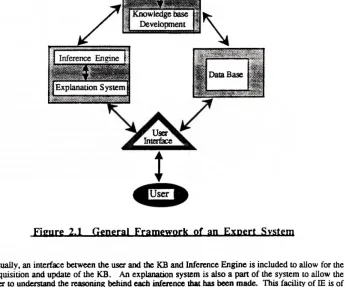
An Expert System (ES) is a problem-solving program that achieves good performance in a particular problem domain that generally requires specialized knowledge and skill. The system processes the knowledge of experts and attempts to imitate their thinking, skill, and intuition. A common framework used to describe the structure of ES is shown in figure 2.1. It contains three essential components, namely: the Data base. Knowledge Base, and Inference Engine.
K ertaskerja ini disunting oleh: PM A n u a r M aa ro f dan E n Z ailani Sidek.
2.0 Inference Engine
The inference engine is a program which uses the information in the Knowledge Base (KB) along with input data to generate useful information about specific cases. An Inference Engine (IE) drives the KB by examining the current body of facts and rules in the KB and adding new ones when applicable. It also decides the order in which inferences are made and performs the mechanics of control. The IE may interpret the data by logical deduction, or by informal methods such as fuzzy reasoning, depending on the function available in the knowledge base. The IE also controls the retrieval of relevant facts. In other words, the IE facilitates the creation and maintenance of the KB bv aiding in knowledge acquisition plus the constructing, debugging, updating, and testing of ihe KB.
r
User^
Interface
Figure 2.1 General Framework of an Expert System
Usually, an interface between the user and the KB and Inference Engine is included to allow for the acquisition and update of the KB. An explanation system is also a part of the system to allow the user to understand the reasoning behind each inference that has been made. This facility of IE is of crucial importance. The IE must be able to explain its line reasoning in a manner that is intelligible and informative. This aspect of the IE has not received a great deal of attention, probably because ESs are only being used by non-experts. The explanation facilities of an IE are usually confined to two levels of explanation:
(i) a full explanation which gives a list of all the rules that were triggered during the evaluation or consultation process.
(ii) a summary explanation which lists the advantages, disadvantages, and compensation of any action.
Jilid 4 Bll. 1 J un, ' 92
Artificial Intelligence in Decision-Making
This is not similar to the way humans explain their chains of reasoning. It is true however that graphical interfaces and the explanation provided by ESs help in convincing the ES users.
The most common forms of inference employed in the reasoning component of ES are abduction, deduction, and induction. Abduction is forward or top-down chaining which enables inference from observed data to small sets of possible hypotheses. Deduction is backward or bottom-up chaining; it checks the hypothesis by suggesting further indicators of the hypothesis in order to confirm it.
Another technique is induction. The expert is required to define a set of attributes which describe the essential features of the problem. Each attribute may be described by a set of values. Once the attributes and their values have been defined, the expert is required to provide a collection of examples; some general rules may be included to describe the expert s behaviour. This method seems attractive to experts as it is easy to use and the format is easy to recognise. When the experts lacks control over the rules, the system provides a way out to the user.
3.®
Z'SnnmwOsdig®
3ais®
Knowledge is what humans use to know something. Barr and Feigenbaum (1981), consider the following to be types of knowledge; objects, events, performance, and meta-knowledge. Compiled knowledge is information that is organized, indexed, and stored in such a way that is easy to access. It ranges from no knowledge to that which is studied formally in textbooks, and at educational institutions, it includes definitions, principles, axioms, hypotheses, theories ana laws. Apart from this kind of knowledge, there exists expenenual and learning knowledge, which someumes comes from individual heuristics, and together they form surface knowledge. Such surface knowledge is necessarily domain dependent
The collection of rules, representing the expert’s knowledge is called a Knowledge Base (KB). This knowledge base should be modular, meaning that new knowledge can be added easily without interfering with the knowledge already there. The major shortcoming of the approach is that, there is no way of knowing if the KB of rules is complete. The expert may express his knowledge, but it is most difficult for the system to diagnose it. A KB exists as a separate entity, which requires a program which can retrieve and manipulate the knowledge which it contains. TTiis system is called the Knowledge Base System.
Knowledge Base Systems are computer programs which use knowledge of a subject, task and user to do something. This can be in the form of interpreting language, speech, and images, which is used to support decision making and problem solving. The KB in an ES provides logic or a reasoning process that leads to a specific conclusion. So, ESs are knowledge systems which are primarily concerned in making decisions supported by an interactive computer system. At present an ES acts as consultant in making decisions. The user supplies the necessary problem information to the system before the system can be used in the form of question-answer. In this way the system collects information and finally gives a suggestion for the decision.
4.0
Concepts
The basic element of a knowledge base is the concept A concept is a class of objects or ideas that is represented as a uniL A concept is described in terms of a frame. The frame of a concept has a slot for each of the elements that describe the concept
A concept can be classified as either a primitive type or definitional type. A primitive concept is a state or condition for which guide-lines exist but for which an absolute definition cannot be given. A definitional concept is a concept for which there is a set of sufficient conditions which define the concept and by using the descriptions of the concept some object or entity can said to belong to that concepL
Jilid 4 Bil. 1 Jun, ' 92
The information in the concept is structured in terms of properties and roles. Properties and roles describe the characteristics which constitute the concept. A property represents a specific quality of a concept and each property has a set of values. These values restrict the property to that confinement. Roles are somewhat flexible and hold more details about the concept. The properties and roles of a concept are sometimes related to other concepts. There then exists a subsumed relationship between concepts in terms of their properties and roles.
5.0
Rule Base
The rule base is composed of a suite of rules about making inferences from the knowledge base. A rule consists of an antecedent and a consequent and is made up of goals. Goals are clauses whose terms are derived from the concepts in the frame of knowledge. The goals are consequents whose truth functions are either true or not true. Given a rule consisting of an antecedent, the consequent is determined to be true if each of the goals in the condition are determined to be true. The rule cannot succeed if any other goals in the antecedent are found to be not true.
IF < antecedent > Then < consequent >
In the simplest design, a rule is an ordered pair of symbol strings, with a left-hand side (LHS) and a right hand side (RHS). The rule base has a predetermined, total ordering, and the global database is simply a collection of symbol strings. The interpreter operates by scanning the antecedent of the LHS of the rules until one is found that can successfully be matched against the global database. If a matching occurs, placement is carried out from the actions of the RHS to the matched symbols in the global database. Scanning continues along the next set of rules. In the simplest design of a production system, the global database is simply a collection of symbols intended to reflect the state of the domain world and is application oriental. The notations would differ somewhat from one application to the other.
A Rule Base consists of a set of production rules that is responsible for,
(i) matching information contained in the working memory with the requirement of the rule,
(ii) selecting the rules to be used based on the results of the match,
(iii) executing the expected rules.
This approach is valuable when the problem-solving environment is complex and the solution control procedures are not known in advance.
There are some other aspects of rules that are claimed for ESs:
(i) rules are natural representations for expert knowledge,
(ii) ES can be developed incrementally,
(iii) rules facilitate logic-based quality control of software,
(iv) ESs are intelligible and accountable.
6 . ® ISnn©wfl®dlg® IK.©jpir(ES® nnttsattnaDnn
The KB consists of the structures which represent general problem-solving information for the given domain. There are several representation techniques in use. The predominant forms of knowledge representation are: Formal logic, networks, frame and rules, sometimes combined with data structures
Jilid 4 Bil. 1 Jun,'92
Artificial Intelligence in Decision-Making
required bv probability theory or tuzzy set theory (Dolk & Konsynski, 1984; Applegate, et al. 1986: Zadeh. 1975).
Formal logic is the direct result of man’s desire to understand the nature of human reasoning and knowledge. It is specially constructed to capture the notions of truth and inference in the human thought process. First order logic is a language that is used to describe the real world in terms of objects and their properties and relations by the formalism of well formed formulae. In fact, there is no restriction on what is said as objects. Objects can well be events, times, kinds, organizations, worlds, and sentences (Moore, 1983). More importantly, logic is regarded as a language to express human thought and inferences (Hayes, 1977). Knowledge such as predicate calculus, production rules and search techniques fall under this category. A logic based approach provides a very clearly defined interface between the semantic intent of an expression and its symbol representation.
Semantic networks or nets is attributed to the work of Quillian (1968). Originally, it was designed to represent the meaning of English words. It is purported, essentially to be a psychological modelling of human associative memory. Simons (1960), treats the theory and model of semantic networks to be a computational theory of superficial verbal understanding in humans. In a semantic net, information is represented as a set of nodes connected to each other by a set of labelled arcs, or links, which represent relationships among the nodes. The two structures between the two nodes represent the linguistic processes of thought that are used to combine them into natural language descriptions of events. It is usual to imagine and illustrate the semantic nets as a graphical notation. Obviously, the illustration of the semantic nets in the form of graphical notation cannot easily be used for a computing program. Semantic nets as depicted in graphical forms are open to many possible interpretations. One way to deliberate about the information is by using attnbute-value memory structure and in the language of predicate logic. A very important property of semantic networks is the hierarchy inheritance of the other nodes. There are of course conventions to be followed in dealing with semantic nets, for example:
(i) Nodes are used to represent objects and descriptors. Objects may be physical objects that can be seen or touched. Objects may be conceptual entities such as acts, events, or abstract categories, including numbers and places. Descriptors provide additional information about objects.
(ii) Links relate objects and descriptors. A link may represent any relationship. Some links are definitional while other links capture heuristic knowledge enriching the networks by providing additional paths.
Evidently, humans tend to interpret and understand present situational problems by recalling the knowledge they have in memory of past experiences, events, objects, and situations. The computational equivalent is a frame representation which is used as a structure to represent facts and relations. Minsky (1975), presented this concept and first used it for the problem of realizing the mechanization of vision systems. In some ways, frames are a progression from semantic nets, but have a more complex international structure. Frames are an attempt to organize the representation of knowledge into a structured framework that facilitates recall and inference and supports the interpretation of new data in terms of previous knowledge concerning similar experiences. It can be a data structure for representing prototype concepts or situations. Frames contain slots which provide information describing the pertinent details of the situation that the frame is intended to represent Each slot is filled by one of several methods detailed below giving rise to the power and flexibility of representation of frame systems. Typically, a frame describes a class of objects, situations or concepts. A frame consists of a number of slots which are labelled and in turn describe in greater detail some aspects of the objects, situations or concepts. In each slot there may be held values in a particular instantiation, otherwise default values are given. There is a certain amount of versatility in frame structure, where both declarative and procedural representations are possible. A declarative representation of some facts is simply an assertion that the truth function is true. A procedural representation of some facts is a set of instructions that when carried out arrive at a result consistent with the facts. The modularity of declarative representations makes them more widely in use compared to procedural representations, which on the other hand are more efficient. The frames may be linked together to allow for inheritance.
Jllld 4 Bll. 1 Jun, ' 92
7.0
Role
of
ExpertSystems
in
the Decision-Making
rrocess
One of the possible ways of using Artificial Intelligence (AI) tools could be to use an ES to express knowledge in the decision-supporting model. Knowledge based models can be used in scenario analysis as well as in evaluation of alternative solutions. One of the greatest problems of the knowledge based model is that they function according to a definite chain of inference. However, the logic of human inferences can be diverse even within one single area
Inference processes of some ES use bottom-up reasoning or deduction while others use top-down reasoning or abduction. This is why the use of ES is limited even in well-circumscribed areas. This is so because not only the knowledge in the KB but also the reasoning must be acceptable to the user before the the solution can be accepted. Because of this the inference engine should be consistent with the inference processes of the users. The user-friendliness of an ES depends on the knowledge representation form as well as on the inference mechanism.
As the building and application of decision-supporting models need a considerable amount of expertise, the use of ES in supporting model construction and application seems to be a promising field in AI research. This has primarily been achieved in the construction and use of simulation models.
The ES can provide substantial help in the application of models as well. Given the increasing trend to hand over complex models such as simulation and decision analytic to clients, who are inexperienced in model application, there is a growing need to support the use and guard against the misuse of such models. ES can provide advice on experimentation, sensitivity analysis and interpretation of output data. Rule-based systems have the capacity to explain aspects of what they are doing, and how they come to certain conclusion. Explanation of a conclusion is given by giving the rules which led to the conclusion. But, just giving an explanation of the routes taken is not enough for a strategic decision, as it requires the reasoning behind each step taken and the strategy underlying their reasoning. For a well-structured problem, the above feature may be good enough. However, the system also does not provide an explanation about the problems that may be posed by a given solution and how values as well as costs may be incorporated into the decision process.
ES use rules to interpret data and make suggestions about decisions. Rules and facts are relatively easy to compile and increase in the knowledge base, which means the system may learn and adapt. They may also facilitate consistency checks and simple explanation because the knowledge is explicit rather than implicit in an algorithm. But, ES does not provide perception, concrete reasoning and the emotional quality which is needed in decision-making.
It is also often difficult to ask decision-makers to interact with ES because they feel that they are being used as an input device instead of decision-maker. They are asked to provide information by answering questions posed by the system when in the end the system will make the final decision. As was mentioned earlier, good communication and self-confidence are necessary in the arriving at a decision; a decision produced by an ES may result in a resistance from the decision-makers. In order to reduce this unwilling attitude in decision-makers, an ES should be designed that fulfil the needs of the decision-makers rather than expecting the decision-makers to learn and adapt to the needs of the system.
8.0 Conclusion
The above discussion is a general view on the role of Artificial Intellience, particularly Expert System, as tool for supporting the decison-making process. Expert System was formally used for more structured problems which require accurate results. This is where an inference engine of an Expert System can act as an inference process of the user. I
JHid 4 Bll. 1 Jun,' 92
Artificial Intelligence in Decision-Making
References
Applegate, L.M., Konysnski, B.R. & N unam aker, J.F . (1986), "Model Management System: Design for Decision Support", Decision Support Systems, pp 81-93.
Barr, A. & Feigenbaum, E.A. (1981), Handbook of Artificial Intelligence, Pittman.
Dolk, D.R. & Konsynki, B. (1984), "Knowledge Representation for Model Management Systems," IEEE Transactions on Software Engineering, pp 619-628.
M insky, M. (1975); "A Framework for Representing Knowledge", The Psychology of Computer Vision; McGraw-Hill.
Moore, P.G. (1983); The Business of Risk; Cambridge University Press, Cambridge.
Quillan, M.R. (1968); "Word Concepts: A Theory and Simulation of Some Basic Semantic Capabilities"; Behavioral Science, 12, pp.410-430.
Simons, H.A. (1960); " The New Science of Management Decision"; Harper and Row.