
Asymmetric Multiprocessing for Simultaneous Multithreading Processors
∗Daniel M. Smith, Vincent W. Freeh, Frank Mueller
Department of Computer Science, North Carolina State University, Raleigh, NC 27695-7534
{dmsmith2,vwfreeh,fmuelle}@ncsu.eduAbstract
Simultaneous Multithreading (SMT) has become common in commercially available processors with hardware support for dual contexts of execution. How-ever, performance of SMT systems has been disappoint-ing for many applications. Consequently, many SMT systems are operated in a single-context configura-tion to achieve better average throughput, depending on the application domain.
This paper first examines the performance of sev-eral benchmarks programs in both uniprocessor mode (one hardware thread context) and SMT mode (two con-texts) on a Hyperthreaded Pentium 4. Based these re-sults, three classes of applications can be distinguished: 1) those that prefer to execute in SMT, 2) those that pre-fer uniprocessor-mode, and 3) those that do not care. Our classification takes into account two aspects: (a) the performance of the applicationitselfwhen sharing the system and (b) the performance ofother applications
whose concurrent execution is being affected.
The paper introduces a novelbi-modalscheduler for Linux that continuously alternates between two distinct modes:SMTandUNI. The SMT mode uses the standard Linux SMP scheduler with its support for SMT while the UNI mode uses the standard uniprocessor scheduler, ac-tivating only one hardware context. Thus, the system al-ternates between operating as an SMT and operating as a uniprocessor even though its hardware is multi-threaded. An application labeled as UNI will only ex-ecute in the UNI mode phase while SMT applications run concurrently. In addition, we provide a third class, calledANY, for processes that are agnostic with regard to SMT.
Need a results sentence here!
1. Introduction
Simultaneous Multithreading (SMT) is a processor design that supports multiple threads with separate hard-ware contexts to dispatch instructions in parallel on a
∗ This work was supported in part by NSF grant CNS-0410203.
single processor core,i.e., SMT creates multiplelogical
processors within a single physical processor. In con-trast, an SMP (or a CMP—chip multiprocessor [10, 15]) executes concurrent threads on distinct physical proces-sors in which sharing starts in the memory hierarchy, usually at the L2 or the L3 cache.
SMT was motivated by the limitations on instruction-level parallelism within single-threaded applications. Hence, SMT replicates some microprocessor state (e.g.,
register files) for each thread context it can concur-rently execute, but the majority of microprocessor re-sources are shared, including functional units and the L1 cache. A few shared resources are partitioned equally to all threads (e.g.,queues) but most resources are al-located dynamically on demand (e.g.,caches). Because concurrent threads compete for more resources in an SMT, there is greater potential for interference and per-formance degradation than in an SMP. However, there are potential benefits to this increased sharing. In par-ticular, sharing all of the cache hierarchy can make inter-thread communication and synchronization inex-pensive.
An SMT microprocessor fetches, issues, and exe-cutes instructions from multiple threads on every cycle. It can process instructions from different threads with-out hardware or software context switches. This is a distinct advantage over single-threaded uniprocessors or traditional multithreaded microprocessors [5, 6]. The re-sultant interleaving of streams has two primary advan-tages. First, an SMT can more easily tolerate memory latency because it can execute instructions from another thread. Second, concurrently executing multiple threads tends to increase the utilization of the microprocessor due to better instruction mix. These two advantages are referred to as reducingverticalandhorizontalwaste, re-spectively [24].
In-tel reports that a Pentium 4 with Hyper-Threading Tech-nology (Intel’s SMT implementation) shows a 30% in-crease in performance with only a 5% inin-crease in die space [12]. Not surprisingly, SMTs are being adopted in many contemporary architectures, ranging from proces-sors by Intel to IBM and Sun.
Overall, SMT is a novel microarchitecture that has the potential to boost performance significantly. How-ever, performance of SMT systems has been disap-pointing for many applications. While peak performance gains of up to 30% have been observed for dual con-texts [12], SMT is reported to adversely affect the per-formance of many applications in practice. In fact, many SMT systems today are operated in a single-context con-figuration to achieve better average throughput, depend-ing on the application domain.
This difference in application behavior can, in part, be attributed to a lack of operating system support for SMTs. In a na¨ıve approach, an SMT is treated as a sym-metric multiprocessor, where eachlogicalprocessor in the SMT is treated as a fully-vested physical proces-sor. While this approach enables basic SMT function-ality, it does not fully exploit the potential benefits of SMT. Just as the introduction of multiprocessors neces-sitated innovation, the arrival of commercially available SMT microprocessors calls for new software architec-ture. Specifically, there is a need to develop new mecha-nisms to expose and control SMT features. Further, there is a need to develop new execution models for operating systems, applications and middleware that exploit SMT. In this paper, we assess the short-comings of pure hardware support to SMT and, instead, promote a syner-gistic approach between the operating system and SMT hardware with two logical processor contexts. We show that event-driven activities and kernel tasks can almost entirely be directed to one logical processor to spare the second one from interrupts or other kernel code. We term this an Asymmetric Multiprocessing (AMP) mode. A dedicated kernel context effectively transforms a con-ventional dual-context SMT system into one that closely resembles the performance characteristics of a single-context system while handling kernel code on the second context. More significantly, we show that applications can easily be characterized into two classes: one that benefits from SMT systems and another that thrives in a single context AMP configuration when kernel activ-ity is present. Our hybrid design exploits such character-ization by dynamically switching between one and two contexts, depending on the active application. We fur-ther demonstrate benefits of AMP in increased respon-siveness and predictability of application performance in
the presence of high interrupt arrival rates. Hence, our synergistic OS/hardware approach is not only beneficial for alternating executions of applications with different SMT characteristics, it also provides sustained respon-siveness and predictability during unexpected and fre-quent interrupts.
The paper is structured as follows. Sections 2 and 3 present the design and implementation of our AMP mode, respectively. Sections 4 and 5 provide the frame-work and results from experiments, respectively. Section 6 relates our contributions to prior work. Section 7 sum-marizes our work.
2. Asymmetric-Multiprocessing Scheduler
In this section, we describe the design of a sched-uler for asymmetric multiprocessing (AMP). Our work is originally motivated by a lack of system support for exploiting SMT architectures, and our design aims at in-tegration into the Linux kernel. Nonetheless, the con-cepts of AMP generalize beyond Linux and are exten-sible beyond dual-context SMT architectures to a larger number of contexts.2.1. Scheduler Design
AMP is supported by modifications to a conventional operating system scheduler. We integrated AMP into the Linux 2.6 kernel as a proof-of-concept for our design. In the following, we will briefly outline the design of the related kernel structures and algorithms. Our changes to Linux are made primarily in the actual kernel source code. Other additions are mostly support-related (e.g., the control interface) and are encapsulated within a load-able kernel module.
The original Linux task scheduler is effectively unbi-ased between kernel and user tasks. Hence, tasks can be scheduled on either context of an SMT. Our AMP de-sign, in contrast, ensures that kernel tasks and user tasks are assigned to separate contexts. As such, the proces-sor can alternate between an unpartitioned mode favor-ing user tasks and a partitioned mode where kernel tasks and user tasks execute in separate contexts.
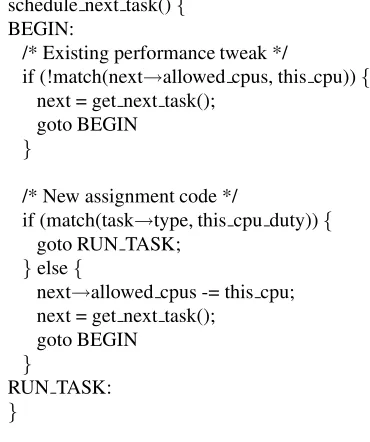
ex-schedule next task(){
BEGIN:
/* Existing performance tweak */
if (!match(next→allowed cpus, this cpu)){
next = get next task(); goto BEGIN
}
/* New assignment code */
if (match(task→type, this cpu duty)){
goto RUN TASK;
}else{
next→allowed cpus -= this cpu;
next = get next task(); goto BEGIN
}
RUN TASK:
}
Figure 1. Modified scheduling algorithm for AMP mode
ecute on the current context according to the AMP policy.
In practice, the new code is only executed a small number of times while the system adjusts the task list appropriately. As tasks transition from a blocked to runnable state in AMP mode, they are marked for execu-tion only on the correct context. Thus, after every pro-cess in the system has been examined, each is marked to run on the correct context. Since both contexts fetch from the same run queue, tasks not allowed to execute on a context are quickly identified at the top of the rou-tine without re-executing the logic detailed in Figure 1. This modification only slightly changes the existing task selection logic and, hence, can be selectively enabled or disabled at runtime. Thereby, the operating system (or user) can select the mode that provides the best perfor-mance.
The AMP mode also impacts the idle state during scheduling. In Linux, a special kernel task, the idle task, is scheduled on unused processors when the number of processors exceeds the number of runnable processes. On an SMT, the idle task explicitly issues a halt instruc-tion, which delays execution until the next hardware in-terrupt. When issuing halt on one context of an SMT, all shared resources are relinquished to the other running context on the Intel architecture,i.e., the processor ef-fectively becomes unpartitioned. Hence, when there is only one runnable task, all processor resources are allo-cated to that task. The processor is effectively a
unipro-cessor, which allows the running task potentially to in-crease its performance. When operating in AMP mode, the context dedicated to kernel tasks rejects any user tasks so that the idle task is invoked in the absence of runnable kernel tasks. Hence, resources are relinquished in favor of user tasks whenever possible,i.e., when no kernel tasks are pending.
2.2. A Context for Event Handling
The kernel code of an operating system is comprised of integer-based work. But in contrast to integer-based applications, kernel code performs worse. Previous stud-ies have shown that the operating system executes so infrequently that branch predictions and cache perfor-mance suffer [17, 9, 4]. This behavior results in favor-able conditions for user applications co-scheduled in the adjacent context during AMP mode. First, the op-erating system is interleaved with application execution. Hence, poor performance in kernel routines will not sig-nificantly delay the execution of the application. Second, the dynamic nature of resource binding in Intel SMTs causes the poorly-performing kernel code to utilize few resources, thereby minimizing the impact of the concur-rently executing user task.
Our subsequent experiments will show that benefits can be found when dissimilar resources are utilized. For example, floating-point intensive computations in-troduce constraints that can be exploited by AMP. We also observed benefits for integer-based applications. Overall, some floating-point and some integer applica-tions benefit while others do not.
Exploiting the AMP mode for interrupts requires ad-ditional modifications to the operating system. Linux separates interrupt handling into a short “top half” han-dler and a “bottom half” routine for longer processing activity in response to an event [11]. If the interrupt oc-curred during an idle period, the bottom half is serviced immediately. If, however, a task was interrupted, the bot-tom half is enqueued as a kernel task for later process-ing within the “kernel idle task” (aka. ksoftirqd). Should the bottom half be delayed too long, its execu-tion may be promoted to avoid buffer overflows.
We exploit the interrupt-handling mechanism in Linux specifically to cater to the AMP mode. When run-ning in AMP mode, bottom halves of interrupts are bound to the context assigned to kernel tasks. This al-lows the system to execute the interrupt bottom halves concurrently with a running user task without ever in-terrupting the latter. The details of our modified interrupt handling mechanism are given in the follow-ing.
3. Implementation Details
We implemented our design of an AMP scheduling mode and the corresponding support for interrupt han-dling within bottom halves within the Linux 2.6.8.1 ker-nel. Prior to our modifications, this kernel already pro-vided scheduler optimizations for a single run queue per physical processor as well as an optimized idle loop for SMT processors.
3.1. Linux Scheduler
Changes to the Linux scheduler closely resemble our design previously discussed in the context of Figure 1. Just before the scheduler transfers control to the next task to be executed, the enhancements depicted in Fig-ure 2 are triggered.
if (AMP ISON && AMP THISCPU) if (next→mm != NULL){
cpu clear(cpu, next→cpus allowed);
next = rq→idle;
goto switch tasks;
}
Figure 2. Actual scheduler modifications
The first conditional guards the statements below to ensure that AMP mode is enabled and the current CPU is the one dedicated to kernel tasks, only. The second con-ditional checks if the next task selected is a user task. In this case, the CPU mask is set on the user task so
that it will not be considered for later execution on this CPU. The last two lines select the idle task to be exe-cuted next on this context before jumping directly to the context switching code. This approach is customary for selecting an alternate task as the idle code immediately checks for runnable processes before idling. Hence, we ensure that the selection code (before our code shown in Figure 2) for another runnable task is properly re-run.
3.2. Redirecting SoftIRQs
As previously mentioned, the top half interrupt pro-cessing system is left unchanged. This simplifies the modifications to the system, as it limits the interaction with device drivers and other hardware-related code. Due to the dual-phase nature of the interrupt system, this is of little consequence to our performance measure-ments since the top halves of interrupts are designed to complete within a very short amount of time, thereby minimizing their impact on the preempted task. Also, the latency of many parts of the system may depend on the speed at which the top halves execute. We did, how-ever, modify the behavior of the bottom-half interrupt processing system.
The primary method for handling interrupt bottom-half processing in Linux is through the use ofsoftirqs,
i.e.a unique number that identifies the bottom-half han-dler.Softirqsare registered when device drivers register their top half Interrupt Service Routine (ISR) with the operating system. Upon raising a softirq, its handler is assigned for processing on one of the processors in the system. While the top half remains unaltered, the logic of the softirqprocessing routine, ( do softirq()), is enhanced.
On an SMT, both contexts routinely execute the
do softirq() routine, which we modified as fol-lows. When AMP mode is enabled, the context dedi-cated to user tasks only runssoftirqsthat match a mask set dynamically at runtime. The mask allows us to retain certain softirqs in the user context since selected ker-nel tasks, such as the timer handler, must be run on the context handling the top half to retain operational in-tegrity of the system. Nonetheless, the majority of the
softirqs can be diverted to the kernel context by mask-ing them in the user context. Hence, the kernel context processes all pending softirqs and, in addition, col-lects softirqs that were raised on the user context. To safely divert softirqs, locking was required for rais-ing and clearrais-ingsoftirqs.
se-quentially instead of observing the priority-based handling of softirqs. In fact, tasklet processing is in-voked from the lowest-priority softirq. Similar mod-ifications were made to the tasklet system to ensure that all were processed by the dedicated kernel con-text.
3.3. AMP Control Module
Support for the AMP scheduling mode was provided by a control module that can be dynamically loaded. Its primary purpose is to facilitate the transitioning from non-AMP mode to AMP mode. In addition, it adjusts the
softirqmask for the user context. Insertion of the mod-ule immediately transitions to AMP mode, and an inter-face to the/procfilesystem is provided for adjusting the
softirqmask for the user context. The module also pro-vides diagnostic information, which we use to observe the functionality and performance of our modifications to the interrupt system. Loading the module into the ker-nel at runtime effectively enables the switching between non-AMP mode and AMP mode from user space.
4. Experimental Framework
We designed a number of experiments to assess the merits of our implementation of AMP scheduling on an Intel Pentium 4 with SMT (Hyperthreading) support. In the experiments, the AMP mode is compared to conven-tional scheduling on the same hardware with two flavors for a total of three scheduling variants.
1. Uniprocessor (UP) mode treats the SMT proces-sor as a normal uniprocesproces-sor,i.e., the second hard-ware context of the SMT is disabled to make all re-sources available to one context, only.
2. Simultaneous multiprocessing (SMP) mode is the default scheduling policy to handle multiple pro-cessors under Linux. In this mode, a multi-context SMT processor is treated as a conventional shared-memory multiprocessor, i.e., subtleties of SMTs are mostly ignored. It shall be remarked that the Linux SMP support incorporates some specializa-tions to reflect the differences specific to an SMT, as mentioned in Section 3, but these are minor com-pared to our AMP design.
3. AMP provides the novel abstraction of a dedicated context for kernel tasks besides another context for user tasks previously introduced in this paper. We evaluated the impact of these schedulers on per-formance for a subset of the SPEC 2000 benchmarks [2, 1]. The benchmarks chosen were a mix of floating-point and integer programs that would fit completely into a
quarter of our available memory without the need for paging.
First, we assess the completion time for n tasks
(threads) of a benchmark (identical executions of the same application), wherenvaries between two and four.
The objective of this experiment is to assess if the par-allelism of SMTs can be exploited in SMP mode when tasks dispatch instructions in parallel as opposed to seri-alizing their execution in UP or AMP mode. The second context in AMP mode remains un-utilized in these ex-periments. The special case of just one thread (n = 1)
was excluded since it would not trigger any parallelism at the SMT and, hence, does not meet our objective.
Second, we repeat the same experiment, but we also trigger kernel activity by imposing considerable network traffic in fast succession on the system. This illustrates how well kernel activity can be sustained in the differ-ent modes. In UP and SMP modes, user tasks are inter-rupted and upper as well as lower halves of interrupts are executed. With AMP, virtually all lower halves are handled in the kernel context while the execution of the benchmark proceeds in the other context without inter-ruption.
Third, we assess benefits of dynamically switching modes depending on the “best fit” of a mode for a given application in the presence of network (kernel) activ-ity. This illustrates the potential of our AMP mode for integration with the SMP mode. The scheduler could then be enhanced to execute applications suitable for one mode while queuing others that excel in another mode. At short intervals, modes and queues could then be swapped, potentially preempting any running tasks and, thus, deferring them to the next mode change.
The network activity imposed in these experiments follows a client-server messaging paradigm where the server resides on the benchmarked platform while the client is located on a separate computer. The proto-col resembles common client-server interactions where large blocks of data are continually being requested by client(s) and supplied by the server. This resembles the I/O-bound load that simple web servers or customized data-feedback applications generate. Client requests are relatively small while server responses are much larger in size.
four threads. This is depicted in Figure 3. The
wrap-fork n times; if (parent){
while (number complete ¡ n){
wait for child exit(); re-spawn a new child;
} }else{
sched yield(); execute benchmark;
}
Figure 3. Multi-Thread execution algorithm
per spawns a fixed number of threads of the same ap-plication. When a thread completes, another thread is started immediately so as to guarantee a constant load,
i.e., threads run with identical resource contention dur-ing our measurements when exploitdur-ing the SMT archi-tecture.
The sched yield() ensures that new tasks for-feit their right to execute immediately, which gives other threads a chance to be spawned before execution pro-ceeds. The timing measurements only reflect the com-pletion times of the firstnthreads,i.e., four threads in
our the example. More specifically, the overall comple-tion time of n threads spans the period from creating
the threads to the completion of the last (slowest) of the threads. The runtime overhead of re-spawned threads is not included. This re-spawning technique is crucial for consistent results and has been used before in SMT ex-periments [23]. If we did not re-spawn, three of the four threads may finish early while the remainder of execu-tion for the last thread would proceed at a faster pace due to reduced resource contention. Average iteration times per thread were also measured and are discussed in a fi-nal set of experiments to assess the predictability under the different modes. The overall completion time pro-vides a fair performance metric since we want to com-pare work under a constant load scenario.
5. Experimental Results
We conducted a number of experiments to assess the benefits of asymmetric multiprocessing, as outlined in the previous section. First, each benchmark is consid-ered in isolation for (a) UP, (b) SMP and (c) AMP modes in (1) absence and (2) presence of kernel activity. Sec-ond, execution of different benchmarks is considered un-der dynamic mode switching between AMP and SMP.
Third, the performance predictability is assessed for the different modes.
5.1. Homogeneous Workload Tests
Tables 1 and 2 depict the performance results for the SPEC benchmarks ART and MESA, respectively. These benchmarks are representative for the behavior of the other SPEC benchmarks tested. Hence, we will first discuss these results in detail before presenting the re-sults for all tested benchmarks. For each benchmark, we tested the completion time for the three modes UP, SMP, AMP. Within each mode, we benchmarked configura-tions with two, three and four threads (2T, 3T, 4T). We depict the completion time (CT) in seconds (Columns 3 and 5) and their change to the corresponding UP config-uration. We also distinguish the absence of kernel tasks or network activity (Columns 3 and 4) and its presence (Columns 5 and 6).
Without Net With net Mode Config CT %-Change CT %-Change
UP 2T3T 129.3384.67 0.00% 95.670.00% 146.33 0.00%0.00% 4T 170.00 0.00% 192.00 0.00%
SMP 2T3T 159.0086.00 18.66% 179.001.55% 103.33 18.25%7.41% 4T 173.33 1.92% 207.67 7.55%
AMP 2T3T 125.3385.00 -3.19% 135.330.39% 88.00 -8.72%-8.13% 4T 170.33 0.19% 176.33 -8.89%
Table 1. Art Runtime [sec]and Change to UP
Without Net With Net Mode Config CT %-Change CT %-Change
UP 2T3T 327.67491.67 0.00% 378.000.00% 576.67 0.00%0.00% 4T 659.00 0.00% 777.33 0.00%
SMP 2T3T 438.67426.33 -15.33% 492.67 -14.57%25.30% 286.67 -24.16% 4T 520.33 -26.65% 574.67 -26.07%
AMP 2T3T 340.67518.33 3.82% 367.675.14% 549.67 -2.81%-4.91% 4T 702.33 6.17% 743.67 -4.52%
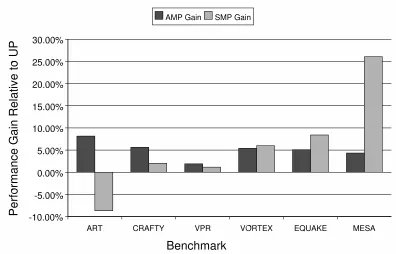
Figure 4. Improvement of SMP and AMP modes over UP for 4 Threads (with Network Activity)
The results for ART in Table 1 illustrate that, in the absence of network traffic, UP outperforms SMP marginally while AMP remains mostly unaf-fected (small win or loss). However, when network traf-fic is added, SMP suffers performance losses of 7-18% while AMP gains 8% in speed. Notice that an odd num-ber of threads (3T) gives significantly different re-sults than an even number of threads (2T and 4T). This anomaly will be discussed later. Overall, ART fa-vors a uniprocessor mode (UP or AMP) over a multipro-cessor mode. ART is a floating-point intensive bench-mark that efficiently utilizes the resources with a sin-gle benchmark thread. Additional threads result in an overall reduction of performance due to resource con-tention.
In contrast, the results for MESA in Table 2 illustrate that, in the absence of network traffic, SMP sometimes outperforms UP while AMP lags behind UP. When net-work traffic is added, SMP always outperforms UP by 14-26% while AMP gains only up to 5% in speed. Again, results for odd numbers of threads are explained later. However, we cannot explain the 25% decrease in performance for two threads in SMP mode, which is reproducible. Overall, MESA favors a multiprocessor mode over a uniprocessor mode. MESA is an integer-centric benchmark that does not fully utilize resources from a single thread,i.e., a second thread of the same
workload still results in better resource utilization. It is not imperative to understand the cause of bet-ter or worse performance for any specific benchmark in our work. Instead, we need to be able to observe if a benchmark favors uni- or multiprocessors to decide upon scheduling modes, as will be shown later. Of the benchmarks tested, ART and MESA represent our best performers in the presence of network traffic for AMP and SMP, respectively. We found that it is sufficient to compare the behavior of benchmarks between AMP and SMP mode in the presence of network activity irrespec-tive of the number of threads.
Figure 4 depicts the results for all tested benchmarks under network traffic for four threads. Improvements in completion time are reported for AMP and SMP rela-tive to UP. The first three applications see a larger bene-fit when running in AMP mode compared to SMP mode. The last three applications, however, benefit more from SMP mode. Notice that the workload was not decisive for the behavior of a benchmark. Some floating-point benchmarks favor AMP, others excel under SMP (and similarly for integer benchmarks).
ab-sence of network activity. Second, AMP mode al-ways outperforms UP mode in the presence of net-work activity. Hence, we can classify the benchmarks into two categories: one that favors multiproces-sors, called pro-SMP, and one that favors uniprocesmultiproces-sors, referred to as pro-AMP. The naming of the latter is jus-tified because AMP always performs as well or better than UP while exhibiting many of the same characteris-tics. The assignment to categories is shown in Table 3. Interestingly, the pro-AMP category is also the pro-UP
Category Member Benchmarks pro-AMP Vpr, Crafty, Art pro-SMP Vortex, Mesa, Equake
Table 3. Categorization of Benchmarks
category when ignoring network activity. Thus, applica-tions that perform better on a uniprocessor than in SMP mode also perform better in AMP mode, even when net-work activity is present. Thus, adding the AMP func-tionality to the operating system provides the ability to utilize the additional resources and capabilities pro-vided by the SMT processor without running in a normal SMP mode when such a mode is detrimen-tal to performance of a specific application.
5.2. Hybrid Tests
Our modifications to the operating system extend beyond a single, static choice of scheduling mode to where dynamic transitioning between AMP and SMP mode can be accomplished. Since neither AMP nor SMP modes offer the best performance by themselves for dif-ferent benchmarks, the scheduler can then choose the most appropriate mode for an application. We designed a hybrid SMP+AMP mode that executes one homoge-neous benchmark in one mode, issues a mode change and then runs the other mode. The performance of the hybrid mode is then compared to the completion time over both benchmarks for any single mode (UP, SMP and AMP).
Our AMP-modified kernel was originally de-rived from an SMP kernel. Hence, disabling AMP mode causes it to behave exactly like the SMP mode. Thus, we can observe the performance of a hy-brid run by simply combining the appropriate re-sults from previous runs. We conducted experiments to run a pro-SMP benchmark, inserted the AMP con-trol module described in the implementation and then executed a pro-AMP benchmark. After exclud-ing the (small) mode switch overhead, the overall
completion time matches the sum of the individ-ual benchmark times for the respective modes. Hence, one can reliably derive the hybrid data construc-tively from data of benchmarks in their correspond-ing scorrespond-ingle mode, which would facilitate an automated choice of modes by the scheduler. The hybrid mode al-lows one to select the fastest run of each applica-tion, which indicates the best mode for each application. The result is then known to be in the smallest possi-ble overall sum.
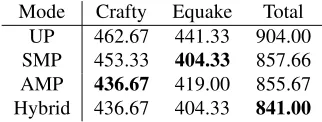
Consider the results for sequential executions of Crafty and Equake depicted in Table 4. The overall
run-Mode Crafty Equake Total UP 462.67 441.33 904.00 SMP 453.33 404.33 857.66 AMP 436.67 419.00 855.67 Hybrid 436.67 404.33 841.00
Table 4. Hybrid Times[sec]for Equake and Crafty (4 Threads plus Network Activity
time in hybrid mode, a combination of Crafty in AMP mode and Equake in SMP mode, is the lowest possi-ble value (including any single-mode as well as any other hybrid run).
Another example is depicted in Figure 5 for Art and Mesa. Art excels under AMP while Mesa peaks in SMP
Mode Art Mesa Total UP 192.00 777.33 969.33 SMP 207.67 574.67 782.34 AMP 176.33 743.67 920.00 Hybrid 176.33 574.67 751.00
Table 5. Hybrid Times [sec] for Art and Mesa (4 Threads plus Network Activity)
mode with a 22.2% gain over UP, which outperforms the 18.9% gain of the second-best choice (SMP-only).
Figure 5. Hybrid Runtimes[sec]
always outperforms any single choice of mode when ap-plications favor opposite modes. In some cases, how-ever, the difference between a hybrid and static modes is so small that the benefit may not justify a mode switch. In others, a significant improvements are seen. In prac-tice, the challenge for the hybrid solution is to balance the dynamic workload between both modes without af-fecting the responsiveness of tasks when hybrid is im-plemented with separate run queues, as suggested in our implementation.
5.3. Performance Predictability
We next conducted experiments to assess the variance in execution time under different modes of execution, both with and without network traffic. Table 6 shows re-sults for a dual-threaded microbenchmark with a work-load in the inner loop that is sampled 9969 times in an outer loop. Specifically, the workload consists of multi-ple independent floating-point (FP) calculations, which should provide sufficient instruction-level parallelism to utilize all FP resources in a single thread. The columns of the table depict the average runtime (in seconds), standard deviation, minimum and maximum for the in-ner loop of the benchmark followed by the average run-time for the entire benchmark. These numbers are re-ported with and without network activity (Columns 4-8 and 9-13, respectively) as well as AMP and SMP modes.
For each mode, three runs of two threads each are mea-sured.
The results in the table show that runtimes are very predictable in the absence of network traffic since the standard deviation is constantly low for both AMP and SMP. When adding kernel activity (network traffic), the standard deviation for AMP only increases insignifi-cantly. Hence, AMP remains predictable with network traffic. In contrast, the standard deviation for SMP in-creases by an order of a magnitude. Thus, SMP becomes significantly less predictable in the presence of network activity.
These findings illustrate the benefits of AMP in in-creased responsiveness and predictability of application performance in the presence of high interrupt arrival rates. Hence, our synergistic OS/hardware approach is not only beneficial for alternating executions of applica-tions with different SMT characteristics, it also provides sustained responsiveness and predictability during unex-pected and frequent interrupts.
5.4. Anomaly for Odd Number of Threads
Without Net With Net
Mode Trial Thread Runtime St.Dev. Min Max Average Runtime St.Dev. Min Max Average
AMP
1 1 76.34 13.85 7.46% 0.57% 3822.68 81.01 50.19 9.42% 5.79% 4045.03 1 2 76.57 16.58 7.32% 0.49% 3823.90 81.08 49.59 6.90% 4.62% 4044.85 2 1 76.45 15.55 7.12% 0.52% 3822.79 81.00 48.63 6.86% 5.15% 4047.25 2 2 76.56 14.47 8.57% 0.56% 3822.59 81.04 48.48 6.95% 4.81% 4047.56 2 1 76.12 15.87 7.26% 0.56% 3822.54 80.96 48.55 6.67% 5.95% 4049.84 3 2 76.55 14.66 7.05% 0.56% 3822.56 81.19 48.26 7.22% 4.46% 4049.79 Avg 76.43 15.16 7.46% 0.54% 3822.84 81.05 48.95 7.34% 5.13% 4047.39
SMP
1 1 85.62 38.02 2.26% 4.52% 8552.55 84.67 545.15 15.13% 6.23% 8452.41 1 2 85.61 38.42 5.52% 2.56% 8556.65 87.23 584.67 10.32% 12.32% 9034.39 2 1 85.60 38.50 5.25% 4.60% 8559.44 83.93 486.67 16.11% 5.69% 8377.29 2 2 85.60 37.84 5.31% 3.70% 8550.38 87.22 532.10 8.20% 13.14% 9123.99 3 1 85.61 37.28 2.29% 4.69% 8551.96 86.99 120.89 4.86% 9.71% 9406.63 3 2 86.61 38.32 5.39% 3.15% 8555.79 81.63 68.36 5.68% 3.06% 8150.30 Avg 85.78 38.06 4.34% 3.87% 8554.46 85.28 389.64 10.05% 8.36% 8757.50
Table 6. Runtimes of Microbenchmark[sec]
caused the completion time to vary as it encompasses the period from start of all threads to completion of the last thread. This overall completion time was always signifi-cantly greater than the average. Since an even number of threads does not exhibit this behavior, we hypothesized that the cause was rooted in scheduling details for an odd number of threads. Experiments with five threads reaf-firmed our suspicion as they yielded the same anomalies and lead us to believe that measured completion times are not reliable for an odd number of threads.
Upon further examination, it was discovered that the standard Linux scheduler is not completely fair to each of the three threads. The threads appear to be sequen-tially pinned to CPUs. Hence, an even number of threads (or, more accurately, a thread count which is a multi-ple of the number of CPUs in the system) results in an evenly distributed load. Conversely, an odd number of threads inflicts an uneven load. In such a case, all pro-cesses should be scheduled round-robin onanyavailable SMT contexts to ensure a fair time distribution. There simply is no benefit to dispatch a preempted context to its original context in an SMT since even L1 caches are shared and other resources, such as BTBs, are likely in-validated due to context switching. We believe that the current Linux scheduler requires round-robin enhance-ments without CPU pinning within contexts of an SMT.
6. Related Work
Applications rarely fully utilize modern processors. This is often due to the latency of other devices within a system, upon which the executing application depends. For in-order pipelined architectures, multithreading pro-vides increased processor utilization by multiplexing the available resources among multiple instruction streams.
The result is not a faster execution time for a single ap-plication, but rather an increased total throughput for multiple applications. Early multithreaded architectures, such as the MIT Alewife machine [3] and the Tera computer [7] provided fast hardware context switching, which allowed the pipeline to be loaded with an instruc-tion from a different stream every cycle without penalty. Interactions between the running threads were minimal because only one instruction occupied a given pipeline stage at a time.
The introduction of superscalar architectures brought concurrent execution of multiple instructions from a sin-gle stream. Sufficient instruction-level parallelism (ILP) identified at runtime by the CPU increases through-put by processing multiple instructions per cycle in a single stage. Such an architecture is limited by the fi-nite amount of ILP available in any instruction stream. Tullsenet al.describe this problem in terms vertical and horizontal waste [24].
6.1. Symbiotic Job scheduling
A simultaneously multithreaded processor introduces many complexities and unique characteristics over a similarly-equipped single-threaded processor. Most con-ventional multiprocessor systems replicate entire CPUs to achieve parallelism. Such a system requires an oper-ating system to intelligently schedule processes to opti-mize cache performance and reduce false sharing. Typ-ically, an operating system would ignore things such as the functional unit usage profile of concurrently ex-ecuting applications, as the independent processors do not share these resources. These factors are exactly re-versed in the case of an SMT processor and provide the justification for specific operating system support for SMT CPUs. When co-scheduling two tasks on the vir-tual CPUs of an SMT, false sharing can acvir-tually increase performance (since the contexts share a cache), and pro-cesses need not be rescheduled on the same CPU, as the shared cache is warm no matter which context executes the process. Similarly, functional units are shared, and, thus, the operating system could increase performance by intelligently scheduling processes that would mini-mize interference.
Snavelyet al.use the termsymbiosisto describe the effectiveness with which multiple jobs achieve speedup when co-scheduled on a simultaneously multithreaded processor [19]. They describe a system, called SOS, that dynamically determines the most beneficial schedule for a set of tasks, based on their measured performances. This is referred to assymbiotic job scheduling[21] and is a crucial step in improving performance on an SMT system. They take their idea further [20] by introducing weights into their system, providing the (very important) ability to support QoS within the system. This is a key concept, as it is similar to our work, although it assumes that the operating system is always scheduled with the highest priority. Also, the SOS system spends execution time measuring the performance of many combinations of running tasks before determining the best schedule. Another solution, however, could be to classify appli-cations statically, thereby eliminating the need for run-time sampling and preventing short-lived processes from hurting the performance of the system.
Settleet al.propose hardware support through active performance counters that can then steer scheduling de-cisions in the operating system based on different mem-ory behavior of threads [18]. Co-scheduling of threads with non-competing memory behavior is shown to en-hance the overall throughput. Our work differs from any of the above approaches by promoting an asymmetric scheduling solution and does not require any hardware
enhancements to existing processor designs.
6.2. Other Asymmetric Systems
The idea of a single system with multiple processors dedicated to separate duties has been in practice since at least 1964. The Control Data Corporation (CDC) 6000 series computers used this technique to allow I/O par-allelism [8]. One or two central processors were used to perform high-speed arithmetic operations and gen-eral program execution, much like the CPUs of today’s microcomputers. Additionally, small peripheral proces-sors (PP) provided I/O service between external devices and central memory (CM). The PPs each had small pri-vate memories and access to all locations of the CM. By loading a small program into a PP’s private memory, a complex I/O operation could be carried out while allow-ing the central processor to continue execution of other tasks. Thus, the CDC 6000 machine had multiple pro-cessors dedicated to different tasks executing different code. Much of the CDC operating system was imple-mented in PP code,1resulting in a system where most of
the OS was executed on dedicated processors, minimiz-ing interference with user tasks.
Nahum et al. studies the effect of adding packet-level parallelism by exploiting shared-memory multi-processors, specifically in terms of protocol overhead, such as locking, for TCP and UDP enhancements [14]. Their objective was to obtain packet-level parallelism, which was accomplished but limited in terms of the amount of parallelism realized. Muir and Smith de-signed an asymmetric multiprocessing extension called Piglet, which was integrated with Linux [13]. Piglet pro-vides a frameset abstraction to multiplex device requests from multiple processes to a single device observing QoS restrictions, and this multiplexing is realized at the driver level so that it can be decoupled from the ap-plication. In their experiments, network requests could such be served on a different processor than the ap-plication within a two-way SMP. Rangarajanet al. de-signed a system called TCP Server that offloads TCP traffic onto dedicated SMP processors or even differ-ent processing nodes within a cluster [16]. Their objec-tive was to off-load the even-increasing processing de-mands due to high-bandwidth network connections. In-terrupt was replaced with polling, and buffering could be avoided in some instances due to the dedication of a processor to network traffic. Interrupts were masked on the application side by reprogramming the hardware at the APIC level. These approaches differ from our
work in that we do not divert interrupts at the hard-ware level, provide packed-level parallelism or off-load network traffic to another physical processor. Instead, we divertSoftirqsto a dedicated logical context on the same physical processor with shared resources. We fo-cus on performance benefits of multi-processing in dif-ferent processor modes, and our hybrid mode is unpar-alleled to past work, particularly since it bears the po-tential to use multiple context whereas past work kept one processor idle when no network traffic required pro-cessing. Our efforts are also aimed at providing a tighter coupling between the application and interrupt process-ing than possible in SMPs, which includes but is not lim-ited to network traffic. Hence, kernel tasks in one con-text can place packets in L1 cache so that applications can benefit from data locality due to network traffic.
A more modern example of an asymmetric architec-ture is the IBM BlueGene/L machine (BGL) [22]. The BGL system packages two PowerPC 440 CPUs per pro-cessing element (PE). Unlike the CDC 6000 system (in which the CPUs were not similarly-equipped), a BGL PE has two equally-powerful processors in a pseudo-SMP configuration.2Although the system is capable of
symmetric task assignment to both processors on a PE (the so-called virtual mode), normal operation utilizes one CPU for computation and the other for messaging (the so-called co-processor mode). The BGL machine is an example of an SMP system where tasks are not symmetrically assigned. Effectively, the second physical processor becomes a service or co-processor, similar to the intent of our work with respect to an additional con-text of an SMT processor. However, many large-scale benchmark perform better in virtual mode, which de-faults to the symmetric model, even though BGL was originally not designed for this type of use.
7. Conclusion
In this paper, we explore an alternative way to ap-proach utilization of the additional resources provided by an SMT processor. We depart from traditional sym-metric scheduling techniques and suggested an operat-ing system modification that illuminates a new path in light of the diminishing returns that result from con-ventional symmetric multiprocessing. We achieve this goal while maintaining compatibility with existing al-gorithms as well as the added benefit of being able to utilize both existing and new paradigms in the same sys-tem at runtime.
2 The PowerPC 440 lacks actual SMP hardware, so the processors on a PE are not L1 cache-coherent.
Our research verified that some applications perform better when scheduled alone, as opposed to being co-scheduled on an SMT processor. We tested benchmarks and categorized their behavior into those which do and do not perform well on an SMT. We also showed that our modification to a conventional operating system allows poor SMT performers to realize a performance gain. Fi-nally, we showed that the flexibility of our system can achieve a best-of-both-worlds result when faced with a heterogeneous application workload.
References
[1] Cfp2000 benchmark descriptions, 2000. [2] Cint2000 benchmark descriptions, 2000.
[3] A. Agarwal, R. Bianchini, D. Chaiken, K. Johnson, D. Kranz, J. Kubiatowicz, B.-H. Lim, K. Mackenzie, and D. Yeung. The MIT alewife machine: Architecture and performance. InProc. of the 22nd Annual Int’l Symp. on Computer Architecture (ISCA’95), pages 2–13, 1995. [4] A. Agarwal, J. Hennessy, and M. Horowitz. Cache
per-formance of operating system and multiprogramming workloads. ACM Trans. Comput. Syst., 6(4):393–431, 1988.
[5] A. Agarwal, B.-H. Lim, D. Kranz, and J. Kubiatowicz. APRIL: A processor architecture for multiprocessing. In Proceedings of the International Symposium on Com-puter Architecture, pages 104–114, June 1990.
[6] R. Alverson, D. Callahan, D. Cummings, B. Koblenz, A. Porterfield, and B. Smith. The Tera computer sys-tem. In Proceedings of the1990 International Confer-ence on Supercomputing, pages 1–6, 1990.
[7] R. Alverson, D. Callahan, D. Cummings, B. Koblenz, A. Porterfield, and B. Smith. The Tera computer sys-tem. In Proceedings of the1990 International Confer-ence on Supercomputing, pages 1–6, 1990.
[8] Control Data Corporation. 6400/6500/6600 Computer Systems Reference Manual, h edition, 1969.
[9] N. Gloy, C. Young, J. B. Chen, and M. D. Smith. An anal-ysis of dynamic branch prediction schemes on system workloads. InProc. 23rd Annual Intl. Symp. on Com-puter Architecture, pages 12–21, 1996.
[10] L. Hammond, B. A. Nayfeh, and K. Olukotun. A single-chip multiprocessor. IEEE Computer, 30(9):79– 85, September 1997.
[11] R. Love. Linux Kernel Development. Sam’s Publishing, 2004.
[12] D. T. Marr, F. Binns, D. L. Hill, G. Hinton, D. A. Ko-ufaty, J. A. Miller, and M. Upton. Hyper-threading tech-nology architecture and microarchitecture.Intel Technol-ogy Journal, 6(1):1–12, February 2002.
[14] E. M. Nahum, D. J. Yates, J. E. Kurose, and D. Towsley. Performance issues in parallelized network protocols. In Proc. of the 1st Symp. on Operating Systems Design and Implementation (OSDI’94), pages 125–137, 1994. [15] K. Olukotun, B. A. Nayfeh, L. Hammond, K. Wilson,
and K. Chang. The case for a single-chip multiproces-sor. In Proceedings of the seventh international con-ference on Architectural support for programming lan-guages and operating systems, 1996.
[16] M. Rangarajan, A. Bohra, K. Banerjee, E. Carrera, R. Bianchini, and L. Iftode. Tcp servers: Offloading tcp processing in internet servers. design, implementation, and performance. DCS-TR 481, Rutgers University, Mar. 2002.
[17] J. Redstone, S. J. Eggers, and H. M. Levy. An anal-ysis of operating system behavior on a simultaneous multithreaded architecture. InArchitectural Support for Programming Languages and Operating Systems, pages 245–256, 2000.
[18] A. Settle, J. Kihm, A. Janiszewski, and D. Connors. Ar-chitectural support for enhanced smt job scheduling. In International Conference on Parallel Architectures and Compilation Techniques, 2004.
[19] A. Snavely. Explorations in symbiosis on two multi-threaded architectures, 1999.
[20] A. Snavely, D. Tullsen, and G. Voelker. Symbiotic jobscheduling with priorities for a simultaneous multi-threading processor, 2002.
[21] A. Snavely and D. M. Tullsen. Symbiotic jobscheduling for a simultaneous multithreading processor. In Architec-tural Support for Programming Languages and Operat-ing Systems, pages 234–244, 2000.
[22] T. B. Team. An overview of the bluegene/l supercom-puter. Technical report, IBM and Lawerence Livermore National Laboratory, 2002.
[23] D. M. Tullsen, S. Eggers, and H. M. Levy. Simultaneous multithreading: Maximizing on-chip parallelism. In Pro-ceedings of the 22th Annual International Symposium on Computer Architecture, pages ??–??, 1995.
![Table 1. Art Runtime [sec] and Change toUP](https://thumb-us.123doks.com/thumbv2/123dok_us/1234997.1156016/6.612.327.541.305.443/table-art-runtime-sec-and-change-toup.webp)
![Figure 5. Hybrid Runtimes [sec]](https://thumb-us.123doks.com/thumbv2/123dok_us/1234997.1156016/9.612.113.514.77.330/figure-hybrid-runtimes-sec.webp)
![Table 6. Runtimes of Microbenchmark [sec]](https://thumb-us.123doks.com/thumbv2/123dok_us/1234997.1156016/10.612.95.537.74.259/table-runtimes-of-microbenchmark-sec.webp)
