ABSTRACT
THOMAS, JAMES M. Automated Scaffolding of Task-Based Learning in Non-Linear Game Environments. (Under the direction of R. Michael Young.)
This work described in this dissertation is an attempt to integrate intelligent tutoring ca-pabilities into a framework that can be applied within any exploratory learning game. The goal is to provide dynamic adaptation to the learning needs of an individual students without constraining the autonomy and fun that digital games can offer.
To accomplish this goal, a theoretical framework was designed that employs a novel plan-based knowledge representation to describe both how the game works and what a student can learn in the game environment. This framework was implemented in a system called Annie, that employs a decompositional partial-order planner as its engine. Automated planning has been shown to provide a balance between user autonomy and story coherence within interactive narrative that is similar to the balance between player autonomy and learning progression that is a goal for Annie.
c
Copyright 2011 by James M. Thomas
Automated Scaffolding of Task-Based Learning in Non-Linear Game Environments
by
James M. Thomas
A dissertation submitted to the Graduate Faculty of North Carolina State University
in partial fulfillment of the requirements for the Degree of
Doctor of Philosophy
Computer Science
Raleigh, North Carolina 2011
APPROVED BY:
Jon Doyle Patrick Fitzgerald
Robert St. Amant R. Michael Young
DEDICATION
BIOGRAPHY
Jim grew up in Vienna, Virginia, a suburb of Washington, D.C. He played his first computer game in 1976, and later in the same year created his own game: a three-card version of poker written in BASIC. At the University of Virginia in Charlottesville he earned a Bachelors degree in Mathematics, a Masters degree in Computer Science, and met the love of his life, Melissa DeRosier.
Jim wrote mainframe software for IBM’s Myers Corners Lab near Poughkeepsie, NY, before relocating to Cary, NC to work for BNR, Inc. At BNR, Jim helped design and implement the first speech recognition software deployed within a public telecommunication network. Jim was the architect and lead designer of the first Voice over IP system to be used in the public network. He also spent several years as one of just eight lead architects throughout the company on one of the largest (30+ million lines of procedural code) software refactoring projects ever undertaken. Jim spent the next decade as a software design manager, culminating in 1999, when he was named a “top 1%” performer among other awards and bonuses. Jim was anxious for a new challenge and moved into strategic marketing, a function in which he was named a “top 1%” performer in 2000, less than one year after making the transition.
ACKNOWLEDGEMENTS
Foremost, I would like to thank my committee members, Jon Doyle, Robert St. Amant, and Pat Fitzgerald, and my advisor and committee chairman, R. Michael Young for their guidance, attention, and patience. Michael Young has helped me develop as a researcher and as a scientist down a path I could not have found on my own. Also, I greatly appreciate working with James Lester, who helped me connect to the ITS community in innumerable ways.
I also appreciate the support and camaraderie of all my fellow graduate students in the Liquid Narrative and Intellimedia research groups, who never failed to accept me despite my youthful enthusiasm and occasional immaturity. Special thanks are due to Mark Riedl, Arnav Jhala, Brad Mott, Jon Rowe, Seung Lee, Alok Baikadi, Julius Goth, Jen Robinson, Justin Harris, Tommy Vernieri, Pat Cash, Joe Winegarden, Yuna Cheong, Leo Bae, James Niehaus, Sam Munilla, Mike Dominguez, Stephen Ware, Matt Fendt, Julio Bahamon, Brad Cassell, Charles Bevan, Stephen Roller, and the rest of the folks who have made the years go by too fast in the DGRC lab.
I would like to thank my parents for encouraging me to put myself in challenging situations. I will never forget when I told my Dad that maybe I shouldn’t leave my current position because I gained 12 years of work experience in that area he asked, “Is it really twelve years of experience or just one year repeated twelve times?”
TABLE OF
CONTENTS
List of Tables . . . ix
List of Figures . . . x
Chapter 1 Introduction . . . 1
1.1 Problem Statement . . . 1
1.2 Background . . . 2
1.3 A Note On Terminology . . . 4
1.4 Automated Scaffolding . . . 6
1.5 Interactive Narrative . . . 8
1.6 Research Aspirations and Contributions . . . 10
1.6.1 Aspirations . . . 10
1.6.2 Contributions . . . 11
1.7 Readers’ Guide . . . 12
Chapter 2 Related Work . . . 14
2.1 Automated Scaffolding . . . 14
2.1.1 Scaffolding in Exploratory ITSs . . . 16
2.1.2 Scaffolding in “Mainstream” (Non-Exploratory) ITSs . . . 17
2.1.3 Scaffolding and Alternative Techniques in Digital Games . . . 19
2.2 Interactive Narrative and Learning . . . 25
2.2.1 Steve: Soar Training Expert for Virtual Environments . . . 25
2.2.2 Mission Rehearsal Exercise . . . 26
2.2.3 U-DIRECTOR . . . 27
2.3 Plan-Based Representations and Task-Based Learning . . . 28
2.3.1 Discourse-focused Tutorial . . . 29
2.3.2 Agent Learning Approaches . . . 29
Chapter 3 Design Overview . . . 31
3.1 System Architecture . . . 33
3.2 Operational Overview . . . 36
3.2.1 System Initialization . . . 36
3.2.2 Execution Cycle: Overview . . . 37
Chapter 4 Detailed Design . . . 42
4.1 Annie’s Inputs . . . 43
4.2 System Initialization . . . 48
4.3.1 Stage One: Remediation Consideration . . . 51
4.3.2 Stage Two: Remediation Selection (when remediation is indicated) . . . 58
4.3.3 Stage Three: Action Specification . . . 70
4.3.4 Stage Four: Action Execution . . . 71
4.3.5 Stage Five: Action Result Processing . . . 71
4.4 Diagnostic Scenarios . . . 77
4.4.1 Scenario 1: Student Inaction . . . 78
4.4.2 Scenario 2: FailedAction - Unthreatened Precondition . . . 79
4.4.3 Scenario 3: FailedAction - Unresolved Threat . . . 81
4.4.4 Scenario 4: Successful, butfatally flawedaction . . . 82
4.4.5 Scenario 5: Successful, butunnecessaryaction . . . 83
4.4.6 Scenario 6: Successful, butsuboptimalaction . . . 84
4.4.7 Scenario 0: Complete Success . . . 85
4.5 Design Summary . . . 87
Chapter 5 Evaluation . . . 88
5.1 Evaluation Domain . . . 89
5.1.1 Essential Actors in the Domain . . . 90
5.1.2 Potential Student Interactions with the Domain . . . 90
5.2 Pilot Evaluation: Diagnostic Capabilities . . . 92
5.2.1 Synopsis . . . 92
5.2.2 Pilot Evaluation: Experimental Design . . . 93
5.3 Subject Knowledge Self-Assessment . . . 93
5.3.1 Pilot Evaluation: Results . . . 96
5.3.2 Pilot Evaluation: Conclusions . . . 98
5.4 Main Evaluation: Scaffolding Effectiveness . . . 101
5.4.1 Main Evaluation: Experimental Design . . . 102
5.4.2 Main Evaluation: Results . . . 107
5.4.3 Main Evaluation: Conclusions . . . 114
Chapter 6 Limitations and Future Work . . . 117
6.1 Limitations of the Annie System . . . 117
6.2 Limitations of the FixIt Evaluation Environment . . . 119
6.3 Future Work: Expanded Capabilities . . . 119
6.3.1 Improved Representation and Reasoning for Student Beliefs . . . 119
6.3.2 Improved Support for Character-Based Remediation . . . 120
6.3.3 Expanded Task-Based Tutorial Authoring Tool Set . . . 120
6.3.4 Increased Expressivity of Plan-Based Reasoning . . . 121
6.4 Future Work: Proposed Experiments . . . 122
References . . . 127
Appendices . . . 135
Appendix A Evaluation Environment Details . . . 136
A.1 FixIt: Level Design “Geography” . . . 136
A.2 FixIt: Actors . . . 139
A.2.1 FixIt Actors: Processes . . . 140
A.2.2 FixIt Actors: Mouse Droids . . . 143
A.3 FixIt Actors: System Status Designations . . . 143
A.4 FixIt: Student Actions and Tools . . . 144
A.4.1 Investigate Tool . . . 144
A.4.2 Nice Tool . . . 146
A.4.3 Destroy Tool . . . 146
A.4.4 Speed Up Tool . . . 146
A.4.5 Pause Tool . . . 146
A.5 FixIt: Heads-Up Display . . . 146
A.5.1 Score . . . 147
A.5.2 Notes . . . 147
A.6 FixIt: Pilot Evaluation Modifications . . . 147
A.7 FixIt: Main Evaluation Modifications . . . 148
A.7.1 Learning Challenge 1: Good program behaving poorly . . . 149
A.7.2 Learning Challenge 2: SPAM Bot . . . 150
A.7.3 Learning Challenge 3: Evil zombie program . . . 151
Appendix B Planning Details . . . 153
B.1 Planning Library . . . 153
B.2 Pilot Plan . . . 156
Appendix C Main Evaluation Materials . . . 160
C.1 Pre-Assessment . . . 160
C.2 FixIt Adjustments . . . 161
LIST OF
TABLES
Table 4.1 Belief Strength Levels . . . 46
Table 4.2 Student Inaction . . . 79
Table 4.3 Action Failure - Unthreatened Precondition . . . 80
Table 4.4 Action Failure - Unresolved Threat . . . 81
Table 4.5 Success - Fatal Flaw . . . 82
Table 4.6 Irrelevant Action . . . 83
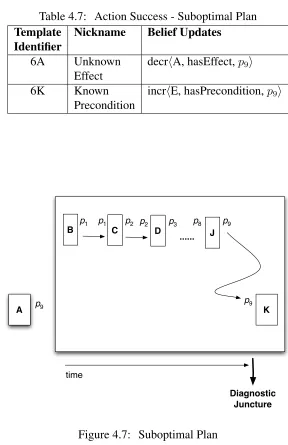
Table 4.7 Action Success - Suboptimal Plan . . . 85
Table 4.8 Action Success - Correct Beliefs . . . 86
Table 5.1 Per-Student Comparative Diagnostic Accuracy . . . 98
Table 5.2 Treatment Group Assignments . . . 107
Table 5.3 Student Task Completion Percentages . . . 109
Table 5.4 Student Challenge Completion Times . . . 111
Table 5.5 Hypothesis 2A: Challenge Completion Time - Correlation . . . 112
Table 5.6 Correlations: Treatment Level vs. Completion Time . . . 113
L
IST OF
FIGURES
Figure 1.1 Scaffolding and the Zone of Proximal Development . . . 7
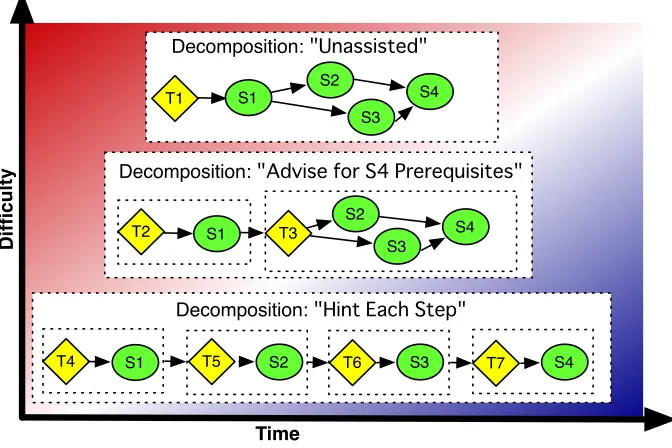
Figure 1.2 Task Decompositions for Scaffolding . . . 9
Figure 3.1 System Architecture . . . 34
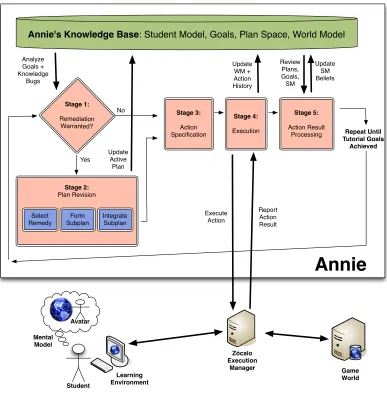
Figure 3.2 Execution Data Flows . . . 39
Figure 4.1 Remediation Consideration . . . 54
Figure 4.2 Student Inaction . . . 79
Figure 4.3 Unthreatened Precondition . . . 80
Figure 4.4 Unresolved Threat . . . 81
Figure 4.5 Fatal Flaw . . . 83
Figure 4.6 Irrelevant Action . . . 84
Figure 4.7 Suboptimal Plan . . . 85
Figure 4.8 Diagnosing Correct Beliefs . . . 86
Figure 5.1 FixIt: Top Down View . . . 89
Figure 5.2 FixIt: Mouse Droid (Center) Emerging From Process Panel . . . 91
Figure 5.3 Pilot Evaluation Instructions (page 1) . . . 94
Figure 5.4 Pilot Evaluation Instructions (page 2) . . . 95
Figure 5.5 Pilot Evaluation Self-Assessment (page 1) . . . 116
Figure A.1 FixIt: Level Views . . . 137
Figure A.2 FixIt: Important Actors . . . 141
Figure A.3 FixIt: System Status Indicators . . . 145
Figure B.1 Operator Library XML Excerpt . . . 154
Figure B.2 Plan XML Excerpt . . . 155
Figure B.3 Portion of Plan Space Graph from Pilot Evaluation . . . 157
Figure B.4 A Plan Graph from Pilot Evaluation . . . 158
Figure B.5 Plan Graph Detail . . . 159
Figure C.1 Main Evaluation PreAssessment (page 1) . . . 163
Figure C.2 Main Evaluation PostAssessment (page 1) . . . 164
Chapter 1
Introduction
1.1
Problem Statement
In contrast, digital games have developed innovative techniques for guiding people through exploratory environments. Despite increasing complexity, games are increasingly easy to learn, because games must be easy to learn to sell well enough to recoup their massive production investments. Researchers have catalogued dozens of learning principles in digital games [28, 60], but they are most frequently implemented as fixed alternative paths tightly woven into the structure of particular games. These multiple options afford a non-lineargame structure that rarely coincides with deep modeling of student knowledge or dynamic adaptation to individual users.
This dissertation describes a general conceptual framework for guiding task-based learning in an exploratory environment. The aim is to combine the exploratory learning mechanisms of digital games with the deep student models of intelligent tutoring systems. In addition, the dissertation describes an implemented system built on that framework and a stand-alone game-based learning environment, both developed by the author to evaluate the effectiveness of the introduced approach. Two formal evaluations of the effectiveness of the system in working with learners in the game-based learning environment are then presented. Although some positive effects were found on learner performance, several areas for future improvements are identified.
1.2
Background
attempt to combine learning with games often either “sucks the fun out” or “sucks out the learning” [61]. Postman goes so far as to argue that learning and entertainment are mutually exclusive: “no one has ever said or implied that significant learning is effectively, durably and truthfully achieved when education is entertainment [59, p. 146].” Nevertheless, a broad com-munity of serious games researchers [12, 97, 83, 47, 70, 36] continues to work to harness the rapidly evolving technologies of digital games to empower teaching in many different domains.
Meanwhile, Intelligent Tutoring Systems (ITS) have demonstrated impressive teaching re-sults in a variety of knowledge domains [19, 87, 2, 24, 29, 48, 3, 63], largely by leveraging detailed cognitive models that allow for precise adaptation to the needs of particular learners. Exploratory learning has long been an active interest of ITS research, especially in the realms of scientific inquiry [24, 96, 64, 22, 31] and mathematics [10, 17]. But as Quintana et. al. point out, despite “individual successes, accumulation of both theory and craft knowledge about scaffolding design has been difficult. The field has not converged on a common framework [...] making it difficult to synthesize claims and results across contexts [62, p. 339].” Although the authors present a synthesis of approaches to scaffolding within tutoring systems that aid scien-tific discovery, it is more an analysis of what has come before than a road map for generating future systems.
dissertation builds on work in interactive narrative that addresses this balance.
1.3
A Note On Terminology
The title of this dissertation, “Automated Scaffolding of Task-Based Learning in Non-Linear Game Environments,” employs several carefully chosen terms whose usage may not be fa-miliar to all readers. “Scaffolding,” in the context of the sub-field of Artificial Intelligence known as Intelligent Tutoring Systems (ITS), is the process of presenting help, often in the form of text-based prompts, to users of computer-based learning systems. Although the terms “scaffold,” and “scaffolding” are found extensively throughout the ITS literature, they are not consistently defined. For the purposes of this dissertation, a scaffold is defined as an atomic unit of help provided to the learner. The process of scaffolding is the optimal selection of the most appropriate scaffold to use with the student at any given point in time.
The intended denotation of the phrase “Non-Linear Game Environments” is the subset of digital or computer games that do not prescribe a linear path the player must take through the game. Instead, such games allow players autonomy in exploring or changing the state of objects in the game environment. Most modern three-dimensional games fall into this category, but also included are non-3D games that promote player autonomy, such as text-based adventure games [38]. As will be shown, automatically generating scaffolding within non-linear game environments presents new and difficult challenges.
the focus of this work. Not only are these domains fairly difficult to learn through traditional sequentially organized instructional media (e.g., books), but they are particularly well-suited to representation in a exploratory learning environments.
The conceptual framework described in this work is designed to enable systems to be im-plemented that automatically generate scaffolding within learning environments that grant a high degree of task-selection autonomy, encouraging knowledge acquisition through student-initiated exploration and discovery. The framework is intended to be generally applicable across a wide range of domains because its core abstractions are the actions the student or the system can use to change the state of the environment. It builds a student model based on the individual student’s sequence of action attempts. The student model guides the gener-ation of scaffolds that also take the form of actions performed in the environment. It is left to the domain author to map these actions to domain-relevant concepts, and to specify the learn-ing objectives in terms of the student’s performance and understandlearn-ing of the various actions available in the world.
scaffolding, andinteractive narrative.
1.4
Automated Scaffolding
“Scaffolding” is a term first coined as a metaphor for learning support processes by Wood, Bruner, and Ross [90]. In studying human tutors working with 3-5 year olds, the authors found that three year olds received the most support from the human tutor, and five year olds the least. The word “scaffold” was chosen to convey that the supports provided by the tutor were temporary constructs to be removed or “faded” as the student gained proficiency, just as scaffolds used on construction projects are temporary supports that are built up and then removed over the course of work.
“Scaffolding” quickly became a dominant theme in educational research partly through its links to Lev Vygotsky’s theories of learning [91, 75, 8]. Vygotsky defined the place where learning is most efficient as the zone of proximal development (ZPD): “the distance between the actual development level as determined by independent problem solving and the level of potential development as determined through problem solving under adult guidance or collabo-ration of more capable peers [89, p. 86].” New competencies can only be generated in the ZPD through collaboration in actual, concrete, situated activities with a more capable peer. With enough assisted practice, the child internalizes the strategies and language for completing this task, which then becomes part of the personal problem-solving repertoire.
environ-ment nor of the student; it is a property of the interaction between the two [53, p. 751].” The role of the tutor is to ensure that the learner is not overly confused by challenges that are too difficult or overly bored by challenges that are too easy. Either condition can lead to frustra-tion, distraction or disengagement. As skills are mastered, scaffolding assistance is “faded” to ensure that learners do not become bored.
S+
S
-S+
Difficulty Level
Time
Individual Learning
Path
Figure 1.1: Scaffolding and the Zone of Proximal Development
Figure 1.1 depicts the zone of confusion in progressively deeper shades of red toward the upper left corner of the chart and the zone of boredom in progressively deeper shades of blue toward the bottom right corner of the chart. The diamonds represent interventions that either add scaf-folding (the “S+” labels) to prevent the learner’s path from straying too far toward confusion, or fade/remove scaffolds (“S-”) to stave off boredom.
Although digital games and Interactive Tutoring Systems seem to have both embraced the concept of scaffolding, their implementation strategies are divergent. Digital games tend to favor user initiative and autonomy at the expense of fine-grained adaptation. ITS systems adapt to subtle details of learning concepts, but tend to constrain student initiative and autonomy beyond what is typical of digital games. Dynamically balancing between user control and a coherent experience is a problem common to the related field of interactive narrative.
1.5
Interactive Narrative
The Annie system described in this dissertation builds on one approach of balancing nar-rative and user goals first described in the Mimesis system [69]. Mimesis generates plans for actions of agents in a story world based on hierarchical task decompositions and discrete causal requirements. Mimesis simultaneously solves for plot coherence and character believ-ability, mediating the actions of the human user through a combination of accommodations (when re-planning can preserve narrative goals) and interventions (where unanticipated and harmful interactions posed by user activity would be fatal to narrative goals).
S1
Decomposition:
S2 S3
S4 T1
S1
Decomposition:
S2 S3
S4
T2 T3
S1
Decomposition:
T4 T5 S2 T6 S3 T7 S4
Time
Diffi
culty
Figure 1.2: Task Decompositions for Scaffolding
de-compositions of a single tutorial task. These sub-tasks may consist of any combination of student actions (ovals), or tutorial actions (diamonds). Based on the current state of the stu-dent model, Annie selects one of these decompositions and initiates the first action (T1, T2, orT4). The easiest decomposition, shown at the bottom of the figure, is the one where each student action is prompted by a unique system action likely providing some “bite-sized” advice to the student. More complex for the student are decompositions like that shown at the top of the figure, where a single system action is expected to kick off a series of appropriate student actions.
1.6
Research Aspirations and Contributions
This research goals described in this dissertation can be categorized in two ways. One set of goals represent actual contributions that are implemented and evaluated as described in this document. Another set of goals, better labelled as aspirations, are described in the conceptual framework and influential in the design and implementation of Annie, but not yet empirically evaluated.
1.6.1
Aspirations
The following are research goals for this work are best described as aspirations.
An implementation architecture independent of any particular domain or game One of the
been evaluated in only a single game and a single domain, neither form of independence has yet been demonstrated. Therefore, it is more appropriate to describe this research goal as an aspiration than as a contribution to the research literature. A high priority item on the list of future work is to evaluate Annie in a new game and domain to demonstrate this independence.
External libraries of diagnostic and remediation templates The libraries of diagnostic and
remediation templates described in Chapter 4 are intended to be separable from the core algorithms in Annie, although in the current implementation they are not. With better understanding of the needs of serious game designers who would use such templates, future work will endeavor to encapsulate these templates in externally manipulable files.
1.6.2
Contributions
This dissertation makes a number of research contributions:
A conceptual framework. Specifically, a conceptual framework to unify the representation
of student knowledge and tutorial reasoning in task-based learning environments. The key decision enabling this work to simultaneously address the needs of the learner and the goals of instruction is to use a common framework to describe and reason about scaffolding alternatives and the needs of the learner.
A working system that implements the framework. This dissertation describes a
function-ing system, called Annie, which implements the conceptual framework. A finely detailed description of the design decisions within Annie, provided in Chapter 4, gives insight to both the methods chosen for implementation and some of the rejected alternatives.
rea-son about multiple possible student plans simultaneously, as the system cannot know for sure what it is that the student is trying to do. By investigating multiple potential plans, Annie is able to generate metrics to rank the urgency between proximate learning objec-tives.
An learning environment. A completely independent game and underlying learning
environ-ment were constructed to support evaluations of Annie’s effectiveness. Lessons learned in the creation of this game, named “FixIt”, have informed the design of Annie, methods for evaluating Annie, and plans for future learning environments.
Two formal evaluations with human learners. Two formal evaluations of Annie within the
FixIt game were held several months apart. The first evaluation compared the accuracy of the automatically generated student model within Annie to that derived by an expert human observer of the performance of subjects within the game. The second evaluation studied the effectiveness with which Annie was able to guide students using the FixIt game through automatically generated scaffolding.
1.7
Readers’ Guide
Chapter 2
Related Work
The work described in this dissertation builds on several overlapping strands of research. Al-though these have been grouped into three categories for the purposes of this commentary, these categorizations are by no means canonical.
The first category includes descriptions of various approaches to automated scaffolding
from mainstream ITS research to the more specialized approaches in exploratory ITSs to the types of scaffolding found in digital games. The second category of related work is the field
of interactive narrative. A special focus is given to recent forays into narrative-centered
learning. Task-based learningand plan-based knowledge representations which are at the the core of this work are grouped into the third and final category.
2.1
Automated Scaffolding
that it has become unclear in its significance [...] Perhaps scaffolding has become a proxy for any cultural practices associated with advancing performance, knowledge, and skills whether social, material, or reproducible patterns of interactivity (as in software systems) are involved [57].”
Similarly, a 2005 special issue of Instructional Science entitled “Scaffolding Self-regulated Learning and Metacognition: Implications for the Design of Computer-based Scaffolds,” found a wide distribution of the ways in which “scaffolding” was expressed in just the seven papers included in that issue. Some scaffold only when learners explicitly request help, others only when a student makes a mistake. Scaffolding may take the form of dynamic adaptation to individual needs or it may be a static calibration that sets a difficulty level for some duration of the learning exercise. Often systems only add but never remove scaffolds, a process referred to as fading. Even the nature of what is being scaffolded varies from domain knowledge, to learning about the system, to learning about ones own learning.
automated scaffolding can bring something to bear on the work in this dissertation.
2.1.1
Scaffolding in Exploratory ITSs
In their exhaustive and extensively cited survey [24], de Jong and van Joolingen compared the types of learner supports offered in exploratory learning environments, specifically, environ-ments geared toward scientific discovery learning. The authors first noted that a number of similar difficulties encountered by learners are common across different systems. For example, they report several cases in the literature where students fail to look for evidence that might not support a hypothesis, incorrectly retain hypotheses in spite of negative results, misinterpret data, and poorly plan and manage their experiments.
The authors proceed to identify eight categories of scaffolding that address these common problems, citing examples from the same literature. For example, the “Support for Design of Experiments” category identifies a system that would offer hints such as “vary only one factor at a time.” Although each of the identified categories contains a few examples of similar types of scaffolding, the overall picture is of a field with little consensus about which types of supports are useful or most important.
“Process Management” and “Articulation and Reflection.” Nearly twenty distinct scaffolding “strategies” are described across these three categories. For example, scaffolding strategy “3A” is to provide students with multiple views of experimental data, while strategy “7C” aids stu-dents in generating self-explanations. Although this can be seen as slightly more prescriptive than the earlier survey, choosing from a menu of high level strategies does not address the key issues to be resolved in building a system.
Perhaps the strong thread of verbal discourse which underlies most ITS research has fo-cused the definition of scaffolding more narrowly than is seen in exploratory systems which have fewer shared communicative constructs on which to ground a common approach. In fact, the ITS field has yet to settle upon a common approach to integrating instructional scaffolding with exploratory learning , “in such a way that learning is supported effectively, but the in-quiry process is not reduced to following cookbook instructions [84].” Providing this common general approach is exactly one of the goals of Annie.
2.1.2
Scaffolding in “Mainstream” (Non-Exploratory) ITSs
For example, Murray and VanLehn compared a “fixed strategy” tutor to one that selects ITS hint strategies on a decision-theoretic basis. The types of assistance were the same for both tutors, the only difference was which particular types of assistance were selected at particular times. There were four different kinds of assistance: prompt, hint, teachor do. An excerpt of the description of these strategies is included below, because these do characterize a fairly representative sample of scaffolding techniques in traditional ITSs.
Thepromptmessage pointed out pertinent information that was already
avail-able in the interface without providing any new information. The hint message provided partial information about the step - not enough to teach the student how to do the step but perhaps enough to either remind the student how to do the step or help the student figure it out. Theteachmessage provided all the information that the student needed to understand the domain rule related to the step, including at least one example, and thus to help the student complete the step correctly by learning the rule. Thedomessage told the student exactly what to do for the cur-rent step (e.g., what text to enter) without teaching anything about the related rule. These help messages are ranked in order of increasing explicitness about what to do for the current step, from prompt (the least explicit,), through hint, teach, and do (the most explicit) [52].
AutoTutor [29] employs a sophisticated model of the typical dialogue elements between tutors and a learners to among the most nuanced forms of verbal assistance found in ITS. Feedback can be positive “Thats right,” negative “Not quite,” or neutral “Uh-huh.” Hints may be “pumps” for more information “What else?,” or for specific information. Hints may take the form of questions about content, assertions about content, or specific corrections to erroneous content supplied by the student. AutoTutor leverages the discourse medium to provide not only information, but emotional support, motivation, and feedback.
Not all of scaffolding in ITS is associated with types of hints. Murray and Arroyo [53] de-scribe scaffolding as something applicable not only to the provision of hints, but also to the sequencing of content, and the provision of feedback and opportunities for practice. They fur-ther describe “hints” as “problem solving assistance that gives information of focuses attention in ways that improve the chances that the learner will be able to solve a problem.” The study in their paper looked at providing hints at two different levels of granularity “concrete” or “for-mal.” These in turn correspond to Piaget’s [58] stages of development, where more abstract, formal reasoning is a later development for most learners. They found that more advanced learners were more efficient when the system first supplies formal hints, and less advanced learners are more efficient with concrete hints.
2.1.3
Scaffolding and Alternative Techniques in Digital Games
ex-ceed this expectation do not sell, so market pressure is a powerful force behind the continuous improvement of learning in games. Because digital games often feature exactly the types of exploratory interfaces educators wish to exploit to inspire deep learning, it is prudent to search for examples of effective scaffolding techniques within digital games.
Scaffolding in digital games is less dynamic, less adaptive, and less fine-grained than scaf-folding in ITSs. Where ITS research strives to adapt systems to the needs of individuals, the game industry designs a one-size-fits-all system for an entire population (a.k.a. “target mar-ket”). This requires vast expenditures of time and money, expenditures that keep increasing as the industry evolves. For example, during the design of Halo 2, over 400 test gamers were brought into Bungee studios for more than 2000 hours of meticulously recorded and analyzed game sessions. Analyses included “heat maps” depicting how much time the different players spent in different parts of each level, and where players failed, to discover “choke points” in the design of the game. In the less than three years that transpired between the release of Halo 2 and its sequel Halo 3, the expense of this testing rose by 50%, requiring over 3000 hours of analysis of 600 gamers [81].
an entirely linear spine, or a spine that supports a small amount of flexibility in terms of the sequence of events but no variation in which events are involved in completing the game and its story [7].” In contrast, the golden path contains additional, non-mandatory game elements that enhance other aspects of the player’s experience. Perhaps equally important, however, the
golden pathenhances the player’s sense of agency over the events that occur during gameplay,
and helps disguise the essentially static structure of the underlying spine. Designers aim to coerce players to take less-direct but more fulfilling routes through the game. Gee describes a particularly relevant example of this coercion in his description of a training episode of the
gameTomb Raider. The designers of this game coerce the player off the the game spine being
described by the in-game tutor character “Von Croy” onto a golden path that enhances the player’s identification with their avatar (Lara), while enhancing the overall sense of fun.
At one point Von Croy ordered Lara to jump across a cavern; in doing so, she fell in the water below, due to my ineptness in controlling her (via the computer’s keys). She can climb back up again and try the jump again (indeed, she needs to do this to follow Von Croy and eventually complete the episode). But, low and behold, as I (Lara) swam toward land, I (Lara) discovered a golden skull in the water. A player cannot help but think: What if I purposely disobey orders and jump and climb other than where I am told? What other good things will I find? Soon one is just a bit more like the willful and spoiled Lara herself (and practicing yet more jumps and climbs). In such video games, players get practice in trying out new identities that challenge some of their assumptions about themselves and the world. A good science class should do the same [28].
other goals (e.g., “fun,” or avatar identification), designers actually steer players off the most expedient path. [72] In an ITS context, other goals might include affect management, or even pedagogical materials that are not directly relevant to the task at hand. Second, this form of guidance is suspiciously brittle. If the player succeeds in this initial jump, the golden skull remains undiscovered. If the game structure could be made to adapt to individual performance differences, as is common in ITS, perhaps another method for profitably disobeying Von Croy could be generated dynamically and the skull could be moved to that path. Third, because of this brittleness, designers must spend a lot of time to calibrate the fixed structure of the game to the target population so that content like the golden skull is not wasted on players who never find it.
industry will develop accommodations for extensive user modeling and dynamic adaptation in the near term.
Nevertheless, an impressive variety of scaffolding techniques are found in nearly all games, including a learning principle Gee has identified as “staggered instruction” [28]. As games have become more complex, designers can no longer afford to tell the player everything they need to know at the beginning of the game. It would take too long and it would be difficult for the player to remember it all. Instead, a bootstrapping approach is followed. The player is given just enough overt information and training to get started. As new challenges are en-countered, the player is given additional information just in time to confront those challenges. “In essence a game manual has been spread throughout the early episodes of the game, giving information when it can be best understood and practices through situated experience.” Games often employ ITS-like hints on demand, and newer games sometimes will present spontaneous hints to the player. However, in contrast to ITS systems, these hints are often not closely linked with what the player is doing at that instant. Also, these hints are usually statically defined “canned” messages that are identical for every user regardless of play history.
mode, but feel situated within the game. Thus there is synergy between “staggered instruction” and sub-domains.
Another feature of game design that exploits the sub-domain design approach is check-pointing and saving. Often, a sub-domain is an episode in a game that requires difficult actions to be performed accurately in a partially-ordered sequence. If the player fails at some point in the episode, the world is reset to the checkpoint, that is the state it was in when the episode began. In other words, the world state is automatically saved as the player begins the episode and restored as many times as necessary until the player successfully completes the assigned task. Often, an episode is divided into multiple “checkpoints” so that partial progress to the goal is also saved automatically. Games have deployed many variations on scaffolding supports for “trial-and-error” learning that could prove useful in an ITS context.
What commercial games typically lack is modeling of the user’s knowledge of the domain. The closest analogue to a student model is the user’s inventory of objects and skills, and the performance history of cleared checkpoints. These are often directly tied to particular sub-domains, so that once a user enters a particular portion of the game, the system knows the user will have a certain items in their inventory and can require those items to be used to make further progress. Unlike ITS student modeling, there is very little focus on individual differences in student knowledge.
Finally, emerging research is uncovering and formalizing underlying game structure. Ludo-core [74] had demonstrated that the an event calculus [51] formalism can be used to describe the mechanics of game rules and generate potentially reachable game traces based on those rules. PaSSAGE [82] uses an internal player model to drive the programmatic generation of interactive narrative within a game environment.
2.2
Interactive Narrative and Learning
The field of interactive narrative studies the automatic generation of stories within virtual worlds in which human users interact with one or more computer controlled agents, [43, 40, 76]. Where “interactive narrative” was initially strictly a field of research, the term has evolved to encompass some aspects of digital games, intelligent tutoring, and training simulations. Still, a persistent challenge for interactive narrative is balancing the autonomy of the user, the believ-ability of computer agents, and the coherence of the author’s story-plan. Few systems attempt to strike a dynamic balance between these goals, choosing at design time to either restrict the user’s autonomy and favor a linear story, or provide an abundance of interesting things for the user to do in hopes that the narrative that emerges will be satisfying. This section reviews sev-eral systems that have applied interactive narrative to learning: STEVE, the Mission Rehearsal Exercise, and U-DIRECTOR.
2.2.1
Steve: Soar Training Expert for Virtual Environments
of procedural instruction.
To teach a procedure, Steve requires HTN (Hierarchical Task Network) descriptions of the procedure, including the actions required and the ordering dependencies between actions. Steve’s repertoire of pedagogical operators includes “describe step,” “perform step,” and “ex-plain result” which are combined into communicative suites associated with the hierarchy of action types in the domain. The communicative suites form a class hierarchy that mirrors the HTN, allowing customized extensions via subclassing wherever appropriate. Furthermore, all the operators required for generic conversation with the student (moving, pointing, turn-taking, and discourse grounding acts) are handled independently from these task-based communicative suites.
However, Steve has no student model. Steve’s goal is simply to complete the demonstration of a task. A student has the ability, but is never required, to seize the initiative from Steve and try to perform the next step(s) in the demonstration. Once the task has been completed, the session is ended, regardless of how many steps the student was able to perform. Thus, a student could complete a session having learned an entire procedure or nothing at all.
2.2.2
Mission Rehearsal Exercise
Although the Mission Rehearsal Exercise is a highly regarded success story within the in-teractive narrative community, it unfortunately did not extend the depth of Steve’s pedagogical strategies. To quote from one of the earliest MRE papers (“Steve Goes To Bosnia”):
Our prior work on Steve provides a solid foundation for developing such virtual humans, and our current work is extending Steve in four key areas: a better body, better natural language capabilities, a model of emotions and personality, and more human-like perception [67].
Although both Steve and MRE are properly described as mixed initiative, their worlds are constructed with very low expectations for the level of initiative displayed by the student. A student who tries to do something off the expected path is quickly coerced back onto it. This creates an implicit understanding that the system and its pedagogical agents own the initia-tive except within narrowly focused windows of delegation. Thus, the student’s exploratory inclinations are throttled.
2.2.3
U-DIRECTOR
The key differences between Annie and U-DIRECTOR center around how the two systems perform student modeling and use those models to direct future actions. Mott’s system con-tinuously monitors the student’s performance and uses a Dynamic Decision Network (DDN) to guess what the student is trying to do next. When the student seems to be stuck, a hint is provided in the form of directing the student’s attention toward some area of the world that U-DIRECTOR believes contains information relevant to the student’s likely goal. Annie is more concerned with fixing the particular knowledge gaps revealed in its task-based student model, which may involve multiple hints about different aspects of a particular task in a particular lo-cation. Finally, Annie’s interventions are dynamically generated narrative sub-plans that may involve multiple action, whereas those of U-DIRECTOR are primitive actions constructed at design time tied to particular assets in the virtual world.
2.3
Plan-Based Representations and Task-Based Learning
2.3.1
Discourse-focused Tutorial
Since a tutorial session is essentially a discourse between student and tutor, it is reasonable to consider combining a plan-based tutorial representation with the well known plan-based discourse representations. For example, Grosz and Sidner’s [30] SharedPlans formalism has been shown to form a good basis for cooperative communication between two parties (e.g., Rich and Sidner’s COLLAGEN [66] system). A key motivation behind SharedPlans is to distinguish between an agent’sknowledgeof a plan schema and that agent’sintentionto execute a plan based on that knowledge.
Both SharedPlans and extensions described by Lochbaum [39] evolve the straight-forward STRIPS-style [] representations into much more expressive and abstract constructions. The additional power of these formalisms would certainly be useful in tutorial generation, leading to pedagogical choices that are more nuanced and perhaps more responsive to student affect.
2.3.2
Agent Learning Approaches
A variety of research has been conducted on the use of plan-based knowledge representations as a basis for agent learning. In most of these systems, the roles between human and agent are reversed from those in ITS: it is a human who is providing the knowledge and the agent that is learning it.
Garland et al., [27] created a programming-by-example system where the domain expert per-forms a set of tasks and then annotates each of these tasks to enrich the representation. Blythe adapts the programming-by-example paradigm with the Tailor system [9], for a human to teach an office assistant how to perform computer-based administrative tasks. In KnowMic, van Lent and Laird [85], also use an HTN action representation in a system that enables an agent to learn conditions and goal formations associated with action selection. In contrast to these and sim-ilar efforts that largely exploit HTN representations, Lau and Weld focus [37] simple rules on primitive tasks, completely avoiding any representation of task / sub-task relationships.
Chapter 3
Design Overview
A tutor has two fundamental objectives: she wants the student to acquire specific domain knowledge and then develop skill in applying this knowledge to a range of domain-specific problems. From an architectural perspective, a human tutor is a single entity that encapsu-lates a knowledge base, methods and strategies to transfer that knowledge to the student, and mechanisms to help the student build skills that incorporate the transferred knowledge.
One reason to use a digital game as a learning platform is that it necessarily contains a computableworld model of the domain and all the objects contained in the domain (includ-ing spatial layout, physics, light(includ-ing, sounds, behaviors, and any other attributes the user may apprehend). In other words, a world model comes “for free” as a byproduct of the game de-velopment process. What game systems lack are general mechanisms to introduce arbitrary learning objectives and model student progress. Teaching, evaluation and feedback are deeply intertwined with the particular logic and flow of each game.
The goal of this research is to build a generalized tutoring system that can leverage the built-in world model of computer games. This system is named “Annie,” because the task of continuously tutoring in an open non-linear world with uncertain knowledge of the student’s understanding is somewhat reminiscent of the challenges Anne Sullivan faced in teaching He-len Keller the rules of verbal communication. Because HeHe-len was blind and deaf, Anne did not always have the luxury of checking for Helen’s understanding after each new teaching segment. Helen’s emotional issues put constant pressure on Anne to forge ahead in her tutoring, even though her internal model of what was in Helen’s mind became increasingly uncertain. Anne needed to maintain complex theories of just what she thought Helen had learned for several weeks before she was able to reach a famous dramatic breakthrough with Helen. Anne writes:
Helen has taken the second great step in her education. She has learned that every-thing has a name, and that the manual alphabet is the key to everyevery-thing she wants
to know.
to know the name for “water.” When she wants to know the name of anything, she points to it and pats my hand. I spelled “w-a-t-e-r” and thought no more about it until after breakfast. Then it occurred to me that with the help of this new word I might succeed in straightening out the “mug-milk” difficulty. We went out to the pump-house, and I made Helen hold her mug under the spout while I pumped. As the cold water gushed forth, filling the mug, I spelled “w-a-t-e-r” in Helen’s free hand. The word coming so close upon the sensation of cold water rushing over her hand seemed to startle her. She dropped the mug and stood as one transfixed. A new light came into her face. She spelled “water” several times [35].
To enable this momentous learning experience, Anne had continued expanding a complex student model in the face of increasing uncertainty of its fit with Helen’s mental model. It was necessary for Helen to acquire a base of incomplete and uncertain knowledge before any of it could “click into place.” Similarly, a tutor must allow a student working within a digital game environment to make forward progress, even when it means the tutor lessens confidence in its student model. Technically, a system could interrupt gameplay constantly to check for understanding, but in practice users resent the distraction of continual interrogation or instruc-tion (e.g., Microsoft’s “Clippy,”[54] or Legend of Zelda’s “Navi”[41]). In order to adapt the digital game paradigm for teaching, Annie must be capable of working several steps ahead of a student model whose accuracy cannot be guaranteed.
3.1
System Architecture
Zócalo Execution
Manager Learning
Environment Student
Avatar Mental
Model
World Model Student
Model
Tutorial
Planner
Annie
LearningGoals
Game World Plan Space
Plan C Plan B Plan A
Figure 3.1: System Architecture
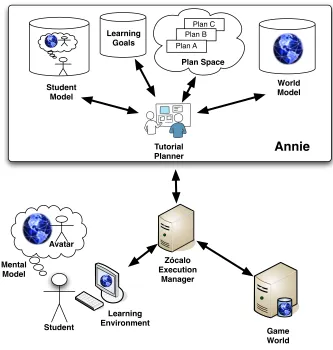
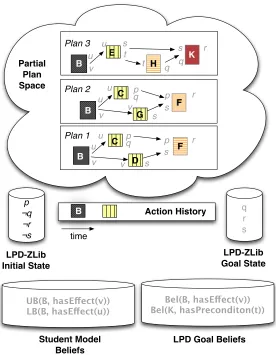
3.1. Theworld modeldescribes what the virtual world contains and how it works. The student forms an internal mental model of this world, initially empty, but illuminated and expanded as the student explores the world. The student’s “avatar” is included in the thought bubble of figure 3.1 because in games where the student has an avatar, it will play a large role in the structure of the mental model. Thestudent model is Annie’s representation of the student’s mental model, based on observations of the student in the virtual world. Thetutorial director
the student model. Note the contrast between this and traditional game-based learning, where the student model and the teaching strategies are deeply and implicitly embedded in the struc-ture of the world. Annie promotes much better context sensitivity, extensibility, customization and reuse of teaching strategies through a domain-independent architecture.
Figure 3.1 also depicts Annie’s dependency upon the Z´ocalo system [88], which is the service-oriented architecture implementation of Mimesis [69]. Z´ocalo contains a decompo-sitional partial order planner that generates story plans that execute in a virtual world. The
Ex-ecution Managercomponent of Z´ocalo controls the progression of this story plan, interceding
between the student and the game world as required to ensure that story goals are realized. To generate plans, Z´ocalo is provided with a library of plan operators and a description of the initial and desired goal states. As a consequence of the generating the story plan, Z´ocalo builds
aplan spacethat contains incomplete plans, as well as plans which successfully reach the goal
conditions. Annie is responsible for maintaing the plan-based description of the operators, ob-jects, and conditions associated with the Z´ocalo game world. To aid discussion, we refer to the Z´ocalo game world as the ZWorld, and the library of plan-based descriptions maintained by Annie as theZLib.
library, but only that portion that is required to accomplish the tasks at hand. Annie can mine the analytical insight of plan space planning to prioritize exactly this necessary subset of the operator library the student needs to know.
3.2
Operational Overview
Figure 3.1 provides a system-level view of Annie’s relationships with other components of the system. Specifically, it shows that Annie maintains and analyzes several data models to inform its interactions with the execution manager. What is not obvious from the figure is that a big chunk of Annie’s work is the creation of these models that occurs during initialization. After the models are initialized, Annie enters into an executionloopthat iterates over tasks in
theZWorldrepresented by plan structures.
3.2.1
System Initialization
Before Annie begins a tutorial session with the student it must perform two important ini-tialization tasks. First, Annie constructs its knowledge base, called ABase. The ABase is initialized with all the information in theZLib. The second main initialization task for Annie is to generate an initial tutorial plan.
will be taken by system actors (NPCs), and others by the student, just as would be the case with the Z´ocalo and Mimesis systems. As student beliefs are added to the goal state, however, the need arises to evolve the story plan into a tutorial plan. Atutorial planis one that not only achieves a particular goal state in the world, but also achieves a particular state in the student model. In a tutorial plan, it is not enough for the student to perform a certain set of actions, the student must also demonstrate particular understanding of those actions.
An important distinction must be made here. Annie builds tutorial plans byelaboratingthe story plans produced by Longbow with additional actions designed to bring about changes in the student model. The distinction is that Longbow remains unaware of both the conditions comprising the possible states of the student model and the actions designed to change those states. This process of plan elaboration begins at initialization, and continues throughout exe-cution, as Annie observes the student’s behavior and updates the student model.
Thus, the final step of Annie’s initialization is creating a tutorial plan consisting of a plausible partially-ordered sequence of student and system-initiated actions that is guaranteed to bring about a specific goal state for the world. Annie uses this plan to initiate the tutorial session within theZWorld. The tutorial plan cannot guarantee that the goal beliefs for the student will be achieved. Annie merely monitors student behavior and tries to optimize the frequency and extent of its tutorial interventions to increase the likelihood that the goal beliefs are acquired. The details of this process are presented in section 4.1.
3.2.2
Execution Cycle: Overview
atten-tive to the actions of the student, deferential to student initiaatten-tive, but skillful and clever when intervention is warranted. However, unlike a human tutor, Annie can exploit the learning en-vironment to intervene with much greater subtlety. For a human tutor it is often difficult to identify an intervention that provides theminimalrequired help. Often, a human-tutored stu-dent is able to derive more useful meaning from tutorial interaction than might be desired. Annie can disguise or hide pedagogical intent through interventions that make changes in the virtual world and multiple non-player controlled agents.
Annie’s interventions can be as simple as increasing or decreasing the difficulty of the next task based on the student’s speed and accuracy on the current task. More complex are Annie’s interventions to help the student complete, with understanding, a partially executed task. Annie uses the student’s action history and the continually-updated ABaseto recognize when inter-vention is needed, choose from alternative possible remedies, and choose between alternative methods for expressing those remedies.
The structure of Annie’s run-time behavior consists of a cycle, or loop. This loop iter-ates continuously, with a nominal delay to conserve computing resources. Each time an ac-tion is taken, either by the student or the system, Annie updates plan history and the student model. Annie then consults these data to decide if intervention is warranted, resulting in either a system-based action, or an anticipated student action.
sometimes over steps in a task. Unlike a concentric loop architecture, however, Annie is free to switch to a completely different task as required.
Annie's Knowledge Base: Student Model, Goals, Plan Space, World Model
Zócalo Execution Manager Game World Learning Environment Student Avatar Mental Model Update Active Plan Analyze Goals + Knowledge Bugs Stage 3: Action Specification Stage 4: Execution Update WM + Action History Stage 5: Action Result Processing Stage 1: Remediation Warranted? Review Plans, Goals, SM Update SM Beliefs Repeat Until Tutorial Goals Achieved
Annie
Stage 2: Plan Revision Select Remedy Form Subplan Integrate Subplan No Yes Report Action Result Execute ActionFigure 3.2: Execution Data Flows
Stage One: Remediation Consideration In this stage, Annie considers whether to continue with the existing tutorial plan, or to introduce a remediation, or change to the plan. An-nie weighs several factors in making this determination. First, AnAn-nie reviews the student model for unrealized pedagogical goals. It then compares the beliefs constituent to prox-imal tasks in the tutorial plan to identify misconceptions that may hinder the student’s immediate progress. An urgency threshold for repairing these misconceptions is derived based on the proportion of steps remaining in the plan. If the threshold is met, the most critical misconception is chosen for remediation. To integrate a remediation into the tuto-rial plan, Annie proceeds to stage two. Otherwise, if no candidate remediation is deemed sufficiently urgent, Annie proceeds directly to stage three.
Stage Two: Plan Revision Annie selects from several different abstract plan templates with to
remediate the misconception indicated in stage one. Domain-independent templates are provided that correspond to common ITS interventions includingprompt,hint,
demon-strate,teachordo. In addition, Annie can select from a library hand-authored
alterna-tive sub-plans particularly attuned to common misconceptions for a particular domain. As a last resort, Annie may abandon the currently active tutorial plan in favor of another potentially successful plan in the plan space, if it offers a better fit for the current plan history. Remember that Annie is largely a spectator, and its active plan is merely a guess at a likely course of action for the student. If the student’s actions show a pattern of increasing divergence from the current plan, coupled with increasing similarity to an al-ternative plan, it is rational for Annie to convert to that representation. Once a remedy or alternative plan is selected, a sub-plan particular to the current plan context is generated, and the existing tutorial plan is repaired to include this new sub-plan.
must single out the action to be performed on this iteration through the execution loop. There may be more than one potential action that could be executed next, and these actions may be either student or system-initiated. Annie selects the next action based on its projected pedagogical utility.
Stage Four: Execution This is the simplest stage of the loop. Annie sends a message to the
execution manager telling it the next action to be executed.
Stage Five: Action Result Processing The plan history, current state of theZWorld and the
student model are updated based on the action result. An extensive catalogue of action result scenarios, guides Annie in decided how to update each component of the student model.
The obvious two-fold challenge for Annie is to acquire the student’s knowledge of the opera-tors in the library, and then leverage this knowledge to improve tutorial planning. As the student progresses, Annie gains more an more information about the state of the student’s knowledge, but has less and less time remaining to act on these revelations. This poses a difficult problem, but it is problem that demands only a reasonable solution, not a perfect one.
Chapter 4
Detailed Design
This chapter describes, in detail, the design of the current implementation of the Annie system. First, the set of inputs required by Annie are described in detail. Next, the five stage execution cycle is described sequentially, from stage one through stage five. The penultimate section of this chapter provides more detail on the diagnostic mechanisms employed in stage five, and the final section is a brief summary.
4.1
Annie’s Inputs
The knowledge representation required as input by the Annie system is similar to that re-quired by other systems that perform automated planning. Typical automated planning systems [55, 44, 33] require as input a planning problem description, often referred to more simply as
aplanning problem, and typically expressed through the STRIPS [26] language, or one of its
variants. Annie requires as input a planning problem expressed in a STRIPS-like language and, in addition, it requires a description of the learning objectives Annie should try to achieve during the learning session. In Annie, these learning objectives are restricted to describing a student’s knowledge of the conditions in theZWorld(as described earlier, the phraseZWorldis the term used by theZ´ocaloservice-oriented architecture, on which Annie is built, to describe the learning environment). Specifically, Annie is concerned with the student’s knowledge of conditions in theZWorld that are related to each action’s successful execution (i.e., their pre-conditions and effects, as described below).
Annie’s planning problem is referred to as theLearning Problem Description, orLPD.
Definition The Learning Problem Description (LPD) is a 4-tuple hI,G, ZLib,
LOi, whereI describes the initial state of the learning environment,Gis a partial description of the goal state of theZWorld, andLOis the set ofLearning Objec-tivesfor the student that Annie strives to establish.
Like the initial state descriptionI, the goal state descriptionG is represented by a conjunc-tion of funcconjunc-tion-free literals. Grepresents those conditions in theZWorldthat must hold at the completion of a successful plan’s execution.
TheZ´ocalo Operator Library, orZLib, describes a set of operators Annie can use to construct
tutorial plans. Each operator consists of a uniquename, a conjunction of function-free literals called preconditions that describe what must be true immediately before the action can be executed, and a conjunction of function-free literals called effects describing state changes brought about by execution of the action. Because Annie reasons about a student’s beliefs relative to an operator’s preconditions and effects, each precondition or effect of an operator is required to have unique identifier called itsname. One method to maintain both readability and uniqueness of these names is to apply a pre-processing step to theZLibthat uses a global counter to generate a unique integer for each precondition and effect of each operator in the
LPD and append this integer to the relation symbol corresponding to each precondition or effect. For example, a name of “hasTool-17” might be generated to ensure uniqueness of the identifier for the “hasTool” effect of operator “PlayerMoveToPickupNiceTool”, if at that point in the pre-processing, 16 names had already been generated.
pre-conditionsand effects of the operator. The termsor parametersof an operator are implicitly defined as the disjunction of all the object variable symbols found in any of thepreconditions,
effects, orconstraintsof the operator.
Also, Annie requires two additional kinds of data to be defined for each operator. First, a boolean value bStudentInitiatedmust be associated with each operator, where a value of true means that the operator is performed by the student and a value of false means the operator is performed by the system. Second, a text fieldoperatorDescriptionmust be associated with each operator and contain template text to be used by Annie to generate help text describing the purpose of the operator. Similarly, each of the conditions included in any of thepreconditions
oreffects lists for any operator must also have an associated template text field
conditionDe-scriptioncontaining text to be used by Annie to generate help text describing that condition.
The other component of theLPDisLO, the set of studentlearning objectivesAnnie works to establish. In order to give a precise definition of a learning objective, some additional definitions are first required. Annie targets task-based learning, which means that its learning objectives are restricted to facts about the preconditions and effects of operators in the ZLib. To underscore that the items Annie endeavors to teach all have this specific focus, each such fact is described using the Annie-specific term: ZFact.
Definition AZFactis a triplehoperatorName, conditionExpression, conditionNamei,
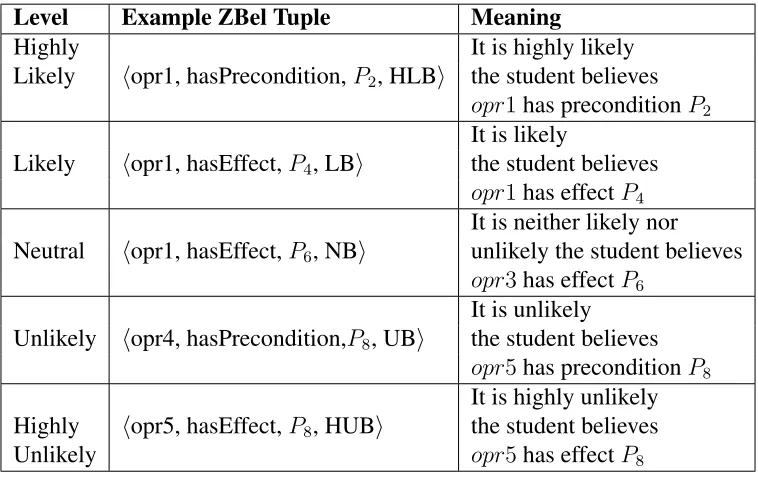
Annie cannot know with absolute certainty what is in the mind of the student. Instead, Annie estimates the likelihood that the student believes, or knows, a particular ZFact. In the current implementation, these estimates are represented using a coarse model of five discrete levels of belief likelihood: “HighlyLikely”, “Likely”, “Neutral”, “Unlikely”, or “HighlyUnlikely.” Future work will consider replacing this coarse model of student belief likelihood with a more precise Bayesian Belief Network [18], or similar model, where the range of likelihood esti-mates is continuous. The combination of aZFactwith a belief likelihood estimate is referred to with the termZBel. Table 4.1 describes the semantics of a set of exampleZBeltuples.
Definition A ZBelis a tuple hstatement, beliefLikelihoodEstimatei, where
state-ment is a ZFact, and beliefLikelihoodEstimate is one of: “HLB”, “LB”, “NB”,
“UB”, or “HUB”.
Table 4.1: Belief Strength Levels
Level Example ZBel Tuple Meaning
Highly It is highly likely
Likely hopr1, hasPrecondition,P2, HLBi the student believes
opr1has preconditionP2 It is likely
Likely hopr1, hasEffect,P4, LBi the student believes
opr1has effectP4 It is neither likely nor Neutral hopr1, hasEffect,P6, NBi unlikely the student believes
opr3has effectP6 It is unlikely
Unlikely hopr4, hasPrecondition,P8, UBi the student believes
opr5has preconditionP8 It is highly unlikely Highly hopr5, hasEffect,P8, HUBi the student believes
Within Annie, a total ordering is defined over belief likelihood estimates reflecting the rel-ative strength of the Annie’s estimate of the likelihood that the student knows a givenZFact. SpecificallyHU B < U B < N B < LB < HLB. When two belief likelihood estimates B0 and B1 differ such that B0 < B1, one can say thatB1 reflects a strongerbelief than B0 and
B0 reflects a weakerbelief than B1. Likewise when a particular ZBel changes such that the new belief likelihood estimate is greater than the previous value, this can be described as an
increasein the belief likelihood, where the opposite would be called adecrease.
Each learning objective l in LO is a ZBel of the form hZFact, beliefLikelihoodEstimatei.
During a tutorial session, Annie attempts to establish for each learning objective, through its monitoring of student progress along tutorial plans, an estimate of belief likelihood for the
ZFact of l that meets or exceeds the specified belief likelihood estimate. An alternative
ap-proach would be for Annie to consider negative beliefs (“Unlikely”, or “HighlyUnlikely”) as satisfied when belief estimates are equal or lowerthan the targets. This alternative approach was not chosen for the existing implementation.
An example of a learning objective that could be included in LO for the FixIt learning environment is shown below:
hhPlayerMoveToPickupNiceTool, hasPrecondition, isToolSpawnLoc-42i, LBi
Thislearning objective would be satisfied when it is estimated to be “Likely” or
the sameZBelconstructs that comprise theLO.
4.2
System Initialization
Annie takes as input theLPD, described above in section 4.1. Upon input of theLPD, Annie begins to initialize its knowledge base, called the ABase. The ABase contains all the data structures beyond theLPDthat Annie uses to perform its tutorial reasoning.
Definition TheABaseis a 5-tuplehSM,PPSS,ET,DT,RT i, whereSM
de-scribes a student model,PPSS is a planning problem solution set,ET is an exe-cution trace of plan actions,DT is a set ofdiagnostic templatesandRT is a set
ofremediation templates.
The student modelSMholds Annie’s model of the student’s current beliefs about the operators available for actions in theZWorld, represented as a set ofZBels. To begin initialization of the
ABase,SMis initialized with oneZBeltuple for each precondition and effect of each operator
in the ZLib. In the current implementation, the initial default belief level applied to each of these conditions is “NB”, or neutral. Future work could examine the provision of input files to describe knowledge specific to a particular student or lesson.