17
TRADEMARK IDENTIFICATION
THROUGH TEXT RECOGNITION
GHAZALISULONG ZAIDAH IBRAHIM
Faculty Of Computer Science & Information System University Technology Malaysia
Skudai, 80990 Johor Bahru
ABSTRACT
Trademark identification is of great interest in the document domain due to two reasons.
Given a document that consists of a trademark, the trademark needs to be conclude whether
present or not in the database and given a known trademark, we need to index into a database
of documents and extract all information related to it. This paper proposes a new method to
recognise the text on mixed-mode trademarks that consists of various font style and sizes,
focusing on uppercase Roman alphabets. A stroke-based feature extraction method
represented by chain codes is used. A modified rule-based classifier recognises the
characters with satisfactory results.
KEYWORDS : Chain Codes, Strokes, Character Recognition, Trademarks
ABSTRAK
Terdapat dua sebab mengapa topik mengenal pasti logo diminati di bidang dokumen.
Pertama, dengan adanya sebuah dokumen yang mengandungi logo, logo tersebut perlu
dikenal pasti samada terkandung di dalam pangkalan data atau tidak. Kedua, dengan adanya
logo yang telah dikenal pasti, kita perlu mencari di dalam pangkalan data dokumen dan
mencapai semua maklumat yang berkaitan dengan logo tersebut. Kertas keija ini
membincangkan satu kaedah baru untuk mengecam aksara yang beranika fon dan saiz yang
terdapat pada logo, khusus untuk aksara berhuruf besar. Kaedah berdasarkan pada strok
digunakan sebagai cara untuk pengambilan ciri-ciri menerusi penggunaan kod rantai. Teknik
pengaturan yang telah diubah suai telah digunakan sebagai kaedah untuk mengecam aksara
dan keputusan ujikaji amatlah memberangsangkan.
19
1.0
INTRODUCTION
Generally, trademarks are characterised as mixed text and graphic symbols and they
are associated with a given group or organisation. They represent a class of images that may
be useful for businessmen, graphic designers or mass communication operators. In the
document domain, trademark identification or recognition tasks are of great interest due to
two reasons. Firstly, given a document that consists of a trademark, the trademark needs to
be concluded whether it is present or not in the database. It is possible that new trademarks
may closely resemble existing ones. Secondly, given a known trademark, we need to index
into a database and extract all information related to the trademark or documents that contain
that trademark. This is an important issue as we may face with the problem of enormous
difficulties in material retrieving and automatic archiving. Text recognition can be one of the
ways for recognising the trademarks and used as index to databases.
There are many commercial devices capable of accurately reading clean machine
printed documents. The first commercial devices were developed in the late 1960s. They
were specialised machines of very high cost designed to handle large amounts of documents.
Matrix matching techniques have been the preferred approach since they are easier to
implement. The unknown image needs to be compared with a set of templates representing
known characters. However, it is not well adapted to size variations and font styles.
[Shlien 1988] developed a feature-based recognition algorithm that uses a decision
tree classifier with 197 binary features which flag the presence or absence of linear, convex,
concave and hole features. [Muelenaere et. al. 1992] developed a character recognition
technique using topological features where the character is described in terms of bars and
Al. 1992] developed a rule-based classifier which is based on stroke detection.
This paper proposed a character recognition technique that is based on a
combi nittiqa
methods developed by [Muelenaere et. al. 1992] and [Shih et. al. 1992]. This propoM?
technique reduces the number of feature vectors used to only 9.
2.0
FEATURE EXTRACTION
Trademarks consists of a combination of text and graphic symbols. And usually there
is only one graphic symbol and one word of text involved, and no interflow between them.
The work presented here is designed specifically for black (represented by l ’s) and white
(represented by ‘0’) trademarks that are within closed borders. The trademark is digitised by
a scanner and thresholded into binary image. Then, the binary image is smeared horizontally
and vertically to close up any broken borders. The borders are deleted by changing the white
pixels to black. Since the characters are nicely separated, character segmentation is based on
the occurrence of white columns or columns of 0’s. More discussions on character
segmentation can be found in [Lu, Yi 1995].
One of the most important aspects of any character recognition system is feature
extraction. Its purpose is to extract features from the character that would simplify the
recognition process. Basically, a character image consists of several lines or curve segments
(also called as strokes) that are drawn and adjoined at specific position which differentiates a
character from other characters [Shirvaikar et. al. 1988].
The feature extraction method proposed here is divided into two levels of analysis
where in the first level, a global analysis is performed and if ambiguity occurs, the second
level is invoked where a roagnified analysis is performed. In global analysis, the strokes are
analysed generally for its straightness where a slight curve or slant is ignored. But, in
magnify analysis, the details of the strokes are analysed where a slight curve or slant is
detected in determining the results.
In [Muelenaere et. Al. 1992], the binary image is scanned in 4 directions which is, left
to right, right to left, top to bottom and bottom to top to obtain the character projections,
outlines and stroke densities. Calculations are performed to produce the number of bars and
holes that present in the image. The image in this research is also scanned in 4 directions to
obtain 4 strokes, referred as Left, Right, Top and Bottom, represented as chain codes [Wilf
1981].
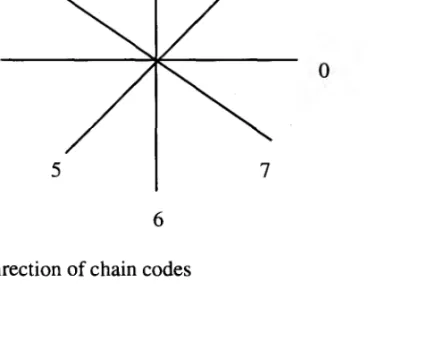
There are 8 possible directions between a point and its neighbour. Figure 1(a) shows
the 8 direction of chain codes and figure 1(b) shows an example of an image and its chain
codes
2
21
6
Fig. 1 (a) 8 direction of chain codes
Left chain codes
65656656566565665656656565665656656566565665655654544 Right chain codes
6766767676676767667676676767667676766767676767770706 Top chain codes
00
Bottom chain codes
0000000000001344322222121221211000000000000000000776766767666655445700000000000000000
Fig. 1(b) A sample of character A and its four strokes represented as chain codes.
2.1
STRAIGHT LINE DETECTION
Various algorithms have been developed to determine the straightness of chain codes
[Freeman 74, We 82, Hung 85]. Yuan et. al. [Yuan et. al. 1995] have developed an algorithm
to detect straight lines based on the quantization scheme. In this scheme, a passing area is
constructed around pixels so that a line formed by these pixels must pass through this area if
it is straight. The passing area is modified as a new point is accepted until a point is rejected
as a pixel on the straight line.
However, before the straight line detection process can be applied, the chain codes
needs to be cleaned or smoothed to delete any noises that may occur [Wilf 1981]. Smoothing
can be time consuming. Thus, to overcome this problem, the straight line detection
algorithm can be modified to cater this noise where a small inclination to the next direction
other than specified by Yuan would also be considered as part of the same chain code of a
straight line. This can be performed by using certain rules where the codes of the same
straight line are grouped together. For instance, a chain codes that consists of values 1, 0 or 2
belong to the same group, values 5, 6 or 7 belong to another group, and so on. By applying
this rule, the smoothing process can be discarded.
2.2
RULE-BASED CLASSIFIER
[Shih et. Al. 1992] developed a rule-based classifier where the character image is
compared with a character recogniser. Each character recogniser consists of a group of
characters that have similar topological structures. Once a rule is matched, the input
character is recognised. Otherwise, the next character recogniser will be tested.
This paper proposes a modified rule-based classifier where the differences in
characters among the different fonts are detected and deleted. For instance, the bottom of the
left stroke of font Times New Roman and Courier consists of a curve to the left. Thus, the
curve is detected and then ignored before straight line detection is performed.
The next step is to check whether the input image satisfies the common properties of
the group where the characters are divided into two groups based on the hole feature as
follows:
Group 1 - A, B, P, R, Q, D, O
Group 2 - C, E, F, G, H, I, J, K, L, M, N, S, T, U, V, W, X, Y, Z
The last step is to match the input image against each recognizer in the group. For
global analysis, each stroke is tested for the number of straight lines. A line with small
curvature or a perpendicular line is also considered as a straight line. For Group 1, ambiguity
occurs for characters D and O, and to differentiate between them, the left stroke is analysed
further under the magnify analysis level. Its top left stroke is tested for the occurrence of a
curve as character O has that feature but not character D.
23
For Group 2, two cases of ambiguity occurs and they are further divided into two
subgroups, that are, Z and T, and U, V and Y. Under the magnify analysis level, the left
chain codes for characters Z and T are looked at. Character T has a vertical line but not
character Z. The depth of the top stroke of character U and V is always deeper than the depth
of the top stroke of character Y. And to differentiate between characters U and V, a vertical
line is detected on the top stroke.
3.0 EXPERIMENTAL RESULTS
Trademarks that consists of machine printed character sets of the Arial, Times New
Roman and Courier fonts served as test sets for the experiments. 20 different trademarks
have been tested with 122 characters from the three different fonts. The recognition rate
obtained was 96%. Errors occur in recognising a few samples of characters G and S. This is
because the difference occur in the middle of the stroke and the algorithm could not detect it.
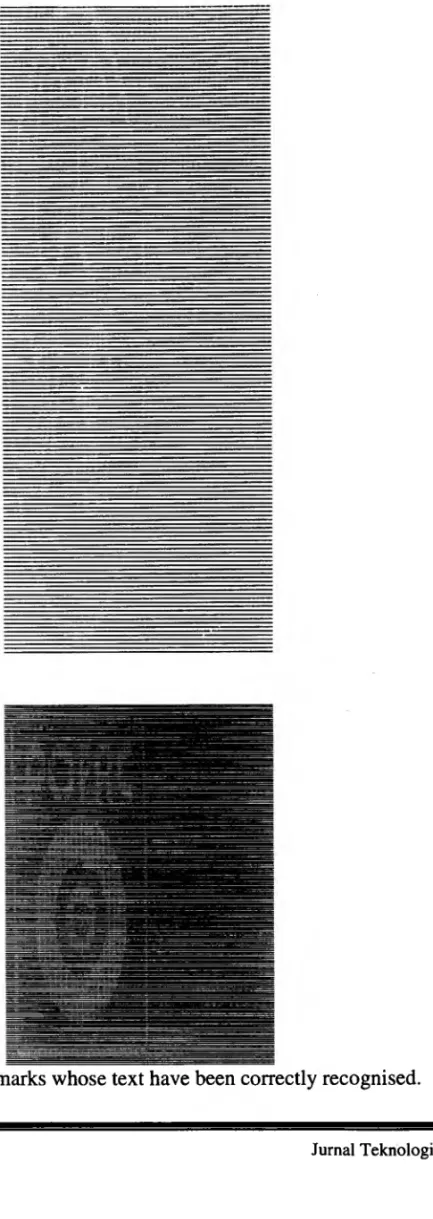
See fig. 3 for some samples of trademarks where the text have been successfully recognised.
Character G in this sample is recognisable by the algorithm.
4.0 CONCLUSION
The proposed algorithm for character recognition described in this paper has produce
satisfactory results. This technique able to cater only 9 feature vectors, that are, horizontal
and vertical lines on all four strokes, plus the hole feature. Reducing the number of features
greatly reduces the memory size needed by the software. Nonetheless, more research is
being done to make this algorithm more flexible and improve the recognition rate.
Fig. 3 Some samples of trademarks whose text have been correctly recognised.
5.0 REFERENCES
1. Bai, G. “Multifont Chinese Character Recognition Using Side-Stroke-End-Feature”, Proc. IEEE, 1993, pp. 794-797.
2. Hung, S.H. Y. “On The straightness Of Digital Arcs”, IEEE Trans. PAMI, vol. PAMI-7, No. 2, March 1985, pp. 203-215.
3. Freeman, Herbert. “Computer Processing Of Line Drawing Images”, Computer Surveys, Vol. 6, No. 1, March 1974, pp. 57-97.
4. Muelenaere, P. De; Dauw, M.; and Legat, J.D. “Omnifont Recognition Of Text Using Topological Recognition Techniques”, Proc. IEEE, 1992, pp. 410-413.
5. Shih, F.; Chen, S.; Hung, D.; and Ng. P. “A Document Segmentation, Classification And Recognition system”, Proc. IEEE, 1992, pp. 258-267.
6. Shlien, S. “Multifont Character Recognition For TypeSet Documents”, Int’l. Journal Of Pattern Recognition & Artificial Intelligence, Vol. 2, No. 1, March 1988, pp. 603-620. 7. Shirvaikar, M.V. and Musavi, M.T. “A Stroke Feature Distribution Scheme For The
Recognition Of Alphanumeric Characters”, Proc. IEEE, 1988, pp. 192-195.
8. We, Le-De, “On The Chain Code Of A Line”, IEEE Trans. PAMI, vol. PAMI-4, No. 3, May 1982, pp. 347-353.
9. Wilf, J.M. “Chain Codes”, Robotics Age, Vol. 3, No. 2, Mar/Apr 1981, pp. 12-19.
10. Yuan, J. and Suen, C. “An Optimal O(n) Algorithm For Identifying Line Segments From A Sequence Of Chain Codes”, Pattern Recognition, Vol. 28, No. 5,1995, pp. 635-646.