International Journal of Emerging Technology and Advanced Engineering
Website: www.ijetae.com (ISSN 2250-2459, ISO 9001:2008 Certified Journal, Volume 4, Issue 12, December 2014)
395
Successful Assessment of Categorization of Indian News Using
JRip and NNge Algorithm
Sushilkumar. R. Kalmegh
Associate Professor, Department of ComputerScience, SGBAU, Amravati (M.S.), India.
Abstract— Recent developments of e-Iearning specifications such as Learning Object Metadata (LOM), Sharable Content Object Reference Model (SCORM), Learning Design and other pedagogy research in semantic e-Learning have shown a trend of applying innovative computational techniques, especially Semantic Web technologies, to promote existing content-focused learning services to semantic-aware and personalized learning services. Classification may refer to categorization, the process in which ideas and objects are recognized, differentiated, and understood. This paper has been carried out to make a performance evaluation of JRip and NNge classification algorithm. The paper sets out to make comparative evaluation of classifiers JRip and NNge in the context of dataset of Indian news to maximize true positive rate and minimize false positive rate. For processing Weka API were Used. The results in the paper on dataset of news also show that the efficiency and accuracy of NNge is good than JRip.
Keywords—JRip, LOM, NNge, SCORM, Weka API,
WWW
I. INTRODUCTION
Each of the past three centuries has been dominated by a single technology. The eighteenth century was the time of the great mechanical systems accompanying the Industrial Revolution. The nineteenth century was the age of the stream engine. During the twentieth century, the key technology has been information gathering, processing and distribution. Among other developments, we have seen the birth and unprecedented growth of the computer industry. Now as we have entered in the twenty-first century all the most of all manual services are replaced by machine operation i.e. complete computerization and hence released human intelligence is utilized in further developments.
In recent years, people have been used to using the Internet as an important information channel for working and living. More and more daily activities are relying on the global network than before, for example, e-Business, e-Government, e-Science, and e-Learning. Among these e-Activities, e-Learning has been regarded as a fast growing research and application area with huge market potential.
However, e-Learning is different from other e-Activities for its involvement of precise information retrieval, systematic knowledge management, and pedagogical process.
These features make e-Learning systems more complicated than basic web-based information systems, which consequently need integrated solutions to address those issues together, especially when multimedia education resources are more and more popular. As the latest stage of learning and training evolution, e-Learning is supposed to provide intelligent functionalities not only in processing multi-media education resources but also in
supporting context-sensitive pedagogical education
processes. The paper discusses the existing methodologies for efficient e-Learning process and suggested model for effective multimedia e-learning.
II. E-LEARNING
E-learning is a new education concept by using the Internet technology, it deliveries the digital content, provides a learner-orient environment for the teachers and students. The e-learning promotes the construction of life-long learning opinions and learning society.
The e-learning industry refers to the effective integration of a range of technologies across all areas of learning. e-learning technologies are designed to support learning by encompassing a range of media, tools, and environments. It allows for both synchronous and asynchronous learning environments. E-learning acts as a catalyst for authentic and meaningful learning experiences [1].
International Journal of Emerging Technology and Advanced Engineering
Website: www.ijetae.com (ISSN 2250-2459, ISO 9001:2008 Certified Journal, Volume 4, Issue 12, December 2014)
396
III. LITERATURE SURVEYThere are a number of e-Learning software systems on the market such as WebCT Blackboard, Learning Space, and PageOut. The most common function offered by those systems is courseware management, which is basically file level content management. Although some of those systems (e.g., WebCT) claim to be able to integrate with certain academic information systems, the underlying computing technology is still at superficial level.
The major implementation that includes the intelligence in e-Learning is ConKMEL. To resolve the knowledge integration and management problem in multimedia e-Learning, it has proposed a semantic context aware approach, which features an integrated contextual knowledge management framework to support intelligent e-Learning [2].
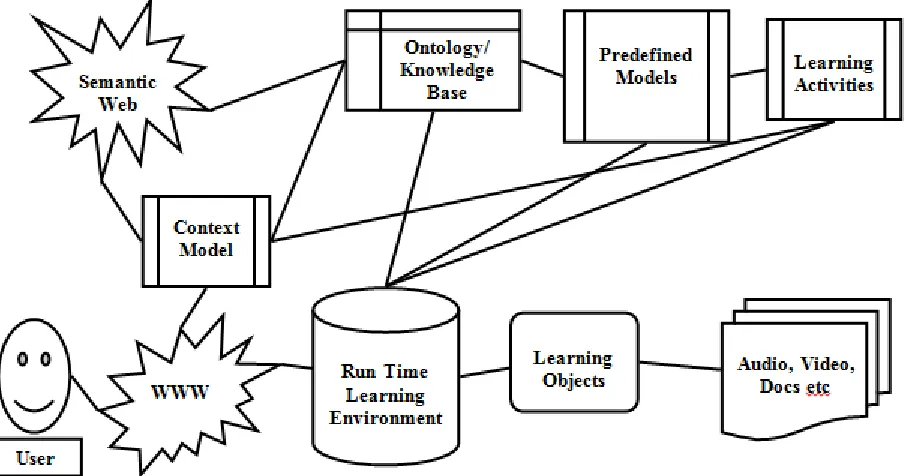
Traditional web-based e-learning systems use a web browser as the interface. Through run-time learning environments (either compatible or incompatible with SCORM) [3] users could access the learning objects, which are directly linked to multimedia learning resources such as lecture video/audio, presentation slides and reference documents.
However, the limitation in generic specification support does not affect their compliancy with e-Learning standards such as SCORM (Shareable Content Object Reference Model) [3] for content management and LOM (Learning Object Model) [4] for learning object description. A flow in
traditional e-Learning system is given in Fig I.
Weihong Huang et. al. has proposed an intelligent semantic e-Learning framework which presents semantic information processing, learning process support and personalized learning support issues in an integrated environment. Architecture of the above framework is as
given below in Fig II.
[image:2.612.90.527.418.505.2]In addition to the traditional learning information flow, three new components namely semantic context model, intelligent personal agents and conceptual learning theories are introduced to bring in more intelligence. Intelligent personal agents perform adequate personal trait information profiling and deliver personalized learning services. Semantic context model uses semantic information for static resource and dynamic process retrieves information from WWW and the future Semantic Web, referring to ontologies or knowledge bases [5].
International Journal of Emerging Technology and Advanced Engineering
Website: www.ijetae.com (ISSN 2250-2459, ISO 9001:2008 Certified Journal, Volume 4, Issue 12, December 2014)
[image:3.612.87.540.145.383.2]397
Fig II: Semantic e-Learning Framework
IV. CLASSIFICATION
Classification may refer to categorization, the process in which ideas and objects are recognized, differentiated, and understood. An algorithm that implements classification, especially in a concrete implementation, is known as a classifier. In the terminology of machine learning, classification is considered an instance of supervised learning, i.e. learning where a training set of correctly identified observations is available. The corresponding unsupervised procedure is known as clustering or cluster analysis, and involves grouping data into categories based on some measure of inherent similarity.
Classification is a data mining algorithm that creates a step-by-step guide for how to determine the output of a new data instance. The tree it creates is exactly that: a tree whereby each node in the tree represents a spot where a decision must be made based on the input, and to move to the next node and the next until one reach a leaf that tells the predicted output. Sounds confusing, but it's really quite straightforward.
There is also some argument over whether classification methods that do not involve a statistical model can be considered "statistical".
Other fields may use different terminology: e.g. in community ecology, the term "classification" normally refers to cluster analysis, i.e. a type of unsupervised learning, rather than the supervised learning. [6].
A. JRip Classifiers
This implements a propositional rule learner, Repeated
Incremental Pruning to Produce Error Reduction
(RIPPER), which is proposed by William W. JRip is an inference and rules-based learner (RIPPER) that tries to come up with propositional rules which can be used to classify elements.
JRip implements heuristic global optimization of the rule set. Classes are examined in increasing size and an initial set of rules for a class is generated using incremental reduced- error pruning. An extra stopping condition is introduced that depends on the description length of the examples and rule set.
International Journal of Emerging Technology and Advanced Engineering
Website: www.ijetae.com (ISSN 2250-2459, ISO 9001:2008 Certified Journal, Volume 4, Issue 12, December 2014)
398
JRip (RIPPER) proceeds by treating all the examples of a particular judgment in the training data as a class, and finding a set of rules that cover all the members of that class. Thereafter it proceeds to the next class and does the same, repeating this until all classes have been covered [7] [8] [9].B. NNge Classifiers
NNge is a nearest-neighbor method for generating rules
using non-nested generalized exemplars. Non-Nested
Generalized Exemplars (NNGE) is an algorithm introduced by Brent, in 1995. It performs generalization by merging exemplars, forming hyper rectangles in attribute space that represent conjunctive rules with internal disjunction.
The algorithm forms a generalization each time a new example is added to the database, by joining it to its nearest neighbor of the same class.
The algorithm learns incrementally by first classifying, then generalizing each new example. When classifying an instance, one or more hyper rectangles may be found that the new instance is a member of, but which are of wrong class. The algorithm prunes these so that the new example is no longer a member. Once classified, the new instance is generalized by merging it with the nearest exemplar of the same class, which may be a single instance or a hyper rectangle [7] [10] [11].
V. SYSTEM DESIGN
We designed a model based on the machine learning
and XML search. In order to co-relate News with the
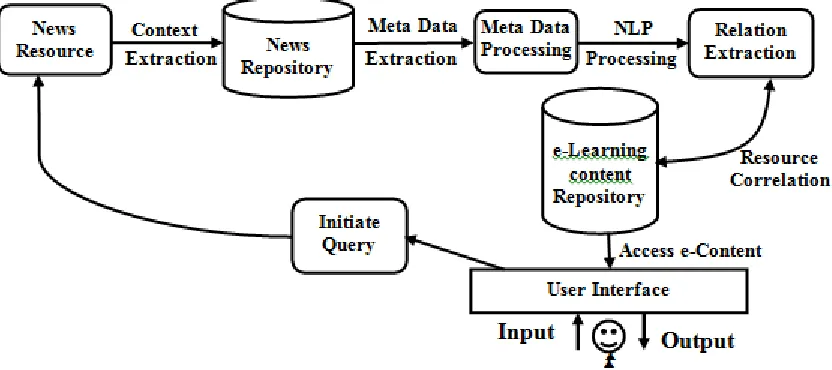
categories a model based on the machine learning and XML search was designed. Flow diagram of the model for
[image:4.612.99.515.349.534.2]news resources is shown below in Fig III.
Fig. III: Flow Diagram of the Model
As a input to the model, various news resources are considered which are available online like the news in Google news repository or online paper like Times of India, Hindustan Times etc. Around 649 news were collected on above repository. In order to extract context from the news and co-relate it with the proper e-content, the News was process with stemming and tokenization on the news contents. The news then was converted into the term frequency matrix for further analysis purpose. Based on this data, features (i.e. metadata) were extracted so that contextual assignment of the news to the appropriate content can be done. This process is known as metadata processing in the flow diagram. Title of the also contains useful information in the abstract form, the title also can be considered as Metadata.
The title of the news is processed using NLP libraries (Standford NLP Library) to extract various constituents of it. The output of NLP process was also used to co-relate the News (textual, audio, video) to the concern e-learning contents. This process can be initiated automatically when the user access any content from e-Learning data repository.
International Journal of Emerging Technology and Advanced Engineering
Website: www.ijetae.com (ISSN 2250-2459, ISO 9001:2008 Certified Journal, Volume 4, Issue 12, December 2014)
399
VI. DATA COLLECTIONHence it was proposed to generate indigenous data. Hence the national resources were used for the research purpose. Data for the purpose of research has been collected from the various news which are available in various national and regional newspapers available on internet. They are downloaded and after reading the news they are manually classified into 7 (seven) categories. There were 649 news in total. The details are as shown in Table I.
TABLE I CATEGORIZATION OF NEWS
News Category Actual No. Of News
Business 123
Criminal 82
Education 59
Medical 46
Politics 153
Sports 147
Technology 39
Total 649
The attributes consider for this classification is the topic to which news are related; the statements made by different persons; the invention in Business, Education, Medical, Technology; the various trends in Business; various criminal acts e.g. IPC and Sports analysis.
During classification some news cannot be classified easily e.g. (1) Political leader arrested under some IPC code, (2) Some invention made in medicine and launched in the market & business done per annum.
Hence, there will be drastic enhancement in e-Contents when we refer to the latest material available in this regards. For example, if some e-Content refers to the political situation of India, then the references needs to be dynamic as the situation may change depending on the result of election.
VII. PERFORMANCE ANALYSIS
The News so collected needed a processing. Hence as given in the design phase, all the news were processed for stop word removal, stemming, tokenization and ultimately generated the frequency matrix. Stemming is used as many times when news is printed, for a same there can be many variants depending on the tense used or whether it is singular or plural. Such words when processed for stemming, generates a unique word. Stop words needs to be removed as they do not contribute much in the decision making process. Frequency matrix thus generated can be processed for generating a model and the model so generated was used in further decision process.
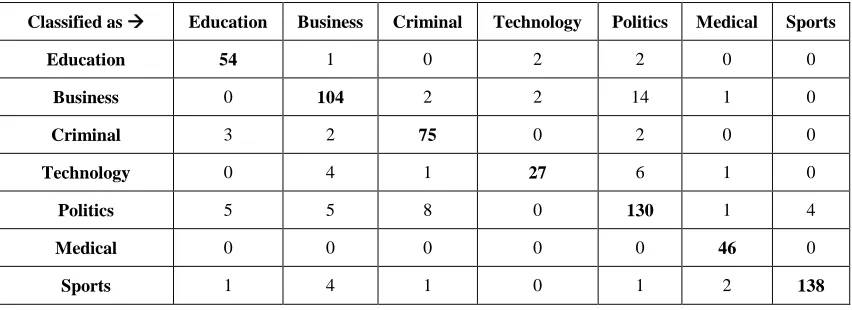
With the model discussed above, two classifier JRip and NNge were used on the data set of 649 news. For processing Weka APIs were used. The result after processing is given in the form of confusion matrix which
is shown in Table II and Table III.
TABLE II
CONFUSION MATRIX USING JRIP CLASSIFIER
Classified as Education Business Criminal Technology Politics Medical Sports Education 54 1 0 2 2 0 0
Business 0 104 2 2 14 1 0
Criminal 3 2 75 0 2 0 0
Technology 0 4 1 27 6 1 0
Politics 5 5 8 0 130 1 4
Medical 0 0 0 0 0 46 0
[image:5.612.46.293.283.447.2] [image:5.612.94.520.543.698.2]International Journal of Emerging Technology and Advanced Engineering
Website: www.ijetae.com (ISSN 2250-2459, ISO 9001:2008 Certified Journal, Volume 4, Issue 12, December 2014)
400
TABLE IIICONFUSION MATRIX FOR NNGE CLASSIFIER
Classified as Education Business Criminal Technology Politics Medical Sports Education 59 0 0 0 0 0 0
Business 0 123 0 0 0 0 0
Criminal 0 0 82 0 0 0 0
Technology 0 0 0 39 0 0 0
Politics 0 0 0 0 153 0 0
Medical 0 0 0 0 0 46 0
Sports 0 0 0 0 0 0 147
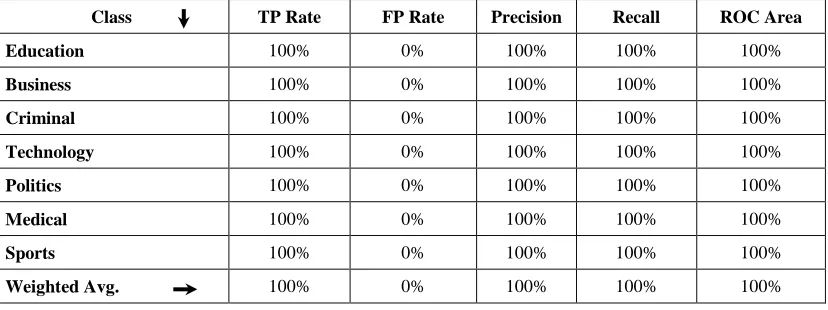
Following table IV and V shows the True Positive and
False Positive Rate of JRip and NNge Classifier and table
VI shows Correct and Wrong Prediction of Classifier.
TABLE IV
TABLE SHOWING TRUE POSITIVE AND FALSE POSITIVE RATE OF JRIP
Class TP Rate FP Rate Precision Recall ROC Area Education 91.5% 1.5% 85.7% 91.5% 98.5%
Business 84.6% 0.3% 86.7% 84.6% 96%
Criminal 91.5% 2.1% 86.2% 91.5% 97.9%
Technology 69.2% 0.7% 87.1% 69.2% 94.1%
Politics 85% 5% 83.9% 85% 94.5%
Medical 1% 0.8% 90.2% 1% 99.9%
Sports 93.9% 0.8% 97.2% 93.9% 98.8%
Weighted Avg. 88.4% 2.4% 88.5% 88.4% 96.9%
TABLE V
TABLE SHOWING TRUE POSITIVE AND FALSE POSITIVE RATE OF NNGE
Class TP Rate FP Rate Precision Recall ROC Area Education 100% 0% 100% 100% 100%
Business 100% 0% 100% 100% 100%
Criminal 100% 0% 100% 100% 100%
Technology 100% 0% 100% 100% 100%
Politics 100% 0% 100% 100% 100%
Medical 100% 0% 100% 100% 100%
Sports 100% 0% 100% 100% 100%
[image:6.612.105.510.159.312.2] [image:6.612.101.515.574.729.2]International Journal of Emerging Technology and Advanced Engineering
Website: www.ijetae.com (ISSN 2250-2459, ISO 9001:2008 Certified Journal, Volume 4, Issue 12, December 2014)
401
TABLE VISHOWING CORRECT AND WRONG PREDICTION OF CLASSIFIER.
Classifier JRip Nnge News Category Actual No. Of News Correct Wrong Correct Wrong
Business 123 104 19 123 00
Criminal 82 75 07 82 00
Education 59 54 05 59 00
Medical 46 46 00 46 00
Politics 153 130 23 153 00
Sports 147 138 `09 147 00
Technology 39 27 18 39 00
Total 649 574 74 649 00
Percentage 88.44 11.56 100 00
Overall Performance of JRip algorithm is acceptable, except some of News from Business are classified into
Politics. However from the table II and table IV, some of
the Technology News is distributed into Education, Business and Sports. This is because every category has some or other references of the other category.
NNge finds the nearest neighbour for generating rules using non nested generalized examples. Hence as it can be seen in the table 3 and table 5 it has given 100% accuracy.
VIII. CONCLUSIONS
This paper has designed a model which will help the e-Content to refer the latest information in the form of News to get dynamically attached to e-Contents, hence empowering the effectiveness of the e-Learning process by making latest information available to the learner using the framework that we designed.
As per the previous discussion identification of news from dynamic resources can be done with the propose model, we use two classifier i.e. JRip and NNge to analyze the data sets. As a result it is found that NNge algorithm performs well in categorizing all the News. Overall Performance of JRip algorithm is acceptable, except some of News from Business are classified into Politics, some of the Technology News is distributed into Education, Business. For overall data set detection rate (True Positive rate) for NNge is 100% and whereas JRip is 88.4%. Hence NNge is good classifier as compare to JRip classifier. This
also can be seen from Table IV Table V and Table VI
above.
REFERENCES
[1] Bassoppo-Moyo, & Temba C., (Retrieved October 28, 2007) “Evaluating e-learning: A front-end, process and post hoc approach.” International Journal of Instructional Media, 33(1), from ProQuest database.
[2] Weihong Huang, & Alain Mille, (2006) “ConKMel: a contextual knowledge management framework to support multimedia e-Learning”, Published online: 8 July 2006, Springer Science + Business Media, LLC 2006 pp 205-219
[3] SCORM (2003) “Advanced distributed learning initiative, sharable content object reference model (SCORM)”. http://www.adlnet.org/ [4] LOM (1999) “Learning object metadata working group, learning
object metadata.” IEEE P1484.12.1- 2002 http://ltsc.ieee.org/wg12/ [5] Weihong Huang, David Webster, Dawn Wood & Tanko Ishaya,
(2006 ) “An intelligent semantic e-learning framework using context-aware Semantic Web technologies”, British Journal of Educational Technology, Vol 37 No 3, pp 351–373
[6] S. R. Kalmegh, S. G. Chaudhari, S. N. Deshmukh, “Semantic e-Learning Methods: A Review”, 3rd International Conference on Intelligent Computational Systems (ICICS'2013) January 26-27, 2013 Hong Kong (China), pp 14-16
[7] http://en.wikipedia.org/wiki/Classification
[8] Ian H. Witten, Eibe Frank, & Mark A. Hall, “Data Mining Practical Machine Learning Tools and Techniques, Third Edition”, Morgan Kaufmann Publishers is an imprint of Elsevier
[9] Anil Rajput, & Ramesh Prasad Aharwal, (2011) “J48 and JRIP Rules for E-Governance Data” International Journal of Computer Science and Security (IJCSS), Volume (5) : Issue (2), pp201-207
International Journal of Emerging Technology and Advanced Engineering
Website: www.ijetae.com (ISSN 2250-2459, ISO 9001:2008 Certified Journal, Volume 4, Issue 12, December 2014)
402
[11] Nada Lavraˇc, Matej Gaˇsperin, (February 2007) ”Case Study on theuse of Data Mining Techniques in Food Science using Honey Samples” pp 1-18, kt.ijs.si/PetraKralj/DM-2007/seminar-Gasperin.pdf