Implementation of Problem-Based Learning in a Typical Engineering
Classroom
Mohd. Kamaruddin Abd. Hamid, Mohd. Ariffin Abu Hassan, Mimi Haryani Hassim, Khairiyah
Mohd. Yusof
Department of Chemical Engineering,
Faculty of Chemical & Natural Resources Engineering, Universiti Teknologi Malaysia,
81310 UTM Skudai, Johor, Malaysia.
Abstract - Problem-based learning (PBL) approaches to engineering education often generate justifiable enthusiasm among faculty who has become frustrated with the limitations of traditional lecture-based education. However, faculty contemplating a change to a problem-based format rarely anticipates the many practical difficulties that can destroy one's enthusiasm and create chaos in the classroom. This paper describes in detail the implementation of PBL, a teaching method that incorporates realistic experiences in the classroom. This implementation technique has been used for two semesters in an undergraduate Chemical Engineering class in the Faculty of Chemical and Natural Resources Engineering, Universiti Teknologi Malaysia.
Keywords: Problem-Based Learning; Engineering education; Implementation
1.
Introduction
Problem-based learning (PBL) is an instructional method that challenges students to "learn to learn," working cooperatively in groups to seek solutions to problems [1]. These problems are used to engage students' curiosity and initiate learning the subject matter. At its most fundamental level, PBL is characterized by the use of "real world" problems as a context for students to learn critical thinking and problem solving skills, and thereby acquire knowledge of the essential concepts of the course. Using PBL, students acquire life-long learning skills that include the ability to find and use appropriate learning resources. The appeal of problem-based learning has several elements. Carefully constructed, open-ended problems help develop critical thinking skills. Through such problems, students encounter concepts in contextually rich situations that impart meaning to those ideas and enhance their retention. In encouraging students to assess their own knowledge, to recognize deficiencies, and to remedy those shortcomings through their own
investigations, PBL provides them with an explicit model for lifelong learning [2]. Through PBL, students learn how to learn by asking the right questions.
The group format of PBL teaches students the power of working cooperatively, which in turn builds valuable communication and interpersonal skills and fosters a sense of community in which diversity enhances the learning experience for all. PBL also addresses the real concerns of industry and graduate schools - namely, that graduates will be prepared with problem-solving skills, that they will be able to communicate effectively across disciplines, and that they will be trained to work with others to solve problems.
PBL originated in medical education and has progressed steadily as a mode of learning through all levels of education. Some universities have adopted PBL as the primary mode of learning for their students. At Department of Chemical Engineering, Universiti Teknologi Malaysia, we have been working for the past two semesters on adapting the medical school model of PBL to a Chemical Engineering undergraduate class, in particular to the Process Control and Dynamics class that has a reputation among undergraduate as one of the toughest subjects in chemical engineering syllabus.
This paper will describe some model that have been implemented in engineering classes, model that we implemented, strategies for implementation, assessment of outcomes, and lastly summary.
2.
Using PBL in Chemical Engineering
Undergraduate Courses
within the context of my course and my department's curriculum?; (3) How will my course content objectives be met?; (4) Will I have support for the risks inherent in revamping my course to a more student-centred format?; (5) How will students' individual success at learning be identified and evaluated?; (6) Does my institution have a classroom configured to facilitate group learning?; (7) How do I design the problem?; and (8) How will I organize and monitor the PBL groups? In this paper, we will highlight typical answers to only a few of these implementation issues.
As is the case for other forms of active or inquiry-based learning, PBL empowers students to take a responsible role in their learning and as a result, faculty must be ready to yield some of their authority in the classroom to their students. The PBL instructor serves as a cognitive coach guiding, probing, and supporting students' initiatives [3], rather than lecturing, directing, or providing ready answers. In the earliest models of PBL in medical schools, the PBL group facilitator (or tutor) worked with a single group [4] of up to 14 students, a faculty-to-student ratio that was hard to reproduce when PBL began to be implemented in the engineering undergraduate setting. The difficulties inherent in scaffolding students' knowledge construction in larger enrolment classes (too large for a single PBL group) were among the challenges faced by faculty attempting to adapt PBL to the typical undergraduate setting. How, then, might PBL instructors facilitate many classroom groups simultaneously?
One strategy for monitoring multiple groups has features that work for collaborative learning settings in general. The instructor walks around the classroom as floating facilitator, looking and listening for signs that the groups are engaged and on track and that all members are participants in the group discussion. The floating facilitator may also enter into discussions, pose questions, looks for overt signs of behaviours that undermine group function, or otherwise focus on a particular group for a short period of time.
This floating facilitator strategy is particularly effective if the PBL problems are constructed so that instructor-led, whole-class discussions can be inserted at key intervals in the problem-resolving process. Groups can then compare notes on each other's progress and the instructor can simultaneously give all groups essential feedback or guidance. This can include tips on finding important resources, helping students beyond conceptual impasses, and encouraging students to dig more deeply into topics whose understanding will enrich their passage through the problem. In essence, faculty using this model are striving to supply to the whole class in a structured way the guidance supplied by the classic PBL facilitator more informally and extemporaneously.
Another model is to enlist the help of other undergraduates to serve as peer or near-peer facilitators [5]. That is, students, who have completed a course and done well return to work in the PBL classroom as group facilitators. They can serve as a “dedicated” facilitator for a single classroom group or as a “roving” facilitator along with the faculty instructor.
In these models for implementation of PBL in undergraduate courses, instructors typically set up structures for group operation that are similar to those used in cooperative learning classrooms [6, 7]. Group composition is selected by the instructor (rather than allowing students to self-select their group members), and group size is typically kept at four students (with a slightly larger size possible when peer facilitators are present). Additional procedures that help to maintain group process include drafting group guidelines or ground rules, assigning rotating roles of responsibility for group members, and requiring periodic oral and written feedback (through peer assessment) on individual contributions to the PBL effort. Student groups draft their own ground rules at the start of the semester and refer to them as needed. Typical ground rules drafted by students incorporate policies on attendance and preparedness, plus an escalating sequence of penalties for each failure to adhere to the guidelines. Roles of responsibility, which rotate among group members on a regular time schedule or with each new problem, typically include a discussion leader, a reporter (for group products and class discussions), a recorder, and an accuracy coach.
3.
Model of PBL Implemented
We took guidance from Tan O. S. [8] in our implementation of PBL and developed and used real-world ‘problems’ or scenarios as a “stimulus and focus for student activity”. We recognised the importance of providing a framework to enable students to work through the PBL problems.
PBL approaches in a curriculum are essentials because:
1. Students should be responsible and plan their own learning.
2. A problem is the starting point of learning new knowledge for the students.
All learning of new knowledge and skills begin with the presentation of a problem scenario where students decide for themselves what needs to be learnt in order to solve or explain the problem. There should be little or no teaching or directing of information to students for them to manage the problem. In areas where there are scarce resources or difficulty in understanding complex issues, an overview of the issues may be given to the students prior to their group functioning. This will help learners to learn new knowledge.
3. Lecturers’ role is to facilitate students’ thinking to achieve the learning outcomes.
The lecturer guides and facilitates the co-construction of knowledge and skills by use of questioning, verbal and non-verbal gestures. The purpose is to extend and deepen the thinking capacities of the students rather than giving them answers. The lecturer does not dispense information unless the lecturer is satisfied that the students have exhausted their search and attempts at understanding the issues. Information may be given when students ask for it.
4. Students should engage in collaborative learning.
The problem should be complex enough such that the students require the need to collaborate with others either in the group or with other external parties in order to acquire the new knowledge to solve or understand the given problem. It must not be so simple that the students can solve them with their existing prior knowledge. Students should engage in group discussions and co-operative learning to share and learn from each other. This fosters teamwork and learning to work with different people.
5. Students should engage in reflective thinking.
There should be opportunities for students to do individual research and learning. This allows the development of managing information and evaluating the relevance and credibility of the sources of information. Students should practice reflection and self-review of their learning and problem solving process. This will help to develop a reflective practitioner who will be committed to life-long learning.
6. Students should learn though a problem solving process.
There should be opportunities for the development of the creative and critical thinking processes in order to solve a problem. The students should familiarize with a natural and yet systematic process of solving problems. This develops the mindset of
having possibilities and persistence in finding a resolution to a problem.
Stage 1 Meeting the problem
Stage 2
Problem analysis and learning issues
Stage 3 Discovery and reporting
Stage 4 Solution presentation and reflection
Stage 5
Overview , integration and evaluation
Self - directed learning
Self - directed learning
Self - directed learning
Self - directed learning
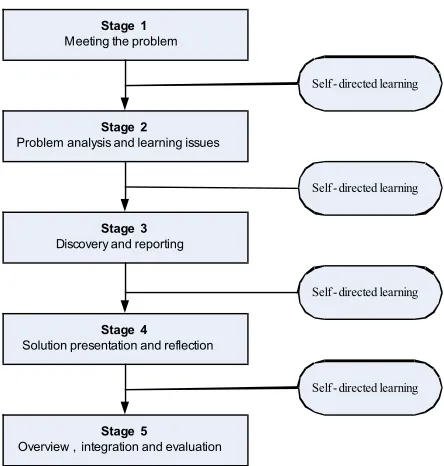
Figure 1: The PBL process
Figure 1 provides a schema of a typical PBL process that we applied in our pilot project. The process consisted of 5 stages and explanations of each stage are as follow [9]:
Stage 1: Meeting the Problem
Students will identify and clarify problem. They do this by describing the facts of the problem and seeking clarifications from the tutor about the scenario. This is done by listing the facts. A student will summarize the problem in his/her own words in order to establish the group’s understandings of the problem.
The activities in this first tutorial include:
Developing collegiality
Individual reading, reflection and inquiry
Commitment to team roles and to the group
Brainstorming and articulation of probable issues
Consensus on problem statement
Commitment to deliberate on problem scenario and problem analysis
Stage 2: Problem Analysis and Learning Issues
problem. These ideas may converge into two areas: learning issues and action plan.
This tutorial thus involves:
Brainstorming and analysis of problem (e.g. generation of possible explanations and hypotheses)
Identification of learning issues and formulation of learning objectives
Assignment of self-directed learning and peer teaching
Students determine what students need to find out in order to solve the problem by generating learning issues and developing an action plan. Action plan are steps you want to take in order to clarify or get more information about the background of the problem. Learning issues are topics where students need to search and study in order to solve or explain the problem. Students will be inquired as to where they will go to get this information. This allows for a reflection on their intended sources of research.
Stage 3: Discovery and Reporting
Following the research and self-directed learning, students report their discovery of learning to their own groups. At this peer-teaching stage, students gather to share the new information they have individually discovered.
Students practice group collaboration and communication skills through questions and the seeking of further information from one another. The PBL tutor helps ensure that key areas to be learnt are not overlooked and also quizzes students on the accuracy, reliability and validity of the information obtained.
Stage 4: Solution Presentation and Reflection
An iterative process follows with the discovery of learning, reporting, peer teaching and presentation of solutions. When students present their solutions to the problem scenario, a reflective and evaluative approach is taken. This involves contextualization and application of the knowledge to the situation. Students rephrase and paraphrase the knowledge acquired and demonstrate their new knowledge. Sometimes more questions may be asked. The tutor helps students to clarify doubt, to beware of gaps and to correct misconceptions or over-generalizations.
Stage 5: Overview, Integration and Evaluation
The integration of knowledge from various disciplines and sources and the synthesis of ideas shared bring the PBL process to closure. The review and evaluation of learning, however, forms an integral part of learning.
Students evaluate their group functioning by giving feedback on how the group observed their ground rules. Students are asked to reflect on their own individual problem solving process. Students are asked to reflect on their solution and explanation of the problem. Students
asked to generate concept map of their knowledge learnt to consolidate their overview and understanding of the subject. Students dialogue on tutor’s facilitation to clarify and build on future expectations and understanding of tutor’s role. All of the above is to cultivate a habit to reflection and giving feedback in one’s learning.
3.1
A PBL Case Study Design
Creating an appropriate problem for a problem based learning class is obviously a critical component that helps determine whether or not your session will be successful. Major variables to consider include:
Choosing a relevant problem,
Ensuring that the problem's coverage includes both the big idea and basic skills, and
Ensuring the problem's complexity mimics real-life problems.
1. Relevancy: Choosing a relevant problem is critical when we want to sustain students’ interest as they attempt to reach a viable solution. Because most PBL solutions take an extended period of time to reach resolution, it is important to maintain motivation, which can be enhanced when students understand the relevance of their class works. Another advantage that ensues by incorporating relevant problem is the ability of students to transfer their acquired skills and knowledge to life outside the classroom, and their ability to solve real world problems. Some suggestions to increase relevancy include focusing problems on current events, students’ lives, or relationships to actual occurrences at the local, national, or international level [10]. Basing instructional problem on existing problems not only helps students see the relevancy of the activity, but helps them develop an appreciation for the way in which professional analyse, design, and develop solutions to their problems.
"objectives," these basic units serve as the touchstones students should encounter in their problem solution. Third, create a problem that not only focuses students on the large problem but also takes them through the objectives. Finally, make sure resources are available for students to reference during their problem analysis and solution.
3. Complexity: A final variable to consider when creating or choosing our problem is its complexity. Because life outside the classroom is filled with complex problems, it makes sense to mimic similar conditions in the classroom. Complex problems offer many advantages over simple problems. First, complexity helps ensure that there is no "one right" answers. Having multiple correct answers that approach the problem from various perspectives and solutions can springboard to class discussions that stimulate student higher level thinking. Also, complex problems often allow for the integration of interdisciplinary solutions; a common occurrence in solving real world problems. Finally, complex problems usually require learners to exhibit management, research, and thinking skills that help distinguish less expert from more expert performers [11] This differentiation can help serve as a grading standards in the class.
4.
Implementation
We report our experience of piloting PBL in a fourth year Process Control and Dynamics subject, in semester 1, 2004-2005, with a class of 40 to 60 students for each section. All students enrolled in this subject automatically being included in the pilot. There were 4 sections and overall of 200 students involved in this pilot. The pilot was delivered in parallel for all sections using two big classrooms. In this semester all students were required to get involve in this pilot because there was no a single class covering the same content material following the traditional, instructivist approach.
To assist in the transition to PBL, we developed and implemented a revised syllabus, where two methods had been implemented; PBL and Cooperative Learning. We can not implement the subject with full PBL method since this was a pilot project. But the main idea was to develop the generic attributes that students are expected to take with them upon graduation. The primary attributes targeted were the ability to work both independently and as a member of a team, effective problem solving skills and research and synthesis of new knowledge, but also secondarily included such skills and abilities as communication and presentation skills, time
management and planning, and develop a sense of community and lifelong learning.
To support the PBL implementation, we provided a variety of support mechanisms such as those used elsewhere. These mechanisms included ongoing professional support and development for tutors by way of tutor's guides, a tutor training programme, weekly briefing/debriefing meetings and a website discussion forum. The website discussion forum provided a discussion forum for students, announcements and case studies releases, and frequently asked questions (FAQs).
4.1
The PBL Pilot Class
The semester began with 196 students in the PBL class. With five students having dropped the subject before the first scheduled session, the remaining 191 students were split into 39 teams of maximum five students each. After a combination of the typical early semester enrolment volatility and trepidation of the new approach, the class finally consolidated into a group of 187 students, forming 39 teams, two teams of three and four teams of four. All teams met in the same 3-hour workshop that split into 1 hour and 2 hours. The big teams were divided into two classrooms with two facilitators roaming between teams.
The class consisted of a mix of students form different courses, races, and seniority. The tutor organised team membership with a view to making each team as heterogeneous as possible. The most important thing that we took into consideration when creating team was each team must consist of students with higher academic performance, medium and also lower academic performance. The reason was we want each team helping each other in order to understand and solve the problem given to them. The higher academic performance will help team members with lower academic performance in every problem.
The teams were given three problems (case studies) to work on during the semester. Together these problems formed a complex real-world scenario that covered the entire curriculum content for the subject. For each problem, teams will follow the process as described in Section 3 and Figure 1.
4.2
Assessment of PBL Outcomes
identify, find, and analyse information that is needed for a particular task; (4) to collaborate productively in teams; (5) to reason critically and creatively; and (6) to make reasoned decisions in unfamiliar situations. These goals within a given PBL course can be documented by comparison of student performance on case study reports, oral presentations, peer group evaluations, classroom observations, and/or written assignments at the start and the end of the semester. For every case study given, groups of student are evaluated based on criteria given in Table 1 below:
Table 1: Case Study Evaluation
No. Item Marks (%)
1. Problem Identification 30
2. Minutes of Meeting 10
3. Content and Solution 40
4. Log Book 10
5. Reflection and Learning Journal 10
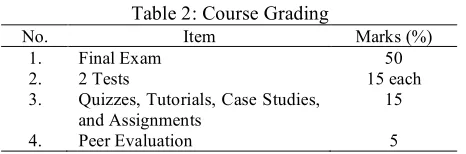
But for the overall grading for this course (SKC 4113 Process Control and Dynamics), the distributions are as follows:
Table 2: Course Grading
No. Item Marks (%)
1. Final Exam 50
2. 2 Tests 15 each
3. Quizzes, Tutorials, Case Studies,
and Assignments 15
4. Peer Evaluation 5
Looking at the Table 2 above, the big percentage of grade came from Final Exam and Tests (80%). Although PBL case study only have less than 15% from the overall grade, understanding of the every case study is every important to answer all questions in the tests and final exams.
5.
Summary
PBL tutors constantly face challenges of encouraging students to go beyond the given information, to reflect on learning, and to actively consider how their knowledge might apply in novel contexts. Students are encouraged to constantly discover and try new ways of learning. To facilitate these goals, tutors and students need to be provided with appropriate and accessible pedagogical tools and support.
Many of the above issues are a reality not just for the faculty of Chemical and Natural Resources Enginering in this example but for most higher educational faculties. Therefore to proceed with PBL in
any educational setting lessons need to be learned from current and previous experiences.
Whilst the benefits of PBL are widely accepted there are still further challenges which need to be resolved by the administrators, educators and students of the future. As long as these areas are dealt with all the above benefits can be attained.
References
[1] Duch, B. J., Groh S. E., & Allen, D. E. The Power of Problem-Based Learning. Sterling, VA: Stylus Publishing, Inc., 2001.
[2] Boud, D. and Feletti G. The Challenge of Problem-Based Learning. New York: St. Martins' Press, 1997.
[3] Mayo, W.P., Donnelly, M.B., and Schwartz, R.W. “Characteristics of the ideal problem-based learning tutor in clinical medicine”. Eval. Health Prof. 18, 1995, pp. 124 136.
[4] Engle, C.E., Not just a method but a way of learning. In: The Challenge of Problem-Based Learning, ed. Boud, D., and Feletti, G., London: Kogan Page, 1998.
[5] Allen, D.E., and White, H.B., III. “A few steps ahead on the same path: Using peer tutors in the cooperative learning classroom. A multilayered approach to teaching”, J. College Sci. Teach. 28, 299 302, 1999.
[6] Tanner, K., Chatman, L.S., and Allen, D. “Cooperative learning in the science classroom. Beyond students working in groups”, Cell Biol. Educ. 2, 1 5, 2003.
[7] Boud, D., and Feletti, G. Changing problem-based learning: Introduction to the second edition. In: The Challenge of Problem-Based Learning, ed. Boud, D., and Feletti, G., London: Kogan Page, 1998. [8] Tan, O. S. Problem-based Learning Innovation:
Using problems to power learning in the 21st century. Thomson Learning, Singapore, 2003. [9] Tan, O. S. “Problem-based learning: More problems
for teacher education”, Review of Education Research and Advances for Classroom Teachers,
21, 43-55, 2002.
[10] Lee, F. J., and Anderson, J. R. “Does learning a complex task have to be complex? A study in learning decomposition”, Cognitive Psychology, 42, 267-316, 2001.