THE EMPLOYABILITY MODEL FOR THE MULTIPLE INTELLIGENCE OF PEOPLE WITH EPILEPSY
NUR SOFIA NABILA BINTI ALIMIN
THE EMPLOYABILITY MODEL FOR THE MULTIPLE INTELLIGENCE OF PEOPLE WITH EPILEPSY
NUR SOFIA NABILA BINTI ALIMIN
A dissertation submitted in fulfilment of the requirements for the award of the degree of Master of Science (Human Resource Development)
Faculty of Management Universiti Teknologi Malaysia
ACKNOWLEDGEMENT
“In the name of Allah, the Most Gracious, the Ever Merciful”
I would like to record my thanks to my supervisor, Dr Siti Rahmah Awang for her continued interest and guidance throughout the course of this dissertation, and for the careful reading of this work. Also, of endless support and advice from my beloved parents, Alimin Ab Rahman and Mimi Suriani Ab Rahman. My special thanks also to my fiancée, Ahmad Ramdan Ismail for his encouragement and concern.
I would also like to express my gratitude to the University Teknologi Malaysia for giving this golden opportunity to further my study in this course and to Majlis Amanah Rakyat (MARA) for the financial support. Not to forget my friends who always give good information and assistance to complete up this study especially kak Noorazilah, Kak Julina, Kak Ezza Syuhada, Kak Roslin, Aina, Aishah and also Liyana.
ABSTRACT
ABSTRAK
TABLE OF CONTENTS
CHAPTER TITLE PAGE
DECLARATION i
SUPERVISOR’S DECLARATION ii
STUDENT’S DECLARATION iv
DEDICATION v
ACKNOWLEDGEMENT vi
ABSTRACT vii
ABSTRAK viii
TABLE OF CONTENTS ix
LIST OF TABLES xiv
LIST OF FIGURES xvi
LIST OF ACRONYMS xvii
I INTRODUCTION
1.1 Background of Study 1
1.2 Statement of Problem 3
1.3 Research Questions 5
1.4 Research Objectives 6
1.5 Scope of Study 6
1.6 Significance of Study 7
1.7 Research Approach 8
1.8 Research Limitations 9
1.9 Conceptual and Operational Definitions 9
1.9.2 Operational Definitions 10
1.10 Research Framework 12
1.11 Summary 14
II LITERATURE REVIEW
2.1 Epilepsy 15
2.1.1 What is epilepsy? 15
2.1.2 Type of Seizures 16
2.1.2.1 Generalized Seizures 17 2.1.2.2 Partial Seizures 17
2.1.3 Epilepsy and Society 18
2.1.4 Epilepsy in Malaysia 21
2.1.5 Epilepsy and Employment 22
2.1.5.1 Competency Model for PWE
25 Employability
2.2 Intelligence 26
2.2.1 Distinctive Development History of
26 Intelligence
2.2.2 Early Views of Intelligence 27
2.2.3 Islamic View on Intelligence 29
2.2.3.1 Intelligence According to
30 Quran
2.2.4 Single View of Intelligence: Howard Gardner and Multiple Intelligence (MI) Theory
32
2.2.4.1 Linguistic Intelligence 32 2.2.4.2 Spatial Intelligence 33 2.2.4.3 Logical/Mathematical
Intelligence
2.2.4.8 Musical Intelligence 36 2.2.5 Research in Gardner’s Multiple
37 Intelligence (MI) Theory
2.2.5.1 Local Research 37
2.2.5.2 Overseas Research 38
2.3 Summary 40
III DATA AND METHODOLOGY
3.1 Research Design and Instrumentation 41
3.2 Sample 42
3.3 Psychometric Test 42
3.4 Reliability 44
3.5 Characteristics of Respondents
45 (Demography)
3.6 Differences between Awang (2012) Study
46 and Current Study (2014)
3.7 Logistic Regression Model 46
3.7.1 Odds 47
3.7.2 The Logistic Curve 49
3.7.3 The Wald Statistics 50
3.7.4 Likehood-Ratio Test 50
3.7.5 Cox and Snell R2 & Nagelkerke R2 51
3.7.6 Hosmer-Lomeshow Test 51
3.8 Summary 52
IV ANALYSIS AND RESULTS
4.1 Descriptive Analysis 53
4.1.1 Independent Variables 57
4.1.1.1 Demographic Profiles 58 4.1.1.2 Illness Background 60 4.1.1.3 Intelligence Profiles 61
4.1.2.1 Types of Intelligence and
62 Employment Status of PWE
4.2 Logistic Regression Analysis 64
4.2.1 Multicollinearity and Singularity 64 4.2.2 PWE’s Employability Model 65
4.2.2.1 Full Model 67
4.2.2.2 Variables in the Equation 68
4.2.2.3 Employability Model 69
4.2.2.4 Interpretation from the
70 Employability Model
4.2.3 Model Fit Tests 72
4.2.3.1 Classification Table 72
4.2.3.2 Omnibus Tests of Model
Coefficients 72 4.2.3.3 Likelihood-Ratio Test 73 4.2.3.4 Hosmer and Lemeshow
74 Test
4.2.3.5 Cox and Snell R2 &
75 Nagelkerke R2
4.2.4 Predicted Probabilities for the
75 PWE’s Employment Status
4.2.5 Characteristics for PWE High 78 Employability
4.3 Summary 79
V DISCUSSION AND CONCLUSION
5.1 Summary of Main Findings 80
5.2 Demographic Profiles of the Respondents 81
5.3 Discussions on the study 81
5.3.1 The intelligence profiles of people
81 with epilepsy (PWE) by using
Ability Test in Epilepsy (ATIE©)
Employment Status
5.3.3 Employability Model 86
5.3.4 The Significant Factors for PWE’s
87 High Employability
5.4 Recommendations 89
5.4.1 Recommendation for Human
90 Resource Personnel (HRP)
5.5 Summary 91
REFERENCES 92
APPENDICES 100
Appendix A 100
Appendix B 116
Appendix C 122
Appendix D 124
Appendix E 126
LIST OF TABLES
TABLE NO. TITLE PAGE
2.1 Etymological Meaning of Intelligence 30
3.1 Summary of the Psychometric Test 43
3.2 The level of Intelligence 43
3.3 Reliability Psychometric Test 44
3.4 Characteristics of Respondents (Demography) 45
3.5 Differences between Awang (2012) Study and 46
Current Study (2014)
4.1 (a) Frequency Distribution for Qualitative
Independent Variables (Demographic Indicators) 54,55 4.1 (b) Frequency Distribution for Qualitative Variables
(Epileptic Profiles) 55
4.1 (c) Frequency Distribution for Qualitative
Independent Variables (Intelligence Indicators) 56,57 4.2 Descriptive Statistics for Quantitative Independent
Variable 56
4.3 Types of Intelligence and Employment Status 63
4.4 Collinearity Statistics 65
4.5 Values of Constant and Exp (B) 66
4.6 Variables in the Equation 68,69
4.7 Classification Table 72
4.8 Omnibus Tests of Model Coefficients 73
4.9 Constant-Only Model 74
4.10 Full Model 74
4.12 Hosmer and Lemeshow Test 75
4.13 Model Summary 75
4.14 Summary of Example of Characteristics of PWE 78
LIST OF FIGURES
FIGURE NO. TITLE PAGE
1.1 Research Framework 13
2.1 ATIE Competency Model 26
3.1 Description of the Sample 42
3.2 Types of Variable and their Relationship 47
4.1 Frequency Distribution for Gender and Ethnic 57
Group
4.2 Distribution of Marital Status and Category of
Education Level 59
4.3 Distribution of the Experience of Job
Discrimination for PWE 59
4.4 Distribution on the Respondent’s Types of 60
Epilepsy
4.5 Number of Current AED Taken by the respondents 60 4.6 Distribution of Intelligence Profiles of the
Respondents 61
4.7 Distribution of Employment Status 62
LIST OF ACRONYMS
PWE People with Epilepsy
ILAE International League Against Epilepsy
MI Multiple Intelligence
ATIE© Ability Test in Epilepsy
HKL Hospital Kuala Lumpur
HSA Hospital Sultanah Aminah
HRP Human Resource Personnel
HR Human Resource
WHO World Health Organization
KCMC Kilimanjaro Christian Medical Centre
FIA Fuzzy Inverse ATIE
AKA Awareness, Knowledge and Attitudes
IQ Intelligence Quotient
AHP-DEA Analytic Hierarchy Process and Data Envelopment Analysis SPSS Statistical Package for the Social Sciences
AED Antiepileptic Drugs
VIF Variance Inflation Factor
df Degree of Freedom
LL Likelihood
Zf Full Model
CHAPTER 1
INTRODUCTION
This chapter is divided into several sections which consist of the background of study, statement of problem, research questions and objectives, scope of the study, significance of the study, research limitations, research approach, conceptual and operational definitions, research framework and finally the summarization of this chapter. The background of the study focuses on brief explanation of the main components of this study which are the Epilepsy and Multiple Intelligence. The problem statement discusses the main issue in this study which is related to employment among People with Epilepsy (PWE).
1.1 Background of Study
Epilepsy is a term given for syndromes of epileptic seizures. An epileptic seizure is a disorder of the nervous system in which abnormal electrical activity in the brain causes a seizure. A seizure means sudden uncontrolled waves of electrical activity in the brain that cause involuntary movement or loss of consciousness (Schmidtand and Willis, 2007).
Understanding the socioeconomic and physiological impacts of epilepsy is important to control the seizures (Lim et al., 2013).
Epilepsy can also be defined as impairment in behavior or motor function caused by an electrical discharge from the brain. Most of the time seizures do not recur or require treatment. Infection, head injury, chemical imbalance, stroke or brain tumor may provoke seizures. About 2% of the general population is found to have epilepsy and it occurs more often in 25-35% of people with neurological based disabilities. It also occurs frequently in people that have a manifestation of brain injury or differences in brain development Centre for Developmental Disability Health Victoria (2005).
According to Fisher et.al (2005), different types of the seizure can be classified into generalized or localized/partial seizures. Generalized seizures are divided according to the effect on the body but they all involve loss of consciousness while partial seizures are further divided on the extent to which consciousness is affected and the localization of the seizure. If the level of consciousness is not affected during the seizure, it can be considered as a simple partial seizure but if the consciousness is affected, it is called a complex partial seizure. Secondary generalization can also occur if the partial seizure spreads within the brain (Preedy and Watson, 2010). Although epilepsy can be related to the brain, it has no correlation with individual intelligence (Awang, Aripin, Rafia and Ahmad, 2011).
1.2 Statement of Problem
Seeking employment is one of the main problems faced by people who are living with epilepsy. In previous studies, epilepsy is associated with high expected rates of unemployment and underemployment. For example, a survey conducted in 1995 in the United States revealed that 25% of PWE were unemployed as compared with 5% of the overall population. Similarly, in the United Kingdom, the unemployment rate was 46% among PWE in contrast to 19% of the general population. In Netherlands, it was found that 48% of PWE were unemployed compared to 20% of the general population (Varma, et.al, 2007).
It is important for a person to have a job. When someone does have a job, the person is able to meet all the requirements that are needed in their daily routine. It can be seen when a previous study by Majkowska-Zwolińka et.al (2012) stated that professional work contributes an important element of social functioning and individual goal realization for an individual. It also shows employment is not just a source of income, but also helps construct a sense of belonging to a group and to maintain self-esteem. This also is supported in the article written by Papadopoulou (2010) about the importance of getting engaged with a job. By having a job, it makes an individual feel useful because their efforts have a positive impact on others, it gives life a meaningful purpose. Therefore, feeling useful also gives a person a great boost of self-esteem and confidence which encourage them to give their best in their work.
In regards to the matter above, the problems that will be discussed in this study focus on the employability problems faced by PWE especially to secure and maintain their job. For example, the previous research by Lim et al., (2013), the unemployment rate for PWE in Neurology Clinic and Ward at the University of Malaya Medical Centre, Malaysia was about 27% from 250 PWE which is considered quite a high number. From this, we can see that there is a serious problem faced by the PWE in attaining employment.
Other previous studies also reveal that people with epilepsy experience difficulties in finding and maintaining regular employment (Smeets et.al, 2007). Several studies also confirmed the claim that unemployment and underemployment rates are generally higher for PWE as compared to the general population. PWE also has been known to have significant problems related to their employment for more than three decades. For example, PWE experience objective limitations such as those related to driving or working in situations in which they may be open to injury (Smeets et.al, 2007).
Therefore, this issue of employability is to be discussed from two different perspectives, the PWE themselves and the employers. From the PWE point of view, finding employment and staying employed are major concerns that affect their lifestyle and quality of life. Since even when employed, PWE may fall victim to misconceptions about epilepsy, co-worker’s unawareness, prejudice, uncertainties of seizures and inability of other people to help during an attack (Majkowska-Zwolińska et al., 2012).Apart from that, those who have been employed believe that if their condition becomes known to their employers, they will be fired. This situation often makes PWE feel less motivated to look for and retain a job.
treat a PWE differently from others.With that, it can also help PWE to improve their confidence to search for and obtain a job.
So, what is the best solution to help PWE in finding jobs in a competitive and challenging job market? One way is to use scientific method to help them in revealing the potential ability and natural talent that they have so they can be successful in finding a job and in making employers realize their ability and talent and consequently employers will stop abandoning them in the job market.
Another way to help PWE identify their capabilities for finding a job is by use of measuring instruments or tools known as psychometric tests. Psychometric tests have been used for many years to measure intelligence. This test refers to the testing done to individuals in order to measure their competency in a specific area of functioning. The test is also used to measure sensitivity, memory, intelligence, attitude and personality. It is commonly used by employers to choose the right person for a certain entry job. Thus, in this study, this test helps the PWE to identify the level of intelligence that they possess which is significant for them in getting a job.
Lastly, a method called logistic regression analysis will also be used in this study to build a predictive model called the employability model. This model can assist the PWE in identifying the significant factors that need to be featured for them to increase their employment rate. This also helps employers in finding a suitable employee among PWE based on the types of the intelligence that they have.
1.3 Research Questions
This study is to answer the questions below:
2. What is the type of intelligence possessed by PWE and their employment status?
3. How to develop an employability model which involves the significant factors that will lead to high employability?
4. What are the significant factors that the PWE should have in order to enhance the chances of employability?
1.4 Research Objectives
As we can see, the main problem found in this study is the difficulties faced by PWE in seeking employment. Therefore, the objectives of this study are:
1. To identify the intelligence profiles of PWE based on ATIE© (2008).
2. To determine PWE’s type of intelligence and their employment status.
3. To develop an employability model which involves significant factors that lead to high employability.
4. To determine the significant factors for PWE high employability.
1.5 Scope of Study
(HKL) and Hospital Sultanah Aminah (HSA). A total of 148 samples found in HKL had been analyzed in the previous study by Awang (2012) while 67 samples were collected from HSA but were not analyzed in the previous study due to time constraints. Thus, the total samples that are used in this study is a combination of data collected from HKL and HSA for a total of 215 samples. The primary method used in this study is a logistic regression analysis that helps in building the employability model of PWE’s.
1.6 Significance of Study
This study can contribute to four different parties including knowledge, human resource personnel (HRP), People with Epilepsy (PWE) and society.
1. Knowledge
This study can contribute to the creation of new knowledge because it represents a new employability model using logistic regression that helps PWE to increase their probability to be employed by combining the eight types of intelligence based on the results obtained from the total score of their ATIE© (2008).
2. Human Resource Personnel (HRP)
3. People with Epilepsy (PWE)
This study has applied a psychometric test called ATIE© (2008) which can assist the PWE to identify their actual strengths and weaknesses based on the type of the intelligence that they have. Knowing this helps them find a suitable career to be engaged in. A new approach called logistic regression analysis was applied to build an employability model in this study. This model makes a big contribution to PWE as it helps them understand their eight skills and enhances their opportunities in employment.
4. Society
This study also helps the society in enhancing their understanding towards the PWE and to treat the PWE equally. At the same time, it helps to reduce discrimination by society against people with epilepsy in terms of social, employment and marriage.
1.7 Research Approach
The study presented in this thesis can be divided into two main parts which are:
i. Descriptive analysis of the data
ii. Development of an employability model by logistic regression analysis
1.8 Research Limitations
The data used in this study are obtained from previous research by Awang (2008) which are collected from Department of Neurology, HKL and from HSA. Thus, the final sample was comprised of 215 patients, 148 from HKL and 67 from HSA. So, this study only analyzed the available data from these two hospitals.
The results from this study may not represent the whole population of PWE in Malaysia but it would still be a useful guide in understanding the intelligence of PWE in general and also helps the HRP and employers in assigning PWE with suitable tasks.
1.9 Conceptual and Operational Definitions
In this study, three main components are defined in two different terms which are conceptual and operational definitions as the following:
1.9.1 Conceptual Definitions
1. Epilepsy
2. Multiple Intelligence
Gardner (1983) defined multiple intelligence as a psychological theory about the mind. He proposed that intelligent behavior does not arise from a single unitary of the mind but from different kinds of intelligence which are generated from separate metaphorical pools of mental energy. Each of these pools enables the individual to solve problems or to create products that are valued within one or more cultural settings (Gardner, 2003).
The seven intelligences proposed by Gardner (1983) are linguistic, logical-mathematical, spatial, bodily-kinesthetic, musical, interpersonal and intrapersonal with two more additional intelligences called naturalist and existential intelligence (Gardner, 1999). He also makes two claims. The first one is that human beings have all of these kinds of intelligence and the second claim is that due to genetics and the environment, no one has exactly the same profile of intelligence, not even identical twins as people’s experiences are different (Gardner, 1983).
3. Employability
Yorke (2008) defined employability as a set of achievements of skills, understandings and personal attributes that makes graduates more likely to gain employment and be successful in their chosen occupations that benefits themselves, the workforce, community and economy. Employability is not only about gaining a job but it is more related to the capacity of the graduate to function in a job and be able to cope well between jobs and remained employed throughout his/her life.
1.9.2 Operational Definitions
1. Epilepsy
and also psychological factors that lead to poor quality of life (Lim et al., 2013). There is one effective quality of life from this disease which is in terms of building a career. This is a major issue to be discussed in this study because based on previous research by Varma et al. (2007), PWE have high unemployment and underemployment rates. Furthermore, this study also discussed the main types of seizures which are generalized and partial seizures. Epilepsy and its perception from society, epilepsy in Malaysia and a focus on epilepsy and employment will also be included in this study.
2. Multiple Intelligence
The definition of Multiple Intelligence in this study is more focused on the intelligence profiles of PWE which are Gardner’s eight different types of intelligence namely, musical, bodily-kinesthetic, math/logic, spatial, linguistic, interpersonal, intrapersonal and naturalist. These MI helps the PWE to have better understanding about their skills and capability for completing a task and increases their confidence and self-esteem (Gardner, 1983).
3. Employability
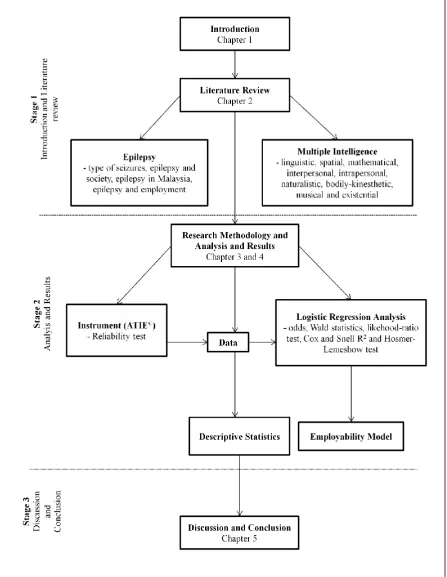
1.10 Research Framework
The overall framework for this study is divided into three stages as shown in Figure 1.1. The first stage consists of two chapters which are Chapter 1 and 2 that describe the introduction and the literature review of this study. The literature review is divided into two main components which are epilepsy and Multiple Intelligence (MI) theory. The topics discussed in the epilepsy section are type of seizures, epilepsy and society, epilepsy in Malaysia and epilepsy and employment while topics in the MI section are eight different types of intelligence which are linguistic, spatial, mathematical, interpersonal, intrapersonal, naturalistic, bodily-kinesthetic and musical intelligence.
1.11 Summary
REFERENCES
Armstrong, T. (2000). Multiple Intelligences in the Classroom. 2nd Edtion. Alexandria. VA: Association for Supervision and Curriculum Development (ASCD).
Awang, S. R., Aripin, R., Rafia, M. H., Ahmad, T. (2013). The classification of Multiple Intelligences of People with Epilepsy using Fuzzy Inverse Model. Malaysian Journal of Fundamental and Applied Sciences 9 (2), pg 86-92.
Awang, S. R., Aripin, R., Rafia, M. H., Ahmad, T. (2011). The Classification of Multiple Intelligences of People with Epilepsy. International Conference on Management, Economic and Social Sciences (ICME’2011). Dec 2011.
Bangkok, 469-475.
Awang, S. R. (2012). Intelligence Classification and Fuzzy Optimization Model of People with Epilepsy. PhD Thesis, Universiti Teknologi MARA, Malaysia. Awang, S. R. (2008). Ability Test in Epilepsy Malaysia Patent No 129396. Universiti
Teknologi Malaysia.
Bachok, N., Jiman, Z., Aishah, K. (2013). The quality of life of people with epilepsy at a tertiary referral centre in Malaysia. Health and Quality of Life Outcomes 2013 11, 143.
Bautista, R. E. D., and Wludyka, P. (2007). Factors associated with employment in epilepsy patients. Epilepsy & Behaviour. 10, 89-95.
Bewick, V., Cheek, L., and Ball, J. (2005). Statistics review 14: Logistic regression. Critical care (London, England). Volume 9 (1), 112-118.
Carroll, J. B. (1993). Human Cognitive Abilities: A Survey of Factor-Analytic Studies. New York: Cambridge University Press.
Centre for Developmental Disability Health Victoria (2005). Management Guidelines for People with Developmental and Intellectual Disabilities.
de Boer, H. M., Mula, M., Sander, J.W. (2008). The Global Burden and Stigma of Epilepsy. Epilepsy Behav. 12, 540-546.
DeVellis, R. F. (2003). Scale Development: Theory and Applications (2nd edn). Thousand Oaks, California: Sage
Eberhardt, L. L., and Breiwick, J. M. (2012). Models for population growth curves. ISRN Ecology 1-7.
Ekenze, O. S., and Ndukuba, A. C. (2013). Perception of epilepsy among public workers: Perspectives from a developing country. Epilepsy & Behaviour. 26, 87-90.
Fisher, R. S., Boas, W.V. E., Blume, W., Elger, C., Genton, P., Lee, P., Engel, J. (2005). Epileptic seizures and epilepsy: Definition proposed by the International League Against Epilepy (ILAE) and the International Bureau for Epilepsy (IBL). Epilepsia 46, 470-472.
Gardner, H. (1983). Frames of Mind: The Theory of Multiple Intelligences. New York: Basic Books.
Gardner, H. (1993). Multiple Intelligences: The theory in practice. New York: Basic Books.
Gardner, H. (1999), Intelligences Reframed: Multiple Intelligences for the 21st Century. New York: Basic Books.
Gardner, H. (2003). Multiple intelligence after few years. Retrieved on November 21, 2013, from http://pzweb.harvard.edu/PIs/HG_MI_after_20_years.pdf. Giordani, B., Berent, S., Sackellaras, J. C., Rourke, D., Seidenberg, M., O’Leary, D.
Guekht, A. B. et al. (2006). Factors influencing on quality of life in people with epilepsy. Seizure 16, 128-133.
Griffin, P. R. (2008). Office of Communications and Public Liaison. MD 20892-2560.
Gzirishvili, N., Kasradze, S., Lomidze, G., Okujava, N., Toidze, O., de Boer, H. M., Sander, J. W. (2013). Knowledge, attitudes, and stigma towards epilepsy in different walks of life: A study in Georgia. Epilepsy and Behaviour. 27, 315-318.
Harden, C. L., Maroof, D. A., Nikolov, B., et al. (2007). The effect of seizure severity on quality of life in epilepsy. Epilepsy Behav. 11, 208-211.
Hassan, A. R. (2011). Kecerdasan Menurut Al-Quran.
Health Grades Inc. (2011). Statistics by Country for Epilepsy. Retrieved 28 November, 2013 from http://www.rightdiagnosis.com/e/epilepsy/stats-country.htm.
Hill, T. and Lewicki, P. (2007). Statistics methods and applications. StatSoft, Inc. Tulsa.
Hindes, Y., Schoenberg, M. R., Saklofske, D. H. (2011). Intelligence. Kreutzer, J. S., DeLuca, J., Caplan, B. Encyclopedia of Clinical Neuropsychology (pg 161-165). Springer Science and Business Media, LLC.
Jacoby, A., Wang, W., Vu, T., et al. (2008). Meanings of epilepsy in its sociocultural context and implications for stigma: findings from ethnographic studies in local communities in China and Vietnam. Epilepsy Behav. 12, 286-297. Jiang, H. (2013). Efficient Teaching Scheme Based on Multiple Intelligence Theory.
Informatics and Management Science VI 209, 477-484.
Just, M. A. and Carpenter, P. A. (1992). A capacity theory of comprehension: Individual difference in working memory. Psychological Review 99, 122-149. Karamikabir, N. (2011). Gardner’s Multiple Intelligence and Mathematics
Lawrence, T. (2002). Teaching and assessing employability skills through skills in USA. Annual Quality Congress Proceedings, ABI/INFORM Global 56, 285-294.
Lim, S. K., Wo, S. W., Wong, M. H., Tan, C. T. (2013). Impact of epilepsy on employment in Malaysia. Epilepsy &Behaviour. 27, 130-134.
London, M. (1985). Developing Managers. San Francisco, CA: Jossey-Bass.
Majkowska-Zwolińska, B., Jędrzejczak, J., Owczarek, K. (2012). Employment in people with epilepsy from the perspectives of patients, neurologists and the general population. Epilepsy and Behaviour. 25, 489-494.
Maloney, E. A., Waechter, S., Risko, E. F., Fugelsang, J. A. (2012). Reducing the sex difference in math anxiety: The role of spatial processing ability. Learning and Individual Differences 22, pg 380-384.
Marinas, A., Elices, E., Gil-Nagel, A., et al. (2011). Socio-occupational and employment profile of patients with epilepsy. Epilepsy Behav. 21 (3), 223-227.
Markus, H., Smith, J. and Moreland, R. L. (1985). Role of the Self-Concept in the Perception of Others. Journal of Personality and Social Psychology 49, pg 1494-1512.
Martin-Gutiérrez, J., García-Domínguez, M., Roca-González, C., Sanjuán-HernanPérez, A., Mato-Carrodeguas, C. (2013). Comparative Analysis Between Training Tools in Spatial Skills for Engineering Graphics Students Based in Virtual Reality, Augmented Reality and PDF3D Technologies. Procedia Computer Science 25, 360 – 363.
Mayer, J. D. and Salovey, P. (1993). The intelligence of emotional intelligence. Intelligence 197, 433-442.
Milovanov, R., Huotilainen, M., Esquef, P. A. A., Alku, P., Välimäki, V., Tervaniemi, M (2009). The role of musical aptitude and language skills in preattentive duration processing in school-aged children. Neuroscience Letters 460, Issue 2, Pages 161-165.
Moran, S. (2011). Multiple Intelligences. Elsevier Inc. pg 161-165.
Moslehifar, M. A. and Ibrahim, N. A. (2012). English language Oral Comunnication Needs at the Workplace: Feedback from Human Resource Development (HRD) Trainees. Procedia-Social and Behavioral Sciences 66. Pg 529-536. Muhammad Ali Al-Shabuni, Shafwah al-Tafasir, (Beirut, Dar al-Fikr, 1988), Juz I, h.
576.
Mushi, D., Hunter, E., Mtuya, C., Mshana, G., Aris, E., Walker, R. (2011). Social-cultural aspects of epilepsy in Kilimanjaro Region, Tanzania: Knowledge and experience among patients and carers. Epilepsy & Behaviour. 20, 338-343. National Institute of Health (2013). National Institute of Neurological Disorders and
Stroke.
Neni, S. W., Latif, A. Z. A., Wong, S. Y., Lua, P. L. (2010). Awareness, knowledge and attitudes towards epilepsy among rural populations in East Coast Peninsular Malaysia: A preliminary exploration. Seizure. 19, 280-290.
Newell, A. and Simon, H. A. (1972). Human Problem Solving, Englewood Cliffs. NJ: Prentice-Hall.
Nicolini, P., Alessandria, G., Bilancioni, G. (2010). Web-Ob for multiple intelligences observation. Procedia Social and Behavioral Sciences. 2, 728-732.
Norusis, M. J. (2005). Statistical Procedures Companion. Upper Saddle River: Prentice Hall Inc.
Pahl, K., and Boer, H. M. (2005). Epilepsy and rights. Atlas: Epilepsy care in the world. Geneva:WHO.
Pallant, J. (2010). SPSS Survival Manual. (4th edn). Australia: Allen & Unwin Book Publishers.
Papadopoulou, M. (2010, November 22). Wikinut Ltd.
Park and Hyeoun-Ae (2013). An Introduction to Logistic Regression: From Basic Concepts to Interpretation with Particular Attention to Nursing Domain. J Korean Acad Nurs. Volume 43 (No 2), 154-164.
Peng, C. J., Lee, K. L., and Ingersoll, G. M. (2002). An introduction to logistic regression analysis and reporting. The Journal of Educational Research. Volume 96 (1), 3-14.
Armstrong, M. (2000). Performance Management: Key Strategies and Practical Guidelines. Business & Economics.
Persons with Disabilities Act 2008 (Act 685). Retrieved November 22, 2013, from http://www.jkm.gov.my/index.php?option=com_content&view=article&id=3 52:2-akta-oku&catid=46:orang-kurang-upaya&Itemid=81&lang=en.
Pourjalali, C., and Kaufman, J. C. (2013). Intelligence. Runehov, A. L. C., and Oviedo, L. Encyclopedia of Sciences and Religions. (pp. 1061-1062). Springer Science and Business Media Dordrecht.
Preedy, V. R., and Watson, R. R. (2010). Handbook of Disease Burdens and Quality of Life Measures. Springer Science and Business Media LLC.
Rahman, A. R., Yusof, Y. M., Kashefi, H., Baharun, S. (2012). Developing mathematical communication skills of engineering students. Procedia – Social and Behavioural Sciences 46, 5541-5567.
Rhodes, K. (2006). Six components of a Model for Workplace. Graziadio Business Review.
Rosenberg, S., Heimler, R.., Morote, E. (2012). Basic employability skills: a triangular design approach. Education þ Training 54(1), 7–20.
Saengsuwan, J., Boonyaleepan, S., Srijakkot, J., Sawanyawisuth, K., Tiamko, S. (2012). Factors associated with knowledge and attitudes in persons with epilepsy. Epilepsy Behav 24, pg 23-29.
Schmidtand, R. F., and Willis, W. D. (2007). Encyclopedia of Pain. Springer-Verlay Berlin Heidelberg.
Sillanpaa, M., and Schmidt, D. (2010). Long-term employment of adults with childhood-onset epilepsy: a prospective population-based study. Epilepsia. 51 (6), 1053-1060.
Smeets, V. M. J., Lierop, B. A. G., Vanhoutvin, J. P. G., Aldenkamp, A. P., Nijhuis, F. J. N. (2007). Epilepsy and Employment: Literature Review. Epilepsy and Behaviour. 10, 354-362.
Sternberg, R. J. (1988). The triarchic mind: A new theory of human intelligence. New York: Viking-Penguin.
Tischler, L. (2002). Linking Emotional Intelligence, Spirituality and Workplace Performance. Journal of Managerial Psychology 42(2), pg 16-33.
Thurstone, L. L. (1938). Primary Mental Abilities. Chicago, IL: University of Chicago Press.
Vahideh, R., Ahmad, T., Awang, S. R., Khanmohammadi, M., Maan, N. (2014). Ranking Epileptic Patients’ Perceived Intelligence Parameters in Data Development Analysis. Life Science Journal 11(5), pg 59-68.
Varma, N. P., Syalaja, P. N., George, L., Sarma, P. S., Radhakrishnan, K. (2007). Employment concerns of people with epilepsy in Kerala, south India. Epilepsy and Behaviour. 10, 250-254.
Vasile, C. and Gabriel, A (2011). The meaning and the application of M.I theory in student’s academic life – a preliminary study. Procedia Social and Behavioral Science. 11, 82-86.
Visser, B. A., Ashton, M. C., Vernon, P. A. (2006). Beyond g: Putting multiple intelligence theory to the test. Intelligence. 34, 487-502.