THE RELATIONSHIP BETWEEN INFORMATION TECHNOLOGY FLEXIBILITY, CAPABILITY AND STRATEGIC ALIGNMENT
SAEID JORFI
FLEXIBILITY, CAPABILITY AND STRATEGIC ALIGNMENT
SAEID JORFI
A thesis submitted in fulfilment of the requirements for the award of the degree of
Doctor of Philosophy (Management)
Faculty of Management Universiti Teknologi Malaysia
iii
ACKNOWLEDGEMENT
I would like to thank my main thesis supervisor, Assoc. Prof. Dr. Khalil Md Nor, for encouragement, guidance, critics and friendship. Without his continued support and interest, this thesis would not have been the same as presented here. I consider myself very fortunate in being able to work with such a very considerate and encouraging professor. I am also thankful to my co-supervisor Assoc. Prof. Dr. Lotfallah Najjar from University of Nebraska at Omaha, USA (Department of Information System and Quantitative Analysis) for his guidance, advices and motivation. Much appreciation is expressed to the members of the examination committee in the first assessment and also viva; Prof. Dr. Nur Naha binti Abu Mansor, Prof. Dr. Amran bin Md Rasli, Dr. Mohd Fauzi bin Othman, and Dr. Noor Azmi Mohamad from Universiti Teknologi Malaysia (UTM), and Prof. Dr.Husnayati bt Hussin from International Islamic University Malaysia (Faculty of Information and Communication Technology). Furthermore, the author is also indebted to the UTM that provided facilities and support to pursue this degree. Special acknowledgement is extended to the people who assisted in the completion of this research, particularly, those IT managers that participated in this study.
v
ABSTRACT
ABSTRAK
vii
TABLE OF CONTENTS
CHAPTER TITLE PAGE
DECLARATION ii
DEDICATION iii
ACKNOWLEDGEMENT iv
ABSTRACT v
ABSTRAK vi
TABLE OF CONTENTS vii LIST OF TABLES xii LIST OF FIGURES xiv LIST LIST OF ABBREVIATIONS xv LIST OF APPENDICES xvi 1 INTRODUCTION 1
1.1 Research Background 1
1.2 Problem Background 4
1.3 Research Gap 6
1.4 Research Objective 10
1.5 Purpose of the study 11
1.6 Research Questions 11
1.7 Scope of the Study 14
1.8 Contribution to Academic Research 14
1.9 Contribution to Practice 15
1.10 Definition of Terms 16
1.10.1 IT-business Strategic Alignment 16
1.10.2 IT Flexibility 17
1.10.2.1 Connectivity 18
1.10.2.3 Modularity 19
1.10.3 IT Capability 19
1.10.3.1 IT Architecture 20
1.10.3.2 IT Infrastructure 21
1.10.3.3 IT Human Resource 21
1.10.3.4 IT Relationship Resource 22
1.11 Plan of the Thesis 24
2 LITERATURE REVIEW 25
2.1 Introduction 25
2.2 IT-business Strategic Alignment: The Concept 29
2.2.1 Prominent Models of Strategic Alignment 29
2.2.1.1 Henderson and Venkatraman‟s Model 29
2.2.1.2 Weill and Broadbent‟s Model 33
2.2.1.3 Sauer and Yetton‟s Model 35
2.2.1.4 Keen‟s and Smaczny‟s Model 37
2.2.2 Terms and Definitions of Strategic Alignment 40
2.3 Importance of Strategic Alignment 42
2.4 IT-business Strategic Alignment Research 44
2.4.1 IT-business Strategic Alignment and Organisational Performance 45
2.4.2 Factors Affecting IT-business Strategic Alignment 48
2.5 The Importance of IT Flexibility 58
2.6 Definition of IT Flexibility 60
2.7 Literature Review on the Link between IT Flexibility and Strategic Alignment 62
2.8 Dimensions of IT Flexibility 67
2.8.1 Connectivity 68
2.8.2 Compatibility 69
2.8.3 Modularity 70
2.9 IT Capability 71
2.10 Dimensions of IT Capability 74
2.10.1 IT Architecture 74
ix
2.10.3 IT Human Resources 76
2.10.4 IT Relationship Resource 78
2.11 Literature on IT Capability 79
2.12 Research Model 82
2.13 Hypotheses 90
2.13.1 IT Flexibility Dimensions and Strategic Alignment 90
2.13.2 IT Capability and Strategic Alignment 93
2.13.2.1 IT Infrastructure 93
2.13.2.2 IT Architecture 95
2.13.2.3 IT Relationship resource 97
2.13.2.4 IT Human resource 102
2.13.3 IT Flexibility Components and IT Capability 104
2.13.3.1 The Impact of Connectivity and Compatibility on IT Capability 105
2.13.3.2 The Impact of Modularity on IT Capability107 2.14 Summery 109
3 RESEARCH METHODOLOGY 110
3.1 Introduction 110
3.2 Research Philosophy 110
3.3 Research Design 111
3.4 Selection of Respondents 117
3.5 Sample Frame 117
3.6 Sample Size 118
3.7 Review and Identify Potential Measurement Tools 120
3.7.1 Strategic Alignment Measurement 120
3.7.2 IT Flexibility Measurement 121
3.7.3 IT Capability Measurement 123
3.8 Instrument Testing and Validation 125
3.8.1 Validity and Reliability 125
3.8.2 Pre-test 128
3.8.3 Pilot Test 130
3.10 Data Analysis 132
3.11 Ethical Consideration 133
3.12 Summery 133
4 DATA ANALYSIS 135
4.1 Introduction 135
4.2 Examining and Screening Data 136
4.3 Descriptive analysis 138
4.4 Pre-Analysis (Possible Biases and Multicollinearity) 143
4.4.1 Non-Response Bias (Comparing Early and Late Responses) 143
4.4.2 Method Bias (Comparing Online and Paper-based Responses) 144
4.4.3 Common Method Bias 146
4.4.4 Multicollinearity 147
4.5 Testing Measurement Model 149
4.5.1 Factorial Validity Assessment Using EFA/PCA 149
4.5.2 Convergent and Discriminant Validity 153
4.5.2.1 Convergent Validity 153
4.5.2.2 Discriminant Validity 156
4.5.2.3 Construct Reliability 157
4.5.3 Section Summary 159
4.6 Structural Model 159
4.6.1 Testing the Structural Model 160
4.6.2 Results of the Relationships Analysis 162
4.7 Summary of the Results 166
5 DISCUSSION AND CONCLUSION 168
5.1 Introduction 168
5.2 Discussion of the Research Hypotheses 169
5.2.1 The Relationship between IT Flexibility Dimensions and Strategic Alignment 169
xi
5.2.3 IT Flexibility Dimensions and IT Capability 180
5.3 Theoretical and Practical Contributions 183
5.3.1 Theoretical Contribution 183
5.3.2 Practical Contribution 185
5.4 Research Limitations 188
5.5 Future research 189
5.6 Conclusion 190
REFERENCES 192
LIST OF TABLES
TABLE NO. TITLE PAGE
1.1 Definition of the Constructs 23
2.1 Factors Affecting Strategic Alignment 54
2.2 Categories of Factors Affecting Strategic Alignment 56
3.1 Strategic Alignment Measurement 121
3.2 IT Flexibility Measurements 122
3.3 IT Capability Measurements 124
3.4 Practical Stages of Pretest and Translation 129 3.5 Demographic of Respondent Firms in Pilot Study 130 3.6 Descriptive and Reliability of Pilot Sample 131
3.7 Data Collection Process 132
4.1 Skewness and Kurtosis of Constructs (N=125) 138
4.2 Firm Size (N=125) 139
4.3 Respondents‟ Firm According to Industry Types
(N=125) 140
4.4 Respondents‟ Experience in Their Current Firm
(N=125) 141
4.5 Respondents‟ Experience in Their Current Job
(N=125) 142
4.6 Descriptive Statistics of Variables 142
4.7 Chi-Square Comparison of Early and Late Cases
(Nominal Variables) 144
4.8 Chi-Square Comparison of Early and Late Cases
xiii
4.9 Chi-Square Comparison of Email and Post-Mail
Methods of Data Collection (Nominal Variables) 145 4.10 Chi-Square Comparison of Email and Postal-Mail
Methods of Data Collection (Ordinal Variables) 145 4.11 Intercorrelations between Independent Constructs 148
4.12 Variance of Inflation Factors (VIF) 149
4.13 Factor Structure Matrix of Loadings and Cross-
Loadings of Main Variables 151
4.14 Psychometric Characteristics of the Research
Constructs 154
4.15 AVE of the Constructs 156
4.16 Correlations between the Main Constructs 157
4.17 CR and Alpha of the Constructs 158
4.18 Supported Hypothesis, Path Coefficients and T-
statistics 163
4.19 Results of the Hypotheses Testing of the Main
LIST OF FIGURES
FIGURE NO. TITLE PAGE
1.1 The Proposed Model 13
2.1 Henderson & Venkatraman‟s Strategic Alignment
Model (SAM) 31
2.2 Alignment Perspectives of Henderson & Venkatraman‟s
Model 32
2.3 Weill & Broadbent‟s Model 34
2.4 Sauer & Yetton‟s Lead-Lag Concept 36
2.5 Smaczny Fusion Model 38 2.6 The Relationships between Dimensions of IT Flexibility
and Strategic Alignment 87 2.7 The Relationship between IT Capability and Strategic
Alignment 88
2.8 The Relationship between Dimensions of IT Flexibility
and IT Capability 89
2.9 The Conceptual Modal 109 3.1 Research Methodology 113
4.1 Boxplots of Constructs 137
xv
LIST OF ABBREVIATIONS
IS - Information System
IT - Information Technology
SA - IT-business Strategic Alignment
CON - IT Connectivity
COM - IT Compatibility
MDU - IT Modularity
ITHUR - IT Human Resource
ITRR - IT Relationship Resource
ITARC - IT Architecture
ITINF - IT Infrastructure
CIO - Chief Information Officer CEO - Chief Executive Officer
RBV - Resource-based View
EFA - Exploratory Factor Analysis VIF - Variance of Inflation Factors CFA - Confirmatory Factor Analysis AVE - Average Variance Extracted PCA - Principal Components Analysis
KMO - Kaiser-Meyer-Olkin
CR - Composite Reliability
SPSS - Statistical Package for Social Sciences PLS - Partial Least Squares
L IS T O F APPPE ND I CES
APPENDIX TITLE PAGE
A Survey Questionnaire 208
B T-test Comparison of Early and Late Cases
(Continuous Variables) 220
C T-test Comparison of Email and Post Mail Methods
of Data Collection (Continuous Variables) 221
D Total Variance Explained 222
E Correlation Matrix 223
CHAPTER 1
INTRODUCTION
1.1Research Background
Organisations are able to make the most of the positive effects of their spending on IT in order to attain a good sync between the business and IT by aligning their business strategies with information technology (IT) (Byrd, Lewis, and Bradley, 2006; Henderson and Venkatraman, 1993; Nelson and Cooprider, 1996; Papp, 1999; Tan and Gallupe, 2006). Over the last couple of decades, attaining alignment has become one of the major concerns with regards to IS management for both the managers of business and IT (Brancheau and Wetherbe, 1987; Luftman, Kempaiah, and Nash, 2006; McGee, 2006; Niederman, Brancheau, and Wetherbe, 1991; Rosa, 1998). In today‟s world, this tendency continues (Alter, 2005). In a survey conducted by the Society for Information Management, it is found that the alignment of business and IT is still one of the top three worries for CIOs (McGee, 2006). In today‟s fast paced global economy, many enterprises realise that there is a gap between their IT strategy and corporate strategy (Sabherwal and Chan, 2001; Hirschheim and Sabherwal, 2001; Kaplan and Norton, 2004).
3
as a skill in the organisations, meaning that it has become a vital cause for a continued competitive excellence.
Despite the fact that there are many benefits associated with strategic alignment as stated above, organisations are confronted with critical challenges in maintaining strategic alignment. Organisations today have to work harder to sustain their territories when confronted with prolonged competition in today‟s age, where everything is more global, regulated, with consumers who are increasingly indecisive and rapidly changing innovations. In light of these factors, a very new and unstable environment has been ushered in. In order to react to these situations, organisations must make some major modifications with regards to their business and IT strategies.
1.2Problem Background
This study seeks to address the research problem of the lack of alignment between the Information Systems (IS) or Information Technology (IT) with business strategies. For a quarter of a century, the lack of alignment between IT and organisational strategies or strategic alignment has been frequently cited as an important problem in the results of surveys of business executives and IT managers (Brancheau, Janz, and Wetherbe, 1996; Boar, 2001; Galliers and Sutherland,1991; Turban et al., 2009). Moreover, the gap between IT and business strategies in Iranian firms has been frequently reported in previous studies (e.g., Manyan, Sarami, and Arabsorkhi, 2008; Faryabi et al., 2012). More recently, Sadeghian and Pilevari (2014) conducted a research to measure the level of strategic alignment in Gharzol-Hasaneh Mehr Bank of Iran. They provided a model for assessing strategic alignment based on fuzzy logic and the results indicated that the participating bank has a low level of strategic alignment between IT and business strategies. IT-business strategic alignment issue is still considered as an important challenge in Iranian firms (Faryabi et al., 2012) and there is a need to build a capacity to align IT with business needs in
Iranian firms (Abbasi, Niaraki, and Dehkordi, 2008).
Rosa (1998) conducted a study and discovered that only a small percentage, namely 8% of managers in IT and business, think they are capable of aligning their business objectives together with Information Systems (IS) efficiently. Luftman, Papp, and Brier (1999) likewise point out that only 50% of the 1000 managers who take part in their study state that they have attained alignment in their organisations.
5
is (Grocery Manufacturers Association, 2008). Additionally, Beal (2003) and Ferranti (2001) conclude that strategic alignment is difficult to comprehend and quantify, and that a lack of it defies easy solutions. In addition, it has been debated by Grant (2003) that it is extremely tough to achieve strategic IS alignment even though it is crucial. Due to globalisation and the need for information systems which can cater for wider global businesses, there is tremendous demand to align IT strategies with business strategies (Grant, 2003). The constantly changing business requirements and the rapidly advancing technological environment have become the force of the on-going challenge in attaining alignment. Moreover, for researchers of IS, the energy and drive between IT and business has been a continuing subject (Chan et al., 1997; Henderson and Venkatraman, 1993; Reich and Benbasat, 1996; Sabherwal and Chan, 2001). As a matter of fact, despite the fact that the issue of business and IT alignment has been a subject studied by researchers earlier on in the IS literature (King, 1978; McLean and Soden, 1977), it has received even more attention over the past few years because businesses are now becoming more dependent on information technology (IT) (Chan, Sabherwal, and Thatcher, 2006; Hu and Huang, 2006; Luftman, Kempaiah, and Nash,2006) in order to achieve competiveness and continued existence in the globalised business environment. Generally speaking, IT managers feel that strategic alignment is one of many crucial hurdles which an organisation must face (Ives and Mandviwalla, 2004; Luftman, 2000; Tallon and Kraemer, 2003a).
More recently, the strategic alignment issue is also considered by IT and business executives as an important challenge for organisations. According to Smits et al. (2009), organisations are faced with a long-running challenge, which is
well recognised and is still viewed as a crucial area of concern by top IT and business executives (Silvius, De Waal, and Smit, 2009).
Additionally, it has been stressed by Hirschheim, Shwarz, and Todd (2006) that a crucial component in recognising business worth of investment in IT, is achieving strategic alignment between the business and information technology. It has also been pointed out by Singh, Lai, and Cheng (2007) that when there is not enough alignment between the strategies of business and IT, the performance of the organisation suffers. The impact of such poor alignment shows itself in a form of insufficient managerial, operational and useful support from IT for the business client (Smaczny, 2001). Over the years, multiple studies (Hirschheim and Sabherwal, 2001; Kaplan and Norton, 2007; Sabherwal and Chan, 2001; Teo and King, 1997) have indicated that poor or non-existent business-IT alignment has contributed to decreased organisational performance. Misalignment can bring about reduced profit margins, problems in putting thought into action, and a weak performance of the organisation on the whole (Chan, 2002; Croteau and Bergeron, 2001). Furthermore, because business objectives are constantly changing with the pressures coming from outside and inside the organisation, attaining a perfect match between business and information technology (IT) at one particular time will not assure an alignment for the future. As a result of this, weak alignment and poorly matched business and IT strategy will be on the rise (Pearlman and Baker, 2005; Sabherwal, Hirschheim, and Goles, 2001). With this in mind, it can be said that attaining and maintaining an effective strategic alignment is an on-going struggle for top managers (Chan, 2002; Luftman, 2003b). Now, the issue that comes to mind is the kind of factors which can influence an acceptable level of strategic alignment.
1.3Research Gap
7
Henderson and Venkatraman, 1999; Truch and bridgeer, 2002; Bergeron, Raymond, and Rivard, 2004; Croteau and Raymon, 2004; Henderson and Venkatraman, 1993; Venkatraman, 1991; Decoene and Bruggeman, 2006; Joshi, Kathuria, and Porth, 2003; Kearns and Lederer, 2000; Chan et al., 1997; Cragg, King and Hussin, 2002; Sabherwal and Chan, 2001; Gutierrez, Orozco, and Serrano, 2009; Grant, 2003; Kearnes and Lederer, 2003; Truch and Bridger, 2002; Croteau and Raymond, 2004; Avison et al., 2004).
In a scenario where the research material is broadly in consensus with the positive effect of IT-business strategic alignment with regard to organisation performance, the next key issue is the manner in which to attain and maintain this kind of an alignment. Obviously, a school of thought has come to emerge which probes the aspects impacting strategic alignment to completely comprehend and give guidelines regarding the manner in which to attain strategic alignment.
A review of the literature reveals that factors such as the relationship between IT and business executives, shared domain knowledge, connections between business and IT planning, environmental uncertainty, communication among IT and business executives, IT value management, corporate governance, skill management, relationship management, human resources, and IT flexibility, have a positive impact on strategic alignment (see Lederer and Mendelow, 1989; Weill and Broadbent ,1993; Brown and Magill, 1994; Ward and Peppard, 1996; Teo and King, 1997a; Teo and King, 1997; Luftman, Papp, and Brier, 1999; Reich and Benbasat, 2000; Truch and Bridger, 2002; Chan, Sabherwal, and Thatcher, 2006; Tallon, 2009). In general, there are important factors to maintain strategic alignment in today‟s business environment, while have been limitedly studied in previous studies (Tallon, 2009; Ness, 2005; Burke 2011), so there are opportunities for studying important factors affecting strategic alignment as explained in detail below.
interested in the subject of having information systems which are able to quickly act in line with the changes in the business strategies. Since changes of strategies are one of the primary challenges confronting strategic alignment as regarded by executives. (Luftman, Papp, and Brier, 1999; Tallon, 2009). Events such as price wars, reduced demand, and the launch of a new product by a competitor, all stimulate changes in business strategy (Mendelson and Pillai, 1998). If firms use legacy information systems, IT in turn reacts to changes slowly and cannot be a cause of sustainable gain (Tallon, 2009). Bharadwaj (2000) argues that the slow-to-change features of legacy systems can lead to inflexibility traps or organisational obstinacy. Thus, there has been a rise in interest around flexible IT (Tallon, 2008) which has the ability to rapidly react to business changes as mentioned in the existing literature.
Despite the importance of IT flexibility in today‟s business environment to align IT with business strategies, studies regarding relationship between IT flexibility and strategic alignment are quite limited (Ness, 2005; Burke 2011). To the researcher's knowledge, previous studies had investigated IT flexibility as one construct with regard to strategic alignment. More specifically, Chung, Rainer, and Lewis's (2003) study is the only research that had studieddimensions of IT flexibility (connectivity, compatibility, and modularity) separately with strategic alignment. The research had been conducted on US and Canadian firms and the study‟s findings supported the significant relationships of the IT flexibility dimensions with strategic alignment, with exception of compatibility. Besides, investigating the relationship of IT flexibility with strategic alignment have been conducted in US and European countries and few of them have been in developing countries. Overall, there were calls to study IT flexibility, especially its dimensions with regard to strategic alignment in other contexts (Zhang and Tansuhaj, 2007; Zhang, 2005, Tallon, 2009), so there is an opportunity for the researcher to fill this gap by studying the dimensions of IT flexibility (i.e., connectivity, compatibility, and modularity) both individually and together as one construct on strategic alignment in other contexts in general and in Middle East context in particular (i.e., Iran)
9
to existing gaps in previous studies. These factors include IT human resource, IT skill and business, IT relationship resource, communication between IT and business, shared knowledge between IT and business, and the relationship between IT and business executive, IT infrastructure and IT architecture (see Coughlan, Lycett, and Macredie, 2005; Luftman and Brier, 1999; Luftman et al., 2004;Henderson and
Venkatraman, 1993; Buchanan and Soley, 2002). Reviewing the literature demonstrates that these factors are dimensions and aspects of IT capability. As stated by Qingfeng and Daqing (2008), IT capability is a multi-dimensions concept which consists of IT architecture, IT infrastructure, IT human resources (i.e., IT skill and business), and IT relationship resources (i.e., shared knowledge, communication and relationship among business and IT). To the best of the researcher‟s knowledge, there are some limitations on the previous studies regarding the link between IT capability dimensions and strategic alignment.
As stated above, IT capability is proposed as an important factor to maintain strategic alignment in today‟s business environment. So, it is important to identify factors that might influence IT capability. Unfortunately, studies of factors affecting IT capability are limited and there is a need to fill this gap in this study. Based on the literature review and to the researcher‟s knowledge, the IT flexibility dimensions are important factors that might support IT capability, but have not been empirically studied in previous studies. Some researchers believe that the dimensions of IT flexibility (connectivity, compatibility, and modularity) influence IT capability. For example, Zhang, Li, and Ziegelmayer (2009) remark that connectivity and compatibility allow for the sharing of information within and even between organisations. They argue that sharability enables and improves IT capabilities. In addition, when IT demands or requirements change, modularity means that it is possible for technology to be rearranged and for business processes to be augmented. Since business processes are crucial in determining how resources are utilised and how business activities are coordinated, modularity improves IT reaction time and capability through flexible process designs (Zhang, Li, and Ziegelmayer, 2009). Thus, there is an opportunity for investigating the relationships between the dimensions of IT flexibility and IT capability to understand the role of each IT flexibility dimensions in improving IT capabilities.
Finally, another important aspect of this study is the fact that it examines IT flexibility, IT capability, and strategic alignment simultaneously. As stated earlier, IT flexibility has not been empirically studied with regard to IT capability. Beside, IT capability (as one construct) has not been investigated in conjunction with strategic alignment in previous studies. Obviously, IT flexibility, IT capability, and IT-business strategic alignment have not also been studied simultaneously. In general, the study provides a more comprehensive view of interrelationship of all these factors.
11
Considering the issues discussed in the problem background and the research gap, the main research objective is to determine the organizational factors that affect IT-business strategic alignment. More specifically:
1. To investigate the relationship between IT flexibility dimensions and IT-business strategic alignment.
2. To investigate the relationship between IT capability dimensions and IT-business strategic alignment.
3. To investigate the relationship between IT flexibility dimensions and IT capability.
1.5Purpose of the Study
The purpose of this study is to provide a better understanding of IT-business strategic alignment and aspects of information technology to maintain a strategic alignment between IT and business strategies in today‟s business setting. Specifically, the present quantitative study examines and determines the degree to which IT strategic alignment is affected by IT flexibility dimensions (i.e., connectivity, modularity, and compatibility) and IT capability dimensions (i.e., IT architecture, IT infrastructure, IT human resources, and IT relationship resources). Moreover, this study intends to study the link between IT flexibility dimensions and IT capability with the intention of understanding the role of IT flexibility dimensions to improve IT capability.
1.6Research Questions
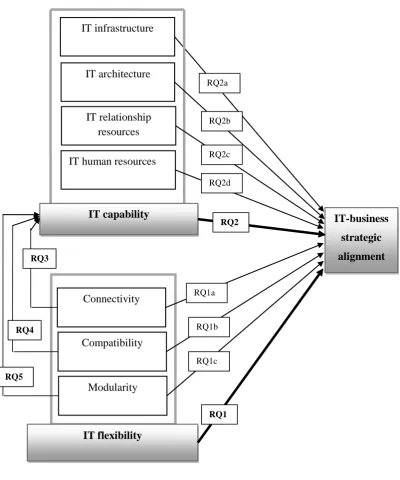
capability components are more related to strategic alignment. The study also considers which IT flexibility components, that is, connectivity, compatibility, and modularity, are more associated with IT capability. To achieve these goals, the following research questions have been posed.
RQ1: To what extent, if any, does IT flexibility relate to the degree of IT-business strategic alignment?
RQ1a: To what extent, if any, does connectivity of IT flexibility relate to the degree of IT-business strategic alignment?
RQ1b: To what extent, if any, does compatibility of IT flexibility relate to the degree of IT-business strategic alignment?
RQ1c: To what extent, if any, does modularity of IT flexibility relate to the degree of IT-business strategic alignment?
RQ2: To what extent, if any, does IT capability relate to the degree of IT-business strategic alignment?
RQ2a: To what extent, if any, does IT infrastructure (as a dimension of IT capability) relate to the degree of IT-business strategic alignment?
RQ2b: To what extent, if any, does IT architecture (as a dimension of IT capability) relate to the degree of IT-business strategic alignment?
RQ2c: To what extent, if any, does IT relationship resource (as a dimension of IT capability) relate to the degree of IT-business strategic alignment? RQ2d: To what extent, if any, does IT human resource (as a dimension of IT capability) relate to the degree of IT-business strategic alignment?
RQ3: To what extent, if any, does connectivity of IT flexibility relate to the degree of IT capability?
13
RQ5: To what extent, if any, does modularity of IT flexibility relate to the degree of IT capability?
Figure 1.1 The Proposed Model Modularity
Compatibility IT infrastructure
IT-business strategic alignment
Connectivity
IT flexibility IT architecture
IT relationship resources
IT human resources
IT capability
RQ1
RQ1a
RQ1b
RQ1c
RQ2
RQ2a
RQ2b
RQ2c
RQ2d
RQ4
1.7Scope of the Study
This research studied IT flexibility dimensions (i.e., connectivity, compatibility, and modularity) and IT capability (i.e., IT infrastructure, IT architecture, IT human resource, and IT relationship resource) as factors affecting strategic alignment. The study focused on organizations in Iran from various industries. Specifically, only those organizations that have a formal IT department were included in this study. The respondents were IT managers (or similar titles) in those organizations as person that possesses detailed knowledge of IT and its relationship to business.
1.8Contribution to Academic Research
The researcher believes that there are significant contributions in conducting
15
One of the purposes of this research is to determine which dimensions of IT capability (i.e., IT architecture, IT infrastructure, IT human resource, and IT relationship resource) have more impact on strategic alignment. The outcome of this study would allow researchers to understand new knowledge of strategic alignment domain in terms of which dimensions of IT capability has more impact on strategic alignment.
IT flexibility, IT capability, and strategic alignment have not been previously studied simultaneously, and thus there is an opportunity to extend knowledge in the strategic alignment domain by simultaneously investigating IT flexibility dimensions and IT capability dimensions and their effect on strategic alignment. The impact of IT flexibility dimensions and IT capability dimensions in combination on strategic alignment provides a more comprehensive view of interrelationship of all these factors.
1.9Contributions to Practice
and understanding they need in dealing with flexible IT. This study also focused on the effects that the components in IT flexibility such as modularity, connectivity and compatibility have on IT capability. The findings from this study will be able to assist business and IT managers to make more accurate decisions regarding factors which affect their IT capability. It is also hoped that managers will have a better insight and knowledge on how to support their IT capabilities in their businesses. As stated earlier, the research studied the impact of IT capability dimensions on strategic alignment. Since this part of the research has not been previously studied in the manner which is employed here, the findings will assist managers in gaining new understanding. In addition, this will help managers gaining new insights into which factors of IT capability dimensions and IT flexibility dimensions are more important to support strategic alignment. In addition, the results will aid IT management in more effectively setting the priorities for allocating financial resources towards IT capability dimensions and IT flexibility dimensions. This new knowledge can benefit managers who are deciding whether or not to invest corporate funds to bring their organizations into compliance with new technologies which could help them to achieve a sustainable competitive advantage. As mentioned earlier, good strategic alignment leads to enhanced performance of the organisation. So, this research can help organisations to improve their performance.
1.10 Definition of Terms
The three main components of this study, which are IT strategic alignment, IT capability and IT flexibility, are defined in this section.
1.10.1 IT Strategic Alignment
17
According to Henderson and Venkatraman (1993), strategic alignment can be viewed as the „“Strategic Fit‟ and „Functional Integration‟ among business strategy, IT strategy, business infrastructure, and IT infrastructure”. In addition, Reich and Benbasat (1996; 2000), believe strategic alignment to be the extent to which the IT goal, targets and agendas aid and are aided by the firm‟s goal, targets and agendas. Luftman (2000) also states that IT-business strategic alignment refers to “applying Information Technology (IT) in an appropriate and timely way, in harmony with business strategies, goals and needs”. The most common view on IT-business strategic alignment is stated by Sauer and Yetton (1997), stating that the basic principle is that IT should be managed in a way that mirrors management of the business. Conceptually, IT strategic alignment is viewed in the literature as a bridge that links IT to different viewpoints on other domains of an organization and its environment (Avila, Goepp, and Kiefer, 2009, Chebrolu and Ness, 2013). In general, IT-business alignment concerns the degree to which IT supports business goals, strategies, and needs (Silvius, 2008; Rahbar, Zeinolabedin, and Afiati Mehrvarz, 2013).
1.10.2 IT Flexibility
Information system flexibility is “the ability to respond and adapt to changing business conditions both within and outside the organisation” (Mensah, 1989). In other literature, Duncan (1995) has demonstrated information technology flexibility by making references to platform, network/telecommunication, data, and applications. Byrd and Turner (2000) have attempted to assess the flexibility of IT infrastructure by assessing IT connectivity, application functionality, IT compatibility, data transparency, technology management, management know-how, business know-how, and technical expertise.
infrastructure with regards adapting to alterations both internal and external to the organisation. It is also concerned with its ability to play the role of catalyst for information sharing, system enhancement and consistency of IT processes. Moreover, this should all be achieved with the least amount of work and time.
In this study, IT flexibility refers to the ability of IT to respond quickly and effectively in order to meet dynamic business strategies and to sustain strategic alignment in today‟s business environment (Luftman, 2005). Regarding the elements of IT flexibility, there appears to be consistency among several researchers. This is especially true of Tallon and Kraemer, (2003c); Byrd and Turner, (2000); and Duncan, (1995) who suggest that the elements applied for measuring IT flexibility consist of connectivity, compatibility, and modularity.
1.10.2.1 Connectivity
Connectivity is defined by Chanopas, Krairit, and Khang(2006) and Byrd and Turner (2000), as the ability of IT components (hardware and software) to attach and connect to others both inside and outside the organisation. It has been stressed by Tapscott and Caston (1993) that with IT connectivity, organisations are flawless and transparent and are free from the influence of time and space. It is much easier to share IT resources at the platform level with connectivity. In general, connectivity is the ability of any technology component to communicate with any of the other components inside and outside of the organizational environment (Duncan, 1995).
1.10.2.2 Compatibility
19
information over a plethora of technology (hardware and software) platforms both internal to the organisation and external to the organisation. Organisations are increasingly interconnected and e-connected with the outside world and they are no longer a technology island. Compatibility refers to the ability to integrate many enterprise systems and enable them to share information (Byrd, Lewis, and Bradley, 2006). According to Ness (2005), compatibility encompasses the ability which a company has to spread any kind of information across a plethora of technology (hardware and software) platforms whether internal to the organisation or external to it. In this research, compatibility is the ability to share and use any type of data and applications across any technology component.
1.10.2.3 Modularity
Duncan (1995) defines modularity as the ability to easily add, modify, and remove technology components to support business strategy changes. Duncan also indicated that modularity is the ability for business processes to be standardized in order for them to be shared and reused (e.g., structured programming and component-based software architectures). According to Schilling (2000), modularity is described as the level or degree in which a system‟s component can be divided and put together again. Seltzer (2005) argues that modularity is an influential tool which is used for controlling the size and complexity of enterprise systems, while also making it possible for application and data management capabilities to interact harmoniously. This research considers modularity as the ability to easily add, modify and remove technology components.
1.10.3 IT Capability
degree of firm‟s efficiency to utilise its IT to process information in the organisation, which consists of IT-operation, IT object, and IT knowledge.
Other researchers such as Peppard and Ward ( 2004) depict IT capability as containing three interconnecting qualities, which are a combination of business knowledge with IT knowledge, an adaptable and recyclable IT infrastructure, and a process which is efficiently used. Jiao, Chang, and Lu (2008) view IT capability as being inseparable from enterprise formation, transfer, and deployment of enterprise information technology resources in an effort to support and enhance other one-of-a-kind functions. These are unique functions which have the power and ability to pioneer the latent potential needed to sustain competitive advantages. Examples of these functions are IT architecture and routine, IT infrastructure, IT human resources, and IT relationship assets.
Recently, Qingfeng and Daqing (2008) and Zhang and Tansuhaj (2007) have pictured IT capability as a multidimensional construct, that is, (1) IT architecture, (2) IT infrastructure, (3) IT human resource, and (4) IT relationship resource, the definition of which is considered in this research.
1.10.3.1 IT Architecture
IT architecture is defined as an elevated map of information and an organisation‟s capabilities in telecommunications technology (Gibson, 1994). The necessity for consistency and integration in an organisation‟s operating model is defined by architecture (Ross and Westerman, 2004). Architecture is the clarity and organizational consensus surrounding technology, data, and process benchmark. Feeny and Willcooks (1998) pointed out that IT architecture as the choices of technical platforms on which to mount IS service, and it is the first critical step in managing IT assets of the organization.
21
organizational consensus around technology, data, and process standards”. This research considers IT architecture as the level of clarity and organizational consensus around technology, data, and processes to support business needs.
1.10.3.2 IT Infrastructure
IT infrastructure consists of communication technologies and computers, as well as the technical platforms and databases which are shareable (Ross, Beath and Goodhue, 1996; Weill, Subramani, and Broadbent, 2002). According to Zhang‟s (2005) study, firms that have sufficient IT infrastructure; they have well-established in- house networks and external Web sites and linkage, a computer lab for employee instruction and strong data and network architecture. In addition, they have communication devices for access of remote database and computer facilities for IT projects. In general, IT infrastructure is defined as the shared IT resource that data and applications access through communication networks for organizational use (Bhatt, 2000; Zhang, 2005).
As stated by Bhatt (2000) and Zhang (2005), the key purpose of IT infrastructure is to provide quick information support throughout the firm to react to dynamic challenges in the markets. In this research, IT infrastructure is the degree to which computers, communication technologies, technical platforms, and databases exist in the organization.
1.10.3.3 IT Human Resources
Farwell, 1995). In today‟s organisations, research has made it clear that these soft skills are just as vital to programmers, database administrators, systems analysts, and other IT staff (Cheney, Hale and Kasper, 1989; Rockart, Earl, and Ross, 1996; Ross, Beath, and Goodhue, 1996).
IT human resources is defined as a valuable human asset that can be used to consistently solve business problems and address business opportunities through information technology. It is related to IT technical skills, IT managerial skills, business understanding and planning, and problem-solving orientation (Bharadwaj, 2000; Zhang, 2005). This research considers IT human resource as level of IT staff‟s technical skills, business understanding, and problem-solving orientation (Zhang, 2005).
1.10.3.4 IT Relationship Resource
IT relationship resource is defined as the valuable relationship between the IT and business departments (Zhang, 2005). Examples of a valuable relationship asset can be found in: 1) business partner ownership of every IT project, 2) executive management guidance in creating IT priorities, 3) furthering users‟ comprehension of IT‟s uses, and 4) IT sourcing ability (Ross, Beath and Goodhue, 1996; Bharadwaj, 2000; Feeny and Willcocks, 1998).In general, IT relationship resource is the level of closeness in relationship between IT and business departments as well as between a firm and its vital business partners (i.e., customers, suppliers, and other organizations) (Zhang, 2005; Zhang and Tansuhaj, 2007).
23
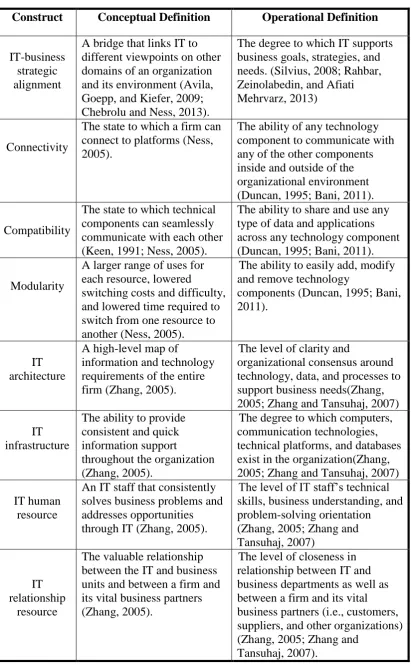
Table 1.1: Definition of the Constructs
Construct Conceptual Definition Operational Definition
IT-business strategic alignment
A bridge that links IT to different viewpoints on other domains of an organization and its environment (Avila, Goepp, and Kiefer, 2009; Chebrolu and Ness, 2013).
The degree to which IT supports business goals, strategies, and needs. (Silvius, 2008; Rahbar, Zeinolabedin, and Afiati Mehrvarz, 2013)
Connectivity
The state to which a firm can connect to platforms (Ness, 2005).
The ability of any technology component to communicate with any of the other components inside and outside of the organizational environment (Duncan, 1995; Bani, 2011). Compatibility
The state to which technical components can seamlessly communicate with each other (Keen, 1991; Ness, 2005).
The ability to share and use any type of data and applications across any technology component (Duncan, 1995; Bani, 2011).
Modularity
A larger range of uses for each resource, lowered
switching costs and difficulty, and lowered time required to switch from one resource to
another (Ness, 2005).
The ability to easily add, modify and remove technology
components (Duncan, 1995; Bani, 2011).
IT architecture
A high-level map of
information and technology requirements of the entire firm (Zhang, 2005).
The level of clarity and
organizational consensus around technology, data, and processes to support business needs(Zhang, 2005; Zhang and Tansuhaj, 2007) IT
infrastructure
The ability to provide consistent and quick information support
throughout the organization (Zhang, 2005).
The degree to which computers, communication technologies, technical platforms, and databases exist in the organization(Zhang, 2005; Zhang and Tansuhaj, 2007) IT human
resource
An IT staff that consistently solves business problems and addresses opportunities through IT (Zhang, 2005).
The level of IT staff‟s technical skills, business understanding, and problem-solving orientation (Zhang, 2005; Zhang and Tansuhaj, 2007)
IT relationship
resource
The valuable relationship between the IT and business units and between a firm and its vital business partners (Zhang, 2005).
The level of closeness in relationship between IT and business departments as well as between a firm and its vital business partners (i.e., customers, suppliers, and other organizations) (Zhang, 2005; Zhang and
1.11 Plan of the Thesis
192
REFERENCES
Abbasi, A., SadeghiNiaraki, A., MirzaeianDehkordi, B., (2008), A Review of ICT Status and Development Strategy Plan in Iran, International Journal of Education and Development using Information and Communication Technology (IJEDICT). 4 (3(, 143-154.
Ahuja, V. (1988). Common Communications Support in Systems Application Architecture. IBM Systems Journal, 27(3), 264-281.
Alter, A. E. (2005). CIOs Shift: Focus IS on Revenue, Not on Saving Money. CIO Insight, October 15.
Arbnor, I., and Bjerke, B. (1997). Methodology for Creating Business Knowledge: Thousand Oaks, Calif.; London, Sage.
Armstrong, C. P., and Sambamurthy, V. (1999). Information Technology Assimilation in Firms: The Influence of Senior Leadership and IT Infrastructures. Information Systems Research, 10(4), 304-327.
Association, G. M. Grocery Manufacturers Association, IBM (2008) GMA Information Technology Investment and Effectiveness Study. City: Washington, D.C: GMA, Publication No. GBE03087-USEN-00.
Avison, D., Jones, J., Powell, P., & Wilson, D. (2004). Using and Validating the Strategic Alignment Model Journal of Strategic Information Systems, 13(3), 223-246.
Bacharach, S. B., and Aiken, M. (1972). Communication in Administrative Bureaucracies. Academy of Management Review, 20, 365-377.
Bai, R. J., and Lee, G. G. (2003). Organizational Factors Influencing the Quality of the IS/IT Strategic Planning Process. Industrial Management & Data Systems, 103(8), 622-632.
Bani, J. (March 2011). Assessing the Relationships among Information Technology Flexibility, IT-Business Strategic Alignment, and Information Technology
Thesis, School of Business and Technology, Capella University, USA.
Barrett, S., and Konsynski, B. (1982). Inter-Organization Information Sharing Systems. MIS Quarterly (Special Issue).
Bassellier, G., and Benbasat, I. (2004). Business Competence of Information Technology Professionals: Conceptual Development and Influence on IT-Business Partnerships. MIS Quarterly, 28(4), 673-694.
Beal, B. (2003). The Priority that Persists. CIO Magazine, October 15.
Bechor, T., Neumann, S., Zviran, M., and Glezer, C. (2010). A Contingency Model for Estimating Success of Strategic Information Systems Planning. Information & Management, 47(1), 17-29.
Berg, B. (2007). Qualitative Research Methods for the Social Sciences USA: Pearson Bergeron, F., Raymond, L., and Rivard, S. (2004). Ideal Patterns of Strategic
Alignment and Business Performance. Information & Management, 41(8), 1003-1020.
Betz, F. (2001). Executive Strategy: Strategy Management and Information Technology, New York: John Wiley and Sons.
Bharadwaj, A., Bharadwaj, S., and Konsynski, B. (1999). Information Technology Effects as Measured by Tobin's q. Management Science 45(6), 1008-1024. Bharadwaj, A. S. (2000). A Resource-Based Perspective on Information Technology
Capability and Firm Performance: An Empirical Investigation. MIS Quarterly, 24(1), 169-196.
Bharadwaj, A. S., Sambamurthy, V., and Zmud, R. W. (1999). IT Capabilities: Theoretical Perspectives and Empirical Operationalization20th International Conferences on Information Systems. City: Charlotte, NC.
Bhatt, G. D. (2000). Exploring the Relationship between Information Technology, Infrastructure and Business Process Re-Engineering. Business Process Management Journal, 6(2), 139-163.
Bhatt, G. D., and Grover, V. (2005). Types of Information Technology Capabilities and Their Role in Competitive Advantage: An Empirical Study. Journal of Management Information System 22(2), 253-277.
Blodgett, M. (2004). The challenge: Globalization. CIO Magazine, 56(August 15). Boar, B. H., AT&T Bell Laboratories (1994). Practical Steps for Aligning
Information Technology with Business Strategies - How To Gain a
194
Boar, B. H. (2001). The Art of Strategic Planning for Information Technology (Second ed.), New York: John Wiley & Sons, Inc.
Bowman, B., Davis, G. B., and Wetherbe, J. C. (1983). Three Stage Model of MIS Planning. Information and Management, 6(1), 11-25.
Brancheau, J. C., Janz, B. D., and Wetherbe, J. C. (1996). Key Issues in Information Systems Management: 1994-95 SIM Delphi Results. MIS Quarterly, 20(2), 225-242.
Brancheau, J. C., and Wetherbe, J. C. (1987). Key Issues in Information Systems Management. MIS Quarterly, 11(1), 23-45.
Broadbent, M., and Weill, P. (1997). Management by Maxim: How Business and IT Managers Can Create IT Infrastructures. MIT Sloan Management Review, 38(3), 77-92.
Brown, C. V., and Magill, S. L. (1994). Alignment of the IS Functions with the Enterprise: Toward a Model of Antecedents. MIS Quarterly 18(4), 371-404. Brown, C. V., and Sambamurthy, V. (1999). Repositioning the IT Organization to
Enable Business Transformation: Pinnaflex Educational Resources,
Cincinnati, OH.
Brown, I. T. J. (2004). Testing and Extending Theory in Strategic Information Systems Planning through Literature Analysis. Information Resources Management Journal, 17(4), 20-48.
Brynjolfsson, E., and Hitt, L. M. (1996). Paradox Lost? Firm-level Evidence on the Returns to Information Systems Spending. Management Science, 42(4), 541-558.
Buchanan, R. D., and Soley, M. (2002). Aligning Enterprise Architecture and IT Investments with Corporate Goals: White Paper, META Group, Inc.
Burke, M. F. (February 2011). IT Effectiveness and Flexibility versus Strategic Alignment: Assessing the Correlative Effects in Higher Education, PhD.
Thesis, School of Business and Technology, Capella University.
Burn, J. M. (1996). IS Innovation and Organisational Alignment – a Professional Juggling Act. Journal of Information Technology Management, 11(1), 3-12. Byrd, T. A., Lewis, B. R., and Bradley, R. V. J. (2006). Is Infrastructure: The
Influence of Senior IT Leadership And Strategic Information Systems Planning. The Academy of Management Executive, 47(1), 101-113.
Technology Infrastructure: Exploratory Analysis of a Construct. Journal of Management Information Systems Management, 17(1), 167-208.
Capon, N., and Glazer, R. (1987). Marketing and Technology: A Strategic Co alignment. Journal of Marketing, 51(3), 1-14.
Chan, Y., and Reich, H. (2007). IT Alignment: What Have We Learned? Journal of Information Technology, 22(4), 297-315.
Chan, Y. E. (2002). Why Haven't We Mastered Alignment? The Importance of the Informal Organization Structure. MIS Quarterly Executive, 1(2), 97-112. Chan, Y. E., and Huff, S. L. (1993). Strategic Information Systems Alignment.
Business Quarterly, 58(1), 51-55.
Chan, Y. E., Huff, S. L., Barclay, D. W., and Copeland, D. G. (1997). Business Strategic Orientation, Information Systems Strategic Orientation, and Strategic Alignment. Information Systems Research, 8(2), 125-150.
Chan, Y. E., Sabherwal, R., and Thatcher, J. B. (2006). Antecedents and Outcomes of Strategic IS Alignment: An Empirical Investigation. IEEE Transactions on Engineering Management, 53(1), 27-47.
Chanopas, A., Krairit, D., and Khang, D. B. (2006). Managing Information Technology Infrastructure: A New Flexibility Framework. Management Research News, 29(10), 632-651.
Chau, P. (1999). On the Use of Construct Reliability in MIS Research: A Meta-Analysis. Information and Management, 35(4), 217-227.
Chebrolu, S. B. (2010). Assessing the Relationships among Cloud Adoption, Strategic Alignment and Information Technology Effectiveness, PhD. Thesis,
Capella University, Minneapolis, MN.
Chebrolu, S.B., Ness, L. (2013). How Does Alignment of Business and IT Strategies Impact Aspects of IT Effectiveness? International Journal of Applied
Management and Technology, 12(1), 1–15.
Chen, L. (2010). Business-IT Alignment Maturity of Companies in China. Information & Management, 47, 9-16.
Chen, R., Sun, C., Helms, M., and Jih, W. (2009). Factors Influencing Information System Flexibility: An Interpretive Flexibility Perspective. International Journal of Enterprise Information Systems, 5(1), 32-43.
196
Conference on Systems Science.
Cheng, Q., Zhang, R., and Tian, Y. (2008). Study on Information Technology Capabilities Based on Value Net Theory. International Symposium on Electronic Commerce and Security, 2008 IEEE, 1045-1050.
Chin, W. W. (1998). The Partial Least Square Approach to Structural Equation Modeling: G.A. Marcoulides (ed.), Lawrence Erlbaum Associates, Mahwah,
NJ.
Chin, W. W. (2010). How to Write up and Report PLS Analyses. In Esposito, V., et al. (eds.), Handbook of Partial Least Squares New York: Springer-Verlag.
Choi, J. (2007). Business Driven Strategy for Service-Oriented Architecture: A Systems Dynamics Approach International Conference on Service Oriented Computing (ICSOC 2007). City: Vienna, Austria, pp. 19-24.
Chung, S. H., Rainer, R. K., and Lewis, B. R. (2003). The Impact of Information Technology Infrastructure Flexibility on Strategic Alignment and Applications Implementation. Communications of AIS, 11, 191-206.
Churchill, G. A. (1979). A Paradigm for Developing Better Measures of Marketing Constructs. Journal of Marketing Research, 16(February), 64-73.
Ciborra, C. U. (1996). The Platform Organization: Recombining Strategies, Structures, and Surprises. Organization Science, 7(2), 103-118.
Ciborra, C. U. (1997). De Profundis? Deconstructing the Concept of Strategic Alignment. Scandinavian Journal of Information Systems 9(1), 67-82.
Clemons, E. K., and Row, M. C. (1991). Sustaining IT Advantage: The Role of Structural Differences. MIS Quarterly, 15(3), 275-293.
Coleman, P., and Papp, R. (2006). Strategic Alignment: Analysis of Perspectives Proceedings of the 2006 Southern Association for Information Systems
Conference. City: Jacksonville, Florida USA, pp. 241–250.
Cooper, D. R., and Schindler, P. S. (2004). Business Research Methods (8th edition), Delhi: Tata McGraw-Hill.
Cooper, D. R., and Schindler, P. S. (2006). Business Research Methods (9th edition), New York: McGraw-Hill Irwin.
Copeland, D. G., and McKenney, J. L. (1988). Airline Reservation System: Lessons from History. MIS Quarterly, 12(3), 353-370.
(1995). IS '95: Guideline for Undergraduate IS Curriculum. MIS Quarterly, 19(3), 341-360.
Coughlan, J., Lycett, M., and Macredie, R. D. (2005). Understanding the Business-IT Relationship. International Journal of Information Management, 25(4), 303-319.
Cragg, P., King, M., and Hussin, H. (2002). IT Alignment and Firm Performance in Small Manufacturing Firms. Journal of Strategic Information Systems, 11(2), 109-132.
Crano, W. D., and Brewer, M. B. (1973). Principles of Research in Social Psychology, New York: McGraw-Hill.
Cronbach, L. J. (1951). Coefficient Alpha and the Internal Structure of Tests. Psychometrika, 22(3), 297-334.
Croteau, A. M., and Bergeron, F. (2001). An Information Technology Trilogy: Business Strategy, Technological Deployment and Organizational Performance. Journal of Strategic Information Systems, 10(2), 77-99.
Croteau, A. M., Bergeron, F., and Raymond, L. (2001). Business Strategy and Technological Deployment: Fit and Performance. Information System and Management, 6(4).
Croteau, A. M., and Raymond, L. (2004). Performance Outcomes of Strategic and IT Competencies Alignment. Journal of Information Technology 19, 178-190. Das, S. R., Zahra, S. A., and Warkentin, M. E. (1991). Integrating the Content and
Process of Strategic Mis Planning with Competitive Strategy. Decision Sciences, 22(5), 953-984.
Decoene, V., and Bruggeman, W. (2006). Strategic Alignment and Middle-Level Managers‟ Motivation in a Balanced Scorecard Setting. International Journal of Operations & Production Management, 26(4), 429-448.
Ding, L., Velicer, W. F., and Harlow, L. L. (1995). Effects of Estimation Methods, Number of Indicators per Factor, and Improper Solutions on Structural Equation Modeling Fit Indices. Structural Equation Modeling, 2, 119–143. DiRomualdo, A., and Gurbaxani, V. A. (1998). Strategic Intent for IT Outsourcing.
Sloan Management Review, 39(4), 115-116.
Dowlatabadi, H.R., Khorasani, M., Shirvan, M.K. (2014, July). Assessing the
198
Bank Saderat Iran. Arabian Journal of Business and Management Review, 3(11), 154-165.
Duncan, N. B. (1995). Capturing Flexibility of Information Technology Infrastructure: A Study of Resource Characteristics and Their Measure. Journal of Management Information Systems, 12(2), 37-58.
Earl, M. J. (1993). Experiences in Strategic Information Systems Planning. MIS Quarterly, 17(1), 1-24.
Earl, M. J., and Feeny, D. F. (1994). Is Your CIO Adding Value? Sloan Management Review, 11-20.
Edmondson, A. C., Roberto, M. R., and Watkins, M. (2003). A Dynamic Model of Top Management Team Effectiveness: Managing Unstructured Task Streams. Leadership Quarterly, 219, 1–29.
Ein-Dor, P., and Segev, E. (1982). Organizational Context and Mis Structure: Some Empirical Evidence. MIS Quarterly, 55-67.
Emmerich, W., Aoyama, M., and Sventek, J. (2007). The Impact of Research on Middleware Technology. ACM SIGSOFT Software Engineering Notes, 32(1), 21-46.
E-Sourcing. (2002, February). Information Technology on Demand: Utility Computing Marks a New Stage in the Evolution of Outsourcing, and May be the First to Fully Deliver on the Strategy's True Potential the Chief Executive. Fang, Y., Wade, M., Delios, A., and Beamish, P. W. (2007). International
Diversification Subsidiary Performance, and the Mobility of Knowledge Resources. Strategic Management Journal, 28(10), 1053-1064.
Faryabi, M., Fazlzadeh, A., Zahedi, B., Alizadeh Darabi, H. (2012). Alignment of Business, IT, and Its Association with Business Performance: The Case of Iranian Firms, Journal of Business and Management, 1(1), 15-28.
Feeny, D., and Willcocks, L. (1998). Core IS Capabilities for Exploiting Information Technology. Sloan Management Review, 39(3), 9-21.
Feeny, D. F., Edwards, B., and Simpson, K. (1992). Understanding the CEO/CIO Relationship. MIS Quarterly, 16, 435-447.
Fertuck, L. (1992). Systems Analysis and Design: With CASE Tools, Wm. C. Brown Communications Inc.Dubuque, Iowa.
Fink, L., and Neumann, S. (2009). Exploring the Perceived Business Value of The Flexibility Enabled by Information Technology Infrastructure. Information & Management, 46(2), 90-99.
Floyd, S. W., and Wooldridge, B. (1990). Path Analysis of the Relationship between Competitive Strategy, Information Technology, and Financial Performance. Journal of Management Information Systems Quarterly, 7(1), 47-64.
Fornell, C., and Larcker, D. F. (1981). Evaluating Structural Equation Models with Unobservable Variables and Measurement Error. Journal of Marketing Research, 18, 39-50.
Galliers, R., and Leidner, D. E. (2003). Strategic Information Management: Challenges and Strategies in Managing Information Systems (3rd Ed.),
Oxford, UK: Butterworth-Heinemann.
Galliers, R. D., and Sutherland, A. R. (1991). Information Systems Management and Strategy Formulation: The „Stages of Growth‟ Model Revisited. Information Systems Management, 1, 89-114.
Gefen, D. (2003). Tutorial Assessing Unidimensionality through LISREL: An Explanation and Example. Communications of the Association for Information Systems 12(2), 1-26.
Gefen, D., and Straub, D. (2005). A Practical Guide to Factorial Validity Using PLS-Graph: Tutorial and Annotated Examples. Communications of AIS, 16.
Gerbing, D. W., and Anderson, J. C. (1988). An Updated Paradigm for Scale Development: Incorporating Unidemensionality and its Assessment. Journal of Marketing Research 25, 186-192.
Gibson, R. (1994). Global Information Technology Architectures. Journal of Global Information Management, 2(1), 28-39.
Goldman, S. L., Nagel, R. N., and Preiss, K. (1995). Agile Competitors and Virtual Organizations: Strategies for Enriching the Customer, NY: Van Nostrand
Reinhold Reinhold.
Goldsmith, N. (1991). Linking IT Planning to Business Strategy. Long Range Planning, 24(6), 67-77.
200
International Conference on System Sciences, IEEE Computer Society Press.
Grant, G. G. (2003). Strategic Alignment and Enterprise Systems Implementation: The Case of Metalco. Journal of Information Technology, 18, 159–175. Grant, R. M. (1991). The Resource-Based Theory of Competitive Advantage:
Implications for Strategy Formulation. California Management Review (spring), 114–135.
Grembergen, W. V., and Haes, S. D. (2009). Achieving Strategic Alignment and Value. Enterprise Governance of Information Technology, 3, 21-.
Grossman, R. B., and Packer, M. B. (1989). Betting the Business: Strategic Programs to Rebuild Core Information Systems. Information Technology & People, 5(4), 235-244.
Gutierrez, A., Orozco, J., and Serrano, A. (2009). Factors Affecting IT and Business Alignment: A comparitive study in SMEs and large organizations. Journal of Enterprise Information Management, 22(2), 197-211.
Hair, J. F., Anderson, R. E., Tatham, R. L., and Black, W. C. (1998). Multivariate Data Analysis New Jersey: Prentice-Hall.
Hatch, J., and Zweig, J. (2001). Strategic Flexibility: The Key to Growth. Ivey Business Journal, 65(4), 44-47.
Hatzakis, T., Lycett, M., Macredie, R., and Martin, V. (2005). Towards the Development of a Social Capital Approach to Evaluating Change Management Interventions. European Journal of Information Systems, 14(1), 60-74.
Henderson, J. C., Rockart, J. F., and Sifonis, J. G. (1987). Integrating Management Support Systems into Strategic Information Systems Planning. Journal of Management Information Systems, 4(1), 5-24.
Henderson, J. C., and Sifonis, J. G. (1988). The Value of Strategic IS Planning: Understanding Consistency, Validity, and IS Markets. MIS Quarterly, 12(2), 186–200.
Henderson, J. C., and Venkatraman, N. (1991). Understanding Strategic Alignment. Business Quartely, winter, 55(3), 72-78.
Henderson, J. C., and Venkatraman, N. (1993). Strategic Alignment: Leveraging Information Technology for Transforming Organizations. IBM Systems Journal, 32(1), 4-16.
Information Technology for Transforming Organizations. IBM Systems Journal, 38(2), 472–478.
Hirschheim, R., and Sabherwal, R. (2001). Detours in the Path toward Strategic Information Systems Alignment. California Management Review, 44(1), 87-108.
Hirschheim, R., Schwarz, A., and Todd, P. (2006). A Marketing Maturity Model for IT: Building a Customer-Centric IT Organization. IBM Systems Journal, 45(1), 181- 199
Hitt, M. A., Ireland, R. D., and Hoskisson, R. E. (1999a). Strategic Management: Competitiveness and Globalization (3rd ed.), Cincinnati: South-Western
Publishing.
Hu, Q., and Huang, C. D. (2006). Using the Balanced Scorecard to Achieve Sustained IT-Business Alignment: A Case study. Communications of the Association for Information Systems, 17, 181-204.
Huang, C. D., and Hu, Q. (2007). Achieving IT-business Strategic Alignment via Enterprise Wide Implementation of Balanced Scorecards. Information Systems Management, 24(2), 173-184.
Hussin, H., King, M., and Cragg, P. (2002). IT Alignment in Small Firms. European Journal of Information Systems, 11(2), 108-128.
InformationWeek (1999). Bond the New and the Old: Enterprise Architecture. Information Week, January 11, 108-109.
Inmon, W. H. (1989). Data Architecture: The Information Paradigm, Wellesley, MA: QED Information Sciences.
Ives, B., Jarvenpaa, S. L., and Mason, R. O. (1993). Global Business Drivers: Aligning Information Technology to Global Business Strategy. IBM Systems Journal, 32(1), 143-161.
Ives, B., and Mandviwalla, M. (2004). Key Issues Facing Information Systems Executives: eBusiness Institute, Temple University, EU.
Jain, A. (2007, May). Towards a Systemic View of Organizational Dynamic IT Capability: An Empirical Assessment, Ph.D. thesis, The University of Texas
at Arlington.
Jarvenpaa, S. L., and Ives, B. (1993). Organizing for Global Competition: The Fit of Information Technology. Decision Sciences, 24(3), 547–580.
202
Capability and Performance: An Empirical Research in the Context of China‟s Yangtze River Delta Region the IEEE International Conference on Industrial Engineering and Engineering Management, pp. 872–876.
Johnson, A. M., and Lederer, A. L. (2005). The Effect of Communication Frequency and Channel Richness on the Convergence between Chief Executive and Chief Information Officers. Journal of Management Information Systems, 22, 227-252.
Joshi, M. P., Kathuria, R., and Porth, S. (2003). Alignment of Strategic Priorities and Performance: An Integration of Operations and Strategic Management Perspectives. Journal of Operations Management, 21, 353-369.
Kaiser, H. F. (1974). An Index of Factorial Simplicity. Psychometrika, 39, 31-36. Kamal, M. M. (2006). IT Innovation Adoption in the Government Sector:
Identifying the Critical Success factors. Journal of Enterprise Information Management, 19(2), 192-222.
Kaplan, R. S., and Norton, D. P. (1992). The Balanced Scorecard - Measures That Drive Performance. Harvard Business Review, 70(1), 71-79.
Kaplan, R. S., and Norton, D. P. (2004). Strategy Map: Converting Intangible Assets into Tangible Outcomes: Harvard Business School Press.
Karimi, J., Gupta, Y. P., and Somers, T. M. (1996). The Congruence between a Firm‟s Competitive Strategy and Information Technology Leader‟s Rank and Role. Journal of Management Information Systems, 13(1), 63–88.