sciences
Article
A New Modified Firefly Algorithm for Optimizing a
Supply Chain Network Problem
Ashkan Memari1,2,* , Robiah Ahmad1, Mohammad Reza Akbari Jokar2 and Abd. Rahman Abdul Rahim1
1 Razak Faculty of Technology and Informatics, Universiti Teknologi Malaysia,
Kuala Lumpur 54100, Malaysia; [email protected] (R.A.); [email protected] (A.R.A.R.) 2 Department of Industrial Engineering, Sharif University of Technology, Tehran 1458889694, Iran;
* Correspondence: [email protected]; Tel.: +60-10-705-9832
Received: 10 November 2018; Accepted: 11 December 2018; Published: 20 December 2018
Abstract:Firefly algorithm is among the nature-inspired optimization algorithms. The standard firefly algorithm has been successfully applied to many engineering problems. However, this algorithm might be stuck in stagnation (the solutions do not enhance anymore) or possibly fall in premature convergence (fall in to the local optimum) in searching space. It seems that both issues could be connected to the exploitation and exploration. Excessive exploitation leads to premature convergence, while excessive exploration slows down the convergence. In this study, the classical firefly algorithm is modified such that make a balance between exploitation and exploration. The purposed modified algorithm ranks and sorts the initial solutions. Next, the operators named insertion, swap and reversion are utilized to search the neighbourhood of solutions in the second group, in which all these operators are chosen randomly. After that, the acquired solutions combined with the first group and the firefly algorithm finds the new potential solutions. A multi-echelon supply chain network problem is chosen to investigate the decisions associated with the distribution of multiple products that are delivered through multiple distribution centres and retailers to end customers and demonstrate the efficiency of the proposed algorithm.
Keywords:firefly algorithm; premature convergence; stagnation; supply chain optimization
1. Introduction
Firefly Algorithm (FA), initially introduced by Yang [1], is a nature-inspired algorithm originated from the flashing lights of fireflies. FA is among the latest swarm intelligence techniques and it is among metaheuristic algorithms and stochastic optimization approaches which can be applied for many difficult engineering problems including NP-Hard problems [2,3]. According to computational complexity theory, there are four types of problems based on their inherent difficulty. These problems
comprise P, NP, NP-Complete and NP-Hard problem (interested may refer to [2,3] for more
information). FA searches for a set of solutions by using a kind of randomization which means that it belongs to stochastic algorithms.
Flashing lights are the main characteristic of fireflies. The flashing lights have two primary functions: to attract mating partners and to warn other fireflies of probable predators. The flashing lights follow laws of physics, that is, according to the term, when the distancerincrease, the intensity of flashing lightsIdecrease. This phenomenon inspired Yang [1] to develop the FA. The classical FA was numerically formulated and implemented in MATLAB and it was explained in detail in Yang (2008) and Yang (2009).
Appl. Sci.2019,9, 7 2 of 12
There are two key factors need to be well defined to design FA properly: the formulation of attractiveness and the variation of light intensity. In FA, the light intensity (I) of a firefly, that presents the solution (s), is relative to the fitness function value (I(s) ∝ f(s)). However, according to the Equation (1), the light intensityI(r) can vary as follow:
I(r) =I0e−γr 2
(1)
where the source’s light intensity is denoted by I0 and the fixed light absorption coefficientγ is
approximating the light absorption. In Equation (1), the singularity atr= 0 is prevented by merging the effects of an absorption estimation in Gaussian form and the inverse square law. Similarly, Equation (2) can be defined to express the attractivenessβwhere the fireflies’ attractivenessβis proportional to
intensities of their lightI(r).
β=β0e−γr 2
(2)
whereβ0presents the attractiveness whenr= 0. The attractivenessβand light intensityIare by some
means synonymous. The attractiveness is the light relative measure which is subjective and judged by other fireflies. Intensity, however, is an absolute measure of released light by a firefly (Yang, 2009). To calculate the distance separating any two firefliessiandsj, the Euclidean distance is used as follows:
rij=||si−sj||=
v u u t
k=n
∑
k=1
(sik−sjk)2 (3)
wherenrepresents the problem dimensionality. Thei-th firefly movement is influenced by one other more attractive fireflyj, formulated in Equation (4):
si =si+β0e−γr 2
(sj−si) +αεi (4)
whereεiis a random number generated by Gaussian distribution. The firefly’s movement includes
three terms: (i) the recenti-th firefly’s position, (ii) absorption to a more attractive firefly and (iii) a random walk includes a random number generated from the interval [0, 1] and a randomization parameterα. Whenβ0= 0, the movement is only based on the random walk. Besides, the convergence speed is highly dependent on the parameterγ. This parameter’s value could be theoretically captured
any value from the intervalγ∈[0,∞). However, it typically varies from 0.1 to 10 and its setting relies on the nature of optimization problem.
In summary, three parameters control FA: (i) the randomization parameterα, (ii) the attractiveness βand (iii) the absorption coefficientγ. Based on the parameter setting, FA distinguishes two asymptotic
behaviours. The first behaviour appears whenγ→0 and the second behaviour latter appears when
γ→∞. In addition, ifγ→0, the attractiveness results in beingβ=β0, which indicates the attractiveness is constant throughout the search space. This special case is mostly a parallel version of particle swarm
optimization (PSO). Whenγ→∞, the fireflies’ movements turned into a random walk according
to Equation (4). This behaviour is a special case of simulated annealing. Simulated annealing is a technique for solving bound-constrained and unconstrained optimization problems. This technique
was introduced by [4] and inspired from the physical procedure of heating a material and then
gradually decreasing the temperature to reduce defects, consequently minimizing the system energy. Indeed, each FA can be considered between these two asymptotic behaviours. For more details about FA, interested readers can refer to [1].
The Need for Modifying Firefly Algorithm
Different strategies can be employed to avoid stagnation and premature convergence. For example, Abdullah et al. (2012) suggested explicit the balancing process for exploitation and exploration through sorting and splitting the initial population of FA in two equal groups (first half assigned to first group and second half is considered into the second group). While FA is applied for the first group, they proved neighbourhood searching of the second group can efficiently enhance the overall performance of standard FA, mainly stagnation, premature convergence and computational time.
For solving the various classes of problems, there is a need to modify the classical FA (Yang, 2010b). Furthermore, the FA relies on the attractiveness formulation and variation of light intensity. Each of these aspects allows substantial opportunity for algorithm enhancement. Several attempts have been made to modify firefly algorithm [5,6]. The main classifications can be found in Table1.
Table 1.Classification of modified FA in literature.
Type of Improvements References
Parallel firefly algorithm Husselmann and Hawick [7], Subutic, et al. [8], Eswari and Nickolas [9] Elitist firefly algorithm Tilahun and Ong [10], Abdullah, et al. [11–14]
Lévy flights randomized firefly algorithm Yang [15], Yang [16]
Binary represented firefly algorithm Chandrasekaran and Simon [17], Falcon, et al. [18], Palit, et al. [19,20] Gaussian randomized firefly algorithm Farahani, et al. [21]
Discrete firefly algorithm Bottani, et al. [22]
Chaos randomized firefly algorithm Coelho, et al. [23], Gandomi, et al. [24]
There are six main directions in literature for modifying FA (Table1). According to Table1, these directions have gone into the development of parallel FA, elitist FA, Lévy flights randomized FA, binary represented, Gaussian randomized FA and chaos randomized FA. In standard FA, the brightest firefly (the current global best solution) moves randomly which may decrease its brightness depending on the direction. This issue leads to decrease the algorithm performance. However, if the brightest firefly is allowed to move only if in a direction its brightness improves, the performance of algorithm will not
decrease. Lévy flights randomized, Gaussian randomized and Chaos randomized were considered
for this purpose. Note that the strengths and weaknesses of different ways for modifying of FA are highly depended on problem at hand. For example, the modify FA based on binary represented is more proper for problems with binary variables.
2. The Proposed Modified Firefly Algorithm
In this research, the standard FA is modified in to make a balance between exploitation and exploration to prevent stagnation and premature convergence by employing further operators in classical FA. The initial solutions of FA are ranked and sorted into two equal groups, afterward, the operators, that is, insertion, swap and reversion (Figure1) are utilized to provide a neighbourhood search of the potential solutions in the second group. Note that these operators are chosen on a random basis. Next, the acquired solutions combined with those in the first group and FA will be used for the new potential solutions. The swap operator changes the sequence of a generated random solutions by swapping two members’ position in the solutions’ sequence. The inversion operator changes the position of a member by assigning it as the last member in the sequence of a generated random solutions. The reversion operator holds the first member position and reverses the rest members’ positions. These operators depicted in Figure1. It should be noted that these operators are similar to simulated annealing operators that are employed for neighbourhood searching [4].
Appl. Sci.2019,9, 7 4 of 12
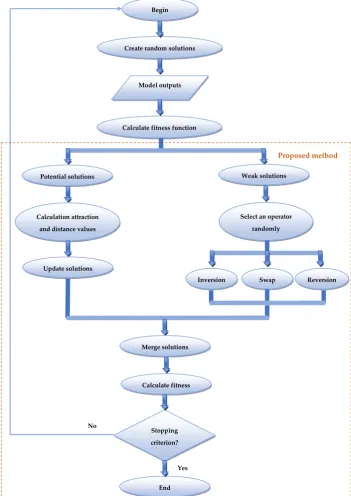
and FA will be run to find the optimal solutions. Figure2depicts the graphical representation of the modified FA.
Appl. Sci. 2018, 8, x FOR PEER REVIEW 5 of 12
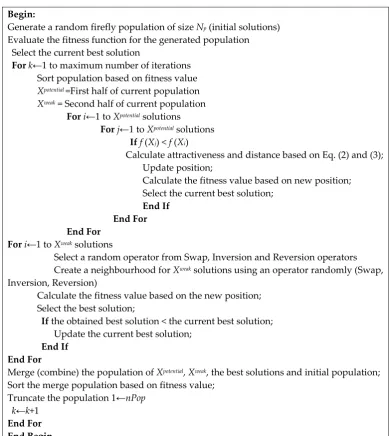
values of fitness function (in the case of minimization problem) stand in the last positions in the sequence of potential solutions for the problem at hand. Consequently, calculating the attraction and distance values for these kinds of solutions is a waste of time, because it is scarce that these solutions are selected as the optimum answer for the problem. However, in the modified algorithm, to not limit the searching space, we categorized these solutions in weak solutions group, in case if they can help the algorithm to find optimum answers in the next iterations. Figure 2 presents the pseudo-code for the modified FA.
Begin:
Generate a random firefly population of size Np (initial solutions) Evaluate the fitness function for the generated population Select the current best solution
For k←1 to maximum number of iterations Sort population based on fitness value Xpotential=First half of current population Xweak = Second half of current population For i←1 to Xpotential solutions For j←1 to Xpotential solutions If f (Xj) < f (Xi)
Calculate attractiveness and distance based on Eq. (2) and (3); Update position;
Calculate the fitness value based on new position; Select the current best solution;
EndIf EndFor EndFor
For i←1 to Xweak solutions
Select a random operator from Swap, Inversion and Reversion operators Create a neighbourhood for Xweak solutions using an operator randomly (Swap, Inversion, Reversion)
Calculate the fitness value based on the new position; Select the best solution;
If the obtained best solution < the current best solution; Update the current best solution;
End If End For
Merge (combine) the population of Xpotential, Xweak, the best solutions and initial population; Sort the merge population based on fitness value;
Truncate the population 1←nPop k←k+1
End For End Begin
Figure 2. Pseudo code for modified FA.
[A1 A2 A3 A4 A5] [A1 A5 A3 A4 A2]
[A1 A2 A3 A4 A5] [A1 A3 A4 A5 A2]
[A1 A2 A3 A4 A5] [A1 A5 A4 A3 A2]
Swap
Inversion
Reversion
Figure 1.Additional operators in the modified FA.
Appl. Sci. 2018, 8, x FOR PEER REVIEW 4 of 12
Figure 1. Graphical representation of modified FA.
As can be seen in Figure 1, the proposed algorithm begins similarly to the standard FA by generating random solutions and calculating their fitness functions. Afterward, the modified FA divides the solutions in two groups namely potential and weak solutions. The modified FA calculates the attraction and distance values for the members in the potential solution group. Note that in the standard FA, the attraction and distance values are calculated for all generated solutions. It must be noted this excessive exploration slows down the convergence. More precisely, while in the first steps of the algorithm initialization, random solutions are generated and their fitness functions are calculated and these solutions are sorted based on their fitness values. Those solutions with very high
Begin
Create random solutions
Model outputs
Calculate fitness function
Potential solutions
Calculation attraction and distance values
Update solutions
Weak solutions
Select an operator randomly
Inversion Swap Reversion
Merge solutions
Calculate fitness
End Stopping criterion?
Yes No
Proposed method
As can be seen in Figure 3, the proposed algorithm begins similarly to the standard FA by generating random solutions and calculating their fitness functions. Afterward, the modified FA divides the solutions in two groups namely potential and weak solutions. The modified FA calculates the attraction and distance values for the members in the potential solution group. Note that in the standard FA, the attraction and distance values are calculated for all generated solutions. It must be noted this excessive exploration slows down the convergence. More precisely, while in the first steps of the algorithm initialization, random solutions are generated and their fitness functions are calculated and these solutions are sorted based on their fitness values. Those solutions with very high values of fitness function (in the case of minimization problem) stand in the last positions in the sequence of potential solutions for the problem at hand. Consequently, calculating the attraction and distance values for these kinds of solutions is a waste of time, because it is scarce that these solutions are selected as the optimum answer for the problem. However, in the modified algorithm, to not limit the searching space, we categorized these solutions in weak solutions group, in case if they can help the algorithm to find optimum answers in the next iterations. Figure3presents the pseudo-code for the modified FA.
Appl. Sci. 2018, 8, x FOR PEER REVIEW 5 of 12
values of fitness function (in the case of minimization problem) stand in the last positions in the sequence of potential solutions for the problem at hand. Consequently, calculating the attraction and distance values for these kinds of solutions is a waste of time, because it is scarce that these solutions are selected as the optimum answer for the problem. However, in the modified algorithm, to not limit the searching space, we categorized these solutions in weak solutions group, in case if they can help the algorithm to find optimum answers in the next iterations. Figure 2 presents the pseudo-code for the modified FA.
Begin:
Generate a random firefly population of size Np (initial solutions) Evaluate the fitness function for the generated population Select the current best solution
For k←1 to maximum number of iterations Sort population based on fitness value Xpotential=First half of current population Xweak = Second half of current population For i←1 to Xpotential solutions For j←1 to Xpotential solutions If f (Xj) < f (Xi)
Calculate attractiveness and distance based on Eq. (2) and (3); Update position;
Calculate the fitness value based on new position; Select the current best solution;
EndIf EndFor EndFor
For i←1 to Xweak solutions
Select a random operator from Swap, Inversion and Reversion operators Create a neighbourhood for Xweak solutions using an operator randomly (Swap, Inversion, Reversion)
Calculate the fitness value based on the new position; Select the best solution;
If the obtained best solution < the current best solution; Update the current best solution;
End If End For
Merge (combine) the population of Xpotential, Xweak, the best solutions and initial population; Sort the merge population based on fitness value;
Truncate the population 1←nPop k←k+1
End For End Begin
Figure 2. Pseudo code for modified FA.
[A1 A2 A3 A4 A5] [A1 A5 A3 A4 A2]
[A1 A2 A3 A4 A5] [A1 A3 A4 A5 A2]
[A1 A2 A3 A4 A5] [A1 A5 A4 A3 A2]
Swap
Inversion
Reversion
Appl. Sci.2019,9, 7 6 of 12
It should be noted that the proposed modified FA (depicted in Figure3) differentiates from the classical FA by considering the additional operators (swap, reversion and inversion). In other word, the proposed modified FA sorts the population based on fitness value into two groups: potential and weak solution groups wherein classical FA, all population is considered in one group.
3. Results and Discussion
3.1. Problem Description
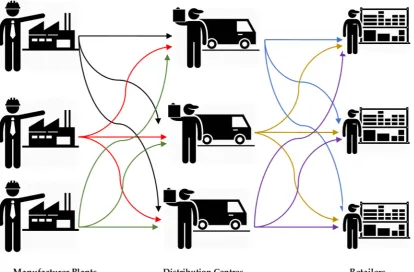
We consider a supply chain network problem to demonstrate the efficiency of the proposed modified FA. The investigated supply chain network problem in this study includes the decision associated with the distribution of multiple products that are produced by multiple manufacturers and distributed through multiple Distribution Centres (DCs) and Retailers. The schematic description of this problem is depicted in Figure4.
Appl. Sci. 2018, 8, x FOR PEER REVIEW 6 of 12
Figure 3. Additional operators in the modified FA.
It should be noted that the proposed modified FA (depicted in Figure 2) differentiates from the classical FA by considering the additional operators (swap, reversion and inversion). In other word, the proposed modified FA sorts the population based on fitness value into two groups: potential and weak solution groups wherein classical FA, all population is considered in one group.
3. Results and Discussion
3.1. Problem Description
We consider a supply chain network problem to demonstrate the efficiency of the proposed modified FA. The investigated supply chain network problem in this study includes the decision associated with the distribution of multiple products that are produced by multiple manufacturers and distributed through multiple Distribution Centres (DCs) and Retailers. The schematic description of this problem is depicted in Figure 4.
Figure 4. The considered supply chain network.
In the following, the problem’s assumptions and model formulation are presented: i. Indices
i Index of manufacturing plants, i = 1, 2, …, I j Index of DCs, j = 1, 2, …, J
k Index of retailers, k = 1, 2, …, K
p Index of different kinds of items, p = 1, 2, …, P t Index of the planning period, t = 1, 2, …, T I Number of manufacturing plants
J Number of DCs K Number of retailers P Number of items types T Number of periods
Figure 4.The considered supply chain network.
In the following, the problem’s assumptions and model formulation are presented:
i. Indices
i Index of manufacturing plants,i= 1, 2, . . . ,I j Index of DCs,j= 1, 2, . . . ,J
k Index of retailers,k= 1, 2, . . . ,K
p Index of different kinds of items,p= 1, 2, . . . ,P t Index of the planning period,t= 1, 2, . . . ,T
I Number of manufacturing plants
J Number of DCs
K Number of retailers
P Number of items types
ii. Parameters
Dkpt Demand in retailerkfor itempat the end of periodt
Caipt Supply capacity of manufacturing plantifor itempin periodt
ηjp Holding cost per unit of itempat DCjin each period
Lij Distance between manufactureriand DCj
υp Shipping cost per unit of itempalong unit distance
L’jk Distance (in kilometres) between DCjand retailerk
Ca’jt Distribution capacity of DCjin periodt
Vjt Total storage (holding capacity) capacity of DCjduring periodt
η’kp Holding cost per unit of itempat retailerkin each period
Skp Backlog cost per unit of itempat retailerk
Ukt Total holding capacity of retailerkduring periodt
iii. Decision variables
Xijpt Quantity of itemspshipped from manufacturing plantito DCjin periodt
Ipjt Inventory level of itempat DCjat the end of periodt
Yjkpt Quantity of itempshipped from DCjto retailerkduring periodt
Bpkt Backlog amount of itempat retailerkin periodt
Jpkt Inventory of itempat retailerkat the end of periodt
• Objective Functions
MinZ1 =
I
∑
i=1
J
∑
j=1
P
∑
p=1
T
∑
t=1
(υpLij)Xijpt+ J
∑
j=1
K
∑
k=1
P
∑
p=1
T
∑
t=1
(υpL0jk)Yjkpt
+
J
∑
j=1
P
∑
p=1
t
∑
t0=1
ηjpIjpt0+
K
∑
k=1
P
∑
p=1
t
∑
t0=1
ηkp0 Jkpt0+
K
∑
k=1
P
∑
p=1
t
∑
t0=1
SkpBkpt0
(5)
Equation (5) represents the objective function that minimizes the total costs, consist of
shipping costs from the plants to DCs (∑I
i=1
J
∑
j=1
P
∑
p=1
T
∑
t=1
(υpLij)Xijpt) and from DCs to retailers
(
J
∑
j=1
K
∑
k=1
P
∑
p=1
T
∑
t=1
(υpL0jk)Yjkpt), costs of holding in both DCs ( J
∑
j=1
P
∑
p=1
t
∑
t0=1ηjpIjpt
0) and retailers
(∑K
k=1
P
∑
p=1
t
∑
t0=1η
0
kpJkpt0) and penalty charges regarding the quantity of backorders at retailers
(∑K
k=1
P
∑
p=1
t
∑
t0=1SkpBkpt
0). It should be noted that the shipping costs considered as proportional to the
traveling distances.
• Constraints
i. Capacity Constraints
J
∑
j=1
Xijpt≤Caipt ∀i,p,t (6)
P
∑
p=1
Ijpt≤Vjt ∀j,t (7)
P
∑
p=1
Jkpt≤Ukt ∀k,t (8)
Appl. Sci.2019,9, 7 8 of 12
ii. Delivery Capacity Constraints K
∑
k=1
P
∑
p=1
Yjkpt≤Ca0jt? ∀j,t (9)
Constraint (9) shows the restrictions of delivery capacity for the DCs. This constraint ensures the number of products that are distributed from each DC, do not exceed the maximum capacity of each distributor.
iii. Flow Conservation Constraints
Ijp(t−1)+ I
∑
i=1 Xijpt=
K
∑
k=1
Yjkpt+Ijpt ∀j,p,t (10)
J
∑
j=1
Yjkpt+Jkp(t−1)−Bkp(t−1)=Dkpt+Jkpt−Bkpt ∀k,p,t (11)
Constraints (10) and (11) formulate the flow conservation at DCs and retailers’ echelon respectively. These constraints mathematically ensure that the sum of the flow through a supply chain echelon toward another stage plus that stage’s supply and available inventories minus shortages, if any, equals the sum of the flow through a supply chain echelon directed away from that stage plus that node’s demand plus available inventories and minus shortages, if any.
iv. Non-negativity Constraint
Xijpt,Yjkpt,Ijpt,Jkpt,Bkpt≥0, Integer ∀i,j,k,p,t (12)
Constraint (12) guarantees non-negativity values of the decision variables, since all the decision variables must be positive-integer numbers.
3.2. Design of Test Problems
In this research, to demonstrate the applicability and verification of the suggested model, several types problems consist of small, medium and large problems were taken into account in order to simulate different in close proximity to real-world situations. Each parameter’s value (in the considered cases) was produced on a random basis identified through uniform distribution in an interval between the lower and upper bounds of parameters. Table2presents the considered test problems.
Table 2.Test problems size as suggested by [13].
Problem Size
Problem Code
No. of Plants (I)
No. of DCs (J)
No. of Retailers (K)
No. of Items (P)
No. of Periods (T)
Small S1S2 22 22 154 22 66
Medium M1M2 32 58 1015 24 126
Large
L1 3 10 20 2 12
L2 6 12 25 8 12
L3 8 15 40 8 12
It should be noted that problem size depends on the number of variables, constraints and the size of the search space (Talbi, 2009; Memari et al., 2016) and there is no obvious prior existing to categorize problems based on their sizes.
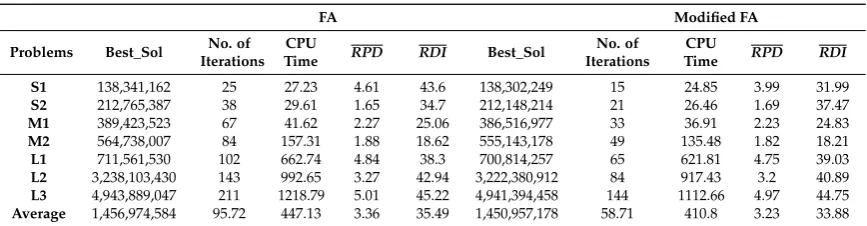
3.3. Experimental Results of Modified FAs
this regard: (1) best fitness solution (Best_Sol), (2) CPU time, (3) relative percentage deviation (RPD) and (4) relative deviation index (RDI).RDIand theRPDare defined as (Talbi, 2009):
RDI=
Alg
sol−Minsol Maxsol−Minsol
×100 (13)
RPD=
Algsol−Minsol Minsol
×100 (14)
whereAlgsolis the value of the fitness function andMinsolandMaxsoldenote the best and the worst
solutions, respectively. It must be noted that lower values of bothRDIandRPDshow the better
efficiency of the considered algorithm. Note also that in this section, the best out of 5 solutions obtained were selected for comparison. Table3provides the comparison study of classical FA and modified FA.
Table 3.Performances comparison of FA and modified FA.
FA Modified FA
Problems Best_Sol No. of Iterations
CPU
Time RPD RDI Best_Sol
No. of Iterations
CPU
Time RPD RDI
S1 138,341,162 25 27.23 4.61 43.6 138,302,249 15 24.85 3.99 31.99
S2 212,765,387 38 29.61 1.65 34.7 212,148,214 21 26.46 1.69 37.47
M1 389,423,523 67 41.62 2.27 25.06 386,516,977 33 36.91 2.23 24.83
M2 564,738,007 84 157.31 1.88 18.62 555,143,178 49 135.48 1.82 18.21
L1 711,561,530 102 662.74 4.84 38.3 700,814,257 65 621.81 4.75 39.03
L2 3,238,103,430 143 992.65 3.27 42.94 3,222,380,912 84 917.43 3.2 40.89
L3 4,943,889,047 211 1218.79 5.01 45.22 4,941,394,458 144 1112.66 4.97 44.75 Average 1,456,974,584 95.72 447.13 3.36 35.49 1,450,957,178 58.71 410.8 3.23 33.88
As can be seen from the obtained results presented in Table3, it is apparent the proposed
modification makes the classical FA more efficient in terms of all considered performance metrics. The modified FA searches more in search space, therefore, it could obtain more feasible solutions. Closer inspection of the Table3reveals that the modified FA finds better solutions (in this case cheaper cost since the minimization problem is in run) for medium sizes problems (M1 and M2) by 1.69% and 1.51% respectively. The obtained solutions by modified FA (Best_Sol) are less than that of the classical FA by 0.41% on average for different sizes of problem. In addition, based on the required iterations to find the optimal solution, it can be seen that the modified algorithm can find the solution by 38.66% less iterations on average compared to the standard FA. Figure5confirms these claims.
The results, as shown in Table3, indicate that regarding required computational time, the modified FA performs more efficient compared to classical with a significant reduction of computational time by 8.12% on average for the different size of problems. From the results depicted in Figure4, it is apparent that the reduction of computational time between modified FA and classical FA for medium sizes problems are 11.31% and 13.87%. A possible explanation for this might be that the convergence of classical FA slows down because of too much exploration in standard FA. In fact, standard FA explores all possible solutions including weak solutions in a search space. This exploration leads to increase the required computational time.
Appl. Sci.2019,9, 7 10 of 12
Appl. Sci. 2018, 8, x FOR PEER REVIEW 10 of 12
(a) Best obtained fitness solution (b) Relative percentage deviation (RPD)
(c) CPU time usage (d) Relative deviation index (RDI)
Figure 5. Performances comparison of modified FA and FA.
As can be seen in the Figure 5, the best obtained solution function of both algorithms is almost identical. However, the modified algorithm found these values with less CPU time and less iterations. As a result, for more complicated and large sizes problems, the modified FA can perform more efficiently. In terms RPD metric while the values of metrics for both algorithms are close, however, for the smallest and the largest problem, the modified FA performs better than the standard FA. The values for RDI metric also show the modified FA in the smallest size problem S1 performs significantly better that the standard FA.
4. Conclusions
The search-based character of metaheuristics algorithms indicates that they might lose some of their speed when all searching parameters are needed. For experimental investigations and strategic decisions, this matter can be less of a concern. Nevertheless, for instant purposes like a real-life dynamic emergency vehicle routing problem in which every single second counted, extra moments of required time may make the approach improper to employ, even if a better solution can be found. This study presented a new modification for the standard FA. A mixed integer linear programming model was developed for a supply chain network problem to demonstrate the efficiency of the proposed model. The findings showed that the proposed algorithm performs more efficient compared to classical FA. A common issue in running the standard FA is it usually stuck in
0 10,000 20,000 30,000 40,000 50,000
BEST_SOL
X 100000
TEST PROBLEMS
FA Modified FA
0 1 2 3 4 5
RPD
TEST PROBLEMS FA Modified FA
0 200 400 600 800 1000 1200
CPU TIME
(SEC)
TEST PROBLEMS FA Modified FA
0 5 10 15 20 25 30 35 40 45
RD
I
TEST PROBLEMS FA Modified FA
Figure 5.Performances comparison of modified FA and FA.
4. Conclusions
The search-based character of metaheuristics algorithms indicates that they might lose some of their speed when all searching parameters are needed. For experimental investigations and strategic decisions, this matter can be less of a concern. Nevertheless, for instant purposes like a real-life dynamic emergency vehicle routing problem in which every single second counted, extra moments of required time may make the approach improper to employ, even if a better solution can be found.
This study presented a new modification for the standard FA. A mixed integer linear programming model was developed for a supply chain network problem to demonstrate the efficiency of the proposed model. The findings showed that the proposed algorithm performs more efficient compared to classical FA. A common issue in running the standard FA is it usually stuck in stagnation or fall in premature convergence (fall into the local optimum) in searching space, especially for large size problems. This issue is connected with too much exploration and exploitation and inherent in the standard FA formulation. The proposed modification in this study resolves this issue by providing a balance between the exploitation and exploration in the standard FA.
care should be taken for nonlinear models. Nonlinear behaviour of parameters and variables might also result in different findings.
The obtained results of implementing metaheuristics approaches are very sensitive to their parameters. Consequently, a little change in their parameters may influence the quality of the obtained solutions. As a result, a fine-tuning procedure for the parameters is needed to find better solutions. However, parameter tuning has almost neglected in all studies in the area under investigation by this research and the previous studies in the area generally have found metaheuristics parameters setting using a trial and error procedure. A further study could assess the effects of parameters setting on the performance of the proposed algorithm.
Author Contributions:Methodology, A.M.; software, A.M.; validation, A.R.A.R., R.A. and M.R.A.J.; formal analysis, A.M.; investigation, A.R.A.R.; resources, M.R.A.J.; data curation, A.M.; writing—original draft preparation, A.M.; writing—review and editing, A.M.; visualization, M.R.A.J.; supervision, R.A.; funding acquisition.
Funding:This research was funded by Universiti Teknologi Malaysia (UTM) and Ministry of Higher Education (MOHE) Malaysia under Professional Development Research University (PDRU) grant Vot Q.J130000.21A2.04E15, for the project “An optimization model of oil-palm biomass supply chain for sustainable power generation in Malaysia” Vot Q.K130000.2601.15J23.
Conflicts of Interest:The authors declare no conflict of interest. The funders had no role in the design of the study; in the collection, analyses or interpretation of data; in the writing of the manuscript or in the decision to publish the results.
References
1. Yang, X.S. Firefly algorithm. InNature-Inspired Metaheuristic Algorithms; Yang, X.-S., Ed.; Wiley Online Library: Hoboken, NJ, USA, 2008; pp. 79–90.
2. Talbi, E.-G.Metaheuristics: From Design to Implementation; John Wiley & Sons: Hoboken, NJ, USA, 2009; Volume 74.
3. Memari, A.; Ahmad, R.; Rahim, A.R.A. Metaheuristic Algorithms: Guidelines for Implementation.J. Soft Comput. Decis. Support Syst.2017,4, 1–6.
4. Kirkpatrick, S.; Gelatt, C.D.; Vecchi, M.P. Optimization by simulated annealing.Science1983,220, 671–680. [CrossRef] [PubMed]
5. Fister, I.; Yang, X.-S.; Fister, D. Firefly algorithm: A brief review of the expanding literature. InCuckoo Search and Firefly Algorithm; Springer: New York, NY, USA, 2014; pp. 347–360.
6. Fister, I.; Fister, I., Jr.; Yang, X.-S.; Brest, J. A comprehensive review of firefly algorithms.Swarm Evol. Comput.
2013,13, 34–46. [CrossRef]
7. Husselmann, A.V.; Hawick, K. Parallel parametric optimisation with firefly algorithms on graphical processing units. In Proceedings of the 2012 International Conference on Genetic and Evolutionary Methods (GEM’12), Las Vegas, NV, USA, 16–19 July 2012; pp. 77–83.
8. Subutic, M.; Tuba, M.; Stanarevic, N. Parallelization of the firefly algorithm for unconstrained optimization problems.Latest Adv. Inf. Sci. Appl.2012,22, 264–269.
9. Eswari, R.; Nickolas, S. Modified multi-objective firefly algorithm for task scheduling problem on heterogeneous systems.Int. J. Bio-Inspired Comput.2016,8, 379–393. [CrossRef]
10. Tilahun, S.L.; Ong, H.C. Modified Firefly Algorithm.J. Appl. Math.2012,2012, 12. [CrossRef]
11. Abdullah, A.; Deris, S.; Anwar, S.; Arjunan, S.N. An evolutionary firefly algorithm for the estimation of nonlinear biological model parameters.PLoS ONE2013,8, e56310. [CrossRef] [PubMed]
12. Abdullah, A.; Deris, S.; Mohamad, M.S.; Anwar, S. An Improved Swarm Optimization for Parameter Estimation and Biological Model Selection.PLoS ONE2013,8, e61258. [CrossRef]
13. Abdullah, A.; Deris, S.; Mohamad, M.S.; Hashim, S.Z.M. A new hybrid firefly algorithm for complex and nonlinear problem. InDistributed Computing and Artificial Intelligence; Springer: New York, NY, USA, 2012; pp. 673–680.
14. Ji-jun, Y. Optimal design for scale-based product family based on multi-objective firefly algorithm.
Comput. Integr. Manuf. Syst.2012,8, 020.
15. Yang, X.-S. Efficiency analysis of swarm intelligence and randomization techniques.J. Comput. Theor. Nanosci.
Appl. Sci.2019,9, 7 12 of 12
16. Yang, X.-S. Firefly algorithm, Levy flights and global optimization. InResearch and Development in Intelligent Systems XXVI; Springer: New York, NY, USA, 2010; pp. 209–218.
17. Chandrasekaran, K.; Simon, S.P. Network and reliability constrained unit commitment problem using binary real coded firefly algorithm.Int. J. Electr. Power Energy Syst.2012,43, 921–932. [CrossRef]
18. Falcon, R.; Almeida, M.; Nayak, A. Fault identification with binary adaptive fireflies in parallel and distributed systems. In Proceedings of the 2011 IEEE Congress on Evolutionary Computation (CEC), New Orleans, LA, USA, 5–8 June 2011; pp. 1359–1366.
19. Palit, S.; Sinha, S.N.; Molla, M.A.; Khanra, A.; Kule, M. A cryptanalytic attack on the knapsack cryptosystem using binary Firefly algorithm. In Proceedings of the 2011 2nd International Conference on Computer and Communication Technology (ICCCT), Allahabad, India, 15–17 September 2011; pp. 428–432.
20. Xu, G.; Wu, S.; Tan, Y. Island Partition of Distribution System with Distributed Generators Considering Protection of Vulnerable Nodes.Appl. Sci.2017,7, 1057. [CrossRef]
21. Farahani, S.M.; Abshouri, A.; Nasiri, B.; Meybodi, M. A Gaussian firefly algorithm.Int. J. Mach. Learn. Comput.
2011,1, 448–453. [CrossRef]
22. Bottani, E.; Centobelli, P.; Cerchione, R.; Gaudio, L.; Murino, T. Solving machine loading problem of flexible manufacturing systems using a modified discrete firefly algorithm.Int. J. Ind. Eng. Comput.2017,8, 363–372. [CrossRef]
23. Coelho, L.D.S.; de Andrade Bernert, D.L.; Mariani, V.C. A chaotic firefly algorithm applied to reliability-redundancy optimization. In Proceedings of the 2011 IEEE Congress on Evolutionary Computation (CEC), New Orleans, LA, USA, 5–8 June 2011; pp. 517–521.
24. Gandomi, A.; Yang, X.-S.; Talatahari, S.; Alavi, A. Firefly algorithm with chaos. Commun. Nonlinear Sci. Numer. Simul.2013,18, 89–98. [CrossRef]

![Table 2. Test problems size as suggested by [13].](https://thumb-us.123doks.com/thumbv2/123dok_us/1291799.1161710/8.595.83.512.552.661/table-test-problems-size-suggested.webp)