IMPLEMENTATION OF REQUIREMENTS ENGINEERING METHOD ON HANDLING PATIENT DATA
ZURAIN BINTI NASARUDDIN @ ISMAIL SHAH
A project report submitted in partial fulfilment o f the requirements for the award o f the degree of
Master o f Science (Information Security)
School of Computing Faculty Engineering Universiti Teknologi Malaysia
ACKNOW LEDGEMENT
Alhamdulillah. Thanks to Allah SWT, whom with His willing to give the opportunity to me to finish the project entitled ‘Implementation o f Requirements Engineering M ethod on Handling Patient D ata’. Firstly, I would like to express my deepest thanks to Dr. Siti Hajar Othman as a supervisor who had been guided me during this project.
Also thanks to the respondents from the Klang hospital for giving cooperation during the data collection process. I also want to thanks the lecturers o f Faculty of Computing, UTM for their valuable information, suggestions and guidance in the preparation and compilation o f this project report.
A deepest thanks and appreciations to my beloved parents and siblings for their encouragements, cooperation, constructive suggestions and full o f support for the project completion from the beginning until the end.
ABSTRACT
ABSTRAK
TABLE OF CONTENT
CHAPTER TITLE PAGE
ACKNOW LEDGEMENT iv
ABSTRACT v
ABSTRAK vi
TABLE OF CONTENT vii
LIST OF TABLES xii
LIST OF FIGURES xiv
LIST OF APPENDICES xvi
1 INTRODUCTION 1
1.1 Introduction 1
1.2 Problem Background 3
1.3 Problem Statement 4
1.4 Project Research Aim 5
1.5 Objectives 5
1.6 Research Scope 6
1.7 Research Contribution 6
1.8 Report Organization 7
2 LITERATURE REVIEW 8
2.1 Overview 8
2.2 Personal Data Security 9
2.2.1 Privacy 9
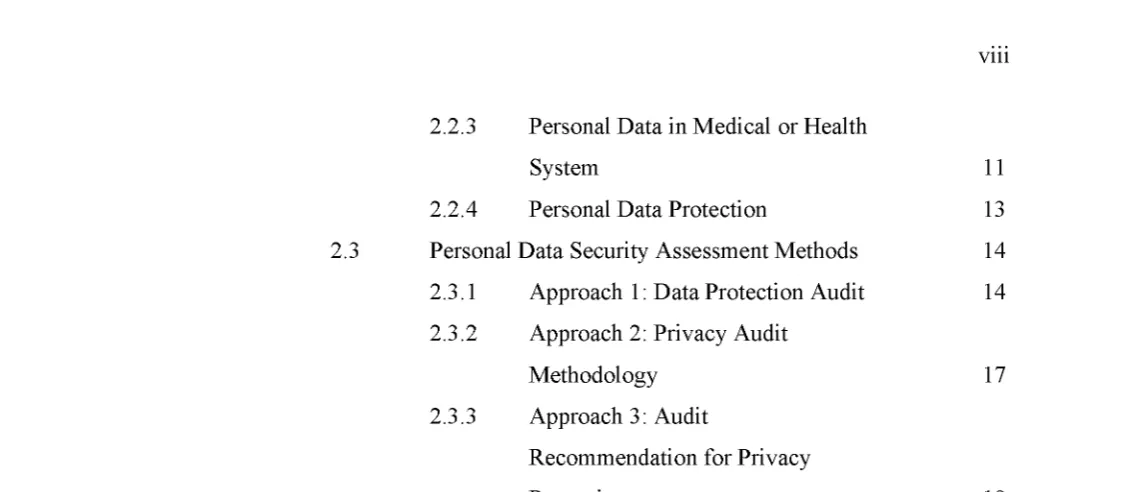
2.2.3 Personal Data in Medical or Health
System 11
2.2.4 Personal Data Protection 13
2.3 Personal Data Security Assessment Methods 14 2.3.1 Approach 1: Data Protection Audit 14 2.3.2 Approach 2: Privacy Audit
Methodology 17
2.3.3 Approach 3: Audit
Recommendation for Privacy
Protection 19
2.3.4 Approach 4: Audit Guideline for
Vulnerability Analysis 20
2.3.5 Approach 5: Clinical Audit Cycle 21 2.3.6 Approach 6: E-health
Internationalization Requirements 23 2.3.7 Approach 7: Personal Data Audit
through Requirements Engineering 26 2.3.8 Comparison on Approaches of
Personal Data Audit 28
2.3.9 Selected Approach 31
2.3.9.1 PDA-RE 31
2.4 Requirements Engineering 33
2.4.1 Requirements Engineering in
Engineering Field 34
2.4.2 Requirements Engineering in
Education System 35
2.4.3 Requirements Engineering in
Financial 36
2.4.4 Requirements Engineering in Legal
and Law-Related 37
2.4.5 Table o f Comparison on
Requirements Engineering 38
2.4.6 Requirements Engineering in
2.5 Assessment on Personal Data Security through Requirements Engineering for Public Hospital in
Malaysia 40
2.5.1 Healthcare in Malaysia 40
2.5.1.1 Public Hospital in
M alaysia 41
2.5.1.2 Security Policy in Klang
Hospital 42
2.5.2 Requirements Engineering References on Healthcare in
Malaysia 42
2.5.2.1 Confidentiality
Guidelines 43
2.5.2.2 Personal Data Protection
Act 44
2.6 Chapter Summary 46
3 RESEARCH M ETHODOLOGY 47
3.1 Overview 47
3.2 Research Framework 48
3.2.1 Phase 1: Planning 49
3.2.2 Phase 2: Implementing 49
3.2.3 Phase 3: Evaluating 50
3.3 Project Deliverables 51
3.4 Project Requirements 53
3.5 Project W ork Plan 54
3.6 Chapter Summary 54
4 R E S E A R C H D E S IG N A N D IM P L E M E N T A T IO N 55
4.1 Introduction 55
4.2 Research Gap 56
4.3 Initial Development 56
4.4.1 Processes o f Requirements
Engineering M ethod 58
4.4.1.1 Step 1: Definitions of
Systems Goals 59
4.4.1.2 Step 2: Requirements
Elicitation 60
4.4.1.3 Step 3: Requirements
Analysis 63
4.4.1.4 Step 4: Requirements
Specification 64
4.4.1.5 Step 5: Requirements
Validation 64
4.5 Questionnaire Development 65
4.6 Data Collection 66
4.7 Chapter Summary 67
5 F IN D IN G S A N D A N A L Y S IS 68
5.1 Introduction 68
5.2 Questionnaire Analysis 69
5.2.1 Section A: General 69
5.2.2 Section B: Personal Data Protection
Act (PDPA) 2010 76
5.2.3 Section C: Confidentiality Guidelines by M alaysia Medical
Council (MMC) 78
5.2.4 Section D: Requirements 88
5.3 Requirements Engineering 88
5.3.1 Requirements Analysis 89
5.3.2 Requirements Specification 91
5.3.3 Requirements Validation 93
5.4 Expert Review and Justification on the Structure 96
6 C O N C L U S IO N 98
6.1 Introduction 98
6.2 Overview o f study 98
6.3 Limitation o f the Project 99
6.4 Future recommendation 99
6.5 Project Achievement 100
6.6 Concluding Remarks 100
REFERENCES
APPENDICES
102
LIST OF TABLES
TABLE NO. TITLE PAGE
2.1 Table o f Comparison on Approaches o f Personal Data
Assessment 29
2.2 Table of Comparison on Requirements Engineering 38
3.1 Research Phases 48
3.2 Project Deliverables 52
4.1 List o f Requirements 61
4.2 Nominal Scale 66
5.1 Demographic Variable and Measure 69
5.2 Demographic o f Gender 70
5.3 Demographic o f Age 71
5.4 Demographic o f Education 71
5.5 Job Type 72
5.6 Job Experience 73
5.7 Understanding on PDPA 74
5.8 Understanding on Confidentiality Guidelines 74
5.9 Understanding on Requirements Engineering 75
5.10 PDPA Q1 to Q7 77
5.11 PDPA Q8 78
5.12 Principles on Confidentiality Guidelines 79
5.13 Protecting Information 79
5.14 Disclosures Required by Law 80
5.15 Disclosures with Consent 81
5.16 The Patient’s Interest 82
5.18 Disclosures about Patients who Lack Capacity to Consent 83 5.19 Sharing Information with a Patient’s Spouse, Partner,
Carers, Relatives or Friends 84
5.20 Genetic and Other Shared Information 85
5.21 Disclosure after a Patient’s Death 85
5.22 Media Inquiries about Patients 86
5.23 Responses for all Parts o f Confidentiality Guidelines 87
5.24 Feedback on Requirements 89
5.25 Total Responses on Requirements Questions 91
5.26 Requirements Specification 91
5.27 Total Specification Requirements 93
5.28 Validation of Software Specification Requirements 93 5.29 Total Validation o f Software Specification Requirements 94 5.30 Validation of System Specification Requirements 94 5.31 Total Validation o f System Specification Requirements 96
LIST OF FIGURES
FIGURE NO TITLE PAGE
2.1 Personal Information 10
2.2 Data Protection Audit Program 15
2.3 Plan-Do-Check-Act Cycle 16
2.4 Chain o f Audit Process 16
2.5 Privacy Audit Methodology Structure 18
2.6 An Overview o f the Audit Recommendation Framework 19
2.7 Process Flow for Security Audit 21
2.8 Clinical Audit Cycle 22
2.9 Internationalization Requirements Catalogue Generation
Process 24
2.10 e-Health Internationalization Audit M ethod 25
2.11 Sources o f SIREN PDP Catalogue Contents 26
2.12 Phases o f the Personal Data Audit Method 32
3.1 Research Framework 50
4.1 Requirements Engineering Structure o f Personal Data
Security on Healthcare-Based 57
5.1 Statistics Graph o f Gender 70
5.2 Statistics Graph o f Age 71
5.3 Statistics Graph o f Education 72
5.4 Statistics Graph o f Job Type 72
5.5 Graph of Job Experience 73
5.6 Graph of Understanding on PDPA 74
5.9 Graph o f PDPA Q1 to Q7 77
5.10 Graph o f PDPA Q8 78
5.11 Graph o f Principles on Confidentiality Guidelines 79
5.12 Graph on Protecting Information 80
5.13 Graph on Disclosures Required by Law 80
5.14 Graph on Disclosures with Consent 81
5.15 Graph on the Patient’s Interest 82
5.16 Graph on the Public Interest 83
5.17 Graph on Disclosures about Patients who Lack Capacity
to Consent 83
5.18 Graph on Sharing Information with a Patient’s Spouse,
Partner, Carers, Relatives or Friends 84
5.19 Graph on Genetic and Other Shared Information 85
5.20 Graph on Disclosures after a Patient’s Death 86
5.21 Graph on Media Inquiries about Patients 86
5.22 Graph on Responses for all Parts o f Confidentiality
LIST OF APPENDICES
APPENDIX TITLE PAGE
APPENDIX A: Gantt Chart Project 1 106
APPENDIX B : Gantt Chart Project 2 108
IN T R O D U C T IO N
1.1 Introduction
All the governments in the world are enacting data protection laws that restrict the disclosure and handling a personal data. These laws enforce administrative and financial burdens on organizations that manage personal data and may constrain the permitted and valuable sharing and analysis o f this data (Johnson and Grandison, 2007). A personal data is an information which relate to a person who can be identified from those data. These information is an important resource and asset to any organization.
A HIS is an integrated and comprehensive information system designed to handle the financial, clinical and administrative aspects o f a hospital (Ismail et al., 2010). The aim o f HIS as a medical informatics area is to attain the most potential resources o f administration and patient care by electronic data processing. One o f the possible solution is to ensure the protection o f information o f the patient by information systems audit.
Information systems audit is defined as the well-ordered procedure of collecting, categorizing and assessing the evidence to decide whether an information system secures the assets, preserves the integrity o f data, fulfils the aims o f the organizations efficiently and utilizes supports effectively (Martinez et al., 2010). Software audit, which is a special type o f audit within this field, with purpose to justify the competence o f both functional and non-functional requirements.
A medical data especially should be protected, and must be ensure on its data disclosure constraint. It should be ensure that medical information can only be used in a legalised medical environment. A proper system must be complied when transmitting information across context fields, for example, a consent should be receive for medical data to be disclose and should remain anonymous before it can be used in research medium (Pasquier and Eyers, 2016).
A data protection audit functions as a control tools and may determine the system weaknesses or prominence regarding the organization’s managing the personal data. It is essential to determine security control for these sensitive data and its strategies to audit.
1.2 Problem Background
A personal data matter has become very important mostly in the healthcare system. The practice o f medicine has been described as being overwhelmed by how well data is gathered, handled, recovered and conveyed. It is crucial to maintain the great working conditions for health experts to get to clinical information while HIS are still being evolved. The preservation o f a patient confidentiality is o f greatest importance in the doctor patient relationship.
The US National Science Foundation-dependent Computing Research Association (CRA) has defined that the security o f information systems and the protection o f the end-users establish one o f the significant global security-related problems (Smith and Spafford, 2004). However, regardless o f existing laws regulating this aspect, a severe threat to privacy constantly take place. It is quite worrying as the patients are concern about the possibility o f loss their personal information. This problem may become a serious matter if there is no solution to confront this problem.
1.3 Problem Statement
The increased availability o f health data in an electronic tools is good for industry-wide efforts to enhance the quality and lessen the cost o f healthcare. However, it brings a bigger concern o f greater risk for loss o f privacy among medical care participant. If the loss o f privacy happens, it can weakens the quality o f personal data especially on the patient records.
There are many algorithms and methods can be used for an assessment of personal data security. Each o f the methods has their own advantages and disadvantages. N ot all method are strong enough to use for a personal data security assessment.
1.4 Project Research Aim
The aim o f the project is to identify current practices o f assessment on personal data security and propose a requirements engineering method on assessment of personal data security in public hospital in Malaysia.
1.5 Objectives
The objectives o f this project are:
1) To identify practices or guidelines on personal data security related to the patient data.
2) To implement requirements engineering method on personal data security for healthcare.
1.6 Research Scope
In order to achieve the objectives, the following scopes are outlined:
1) This project is focused on personal data security o f patients in the public hospital. The effort highlight on providing a methods o f assessment on personal data security related to the patient data.
2) The project used a requirements engineering method to assess the personal data security. It includes to protect the confidentiality and the privacy of personal data.
3) The requirements engineering process is validated through a data collection in Klang hospital. The data collection is through a questionnaire in order to get the feedback and response based on the requirements.
1.7 Research Contribution
From this project, one o f the expected research contribution is that the methods and techniques related to project are analysed and the current practice o f assessment on personal data security are identified. Besides, an assessment on personal data security can be adapted through a requirement engineering from this project.
1.8 Report Organization
This report consists o f 5 chapters:
1) Chapter 1: Introduction to the research including background o f project with purposes, aims and objectives, and identified problem related to it, scope o f project and expected research contribution.
2) Chapter 2: Contains the overview o f the area o f research, previous and existing trends of research.
3) Chapter 3: Explanation o f research methodology including the research framework, project plan and project deliverables.
4) Chapter 4: Design and Implementation o f the project with the research requirements that will be used.
5) Chapter 5: Analysis and evaluation o f the results and findings based on selected approach.
REFERENCES
Abdullah, M. et al. (2016) Clinical Audit Handbook.
Abdullah, Z. S. (2012) ‘Hospital information systems implementation: Testing a structural model’, Information Science and Digital Content Technology (ICIDT), 2012 8th International Conference on, 1, pp. 74-81.
Baloyi, N. and Kotze, P. (2017a) ‘Are Organisations in South Africa Ready to Comply with Personal Data Protection or Privacy Legislation and Regulations?’, IST- Africa Conference Proceedings, pp. 1-11.
Baloyi, N. and Kotze, P. (2017b) ‘Do Users Know or Care About W hat is Done with their Personal Data : A South African Study’, pp. 1-11.
Barca, C. C. et al. (2014) ‘YourEHRM: Standard-based management o f your personal healthcare information’, 2014 IEEE-EMBS International Conference on Biomedical and Health Informatics, B H I 2014, pp. 89-92. doi:
10.1109/BHI.2014.6864311.
Blocki, J. et al. (2012) ‘Audit Mechanisms for Provable Risk Management and Accountable Data Governance’.
Datta, A. et al. (2011) ‘Understanding and Protecting Privacy: Formal Semantics and Principled Audit M echanism s’, in Jajodia, S. and Mazumdar, C. (eds) 7th International Conference, ICISS. Berlin, Heidelberg: Springer Berlin Heidelberg, pp. 1-27. doi: 10.1007/978-3-642-25560-1_1.
Emeka, B. O. and Liu, S. (2017) ‘Security requirement engineering using structured object-oriented formal language for m-banking applications’, Proceedings - 2017 IEEE International Conference on Software Quality, Reliability and Security, QRS 2017, pp. 176-183. doi: 10.1109/QRS.2017.28.
Fischer, P. E. (2013) ‘Data Protection Audit: The German Experience’, Springer- VerlagBerlin Heidelberg, pp. 233-259. doi: 10.1145/2505515.2514691. Han, Z., Sun, Y. and Wang, Y. (2013) ‘Audit Recommendation for Privacy Protection
in Personal Health Record Systems’, pp. 533-538.
Hasan, R. et al. (2016) ‘How Secure is the Healthcare Network from Insider Attacks ? An Audit Guideline for Vulnerability Analysis’. doi: 10.1109/COMPSAC.2016.129.
Ismail, A. et al. (2010) ‘The implementation of Hospital Information System (HIS) in tertiary hospitals in Malaysia: a qualitative study’, Malaysian Journal o f Public Health Medicine 2010, 10(2), pp. 16-24.
Johnson, C. M. and Grandison, T. W. A. (2007) ‘Compliance with data protection laws using Hippocratic Database active enforcement and auditing’, IB M Systems Journal, 46(2), pp. 255-264. doi: 10.1147/sj.462.0255.
Kasuya, S. et al. (2017) ‘Cyber-Enabled W ell-Being Oriented Daily Living Support Based on Personal Data Analytics’, IEEE Transactions on Emerging Topics in Computing, 6750(c). doi: 10.1109/TETC.2017.2763966.
Laws o f Malaysia (2010) Personal Data Protection A ct 2010, Percetakan Nasional Malaysia Berhad.
Makri, E.-L. and Lambrinoudakis, C. (2015) ‘Privacy Principles: Towards a Common Privacy Audit M ethodology’, Springer International Publishing Switzerland 2015, 9264, pp. 219-234. doi: 10.1007/978-3-319-22906-5.
Martinez, M. A. et al. (2010) ‘A Personal Data Audit Method through Requirements Engineering’, Computer Standards and Interfaces. Elsevier B.V., 32(4), pp.
166-178. doi: 10.1016/j.csi.2010.01.001.
Mead, N. R., Shoemaker, D. and Ingalsbe, J. (2010) ‘Teaching Security Requirements Engineering Using SQUARE’.
Muyanja, A. et al. (2013) ‘Requirements engineering for the uganda police force crime records management system’, 2013 21st IEEE International Requirements Engineering Conference, RE 2013 - Proceedings, pp. 302-307. doi:
10.1109/RE.2013.6636734.
Namoglu, N. and Ulgen, Y. (2014) ‘Network Security Vulnerabilities and Personal Privacy Issues in Healthcare Information Systems : A Case Study in a Private Hospital’, pp. 3-5.
Ouhbi, S. et al. (2017) ‘E-health internationalization requirements for audit purposes’, Computer Methods and Programs in Biomedicine. Elsevier Ireland Ltd, 144, pp. 49-60. doi: 10.1016/j.cmpb.2017.03.014.
Pasquier, T. F. J. M. and Eyers, D. (2016) ‘Information flow audit for transparency and compliance in the handling o f personal data’, Proceedings - 2016 IEEE International Conference on Cloud Engineering Workshops, IC 2 E W 2016, pp.
112-117. doi: 10.1109/IC2EW.2016.29.
Patel, S. S. and Sankpal, S. V. (2016) ‘Secure patients data transmission using XOR ciphering encryption and ECG steganography’, International Conference on Electrical, Electronics, and Optimization Techniques, IC EEO T 2016, pp.
1311-1315. doi: 10.1109/ICEEOT.2016.7754895.
Peng, F. and Jiang, X. (2011) ‘A Novel Education System Requirements Engineering Methodology’, IEEE 2011, pp. 428-230.
Ratnam, K. A. and Dominic, P. D. D. (2011) ‘A study o f technology sustainability on hospital information management system (HIMS) Governance in M alaysia’, 2011 National Postgraduate Conference - Energy and Sustainability: Exploring the Innovative Minds, NPC 2011. doi:
10.1109/NatPC.2011.6136309.
Security Policy (2017). Available at: http://htar.moh.gov.my/en/polisi-keselamatan (Accessed: 15 August 2018).
Seong, K. (2009) Defense Health Information System as a Case Study fo r National Health IT, Biomedical Informatics Session.
Smith, S. W. and Spafford, E. H. (2004) ‘Grand challenges in information security: process and output’, IEEE Security & Privacy, 2(1), pp. 69-71. doi:
Will, M. A. et al. (2017) ‘Returning control o f data to users with a personal information crunch - A position paper’, Proceedings - 5th International Conference on Cloud Computing Research and Innovation, ICCCRI 2017, pp. 23-32. doi: 10.1109/ICCCRI.2017.12.