Improved SpikeProp for Using Particle Swarm Optimization
Article in Mathematical Problems in Engineering · September 2013 DOI: 10.1155/2013/257085
CITATIONS
6
READS
52
3 authors, including:
Some of the authors of this publication are also working on these related projects:
quantum based meta-heuristic algorithm for elman recurrent neural network learningView project
Big Data Review View project Siti Mariyam Shamsuddin
Universiti Teknologi Malaysia
360PUBLICATIONS 2,507CITATIONS
SEE PROFILE
Siti Z Mohd Hashim
UNIVERSITI TEKNOLOGI MALAYSIA
169PUBLICATIONS 1,568CITATIONS
SEE PROFILE
All content following this page was uploaded by Siti Mariyam Shamsuddin on 08 January 2016.
Volume 2013, Article ID 257085,13pages http://dx.doi.org/10.1155/2013/257085
Research Article
Improved SpikeProp for Using Particle Swarm Optimization
Falah Y. H. Ahmed, Siti Mariyam Shamsuddin, and Siti Zaiton Mohd Hashim
Soft Computing Research Group, Faculty of Computer Science & Information Systems, Universiti Teknologi Malaysia, 81310 Skudai, Johor, Malaysia
Correspondence should be addressed to Siti Mariyam Shamsuddin; [email protected]
Received 27 March 2013; Accepted 1 July 2013
Academic Editor: Praveen Agarwal
Copyright © 2013 Falah Y. H. Ahmed et al. This is an open access article distributed under the Creative Commons Attribution License, which permits unrestricted use, distribution, and reproduction in any medium, provided the original work is properly cited.
A spiking neurons network encodes information in the timing of individual spike times. A novel supervised learning rule for SpikeProp is derived to overcome the discontinuities introduced by the spiking thresholding. This algorithm is based on an error-backpropagation learning rule suited for supervised learning of spiking neurons that use exact spike time coding. The SpikeProp is able to demonstrate the spiking neurons that can perform complex nonlinear classification in fast temporal coding. This study proposes enhancements of SpikeProp learning algorithm for supervised training of spiking networks which can deal with complex patterns. The proposed methods include the SpikeProp particle swarm optimization (PSO) and angle driven dependency learning rate. These methods are presented to SpikeProp network for multilayer learning enhancement and weights optimization. Input and output patterns are encoded as spike trains of precisely timed spikes, and the network learns to transform the input trains into target output trains. With these enhancements, our proposed methods outperformed other conventional neural network architectures.
1. Introduction
For all three generations of neural networks, the output sig-nals can be continuously altered by variation in synaptic weights (synaptic plasticity). Synaptic plasticity is the basis for learning in all ANNs. As long as there is nonvariant activation function, accurate classification based on certain vector input values can be implemented with the help of a BP learning algorithm like gradient descent [1,2].
Spiking neural network (SNN) utilises individual spikes in time domain to communicate and to perform computation
in a manner like what the real neurons actually do [3, 4].
This method of sending and receiving individual pulses is called pulse coding where information which is transmitted is carried by the pulse rate. Hence, this type of coding permits multiplexing of data [2].
For instance, analysis of visual input in humans requires less than 100 ms for facial recognition. Yet, facial recognition
was performed by [5] by using SNN with a minimum of 10
synaptic steps on the retina at the temporal lobe, allowing nearly 10 ms for the neurons to process. Processing time is short, but it is sufficient to permit an averaging procedure
which is required by pulse coding [2,5,6]. In fact, pulse cod-ing technique is preferred when speed of computation is the issue [5].
2. Page Background and Related Works
2.1. Spiking Neural Networks (SNNs). Neural networks which
perform artificial information processing are built using processing units composed of linear or nonlinear processing
elements (a sigmoid function is widely used) [6–9]. SNN had
remained unexplored for many years because it was consid-ered too complex and too difficult to analyze. Apart from that, biological cortical neurons have long time constants. Inhibi-tion speed can be of the order of several milliseconds, while excitation speed can reach several hundreds of milliseconds. These dynamics can considerably constrain applications that need fine temporal processing [10,11].
supporting the theory of spike rate coding, it is reasonable to approximate the average number of spikes in a neuron with continuous values and consequently process them with tra-ditional processing units (sigmoid, for instance). Therefore, it is not necessary to perform simulations with spikes, as the computation with continuous values is simpler to implement and evaluate [13].
An important landmark study by Maass [14] has shown
that SNN can be used as universal approximations of continu-ous functions. Maass proposed a three-layer SNN (consisting of the input layer, the generalization layer, and the selection layer) to perform unsupervised pattern analysis. Reference
[15] applied spiking neural networks to several benchmark
datasets (which include internet traffic data, EEG data, XOR problems, 3-bit parity problems, and iris dataset) and performed function approximation and supervised pattern recognition [16].
One of the ongoing issues in SNN research is how the networks can be trained. Much research has been done on
biologically inspired local learning rules [13, 17], but these
rules can only carry out supervised learning for which the networks cannot be trained to perform a given task. Classical neural network research became famous because of the error-backpropagation learning rule. Due to this, a neural network can be trained to solve a problem which is specified by a representative set of examples. Spiking neural networks use a learning rule called SpikeProp which operates on networks of spiking neurons and uses the exact spike time temporal
coding [18]. This means that the exact spike time of input and
output spikes encodes the input and output values.
2.2. Learning in Networks of Spiking Neurons (SpikeProp).
Learning in the perceptron networks is usually performed by
a gradient descent method [19] by using the backpropagation
algorithm [20], which explicitly evaluates the gradient of an
error function. The same approach has been employed in
theSpikePropgradient learning algorithm [18] which learns
the desired firing times of the output neurons by adapting the weight parameters in the Spike Response Model SRM0
[21]. Several experiments have been carried out onSpikeProp
to clarify several burning issues, for example, the role of
the parameter initialization and negative weights [22]. The
performance of the original algorithm can be improved by
adding the momentum term [23].SpikePropcan be further
enhanced with additional learning rules for synaptic delays,
thresholds, and time constants [24], which will normally
result in faster convergence and smaller network sizes for the given learning tasks. An essential speedup was achieved by approximating the firing time function using the logistic
sigmoid [25]. Implementation of SpikeProp algorithm on
recurrent network architectures has shown promising results [26].
SpikePropdoes not usually allow more than one spike per
neuron, which makes it suitable only for “time-to-first-spike”
coding scheme [5]. Its adaptation mechanism fails for the
weights of neurons that do not emit spikes. These difficulties are due to the fact that spike creation or its removal due to
weight updates is very discontinuous.ASNA-Prophas been
proposed [24] to solve this problem by emulating the feed
forward networks of spiking neurons with the discrete-time analog sigmoid networks with local feedback, which is then used for deriving the gradient learning rule. It is possible to estimate the gradient by measuring the fluctuations in the error function in response to the dynamic neuron parameter perturbation [27].
SpikeProp adopts error backpropagation procedures which have been used widely in the training of analog neural
networks to perform supervised learning [28]. SpikeProp
does have weaknesses. The first weakness concerns sensitivity to parameter initialization values, which means that if the neuron is still inactive after initialization, the SpikeProp will not perform training for these weights which will not produce any spike. The second weakness is that SpikeProp is only suitable in cases where there is latency-based coding. The third weakness is that SpikeProp works only for SNNs where neurons spike only once in the simulation time. Finally, SpikeProp algorithm has been designed for training the weights only. To address these weaknesses, several
improve-ments to SpikeProp algorithms have been suggested [29].
3. Methodology
We introduce new learning rules and enhancement architec-ture for improved SpikeProp.
3.1. Enhancement of SpikeProp Architecture by PSO
(PSO-SpikeProp) (Model 1). In this proposed method, the
Spike-Prop was accelerated using four basic parameters of PSO;
these parameters are the acceleration constant for 𝑔best,
the acceleration constants for 𝑝best, the time interval (Δ𝑡),
depending on the time of SpikeProp, and the number of particles used in SpikeProp.
The acceleration constants are used in the simulation to
specify swarm behavior of particles.𝑝bestand𝑔bestpositions
are formed by the constants𝑐1and𝑐2. The global best solution
over the particle depends on the pulse time of SpikeProp
(this is given by the constant𝑐1). The individual personal
best solution over the particle depends on the pulse time of
the SpikeProp (this is given by the constant𝑐2). If𝑐1is more
than𝑐2, the swarm moves around the global best solution. On
the other hand, when𝑐2is greater than𝑐1, the swarm moves
around the individual personal best.
The time Δ𝑡 of the parameters in SpikeProp defines
the time in each pulse interval over each movement that occurs in the solution space in the pools processes. Reducing these parameters in SpikeProp leads to higher granularity
movement within the solution space and a higher 𝑑 time
Table 1: PSO parameters used in SpikeProp.
Parameters Values
𝑐1(𝑔best) 1.0
𝑐2(𝑝best) 1.0
Δ𝑡(time interval) 0.1
Number of particles 20
Problem dimension Based on dataset SpikeProp
architecture
Stop condition SpikeProp minimum error or
maximum number of iterations
Range of particles From−1 to 1[−1, 1]
The number of particles in SpikeProp using PSO signifi-cantly affects the execution time. There is a tradeoff between the size of the practical swarms and the execution time. PSO with a well-selected parameter set can perform well under all
circumstances [30].
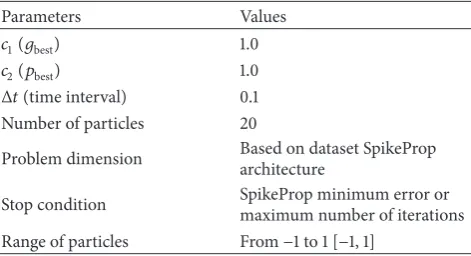
In this study, the parameters that have been used are
summarized inTable 1, while particle position (weight and
bias values) is initialized randomly with initial position velocity value set at 0.
Each particle position of the swarm is represented by a set of the weights for the current iteration. The dimension of the practical swarm determines the weight number of the network. In order to minimize the learning error, the particle should move within the weight space. Updating the weight of the network means changing the position in order to reduce the number of iterations. For each iteration, a new velocity calculation takes place to determine the new particle position movement. A set of new weights is used to obtain the new error, thus a new position. For PSO, the new weights are registered even if there is no noticeable improvement. This process applies for all particles. The global best particle position is the one with the least number of errors. The training process stops when the target minimum error is reached or the numbers of computational processes exceed the number of iterations allowable. When the training is complete, the weights are used to compute the classification error for the training patterns. The same patterns are used to test the network by using the same set of weights.
No researcher has yet used SpikeProp on PSO.𝑝bestvalue
and𝑔bestvalue are applied to solve problems associated with
the learning error. The SpikeProp weight and SpikeProp bias are achieved by adding the calculated velocity value
as shown in (1) and (2). A new set of positions is used to
produce the new learning error. In this proposed method, the classification dataset output has been written in a minimum number of iterations with the lowest error. The summary on
PSO-SpikeProp learning process is shown inFigure 1.
𝑤𝑖𝑗new= 𝑤𝑖𝑗old+ Δ𝑤𝑖𝑗∗ Δ𝑡(𝑡)𝑡=𝑡𝑑
𝑗, (1)
Δ𝑤𝑖𝑗(𝑛)=𝑐1∗ (𝑝best,𝑛− 𝑤𝑖𝑗(𝑛))+𝑐2∗(𝑔best,𝑛−𝑤𝑖𝑗(𝑛))(𝑡)𝑡=𝑡𝑑
𝑗.
(2)
Particles
Output
Particles
Remove vector
End of hidden
or output matrix
Yes No
Particles
input
position
Train SpikeProp using initial particle
with the current
initial weights over all
Calculate velocity and update all particles
Targeted learning error or
maximum number of
iterations No
Yes W
W
ReplaceWiby
i + 1
...
W
Wposition
. . .
hidden Hidden
W W
. . .
Initialize particleW
W i → 1
HiddenW OutputW
N
...
W N
i >size
w2 w1 w2
w1
W1
W2
W1
W2
gbest
Compare eachgbest
particles to obtainpbest
Comparegbestwith the
positions based ongbest
andpbestparticles
previous best to obtaingbest
Figure 1: PSO-SpikeProp learning process.
In this proposed technique, the PSO is applied to
SpikeP-rop algorithm (refer toFigure 1). Equation (1), the new weight
of𝑝best and𝑔best. In (2),Δ𝑤𝑖𝑗(𝑛)subtracts the dimensional weight of the element from the dimension from the best vector and then multiplies this by a random number (between
0.0 and 1.0) and an acceleration constant (𝑐1 and 𝑐2). A
number of particles have been used to solve 8 different dataset problems. The objectives of the study are to reduce errors, enhance the learning rate of SpikeProp, and to speed up
the algorithm process. Figure 1shows that particle swarms
with initial random rates have different mean squared error (MSE). During the learning process, all particles move together to get𝑝bestand𝑔best.𝑔bestfit is an optimum solution.
3.2. Proposed 𝜇 Angle Driven Dependency Learning Rate
(Model 2). The proposed𝜇angle driven dependency learning
rate is an extension of Chan’s [31] adapted learning rate and
momentum during the training used in BP. This proposed method enhances SpikeProp learning according to the angle
calculation betweenΔ𝐸(𝑛)and Δ𝑤(𝑛 − 1). The adaptation
adjusts the angle at 90 degrees as per the Pythagoras formula method to get the square of the hypotenuse that equals to the sum of the squares of the other two sides. If the angle is less than 90 degrees, the learning rate is increased inversely, but if the angle is larger than 90 degrees, the learning rate is decreased. These mathematical methods have been applied to enhance SpikeProp, as shown next.
(1) The angle 𝜃 between the change of errors and the
change of the weights can be calculated by
cos𝜃 (𝑛) = Δ𝑊 (𝑛 − 1)
√Δ𝐸 (𝑛)2+ Δ𝑊 (𝑛 − 1)2
(𝑡) 𝑡=𝑡𝑑 𝑗 . (3)
(2) The adaption learning rate cab be calculated by using the flowing formula:
𝜇 (𝑛) = 𝜇 (𝑛 − 1) ∗ (1 + 0.5 ∗cos𝜃 (𝑛)) . (4)
(3) Adaption of the momentum can be acquired as follows:
𝛼 (𝑛) = 𝛼 (0) ∗ ‖Δ𝑊 (𝑛 − 1)‖‖Δ𝐸 (𝑛)‖ (𝑡)
𝑡=𝑡𝑑
𝑗
. (5)
(4) As mentioned previously, the weights can be changed as follows:
Δ𝑊𝑖𝑗(𝑛) = 𝜇 (𝑛) ∗ (𝜕𝑊𝜕𝐸
𝑖𝑗) + 𝛼 (𝑛) ∗ Δ𝑊𝑖𝑗(𝑛 − 1)
𝑡 𝑡=𝑡𝑑 𝑗 . (6)
Fortunately, the learning rate is adapted much faster when we are using the modified adaptation rule:
𝜇 (𝑛) = 𝜇 (𝑛 − 1) ∗ (1 + 0.1 ∗cos𝜃 (𝑛)) . (7)
Moreover, a backtracking strategy has been used, which reruns learning steps taking more than half learning rate time if total error increases. From this it can be concluded that the learning rate gets improved in Spikeprop with a higher rate than the standard SpikeProp.
3.3. Merging Model 1 with Model 2 for Enhancing SpikeProp
(Model 3). In order to get better performance and enhance
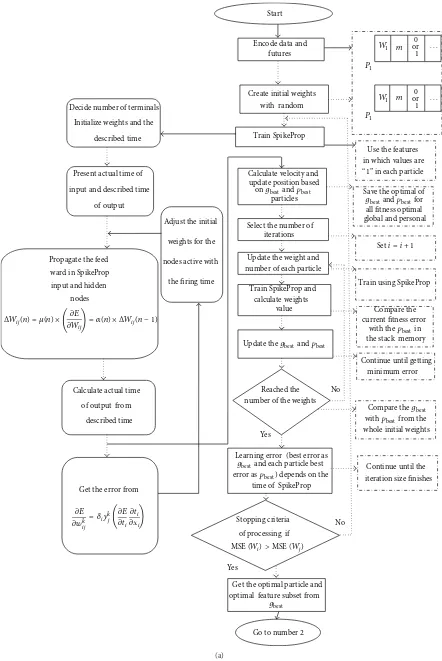
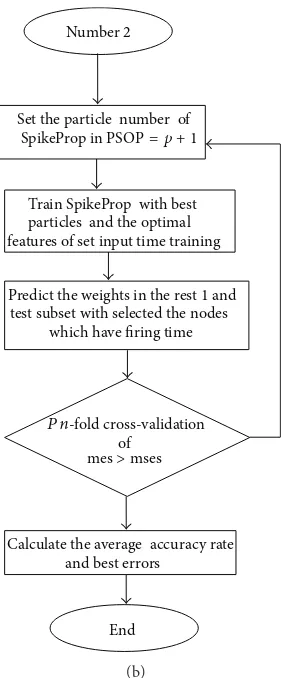
the operation of Spikeprop, a merging process between Model 1 and Model 2 (resulting in Model 3) has been carried out. Model 3 has an architecture which is partly PSO and partly angle driven dependency learning rate system. The flowchart
inFigure 2shows the general working of Model 3.
3.4. Error Measurement Functions. The target of the
Spike-Prop algorithm is to learn a set of target firing times, denoted
by{𝑡𝑑𝑗}, at the output neurons𝑗 ∈ 𝐽for a given set of input
patterns{𝑃[𝑡𝑗⋅ ⋅ ⋅ 𝑡ℎ]}, where𝑃[𝑡𝑗⋅ ⋅ ⋅ 𝑡ℎ]defines a single input
pattern described by single spike times for each neuronℎ ∈
𝐻. Given the desired spike times{𝑡𝑎𝑗}and actual firing times
{𝑡𝑎
𝑗}, this error function is defined by
(a) MSE= 1
𝑛 𝑛 ∑ 2−1
(𝑡𝑎
𝑗 2− 𝑡𝑑𝑗 2)
2
. (8)
This thesis uses other error functions such as RMSE (9),
MAPE (10) and MAD (11) to get more validation to evaluate
the accuracy of SpikeProp (SNN) that has been enhanced and proposed (Models 1, 2, and 3).
Consider
(b) RMSE= √1
𝑛 𝑛 ∑ 2−1
(𝑡𝑎
𝑗 2− 𝑡𝑑𝑗 2)
2
, (9)
(c) MAPE=
𝑛 ∑ 2−1 𝑡𝑎
𝑗 2− 𝑡𝑑𝑗 2
𝑡𝑑 𝑗 2 ∗ 100
𝑛 , (10)
(d) MAD=
𝑛 ∑ 2−1
𝑡𝑗 2𝑎 − 𝑡𝑑𝑗 2
𝑛 . (11)
4. Results and Discussion
This section presents the results of study on learning of Spike-Prop network based on the proposed method of improved SpikeProp. The results for all datasets involved are analyzed based on the convergence to MSE, RMSE, MAPE, and MAD with their classification performance. The results of the proposed methods for each dataset are analyzed based on performance (accuracy). For analysis purposes, methods of improved SpikeProp are used to train and optimize the networks, comparing different measurements of error. The results of SpikeProp based on the proposed method of improved SpikeProp are presented in the following subsec-tions.
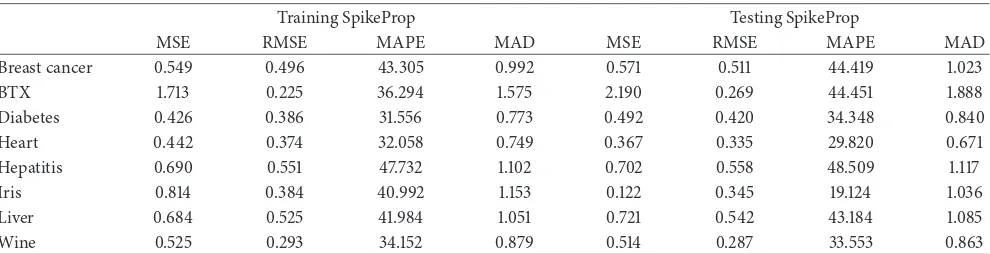
4.1. Results and Analysis of Standard SpikeProp. This section
presents the result of standard SpikeProp for all datasets. The results are analyzed based on the convergence to MSE, RMSE, MAPE and MAD findings with their classification
performance as shown inTable 2. All experiments for
stan-dard SpikeProp are based on ten runs. FromTable 2, RMSE
Go to number 2
0 or Start
Encode data and futures
Create initial weights with random
Train SpikeProp
Calculate velocity and update position based
particles
Select the number of iterations
Update the weight and number of each particle
Train SpikeProp and calculate weights
value
Learning error (best error as
time of SpikeProp
Get the optimal particle and optimal feature subset from
Reached the number of the weights
Stopping criteria
of processing if
Use the features in which values are “1” in each particle
Save the optimal of
all fitness optimal global and personal
Train using SpikeProp
Compare the current fitness error
the stack memory
whole initial weights Continue until getting
minimum error
Continue until the iteration size finishes Yes
Yes
No No Decide number of terminals
Initialize weights and the
described time
Present actual time of
input and described time
of output
Propagate the feed ward in SpikeProp input and hidden
nodes
Calculate actual time
of output from
described time
Get the error from
Adjust the initial
weights for the
nodes active with
the firing time
MSE(Wi) >MSE(Wj)
Seti = i + 1
1
m
m or 0 1
· · ·
· · ·
𝜕E
𝜕wk
ij
𝜕E
𝜕ti
𝜕ti
𝜕xi
ΔWij(n) = 𝜇(n) × 𝜕E
𝜕Wij = 𝛼(n) × ΔWij(n − 1)
W1
W1
P1
P1
) (
) (
= 𝛿iyk
j
ongbest andpbest
Update thegbest
gbest
andpbest
gbestand each particle best error aspbest) depends on the
gbestandpbestfor
with thepbest in
Compare thegbest
withpbest from the
(a)
Set the particle number of
Train SpikeProp with best particles and the optimal features of set input time training
Predict the weights in the rest 1 and test subset with selected the nodes
which have firing time
of
Calculate the average accuracy rate and best errors
Number 2
End mes>mses
SpikeProp in PSOP= p + 1
P n-fold cross-validation
(b)
Figure 2: Merge Model 1 with Model 2 learning process.
Heart, Iris, Diabetes, Breast Cancer, Liver, Hepatitis, and XOR, respectively. The RMSE is also better than MAPE, and MAD error measurements for all datasets. These show that the SpikeProp algorithm also demonstrates in a direct way that networks of spiking neurons can carry out complex, nonlinear tasks in a temporal code. As the experiments indicate, the SpikeProp algorithm is able to perform correct classification on nonlinearly separable datasets with all types of errors measurement compared to traditional sigmoidal
networks (BP) as shown in Table 3. Table 2 illustrates a
comparison of the measurements between the training and testing of SpikeProp algorithm. From this table, we can see that the SpikeProp converges with less errors than standard BP.
4.2. Results and Analysis of Standard BP. The analyses of
standard BP for all datasets are validated based on MSE,
RMSE, MAPE, and MAD as shown in Table 3. From the
training part inTable 3, the RMSE is better than MSE for
the training datasets of Diabetes, Heart, Breast Cancer, Liver, Hepatitis, Wine, Iris, BTX, and XOR, respectively. The MSE is also better than MAPE and MAD for all datasets except BTX, which shows that MAD values are less compared to MSE. This traditional BP network is widely used by other researchers for
classification problems. Bohte et al. [18] designed SpikeProp
for BP learning strategy; the comparisons between BP and
SpikeProp are given in Tables 2 and 3. It shows that BP
generates higher errors compared to SpikeProp.
4.3. Analysis of the Proposed Model 1: PSO-Spikeprop. Table 4
reveals the MSE generalization from the training part. MSE gives better results on Diabetes, Heart, Wine, and Breast Cancer datasets and least competitive for Liver, Hepatitis, Iris, BTX, and XOR datasets. For RMSE, the proposed PSO-SpikeProp is better for Wine, BTX, Diabetes, Iris, and Heart and less competitive in Liver, Breast Cancer, Hepatitis, and XOR, respectively. For MAD, the finding is better in Breast Cancer, Diabetes, and Heart and worse in Wine, Liver, Iris Hepatitis, BTX, and XOR, respectively. On the other hand, MAPE for PSO-SpikeProp gives higher error but still better than standard SpikeProp algorithm.
The PSO-SpikeProp gives the smallest error in MAPE compared to standard Spikeprop. However, PSO-SpikeProp stands out to be better if RMSE is being compared. Since the errors are squared before they are averaged, the RMSE gives a relatively low error rates, although the MSE has close
values to RMSE as shown in Table 4. Therefore, Model 1:
Table 2: Analysis for standard SpikeProp algorithm.
Training SpikeProp Testing SpikeProp
MSE RMSE MAPE MAD MSE RMSE MAPE MAD
Breast cancer 0.549 0.496 43.305 0.992 0.571 0.511 44.419 1.023
BTX 1.713 0.225 36.294 1.575 2.190 0.269 44.451 1.888
Diabetes 0.426 0.386 31.556 0.773 0.492 0.420 34.348 0.840
Heart 0.442 0.374 32.058 0.749 0.367 0.335 29.820 0.671
Hepatitis 0.690 0.551 47.732 1.102 0.702 0.558 48.509 1.117
Iris 0.814 0.384 40.992 1.153 0.122 0.345 19.124 1.036
Liver 0.684 0.525 41.984 1.051 0.721 0.542 43.184 1.085
Wine 0.525 0.293 34.152 0.879 0.514 0.287 33.553 0.863
Table 3: Analysis for standard BP algorithm.
Training BP Testing BP
MSE RMSE MAPE MAD MSE RMSE MAPE MAD
Breast cancer 0.672 0.525 54.759 1.278 0.816 0.638 54.443 1.277
BTX 1.982 0.796 88.018 2.575 2.707 0.798 88.344 2.588
Diabetes 0.510 0.429 37.576 1.271 0.792 0.627 59.208 1.255
Heart 0.608 0.477 41.902 1.270 0.805 0.633 55.724 1.267
Hepatitis 0.837 0.646 55.588 1.293 0.837 0.647 55.607 1.294
Iris 0.874 0.763 69.176 2.290 0.865 0.759 68.660 2.278
Liver 0.826 0.641 56.315 1.283 0.831 0.643 56.459 1.287
Wine 0.749 0.419 72.471 1.119 0.753 0.408 72.649 1.125
Table 4: Analysis for Model 1.
Training Model 1 Testing Model 1
MSE RMSE MAPE MAD MSE RMSE MAPE MAD
Breast cancer 0.356 0.361 35.261 0.723 0.367 0.372 36.268 0.745
BTX 1.270 0.199 35.596 1.398 1.763 0.247 43.785 1.730
Diabetes 0.241 0.245 22.650 0.490 0.284 0.277 25.778 0.555
Heart 0.2828 0.281 26.813 0.563 0.272 0.272 25.997 0.545
Hepatitis 0.483 0.448 42.640 0.896 0.494 0.457 43.609 0.915
Iris 0.351 0.251 33.270 0.754 0.112 0.147 18.38 0.443
Liver 0.360 0.340 31.854 0.680 0.383 0.357 33.332 0.714
Wine 0.312 0.196 25.033 0.590 0.305 0.196 25.269 0.589
the smallest error during the implementation. For this model we conclude that error can be reduced to reach the minimum value.
4.4. Analysis of the Proposed Model 2: SpikeProp with Angle
Driven Dependency (𝜇). Similar to previous experiments, the
results of Model 2 of SpikeProp with angle driven dependency are computed based on MSE, RMSE, MAPE, and MAD
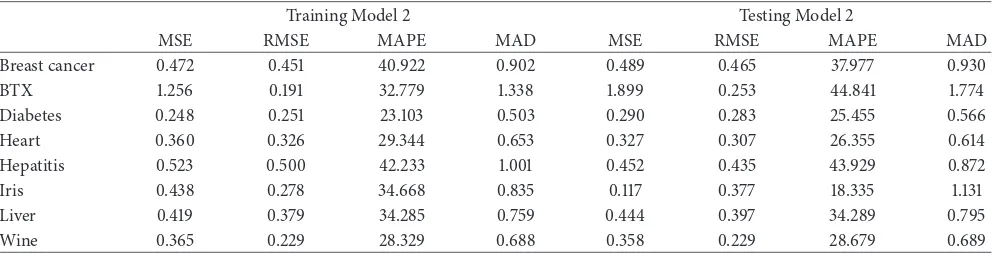
error measurements.Table 5shows the findings of the model,
which are based on ten independent runs on both training and testing datasets, respectively. The average testing errors are being calculated along with the standard deviations for all datasets.
As can be seen fromTable 5, it is interesting to see the
small standard deviations for all error rates on the training set
and the testing set in all datasets. The results of this proposed Model 2 have demonstrated that the generalization of MSE is better for Diabetes, Heart, and Wine datasets, while the results for Liver, BTX, Hepatitis, Iris, Breast Cancer, and XOR datasets are the least competitive. The results also have shown that the RMSE is better on all datasets and less competitive for other error measurements except for the Diabetes dataset which has better MSE values compared to RMSE. In general, the diversity of errors rates (MSE, RMSE, MAPE, and MAD) for this proposed Model 2 is considered better for all datasets. According to this model, we can find that the error is less than BP and SpikeProp standard.
4.5. Analysis of the Proposed Model 3: Hybridization of Model
Table 5: Analysis for Model 2.
Training Model 2 Testing Model 2
MSE RMSE MAPE MAD MSE RMSE MAPE MAD
Breast cancer 0.472 0.451 40.922 0.902 0.489 0.465 37.977 0.930
BTX 1.256 0.191 32.779 1.338 1.899 0.253 44.841 1.774
Diabetes 0.248 0.251 23.103 0.503 0.290 0.283 25.455 0.566
Heart 0.360 0.326 29.344 0.653 0.327 0.307 26.355 0.614
Hepatitis 0.523 0.500 42.233 1.001 0.452 0.435 43.929 0.872
Iris 0.438 0.278 34.668 0.835 0.117 0.377 18.335 1.131
Liver 0.419 0.379 34.285 0.759 0.444 0.397 34.289 0.795
Wine 0.365 0.229 28.329 0.688 0.358 0.229 28.679 0.689
Table 6: Analysis for Model 3.
Training Model 3 Testing Model 3
MSE RMSE MAPE MAD MSE RMSE MAPE MAD
Breast cancer 0.350 0.355 34.812 0.711 0.361 0.367 35.863 0.734
BTX 0.972 0.162 27.401 1.138 1.592 0.226 39.155 1.585
Diabetes 0.211 0.212 20.218 0.425 0.251 0.245 23.496 0.491
Heart 0.252 0.250 24.543 0.501 0.241 0.240 23.634 0.481
Hepatitis 0.437 0.421 41.179 0.843 0.446 0.431 42.194 0.863
Iris 0.330 0.244 32.747 0.732 0.105 0.153 17.576 0.461
Liver 0.359 0.339 31.778 0.678 0.380 0.356 33.296 0.712
Wine 0.263 0.168 22.186 0.506 0.273 0.178 23.637 0.535
two good genes, it may be possible to get good SpikeProp algorithm by merging (hybridizing) two good techniques. Therefore, this paper is concerned about the merging imple-mentation of Model 1 and Model 2 (to get Model 3) as
maintained inFigure 2.
In this section, we hybridize Model 1: PSO-SpikeProp and Model 2: SpikeProp with angle driven dependency to obtain a better performance for error rates (MSE, RMSE, MAPE, and MAD). We notice that the performance mea-surement is better than in the previous proposed method
when the hybridization takes place as shown in Table 6.
The experiments are based on 10 independent runs for the training and testing for all datasets, respectively. The results have revealed that generalization of error rates in RMSE is better for BTX, Wine, Diabetes, Iris, and Heart datasets and the least competitive for Breast Cancer, Hepatitis, Liver, and XOR datasets. Similarly, the result of MSE error rate has been demonstrated to be less better for Diabetes, Heart, Wine, Iris, Breast Cancer, Liver, Hepatitis, and BTX datasets, respectively. To get better performance, we hybridized Model 1 and Model 2, to get Model 3, to minimize the error to reach the optimum error value.
4.6. Analysis and Result for Proposed Methods Based on Error.
In this section, the spiking neural network and SpikeProp use the encoding by depending on the timing of spike, where the first spike has a higher weight than the last one. Since a biological neuron uses few milliseconds to process information data, only few spikes are required and emitted, however the few first spikes with highest value information
can contribute to all process learning, as we used Gaussian
function for encoding. Figures3–10show the convergence
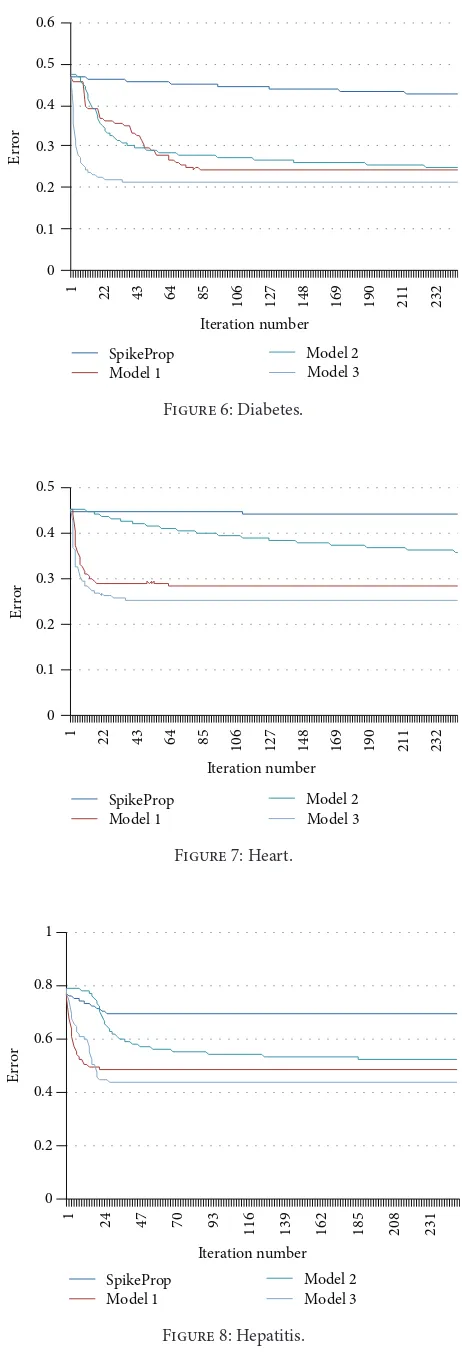
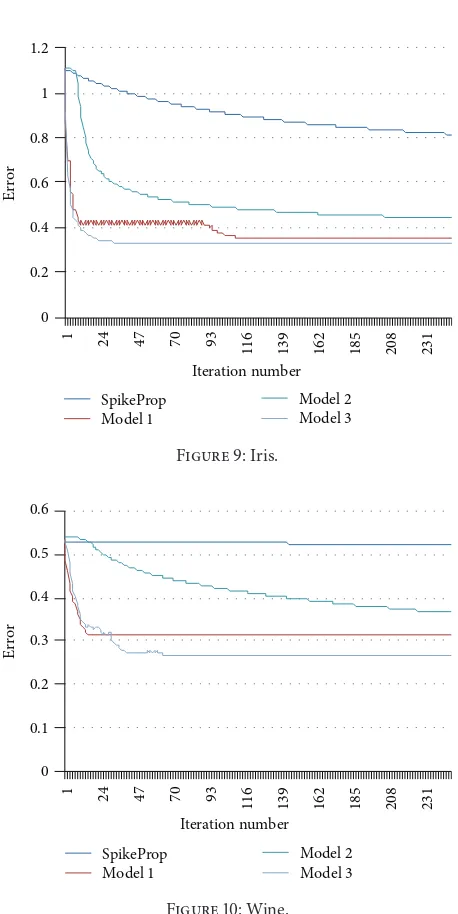
of the error and the number of iterations of the Spikeprop standard and the proposed methods for the improved SpikeP-rop in the classification Liver dataset, Breast Cancer, BTX, Diabetes, Heart, Hepatitis, Iris, and Wine data problems. The SpikeProp standard configuration had a much slower rate of convergence, as can be clearly seen in the plot. Although its rate of progress gradually slow down from the beginning till last iteration but kept in high error in the MSE, despite this
slowdown in all data problems as shown in Figures3–10.
4.6.1. Analysis Error and Iterations of Model 1
(PSO-SpikeP-rop). We also see from the convergence that the proposed
method for improved SpikeProp is much better than standard SpikeProp as PSO-SpikeProp (Model 1) had dramatic slow-down from the first 10 iterations slow-down to iteration number 40, and afterwards the plot got a slight slowdown in Liver as
shown inFigure 3. In Breast Cancer data problem inFigure 4
the curve steps down at the start in error near to 0.5 until 0.38 exactly and then it continued descending to the last itera-tion at error 0.35 gradually. PSO-SpikeProp (model 1) is the first model from the proposed methods; the error turned down quickly in the first 10 iterations at 1.78 and continued to drop down till the last iteration in the error 1.27 in the
BTX data problem as seen inFigure 5. Also in Diabetes data
problem inFigure 6 the curve for the error steps down so
Er
ro
r
Iteration number 0
0.2 0.4 0.6 0.8 1
1 19 37 55 73 91
10
9
12
7
14
5
16
3
18
1
19
9
21
7
23
5
SpikeProp Model 1
Model 2 Model 3
Figure 3: Liver.
Er
ro
r
Iteration number 0
0.1 0.2 0.3 0.4 0.5 0.6 0.7
1 22 43 64 85
106 127 148 169 190 211 232
SpikeProp Model 1
Model 2 Model 3
Figure 4: Breast cancer.
0 0.5 1 1.5 2 2.5
1 21 41 61 81
101 121 141 161 181 201 221 241
SpikeProp Model 1
Model 2 Model 3
Er
ro
r
Iteration number
Figure 5: BTX.
Er
ro
r
Iteration number 0
0.1 0.2 0.3 0.4 0.5 0.6
1 22 43 64 85
106 127 148 169 190 211 232
SpikeProp Model 1
Model 2 Model 3
Figure 6: Diabetes.
Er
ro
r
Iteration number 0
0.1 0.2 0.3 0.4 0.5
1 22 43 64 85
106 127 148 169 190 211 232
SpikeProp Model 1
Model 2 Model 3
Figure 7: Heart.
Er
ro
r
Iteration number 0
0.2 0.4 0.6 0.8 1
1 24 47 70 93
116 139 162 185 208 231
SpikeProp Model 1
Model 2 Model 3
0 0.2 0.4 0.6 0.8 1 1.2
1 24 47 70 93
116 139 162 185 208 231
SpikeProp
Iteration number
Model 1
Model 2 Model 3
Er
ro
r
Figure 9: Iris.
0 0.1 0.2 0.3 0.4 0.5 0.6
1 24 47 70 93
116 139 162 185 208 231
Iteration number
SpikeProp Model 1
Model 2 Model 3
Er
ro
r
Figure 10: Wine.
it was a little sloped and stopped at the last iteration in error 0.24.
As we can see fromFigure 7in Heart problem the curve
in error has dropped in a dramatic manner in the first 15 iterations in error from 0.45 to 0.28, and then the dropping is slowed down till iteration number 67 in error 0.28 and continued steadily till the last iteration for the same error. From the same proposed model in Hepatitis data problem
inFigure 8 we can see that the slope of the curve starts at
the first 15 iterations in a fast way in error 0.76 to 0.49, and then it slows down till iteration number 38 in error 0.48 and it stays likely stable till the last iteration. In Iris data problem
in this model the plot fromFigure 9is stepped down in very
fast drop from the first 10 iterations in error 1.105, and then it is zigzagged in error range 0.433 to 0.410 till iteration number 90 and then immediately fell down till the iteration number 112 in error 0.351 and it stayed on it till last iteration. Finally the plot of the error is stepped down in a high manner in the first
15 iterations of error 0.534 to 0.312, and then it stabilized in this error till the last iteration in Wine data problem as shown
inFigure 10. From this model we have seen from Figures3–10
how to obtain the list error from list iteration number from the whole data sets.
4.6.2. Analysis Error and Iterations of Model 2. In the second
improvement for SpikeProp through the learning rate angle driven dependency (Model 2), we can also notice in Liver data
problem as shown inFigure 3that it has a slight dropping for
the first 10 iterations in error around 0.75 and got a huge fall down till iteration number 50 for the error of nearly 0.55 and then it had a slight dropping till last iteration for the error
0.4. In the same model in Breast Cancer problem inFigure 4,
the plot started to fall down on the first 20 iterations in error 0.57 until 0.47 gradually. Also the curve in BTX data problem
as shown inFigure 5 start dropping down from the first 5
iterations in error 1.73 to 1.72, and it is fluctuated between the 6th iteration and iteration number 197 of the error range 1.73 to 1.31. Afterwards it has a steady drop till iteration 250 at error interval 1.30 to 1.25. From the result in Diabetes problem at
the same Model 2 on the plot inFigure 6, the error in first
seven iterations has dropped down slowly at error 0.47; after that it stepped down quickly till iteration number 20 in error 0.35 and then continued steadily until the last iteration for
error 0.24. In the Heart data problem fromFigure 7, the plot
is stepped down from first iteration in error 0.45 until last iteration in error 0.36, and in some iterations, it is stable and then it continues descending. Also in Hepatitis data problem as shown inFigure 8, it has a stable error of 0.786 for the first 5 iterations, and then it start to fall down till iteration number 80 for error 0.549; after that it has a slower dropping till last iteration on error 0.523 in a sequence stepping down.
FromFigure 9as we can see clearly the curve is dropped
down slowly in first 10 iterations in error 1.111 till 1.040; then it accelerates in dropping till iteration number 55 of error 0.53 and the drop slows down till last iteration in 0.438 error
in the Iris data problem. Finally from Figure 10 in Wine
data problem the plot shows Model 2 (learning rate angle driven dependency) is almost steady in first 15 iterations in error 0.538 to 0.526, and then the dropping got accelerated continuously till last iteration for error 0.366.
4.6.3. Analysis Error and Iterations of Model 3 (SpikeProp with
Angle Driven Dependency (𝜇)). (PSOSpikeProp and
Learn-ing Rate Angle Driven Dependency) or (model 3), in Liver
dataset as it is clear from Figure 3the plot it provides the
best enhancement result for the convergence of error and number of iteration. The slant starts from the first iteration in the error a bit less than 0.8 till iteration number 20 impressively, and then a gradual descending has been done till last iteration of error close to 0.354. The curve from
Figure 5witnessed a dramatic drop in first 10 iterations
start-ing from error 1.95 and the drop decreases till last iteration
at error 0.97. We can notice from the curves inFigure 4that
Table 7: Result of training in terms of accuracy.
Training
SpikeProp Model 1 Model 2 Model 3 BP
Breast cancer 50.36 63.82 54.88 60.9 33.68
BTX 73.75 76.69 75.7 77.01 42.19
Diabetes 22.68 50.97 49.64 52.3 14.81
Heart 25.04 43.69 34.69 42.24 13.17
Hepatitis 8.21 21.38 17.57 22.23 2.44
Iris 57.68 72.27 68.22 73.22 32.79
Liver 4.86 31.97 24.01 29.3 2.14
Wine 56.03 70.47 67.57 70.36 35.78
Table 8: Result of testing in terms of accuracy.
Testing
SpikeProp Model 1 Model 2 Model 5 BP
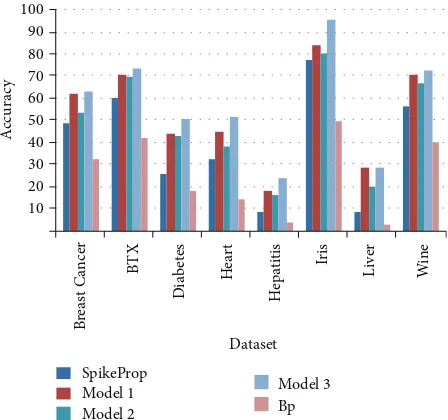
Breast cancer 48.82 62.7 53.46 63.28 32.21
BTX 60.52 71.15 70.42 73.57 41.77
Diabetes 25.99 44.45 43.31 50.8 18
Heart 32.81 45.4 38.56 51.81 14.64
Hepatitis 8.78 18.42 16.5 23.65 4.33
Iris 77.66 84.66 80.73 96.03 50.03
Liver 8.55 28.55 20.48 28.79 2.8
Wine 56.84 70.53 67.53 73.24 40.13
the first iteration of error 1.93 to last iteration of error 0.97. From this we can see that most impact on SpikeProp standard is from PSO-SpikeProp and the leaning rate methods, and other proposed methods have less impact on BTX data
problem as shown inFigure 5.
From the plot in Figure 6, this model started to drop
down in a very fast way in first 10 iterations for error 0.7 to error 0.24, and then it started to slow down till iteration number 43 in error 0.21, and then it became almost stopped in error 0.21 till last iteration; we conclude from the comparison of the previous result that the model 3 gives the best and the least error from all other methods in Diabetes dataset. We can see from the plot that the curve fell down quickly in first 10 iterations for error range 0.45 to 0.29, and then the dropping started to slow down till iteration number 30 in error 0.258, then it got almost steady till last iteration in error 0.252. From the previous it is obvious that this model is the best among all
the other models for Heart data problem as seen inFigure 7.
This merge (Model 3) starts to drop down quickly from the first iteration for the error 0.787 until iteration number 30 for error 0.438, and then it stays stable until last iteration, as it
is obvious fromFigure 8and the results that the third model
has the most impact on SpikeProp compared to the previous
models for Hepatitis data problem. Finally fromFigure 9it
can be seen that the plot in this merge model started to step down quickly in first 30 iterations in error 1.107 to 0.332 and then it got steady for the same error till last iteration. This can show that the third model of improving SpikeProp gives the best result compared to other previous methods in Iris data problem.
Lastly, Model 3 is merging between Model 1 and Model 2 (PSO-SpikeProp and learning rate angle driven depen-dency); this merging model has a high impact on enhancing
SpikeProp as it is seen in the curve ofFigure 10that in Wine
data problem the slope is dropped quickly starting from first iteration of error 0.533 till iteration number 70 of error 0.263 and then it becomes almost stable till last iteration.
4.7. Result and Analysis Comparison of the Proposed
Meth-ods in Terms of Accuracy. This section displays the result
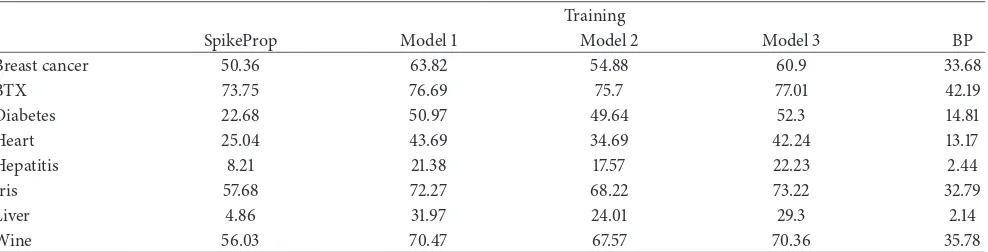
of SpikeProp standard besides the proposed methods for enhanced SpikeProp measured in terms of accuracy. The experiments are run 10 s, 10 dependent runs on training
and testing for all datasets, respectively (refer to Tables 7
and8 and Figures11 and12). As it is shown inTable 7 for
training, the first proposed method PSO-SpikeProp (Model 1) is evaluated in terms of accuracy; we can see that we got the value in Breast Cancer better than SpikeProp standard and proposed methods except Model 5. Regarding the BTX dataset problem, it is also better than SpikeProp standard and other proposed methods except Model 3. The generalization of accuracy for the proposed method PSOSpikeProp is better than SpikeProp standard and learning rate angle driven dependency (Model 2) in all datasets. Learning rate angle driven dependency is our proposed method; it is better than SpikeProp standard in all datasets. Finally, Model 3 is merging model (PSO-SpikeProp and Learning Rate Angle Driven
Dependency) as illustrated inFigure 11andTable 7that it is
0 20 40 60 80 100 SpikeProp Model 1 Model 2 Model 3 Dataset Bp B re ast C ancer BT X Dia b et es He ar t H epa ti ti s Ir is Li ve r Wi n e A cc urac y
Figure 11: Results in training of the proposed methods in terms of accuracy. 10 20 30 40 50 60 70 80 90 100 SpikeProp Model 1 Model 2 Model 3 Dataset Bp B re ast C ancer A cc urac y BT X Dia b et es He ar t H epa ti ti s Ir is Li ve r Wi n e
Figure 12: Results in testing of the proposed methods in terms of accuracy.
5. Conclusions
We introduced several extensions to the SpikeProp learn-ing algorithm that make it possible to learn not only the weights, but also the delays and synaptic time constants of the connections and the thresholds of the neurons. Due to these enhancements, smaller network architecture can be used. This is mainly due to the fact that delays can now be trained and need not be enumerated. The simple 8 data sets could be solved with the same precision as the original SpikeProp algorithm, less errors (making the simulation and learning phase of the network much faster), and an increased learning convergence. There are several proposed models needed to improve the performance of SpikeProp further; hybridization of two or more good architectures is carried
out (for instance the hybridization of Model 1 and Model 2 to obtain Model 3). The purpose of hybridization is to leverage the best function from each component of the hybrid. As an example, Model 3 is the hybridization of Model 1 which is PSO-SpikeProp (enhancement Spikeprop architecture by PSO) with Model 2 which is SpikeProp enhancement using angle driven dependency learning rate. For Model 3, when the position of search is far from the optimum, PSO is used to directly move the point of search close to the optimum. When the search point is close to the optimum, Model 3 switches over to the system where there is SpikeProp enhancement using angle driven dependency learning rate to reach the optimum position. Also a thorough analysis of the weight initialization problem is required. The convergence rate seems to be pretty sensitive to this. Several techniques used in classic neural networks to speed up backpropagation learning could be added to SpikeProp to further speed up learning.
References
[1] Y. J. Jin, B. X. Shen, R. F. Ren, L. Yang, J. Sui, and J. G. Zhao, “Prediction of the styrene butadiene rubber performance by emulsion polymerization using backpropagation neural
net-work,”Journal of Engineering, vol. 2013, Article ID 515704, 6
pages, 2013.
[2] W. Gerstner, R. Kempter, J. L. van Hemmen, and H. Wagner,
Hebbian Learning of Pulse Timing in the Barn Owl Auditory System in Maass, 1999.
[3] A. Belatreche and R. Paul, “Dynamic cluster formation using
populations of spiking neurons,” in Proceedings of the 2012
International Joint Conference on Neural Networks (IJCNN ’12), pp. 1–6, June 2012.
[4] D. Ferster and N. Spruston, “Cracking the neuronal code,”
Sci-ence, vol. 270, no. 5237, pp. 756–757, 1995.
[5] S. Thorpe, A. Delorme, and R. van Rullen, “Spike-based
strate-gies for rapid processing,”Neural Networks, vol. 14, no. 6-7, pp.
715–725, 2001.
[6] N. Kasabov, “Evolving, probabilistic spiking neural networks and neurogenetic systems for spatio- and spectro-temporal data
modelling and pattern recognition,” inProceedings of the IEEE
World Congress on Computational Intelligence (WCCI ’12), vol.
7311 ofLecture Notes in Computer Science, pp. 234–260, 2012.
[7] C. M. Bishop,Neural Networks for Pattern Recognition, 2000.
[8] S. Haykin, Neural Networks: A Comprehensive Foundation,
Prentice Hall PTR, 1998.
[9] M. Negnevitsky,Artificial Intelligence: A Guide to Intelligent
Sys-tems, Addison Wesley, 2002.
[10] N. Kasabov, “Integrative connectionist learning systems in-spired by nature: current models, future trends and challenges,”
Natural Computing, vol. 8, no. 2, pp. 199–218, 2009.
[11] Gewaltig,Evolution of Synchronous Spike Volleys in Cortical
Net-works: Network Simulations and Continuous Probabilistic
Mod-els, vol. 1822 ofLecture Notes in Artificial Intelligence, Springer,
2000.
[12] S. Thorpe and J. Gaustrais, “Rank order coding,” in
Compu-tational Neuroscience: Trends in Research, pp. 113–118, Plenum Press, New York, NY, USA, 1998.
[13] N. Kasabov, “To spike or not to spike: probabilistic spiking
[14] W. Maass, “Computing with spiking neurons,” inPulsed Neural Networks, W. Maass and C. Bishop, Eds., vol. 2, pp. 55–85, MIT Press, Cambridge, Mass, USA, 2001.
[15] D. Mishra, A. Yadav, A. Dwivedi, and P. K. Kalra, “A neural network using single multiplicative spiking neuron for function
approximation and classification,” inProceedings of the
Inter-national Joint Conference on Neural Networks (IJCNN ’06), pp. 396–403, July 2006.
[16] A. Gr¨uning and I. Sporea, “Supervised learning of logical operations in layered spiking neural networks with spike train
encoding,”Neural Processing Letters, vol. 36, no. 2, pp. 117–134,
2012.
[17] W. Gerstner and W. M. Kistler,Spiking Neuron Models,
Cam-bridge University Press, 2002.
[18] S. M. Bohte, J. N. Kok, and H. La Poutr´e, “Error-backprop-agation in temporally encoded networks of spiking neurons,”
Neurocomputing, vol. 48, no. 1–4, pp. 17–37, 2002.
[19] J. ˇSıma, “Gradient learning in networks of smoothly spiking neurons,” Tech. Rep. 1045, 2009.
[20] D. E. Rumelhart, G. E. Hinton, and R. J. Williams, “Learning
representations by back-propagating errors,”Nature, vol. 323,
no. 6088, pp. 533–536, 1986.
[21] W. Gerstner and W. M. Kistler, Spiking Neuron Models: An
Introduction, Cambridge University Press, 2002.
[22] S. C. Moore,Back-propagation in spiking neural networks [M.S.
thesis], Department of Computer Science, University of Bath, Bath, UK, 2002.
[23] J. Xin and M. J. Embrechts, “Supervised learning with spiking
neural networks,” in Proceedings of the International Joint
Conference on Neural Networks (IJCNN ’01), pp. 1772–1777, July 2001.
[24] B. Schrauwen and J. V. Campenhout, “Parallel hardware imple-mentation of a broad class of spiking neurons using serial
arithmetic,” inProceedings of the 14th European Symposium on
Artificial Neural Networks, M. Verleysen, Ed., pp. 623–628, 2007.
[25] K. Berkovec, Learning in networks of spiking neurons [M.S.
thesis], Faculty of Mathematics and Physics, Charles University, Prague, Czech Republic, 2006.
[26] P. Tiˇno and A. J. S. Mills, “Learning beyond finite memory in
recurrent networks of spiking neurons,”Neural Computation,
vol. 18, no. 3, pp. 591–613, 2006.
[27] I. R. Fiete and H. S. Seung, “Gradient learning in spiking neural
networks by dynamic perturbation of conductances,”Physical
Review Letters, vol. 97, no. 4, Article ID 048104, 2006.
[28] K. Mergenthaler and R. Engbert, “Modeling the control of
fixa-tional eye movements with neurophysiological delays,”Physical
Review Letters, vol. 98, no. 13, Article ID 138104, 2007. [29] K. Nakazawa, M. C. Quirk, R. A. Chitwood et al., “Requirement
for hippocampal CA3 NMDA receptors in associative memory
recall,”Science, vol. 297, no. 5579, pp. 211–218, 2002.
[30] Y. Shi, Particle Swarm Optimization, IEEE neural Network
Society, 2004.
[31] L. W. Chan and F. Fallside, “An adaptive training algorithm for
back propagation networks,”Computer Speech and Language,
Submit your manuscripts at
http://www.hindawi.com
Operations
Research
Advances in
Hindawi Publishing Corporation
http://www.hindawi.com Volume 2013
Hindawi Publishing Corporation
http://www.hindawi.com Volume 2013
Mathematical Problems in Engineering
Hindawi Publishing Corporation
http://www.hindawi.com Volume 2013
Abstract and
Applied Analysis
ISRN
Applied Mathematics
Hindawi Publishing Corporation
http://www.hindawi.com Volume 2013
Hindawi Publishing Corporation
http://www.hindawi.com Volume 2013 International Journal of
Combinatorics
Hindawi Publishing Corporation
http://www.hindawi.com Volume 2013
Journal of Function Spaces and Applications
International Journal of Mathematics and Mathematical Sciences
Hindawi Publishing Corporation http://www.hindawi.com Volume 2013
ISRN
Geometry Hindawi Publishing Corporation
http://www.hindawi.com Volume 2013 Hindawi Publishing Corporation
http://www.hindawi.com Volume 2013
Discrete Dynamics in Nature and Society
Hindawi Publishing Corporation
http://www.hindawi.com Volume 2013
Advances in
Mathematical Physics
ISRN
Algebra
Hindawi Publishing Corporation
http://www.hindawi.com Volume 2013
Probability
and
Statistics
Journal of
Hindawi Publishing Corporation
http://www.hindawi.com Volume 2013
ISRN
Mathematical Analysis Hindawi Publishing Corporation
http://www.hindawi.com Volume 2013
Journal of
Applied Mathematics
Hindawi Publishing Corporation
http://www.hindawi.com Volume 2013
Sciences
Hindawi Publishing Corporation
http://www.hindawi.com Volume 2013
Hindawi Publishing Corporation
http://www.hindawi.com Volume 2013
Stochastic Analysis
International Journal of Hindawi Publishing Corporationhttp://www.hindawi.com Volume 2013 Hindawi Publishing Corporation
http://www.hindawi.com Volume 2013
The Scientific
World Journal
Hindawi Publishing Corporation
http://www.hindawi.com Volume 2013 ISRN
Discrete Mathematics
Hindawi Publishing Corporation http://www.hindawi.com
Differential
Equations
International Journal of
Volume 2013