GENETIC ANALYSIS OF
THE
DUMPYCOMPLEX LOCUS IN DROSOPHZLA MELANOGASTER:
COMPLEMENTATION, FINE STRUCTURE AND FUNCTION
DALE GRACE
Department cf Biology, University of Oregon, Eugene, Oregon 97403 Manuscript received May 4, 1979
Revised copy received November 13, 1979
ABSTRACT
An extensive genetic analysis of the dumpy locus is presented. This study includes complementation, fine structure mapping and allelic interaction. A number of complementing recessive lethals of the d p complex have been genetically mapped. Two alleles of the o l ( u ) type that complement 1 alleles map to the left portion of the locus. A number of olu alleles that complement both l and Zv lethals map within the right portion of the locus.--Fine-struc- ture analysis demonstrated that both olu and o alleles are distributed among various subloci. Evidence for spacer regions between subloci is presented.- An extensive discussion of the data considers whether the locus is unicistronic or multicistronic. The conclusion reached is that the locus is not a single functional cistron. The possibility of a single cistron encoding a multifunc- tional polypeptide is discussed.--The hypothesis is proposed that the left portion of the map and the I mutations function as regulatory sequences and that the right portion of the map encodes structural sequences.
G E N E T I C A L L Y complex loci in Drosophila are interesting because they represent arrangements that may offer clues to the organization and intri- cacies of gene regulation in higher organisms. Most complex loci are charac- terized by pleiotropism and partial or complete allelic complementation. Based primarily on complementation patterns and the genetic map, many complex loci have been considered to be groups of closely linked genes (gene-clusters)
,
e.g., bithorax (LEWIS 1963, 1967, 1978), dumpy (GRACE 1970) and lozenge(GREEN and GREEN 1956). However, other complex loci may be composed of a single gene encoding a single polypeptide sequence with a single function, e.g., vermilion ( BAILLIE and CHOVNICK 1971 )
.
The complexity and relatively large size of many genetic loci have presented difficulties to workers attempting to understand their structure and function. I n Drosophila, these difficulties have been, in part, related to the paucity of information about the biochemical prod- ucts of these loci.The isolation of single multifunctional polypeptides in eukaryotes other than Drosophila has led to an apparent resolution of this impasse. The data indicate that a single gene encodes a single polypeptide with discrete multiple functions (GAERTNER and COLE 1977; KIRSCHNER and BISSWANGER 1976). I t appears that a single protein can be multifunctional; that is, discrete regions with unique
648 D. GRACE
€unctions exist within a single polypeptide. Each region maintains its functional capabilities even when isolated (KIRSCHNER and BISSWANGER 1976).
Multifunctional proteins may also exist in Drosophila. Recent studies on the rudimentary locus, which encodes three enzyme activities in the pathway to the biosynthesis of pyrimidines ( NORBY 1973; RAWLS and
FRISTROM
1975), indicate that the three enzyme activities co-sediment as a single peak in sucrose gradients (BROTHERS et al. 1978). This suggests that the three discrete activities of the complex are contained on one polypeptide. The multifunctional protein concept provides a straightforward explanation for the rudimentary locus and possibly other genetically complex loci.While the relative location of genes in Drosophila has been known for many years, the detailed fcatures of each gene and its surrounding sequences are just beginning to be elucidated. A complete picture will become possible only with a thorough analysis of gene structure and gene function.
This paper describes extensive studies o n the genetics of the dumpy complex locus. Mutants at this locus exhibit a variety of phenotypes (MULLER 1922; CARLSON 1959a,b). For some phenotypes, all alleles are restricted to a specific region within the locus; other phenotypes can result from a single mutation at
any one of a number of sites.
I n a n earlier paper, I suggested that there may exist seven to ten genes within the dumpy complex (GRACE 1970). In light of the evidence related to multi- functional proteins, this hypothesis must be altered. This paper reports expen- ments on complementation between recessive dumpy lethals, on intralocus mapping and on fine structure.
MATERIALS A N D METHODS
Different various dp mutants are designed by their phenotypic expressions, primarily affect- ing the wings and/or thorax: 0, homozygous oblique (wing defect); U, homozygous vortex
(thorax defect) ; OU, homozygous oblique-vortex; o h , recessive oblique-lethal-vortex (CARLSON 1959a,b). Allelic designations postscripted by “CS” were induced by ICR-170 (SOUTHIN and CARLSON 1962). Those postscripted by “HC” or “DG” were induced by n-nitrosomethylurea according to the method described by CORWIN (1968) or by ethyl methanesulfonate according to the method described by LEWIS and BACHER (19G8). All other d p alleles referred to have been described elsewhere (CARLSON 1959a,b; LINDSLEY and GRELL 1967).
Early genetic studies led to the subdivision of the dumpy locus into subloci (CARLSON 1959a). These subloci corresponded to areas defined by map location, complementation tests and com- parison of phenotypes. The inference was also made that each sublocus represents a functional unit. The term sublocus will be retained in preference to gene or cistron, because it can be used in a more general sense.
Stocks: Stocks were maintained in homozygous condition unless they were poorly viable or contained a secondary lethal. The lethal stocks were balanced over ZnCy StwDc L4 ( S t w D C is a
chromosome 2 dominant, yellow-like mutant induced by X rays in the ZnCy L4 chromosome by OSTEP. and CARLSON, unpublished, and designated by them as straw dominant).
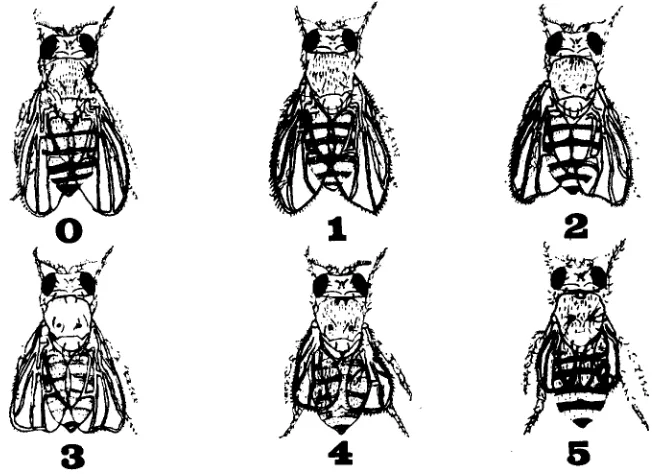
Phenotypic index: dp mutant phenotypes have been described previously; however, no attempt has been made to quantify the phenotypic e€fects. To measure the possible correspon- dence between the intensity of mutant phenotype and the position of the mutation within the locus, a scale was developed to express the severity of a mutant phenotype, the phenotypic index,
GENETIC ANALYSIS OF DUMPY 649
classified according to a numerical scale ranging from 0 (wild type) to 5 (extreme dumpy)
for both oblique wing and thoracic vortex (see Figure I ) . Effects on the legs were noted. Since
d p males are generally affected less than d p females, each phenotypic index was based on three- to six-day-old females at 22“ or, in a few cases, at m m temperature. The phenotypic index proved to be particularly useful in rating the recessive lethals.
Lethality: Some homozygous dumpy mutants express a very weak mutant effect, while others are semilethal. These extreme alleles (e.g., o-bm ou-h) produce viable heterozygotes with most, if not all, d p lethals (LINDSLEY and GRELL 1967). In this study, alleles were classified as lethals and included in the lethal analysis only if they (1) were stable as balanced stocks, (2) showed a strong or extreme phenotype in combination with the tester allele ou-I, and/or (3) were lethal in combination with one or more of the d p lethal types 02, Zu, olv or 1.
Dumpy map: Based o n the work of several investigators, a simplified general map of the dp
complex has been constructed (CARLSON 1959a; SOUTHIN and CARLSON 1962; GRACE 1970; MONT-
GOMERIE 1974; and GRACE, unpublished).
0 0 olu I 2v ov 02 U
The order olv-2 and 1-2u was determined by MONTGOMERIE, using a second lethal induced on the mutant 2 chmmosome. Other o b ’ s exist throughout the locus and will be discussed in detail later. Alleles OD and 02u are referred to as “polar” mutations because they show both o and U effects. Alleles 0, U, Zu, 02 and 1 are referred to as nonpolar mutations. Each location shown on the map represents a possible sublocus rather than a particular allele. Each sublocus is represented by two or more phenotypically similar alleles and in some cases also by phenotypically different alleles, i.e., both polar and nonpolar alleles. The problem of determining the boundaries of dif- ferent subloci is addressed in detail in the RESULTS. For clarity, references to a mutant mapping
within a particular sublocus will be designated by one of the allelic types as given above, even
L
w w
0
”1
-
2 ,
3
4
S
650 D. GRACE
though the mutant under discussion rqresents a different phenotype if it maps within that sublocus, e.g., an olu allele of the ou sublocus.
Lethal complementarity: A total of 45 lethal alleles, representing all known dp lethal types, were tested for complementarity by their ability to produce viable offspring when mated to other lethal alleles. The tests consisted of a series of crosses that involved mating each lethal line to the other 44lines. Matings between different lines were made as mass cultures in shell vials containing six to ten virgin females of one line and five o r more males of the other line. Each cross was kept at 16" and iransferred to fresh medium tvcice at six-day intervals. The second transfer vial was maintaiped a t roam temperature. Complementation was determined by in- specting all culture vials f n r the presence of nonstraw progeny. Their presence was tentative evidence for complementation. The complementing individuals were verified as heteroallelic by mating them to the ou-1 allele and demonstrating the presence of the two original lethals.
If 1 was one of the two lethal alleles of the cross, both 07)-1 and a lethal, such as olu, were used to verify that complementaiion occurred between the two lethal alleles.
Mapping procedures: The four-point mapping procedure used f o r mapping slp alleleq has been described by SOUTHIN and CARLSON (1962). In most cases, a stock containing a double dp lethal (ol-olu-s = olu57) ed ob57 cl/ZnCy StwDC L4 was used as the screening allele (CARLSON
1958). Otherwise, a marked balanced lu or ol stock was used.
RESULTS
Complementarity: Over 1,000 crosses were made using a random selection of
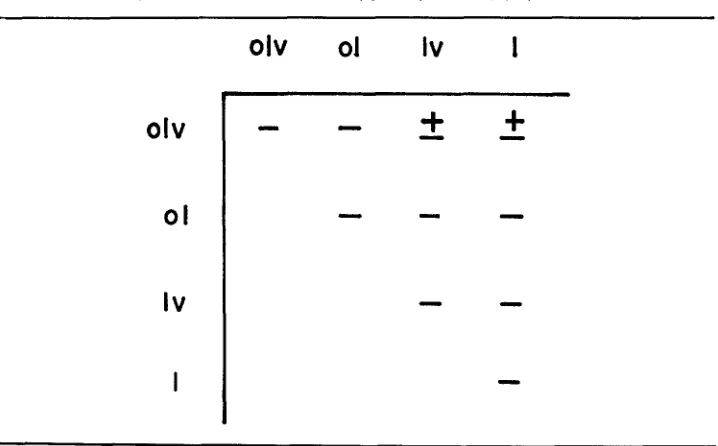
various dumpy lethal types. Four olv alleles were identified, o n the basis of these matings, that complemented all l u and 1 alleles (oh's DG27, 61, HC39 and 59). Two additional olv alleles that complemented only l (Table 1 ) map to the left
TABLE 1
Complementation between heterozygotes of mutants, 1, 01, lv and olv
olv
01
Iv
I
olv
01Iv
I
The chart summarizes the results from more than a thousand crosses. (-) indicates that no complementation. ( f ) indicates that complementation was allele-specific. In each case, the specific allele was an o h . Any olu that complemented one Ev or E complemented all 1 and Zu
G E N E T I C ANALYSIS O F D U M P Y 65 1 side of the locus. These two alleles, o l ( v ) M S l b and oZ(v)DG20 are unusual in that they have less than 50% of the vortex defect when heterozygous with ov-l.
Most olu’s show nearly complete penetrance for oblique and vortex (GRACE 1970), No complementation was found among combinations of lv/ol, oZ/olv or
olv/oZv. A more exhaustive search might isolale complementing lethals for some
of these combinations. I n combinations that showed complementation in the first series of crosses, the number of nonstraw progeny was less than 5% of the total number of straw off spring. However, when some crosses were repeated several months later, the percentage of surviving nonstraw flies increased. Presumably, this change was due to a n accumulation of d p modifiers that acted as dominants a r were present in both lines (ALTENBURG and MULLER 1920). However, the complementation observed seems to depend on the nature of the mutations them- selves in that these oIv mutants have “less extreme” phenotypes than other typi- cal olv mutants, rather than o n modifiers. It seems highly unlikely that modifiers alone are involved because the complementing properties of the olv stocks are stable and the complementing lethals map to specific sites within the d p locus.
In
all cases, complementation tests occurred both at 16” and room temperature. Tests for temperature sensitivity for all lines were negative at 16”.Phenotypes of complementing lethals: Viable combinations of oIv/l that are phenotypically wild type can be maintained without difficulty as stable lines. The combination olv/lv is unable to fly, but generally has normal wings and legs. However, one combination, lv/oZvDG27, produces a “balloon” o r blistering on at least one wing in nearly 100% of the progeny. Usually, one or two pairs of vortices (one pair dorso-lateral, the other anterio-lateral) are present, as well as a n anterior central “comma” effect. There is often a distortion of cell hair “pattern” on the thorax. Under conditions of stress, such as high temperature or nutritional restriction, a mild oblique wing can be found in these comple- menting lethal combinations. Among some olv/lv flies, a n air bubble can occa- sionally be seen in the thorax under the cuticle. Rolling the fly back and forth maneuvers this bubble over the entire undersurface of the thorax, indicating that the flight muscles are absent. This absence may be due to factors such as muscle breakdown
(METCALF
1970), abnormal tissue movement (KING 1964) or cell death, it may also be connected t o the disturbance of bristle and cell hair pattern. A small percentage of the flies have their wings i n a permanent vertical(“dead fly”) position.
After the discovery of complementing oZv’s, a n attempt was made to recognize this particular type of o h by its phenotypic index (see MATERIALS AND METHODS). Virtually all noncomplementing olv alleles had been scored as #5 oblique
(extreme) and had shortened legs (femurs). The complementing olv alleles were usually
#4,
or less, oblique and the leg effect was reduced. This pattern is con- sistent and has been successfully used to detect another olv (olvDGdP), which also complements lv and I alleles. The vortex effect is inconsistent and apparently does not allow determination of a useful phenotypic index.The recombination results have been divided into intersublocus mapping and intrasublocus mapping.
D. GRACE
TABLE 2
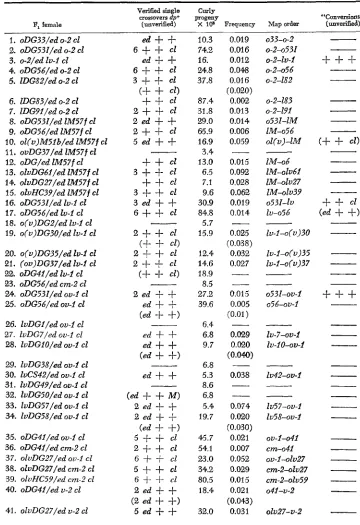
Summary of results from heterozygous crosses between various dumpy alleles
P, female
Verified single Curly
crossovers dp+ progeny "Conversions" (unverified) X 10" Frequency Map order (unveriiied)
f .
oDG33/ed 0-2 el ed+
+
2. oDG53I/ed 0-2 el 6 4 - 4 - cl 3. o-Z/ed lv-1 el ed
+
+
4. oDG56/ed 0-2 cl 6 4 - 4 - cl
5. 1DG82/ed 0-2 cl 3 + + c l (+
+
cl) 6. lDG83/ed 0-2 el+ +
cl 7. 1DG9l/ed 0-2 el 2 + + el 8. oDG53I/ed lM57f cl Z e d + + 9. aDG56/ed 1M57f el 2 + + cl5 ed
+
3.
12. oDG/ed lM57f el+
+
cl 13. oEvDG6l/ed lM57f el 3 + + cl 14. olvDG27/ed 1M57f cl+
+
el15. olvHC39/ed lM57f cl 3 + + cl 16. oDG53I/ed lv-1 cl 3 e d + + 17. oDG56/ed lv-I cl 6 + + cl 18. o(v)DGZ/ed lu-1 el
19. o(v)DG3O/ed lv-f cl 2 + + cl
( f
+
4
20. o(v)DG35/ed lv-I cl 2 + + cl 21. (ov)DG37/ed Iv-f el 2 + + cl 22. oDG4l/ed lv-f cl (+
+
e o23. oDG56/ed em-2 el
--
24. oDG53I/ed ov-1 el 2 e d - I - i - 25. oDG56/ed ov-I cl ed
+
-/-(ed
4-
+I
26. luDGl/ed ov-1 el
27. lvDG7/ed ou-1 el ed
f
-/-28. luDGlO/ed ov-i el ed
+ +
(ed+
4-129. luDG38/ed ov-f el
30. lvCS42/ed ov-1 cl ed
+ +
31. lvDG49/ed ov-I el32. lvDGSO/ed o v d el (ed
+
+
M ) 33. lvDG57/ed ov-I el 2 e d + + 34. IuDG58/ed ov-I el Z e d + +(ed
+
+) 35. oDG4l/ed ov-1 el 5 + + el 36. oDG4l/ed em-2 el 2 + + cl 37. olvDG27/ed ov-1 el 6 + + el38. oluDG27/ed cm-2 el 5 f f c l 39. olvHC59/ed em-2 el 6 + + cl
40. oDG41/ed U-2 el Z e d + + ( 2 ed
+
+>
41. olvDG27/ed U-2 el 5 e d + + 10. ol(v)M5lb/ed lM57f cl11. ovDG37/ed 1M57f cl
10.3 74.2 16. 24.8 37.8 87.4 31.8 29.0 65.9 16.9 3.4 13.0 6.5 7.1 9.6 30.9 84.8 5.7 15.9 12.4 14.6 18.9 8.5 27.2 39.6 6.4 6.8 9.7 6.8 5.3 8.6 6.8 5.4 19.7 45.7 54.1 23.0 34.2 80.5 18.4 32.0 0.019 0.01 6 0.012 0.048 0.01 6 0.002 0.013 0.014 0.006 0.059 0.015 0.092 0.028 0.062 0.019 0.014 0.025 (0.038) 0.032 0.027 (0.020)
-
-
-- __ 0.015 0.005 (0.01) 0.029 0.020 (0.040)-
__ 0.038-
-
0.074 0.020 (0.030) 0.021 0.007 0.052 0.029 0.015 0.021 (0.043) 0.03 1 033-0-2 0-2-0531 0-2-lu-f 0-2-056 0-2-182 0-2-183 0-2-191 EM-056 ol(v)-EM 053I-lM-
1m-06 IM-olvbl lM-01~27 EM-olv39 0531-lu lu-056-
lv-l-o(v)30053 I-OV-1 056-0u-1
.?U-7-oV-I
1u-1 o-ov- f
GENETIC ANALYSIS OF DUMPY
653
TABLE %Continued
VerXed single Curly crossovers dp+ progeny
Fl female (unverified) X 108 Frequency Map order
42. olvHC39/ed U-2 el I1 ed
+
+
20.7 0.106 01~39-U-243. olvHC59/ed U-2 el 44. olvDGbI/ed v-2 el
45. oDG6/ed OD-1 el
46. ovDG30/ed ov-I el 47. o(v)DG35/ed ov-I el 48. olvDG6I/ed ov-I el
49. oDGb/ed em-2 el 50. ovDG3O/ed em-2 el 51. ouDG35/ed em-2 el 52. ovDG37/ed em-2 el
53. olvHC39/ed cm-2 el
54. oluDGbI/ed em-2 el
38.5 22.9 215.3 35.6 60.0 463.0 79.3 12.6 15.5 5.6 66.1 52.5 (0.116) 0.036 0.070 o.oO09
-
-
0.002 0.005 01~59-U-2 olvbl-U-2 0 6 - 0 ~ - Io~?v~Z-OV-Z 06-em-2
-
olv6I-em-2 “Conversions” (unverified)ed
+
cl55. oDGll/~d 01-s cl 6 ed
+ +
92.0 0.013 041-01-s 2+ + +
56. olvDG27/ed 041 el ed
+
+
84.6 0.005 041-0lv2757. olvHC39/ed 041 el ed
+
+
113.8 0.002 olv39-04158. olvHC59/ed 041 el 6
+
+
el 69.3 0.017 04f-oh~59(ed
+
4
59. olvCSlO3/ed em-2 el
-
15.7- -
60. olvCSIO8/ed em-2 el
-
36.5-
-
61. olvCS69/ed 0-2 el
-
22.6- -
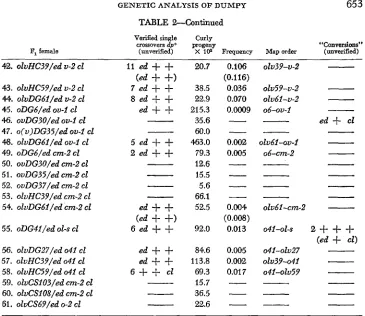
The map order given refers to the sequence of the two alleles being tested. The number of verified recombinants and possible convertants are also shown. Those crossovers that died before verification are shown in parentheses under the data of the cross. For a description of the allelic designations, see MATERIALS AND METHODS.
033 02 0531 olv I Iv 0 5 6 ov 041 01 V
I I I I I I I I I I I
02
-02 014
w:
4.9 x 10⁻⁵,
.
(
-
A
w‘016- .067
I
I I
.012 .02
,
.027 I.056
i .03 I
FIGURE 2.-A comprehensive map of the structural arrangement a t the dumpy locus. Map distances shown are all bzsed on a four-point test. The wide spatial arrangement of mutation sites is clearly evident. The olv-1-2v sequence has been determined by use of double mutants by
MONTGOMERIE and involved a single allele. The alleles shown represent designations for the separate subloci. The left portion of the map is less precise than the right portion since mutant heterozygotes involving alleles from this region have a low viability. The distances between various subloci are averages taken from previous reports and the data in Table 2. Fine structure
654 D. GRACE
crosses 1-44), the locus appears to be composed of clusters of discontinuously distributed alleles. A map summarizing the recombination data (Figure 2) gives recombinational distances between various d p subloci. The distances are average recombination frequencies taken from published papers and the data of Table 2. Except for the o and olu alleles, each phenotypic type is limited to a unique sublocus. Virtually every sublocus that contains an o allele also includes an olu
allele, suggesting that there is no S OIL^ sublocus” per se. This result would be expected if o h results from a “polarity mutation” of the o sublocus. Since the
o h alleles can be mapped by intersublocus and intrasublocus methods, they cannot be extensive deletions and are thought t o be point mutations.
All lu and ol alleles appear to map to specific subloci. The order of Zu and 01
alleles within their respective areas cannot be determined by recombination frequencies because the necessary heterozygotes are lethal. The allele lu-l recom- bines with a number of different ou alleles at about the same frequency (Table 2, crosses 26-34). A comparable situation has been encountered with 01 alleles, but these involve crosses where only one o r a few recombinants have been
recovered.
The intersublocus mapping data do not sharply delineate subloci boundaries. Figure 2 shows three possible subloci not found by other investigators. One is to the left of 0-2 at the site of the oDG33 allele (Table 2, cross 1 )
,
a second may be between 2 and ou (Table 2, crosses 9 and 25). a third sublocus may be located between the ou and 01 subloci (Table 2, crosses 36.55 and 56). The existence of these subloci is tentative; each is represented by only one allele and additional recombination data will be needed to verify their existence.Intrasublocus mapping data: Detailed intrasublocus mapping has been pos- sible only at the ou sublocus. Previous investigators have mapped several ou
alleles within this sublocus (SOUTHIN and CARLSON 1962; SEDEROFF 1967; GRACE 1970). Interlocus mapping provided evidence that alleles oDG6 and 0luDG61 were within the ou sublocus. An attempt was made to decipher the intrasublocus positions of oZuDG6l and oDG6 relative to ou alleles ou-1 and cm-2. Crosses 46, 49. 50 and 55 (Table 2) show that oluDG6I and oDG6 are both to the left of ou-1. Figure 3 summarizes the fine-structure map of the ou sublocus, indicating the relative positions of six alleles. Except for the nonpolar oDG6 allele, which has a mild oblique phenotype, the “strength” o€ the phenotypes of ou alleles
ovh ov-1
. O O W k
.002
,
O b 6 1 106
I
52b cm 2I I I
.002
.006
,.ool!
II .005 I
I
i .008
FISURE 3.-The fine structure of the ou sublocus. The positions of the alleles are based on crosses with ou-1 and cm-2 and the frequency of recombination. Allelic phenotypes o h , ou and
I l l I
decreases progressively from left to right (see Figure 6c). This “gradient” may relate to the general function of the locus. Gradients within a single gene corre- sponding to the position of various polar (nonsense) mutations have been described thoroughly in prokaryotes (NEWTON et al. 1965; ZIPSER 1969). It would be meaningful to determine the map positions relative to ov-l and cm-2
of the several unmapped mild phenotype ou alleles (e.g., see Table 2, crosses 19, 20,21,50,52,46 and 47).
Tightly linked alleles were mapped in two other subloci (Figure
4),
the 0-2sublocus, which contains the alleles 0-2, o-bm and olvCS24 ( SOUTHIN and CARL- SON 1972; GRACE 1970) and the sublocus involving the oDG4l allele to the right of ou. Crosses 56 and 57 of Table 2 show the comparative recombination fre- quencies between oDG41 and two nearby olv alleles, olvDG27 and olvHC39.
I
DISCUSSION
General nature of the dumpy locus: Based on recombination frequencies,
dumpy is quite large. approximately 0.10 m.u. (SOUTHIN and CARLSON 1962). Other loci of comparable size are lz, 0.14 m.u. (GREEN and GREEN 1956), and
N , 0.14 m.u. (WELSHONS and VON
HALLE
1962). Two external dumpy alleles,o-brn and v-2, were shown by SOUTHIN and CARLSON (1962) to be separated
by
0.1 1 m.u. Some d p alleles recombine with a higher frequency than do o-bm and
21-2 (SOUTHIN and CARISON 1962: GRACE 1970). Most studies on recombination
of complex loci demonstrate that internal distances are not additive (CARLSON 1959a) ; lz, however, does show additivity (GREEN and GREEN 1956). Although the exact length of the d p locus cannot be determined from recombination data, it seems unlikely, judging by the large number of recombinational events, that the true size could be less than 0.10 m.u. Thus. it is assumed in this discussion that d p is at least 0.10 m.u. long.
656 D. GRACE
hypothesis: ( 1 ) mutations have been found that do not complement any other allele of the locus, and (2) recessive lethals from different subloci, having differ- ent phenotypes, are noncomplementary. This clearly demonstrates an interaction between products encoded by different regions of the locus. Thus, the question of a unicistronic or a mu1 ticistronic locus is unresolved.
In a review of complex loci, FRISTROM and
YUND
(1973) listed four useful criteria to determine whether or not a locus might consist of one or more cistrons: (1) distribution of mutant sites, (2) characteristics of complementation, (3) the ratio of classical recombinants to gene convertants, and(4)
the molecular size of the intragenic recombinant unit. A genetic analysis incorporating criteria lhat evaluate both the structure and function of a locus can provide a strong argument for or against a single cistron locus, although such an analysis alone will not distinguish between a multicistronic and a multifunctional locus.Distribution of mutant sites: If the distribution of mutant sites within a locus are continuous, either the genes themselves are continuous or only one cistron is involved. If the sites are discontinuous, then there is likely to be spacing be- tween genes in a multigenic cluster. The conclusiveness of this test rests upon an extensive recombination analysis, not always an easy task. At the d p locus, there clearly appears to be “clustering” of allelic sites for different allelic phenotypes, e.g., Iv,
I,
ol, and U (Figure 2 ) - In general, the regions of clusters are about 0.02m.u. apart. In the rightmost region of the map, there is an unusually large dis- tance, 0.067, between ol and U . A continuity of sites is suggested near the ou
allele region, discussed in detail in the paragraph on fine structure. For most regions of the d p locus, however, discontinuities appear to exist (Figure 5). The genetic map, therefore, argues against a single cistron.
Characteristics of complementation: Theoretically, in a two-cistron locus, a fly heterozygous f o r mutations in separate cistrons would be wild type if there is no functional interaction between the gene products. A complicated pattern of complementation between d p alleles is observed, which suggests a functional interaction of gene products (CARLSON 1959). Different levels of complementa- tion are found in crosses between different alleles. For example, complementing phenotypes can be (1) wild type, Z/o = f; (2) viable individuals can be visibly mutant, v/oZv = viable U ; or (3) a cross can produce fewer than normal (reduced
function) offspring with a wild phenotype, oZv/Z o r Zv-l/0-2 = wild type with
033 02 0531 olv I Iv 056 ov 041 d
111 11111 I I rlu 111111 I 111111 I uulllll I,Illllllul I 1
GENETIC ANALYSIS O F D U M P Y
65 7
low viability. More than one type of complementation occurs for different muta- tions within the same sublocus.
Since the ou allele is viable and noncomplementing with all known
d p
alleles (exceptI ) ,
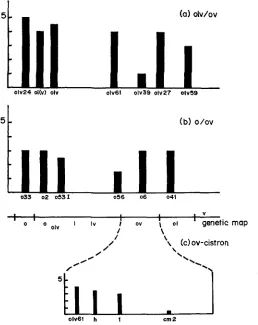
it is possible to compare the type and severity of phenotypes of differ- ent dp alleles as a function of the genetic map position. In Figure 6a, the inten- sities (phenotypic index) of phenotypes of o h alleles as a function of map position are shown. Extreme 0 2 ~ ’ s are found on both sides of the map. One allele (oZuHC39) has a low index, that is, it complements ou well, but is nonetheless lethal with olv and01
alleles. Of the ob’s mapped thus far, them o s t
extreme allele is a t the leftmost end of the map. Preliminary results indicate that oh’s (Table 2, crosses 58 and59)
may be close to or within the ou sublocus, making it apparent that mutations of the intense olv types exist at different sites.The o alleles also map at a number of sites within the locus (Figure 6b). Most
5 - (a) olv/ov
-
-
-
5 (b) o/ov
033 02 0531 056 06 041
I I , v
1
’
0’
0 oIv I Iv;
ov\
01’
genetic mapO W 1 h 1 cm 2
658 D. GRACE
of those alleles available for testing do not show a variety of different oblique intensities with ou-1. An exceptional allele, oDG56, has a rather mild phenotype with a n index of 1, and maps to the left of the allele oluDG62 in the center of the map, while oluHC39 maps to the right of oluDG62. The map distance be- tween oDG56 and oluDG61 is estimated to be about 0.03 m.u., indicating that these alleles may be in separate subloci. The sublocus is noticeably complicated (Figure 6c). Alleles olu, ou and o map within 0.008 m.u. of one another. When the intensity of phenotypes of “polzr” mutations is plotted according to map position, a left-to-right descending gradient is suggested. These “polar” mutations are not known to be terminators. It is assumed that these phenotypes reflect levels of gene activity. Gradients of gene activity are reminiscent of mutations in prokaryotes where nonsense (polar) mutants within a cistron exhibit a de- crease in enzyme activity the closer the lesions are to the promotor. Clearly, these observations do not support a single cistron hypothesis.
The ratio of classical recoinbinants to gene convertants: Gene conversion usually occurs where there is tight liiikage between a pair of heteroalleles. As the distance between alleles decreases, conversion increases ( CHOVNICK, BALLANTYNE and HOLM 1971). When the distance is greater than a cistron
( 1000 bp)
,
conversion is rare and can be confused with other rare events, such as reversion or multiple recombination. Conversion has been extensively studied in fungi (FOGEL and MORTIMER 1971). but only a few detailed analyses have been carried out in Drosophila (CARLSON 1971; CHOVNICK, BALLANTYNE andHOLM 1971; FINNERTY, DUCK and CHOVNICK 1970).
Virtually all recombination observed at the d p locus is coupled with the ex- change of outside markers. Although over 500 d p + exceptionals have been recovered from crosses involving various alleles, only 16 recombinant events were not consistent with classical crossing over (SOUTHIN and CARLSON 1962; CART,SON 1959a; Table 1). It may be significant that seven of the 16 crosses involved ou-2 as one of the alleles in the cross; one is tempted to consider them as convertants or revertants. However, except for ouDG3O and ou-n, none of these alleles maps “close” to ou-1. Of the 16 events. two were associated with the exchange of outside markers, which suggests both a conversion event and recom- bination of outside markers. Since the ou-1 allele was discovered by MORGAN in 1916, there has been only one reported reversion event, even though it has been maintained in a number of laboratories for over fifty years (MEYER, personal communication). In one cross, oDG42 X 01-s, three possible convertants were recovered (Table 1, cross 5 5 ) . Two of these cases were verified by progeny testing; the third was sterile. These data could be considered to be the upper limit for the actual rate of conversion at the d p locus. No experiment has been designed to screen specifically for conversion or reversion. It is concluded that crosses between most of the d p alleles involve distances that favor classical recom- bination, and the rarity of gene conversion suggests that the distances encountered in d p crosses are beyond those short intervals expected to favor gene conversion.
Molecular size of the intragenic recombination unit: ou is the only sublocus
GENETIC ANALYSIS O F DUMPY 659 cussed in detail. Fine-structure mapping at the d p locus between phenotypically identical alleles was first achieved with ou-l and ov-52b (SEDEROFF 1967). Since 1967, six alleles have been mapped to the ou sublocus. Their relationships are shown in Figure 3. The smallest distance between two alleles is 0.0009 m.u. (oDG6 to o u - l ) , the largest is 0.008 m.u. (oEvDG6l to cm-2). Although only one of two crossovers between the latter alleles survived to be verified, 0.008 is also the sum of the map distances from dvDG6l to ou-l plus ov-l to cm-2. Ten crossovers were verified from these crosses. Assuming 2.94 X map units per base pair, one can estimate that the ou sublocus contains 2720 base pairs, enough to code for a polypeptide 90.0 amino acids long. The entire dumpy locus would be roughly equivalent to 34,000 nucleotide pairs.
Three enzymes in the pathway of pyrimidine synthesis are coded by the rudi- mentary locus (NORBY 1973;
RAWLS
and FRISTROM 1975;FALK
1976). The genetic size of r is 0.07 m.u., a distance sufficient to encode 24 genes of average size (FRISTROM and YUND 1973). There are several possibilities that might ac- count for this DNA excess: (1 ) The enzymes are multimeric and many different polypeptides must be assembled for activity. (2) Genes are separated by large neutral (spacer) DNA regions. (3) The extra DNA sequence codes for regions that are later eliminated or are necessary for the processing or function of the enzymes. Transcription of the entire locus would produce a very large RNA molecule. ( 4 ) Each gene contains a specific region for autoregulation and control even though the locus may be coordinately transcribed as a single polycistronic message.(5)
The calculations are misleading.It is reasonable to speculate that the d p products function as a single enzyme unit. Support for such an enzyme unit may be suggested by the large number O€ noncomplementing mutations in different subloci. These points have been discussed by JUDD and YOUNG (1973 and JUDD (1976). At both the r and d p
loci, 50% of the known alleles are noncomplementing. Of course, other events may account f o r the high rate of noncomplementation, including nonsense muta- tions. Clearly all of the genetic criteria discussed indicate that dumpy is too complex genetically to be classified as a single functional cistron. This distinc- tion is not a trivial one even though the locus may be a single multifunctional cistron.
660 D. GRACE
Biochemical studies on complex loci in Neurospora offer a useful model for understanding the functions of complex loci. For example, the Neurospora urom gene cluster encodes five discrete enzyme functions ( GILES et al. 1967). All the enzyme activities appear to be specified by a single locus that encodes a single multifunctional polypeptide ( GAERTNER and COLE 1977).
BROTHERS et al. (1978) reported that the three enzyme activities specified by the I+ locus in Drosophila co-sediment as a single peak in sucrose gradients. This is interpreted as indicating that all three enzyme activities reside in a single polypeptide.
If this hypothesis is substantiated, the apparent ambiguities observed at many complex loci in Drosophila could be resolved. The exciting results reported for the r locus are significant to this report because a close genetic similarity exists between r and d p . Many complex loci formerly considered to be multicistronic may be, in fact, single cistrons encoding a multifunctional protein.
The length of the dumpy locus, as determined by genetic recombination, stimulates speculation about possible intralocus regulatory regions. Some obser- vations support the hypothesis that regulatory and structural elements are con- tiguous. Four mutations map as follows: l is approximately at the center of the locus; 0-2 is near the left end of the locus; ol and v-2 are on the right half o f the locus, 71-2 at the right end (see Figure 2). The recessive lethal I mutations are unique among dumpy alleles. These are the only alleles that have no mutant phenotype when heterozygous with nonlethal alleles or with the few recessive lethals that they complement (see RESULTS). Mutants from a cross between the double mutant 0-2-v-2 and ov-l express a more enhanced phenotype than either 0-2 or v-2 separately with ov-I. However, offspring from the double mutant
ol-v-2 crossed to ov-I do not have an enhanced phenotype (CARLSON 1959a). The 0-2 allele might be a mutation in a regulatory sequence, with a trans effect. A working hypothesis is that the left half of the locus, including
I,
contains regu- latory sequencies and the right half contains structural sequences.This work was supported in part by the Association between Euratom and the University of Leiden, Holland Contract 052-64 BIAN.
LITERATURE CITED
ALTENBURG, E. and H. J. MULLER, 1920 The genetic basis of truncate wing-an inconstant and modifiable character in Drosophila. Genetics 5 : 1-59.
BAILLIE, D. L. and A. CHOVNICK, 1971 Studies on the genetic control of tryptophan pyrrolase i n Drosophila melanogaster. Mol. Gen. Genet. 112: 341-353.
BROTHERS, V. M., S. I. TSUBOTA, S. E. GERMERAAD and J. W. FRISTROM, 1978 Rudimentary locus of Drosophila melanogaster: Partial purification of a carbamylphosphate synthas- aspartate transcarbamylase-dihydroorotase complex. Biochem. Gen. 16: 321-332.
Allelism complementation, and pseudoallelism a t the dumpy locus in Drosophila melanogaster. Genetics 44.: 347-373.
-
, 1959b Comparative genetics of complex loci. Quart. Rev. Biology 34: 33-67.Studies on gene conversion and its relationship to linked exchange i n Drosophila melanogaster. Genetics 69 : 179-209. CARLSON, E. A., 1959a
GENETIC ANALYSIS O F DUMPY 661
CORWIN, H. O., 1968 The mutagenic effect of n-nigrosomethylurea on the d u m p y locus in
Drosophila melanogaster. Mutation Res. 5 : 259-270.
FALK, D., 1976 Pyrimidine auxotrophy and the complementation map of the rudimentary locus of Drosophila m e h o g a s t e r . Mol. Gen. Genet. 1 4 : 1-8.
FINNERTY, V. G., P. DUCE and A. CHOVNICK, 1970 Studies on genetic organization in higher organisms. 11. Complementation and fine structure of the marom-like locus of Drosophila melanogaster. Prsc. Natl. Acad. Sci. U.S. 6 5 : 939-946.
FOGEL, S. and R. K. MORTIMER, 1971 Recombination in yeast. Annu. Rev. Genet. 5: 219-236.
FRISTROM, J. W. and M. A. YUND, 1973 Genetic programming for development in Drosophila.
Critical Rev. Biochem. 1 : 537-570.
GAERTNER, F. H. and K. W. COLE, 1977 A cluster-gene: Evidence for one gene, one polypeptide, five enzymes. Biochem. Biophys. Res. Commun. 75 : 259-262.
GILES, N. H., M. E. CASE, C. W. H. PARTRIDGE and S. I. AHMED, 1967 A gene cluster in
Neurospora crassa coding for an aggregate of five aromatic synthetic enzymes. Proc. Natl. Acad. Sci. U.S. 1453-1460.
GRACE, D., 1970 Genetic analysis of the dumpy region in Drosophila: Its multigenic composi- tion. Mutation Res. 10: 489-496.
GREEN, M. M. and K. C. GREEN, 1956 A cytogenetic analysis of the lozenge pseudoalleles in
Drosophila. Z. ind. Abst. Vererb. 87: 708-821.
JUDD, B. H., Genetic units of Drosophila complex loci. pp. 767-799. In: T h e Genetics and Biology of Drosophila, Vol. lb. Edited by M. ASHBURNER and E. NOVITSBI. Academic Press, New York and London.
JUDD, B. H. and M. W. YOUNG, 1973 An examination of the one cistron: one chromomere concept. Symp. on Quant. Biol. 38: 573-579.
KING, J. L., 19643 The formation of clumpy vortices in mosaics of Drosophila rnelanogaster.
Genetics 49: 425-438.
KIRSCHNER, K. and H. BISSWANGER, 1976 Multifunctional proteins. Ann. Rev. Biochem. 45:
LEWIS, E. B., 1963 Genes and developmental pathways. Amer. Zool. 3: 33-66.
-
,
1967Genes and gene complexes. pp. 1 7 4 7 . In: Heritage from Mendel, Proceedings of the Mendel 1978 A gene complex controlling segmentation in Drosophila. Nature 276 : 565-570.
LEWIS, E. B. and F. BACHER, 1968 Method of feeding ethyl methanesulfonate (EMS) to Dro- sophila males. Drosophila Inf. Serv. 43: 193.
LINDSLEY, D. L. and E. H. GRELL, 1967 Genetic variations of Drosophila melanogaster. Carnegie Inst. Washington Publ. No. 627.
METCALF, J., 1970 Developmental genetics of thoracic abnormalities of dumpy mutants of
Drosophila melanogaster. Genetics 6 5 : 627-654.
MONTGOMERIE, D. W., 1974 Recombination and mutation analysis of lethals at the d u m p y
locus in Drosophila melanogaster. Ph.D. Thesis. McGill University, Montreal, Canada.
MULLER, H. J., 1922
NEWTON, W. A., J. R. BECKWITH, D. ZIPSER and S . BRENNER, 1965
NORBY, S., 1973
RAWLS, J. M. and J. W. FRISTROM, 1975 1976
143-166.
Centennial Symposia. Edited by R. A. BRINK.. University of Wisconsin Press.
-
,Variation due to change in the individual gene. Amer. Nat. 56: 32-50.
Nonsense mutations and
The biochemical geuetics of rudimentary mutants of Drosophila melanogaster.
A complex genetic locus that controls the first three polarity in the lac operon of Escherichiu coli. J. Mol. Biol. 14: 290-296.
Hereditas 73: 11-16.
662 D. GRACE
SEDERGFF, R., 1967
SOUTHIN, J. L. and E. A. CARLSON, 1962
Rare pseudoallelic crossover between two phenotypically identical alleles at a restricted sublocus of clumpy in DrosophiZa melanogaster. Nature 214: 1348-1349.
Comparison of micromaps obtained by direct and indirect methods of recombinntion in the dumpy region of Drosophila mehnogastzr. Genetics 47: 1017-1026.
Pseudoallelism at the Notch locus in Drosophila. Genetics 47 : 743-759.
WELSHONS, W. J. and E. S. VON HALLE, 1962
ZIPSER, D., 1969 Polar mutations and nperon function. Nature 221: 21-25.