Exponential Memory-Bound Functions
for Proof of Work Protocols
Technical Report A/370/CRI version 3
Fabien Coelho ([email protected])
CRI, ´Ecole des mines de Paris, 35, rue Saint-Honor´e, 77305 Fontainebleau, France.
Abstract
In Year 2005, Internet users were twice more likely to receive unsolicited electronic mes-sages, known as spams, than regular emails. Proof of work protocols are designed to deter such phenomena and other denial-of-service attacks by requiring computed stamps based on hard-to-solve problems with easy-to-verify solutions. As cpu-intensive computations are badly hit over time by Moore’s law, memory-bound computations have been suggested to deal with heterogeneous hardware. We introduce new practical, optimal, proven and pos-sibly memory-bound functions suitable to these protocols, in which the client-side work to compute the response is intrinsically exponential with respect to the server-side work needed to set or check the challenge. One-way non-interactive solution-verification variants are also presented. Although simple implementations of such functions are bound by memory latency, optimized versions are shown to be bound by memory bandwidth instead.
Keywords: proof of work protocol, memory-bound function, anti-spam technique.
1
Introduction
In recent years, the Internet electronic mail user has been plagued with massively sent unsolicited messages, or spams [17]. This communication channel has proven interesting to marketers and crooks thanks to its combined worldwide-spread use in upscale households and very low sender-cost per message: two thirds of all emails were spams in 2005 [16]. This phenomenon can be tackled by preventing, deterring, detecting or responding to it appropriately [12]. Behavior and contents filters [15] allow organizations to reduce the user and system burdens of these messages. We focus here on a cryptographic technique by Dwork and Naor [6] which aims at putting a tighter economic bound to spamming by making emails more expensive to send, thanks to stamps. The stamps are not actual money, but rely on a proof of computation work performed by the sender, on top of the popular saying thattime is money [7]. In the Hashcash [3] scheme, a stamp is built for a service, such as sending a mail to an address today, by producing a bit-string: the hash of the bit-string and of the service description must start with a number of leading zeros. The high solution cost comes from enumerating many bit-strings up to one having the partial hash collision property, but the verification is one straightforward computation on the provided solution.
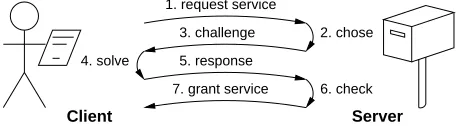
Proof of work scheme variants may include interactive challenge-response protocols shown in Figure 1, or one-way solution search followed by a verification in Figure 2. A key issue in both approaches is to compare the effort required of the client to compute the stamp in the response or solution part with the work of the server to set the challenge or verify the solution.
1. request service
3. challenge 2. chose
7. grant service 5. response
6. check 4. solve
Client Server
Figure 1: Interactive Challenge-Response Protocol
The challenge-response approach suits synchronous end-to-end client-server protocols, where a server regulates its own incoming traffic. As there is no direct end-to-end connections in the electronic mail realm where intermediateMail Transfer Agents handle messages, it could be used at the entry point of a trusted network of such agents built by other means. The client-server sides are reversed in the inner protocol, as the server which is requested the final service does request the proof of work, and the client which want to be granted the service must respond.
Sender Receiver
1. compute 2. solve
4. verify 3. send
Figure 2: One-way Solution-Verification Protocol
The solution-verification approach targets asynchronous off-line message composition and later transfer. It does not need any interaction between the sender requesting the service and the final service provider. As the problem to solve is self-imposed, it depends somehow on the requested service, and the receiver must validate both the chosen problem and the provided solution.
Processor computational performance varies more widely than cache to memory access per-formance [24] from high-end servers to low-end personal digital assistants and over time,
fol-lowing Moore’s law [18]. Thus, Abadi et al. [1] suggests a scheme based on memory-bound
functions, the performance of which are bound by main memory access speed instead of cpu and cache accesses. This novel approach is further investigated by Dwork et al. [5].
This paper presents new contributions about memory-bound proof of work functions. Sec-tion 2 presents and analyzes related work by Abadi et al. and Dworket al. Section 3 describes Hokkaido, our new challenge-response protocol for memory-bound proof of work schemes. For a challenge cost of O(ℓ) the response cost is O(2ℓ) memory accesses, thus inducing an optimal exponential work for the client compared to the server. Section 4 details one-way variants for the same purpose. Section 5 contributes experimental results. It shows that optimized implementa-tions of these funcimplementa-tions are bound by memory bandwidth, not by memory latency as previously believed. Finally, Section 6 concludes this paper.
2
Related work
accesses, although the verification of computation result costs O(ℓ), whereℓ is a length param-eter. The challenge-setting phase uses a sequence xi of ℓ+ 1 elements starting from a chosen x0:
xi+1=f(xi)⊕i
where f is a random-like function on a domain of size 2n and ⊕the exclusive-or operator. The response looks forx0 by computing a reverse path starting backwards from xℓ:
xi∈f−1(xi+1⊕i)
and checking the path against a provided checksum of size m. Asf−1 is not a simple function, possible multiple pre-images at each stage may lead to multiple paths: The response-to-challenge work ratio comes from exploring this tree of reverse paths using the tabulated inverse of the function, while the verification uses simpler forward computations. If the function domain is large enough, e.g. 222 elements, the tabulated inverse does not fit into the cache, and many costly main memory accesses are performed. Assuming that Function f is known, the amount of communication involved in a protocol instance is about n+m bits for the challenge and n bits for the response.
This novel technique has some drawbacks. First, the solution cost isonlyquadratic, requiring a sizeable amount of server verification if the client is to provide proof of significant work: a large value ℓ= 213 = 8192 is suggested in practice. Second, this quadratic behavior depends on the chosen function to be random and on the forward path to be known to exists: a permutation gives equal challenge and response works as only one reverse path exists; a random function without known forward path does not display the quadratic effect either as only one reverse path exists on average. Third, the actual multiplier hidden by the O() is a small 2(e1−1) ≈0.3 for purely random functions: few reverse paths are found as the average number of pre-image by a function on a domain is just one. Fourth, the data structures needed for handling the inverse of random functions on an arbitrary domain involve a computation-memory trade-off: either fast lookups need more memory, or a packed representation requires a higher computation cost, defeating the purpose of memory-bound functions as a better representation can be chosen for better hardware. Moreover, it must handle a variable number of pre-images, what requires a loop and tests which add to the computation overhead.
Dwork et al. [5] propose a non-interactive abstract and proven one-way scheme, plus a concrete instantiation inspired by the RC4 cipher. Solution-seeking trials are performed till a solution satisfying some property is reached. For trial numberk, an initial state s0 is computed
from the result of a cryptographic-strong hash function h applied on the message or service µ and k:
s0 = init(h(µ, k))
Then the state is updatedℓtimes with a function that performs one lookup into a large constant random integer table t:
si+1 = update(si, t(r(si)))
The final state sℓ is a success if some E1-probable property holds for h(sℓ). Verifying a solu-tion requires to perform the full trial computasolu-tion again for the provided parameter k. The communication cost involved is about log(E) bits.
The verification costs O(ℓ) for a O(E ℓ) memory accesses exploration. Although a simple constant work ratio seems less interesting than the previous proposal, E can be chosen quite freely to tune the solution-seeking cost. However, even if settingE= 2ℓresults in a theoretically exponential work ratio, it is not practical: a large ℓ = 211 = 2048 is needed to amortize
thus induce a tremendous amount of work if used to achieve the exponential ratio: Nobody want to perform 22048 anything. A more realistic effort parameter E= 215= 32768 is proposed to achieve a significant work for the solution seeking process, so that about 226 table accesses
occur.
The next four sections present our contributions. We first introduce new challenge-response memory-bound functions similar to Abadi et al., but with much better exponential client-to-server work ratio. Then we describe one-way solution-verification variants with faster checking costs compared to Dwork et al. proposal. Finally, experiments and analyses illustrate our achievements. Moreover, we show that the expected time to compute a proof of work depends on the more variable memory bandwidth, rather than the memory latency previously suggested by both related work.
3
The Hokkaido protocol
The forward and backward variants are described, before discussing parameters and security.
3.1 Challenge-response protocol
Let Dbe a finite integer domain of size 2n. Let ℓbe the (will-be short) path length. For every 1 ≤ i ≤ ℓ, let fi and gi be D → D functions, discussed further in the next section. Let h be a checksum function from any sequence of D elements into a finite integer domain of size 2m. The server chooses a starting point x0 ∈D and a binary path b of length ℓ. Then it computes ℓ mangling iterations starting fromx0, using every two functions:
xi = ifbi thenfi(xi−1) else gi(xi−1) (1)
Finally the checksum of the path from x0 to xℓ is computed as c =h(x0. . . xℓ). The challenge is composed of ℓ, h, for every 1 ≤ i≤ ℓ fi and gi, x0 and c. The response is a binary path b
matching the checksum through Formula (1). It may be different from the server-chosen binary path, depending on checksum collisions.
A first worst-case O(2nℓ) search algorithm is to try all sequences without even using the mangling functions, and to check the validity of the found hash matches by rebuilding the binary path. A better worst-case O(2ℓ) algorithm is to enumerate all possible paths starting from x0 through Formula (1) with the mangling functions. If the function computations require
memory accesses, e.g. they are tabulated, the search can be memory-bound.
As Abadiet al., the challenge is based on forward computations, but here the response is also forward: the reverse-path computation trick is not needed to induce a significant work ratio, as it is already intrinsically exponential thanks to the binary path mangling. Nevertheless, a backward variant can be devised simply by giving the end point xℓ in the challenge, and requesting both x0 and the binary path bas the response. The starting point is needed by the server to check the possibly different client solution. This variant could also benefit from the fact outlined by Abadi et al. that computed forward functions may require tabulated inverses, adding to the asymmetry of the workload.
3.2 Discussion
Mangling functions
Formula (1) requires 2ℓ tabulated functions in D. Random functions are not very interesting because of the collisions, which reduce the effective number of path. Instead, we want to rely on collision-free random permutations. However, having to build and handle 2ℓ tabulated per-mutations is troublesome for both server and clients: we would like just one large table accessed randomly enough to make the search process memory bound.
Thus we propose to build these 2ℓpermutations as follows: Lettbe a tabulated permutation inD. Let us choose 2ℓdistinct integers inD: vi and wi for 1≤i≤ℓ. Let⊕be the exclusive-or operator. For the forward variant, the 2ℓmangling functions are defined as:
∀x∈D, fi(x) =t(x⊕vi) and gi(x) =t(x⊕wi) (2)
For the backward variant, better mangleafter the table access. These functions are permutations because composed of permutations, the distinct integers make them collision-free, and their values can be easily computed from t and a cheap xor. The xor-mangling is not motivated by the short cycle issue mentioned by Abadi et al. which may be used to help the search in their scheme, because such cycles are unlikely with permutations followed on a small path length. However it is necessary for the functions to be near-independent, and thus insure that memory accesses are needed.
Tabulated permutation t must be known to both client and server. It must not be
com-putable, so that memory accesses are needed. It could be built from a random generator; however its distribution would require to transmit about n2n bits. Another option is to build it from a known pseudo-random generator, so that only the seed is needed. Building such a table requires about 2n random memory accesses. This is fine on the client, which is expected to perform many memory accesses, but quite annoying on the server. Thus we propose that when a server builds a table it keeps it long enough so as to amortize its building cost on many challenges. The 2ℓ distinct integers used to build the functions could also be derived from the shared pseudo-random generator. They can also be generated quite cheaply by the server for each challenge. Finally, the checksum function is assumed to be fixed by the protocol. Under these arrangements, the challenge sendss+ 2ℓn+n+mbits for the seed, integers, starting point and checksum, and the response only ℓbits.
Domain size and path length
Following related work, the size of the tabulated function must be much larger than the cache size on high-end hardware but small enough to fit in the main memory of low-end machines: about 16 MB is considered appropriate as of 2003’s technology. Moreover, the client delay must be both significant and reasonable, which is achieved with about 64 million memory accesses.
A compact tabulated permutation in Dneeds n2n bits, at the cost of shift and mask oper-ations to deal with memory alignments: n = 22 and 23 lead to 11 and 23 MB respectively. A simpler word-aligned data structure is less economical in memory and cache miss rate.
The length parameter can be chosen pretty independently of the domain size, althoughℓ > n seems reasonable so that the table is heavily used and its building is negligible for the client. Targeting 226 memory accesses for the client, our experiments use n = 22 and ℓ = 26, that is a 11 MB table and a mere 26 memory accesses challenge or verification on the server, plus the amortized table-initialization cost.
Checksum function
interfere with the overall search complexity. Thus we require m > ℓ. With our above settings, m= 32 is sufficient as it induces a small collision probability of about 2ℓ−m= 2−6≈1.5%.
As there are a lot of trials, each one involving very few operations, a cryptographic-strong software function cannot be used, as such functions are usually cpu-intensive, thus would break the short-path memory-bound property. The best choice is a strong but fast hardwired checksum on the processor, if available. As a second-choice low-cost software checksum, a simplistic idea is to return the m last bits of the path. However, this gives away part of the answer and allows to shorten the search: some mangling is necessary. A simple yet convenient proposition is c = Lℓi=0rot(xi, i) where rot(x, i) is the bitwise rotation of integer x by i bits. As it is cumulative, it can be computed on the fly incrementally in a recursive search.
3.3 Hokkaido Security
This section proves the Hokkaido function security under ideal assumptions, by showing that a best search algorithm requires in the worst-case 2ℓ checksums, 2ℓ memory accesses, andO(2ℓ) memory fetches. It also describes an attack that reaches the provided memory fetches lower-bound, as well as a simple counter-measure. All complexities are worst-case unless otherwise stated. The actual detailed proof is presented in the Appendix.
Proof Sketch
We first define a valid path (Definition 1) and perfect hash function (Definition 2). Lemma 1 counts the number of valid paths and Lemma 2 states that all such paths may be enumerated by an iterative search. Then Theorem 1 shows that in the worst-case a valid path search can involve an exponential number of computations. Theorem 2 proves that this work ratio is optimal for interactive challenge-response protocols. One-way solution-verification protocols rely on finding an item matching a probabilistic property in a possibly infinite search space, thus their work ratio is probabilistically bound, without absolute upper-bound, and is not related to the search-space size but to the probability of the property. This first stage of the proof does not address whether the search is memory-bound, but simply focus on the computation-bound aspect.
We then proceed to define abest search algorithm (Definition 3), which displays this worst-case optimal complexity, and only focus on valid paths (Lemma 3). This is paradoxically a subtle restriction, as we neglect by doing so random searches. For such non-best algorithms, it is indeed possible to have a far worse computation complexity, but a much better memory access complexity for some settings: For the 2nℓ sequence enumeration algorithm in Section 3.1, which does not use the mangling functions in the enumeration, and given a sufficient checksum size m, the search may only need to verify that one found matching path is valid, requiring only about 2ℓ memory accesses. However, such solutions, even with hybrid valid-path enumeration parts, seem impractical because of their computation complexity. Our valid-path O(2ℓ) enumeration search described in Section 3.1 is a best algorithm.
As a third part of the proof, we discuss collision-free independent functions or permutations, defined as near-independent (Definition 4). Near-independence is independence slightly skewed so as to be collision-free. These functions result from our construction offiandgifunctions based on a single table (Lemma 4). Pretty-independence is defined (Definition 5) as near-independence or something closer to independence, allowing possible low-probability collisions. Some useful properties are derived on these functions (Lemma 5 and Lemma 6). Values computed from near-or pretty-independent functions will be described as near- near-or pretty-independent one from the other, meaning that nothing is known about them apart that they may be distinct.
demonstration, because these pretty-independent values will result directly in memory accesses. It also suggests that search algorithms that would take advantage of the search history by memoizing some results do not avoid these memory accesses, as they involve pretty-independent values anyway.
We then define memory accesses as a unit of cost (Definition 6), incurred from computing the value of a random function or permutation on a value pretty-independent from previously available data (Axiom 1). This cost applies to our mangling functions (Lemma 9). The idea behind this axiom is that a tabulated random function must always generate memory accesses to get a value. From a theoretical point of view, this is not true. For instance, an implementation may memoize recently accessed values in registers and check whether a value is reused. However, there are few registers thus hits are unlikely.
The second simplifying trick is that we also deal with non deterministic algorithm that would memoize intermediate results by stating that memoization basically will also cost a memory access (Axiom 2). This is not absolutely true either. Instead of using some data-structure to check whether a binary-path was already visited, a non-deterministic algorithm could be expanded, dropping loops and calls, so that computed set information is implicit from the point in the execution. However, this would lead to a very large code, and although no data structure would be used, the memory accesses would be paid for accessing the code instructions.
Based on these two axioms, we can now demonstrate our main result, namely Theorem 3 which states that an exponential number of memory accesses is necessary to find a solution, whatever the best algorithm, whether deterministic or non-deterministic in its enumeration. Our valid-path 2ℓ enumeration search reaches this bound.
We then proceed likewise to compute a bound on memory fetches (Definition 7), which is also axiomatized (Axiom 3) and then demonstrated through Lemma 10 and Theorem 4. A cache line is fetched from the main memory, bringing data to the processor. There may be no actual transfer if the line is already in the cache: what is meant by a memory fetch is a potential cache miss because unforeseen data are requested. Our approach imply the definition of related values (Definition 8) which depend one from the other through fi orgi functions, because such related values may be stored together to help the search. As a line is fetched for some x, all the coming data may be related to this x, if a careful arrangement of data has been devised by the algorithm. The amount of useful data is nevertheless limited by the cache line: if more data are to be accessed, several independent fetches are necessary.
In the last part of this demonstration, we define the coverage of the domain reached at each stage by a search (Definition 9) and compute it in Theorem 5, so as to check that most values are actually used: it diverges quickly on the first iterations then converges quickly towards one. Finally we discuss in Theorem 6 the impact of these various results on our concrete proposal, by computing the average complexity which can be expected with the Hokkaido search.
An attack to reach the lower-bound
depends on the previous path, for instancevi′+1=vi+1⊕h(x0. . . xi−1) or evenvi′+1=vi+1⊕xi−1,
and idem forw′i+1.
Proof comparisons
Our and Dworket al. proofs are somehow similar yet complementary. In both cases, the proofs rely on the structure of the proposed functions. However [5] assumes in its Lemma 1 that the computations are necessarily needed to find a solution, and proceeds in its technical proof for Lemma 3 to show that it results in cache misses through a precise mathematical modelization of a computer memory hierarchy. In contrast, we roughly assume that somehow independent computations using tabulated function costmemory accesses, whatever that may be, simplifying this part of the proof a lot by merely axiomatizing it, and we rather focus on showing that the accesses are indeed independent and that there is no better search algorithm to find a solution, which leads us to characterize these algorithms and their deterministic nature. It is possible that our results would still hold on the whole if random functions are used instead of random permutations, but such proof would be more technical as it has to deal with collisions which may reduce the overall search complexity.
4
One-Way Hokkaido
This section describes one-way variants, the first directly adapted from the forward challenge-response protocol, the other relying on a simpler integer array, and discusses choices of param-eters.
4.1 Solution-verification protocols
Lettbe a tabulated permutation inD. Letℓbe the binary path length. Let the client compute 2ℓ+ 1 distinct integers in D, x0, vi and wi derived from the specific message or service. The client must find aℓ-length binary pathb so that with:
xi =t(xi−1⊕ifbi then vi else wi) (3) some low-probability property holds on the path checksum h(x0. . . xℓ).
The same issues as discussed in the previous section are raised by this variant: the checksum computation must be very cheap and there is a memory-computation tradeoff for compact bit-aligned data structures. The next variant uses a simple integer table fort, as Dwork et al.
Lett be a tabulated function from DomainD to words (typically 32 bits integers). Let the client derive 2ℓ+ 1 distinct wordsx0,vi and wi from the service. Let r be a restriction function from any word to D, for instance r(x) = (2n−1)and(rot(x, n−32)⊕x), so that table accesses will always be performed on valid indices. The client must find a ℓ-length binary path bso that with:
xi=t(r(xi−1⊕ifbi then vi else wi)) (4) some low-probability property holds for h(x0. . . xℓ).
4.2 Discussion and security
Identifier A B C D Unit
cpu type P2 P3 P6 M P6 HT Intel
cpu freq. 310 900 1200 3000 MHz
cache size 512 256 2048 1024 KB
mem. bw. 6.5 8 14 43 Ml/s
mem. lat. 285 147 130 125 ns
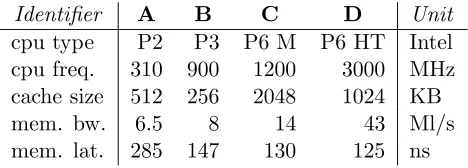
Table 1: Tested hardware
computations to mangle the description, so that the cost of deriving the integers is higher than performing a single trial, and that targeting specific values is ineffective.
Although the size of the search space is driven by ℓ, the effort is only based on the chosen target property, typically that w bits of the checksum are zeroed. For an expected 2w effort, a parameterℓ=w+ 10 can be chosen so that the probability not to find a solution in the search space is as low as e−210 =e−1024.
In both protocols, the same table must be available to both client and server. As pointed out before, the computation of these structures must be a small part work, and the server should not have to do it over again. A first solution is to build a table pseudo-randomly with a per-service seed. For instance, if the recipient is [email protected], the seed would be the hash of the domain name only. However, this would not allow servers to have their own policy. It would be very costly for mail servers that home many domains. Another idea is to distribute the needed parameters, such as seed, table size, required effort and so on by mean of the name server [10] infrastructure, as already used for mail exchangers or black lists [22].
The different theorems in Section 3.3 can be adapted to these solution-verification protocols. The key difference is that the amount of work is probabilistically defined, without actual upper-bound. Basically, a perfect checksum function hides the paths and thus many paths must be enumerated. As the involved functions are near-independent, their combinations result in many unrelated memory accessed, and many memory fetches. For a 226 client effort, the server verification work involves 36 = 26 + 10 memory accesses only, plus the verification of the chosen parameters.
5
Performances
Memorylatency andbandwidth characterize processor to main memory transfer [9] performance. Latency is the time between a load instruction and the availability of the data. It is driven by the propagation of signals within the hardware: the physics [21] involved does not evolve much in time or for more expensive computers. Bandwidth is the amount of data that can be fetched from memory per unit of time. It can be improved by widening the transfer bus and its related logic so that more data are fetched together. On inexpensive hardware, these figures are somehow merged: the available bandwidth corresponds to the latency, i.e. one cache miss is handled at a time. Table 1 illustrates these facts about hardware used in our experiments. FromAto D, cpu is about 10 times faster, bandwidth about 7 times larger, but latency only 2.3 times smaller. By multiplying bandwidth and latency, A may handle 2 concurrent cache misses, butD about 7.
Function N Description A B C D
22 sequential 314.2 199.6 173.1 137.0
mbound [5] 22 parallel 242.5 125.4 121.5 51.0
10 in cache 89.7 43.5 21.2 11.0
22 sequential 559.0 293.5 235.8 169.9
moderate [1] 22 parallel 556.0 293.5 231.0 110.0
10 in cache 306.6 104.1 77.6 37.5
22 sequential 387.8 228.8 135.0 136.6
hokkaido 22 parallel 354.0 217.5 135.0 83.3
10 in cache 159.8 55.3 36.1 15.0
hardware native memory latency 285.0 147.0 130.0 125.0
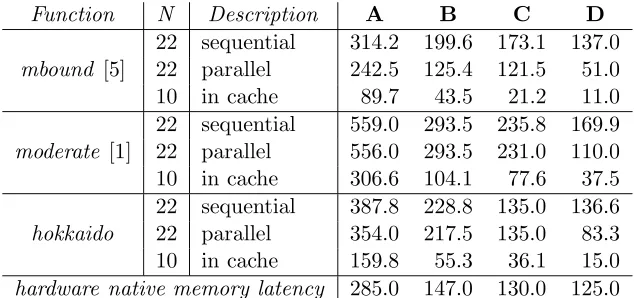
Table 2: Apparent delay per memory access in nanoseconds
on. When finally coming back to the first trial computation, the very first requested data may be available, and the processor can resume its computation. Although each trial computation is indeed bound by memory latency, the overall optimized search is bound by memory bandwidth, as the latency is hidden by switching between trials.
The very same trick can be used on any other scheme, as they rely on finding one solution in a large search space. Each trial is necessary independent of others, because the server must be able to verify it without doing the whole search, thus a parallel search is always possible by doing it the way the server would check a solution. So the actual issue is to perform a parallel search. Processors can be hyper-threaded, thus can switch quickly between threads or processes on cache misses, or dual-core, where two cpus share the same memory. Launching parallel explorations on distinct parts of the search space takes advantage of such features. Moreover, specialpreload instructions can tell a processor to load data ahead of their use, to help hide this delay. They may be generated by the compiler or hinted manually. Finally, unroll-and-jam [2] loop transformations can suggest when it is best to switch from one trial to the next.
We have developed manually-tuned implementations [4] for Dwork et al’s mbound, as well as simple codes for Abadi et al.’s moderate and our Hokkaido function. Table 2 presents ex-perimental results on various computer architectures with these functions. The figures are normalized in nanoseconds by computing the apparent latency of the memory accesses, i.e. the total search time divided by the number of accesses. For a small table, all data arein cache and performances are fast in all schemes. On large tables, the sequential mbound implementation reproduces Dwork et al. experimental results [5], with a delay intrinsically bound by memory latency. The optimized version is significantly faster: thanks to the high available bandwidth,D apparent delay is under half the real hardware latency. Taking this effect into account, we can restate the analysis of Section 6.2 in [5]: the expected time for computing a proof of effort for a memory-bound solution-verification function on a processor is 2e·ℓ·ν
b withethe expected effort, ν the bandwidth,bthe cache line size, where νb ≤τ the memory latency. Less striking results are obtained for moderate and Hokkaido, because both functions rely on a recursive search which cannot be as easily optimized. Concurrent processes are used for parallel figures, but do not perform significantly better.
Finally, Table 3 compares the different memory-bound schemes for a fixed common response or solution work of 226 table accesses targeting a realistic proof of 10 seconds work. The
Scheme Challenge/Verification Work ratio
cost type normalized
Abadi et al. 15000 comp. 22K ≈214.5
Dworket al. 2048 mem. 32K = 215
Hokkaido 26 mem. 2.6M ≈221.3
Table 3: Comparison for a 226= 64M memory accesses search
very close practical client-to-server work ratio. Our Hokkaido variants have a much higher work ratio, thanks to their exponential behaviors: a very low 26 cost for the challenge or verification part is sufficient to achieve the expected work on the other side.
6
Conclusion
Following Dwork and Naor [6] idea to use proof of work functions to deter denial-of-service attacks, and Abadi et al. [1] idea to rely on memory-bound functions in such schemes so as to reduce the influence of Moore’s law, we have presented new proof of work functions together with experimental results. Our functions are practical, optimal, proven and possibly memory-bound. They include both interactive challenge-response and one-way solution-verification variants. As related work, they rely on tabulated functions to require slow out-of-cache pseudo-random mem-ory accesses. The amount of work for computing a response is exponential with respect to the work needed to set the challenge, thanks to a simple binary path mangling. The communication overhead of our functions as well as those of the related work is low. Moreover, the initializa-tion cost for the tabulated permutainitializa-tion on the server needed by some variants of our scheme is negligible if amortized on enough clients.
Although sequential implementations of such functions are bound by memory latency, opti-mized versions are shown to be bound by memory bandwidth instead, which varies more widely from low end to high end hardware. Even if this fact reduces the interest of memory-bound func-tions, our mangling path combinatorial technique is still interesting and the optimality results still hold for computation-bound functions based on our work.
In order to make proof of work memory-bound schemes a workable solution to the particular spam problem, a range of technical, practical and economical issues must be addressed. First, as these schemes are bound by memory bandwidth which depends on machine price and design date, they do not fulfill their promises as high end hardware offer large memory bandwidth. Also, on the low end of the hardware spectrum, where small machines run primitive operating systems, the impact of the stamping computation may be significant on other user applications and hamper the machine’s usability. Second, their deployment requires a standard on both client and server sides. There are many clients, and how to deal with the unavoidable transition period is unclear. Third, more expensive mails are paid by everybody, whether spammers or not: this hurts the common sense of justice. As far as the spamming problem is concerned, server-to-server interactions as well as list servers should not be penalized by such a scheme. Some other approaches should be required for these, such as building a trusted network. Indeed, if such schemes were applied to list servers, stamps cannot be paid per recipient. However, if they were paid per mail independently of the recipient, this would make an easy loophole for spammers.
in-cluding our own, a user will statistically spend over 4 times the average effort every e4 ≈ 55 mails, hanging one’s laptop for one minute once in a while. All proposed techniques rely on a probabilistic partial collision search which displays high variance efforts, including unlucky but not so infrequent instances where the client can be stuck for a long time.
Acknowledgment
Many thanks to Pierre Jouvelot, Fran¸cois Irigoin, Sebastian Pop, Corinne Ancourt and others for their help in improving the contents, the structure, the data and the wording in this paper. I am also in debt to reviewers of previous versions of this paper whose detailed comments, discussions and insights greatly helped to enhance the overall presentation and the justifications provided.
References
[1] Mart´ın Abadi, Mike Burrows, Mark Manasse, and Ted Wobber. Moderately hard, memory-bound functions.ACM Trans. Inter. Tech., 5(2):299–327, 2005. A previous version appeared in NDSS’2003.
[2] F. Allen and J. Cocke. Design and Optimization of Compilers, chapter A catalogue of optimizing transformations, pages 1–30. Prentice-Hall, 1972.
[3] Adam Back. Hashcash package first announced. http://www.hashcash.org/papers/
announce.txt, March 1997.
[4] Fabien Coelho. Implementation of memory-bound functions. http://www.coelho.net/
mbound.html, September 2006. Optimized C source codes.
[5] Cynthia Dwork, Andrew Goldberg, and Moni Naor. On memory-bound functions for
fight-ing spam. InAdvances in Cryptology — CRYPTO 2003, volume 2729 of Lecture Notes in
Computer Science, pages 426–444. Springer, 2003.
[6] Cynthia Dwork and Moni Naor. Pricing via processing or combatting junk mail. InAdvances
in Cryptology—CRYPTO ’92, pages 139–147. Springer, 1992.
[7] Benjamin Franklin. Advice to a young tradesman, 1748.
[8] Matthew K. Franklin and Dahlia Malkhi. Auditable metering with lightweight security. In
Financial Cryptography 97, 1997. Updated version May 4, 1998.
[9] John L. Hennessy and David A. Patterson. Computer Architecture, a Quantitative
Ap-proach. Morgan Kaufmann Publishers, third edition, 2003.
[10] IETF. RFC 1035, domain names - implementation and specification. http://www.ietf.
org/rfc/rfc1035.txt, November 1987.
[11] Markus Jakobsson and Ari Juels. Proofs of work and bread pudding protocols. In Comms and Multimedia Security 99, 1999.
[12] Paul Judge. Taxonomy of anti-spam systems. http://asrg.sp.am/, March 2003. draft,
version 3.
[14] Ben Laurie and Richard Clayton. ”proof-of-work” proves not to work. InWEAS 04, May 2004.
[15] Jos´e-Marcio Martins da Cruz. Mail filtering on medium/huge mail servers with j-chkmail.
InTERENA Networking Conference 2005, Pozna´n, Poland, June 2005.
[16] MessageLabs. Spam intercepts. http://www.messagelabs.com/, 2005.
[17] Monty Python. Spam skit. Flying Circus episode 25 (season 2), broadcast on BBC One, december 15 1970.
[18] Gordon E. Moore. Cramming more components onto integrated circuits. Electronics, 38(8), April 1965.
[19] Ron Rivest and Adi Shamir. Payword and micromint – two simple micropayment schemes. CryptoBytes, 2(1), 1996.
[20] David S. H. Rosenthal, Mema Roussopoulos, Petros Maniatis, and Mary Baker. Economic measures to resist attacks on a peer-to-peer network. InWorkshop on Economics of
Peer-to-Peer Systems, Berkeley, CA, USA, June 2003.
[21] Ole Christensen Rømer. D´emonstration touchant le mouvement de la lumi`ere. Journal des S¸cavans, pages 233–236, 7 d´ecembre 1676.
[22] Paul Vixie. DNSBL – DNS-based blackhole list. part of MAPS, Mail Abuse Prevention System, 1997.
[23] XiaoFeng Wang and Michael Reiter. Defending against denial-of-service attacks with puzzle auctions. InIEEE Symposium on Security and Privacy 03, May 2003.
[24] Wm. A. Wulf and Sally A. McKee. Hitting the memory wall: implications of the obvious.
SIGARCH Comput. Archit. News, 23(1):20–24, 1995.
Appendix
Here is the detailed proof of our scheme, which is discussed and commented in Section 3.3.
Exponential computations
Def 1 (valid path) a sequence which follows Formula (1) for a binary path.
Lem 1 collision-free at each stage mangling functions in Formula (1) lead to 2ℓ distinct valid paths.
Proof There are 2ℓ distinct binary paths of length ℓ. If two distinct binary paths lead to a same path, there is a first differing bitbi with an identical xi, thus fi(xi−1) =gi(xi−1), and the
functions are not collision-free at stage i, contradicting the hypothesis. QED
Def 2 (perfect hash function) behaves as a random function: its value on an entry must always be computed, and all values in the finite target space are equiprobable.
Proof As h is perfect, it must be computed on any valid path to check if it matches. In the worst-case, only one valid path matches, and it is enumerated last of all by the search. QED
Theo 1 (exponential search) If h is perfect, any search for Formula (1) with collision-free at each stage functions induces up to 2ℓ h-operations to find a proven solution.
Proof From Lemma 1 and Lemma 2. QED
Theo 2 (optimality) The best work ratio of challenge-response protocols is the exponential.
Proof The response to the challenge lies within a finite size σ space. Once found, it must be sent to the server to be checked, requiring about ln(σ) data communication and processing. QED
Best Search
Def 3 (best search algorithm) has the above2ℓ upper-bound h-operation complexity.
Lem 3 A bestalgorithm only checks valid paths, at most once.
Proof Otherwise it would break the worst-case upper-bound which defines abest search. QED
Independence
Def 4 (near-independence) Functionsf andginDare near-independent iff they are collision-free P(f(x) =g(x)) = 0, but otherwise independent P(f(x) =g(y)|x6=y) = 2n1−1.
Lem 4 ∀v∈D, v6= 0, f(x) =x and g(y) =y⊕v are near-independent permutations in D. Proof Although the property seems obvious, a non-zero xor-permutations may be somehow skewed with respect to collisions. . . If x = y ⊕v then y⊕x = y ⊕y⊕v = 0⊕v = v, i.e. v =y⊕x is a xor-permutation solution. Then if x =y,v =y⊕x =x⊕x = 0, contradicting the hypothesis, thus P(x =y⊕v|x =y) = 0. For each x (2n cases) and y 6=x (2n−1 cases), v=y⊕x6= 0 isthe solution for thisx (2n cases), henceP(x=y⊕v|x6=y) = 2n 2n
(2n
−1) = 2n1 −1.
Admitting v = 0 would break near-independence as close to independence: the weak identity
permutation would double the overall number of collisions. QED
Def 5 (pretty-independence) functions at least near-independent, or closer to independence.
Lem 5 (independence compositions) Letf1, f2, f3, f4 be near-independent permutations inD. Let g be a permutation in D. Then (a) f1◦g and f2◦g are near-independent, (b) g◦f1 and
g◦f2 are near-independent, (c) f1◦f2 and f3◦f4 are pretty-independent.
Proof The first two properties are obvious because the common composition with one permu-tation does not change the collision probability. For the third property, one must compute the
collision probability. QED
Lem 6 (application independence) If f is a random function or a random permutation in D, then ∀x∈D, f(x) andx are independent.
Proof ComputeP(x=f(x)) = 21n in both cases. QED
Proof Letj≤ibe the index of the first differing bit in the binary paths. Ifj=ithen through Formula (1) xi =fi(xi−1) and x′i =gi(xi−1) or vice versa, thus they are near-independent asfi and gi are near-independent. ifj < ithenxj =fj(xj−1) andx′j =gj(xj−1) or vice versa. These
intermediate values are near-independent. Following Formula (1) up to i, then by Lemma 5 either the cumulated permutations are the same, and the values are still near-independent at stage i, or the permutations differ somewhere, and the values are pretty-independent at stage i. QED
Lem 8 (horizon) If two binary paths band b′ have distincti-length prefixes, then thex′i value computed for b′ from Formula (1) with near-independent functions is pretty-independent of any xj path variables corresponding to binary path b and of any x′k with k < iin its own path.
Proof Same technique as Lemma 7: at least one near-independent function computation is involved to switch from one value to this x′i. Within one path, values are independent by
Lemma 6. QED
Exponential memory accesses
Def 6 (memory access) a unit of cost for transferring some bits from memory to processor.
Axiom 1 computingt(x), where tis a random function in Dandx is pretty-independent from previously available x, costs onememory access implying the transfer of n bits.
Lem 9 (mangling function cost) computingfi(x)andgi(x) defined by (2) wherexis
pretty-independent from previous values costs onememory access for each computation.
Proof x⊕vi and x⊕wi are near-independent by Lemma 4 with v =vi⊕wi 6= 0 as vi 6=wi,
thus by Axiom 1 the cost is one in each case. QED
Axiom 2 checking if a binary path belongs to a non deterministic set costs onememory access.
Theo 3 (exponential memory access) If h is perfect, any best search algorithm for
For-mula (1) with Functions (2) may require up to 2ℓ memory accesses.
Proof From Theorem 1 and Lemma 1, we know that up to 2ℓ valid paths may be enumerated. Let us first assume that paths are enumerated in a deterministic order: at any point, a set of deterministic binary pathBhas been checked, and a new distinct binary pathb′is considered. As b′ 6∈B,b′ differs of any b∈B by someith bit. Ifi < ℓ, from Lemma 8,xi is near-independent of previous values, hence computingfi+1(xi) orgi+1(xi) will cost one memory access by Lemma 9. If i =ℓ, then xl−1⊕vℓ and xℓ−1⊕wℓ are near-independent from Lemma 4 with v = vℓ⊕wℓ, hence the tcomputation of one of these value will also cost one memory access by Axiom 1.
If the paths are not enumerated in a deterministic order, and as abest search cannot check the same path twice by Lemma 3, then it must check whether a binary path was already computed, adding one memory access by Axiom 2.
So for anybest search, a valid path computation requires at least one memory access, thus
computing the 2ℓ valid paths costs at least 2ℓ memory accesses. QED
Exponential memory fetches
Def 7 (memory fetch) a unit of cost which involves accessing γ bits of memory.
Axiom 3 computing t() values related through x, where t is a random function and x is near-independent of previously available values, costs one memory fetch.
Lem 10 (fetched values) If t is a random function inD, one memory fetch can bring up to γ
n values related to t values to the processor.
Proof This the number of distinct values held by a cache line. QED
Theo 4 (exponential memory fetches) If h is perfect, any best search algorithm for For-mula (1) with Functions (2) may require up to nγ2ℓ memory fetches.
Proof From Theorem 3, we know that up to 2ℓ memory accesses are performed by abest search. On the first memory access, a memory fetch is performed, bringing by Lemma 10 and if lucky
γ
n related and useful values from memory. Then another memory fetch is necessary for further
values. QED
Spread and settings
Def 9 (coverage) The coverage at level i for Formula (1), noted ci, is the fraction of values xi in Dwhich belong to a valid path: ci = |{2xni}|.
Theo 5 (spread) If for every 1≤i≤ℓ, fi, gi are near-independent permutations in D, then for n large enough the coverage is: c0 = 21n, c1 = 2
2n and ci+1 ≈ 2ci −c2i. Thus for the first
iterations, the coverage grows exponentially: if i < n then ci ≈2i−n. It also converges quickly towards 1 as 1−ci+1 ≈(1−ci)2.
Proof There is one x0, and two x1 because the permutations are collision-free. Then by
in-duction on i. Let coverage ci be known. As the functions are permutations, all 2nci distinct xi values lead to 2nci values through fi+1 and 2nci values through gi+1. Thanks to the
near-independence, the collision probability is about c2i and the formula is obvious. Fast initial
divergence and convergence are simply derived from the iterative formula. QED
Theo 6 (our settings) Withn= 22andℓ= 26, and assuming a perfect checksum, the average complexity of a best search is about half the worst-case given in the above theorems.
Proof The worst-case is reached if there is only one solution to the server riddle and the client is unlucky enough to enumerate it the last.
On the first point, whether other solutions exist depends on collisions on the hash function: as it is assumed perfect, the probability of such an event only depends on the checksum size, and is about 2−m at each trial. For our parameter m = 32 and ℓ = 26, the probability of another solution is low (around 2−6 ≈1.6%), thus does not impact significantly the average complexity. On the second point, as the enumeration is without bias towards a solution, because the binary path is hidden by the hash function, and shamelessly neglecting the above collision probability, the solution is reached on average when half of the search space is explored.
Although the actual settings of t is pretty close to a random permutation because possibly built as such with a pseudo random-generator, our proposed software checksum is not perfect. Thus we do not claim that our full concrete proposal is necessarily as secure as demonstrated
here under ideal conditions. QED