Visual Information in Semantic Representation
Yansong Feng and Mirella Lapata
School of Informatics, University of Edinburgh 10 Crichton Street, Edinburgh, EH8 9AB, UK [email protected],[email protected]
Abstract
The question of how meaning might be ac-quired by young children and represented by adult speakers of a language is one of the most debated topics in cognitive science. Existing semantic representation models are primarily amodalbased on information provided by the linguistic input despite ample evidence indi-cating that the cognitive system is also sensi-tive to perceptual information. In this work we exploit the vast resource of images and associ-ated documents available on the web and de-velop a model of multimodal meaning repre-sentation which is based on the linguistic and visual context. Experimental results show that a closer correspondence to human data can be obtained by taking the visual modality into ac-count.
1 Introduction
The representation and modeling of word mean-ing has been a central problem in cognitive science and natural language processing. Both disciplines are concerned with how semantic knowledge is ac-quired, organized, and ultimately used in language processing and understanding. A popular tradition of studying semantic representation has been driven by the assumption that word meaning can be learned from the linguistic environment. Words that are sim-ilar in meaning tend to behave simsim-ilarly in terms of their distributions across different contexts. Se-mantic spacemodels, among which Latent Semantic Analysis (LSA, Landauer and Dumais 1997) is per-haps known best, operationalize this idea by captur-ing word meancaptur-ingquantitativelyin terms of simple co-occurrence statistics. Each wordwis represented by a k element vector reflecting the local distribu-tional context ofwrelative tokcontext words. More recently,topic modelshave been gaining ground as a more structured representation of word meaning.
In contrast to more standard semantic space mod-els where word senses are conflated into a single representation, topic models assume that words ob-served in a corpus manifest some latent structure — word meaning is a probability distribution over a set of topics (corresponding to coarse-grained senses). Each topic is a probability distribution over words, and the content of the topic is reflected in the words to which it assigns high probability.
Semantic space (and topic) models are extracted from real language corpora, and thus provide a direct means of investigating the influence of the statistics of language on semantic representation. They have been successful in explaining a wide range of be-havioral data — examples include lexical priming, deep dyslexia, text comprehension, synonym selec-tion, and human similarity judgments (see Landauer and Dumais 1997 and the references therein). They also underlie a large number of natural language processing (NLP) tasks including lexicon acquisi-tion, word sense discriminaacquisi-tion, text segmentation and notably information retrieval. Despite their pop-ularity, these models offer a somewhat impoverished representation of word meaning based solely on in-formation provided by the linguistic input.
Many experimental studies in language acquisi-tion suggest that word meaning arises not only from exposure to the linguistic environment but also from our interaction with the physical world. For ex-ample, infants are from an early age able to form perceptually-based category representations (Quinn et al., 1993). Perhaps unsurprisingly, words that re-fer to concrete entities and actions are among the first words being learned as these are directly ob-servable in the environment (Bornstein et al., 2004). Experimental evidence also shows that children re-spond to categories on the basis of visual features, e.g., they generalize object names to new objects of-ten on the basis of similarity in shape (Landau et al., 1998) and texture (Jones et al., 1991).
In this paper we aim to develop a unified
eling framework of word meaning that captures the mutual dependence between the linguistic and visual context. This is a challenging task for at least two reasons. First, in order to emulate the environment within which word meanings are acquired, we must have recourse to a corpus of verbal descriptions and their associated images. Such corpora are in short supply compared to the large volumes of solely tex-tual data. Secondly, our model should integrate lin-guistic and visual information in a single tion. It is unlikely that we have separate representa-tions for different aspects of word meaning (Rogers et al., 2004).
We meet the first challenge by exploiting mul-timodal corpora, namely collections of documents that contain pictures. Although large scale corpora with a one-to-one correspondence between words and images are difficult to come by, datasets that contain images and text are ubiquitous. For exam-ple, online news documents are often accompanied by pictures. Using this data, we develop a model that combines textual and visual information to learn semantic representations. We assume that images and their surrounding text have been generated by a shared set of latent variables or topics. Our model follows the general rationale of topic models — it is based upon the idea that documents are mixtures of topics. Importantly, our topics are inferred from the
joint distribution of textual and visual words. Our experimental results show that a closer correspon-dence to human word similarity and association can be obtained by taking the visual modality into ac-count.
2 Related Work
The bulk of previous work has focused on models of semantic representation that are based solely on tex-tual data. Many of these models represent words as vectors in a high-dimensional space (e.g., Landauer and Dumais 1997), whereas probabilistic alterna-tives view documents as mixtures of topics, where words are represented according to their likelihood in each topic (e.g., Steyvers and Griffiths 2007). Both approaches allow for the estimation of similar-ity between words. Spatial models compare words using distance metrics (e.g., cosine), while proba-bilistic models measure similarity between terms ac-cording to the degree to which they share the same topic distributions.
Within cognitive science, the problem of how
words are grounded in perceptual representations has attracted some attention. Previous modeling ef-forts have been relatively small-scale, using either artificial images, or data gathered from a few sub-jects in the lab. Furthermore, the proposed models work well for the tasks at hand (e.g., either word learning or object categorization) but are not de-signed as a general-purpose meaning representation. For example, Yu (2005) integrates visual informa-tion in a computainforma-tional model of lexical acquisi-tion and object categorizaacquisi-tion. The model learns a mapping between words and visual features from data provided by (four) subjects reading a children’s story. In a similar vein, Roy (2002) considers the problem of learning which words or word sequences refer to objects in a synthetic image consisting of ten rectangles. Andrews et al. (2009) present a proba-bilistic model that incorporates perceptual informa-tion (indirectly) by combining distribuinforma-tional infor-mation gathered from corpus data with speaker gen-erated feature norms1(which are also word-based).
Much work in computer vision attempts to learn the underlying connections between visual features and words from examples of images annotated with description keywords. The aim here is to enhance image-based applications (e.g., search or retrieval) by developing models that can label images with keywords automatically. Most methods discover the correlations between visual features and words by introducing latent variables. Standard latent se-mantic analysis (LSA) and its probabilistic variant (PLSA) have been applied to this task (Pan et al., 2004; Hofmann, 2001; Monay and Gatica-Perez, 2007). More sophisticated approaches estimate the joint distribution of words and regional image fea-tures, whilst treating annotation as a problem of sta-tistical inference in a graphical model (Blei and Jor-dan, 2003; Barnard et al., 2002).
Our own work aims to develop a model of se-mantic representation that takes visual context into account. We do not model explicitly the correspon-dence of words and visual features, or learn a map-ping between words and visual features. Rather, we develop a multimodal representation of meaning which is based on visual information and distribu-tional statistics. We hypothesize that visual features are crucial in acquiring and representing meaning
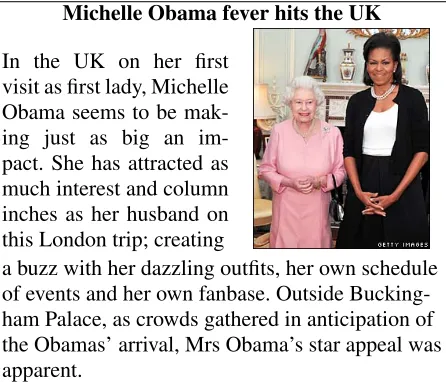
Michelle Obama fever hits the UK
In the UK on her first visit as first lady, Michelle Obama seems to be mak-ing just as big an im-pact. She has attracted as much interest and column inches as her husband on this London trip; creating
[image:3.612.77.300.60.251.2]a buzz with her dazzling outfits, her own schedule of events and her own fanbase. Outside Bucking-ham Palace, as crowds gathered in anticipation of the Obamas’ arrival, Mrs Obama’s star appeal was apparent.
Table 1: Each article in the document collection contains a document (the title is shown in boldface), and image with related content.
and conversely, that linguistic information can be useful in isolating salient visual features. Our model extracts a semantic representation from large docu-ment collections and their associated images without any human involvement. Contrary to Andrews et al. (2009) we use visual features directly without rely-ing on speaker generated norms. Furthermore, un-like most work in image annotation, we do not em-ploy any goldstandard data where images have been manually labeled with their description keywords.
3 Semantic Representation Model
Much like LSA and the related topic models our model creates semantic representations from large document collections. Importantly, we assume that the documents are paired with images which in turn describe some of the document’s content. Our ex-periments make use of news articles which are of-ten accompanied with images illustrating events, ob-jects or people mentioned in the text. Other datasets with similar properties include Wikipedia entries and their accompanying pictures, illustrated stories, and consumer photo collections. An example news article and its associated image is shown in Table 1 (we provide more detail on the database we used in our experiments in Section 4).
Our model exploits the redundancy inherent in this multimodal collection. Specifically, we assume that the images and their surrounding text have been generated by a shared set of topics. A potential
stumbling block here is the fact that images and documents represent distinct modalities: images are commonly described by a continuous feature space (e.g., color, shape, texture; Barnard et al. 2002; Blei and Jordan 2003), whereas words are discrete. For-tunately, we can convert the visual features from a continuous onto a discrete space, thereby rendering image features more like word units. In the follow-ing we describe how we do this and then move on to present an extension of Latent Dirichlet Allocation (LDA, Blei and Jordan 2003), a topic model that can be used to represent meaning as a probability distri-bution over a set of multimodal topics. Finally, we discuss how word similarity can be measured under this model.
3.1 Image Processing
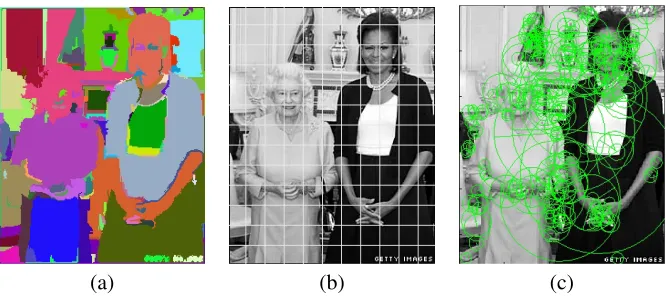
A large number of image processing techniques have been developed in computer vision for extracting meaningful features which are subsequently used in a modeling task. For example, a common first step to all automatic image annotation methods is partitioning the image into regions, using either an image segmentation algorithm (such as normalized cuts; Shi and Malik 2000) or a fixed-grid layout (Feng et al., 2004). In the first case the image is represented by irregular regions (see Figure 1(a)), whereas in the second case the image is partitioned into smaller scale regions which are uniformly ex-tracted from a fixed grid (see Figure 1(b)). The ob-tained regions are further represented by a standard set of features including color, shape, and texture. These can be treated as continuous vectors (Blei and Jordan, 2003) or in quantized form (Barnard et al., 2002).
(a) (b) (c)
Figure 1: Image partitioned into regions of varying granularity using (a) the normalized cut image segmentation algo-rithm, (b) uniform grid segmentation, and (c) the SIFT point detector.
(11×13) regions, whereas an average of 240 points (depending on the image content) are detected. A non-sparse feature representation is critical in our case, since we usually do not have more than one image per document.
We compute local image descriptors using the the Scale Invariant Feature Transform (SIFT) algo-rithm (Lowe, 1999). Importantly, SIFT descriptors are designed to be invariant to small shifts in posi-tion, changes in illuminaposi-tion, noise, and viewpoint and can be used to perform reliable matching be-tween different views of an object or scene (Mikola-jczyk and Schmid, 2003; Lowe, 1999). We further quantize the SIFT descriptors using the K-means clustering algorithm to obtain a discrete set of vi-sual terms (visiterms) which form our vivi-sual vo-cabularyVocV. Each entry in this vocabulary stands
for a group of image regions which are similar in content or appearance and assumed to origi-nate from similar objects. More formally, each im-ageI is expressed in a bag-of-words format vector, [v1,v2, ...,vL], where vi =n only ifI hasn regions labeled with vi. Since both images and documents in our corpus are now represented as bags-of-words, and since we assume that the visual and textual modalities express the same content, we can go a step further and represent the document and its as-sociated image as a mixture of verbal and visual wordsdMix. We will then learn a topic model on this concatenated representation of visual and textual in-formation.
3.2 Topic Model
Latent Dirichlet Allocation (Blei et al., 2003; Grif-fiths et al., 2007) is a probabilistic model of text
gen-eration. LDA models each document using a mix-ture overK topics, which are in turn characterized as distributions over words. The words in the docu-ment are generated by repeatedly sampling a topic according to the topic distribution, and selecting a word given the chosen topic. Under this framework, the problem of meaning representation is expressed as one of statistical inference: given some data — textual and visual words — infer the latent structure from which it was generated. Word meaning is thus modeled as a probability distribution over a set of latent multimodal topics.
LDA can be represented as a three level hierarchi-cal Bayesian model. Given a corpus consisting ofM
documents, the generative process for a documentd
is as follows. We first draw the mixing proportion over topics θd from a Dirichlet prior with
parame-tersα. Next, for each of theNd wordswdn in doc-umentd, a topiczdn is first drawn from a
multino-mial distribution with parametersθdn. The
probabil-ity of a word token w taking on value igiven that topic z= j is parametrized using a matrix β with
bi j=p(w=i|z= j). Integrating outθd’s andzdn’s,
givesP(D|α,β), the probability of a corpus (or doc-ument collection):
M
∏
d=1
Z
P(θd|α) Nd
∏
n=1
∑
zdnP(zdn|θd)P(wdn|zdn,β)
!
dθd
ap-proximate inference algorithms have been proposed in the literature including variational inference which our model adopts. Blei et al. (2003) introduce a set of variational parameters, γ and φ, and show that a tight lower bound on the log likelihood of the probability can be found using the following optimization procedure:
(γ∗,φ∗) =argmin
γ,φ
D(q(θ,z|γ,φ)||p(θ,z|w,α,β))
Here, D denotes the Kullback-Leibler (KL) diver-gence between the true posterior and the variational distribution q(θ,z|γ,φ) defined as: q(θ,z|γ,φ) =
q(θ|γ)∏Nn=1q(zn|φn), where the Dirichlet
parame-terγand the multinomial parameters(φ1, . . . ,φN)are
the free variational parameters. Notice that the opti-mization of parameters(γ∗(w),φ∗(w))is document-specific (whereasαis corpus specific).
Previous applications of LDA (e.g., to docu-ment classification or information retrieval) typi-cally make use of the posterior Dirichlet parame-tersγ∗(w)associated with a given document. We are not so much interested in γas we wish to obtain a semantic representation for a given word across doc-uments. We therefore train the LDA model sketched above on a corpus of multimodal documents{dMix}
consisting of both textual and visual words. We se-lect the number of topics,K, and apply the LDA al-gorithm to obtain theβ parameters, whereβ repre-sents the probability of a wordwi given a topic zj, p(wi|zj)=βi j. The meaning ofwi is thus extracted
from β and is a K-element vector, whose compo-nents correspond to the probability ofwigiven each latent topic assumed to have generated the document collection.
3.3 Similarity Measures
The ability to accurately measure the similarity or association between two words is often used as a di-agnostic for the psychological validity of semantic representation models. In the topic model described above, the similarity between two wordsw1andw2
can be intuitively measured by the extent to which they share the same topics (Griffiths et al., 2007). For example, we may use the KL divergence to mea-sure the difference between the distributionspandq:
D(p,q) =
K
∑
j=1
pjlog2 pj qj
where p and q are shorthand for P(w1|zj)
andP(w2|zj), respectively.
The KL divergence is asymmetric and in many ap-plications, it is preferable to apply a symmetric mea-sure such as the Jensen Shannon (JS) divergence. The latter measures the “distance” between pandq
through (p+2q), the average ofpandq:
JS(p,q) =1 2
D(p,(p+q)
2 ) +D(q, (p+q)
2 )
An alternative approach to expressing the similar-ity between two words is proposed in Griffiths et al. (2007). The underlying idea is that word association can be expressed as a conditional distribution. If we have seen wordw1, then we can determine the prob-ability that w2 will be also generated by comput-ingP(w2|w1). Although the LDA generative model allows documents to contain multiple topics, here it is assumed that bothw1andw2came from a single topic:
P(w2|w1) =
K
∑
z=1
P(w2|z)P(z|w1)
P(z|w1)∝P(w1|z)P(z)
where p(z) is uniform, a single topic is sampled from the distribution P(z|w1), and an overall esti-mate is obtained by averaging over all topicsK.
Griffiths et al. (2007) report results on mod-eling human association norms using exclu-sivelyP(w2|w1). We are not aware of any previous work that empirically assesses which measure is best at capturing semantic similarity. We undertake such an empirical comparison as it is not a priory obvious how similarity is best modeled under a multimodal representation.
4 Experimental Setup
In this section we discuss our experimental design for assessing the performance of the model pre-sented above. We give details on our training proce-dure and parameter estimation and present the base-line method used for comparison with our model.
Data We trained the multimodal topic model on the corpus created in Feng and Lapata (2008). It contains 3,361 documents that have been down-loaded from the BBC News website.2 Each doc-ument comes with an image that depicts some of its content. The images are usually 203 pixels wide
and 152 pixels high. The average document length is 133.85 words. The corpus has 542,414 words in total. Our experiments used a vocabulary of 6,253 textual words. These were words that occurred at least five times in the whole corpus, excluding stopwords. The accompanying images were prepro-cessed as follows. We first extracted SIFT features from each image (150 on average) which we subse-quently quantized into a discrete set of visual terms using K-means. As we explain below, we deter-mined an optimal value forKexperimentally.
Evaluation Our evaluation experiments compared the multimodal topic model against a standard text-based topic model trained on the same corpus whilst ignoring the images. Both models were assessed on two related tasks, that have been previously used to evaluate semantic representation models, namely word association and word similarity.
In order to simulate word association, we used the human norms collected by Nelson et al. (1999).3 These were established by presenting a large num-ber of participants with a cue word (e.g.,rice) and asking them to name an associate word in response (e.g.,Chinese, wedding, food, white). For each word, the norms provide a set of associates and the fre-quencies with which they were named. We can thus compute the probability distribution over associates for each cue. Analogously, we can estimate the de-gree of similarity between a cue and its associates using our model (and any of the measures in Sec-tion 3.3). And consequently examine (using corre-lation analysis) the degree of linear recorre-lationship be-tween the human cue-associate probabilities and the automatically derived similarity values. We also re-port how many times the word with the highest prob-ability under the model was the first associate in the norms. The norms contain 10,127 unique words in total. Of these, we created semantic representations for the 3,895 words that appeared in our corpus.
Our word similarity experiment used the Word-Sim353 test collection (Finkelstein et al., 2002) which consists of relatedness judgments for word pairs. For each pair, a similarity judgment (on a scale of 0 to 10) was elicited from human subjects (e.g., tiger-cat are very similar, whereas
delay–racismare not). The average rating for each pair represents an estimate of the perceived sim-ilarity of the two words. The task varies slightly from word association. Here, participants are asked
[image:6.612.312.539.58.228.2]3http://www.usf.edu/Freeassociation.
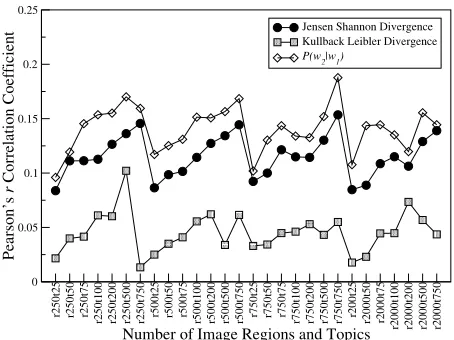
Figure 2: Performance of multimodal topic model on pre-dicting word association under varying topics and visual terms (development set).
to rate perceived similarity rather than generate the first word that came into their head in response to a cue word. The collection contains similarity ratings for 353 word pairs. Of these, we constructed seman-tic representations for the 254 that appeared in our corpus. We also evaluated how well model produced similarities correlate with human ratings. Through-out this paper we report correlation coefficients us-ing Pearson’sr.
5 Experimental Results
Model Selection The multimodal topic model has several parameters that must be instantiated. These include the quantization of the image features, the number of topics, the choice of similarity function, and the values for α and β. We explored the pa-rameter space on held-out data. Specifically, we fit the parameters for the word association and similar-ity models separately using a third of the associa-tion norms and WordSim353 similarity judgments, respectively. As mentioned in Section 3.1 we used
K-means to quantize the image features into a dis-crete set of visual terms. We varied K from 250 to 2000. We also varied the number of topics from 25 to 750 for both the multimodal and text-based topic models. The parameterα was set to 0.1 andβ was initialized randomly. The model was trained using variational Bayes until convergence of its bound on the likelihood objective. This took 1,000 iterations.
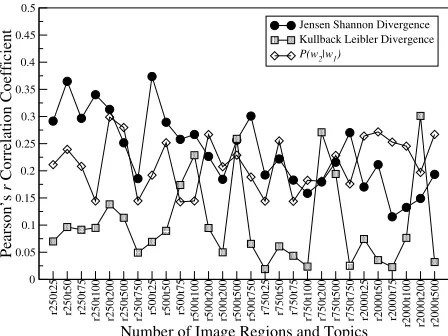
Figure 3: Performance of multimodal topic model on pre-dicting word similarity under varying topics and visual terms (development set).
to three similarity measures: KL divergence, JS di-vergence, andP(w2|w1), the probability of wordw2 givenw1(see Section 3.3). Figure 3 shows results on the development set for the word similarity task. As far as word association is concerned, we obtain best results withP(w2|w1), 750 visual terms and 750 top-ics (r=0.188). On word similarity, JS performs best with 500 visual terms and 25 topics (r=0.374). It is not surprising thatP(w2|w1)works best for word as-sociation. The measure expresses the associative re-lations between words as a conditional distribution over potential response wordsw2 for cue wordw1. A symmetric function is more appropriate for word similarity as the task involves measuring the degree to which to words share some meaning (expressed as topics in our model) rather than whether a word is likely to be generated as a response to another word. These differences also lead to different parametriza-tions of the semantic space. A rich visual term vo-cabulary (750 terms) is needed for modeling associ-ation as broader aspects of word meaning are taken into account, whereas a sparser more focused repre-sentation (with 500 visual terms and 25 overall top-ics) is better at isolating the common semantic con-tent between two words. We explored the parame-ter space for the text-based topic model in a sim-ilar fashion. On the word association task the best correlation coefficient was achieved with 750 top-ics and P(w2|w1) (r=0.139). On word similarity, the best results were obtained with 75 topics and the JS divergence (r=0.309).
Model Word Association Word Similarity
UpperBnd 0.400 0.545
MixLDA 0.123 0.318
[image:7.612.72.296.59.227.2]TxtLDA 0.077 0.247
Table 2: Model performance on word association and similarity (test set).
Model Comparison Table 2 summarizes our re-sults on the test set using the optimal set of pa-rameters as established on the development set. The first row shows how well humans agree with each other on the two tasks (UpperBnd). We estimated the intersubject correlation using leave-one-out re-sampling4 (Weiss and Kulikowski, 1991). As can be seen, in all cases the topic model based on tex-tual and visual modalities (MixLDA) outperforms the model relying solely on textual information (TxtLDA). The differences in performance are sta-tistically significant (p<0.05) using at-test (Cohen and Cohen, 1983).
Steyvers and Griffiths (2007) also predict word association using Nelson’s norms and a state-of-the-art LDA model. Although they do not report correla-tions, they compute how many times the word with the highest probability P(w2|w1) under the model was the first associate in the human norms. Using a considerably larger corpus (37,651 documents), they reach an accuracy of 16.15%. Our corpus con-tains 3,361 documents, the MixLDA model per-forms at 14.15% and the LDA model at 13.16%. Us-ing a vector-based model trained on the BNC corpus (100M words), Washtell and Markert (2009) report a correlation of 0.167 on the same association data set, whereas our model achieves a correlation of 0.123. With respect to word similarity, Marton et al. (2009) report correlations within the range of 0.31–0.54 us-ing different instantiations of a vector-based model trained on the BNC with a vocabulary of 33,000 words. Our MixLDA model obtains a correlation of 0.318 with a vocabulary five times smaller (6,253 words). Although these results are not strictly com-parable due to the different nature and size of the training data, they give some indication of the qual-ity of our model in the context of other approaches that exploit only the textual modality. Besides, our intent is not to report the best performance possible,
[image:7.612.313.545.60.114.2]GAME, CONSOLE, XBOX, SECOND, SONY, WORLD,
TIME, JAPAN, JAPANESE, SCHUMACHER, LAP, MI
-CROSOFT, ALONSO, RACE, TITLE, WIN, GAMERS,
LAUNCH,RENAULT,MARKET
PARTY, MINISTER, BLAIR, LABOUR,PRIME, LEADER,
GOVERNMENT, TELL, BROW, MP, TONY, SIR, SECRE
-TARY,ELECTION,CONFERENCE,POLICY,NEW,WANT,
PUBLIC,SPEECH
SCHOOL, CHILD, EDUCATION, STUDENT, WORK,
PUPIL, PARENT, TEACHER, GOVERNMENT, YOUNG,
SKILL, AGE, NEED, UNIVERSITY, REPORT, LEVEL,
GOOD,HELL,NEW,SURVEY
Table 3: Most frequent words in three topics learnt from a corpus of image-document pairs.
but to show that a model of meaning representation is more accurate when taking visual information into account.
Table 3 shows some examples of the topics found by our model, which largely form coher-ent blocks of semantically related words. In gen-eral, we observe that the model using image fea-tures tends to prefer words that visualize easily (e.g., CONSOLE, XBOX). Furthermore, the visual modality helps obtain crisper meaning distinctions. Here, SCHUMACHER is a very probable world for the “game” cluster. This is because the Formula One driver appears as a character in several video games discussed and depicted in our corpus. For com-parison the “game” cluster for the text-based LDA model contains the words:GAME, USE,INTERNET, SITE, USE, SET, ONLINE, WEB, NETWORK, MUR -RAY, PLAY, MATCH, GOOD, WAY, BREAK, TECH -NOLOGY,WORK,NEW,TIME,SECOND.
We believe the model presented here works bet-ter than a vanilla text-based topic model for at least three reasons: (1) the visual information helps cre-ate better clusters (i.e., conceptual representations) which in turn are used to measure similarity or as-sociation; these clusters themselves are amodal but express commonalities across the visual and textual modalities; (2) the model is also able to capture per-ceptual correlations between words. For example, REDis the most frequent associate forAPPLEin Nel-son’s norms. This association is captured in our vi-sual features (pictures with apples cluster with pic-tures showing red objects) even thoughREDdoes not co-occur withAPPLEin our data; (3) finally, even in cases where two words are visually very different in terms of shape or color (e.g.,BANANAandAPPLE),
they tend to appear in images with similar structure (e.g., on tables, in bowls, as being held or eaten by someone) and thus often share some common ele-ment of meaning.
6 Conclusion
In this paper we developed a computational model that unifies visual and linguistic representations of word meaning. The model learns from natural lan-guage corpora paired with images under the assump-tion that visual terms and words are generated by mixtures of latent topics. We have shown that a closer correspondence to human data can be ob-tained by explicitly taking the visual modality into account in comparison to a model that estimates the topic structure solely from the textual modality. Be-yond word similarity and association, the approach is promising for modeling word learning and cate-gorization as well as a wide range of priming stud-ies. Outwith cognitive science, we hope that some of the work described here might be of relevance to more applied tasks such as thesaurus acquisition, word sense disambiguation, multimodal search, im-age retrieval, and summarization.
Future improvements include developing a non-parametric version that jointlylearnshow many vi-sual terms and topics are optimal. Currently, the size of the visual vocabulary and the number of topics are parameters in the model, that must be tuned sep-arately for different tasks and corpora. Another ex-tension concerns the creation of visual terms. Our model assumes that an image is a bag of words. The assumption is convenient for modeling purposes, but clearly false in the context of visual processing. Im-age descriptors found closely to each other are likely to represent the same object and should form one term rather than several distinct ones (Wang and Grimson, 2007). Taking the spatial structure among visual words into account would yield better topics and overall better semantic representations. Analo-gously, we could represent documents by their syn-tactic structure (Boyd-Graber and Blei, 2009).
References
Andrews, M., G. Vigliocco, and D. Vinson. 2009. In-tegrating experiential and distributional data to learn semantic representations. Psychological Review 116(3):463–498.
pic-tures.Journal of Machine Learning Research3:1107– 1135.
Blei, D. and M. Jordan. 2003. Modeling annotated data. InProceedings of the 26th Annual International ACM SIGIR Conference. Toronto, ON, pages 127–134. Blei, D. M., A. Y. Ng, and M. I. Jordan. 2003. Latent
Dirichlet allocation. Journal of Machine Learning Re-search3:993–1022.
Bornstein, M. H., L. R. Cote, S. Maital, K. Painter, S.-Y. Park, and L. Pascual. 2004. Cross-linguistic analy-sis of vocabulary in young children: Spanish, Dutch, French, Hebrew, Italian, Korean, and American En-glish. Child Development75(4):1115–1139.
Boyd-Graber, J. and D. Blei. 2009. Syntactic topic models. In Proceedings of the 22nd Conference on Advances in Neural Information Processing Systems. MIT, Press, Cambridge, MA, pages 185–192.
Cohen, J. and P. Cohen. 1983. Applied Multiple Regres-sion/Correlation Analysis for the Behavioral Sciences. Hillsdale, NJ: Erlbaum.
Feng, S., V. Lavrenko, and R. Manmatha. 2004. Mul-tiple Bernoulli relevance models for image and video annotation. InProceedings of the International Con-ference on Computer Vision and Pattern Recognition. Washington, DC, pages 1002–1009.
Feng, Y. and M. Lapata. 2008. Automatic image annota-tion using auxiliary text informaannota-tion. InProceedings of the ACL-08: HLT. Columbus, pages 272–280. Finkelstein, L., E. Gabrilovich, Y. Matias, E. Rivlin,
Z. Solan, G. Wolfman, and E. Ruppin. 2002. Placing search in context: The concept revisited. ACM Trans-actions on Information Systems20(1):116–131. Griffiths, T. L., M. Steyvers, and J. B. Tenenbaum. 2007.
Topics in semantic representation. Psychological Re-view114(2):211–244.
Hofmann, T. 2001. Unsupervised learning by proba-bilistic latent semantic analysis. Machine Learning 41(2):177–196.
Jones, S. S., L. B. Smith, and B. Landau. 1991. Ob-ject properties and knowledge in early lexical learning. Child Development(62):499–516.
Landau, B., L. Smith, and S. Jones. 1998. Object percep-tion and object naming in early development. Trends in Cognitive Science27:19–24.
Landauer, T. and S. T. Dumais. 1997. A solution to Plato’s problem: the latent semantic analysis theory of acquisition, induction, and representation of knowl-edge. Psychological Review104(2):211–240.
Lowe, D. 1999. Object recognition from local scale-invariant features. In Proceedings of International Conference on Computer Vision. IEEE Computer So-ciety, pages 1150–1157.
Marton, Y., S. Mohammad, and P. Resnik. 2009. Estimat-ing semantic distance usEstimat-ing soft semantic constraints in knowledge-source – corpus hybrid models. In
Pro-ceedings of the 2009 Conference on Empirical Meth-ods in Natural Language Processing. Singapore, pages 775–783.
Mikolajczyk, K. and C. Schmid. 2003. A performance evaluation of local descriptors. InProceedings of the 9th International Conference on Computer Vision and Pattern Recognition. Nice, France, volume 2, pages 257–263.
Monay, F. and D. Gatica-Perez. 2007. Modeling semantic aspects for cross-media image indexing. IEEE Trans-actions on Pattern Analysis and Machine Intelligence 29(10):1802–1817.
Nelson, D. L., C. L. McEvoy, and T.A. Schreiber. 1999. The university of South Florida word association norms.
Pan, J., H. Yang, P. Duygulu, and C. Faloutsos. 2004. Au-tomatic image captioning. InProceedings of the 2004 International Conference on Multimedia and Expo. Taipei, pages 1987–1990.
Quinn, P., P. Eimas, and S. Rosenkrantz. 1993. Evidence for representations of perceptually similar natural cate-gories by 3-month and 4-month old infants.Perception 22:463–375.
Rogers, T. T., M. A. Lambon Ralph, P. Garrard, S. Bozeat, J. L. McClelland, J. R. Hodges, and K. Pat-terson. 2004. Structure and deterioration of semantic memory: A neuropsychological and computational in-vestigation. Psychological Review111(1):205–235. Roy, D. 2002. Learning words and syntax for a visual
de-scription task.Computer Speech and Language16(3). Shi, J. and J. Malik. 2000. Normalized cuts and image segmentation. IEEE Transactions on Pattern Analysis and Machine Intelligence22(8):888–905.
Steyvers, M. and T. Griffiths. 2007. Probabilistic topic models. In T. Landauer, D. McNamara, S Dennis, and W Kintsch, editors, A Handbook of Latent Semantic Analysis, Psychology Press.
Wang, X. and E. Grimson. 2007. Spatial latent Dirichlet allocation. InProceedings of the 20th Conference on Advances in Neural Information Processing Systems. MI Press, Cambridge, MA, pages 1577–1584. Washtell, J. and K. Markert. 2009. A comparison of
win-dowless and window-based computational association measures as predictors of syntagmatic human associa-tions. InProceedings of the 2009 Conference on Em-pirical Methods in Natural Language Processing. Sin-gapore, pages 628–637.
Weiss, S. M. and C. A. Kulikowski. 1991.Computer Sys-tems that Learn: Classification and Prediction Meth-ods from Statistics, Neural Nets, Machine Learning, and Expert Systems. Morgan Kaufmann, San Mateo, CA.