2
Probabi I ity
We often make uncertain statements similar to the following: It will probably rain today.
I have a good chance of being selected in the hockey team.
There is a 50-50 chance that a head will come up when I toss a coin. I have only a slight chance of catching a cold this week.
In each case there is some doubt about the outcome, but the degree of doubt is not the same in each case. Probability is a study of events that may or may not happen, rather than of events that will happen or that have already happened.
Figure 2-1
If we toss a coin, a head may turn up or it may not turn up. Since a head or a tail must turn up, there are two possible outcomes, H or T, and each is equally likely.
We say that the probability of a head is½: 1
Pr(H) = 2
This can be expressed in a variety of ways:
There is a 50-50 chance that a head will turn up. There is a 1 in 2 chance that a head will turn up. The odds are 1 to 1 that a head will turn up. It is an even-money bet that a head will turn up.
Before beginning a game of tennis, cricket, basketball, etc. the opposing sides toss a coin. Why?
Toss a coin 10 times, 50 times, 100 times, 200 times, and 500 times, and count the number of heads. Copy and complete the following table:
--·
Number of tosses 10 50 100 200 500
Number of heads
If you toss the coin 10 times, how many heads would you expect? If you toss the coin 50 times, how many heads would you expect? Would you be surprised if you didn't get exactly the number you expected?
An American soldier, while a prisoner of war in World War II, performed the experiment of tossing a coin 1000 times. He actually performed the experiment 10 times and obtained the following numbers of heads: 502, 511,497, 529, 504, 476,507, 528, 504, 529.
Die Figure 2-2
A die (plural: 'dice') is a small cube with its six faces numbered with dots from 1 to 6 as shown in Figure 2-2. If the die is rolled on a table, one of the six numbers will appear uppermost. Each number is equally likely to turn up. Why?
What is the probability that a 5 will appear uppermost? There are six possible outcom@s and one of these six, namely the 5, is favourable to what we want.
So the probability of a 5 appearing uppermost is¼: Pr(5)
=
¼This can be expressed in a variety of ways. There is a 1 to 6 chan�e that a 5 will turn up. The odds are 5 to 1 against a 5 turning up. This means that, for every 1 favourable outcome, there are 5 unfavourable outcomes.
We may define probability as being the ratio of the number of favourable outcomes to the number of possible outcomes, assuming that the outcomes are equally likely. The
probability, Pr(A), of a particular result A is given by:
Pr(A)
=
number of favou�able outcomesnumber of possible outcomesRoll a die 6 times, 60 times, 120 times, 300 times, and 600 times, and count th1;1 nµmber of times a 5 (or any other chosen number) appears uppermost. Copy and complete the following table:
Number of rolls of die 6 60 120
Numbe; of times 5 appears
.
-240 300 600
If you roll the die six times, how many fives would you expect? If you roll the die 60 times, how many fives would you expect? Would you be surprised if you didn't get exactly the number you expected?
From the definition of probability as 'the number of favourable outcomes + number of possible outcomes', we can see that, if the number of favourable outcomes is equal to the number of possible outcomes, the probability is 1. In this case the event is rer(ain to happen. It is certain that the sun will rise in the East tomorrow. The probability qf a number less than 7 when a die is rolled = � = 1 (a certainty). Can you think of other sitµations where the probability is 1?
If there are no favourable outcomes, then the probability is 0. Many athletes have run in a 100-metre race but no athlete has run the distance in 1 second. So the probability that an athlete will run 100 m in 1 s is 0. Probability that a 7 will appear when a die is rolled
= � = 0. Probabilities then will lie between O {lnd 1.
I O �Pr� 1
Usually, to win Tattslotto, you must pick the six winning numbers and you have the 45 numbers, 1 to 45, to pick from. The number of different ways you can pick six numbers when you have 45 to pick from is 8 145 060 and only one of these is favourable.
The following table shows the number of live births and the number of males and females born in Australia over the three-year period 1975 to 1977, and another three-year period
1981 to 1983.
Proportion
Year Live births Males Females of males
1975 233 01 � 119 850 113 162 0.514
1976 227 810 116 838 110 972 0.513
1977 226 291 116 551 109 740 0.515
1981 235 842 121 170 114 672 0.514
1982 239 903 123 254 116 649 0.514
1983 242 570 124 558 118 01 2 0.513
With rare exceptions, statistics over the years indicate a slight excess of male births over female births.
. . number of males born Pr(a newborn child 1s a boy) = t 1 b f b' th to a num er o Ir s
:::::: 0.51
Example 1
A die is rolled on the floor. What is the probability that the number appearing uppermost is:
a even?
b divisible by 3?
c even or divisible by 3? d even and divisible by 3?
As we have seen, there are six possible outcomes as a result of rolling a die and they are equally likely.
a There are three even numbers, namely 2, 4 and (i, and, therefore, three favourable outcomes.
:. Pr(even) = ¾ =
½
b There are two numbers divisible by 3, namely 3 and 6, and, therefore, two favourable outcomes.
:. Pr(divisible by 3) =
i
=½
c 2, 3, 4 and 6 are favourable; so there are four favourable outcomes. :. Pr(even or divisible by 3) =
i
= �d 6 is the only number that is even and also divisible by 3; so there is only l favourable outcome.
2.1 Complementary events
:' •,,
The complement of event A is the event 'A does not occur' and is denoted by A'. If an experiment hasn
possible outcomes,m
of which are associated with event A and so (n - m) are associated with event A', then:Pr(A) m n
Pr(A ')
=
n -n m=
!1 -n n m=
l - mn=
l - Pr(A)i.e. Pr(A) + Pr(A ') = 1
Example 2
A die is rolled on the floor. What is the probability that the number appearing uppermost is not 4?
Pr(4 appears uppermost) = ¼
1' 5 Pr(4 does not appear uppermost) = 1 - 6 = 6
Example 3
An ordinary pack (deck) of playing cards contains 52 cards made up of 13 diamonds, 13 hearts, 13 clubs and 13 spades. If the pack is well shuffled and a card is drawn at random, each of the 52 cards is equally likely to be drawn and so has a probability of A of being drawn.
Figure 2-3
•• ••••
• ••
L,•
•
From a pack of 52 playing cards one card is drawn at random. What is the probability that it is:
a a spade?
b not a queen? c an ace?
d a club or an ace?
e a club and an ace?
f a heart and the ace of diamonds?
There are 52 equally likely outcomes.
a There are 13 spades and so: 13 1 Pr(spade) = 52 = 4
b There are four queens and, therefore, 48 cards that are not queens. 48 12
Pr(not a queen) = 52 = TI c There are four aces and so:
4 1 Pr(ace) = 52 = TI
d There are 13 clubs and four aces but there is one club that is also an ace. So there are 16 cards that are favourable to the outcome we want.
16 4 Pr(a club or an ace) = 52 = TI
e The ace of clubs is the only card that is a club and also an ace. Pr (club and an ace) = A
f There is no card that is a heart and also the ace of diamonds. Pr(heart and the ace of diamonds) = 0
2.2 Life tables (1984]
The tables on the facing page are extracted from life tables (or mortality tables, as they are sometimes called) prepared by the Australian Bureau of Statistics. As a consequence of the number of deaths registered in 1984, the life tables are now prepared by statisticians to provide an estimate of the number of individuals, out of 100 000 live births, expected to be alive
x
years later.Ix = number of persons surviving at age
x
years q x = proportion dying between agex
and agex
+ef = life expectancy at age x years.
Age 0 10 (15 20 30 40 50 60 70 80 Ma/es
'·
100 000 0.01045
98 955 0.00086
98 621 0.00018
"'
I
98 472 0.00062
97 997 0.00140
96.724 0.00119
0.00188
92 591 0.00511
84 564 0.01541
' 66 465
.. ) 0.03859
35:792 0.09284
eo X 72.59 72.36 63.59 58.68 53.95 44.60 35.13 26.03 17.95 11.32 6.54 Females
'·
100 000 0.00788
99 212 0.00063
98 966 0.00013
98 873 0.00029
98 685 0 0.00047
I
l��-�
0.00052
97 532 0.00115
95 774 0.00298
80 921 0.01994
58 109 0.05751
eo X
79.09 78.71 69.90 64.97 60.08 50.35 40.66 31.30 22.53 14.70 8.28
Example4
Using the ltfe tables provided above, find the probability that: a a new born boy will reach the age of 40 years
b a female, aged 40 years, will survive until the age of 50 years c a male, aged 30 years, will die in his sixties
d a female, aged 20 years, will die in her 41st year
a Since 95 446 males are expected to be alive at the age of 40 years: 95 446
Pr = l00 000 = 0.95446
b Out of 97 532 females aged 40 years, 95 774 will survive until the age of 50 years. 95 774
Pr = 97 532 = 0.9820
C 84 564 - 66 465 = 18 099
Out of96 724 males alive at the age of 30 years, 18 099 will die in their sixties. 18 099
Pr = 96 724 = 0.1871
d From the Qx column, 0.00115 of 97 532, i.e. 112 females, will die between the ages of 40 years and 41 years.
112
Exercises 2a
(1
·
Select 20 lines on a page of a novel. Count the number of times each letter of the alphabet appears.a Would you expect each of the 26 letters of the alphabet to be used approximately the same number of times?
b If a letter in these 20 lines is selected at random, would you say that the probability that it is 'e' would be the same as the probability that it is 'z'?
2 Select any page in a telephone directory and count the number of times 0, 1, 2, 3, ... 9 appears as the last digit in a telephone number. Prepar·e a table showing your results. Do you think these results were to be expected?
3 Write whether the following have probabilities close to 0, 0.5 or 1. a A person will die because of accidental drowning.
b A student in your class has fair hair.
c There will be an aircraft crash in Australia today. d The cost of living will increase this year.
e A household has a television set. f It will rain in Sydney tomorrow. 4 Perform this experiment.
From a bag containing 7 black marbles and 3 white marbles, withdraw a marble, note its colour and then replace it in the bag. Shuffle the marbles and then withdraw a marble again. Repeat this 10, 50, 100, 1 50, and 200 times. Copy and complete the following table:
Number of withdrawals 10 50 100 150 200
Number of black marbles
How many black marbles do you expect to get in each series of experiments? /(}) A set of 20 cards is numbered 1, 2, 3, ... 20. A card is drawn at random from the
set. What is the probability that the number on it is divisible by: a 3?
b 5?
c 3 or 5 or both? d 3 and 5?
6 A die with its faces numbered 1 to 6 is rolled on the floor. What is the probability that the number appearing uppermost is:
a greater than 2?
b greater than 3 but less than 5? C odd?
;('\ d odd and divisible by 3?
( 'Z_) A set of 10 cards is numbered 3, 4, 5, ... 12. A card is drawn at random. What is the probability that the number on it is:
a even? b odd? c odd or even? d greater than 7? e divisible by 3?
f even and divisible by 3? g divisible by 5?
G') A card is drawn at random from a pack of 52 playing cards. What is the probability that it is:
a a heart? b a king?
c a heart or a king? d a heart and a king? e the queen of diamonds?
9 A digit is chosen at random from the digits 7, 8, 9, ... 15. What is the probability that the digit is:
a odd?
b odd and divisible by 5?
c odd but not divisible by 5? 'l
d a multiple of 2? e a multiple of 3?
f a multiple of both 2 and 3? g a multiple of 2 or 3?
h a multiple of 2 or 3, but not both?
10 In a group of 25 students, 18 study Biology, 12 study Physics and 5 study neither Biology nor Physics. If a student is chosen at random, what is the probability that the student studies:
a Biology only?
b Physics only?
c Biology or Physics or both? d both Biology and Physics?
11 There are four horses competing in a weight for age race at Flemington racecourse. A punter was able to get the following odds: Tanglefoot 2 to 1, Dapple Grey 3 to 1, The Champ 4 to 1 and No Hoper 5 to 1.
a Express each of these odds as probabilities. b What is the sum of these probabilities?
c Devise a strategy for the punter so that, no matter which horse wins, the punter will win.
12 A survey of a certain district showed that 6% of families have 1 child, 38% have 2 children, 420Jo have 3 children, and 10% have more than 3 children. A family is selected at random. What is the probability that it will have:
a some children? b no children? c at least 2 children? d not more than 2 children?
13 Use the life tables provided on page 37 to find the probability that:
a a new born girl will reach the age of 60 years.
b a boy aged 15 yea1., will survive until tlie age of 70 years. c a female aged 20 will die in her fifties.
d a male aged 50 will die in his seventies.
( 14 A French roulette wheel has 37 compartments around its rim. One of these is numbered \ 0 and is coloured green. The others are numbered 1 to 36 and half of these are coloured
red and the other half are coloured black.
The wheel is spun in one direction and a small ball is rolled in the opposite direction. The chances of the ball falling into any of the 37 compartments are equally likely. Find the probability that the ball will land on:
a black
b an odd number c a multiple of 3
d any number from 1 to 12 e 15.
15 For the roulette wheel in Question 14, the payouts for a win are: even money for red or black, odd or even numbers; 35 to 1 for any number.
a If a gambler invests $1 in each of the situations in Questions 14a to 14e and wins, how much does he or she receive back in each C'1se?
b If the gambler invests $1 on black for 37 consecutive spins, how much would you expect he or she would win or lose?
2.3 Finite sample space
A set of favourable outcomes may be considered as an event. The tossing of even numbers with a die (three favourable outcomes), the drawing of a heart from a pack of cards (13 favourable outcomes) ancl the tossing of a head with a coin (one favourable outcome) may be considered as events.
The tossing of a die, the drawing of cards from a pack, etc. are called experiments or trials. In modern probability theory, all possible outcomes of an experiment are considered as points in a space, called a sample space or a probability space, t. If t contains a finite number of points, n, and, if the outcomes of an experiment are equally likely, then we can assign to each point, called a sample point, a probability of l. The sum of the probabilities of all the sample points is, therefore, 1. n
A sample space of the experiment of tossing a die consists of six sample points. The set t = {1, 2, 3, 4, 5, 6) gives the possible outcomes of the experiment. Three points correspond
to event A (the tossing of an even number) the other three correspond to event B (the tossing of an odd number). If we are interestep only in the tossirig of even numbers (e) and odd numbers (o), the sample space may be considered as consisting of only two sample points. In this case, the sett = {e, o) is a sample space, one point of which corresponds to event
A, the other to event B.
An event, then, is a set or collection of sample points int; i.e. it is a subset oft.
A sample space of the experiment of choosing a letter of the alphabet may be considered as consisting of 26 sample points. The set:
t
=
{a, b, c, . . . x, y,z);
n(t)=
26gives the possible outcomes of the experiment, each outcome being equally likely. Five points correspond to event A, the choosing of a vowel:
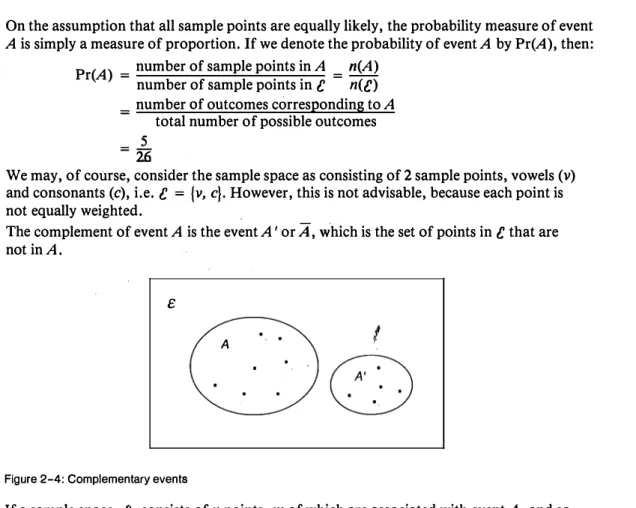
On the assumption that all sample points are equally likely, the probability measure of event A is simply a measure of proportion. If we denote the probability of event A by Pr(A), then:
Pr(A)
=
number of sample points in number of sample points in I: A=
n(A)n(t)
_ number of outcomes corresponding to A
-total number of possible outcomes
=
26We may, of course, consider the sample space as consisting of 2 sample points, vowels (v) and consonants (c), i.e. I:
=
{v, c}. However, this is not advisable, because each point is not equally weighted.The complement of event A is the event A' or A, which is the set of points in t that are not in A.
e
A
Figure 2-4: Complementary events
If a sample space, /;, consists of n points, m of which are associated with event A, and so
(n
-m)
are associated with event A', then: Pr(A)=
m
n
and: Pr(A')
=
n - m=
1 - m=
1 - Pr(A)n n
i.e. Pr(A) + Pr(A ')
=
1The symbol </> is used to denote a set with no points in it, called the null set. The probability of an event corresponding to this set is zero; i.e. Pr (</>)
=
0. Similarly Pr(t)=
1, and so:0 � Pr(A) � 1
2.4 Mutually exclusive events
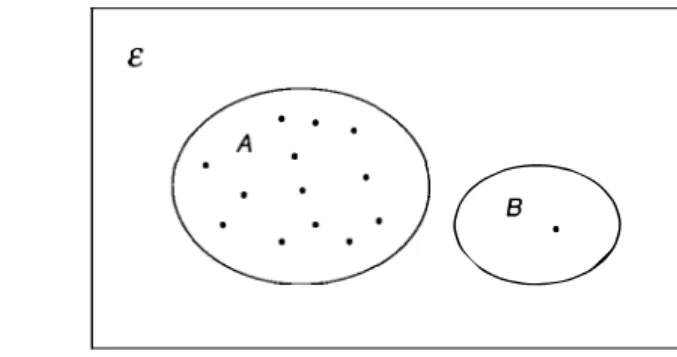
If two or more events cannot occur simultaneously, they are said to be mutually exclusive or disjoint;ln the language of sample space, the events have no points in common.
If a coin is tossed, either a head or a taii may tum up, but both events cannot occur in
Example 5
If one card is drawn at random from a pack of 52 playing cards, what is the probability that it is a heart or the ace of spades?
Figure 2-5: Mutually exclusive events
. .
0
Event A is the drawing of a heart from a pack of 52 playing cards and is, therefore, a set of 13 points in a sample space, l, of 52 points.
Event Bis the drawing of the ace of spades and is a set containing 1 point. That is:
n({:) = 52, n(A) = 13, n(B) = 1
A U Bis the set of all points belonging to A or B or both and is called the union
of the two sets. So A U Bis a set of 14 points. That is:
n(A U B) = 14
Pr(A U B) = n(A U B)
j
1.. 4
n(l) 152
Pr(A) = n(A) n({:) = 11 .. · I 52
Pr(B) = n(B) n({:)
J
'52 l__A and B have no points in common and, therefore, are mutually exclusive, in which case:
I
Pr(A U B) = Pr(A) + Pr(B)I
· Example 6
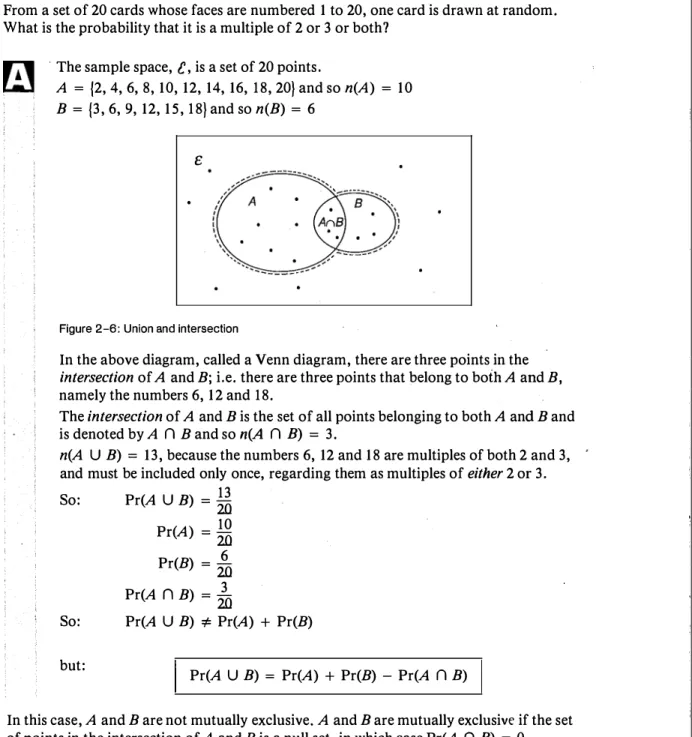
From a set of 20 cards whose faces are numbered 1 to 20, one card is drawn at random. What is the probability that it is a multiple of 2 or 3 or both?
· The sample space, t., is a set of 20 points.
A = 12, 4, 6, 8, 10, 12, 14, 16, 18, 20} and so n(A) = 10 B = {3, 6, 9, 12, 15, 18} and so n(B) = 6
e
Figure 2-6: Union and intersection
In the above diagram, called a Venn diagram, there are three points in the
intersection of A and B; i.e. there are three points that belong to both A and B,
namely the numbers 6, 12 and 18.
The intersection of A and B is the set of all points belonging to both A and B and is denoted by A n Band so n(A n B)
=
3.n(A U B)
=
13, because the numbers 6, 12 and 18 are multiples of both 2 and 3,and must be included only once, regarding them as multiples of either 2 or 3. 13
So: Pr(A U B)
=
2010
Pr(A)
=
206 Pr(B) = 20
3 Pr(A
n
B)=
20So: Pr(A U B) -:f:. Pr(A) + Pr(B)
but: Pr(A U
B) = Pr(A) + Pr(B) - Pr(A n B)
In this case, A and B are not mutually exclusive. A and B are mutually exclusive if the set
Example 7
If Pr(A)
=
0.52, Pr(An
B)=
0.25 and Pr(A U B)=
0.70, find Pr(B). Since: Pr(AUB)=
Pr(A)+
Pr (B) - Pr(An
B)it follows that:
Figure 2-7
0.70
=
0.52+
Pr(B) - 0.25Pr(B) = 0.43
30
,,,,.,,..,,.
...
.. ... ,
(
A27---,,>
\___ ,r-=---:-, ,
Alc..,e---,,
We may consider a sample space consisting of 100 points of which 52 belong to A,
43 to B, 25 to the intersection of A and B, 70 to the union of A and B, and 30 to neither A nor B.
Putting this into a practical context, we may consider 100 students, of whom 52 study Chemistry, 43 study Biology, 25 study both Chemistry and Biology, 70 study either Chemistry or Biology or both, and 30 study\neither Chemistry nor Biology.
Exercises 2b
1 A die is rolled on the floor. A is the event 'an even number', Bis the event 'an odd number', C is the event 'a number less than 4'. Find the probability of:
a A U B b A' U B 1, L' 3 c A U C d B' UC'
2 From a set of 20 cards numbered 1, 2, 3, ... 20, one card is drawn at random. A is the event 'a multiple of 2', Bis the event 'a multiple of 3', and C is the event 'a multiple of 5'. Find the probability of:
a A b B c C d A'
fA
u
B g Au
C hA Iu
B i Au
C'Which of the events A, B and C are mutually exclusive?
e B'
j B' UC'
3 A card is drawn at random from a pack of 52 playing cards. A is the event 'drawing a club', B the event 'drawing the king of spades', and C is the event 'drawing a king'. Find the probability of:
a A
d A UB be AUC B Are A and B mutually exclusive? Are A and C mutually exclusive? Are Band C mutually e�usive?
c C
f BU C
4 An integer is chosen at random from the first 50 positive integers. A is the event 'divisible by 3', B the event 'divisible by 5', and C the event 'divisible by 8'. -Find the probability of:
a
A nB5 If Pr(A) + Pr(B)
=
1, does it follow that either event A or event B must occur? 6 Pr (A U B) = 0.6, Pr(An
B) = 0.3, Pr(A) = 0.5. Find:a Pr(B) b Pr(A ') c Pr(A U A') d Pr(A' U B)
7 Pr(A) = 0.68, Pr(B) = 0.28 and Pr(A U B) = 0.80. Find:
a Pr(A nB) b Pr(A u B') C Pr(A' u B)
8 Pr(A) = 0.4, Pr(B) = 0. 7 and Pr(A
n
B) = 0.4.What can be said of events A and B? Illustrate this with a Venn diagram.
· 9 .From a group of 100 students, SO.study History, 30 study English Literature and 20 ' -' study both. If a student is selected at random from the group, what is the probability
that the student studies:
, a at least one of these subjects? b History but not English Literature?
"'-, c History, given that the student also studies English Literature?
10 In a group of 50 students, 30 study Mathematics, 25 study Physics and 20 study both Mathematics and Physics. One student is selected at random from the group. What is the probability that the student studies:
a Mathematics but not Physics? b Physics but not Mathematics? c neither Physics nor Mathematics? ,,
2.5 Successive outcomes
Examples
A coin is tossed twice. What is the total number of possible outcomes?
In the first toss, there are two possible outcomes, H or T. Each of these can be associated with H or T in the second toss as shown in the following tree diagram (Figure 2-10).
Possible First toss Second toss outcomes
<"<
H HH
T HT
T<: H TH
T TT
Figure 2-1 O
There are four possible outcomes (2 x 2), namely HH, HT, TH, TT, where HH means head in the first toss followed by head in the second toss, and so on. Note that HT and TH are two different outcomes - HT is head first toss, tail second toss; TH is tail first toss, head second toss.
Are each of these four outcomes equally likely? If so, Pr(2 heads)
=
¼,
Pr(l head)=
¾,
The four possible outcomes can also be
illustrated well by a lattice diagram, (Figure 2-11).
Example 9
1:rn
H TFirst toss
Figure 2-11
A card is drawn from a pack of 52 playing cards and also a coin is tossed. If we are interested only in whether the card drawn is a heart (h), diamond (d), spade (s) or club (c), how many possible outcomes are there?
In drawing the card from the pack, there are four possible outcomes, h, d, s or c. Each of these can be associated with H or T when the coin is tossed as shown in the following tree diagram.
Cards Coin
C
--- H
--- T
Figure 2-12
Possible outcomes
hH
hT
dH
dT
sH
sT
cH
cT
There are eight possible outcomes (4 x 2), where hH means heart and head, hT means heart and tail, etc.
Are these eight outcomes equally likely? If so, each has probability½, So the probability of drawing a spade and tossing heads is ½,
Similarly, the eight possible outcomes can be illustrated by a lattice diagram. (Figure 2-13).
T� ---.-- ---4.---e---e
-8
Hh d Cards
Figure 2-13
Example 10
On school sports day, Joanna runs in the 100-metre, 200-metre and 400-metre races. In terms of win (W) and loss (L), there are two possible outcomes for each race. How many possibilities are there for the three races?
@
100 metre 200 metre 400 metre Possibilities--=======�
WWWw
WWL
w
WLW<
L--======= �
WLL--======= �
LWWw
LWL� L
--======= �
.LLW LLLL Figure 2-14
There are eight possible outcomes (2 x 2 x 2), where WWW denotes a win in each of the three races, WWL denotes a win in the 100 m and the 200 m and a loss in the 400 m, etc.
Are the eight outcomes equally likely? The answer is 'no' unless she has a 50-50 chance of winning each race. If this is so, then:
Pr(she wins the 3 races) = ½ Pr(she wins any 2 races) = ¾ Pr(she wins any 1 race) Pr(she wins no races)
3 8 1 8
This example cannot be illustrated on a two-dimensional lattice diagram. Why?
Multiplication principle
Each of the three preceding examples, 8, 9 and 10, makes use of the multiplication principle, which states:
l
Exercises 2c
:1 A coin and a die are tossed at the same time. Draw a tree diagram and a lattice diagram and list all the possible outcomes. Are they equally likely outcomes? If so, what is the probability of:
a a head and an even number?
b a tail and a number greater than 4?
2 Two cubes each with two faces painted red, another two white and another two blue are rolled on the floor. Draw a tree diagram and a lattice diagram showing nine possible outcomes of the colours appearing uppermost. Are they equally likely outcomes? What is the probability that:
a both colours are the same?
b one is red and the other white?
3 A committee consisting of one boy and one girl is to be selected from three girls (Anne, Karen and Helen) and four boys (Joe, Harry, Tim and Leon).
a How many pairs can be formed? Illustrate with a tree diagram and a lattice diagram.
b What is the probability that either Anne or Helen and Joe or Leon are on the committee?
4 A carvery offers roast lamb, roast beef, roast pork and roast chicken as the main course, and apple pie, cheesecake and orange cake as sweets.
a Draw a tree diagram and a lattice diagram to show the number of possible selections consisting of one item from the main courses and one from the sweets.
b If each is equally likely to be selected, what is the probability of selecting: (i) roast pork and either cheesecake or orange cake?
(ii) roast chicken but not apple pie?
5 A die is rolled twice. Explain why there are 36 possible pairs of numbers. Are they all equally likely? What is the probability that:
a both numbers are the same?
b the sum of the two numbers is 5?
c the sum of the two numbers is 2, 3 or 12?
Illustrate with a lattice diagram. Why is a lattice diagram preferable to a tree diagram in this case?
6 A coin is tossed three times.
a Illustrate on a tree diagram the eight possible outcomes. Are the outcomes equally likely?
b Find,.
(i) 'Pr(O heads) (ii) Pr(l head) (iii) Pr(2 heads) (iv) Pr(3 heads).
7 A box has four balls marked 1, 2, 3 and 4. A ball is selected at random from the box and the pointer is rotated on a circular disc similar to that shown on the right.
Illustrate on a tree diagram the 12 possible outcomes. What is the probability of:
a R and an odd number?
8 Three students, Arnold, Brenda and Christina, work independently on a mathematics problem and each has a 50-50 chance of success (S). Draw a tree diagram illustrating the possible outcomes. What is the probability that:
a all three solve it?
b only Brenda and Christina solve it? c none of them solves it?
d at least one of them solves it?
9 One cube has four red faces and two white faces; another has three red and three white faces; another has two red and four white. The three cubes are rolled. Draw a tree diagram indicating the colour of the faces uppermost. Are the outcomes equally likely? 10 A 20-cent coin, a 10-cent coin and a 5-cent coin are tossed.
a Draw a tree diagram showing the possible outcomes of heads and tails. b What is the probability of:
(i) 3 heads?
(ii) a head with the 5-cent coin only? (iii) at least 2 tails?
11 The diagram shows a circular disc divided into four equal sections 1, 2, 3 and 4. A pointer, pivoted at the centre, is free to rotate. The pointer is rotated twice. Draw a tree diagram to illustrate the 16 possible outcomes. What is the probability that: a the pointer lands on the same number twice?
b the sum of the two numbers is at least 5?
4
3 2
12 Use the lattice diagram from Question 5 to find the following probabilities resulting from rolling a die twice:
a the two numbers add to more than 5
b an even number with the first and an odd number witb the second c the highest total possible
d both numbers the same e the numbers sum to 10 or less
f a multiple of 3 with the first and a multiple of 2 with the second g both numbers different and they sum to 8
13 A card is drawn at random from a pack of 52 playing cards. It is replaced, the pack is shuffled and a card is drawn again. What is the probability that:
a both cards are spades? b neither card is a heart? c both cards are the same suit?
14 A die is tossed twice. A is the event 'the sum of the two numbers uppermost is 4 or more'. Bis the event 'the sum of the two numbers uppermost is less than 6', and C is the event 'the two numbers uppermost are the same'. Find the probability of these events:
a An B c B
n
C e AU B g BU CbAnc dAnBnc f AU C h AUBUC
15 A die is tossed twice. A is the event 'the sum of the two numbers uppermost is greater than 5', and Bis the event 'the sum of the two numbers uppermost is less than 8'. Find the probability of these events:
a A b B c An B dAUB
Show that Pr(A U B) = Pr(A) + Pr(B) - Pr(A
n
B).Are A and B mutually exclusive?
2.61ndependentevents
Events A and B are independent if:J Pr(A
n
B) = Pr(A). Pr(B)This definition of independent events can be illustrated by the following examples.
Example 11
If two dice are tossed, what is the probability of a number less than 4 with the first die and a number greater than 4 with the second die?
The sample space consists of 6
x
6, or 36, points as listed below. For convenience, the numbers on the first die are printed in bold type.(1, 1) (2, 1) (3, 1) (4, i) (5, '1) (6, 1) (1, 2) (2,2) (3, 2) (4,.2) (5, 2) (6, 2) (1, 3) (2, 3) (3, 3) (4,-3) (5, 3) (6, 3) (1, 4) (2, 4) (3,4) (4, 4) (5, 4) (6, 4) 1(1, 5)1 1(2, 5)1 1(3, 5)1 (4, 5) (5, 5) (6, 5) 1(1, 6)1 1(2, 6)1 1(3, 6)1 (4, 6) (5, 6) (6, 6)
18 points correspond to event A, a number less than 4 with the first die and any number with the second die.
12 points correspond to event B, a number greater than 4 with the second die and any number with the first die.
18 1
So: Pr(A)
=
36
=
2 12 1 and: Pr(B)=
36=
3The intersection of A and Bis the set of 6 points, indicated with boxes in the table,
So:
A
n
B = {(1, 5), (1, 6), (2, 5), (2, 6), (3, 5), (3, 6)} 6 1Pr(A
n
B) = 36 = 618 1 Pr(A) = 36 = 2 12 1 Pr(B) = 36 = 3 Pr(A). Pr(B) = Pr(A
n
B)This result conforms to our definition of independent events and to the everyday meaning we attach to the word 'independent'. It is quite apparent1hat whichever number happens to turn up when the first die is tossed will have absolutely no influence on the number likely to turn up when the second die is tossed.
This example could also be solved by a careful observation of the 36 sample points listed above.
Observe that½ of the outcomes contain a number less than 4 with the first die and ½ of this½, i.e.¼, contain a number less than 4 with the first die and a number greater than 4 with the second die.
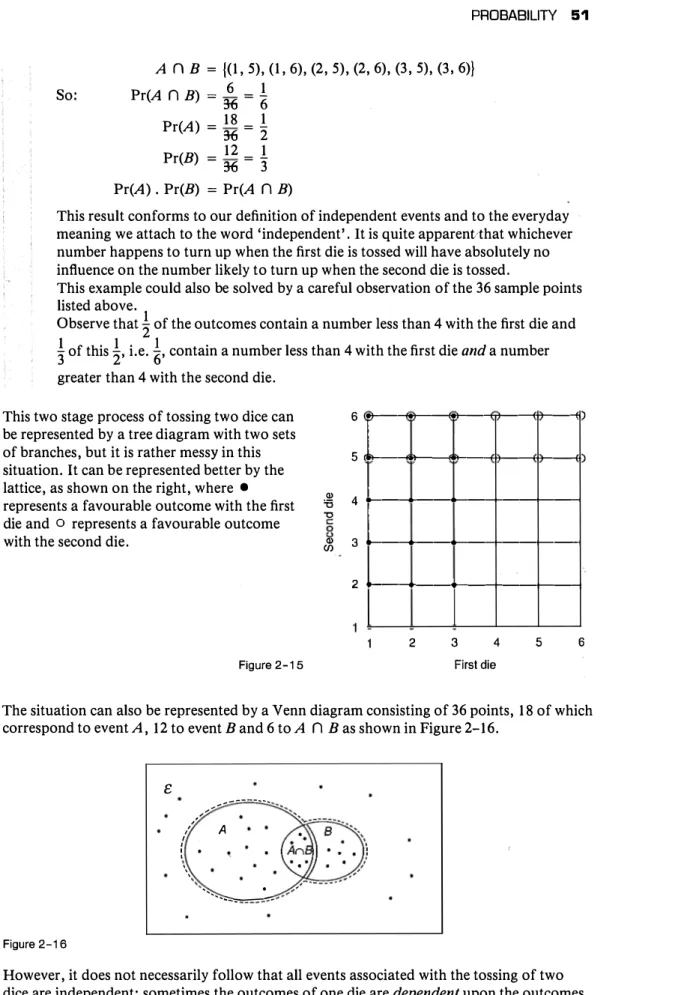
This two stage process of tossing two dice can be represented by a tree diagram with two sets of branches, but it is rather messy in this situation. It can be represented better by the lattice, as shown on the right, where • represents a favourable outcome with the first die and o represents a favourable outcome with the second die.
Figure 2-15
6 c.i---t---£el---t-rt---;Tl---t.J 5 , ____ ,__ ____ ---t-tt--ttt----ttl
i
4---+---t---�"O
� 3---+---t--�
2 ---+---t---i
2 3 4 5 6
First die
The situation can also be represented by a Venn diagram consisting of 36 points, 18 of which correspond to event A, 12 to event Band 6 to A
n
Bas shown in Figure 2-16.c
Figure 2-16
--,.,,,,.,,.
I A I I I • I
' ' '
---... =----
---c-::However, it does not necessarily follow that all events associated with the tossing of two dice are independent; sometimes the outcomes of one die are dependent upon the outcomes of the other.
Example 12
Two dice are tossed. A is the event 'a 5 with the first die' and B is the event 'sum of the numbers on the two dice exceeds 10'.
A
=
{(5, 1), (5, 2), (5, 3 ), (5, 4), (5, 5), (5, 6)} and so: n(A)=
66 1
Therefore: Pr(A) = 36 = 6
B
=
{(5, 6), (6, 5), (6, 6)} and so: n(B) = 33 1
Therefore: Pr(B) = 36 = 12
A
n
B=
{(5, 6)} and so: n(An
B)=
1 Therefore:Pr(A
n
B) = }6 *- Pr(A). Pr(B) Events A and B are dependent.Check Pr(A n B) from Pr(A U B)
=
Pr(A) + Pr(B) - Pr(A n B)Example 13
A coin is tossed three times. A is the event 'at least two tails'; B is the event 'three heads or three tails'; and C is the event 'at least one tail'. Which of the following are independent? a AandB
b Aand C
The experiment of tossing a coin three times can be represented by a tree diagram with three sets of branches or with a 3-dimensional lattice.
First toss Second toss
<
H �H
1 T
2
�T
<
H
1 T
2
Figure 2-17
So:
Third toss 1
� H
.! 2 T
1
� H
½ T
.! H
�T 2
�H
.! T
Possible
outcomes Probability
HHH
½x½x½=¾
HHT
½x½x½=¾
HTH ½x½x½=½
HTT
½x½x½=½
THH
½x½x½=¾
THT
½x½x½=¾
TTH ½x½x½=½
TTT ½x½x½=½
t
=
{(H H H), (H HT), (HT H), (HT T), (TH H), (TH T), (T TH), (T TT)} n(t) = 8 and each of the eight outcomes is equally likely.a
So:
A
=
{(HT T), (TH T), (T TH), (T TT)} Pr(A)= � =
l8 2
B
=
{(H H H), (T TT)} Pr(B)= � =
8 4 .!An B
=
{(TTT)}Pr(A n B)
=
½
=
Pr(A) . Pr(B)A and B are independent.
b C
=
{(H HT), (HT H), (HT T), (T H H), (TH T), (T T H), (T TT)} 7Pr(C)
= S
A
n
C=
{(HT T), (T H T), (T TH), (T TT)}Pr(A n C)
=
½*
Pr(A). Pr(C) So: A and Care not independent.Example 14
Arthur and Barbara are a married couple, aged 30. According to the life tables on page 37 probabilities of their being alive in 40 years time are approximately 0.7 and 0.8 respectively. Calculate the probability that 40 years from now:
a both will be alive
b neither of them will be alive c only one will be alive d at least one will be alive.
The following probability tree diagram represents the situation very neatly. For A there are two possible outcomes which we can call a- success, S ( i.e. being alive in 40 years time), or a failure, F. Similarly for B.
A B Outcome Probability
�
s�
s
ss
0.56F SF 0.14
�
s
FS 0.24F
0.2 F FF 0.06
Total 1.00
Figure 2-18
a Pr(A will be alive) = 0.7 Pr(B will be alive) = 0.8 The events are independent and so:
Pr(both will be alive)
=
0.7 x 0.8=
0.56 b Pr(A will not be alive)=
0.3Pr(B will not be alive)
=
0.2 The events are independent and so:Pr(neither will be alive) = 0.2 X 0.3
= 0.06
c The statement 'only one will be alive' implies that A and not B or Band not A will be alive.
Pr(A and not B will be alive) = 0.7 x 0.2
= 0.14 Pr(B and not A will be alive)
=
0.8 x 0.3=
0.24 These events are mutually exclusive and so:Pr(only one will be alive)
=
0.14 + 0.24=
0.38d The statement 'at least one of them will be alive' means that 1 or 2 will be alive. However, it is certain that 0, 1 or 2 will be alive and the sum of these three probabilities is therefore 1. So:
Pr(at least one will be alive)
=
1 - Pr(neither will be alive)=
1 - 0.3 X 0.2=
1 - 0.06= 0.94
We can consider a sample space of 100 points, 56 of which refer to both people being alive in 40 years time, 14 of which refer to A and not B being alive, etc. as shown in the Venn diagram (Figure 2-19).
A
6
Figure 2-19
14
B
Example 15
On school sports day, Joanna runs in the 100-metre, 200-metre and 400-metre races and estimates that her chances of winning are½,½ and¼ respectively.
Calculate the probability that:
a she does not win any of the three races b she wins at least two of the races. (Compare this with Example 10.)
100 metres 200 metres
<
Figure 2-20
400 metres 1
w
-=---=!==
¾w
LL
-=---=!==
W ¾ L1
---·-=
w
¾ L
Outcomes WWW WWL WLW WLL LWW LWL LLW LLL Probability I 1 1 1 2X3X4= 24
1 1 3 3 2 X3X4= 24
½xix¾= ff4
1 2 3 6
2X3X4=24
½x½x¾=
h
½x½x¾=
i
I 2 1 2
2X3X4=24
1 2 3 6
2X3X4=24
Total
There are eight possible outcomes (2 x 2 x 2) where WWW denotes a win in each of the three races, WWL denotes a win in the 100 m and 200 m and a loss in the
400 m, and so on. The eight outcomes are not equally weighted. Assuming the events are independent, then:
a b
1 2 3 6 Pr(LLL) = 2 X 3 x 4 = 24
Required Pr = Pr(WWW) + Pr(WWL) + Pr(WLW) + Pr(LWW) 1 1 1 1 1 3 1 2 1 1 1 1 =
2X3X4 + 2X3X 4 + 2 x 3 x4 + 2X3X4
1 3 2 1
= 24 + 24 + 24 + 24 = 24
Addition is used because of mutual exclusion.
The definition of two independent events can be extended to cover three or more independent events. Three events A, Band Care independent if they are pairwise independent as before and also:
Pr(A nB n C) = Pr(A). Pr(B). Pr(C)
Example 16
A die and a coin are tossed in that order, and then a letter is taken from the set la, b, c}. Find the probability of these events:
a A: a 3 with the die
b B: a head with the coin c C: b from the set (a, b, c}
dAnBnc
@
A sample space consists of 6 x 2 x 3, or 36, equally weighted points (multiplication principle). List the 36 ordered triples.Of these 36 points, 6 correspond to event A, 18 to event Band 12 to event C.
So:
a b
C
d
6 1
Pr(A) = 36 = 6 18 1 Pr(B) = 36 =
2
Pr(C) = g = !36 3
A n B n C = 1(3, H, b)} Pr(A n B n C)
=
}6=
Pr(A) . Pr(B). Pr(C)A, Band C are independent events.
Check that: Pr(A
n
B) = Pr(A) . Pr(B) Pr(An
C)=
Pr(A) . Pr(C) Pr(Bn
C) = Pr(B). Pr(C)Exercises 2d
(Draw a tree diagram or a Venn diagram where appropriate).
1 From a set of 20 cards numbered 1, 2, 3, . .. 20, one card is selected at random. What is the probability of:
a A: an odd number being selected?
b B: a number greater than 12? c
An
B?d AU B?
Are A and B (i) independent? .
(ii)mutually exclusive?
2 A card is drawn at random from a pack of 52 playing cards. What is the probability of:
a a heart?
b the queen of hearts?
Are these two events independent?
3 A die and a coin are tossed. Find the probability of:
a an even number with the die
b a tail with the coin
4 A die is tossed. What is the probability of: a A: a number less than 5?
b B: a number greater than 2? c An B?
d AU B?
Are A and B independent? Are they mutually exclusive?
5 a A red die and a blue die are tossed. List the sample points in these events: (i) A: a
6
with the red die(ii) B: a
6
with the blue die (iii) A n Bb Find the following:
(i) Pr(A) (ii) Pr(B) (iii) Pr(A n B) (iv) Pr(A U B)
6 A coin and a die are thrown together. What is the probability of a head and a number greater than 4, or a tail and a number not exceeding 3?
7 A die is thrown and a number from the set { l', 2, 3, 4, 5} is selected. a Show all the ordered pairs in the sample ·space· t.
b Find the probabilities of:
(i) A, the event in which an even number is selected from the given set (ii) B, the event in which the die shows an odd score
(iii) C, the event in which the total score exceeds 9 • (iv) D, the event in which the total score is 10 • c (i) Are A and B independent event�?
(ii) Are C and D independent events? (iii) Are A and C independent events?
8 From a group of 30 girls and 20 boys, of whom·12 girls and 8 boys study French, a student is selected at random. What is the probability that the student:
a is a girl? b studies French?
c is a girl who studies French?
Are events a and b above independent? Are they mutually exclusive?
9 a A coin is tossed three times. List a sample space consisting of eight points. Find the probability of these events:
(i) A: at least two heads
(ii) B: head, tail, head in that order (iii) C: not more than one head
b Which of the following are independent events? (i) A and B (ii) A and C (iii) B and C
10 A die is tossed and a
6
turns up. A gambler is not prepared to bet on a6
turning up the next time the die is tossed, arguing that th� probability of two sixes is onlyl
6
, and so it is more likely that a number other than6
will turn up in the second toss. Do you agree?11 In a large school, 25% of the students ride bicycles to school, and 40% of the students have fair hair. One student is selected at random.
a What is the probability that the student: (i) has fair hair and rides a bicycle to school?
(ii) does not have fair hair and does not ride a bicycle to school? (iii) has fair hair but does not ride a bicycle to school?
12 A die is loaded so that the probability of a 3 is 0.4, the probability of a 4 is 0.2 and each of the other numbers is equally likely. If the die is tossed twice, find the probability of:
a two threes
b no sixes
-, c at least one four ()
d the sum of the numbers exceeding 8.
13 One card is drawn at random from a pack of 52 playing cards. It is replaced, and the
pack is shuffled. A second card is then drawn. What is the probability that: a both cards are diamonds?
b neither card is a diamond?
c only one of the cards is a diamond?
d the first card only is a diamond?
e the second card is a diamond?
f at least one of the cards is a diamond?
14 Two friends, Huong and Colin, frequently play golf and tennis with each other. In the long run, it has been found that Huong wins three rounds of golf out of every five, and
1 I one game of tennis out of every four. If they play one round of golf and one game of
tennis, find the probability that Huong:
a wins both
b loses both
c wins the round of golf only
d wins either the golf or the tennis, but not both.
15 Consider two spin dials. On one of them the letters A, B, C, D and E are printed and, on the other, the digits 11, 2, 3, 4 and 5. When the dials are spun, it is equally likely
that they will stop on any letter or number. What are the probabilities of the following events?
a B and an even number
'1
C or D and an odd numberc E and an even number, or C and a number greater than 3
d
a
consonant and an odd number, or a consonant and a number greater than 2.16 Enza and Brian play three tennis matches and Enza's chance of winning any one match isl What is the probability that Enza:
a wins all 3 matches?
b loses all 3 matches?
c wins the first and the third match but loses the second?
d loses the first match and wins the other two?
17 A die is tossed three times. What is the probability of: a 3 sixes?
b O sixes?
c 3 odd numbers?
d 3 even numbers?
e a six in the first two tosses only?
f a six, not a six, then a six, in that order?
18 An urn contains 5 white, 3 black and 2 blue balls. A ball is withdrawn, replaced, and a second is drawn. What is the probability of:
a 2 white balls? (
b a black ball in the first drawing but not in the second? c white then black, in that order?
i ' '
�
19 Cube A has 4 red face� and 2 white faces; cube B has 3 red and 3 white faces; cube Chas 2 red and 4 white faces. The three cubes are tossed. What is the probability of:
a 3 red faces uppermost? /
b 3 white faces uppermost?
c red with A and B and white with C? d red with A and white with B and C? '1e at least 'one red face?
20 A student estimates that his chances of passing Mathematics and Physics are respectively 0.9 and 0.8. Estimate the probability that the student passes:
a both subjects· ,: . ·1 ·, .
b Mathematics only
c at least one subject
d not more than one subject.
The probability of a cure with drug A is
o:s-
and with drug Bis 0.6. One randomly . selected patient is treated with drug A and another with drug B. What is the probability that:a neither patient is cured?
b both are cured?
22 One urn contains 2 �ed cub�s and 4 blue cubes and a second urn contains 4 red·cubes and 3 blue cubes. One cube is selected at random from each of the two urns. What is the probability that one of the cubes is red?
23 The probability that a man will be alive in 20 years is 0.5, and the probability that his wife will be alive is 0.6. What is the probability that, in 20 years time:
a both will be alive?
b only one of them will be alive?
c at least one will be alive?
24 Of the articles manufactured in a certain factory, machines A and,B manufacture 60 per cent and 40 per cent respectively. Of their.respective output, 4 i?r·cent and 2 per cent are defective. An article is selected at random. What is the probability that it was manufactured by:
a A and is defective?
b B and is not defective?
25 Consider three urns A, Band C. A contains 3 blah cubes and 2 white cubes, B contains 3 black cubes and 1 white cube, and C contains 3 black cubes and 3 white cubes.
a An urn is chosen at random, and from it a cube is chosen at random. Illustrate this two-stage process by a probability tree diagram.:·
b What is the probability that the cube is black?
26 A student finds that, on the average, he 'misses' the school bus once every eight weeks (five days in a school week). Find the probability of:
a not missing the bus on any one morning
b catching the bus on two successive mornings
c catching the bus each morning for a week (five days) 1, ,··
d missing the bus on at least one morning of a given week. 1 _
27 To open a locked safe requires a correct three-digit combination. Calculate the probability of:
a succeeding at the first attempt
28 An urn contains 5 white, 3 black and 2 blue balls. A ball is withdrawn, replaced, and a second ball is drawn. This is repeated three times. What is the probability of the following events?
a three white balls
b a black ball in the first two drawings, but not in the third
c white, black, blue, in that order
d white, black, white, in that order
e not more than two white balls
f') a white or a black ball in each drawing.
29 Sixty per cent of the students in a particular VCE class are girls. Seventy per cent of _ the girls and fifty per cent of the boys study English Literature. A student is selected
at random. What is the probability that the student selected:
a is a boy who studies English Literature?
b is a girl who does not study English Literature?
c studies English Literature? ·;
(
30 A Gallup Poll establishes that, on the average, two out of every three people interviewed are in favour of a certain proposal. What is the probability that, out of a group of three people interviewed:
a all will be in favour?
b none will be in favour?
c only one will be in favour?
31 The first race at Flemington has 10 runners and the second race has 12 runners. Assuming that all horses have an equal chance of winning, calculate the probability of:
a a double (i.e. a winner in each race) �-'
b a quinella (i.e. first and second in either order) in the first race
c a quinella in the second race d a quinella in both races.
32 To gain a driving licence in NSW both a written test and a practical driving test must be passed. Statistics show that 700/o of candidates pass the written test on the first attempt and 900/o of those who need a second test pass that test. Also 600/o of candidates pass their first practical test and 800/o pass their second test. The written and practical tests are independent. Calculate the probability of.:
a passing the written test on the second attempt
b passing the written test after no more than two attempts c requiring a third written test 7
d passing the practical test on the second attempt
e receiving a licence after requiring orie practical test and two written tests
33 A bag contains 3 white cubes and 3 black cubes. Another bag contains 4 white and 6 black cubes.
a A bag is selected at random and from it a cube is selected. What is the probability that the cube is white?
b A cube is selected from each of the two bags. What is the probability that at least one of the cubes is white?
.,
34 Eli and Magda toss a coin alternately. The first person to toss a head wins. If Magda tosses first, what is the probability that she wins?
2. 7 Conditional probability: a reduced samP.le space
Often, when dealing with probabilities, we are concerned with some but not all of the outcomes of an experiment. For example, Theo tosses a die and asks his friend Minh to guess the number. Minh's chance, of course, of guessing the correct number is¼· However, Theo gives Minh a clue by telling him that an even number has turned up. Minh concludes that 2, 4 or 6 has turned up and so now his chance of guessing the number is½,
Such a problem could be worded as follows: 'What is the probability that,if
the throw of a die produces an even number, that number is divisible by three?' (Answer½) as distinct from 'What is the probability that the number is even and divisible by three?' (Answer¾), There is no condition attached to this latter question.We have seen from the life tables considered earlier in the chapter that, out of 100 000 males born, 66 465 are expected to reach the age of 70 and so the probability of this is:
66 465
100 000 = 0.66465.
However, as the male grows older, this probability increases. At the age of 30 years, 96 724 of the original 100 000 are expected to be alive and so the probability of a male aged 30 reaching the age of 70 is����� = 0.68716. The sample space has been reduced from the original I 00 000 to 96 724. The probability of reaching the age of 70 then is conditional upon the male's present age. The problem could be worded as follows: 'What is the probability that a male will reach the age of 70, given that the male is aged 30?
Example 17
If two dice are tossed, what is the.probability of a number greater than 4 with the second die, given a number less than 4 with the first die? (Compare this with Example 11.)
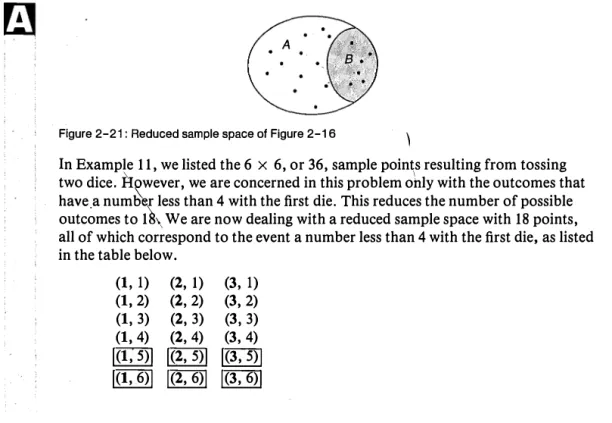
Figure 2-21: Reduced sample space of Figure 2-16
In Example 11, we listed the 6 x 6, or 36, sample point1s resulting from tossing two dice. However, we are concerned in this problem ohly with the outcomes that have.a number less than 4 with the first die. This reduces the number of possible outcomes to 18'\ We are now dealing with a reduced sample space with 18 points, all of which correspond to the event a number less than 4 with the first die, as listed in the table below.
(1, 1)
(1, 2)
(1, 3)
(1, 4) 1(1, 5)1 1(1, 6)1
(2, 1)
(2, 2)
(2, 3) (2, 4) 1(2, 5)1 1(2, 6)1
(3, 1) (3, 2)
\
Figure 2-22
6
5
i
4"O C:
� 3
2
f'
2 3
First die
Compare the lattice above with the lattice in Example 11.
Calling the occurrence of a number less than 4 with the first die event A and the
number greater than 4 with the second die event B, the notation for 'the probability
of B, given that A has occurred' is Pr(B
I
A).Comparing Figure 2-21 with Figure 2-16 we see that, if event A is given, we must
ignore all other outcomes which are not associated with event A and consider A
as our new, reduced sample space, r,, and assign to each of the 18 points in it a probability of /8. Since there are six points in this sample space corresponding to · 6 1 event B, it follows that Pr (BI A) = 18 = 3.
From Example 11, Pr(A
n
B) =¾,
Pr(A) =½,Pr (B) =½·
From this we observe that:· Pr(A
n
B) = Pr (A). Pr(BI
A) ... (1). i.e. p r (B
I
A) = Pr(A Pr(A)n
B)The conditional probability of B, given A, is given by:
I Pr(B
I
A) = Pr�(�) B) if Pr (A)*
0. . ... (2)We also observe that Pr(B
I
A) =½
= Pr (B) in this example. .. ... (3) From Example 11, we saw that events A and B were independent because they conformedwith our definition of independent events.
Pr(A
n
B) = Pr(A) . Pr(B). So from (2):Pr(B
I
A) = Pr(1rc!(B) = Pr(B)i.e. Pr(B
I
A) = Pr(B)also serves as a definition of independent events. It appeals to our intuitive notion of independence and tells us, in this example, that the probability of a number greater than 4 with the second die has not been altered by the fact that a number less than 4 turned up with the first die. However, formula (2) for conditional probability applies for dependent
I
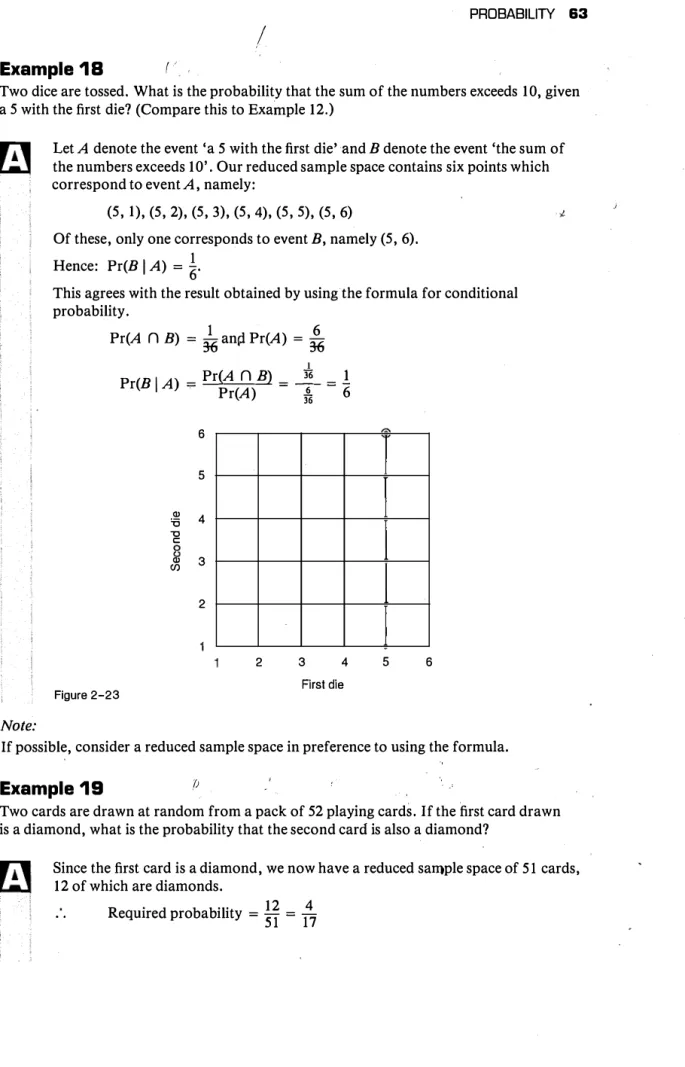
Example 18
/
-Two dice are tossed. What is the probability that the sum of the numbers exceeds 10, given a 5 with the first die? (Compare this to Example 12.)
Note:
Let A denote the event 'a 5 with the first die' and B denote the event 'the sum of the numbers exceeds 10'. Our reduced sample space contains six points which correspond to event A, namely:
(5, 1), (5, 2), (5, 3), (5, 4), (5, 5), (5, 6)
Of these, only one corresponds to event B, namely (5, 6). Hence: Pr(B
I
A)=
¼·
This agrees with the result obtained by usingthe formula for conditional probability.
1 6
Pr(A
n
B) = 36 anp Pr(A) = 36Figure 2-23
Pr(B
I
A)=
Pr(A Pr(A)n
B)= � =
!36 6
6
5
i
4"O C:
� 3
2
2 3 4
First die
5 6
If possible, consider a reduced sample space in preference to using the formula.
Example 19
/}Two cards are drawn at random from a pack of 52 playing cards. If the first card drawn is a diamond, what is the probability that the second card is also a diamond?
Since the first card is a diamond, we now have a reduced sample space of 51 cards, 12 of which are diamonds.
Example20
,-,,- I From a set of five cards numbered 1, 2, 3, 4 and 5, two cards are selected at random
:,without)
replacement.
What is the probability that both are odd numbered cards?Let A be the event 'odd number first draw' and B be the event 'odd number second
draw'. We are asked to find Pr(A
n
B).The probability that first card drawn is odd
=
¾i.e. Pr(A)
=
¾The probability that the second card drawn is odd could be either¾ or¾ depending on whether the first card is odd or even.
If the first card is odd, the probability that the second card is odd
=
¾ 2i.e. Pr(B
I
A)=
4Pr(A
n
B)=
Pr(A). Pr(BI
A)3 2
= 5·4
=
20A sample space of the experiment may be considered as consisting of 20 sample points, each equally likely.
(1, 2) (2, 1) (3, 1) (4, 1) (5, 1) (1, 3) (2, 3) (3, 2) (4, 2) (5, 2) (1, 4) (2, 4) (3, 4) (4, 3) (5, 3) (1, 5) (2, 5) (3, 5) (4, 5) (5, 4)
Note that the ordered pairs (1, 1), (2, 2), (3, 3), (4, 4), (5, 5) are missing. Why? Of these 20 equally likely outcomes, six are favourable, namely:
So:
(1, 3), (1, 5), (3, 1), (3, 5), (5, 1), (5, 3). 6
Pr(A
n
B)=
20We can represent the situation by a tree diagram (Figure 2-24) or a lattice diagram (Figure 2-25).
First draw Second draw
2 0
<=
<=
oE
4
3 0
<=
E
E
4
Figure 2-24
Possible outcomes
00
OE
EO
EE
Probability
3 2 6
s X4=20
¾ x¾=fo
"O "O C:
Q)
U)
5
4
3
2
�
2 4 5
o
Indicates missing pointse
Indicates favourable outcomesFigure 2-25
3 First draw
Example 21
Arthur and Barbara are a married couple, aged 30. Their respective probabilities of being alive in 40 years time are approximately 0. 7 and O__&. What is the probability that Barbara is alive in 40 years time, given that one of them is alive then? (See Example 14.)
So:
P r 1s a 1ve one 1s a 1ve -(B. 1.
I
.
1. ) _ Pr(one is alive and it is P ( r one 1s a 1ve . 1. ) B)Pr(one is alive and it is B) = Pr(B and not A)
= Pr(B). Pr(not A)
= 0.8 X 0.3
=
0.24Pr(one is alive) = Pr(A and not B) + Pr(B and not A)
= Pr(A). Pr(not B) + Pr(B). Pr(not A)
= 0.7 X 0.2 + 0.8 X 0.3
=
0.38 P r 1s a 1ve one 1s a 1ve = 0_38 = 19(B. I'I .
1· ) 0.24 12Consider the following tree diagram, in which S denotes a success, i.e. being alive in 40 years time, and F denotes a failure.
A B Outcomes Probability
�
s
ss
0.56s
F SF 0.14·
0.2
�
s
FS'f24�