R E S E A R C H
Open Access
Linear precoding in distributed MIMO systems
with partial CSIT
Chongbin Xu
1*, Jianwen Zhang
1, Fuchun Zheng
2and Li Ping
1Abstract
We study the transmission problem in a distributed multiple-input multiple-output (MIMO) system consisting of several distributed transmitters and a common receiver. Assuming partial channel state information at the transmitter (CSIT), we propose a low-cost weighted channel matching and scattering (WCMS) linear precoding strategy. The proposed precoder can be decomposed into two parallel modules: channel matching (CM) and energy scattering. The signals generated by the CM modules from different transmitters provide acoherentgain with improved power efficiency. The use of the scattering modules provides robustness against CSIT uncertainty. By properly combining these two modules, WCMS can achieve coherent gain proportional to the accuracy of the available CSIT as well as robustness against CSIT error. WCMS is simple and fully decentralized and thus is highly suitable for a distributed MIMO system. Numerical results demonstrate that WCMS indeed achieves significant gains in distributed MIMO environments with partial CSIT.
Keywords:Distributed multiple-input multiple-output (MIMO) systems, Channel state information at the transmitter (CSIT), Linear precoding, Iterative detection
1. Introduction
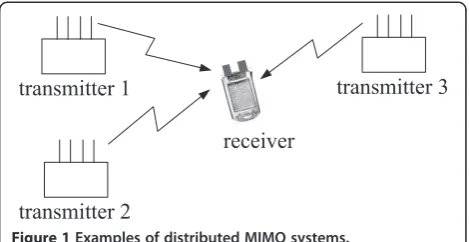
Consider a distributed multiple-input multiple-output (MIMO) system involving several distributed transmitters and a common receiver [1-8]. All the transmitters share the same information to be transmitted. Every transmitter is equipped with multiple antennas, so is the receiver. Thus, the channel between a transmitter and the receiver forms a local MIMO link. The overall system consists of several such local links. Examples of this system can be found in the scenarios such as distributed MIMO systems [1-4] or parallel relays serving the same destination after recovering the data from the source in relaying systems [5-8].
If full channel state information at the transmitter (CSIT) for all the local links is available at every transmit-ter, the overall system can be regarded as an equivalent MIMO system and optimized using a centralized strategy [9,10]. However, this full CSIT assumption can be very costly due to its heavy requirement on feedback links. The problem becomes very stringent when the total number of
antennas involved is large (e.g., in a so-called large-scale MIMO setting [11,12]).
Partial CSIT is a more realistic assumption. In particular, each transmitter can acquire the CSIT of its local reverse link (from the receiver) using channel estimation. With time division duplex (TDD) and based on channel reci-procity, such CSIT can also be used for the local forward link [13]. This can greatly reduce the burden on the feed-back requirement, but then a decentralized transmission method is necessary. The problem becomes more compli-cated when the CSIT on each local link is not reliable, which can be caused by, e.g., channel variation due to high mobility [14]. Improving channel estimation accuracy alone cannot solve the problem completely.
The standard singular value decomposition (SVD)-based techniques [15] do not perform well when CSIT is not reliable. Conventional space–time coding techniques [16,17], on the other hand, are not efficient in making use of the available CSIT. It is a challenging task to de-velop transmission techniques that are efficient in exploiting the advantage of partial CSIT and, in the meanwhile, robust against the CSIT error.
Linear precoding techniques have widely been studied for MIMO systems, mostly in centralized scenarios * Correspondence:[email protected]
1
Department of Electronic Engineering, City University of Hong Kong, 83 Tat Chee Avenue, Kowloon, Hong Kong, SAR, China
Full list of author information is available at the end of the article
[14,18-24]. Optimization techniques have been applied to provide robust performance in case of imperfect CSIT [14,23,24]. These precoding techniques usually involve complicated matrix operations, such as matrix inversion, QR decomposition, or SVD. The related complexity is quite high, which can be a major obstacle in practice, es-pecially for a large-scale MIMO setting.
In this article, we study a weighted channel matching and scattering (WCMS) strategy for distributed MIMO systems with partial CSIT. It involves a linear precoder at each transmitter that can be decomposed into two parallel mod-ules, one for channel matching (CM) and the other for en-ergy scattering. The signals generated by the CM modules from different transmitters add coherently at the receiver, resulting in a coherent gain with improved power efficiency. On the other hand, the use of the scattering modules pro-vides robustness against CSIT uncertainty. By properly combining these two modules, we can achieve the coherent gain proportional to the accuracy of the available CSIT as well as robustness against CSIT error. The WCMS scheme is fully decentralized since each transmitter only needs to know the CSIT about its own link. The scheme is also very simple and there is no need for SVD or matrix inversion, and thus it is highly suitable for large-scale MIMO systems. Our discussions will be based on both mutual informa-tion analysis and numerical simulainforma-tion. For the former, the channel capacity of the distributed MIMO system under consideration is still unknown. We will show that the WCMS scheme can perform close to a referenced central-ized scheme. We conjecture that this centralcentral-ized scheme can perform close to or even beyond the capacity of the decentralized system, which implies that the WCMS per-formance is not far from the optimum. For numerical simulation, we focus on an iterative linear minimum mean squared error (LMMSE) detection technique. An extra precoding stage is introduced to reduce the potential per-formance loss in practically coded systems due to the fluc-tuation in symbol reliabilities. Simulation results show that the proposed scheme indeed achieves significant gain in distributed MIMO environments with partial CSIT.
The remainder of the article is organized as follows. Section 2 introduces the system model and Section 3 pro-vides some mutual information analysis results of central-ized MIMO systems with imperfect CSIT. In Section 4, a distributed WCMS scheme is presented and its outage performance is analyzed. The implementation of the WCMS method in a low-density parity-check (LDPC)-coded system with iterative detection is discussed in Section 5. Section 6 concludes the whole article.
2. System model
Consider K transmitters {T1,. . ., Tk,. . . TK} serving a
common receiver cooperatively to deliver a common in-formation sequence d, as illustrated in Figure 1. The
receiver has Nr antennas and each transmitter has Nt
antennas. The received signal is given by
r¼XK
k¼1
Hkykþη: ð1aÞ
whereris aNr×1 received signal vector,Hkis theNr×Nt
channel transfer matrix between the receiver and the transmitter Tk, η a vector of complex additive white
Gaussian noise samples with mean 0 and variance σ2I, andykaNt×1 signal vector transmitted byTkwith a zero
mean and a power constraintPk, i.e.,
E y½ ¼k 0and trf gQk ≤Pk ð1bÞ
whereE[∙] is the expectation operation andQk=E[ykykH]
is the transmission covariance matrix ofTk. Note that all
{yk} in (1) carry the same information sequence d as
mentioned previously. This is different from the trans-ceiver design in the conventional multiple access channel where different transmitters have different information sequences to transmit [25,26].
We assume that partial channel state information (CSI) is available at the transmitters, and full CSI is available at the receiver. Following [14,27], we model the link betweenTkand the receiver as
Hk¼ ffiffiffiffiffiak
p ― Hkþ
ffiffiffiffiffiffiffiffiffiffiffiffiffi
1ak
p e
Hk;k¼1;2;. . .;K ð2Þ
where Hk is the actual channel transfer matrix and is
perfectly known at the receiver,H―k andHekrepresent, re-spectively, the known and unknown parts of the channel matrix at Tk, and αk ∈ [0,1] is a measure on the CSIT
quality. In practice,H―k in (2) can be obtained by using channel estimation and Hek is related to channel vari-ation during the channel estimvari-ation period [14]. In TDD systems,H―k can be estimated from the signal received in the last frame andakin this case is the correlation
coef-ficient of channel matrices in two adjacent frames [27]. Throughout the article, we assume that the entries of
―
Hk and Hek
n o
distributed (i.i.d.) circularly symmetric complex Gaussian random variables with zero mean and unit variance.
The following is a basic assumption in this article (referred to as thedistributive assumption).
Assumption 1:EachTkknows
―
Hk and {αk'} for allk0, but
it does not know Hek. Furthermore, eachTk knows
nei-therH―k0 norHe
k0 for allk
0≠ k.
3. Centralized transmissions
The capacity of the distributed system in (1) is generally unknown. To circumvent the difficulty, we first remove the distributive assumption temporarily and consider several centralized transmission strategies in this section. We then use the obtained results as an approximate upper bound to evaluate the performance of the distrib-uted transmission strategy developed in the next section. With centralized control, the overall system can be regarded as an equivalent MIMO system. For simplicity, we assume here a common CSIT quality index α for all {Tk}, i.e.,α1=···=αK=α. Substituting (2) into (1a), we have
r¼ pffiffiffiαH― þpffiffiffiffiffiffiffiffiffiffiffi1αHe
yþη; ð3aÞ
―
H¼ H―1;. . .;H―K
; ð3bÞ
e
H¼ He1;. . .;HeK
h i
ð3cÞ
y¼ y1H;. . .;yKH
H
: ð3dÞ
We assume thatH― is known by all transmitters, which implies a centralized transmission control. We also as-sume a total power constraint foryas
trf gQ ≤P ð4Þ
where Q = E[yyH] and P is the total power constraint. Take decomposition Q = FFH. Then Q can be realized by a linear precoding scheme as
y¼Fx: ð5Þ
Here we assume that x is a coded sequence with i.i.d. symbols withE[x] =0andE[xxH] =I.
3.1.Optimal centralized transmission with perfect CSIT
Let us first consider the extreme case ofα= 1. (We will consider 0≤α< 1 in Section 3.3.) In this case, the CSIT is perfect and we haveH¼H―. DefineM¼H―HH― Let the
eigenvalue decomposition ofMbeM¼V―ΛV―H withV― a unitary matrix consisting of eigenvectors of M and Λ a diagonal matrix consisting of eigenvalues ofM. Then the optimal precoder is given by the so-called water-filling
(WF) solution
y¼V Wx― : ð6aÞ
Win (6a) is a diagonal matrix obtained by WF [28] over the diagonal entries ofΛ
w2ð Þ ¼i;i μσ2=λð Þi;i þ;i¼1;. . .;KNt ð6bÞ
wherew(i,i) andλ(i,i) are, respectively, theith diagonal elements of matricesW and Λ, [a]+ ≡max{0,a}, and μ is a constant to meet the total power constraintP:
XKNt
i¼1
w2ð Þ ¼i;i P: ð6cÞ
We haveQ¼V W― 2V―H for the above WF precoder.
3.2. Suboptimal CM precoder
We now consider the following suboptimal CM precoder
y¼cH―Hx ð7Þ
whereH―His the conjugate transpose of the channel matrix
―
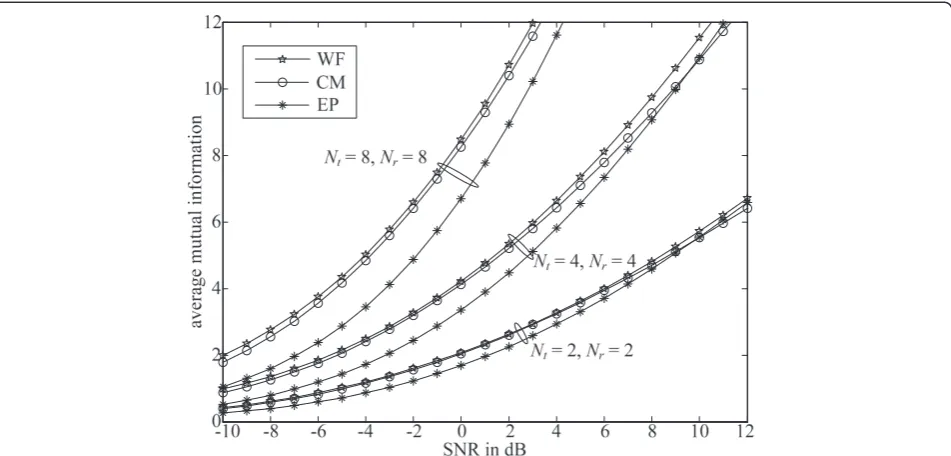
Handcis a constant for power adjustment. Clearly, this is a very simple solution. Figure 2 compares its average mu-tual information performance (based on Gaussian signal-ing) with WF for Rayleigh-fading MIMO channels. The channels are assumed to be unchanged during a frame but change independently from frame to frame. The per-formance in Figure 2 is averaged over different frames. It is seen that the CM precoder can achieve performance close to the capacity in the median rate region. This obser-vation can be explained as follows. LetV―D―U―Hbe the SVD
of H―H and rewrite (7) as
y¼cV―D―U―Hx: ð8Þ
Equation (8) can also be obtained by replacingWin the optimal WF precoder (6a) bycD―U―H. AsU―H is unitary, it does not affect mutual information. Therefore, the per-formance difference between (6a) and (8) is caused byW and cD―. It can be shown that the amplitudes of the diag-onal entries ofWandD― have the same order (i.e., ifD i―ð Þ;i
is the ith largest entry inD―, so isW(i,i) inW). This im-plies thatcD― has an approximate WF effect similar toW and explains the close performance of (6a) and (8).
region (e.g.,R≈min{Nt,Nr}) is of most interest, which
in-dicates the attractiveness of the CM option.
3.3. Centralized control with partial CSIT
As illustrated in Figure 2, the CM precoder performs well when CSIT is reliable. On the other hand, when there is no CSIT (i.e.,α= 0), according to the conjecture in [29], the precoding operation given below is optimal (for a sufficiently small outage probability):
y¼ ffiffiffiffiffiffiffiffiffi
P KNt
r
x: ð9Þ
The signal power in the above scheme is scattered evenly over all directions and so we will refer to it as scattering precoding.
In the general case of 0 < α < 1, the optimal precoder structure that achieves ergodic capacity of the system in (3) (under the assumption that the entries of Hek
n o
are i.i.d.
circularly symmetric complex Gaussian random variables) is given byy¼V―Ωx, whereV― is obtained from SVD ofH― (i.e., H― ¼U―D―V―H) and Ω is a real diagonal matrix [27]. According to the best of the authors’knowledge, the opti-mal precoder structure that achieves outage capacity is still an open problem even for a centralized transmission. The following conjecture is given to circumvent the difficulty.
Conjecture 1: The optimal precoder F in (5) that achieves the outage capacity of the system in (3) is given
byy¼V―Ωx, whereV― is obtained from SVDH― ¼U―D―V―H andΩis a real diagonal matrix.
Under the above conjecture, to find the outage cap-acity, we only need to find the real diagonal matrix Ω, which is a simpler task than finding a full matrix F. It can be done by exhaustive search when the size of His relatively small. However, the search becomes compli-cated as the size ofHincreases.
Alternatively, consider a suboptimal but simple WCMS precoder defined below
y¼c pffiffiffiβH―Hx0þ
ffiffiffiffiffiffiffiffiffiffiffiffiffiffiffiffiffiffi
1β
ð ÞP KNt
s
xd
!
ð10Þ
whereβ∈[0, 1] is a variable to be optimized according to the CSIT qualityαand the power constraintP, andcis a constant for power adjustment. In (10),x0andxdare two
statistically independent coded sequences obtained by en-coding the same information sequence d with different coding schemes, and both of them consist of i.i.d. symbols with zero mean and unit variance. Here, the use ofx0
pro-vides a beamforming effect as it steers more energy at good eigenmodes. On the other hand, the use ofxd
pro-vides a scattering effect since it scatters the energy evenly in all eigenmodes. Clearly, the scheme in (10) provides a weighted combination of these two effects.
Since x0 and xd in (10) are uncorrelated, Q in (4) is
given by
Q¼EyyH¼βQCMþð1βÞQES ð11Þ
where QCM and QES, respectively, are the transmission covariance matrices for the CM and energy scattering schemes in (7) and (9). Clearly, the scheme in (10) Figure 2The average mutual information performance of WF and CM precoders in centralized MIMO systems.SNR =P/σ2,K= 1, and
reduces to (7) and (9), respectively, whenβ = 1 for α= 1, andβ= 0 forα= 0. For a generalα, the optimalβcan be obtained by a one-dimensional exhaustive search. This search is based on channel statistical distributions and so the complexity involved is modest. In practice, it can be performed at the receiver and then the result is fed back to the transmitters.
Replacing the CM precoder in (10) with the WF one, we can obtain a weighted WF and scattering (WWFS) precoder as follows
y¼c pffiffiffiβ⋅―V Wx0þ
ffiffiffiffiffiffiffiffiffiffiffiffiffiffiffiffiffiffi
1β
ð ÞP KNt
s
xd
!
ð12Þ
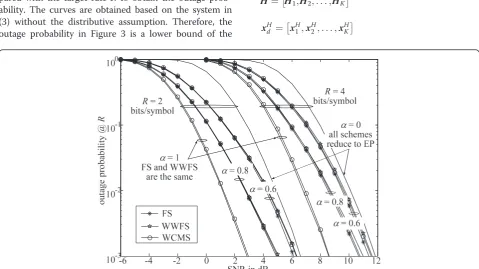
Compared with (10), the WWFS approach in (12) in-volves SVD and thus is more complicated than the WCMS approach. Despite its high complexity, the former cannot be guaranteed to outperform the latter except the extreme cases ofα= 1 andα= 0, as seen from the numer-ical results provided in Figure 3. This is possible since both approaches are suboptimal in general.
Figure 3 compares the outage performance of the WCMS scheme (assuming Gaussian signaling) with the outage capacity (under Conjecture 1) obtained using full search (FS) for a centralized MIMO channel. The chan-nels are assumed to be unchanged in a frame but change independently from frame to frame. The instantaneous mutual information of each frame is calculated and com-pared with the target rate R to obtain the outage prob-ability. The curves are obtained based on the system in (3) without the distributive assumption. Therefore, the outage probability in Figure 3 is a lower bound of the
outage of the distributive system in (1). It is seen that the WCMS performance is quite close to the outage capacity. We have made similar observations for other system parameters within the range of our computing power. We expect that WCMS also performs well in more general cases but we do not have a rigorous justifi-cation so far.
As it is very time consuming to compute the outage capacity for relatively large system sizes (even using Conjecture 1), we will use the centralized WCMS per-formance as a coarse estimate of the lower bound of the outage performance of the distributed schemes in our discussions hereafter.
4. Distributed linear precoding and outage analysis
In this section, we discuss design technique for distrib-uted linear precoding and study its theoretical perform-ance based on mutual information analysis.
4.1. Distributed linear precoding
Return to the system in (10). Let us segmenty,H―;andx as
yH¼ yH 1;y
H 2;. . .;y
H K
―
H¼ H―1;H―2;. . .;H―K
xH
d ¼ xH1;xH2;. . .;xHK
Figure 3Outage performances of various schemes in a centralized MIMO system.SNR =P/σ2,K= 1,N
t= 4,Nr= 2. Target rateR= 2, 4
Then the transmitted signalykfromTkis given by
yk¼c
ffiffiffi β
p ―
HHkx0þ
ffiffiffiffiffiffiffiffiffiffiffiffiffiffiffiffiffiffi
1β
ð ÞP KNt
s
xk
!
;
k¼1;2;. . .;K:
ð13aÞ
This construction almost meets Assumption 1, since onlyH―k is required to generateyk.
A subtle point is that the power constraint tr{Q}≤ P
in (4) involves the global coordination. We can change (4) to the local constraints below
trf g ¼Qk tr E ykykH
≤Pk: ð13bÞ
Correspondingly, we rewrite (13a) as
yk¼ck
ffiffiffi β
p ―
HHkx0þ
ffiffiffiffiffiffiffiffiffiffiffiffiffiffiffiffiffiffiffiffi
1β
ð ÞPk
Nt
s
xk
!
;
k¼1;2;. . .;K;
ð13cÞ
whereckis a constant to meet the power constrainPkat Tk. Recall that the common weighting coefficient β for
all {Tk} in (13c) results from the assumption that the
CSIT qualityαis the same for all {Tk}. In a more general
case, α may vary with Tk, and so does β. In the latter
case, we rewrite (13c) as
yk¼ck
ffiffiffiffiffi βk
p ―
HHkx0þ
ffiffiffiffiffiffiffiffiffiffiffiffiffiffiffiffiffiffiffiffiffiffi
1βkPk
Nt s xk 0 @ 1 A;
k¼1;2;. . .;K:
ð13dÞ
Then the transmission scheme becomes fully distributed. We will refer to the scheme in (13d) as the distributed WCMS precoding.
4.2. Coherent gain
A distributed WCMS precoder can provide the so-called coherent gain whenαk> 0,∀k, as analyzed below. Define
― Ak≡ck
― Hk
―
HHk and Aek≡ckHek
―
HHk. Combining (1), (2), and (13d), we have
r¼ XK
k¼1
ffiffiffiffiffiffiffiffiffiffi αkβk
p ―
Ak
!
x0
þ XK
k¼1
ffiffiffiffiffiffiffiffiffiffiffiffiffiffiffiffiffiffiffiffiffiffi
1αk
ð Þβk
q
e
Ak
!
x0
þXK
k¼1
ck
ffiffiffiffiffiffiffiffiffiffiffiffiffiffiffiffiffiffiffiffiffiffi
1βkPk
Nt
s
Hkxk
0 @
1
Aþη: ð14Þ
We callrcohthe coherent component ofr, where
rcoh≡
XK
k¼1
ffiffiffiffiffiffiffiffiffiffi αkβk
p ―
Ak
!
x0: ð15Þ
It is important to note from the definition that all
―
Ak ¼ ck
― Hk
― HHk
n o
in (15) are Hermitian and positive semi-definite. Sincex0is an i.i.d. sequence withE[x0x0H] =I,
the received power related torcohis given by
E rHcohrcoh
¼ X
K
k¼1
αkβktrð
― Ak
― AHk
!
þ X
K
k¼1;k0¼1;k≠k0
ffiffiffiffiffiffiffiffiffiffiffiffiffiffiffiffiffiffiffiffi αkβkαk0βk0
p
tr A―k
― AHk0
Þ: ð16Þ
In (16),
tr A―k
― AHk
≥0; ð17aÞ
tr A―k
― AHk0
≥0: ð17bÞ
The inequality in (17a) can be verified from the defin-ition of trace [30]. The inequality in (17b) holds since
― Ak≡ck
― Hk
― HHk
n o
are Hermitian and positive semi-definite,
and so [30]
tr A―k
― AHk0
≥XN n¼1
λn
― Ak
λNn
― Ak0
≥0; ð18Þ
whereλn(A) is thenth eigenvalues of matrixAin the
in-creasing order. From (17a) and (17b), all the terms in (16) are positive and add“coherently”, which is the cause of coherent gain. We can see such gain more clearly in the special case ofNr= Nt=1 when
―
Ak reduces to a sca-lara―k ¼ck
―
hk
―
hHk ≥0. Hence,
E rcohH rcoh
¼ XK
k¼1
ffiffiffiffiffiffiffiffiffiffi αkβk
p ― ak 2
¼XK
k¼1
αkβk
―
ak 2
þX
k≠k0
ffiffiffiffiffiffiffiffiffiffiffiffiffiffiffiffiffiffiffiffi αkβkαk0βk0
p ―
ak
―
aHk0
The terms a―k 2
n o
and a―k
―
aHk0
n o
are all positive and so
add coherently.
Coherent gain can also be demonstrated by examining the system capacity in the special case ofβ1=···=βK= 1
forα1=···=αK= 1. In this case, (14) reduces to
r¼ XK
k¼1
― Ak
!
x0þη: ð19Þ
The capacity is given by
C¼log2det Iþ X K
k¼1
― Ak
!
XK
k¼1
― AHk
!
=σ2
!
: ð20Þ
We refer to the capacity of a single link to transmitter
Tk as Ck¼log2det Iþ
― Ak
― AHk=σ2
. IfA―k is not positive
semi-definite, then there is a possibility that C < Ck.
Thus distributed cooperation may not necessarily lead to the capacity improvement. On the other hand, (20) can be rewritten as [30]
C¼X
N
n¼1
log2 1þλ2n X K
k¼1
― Ak
!
=σ2
!
ð21Þ
Denote by A―k―¼
XK
k0¼1;k0≠k
―
Ak0 and
XK
k0¼1
― Ak0 ¼
― Akþ
―
Ak―. When
―
Ak are Hermitian, it can be verified thatA―k―is also Hermitian. Then we have [30]
λn
― Ak
þλ1
― Ak― ≤λn
XK
k0¼1
― Ak0
¼λn
― Akþ
― Ak―
≤λn
― Ak
þλN
―
Ak― ; ∀n;∀k: ð22Þ
Furthermore, when A―k are all positive semi-definite
and so isA―k―, we haveλ
n
―
Ak― ≥0; ∀n. Thus,
λn
― Ak
≤λn
― Ak
þλ1
― Ak― ≤λn
XK
k¼1
― Ak
!
; ∀n;∀k: ð23Þ
From (21) and (23), CM precoding guarantees that
C≥Ck, which implies a coherent effect.
4.3. Numerical results
Now we present some numerical results to demonstrate the performance of the proposed scheme.
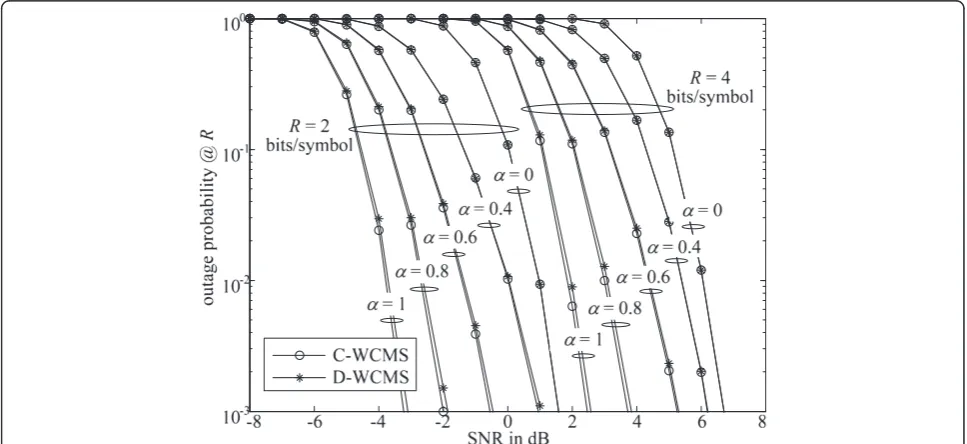
Figure 4 provides the outage performance of distrib-uted WCMS for Rayleigh fading and common CSIT quality. Centralized WCMS is used as the reference. From Figure 4, distributed and centralized WCMS schemes have quite close performance. Recall (from Figure 3) that centralized WCMS can perform close to the capacity with global CSIT. (The performance of cen-tralized WWFS is included in Figure 4 for reference.) It
is thus reasonable to conjecture that the distributed WCMS performance is also not far from the optimum, although we are not able to provide more rigorous analysis.
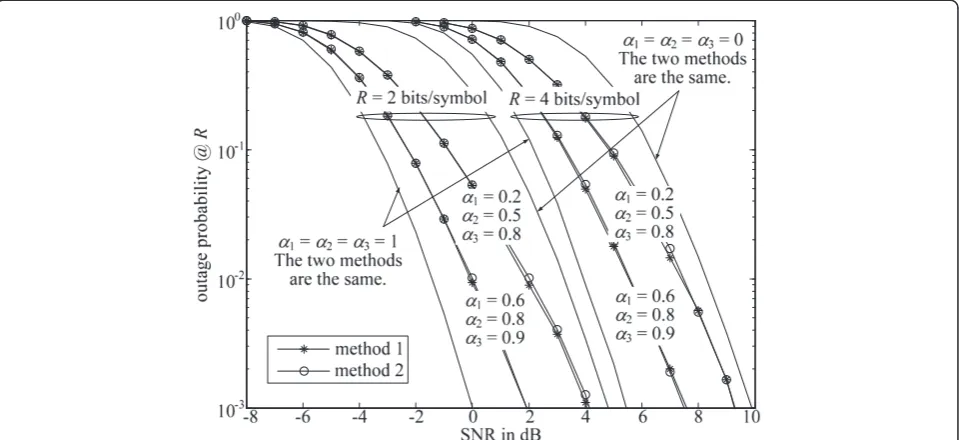
Figure 5 provides the outage performance of distrib-uted WCMS considering large-scale fading and individ-ual CSIT qindivid-uality. The number of transmitters is K = 3. For simplicity, we fix the large-scale fading factor seen byTkto be a constantgLS(k),k= 1, 2,. . .,K. (The values
of {gLS(k)} are given in the caption of Figure 5.) We
as-sume that {gLS(k)} are known by all transmitters and the
power constraints {Pk} can be adjusted correspondingly.
For distributed WCMS, this power allocation is given by
Pk¼P⋅
gLSð Þk
XK
k0¼1gLS k 0
ð Þ;k¼1;2;. . .;K: ð24Þ
The Rayleigh fading factors are the same as in Figure 4. Two search methods are used to find {βk} in (13d).
Method 1 is the K-dimensional exhaustive search. Method 2 assumes that βk/β1 = αk/α1, k = 2,. . .,K and
finds the optimal β1using the exhaustive search. From
Figure 5, we can see that the two methods obtain almost the same performance.
Next we consider the performance of the proposed scheme when the CSIT quality varies. For simplicity, we assume thatαk=αfor all {Tk}.
Figure 6 provides the outage performance of distrib-uted WCMS considering large-scale fading and common CSIT quality. The system settings are the same as those in Figure 5 except that the same CSIT quality indexαis assumed for all {Tk}. We can make observations from
Figure 6 similar to those from Figure 4. The distributed WCMS can obtain significant performance improvement as the CSIT quality increases, and it performs closely to centralized WCMS.
Figure 7 examines the performance of distributed WCMS in a multicarrier OFDM system. The system set-tings are as follows: The number of transmitters is K= 3. The large-scale fading factors are the same as in Figure 6. For the Rayleigh fading, each transmitter sees a MIMO ISI channel withNt= 2 transmit antennas,Nr=
2 receive antennas, and L = 4 delay taps that are uni-formly distributed. The total average gain over the L
paths between each transmit–receive antenna pair is normalized to 1. The number of OFDM subcarriers is
5. Transmission in systems with practical coding The precoder design discussed in Section 4 is assessed by mutual information analysis. In this section, we will consider practical coding and decoding issues. Recall thatykin the distributed WCMS precoder in (13) is
gen-erated from x0 and xk, k= 1, 2,. . .,K. The following are
the basic requirements on {xk},
(i) all {xk} are generated based on a common
information sequenced,
(ii) everyxkconsists of i.i.d. elements, and
(iii) {xk} are mutually uncorrelated of each other.
The above requirements on {xk} are related to the
mu-tual information analysis in Section 4. They are not Figure 4Outage performances of various schemes in a distributed MIMO system with Rayleigh fading and common CSIT qualityα.
Target rateR= 2, 4 bits/symbol, respectively. SNR =P/σ2,Nt=Nr= 2,K= 3.Pk=P/K,k= 1, 2,. . .,K. C-WWFS, centralized WWFS; C-WCMS,
centralized WCMS; D-WCMS, distributed WCMS.
Figure 5Outage performances of the proposed D-WCMS scheme in a distributed MIMO system with large-scale fading and individual CSIT quality.Target rateR= 2, 4 bits/symbol, respectively. SNR =P/σ2,N
t=Nr= 2,K= 3.Pk=P·gLS(k)/ P
sufficient to guarantee good performance in practically coded systems. For example, we may simply generate {xk} by segmenting a single FEC-coded sequence c. In
this way, different elements inc undergo different chan-nel conditions and suffer from different levels of inter-ference. Such variation of channel conditions may bring about adverse effect on performance. Below, we will
outline a treatment to the problem using an extra stage of linear precoding [31,32].
5.1. Diversity linear precoding
We first introduce an extended channel model as
fol-lows. Let H―kð Þt be the tth samples of the
―
Nr
―
Nt Figure 6Outage performances of various schemes in a distributed MIMO system with large-scale fading and common CSIT qualityα.
Target rateR= 2, 4 bits/symbol, respectively. SNR =P/σ2,N
t=Nr= 2,K= 3.Pk=P·gLS(k)/ P
gLS(k'),k= 1, 2,. . .,K.gLS(1) = 0.5,gLS(2) = 1,gLS(3) = 2.
C-WCMS, centralized WCMS; D-WCMS, distributed WCMS.
Figure 7Outage performances of various schemes in a distributed MIMO OFDM system with large-scale fading and common CSIT qualityα.Target rateR= 2, 4 bits/symbol, respectively. SNR =P/σ2,N
t=Nr= 2.L= 4,J= 32,K= 3,Pk=P·gLS(k)/ P
gLS(k'),k= 1, 2,. . .,K.gLS(1) =
transfer matrix of the MIMO channel seen by the trans-mitter Tk. We define an extended channel model, for
whichHkis obtained by sampling
―
HkTtimes as
Hk¼
―Hkð Þ1
―Hkð Þ2
⋱
― Hkð ÞT
2 6 6 6 6 6 6 4
3 7 7 7 7 7 7 5
: ð25Þ
In practice,Hkcan be obtained by using the MIMO
chan-nelTtimes consecutively in time domain orTsubcarriers in frequency domain [31,32]. Clearly, all the precoding techniques discussed so far can be applied toHk defined
in (25). The system size isNt¼T
―
Nt andNr¼T
―
Nr. The matrix augmentation in (25) does not lead to significant complexity increase, as explained in Section 5.2 later. With the extended channel model, we can ensure that all the elements in c will undergo the same channel condi-tion, which leads to more robust performance. We will discuss the related details in the subsequent sections.
Letc be a length (KNt+ Nr)Tcoded sequence
gener-ated by underlying FEC coding scheme usingdas its in-put. Without loss of generality, the average power per entry ofcis normalized to 1. With random interleaving, we can treatcas a sequence with i.i.d. symbols [33-37].
Now we generate {xk} by an extra stage of linear
precodingcas follows
xk¼SkPc ð26aÞ
where {Sk=IT⊗sk} are used to segment the vector Pc
with ⊗ being the Kronecker product. We construct s0
andsk,k= 1, 2,. . .,K, as follows
s0¼½INr 0NrKNt; ð26bÞ
sk¼ 0Ntððk1ÞNtþNrÞ INt 0NtðKkÞNt
;
k¼1;2;. . .;K:
ð26cÞ
These matrices segment Pc in a straightforward way. Note that the size ofs0isNr× (KNt+Nr) while the size
of eachsk,k≥1, isNt× (KNt+Nr). This is to match the
sizes ofH―Hk and INt in (13), respectively. [The Kronecker productSk=IT⊗skmeans that all the matrices {Sk} are
block diagonal, which is consistent with the extended channel model in (25).] It can be verified that {xk}
de-fined in (26) meet requirements (i)–(iii) mentioned above. (Recall that {xk} are constructed fromcwhich is a
coded sequence using the information sequencedas in-put. Hence, all {xk} will be related to the information
se-quenced.) We will explain the function ofPbelow. The matrixPin (26) is for diversity coding. In this art-icle, we selectPto be a size (KNt+Nr)T× (KNt+Nr)T
normalized Hadamard matrix for the following reasons
[31,32]. First, a normalized Hadamard matrix is unitary and hence of full-rank. No capacity loss is caused by such P. Second, for a MIMO channel, different beams have different channel gains in general. The use of a Hadamard matrix can result in a diversity advantage. (We will return to this issue in Section 5.3.) Third, fast Hadamard transform (FHT) [38] allows efficient calcula-tion, which is discussed in Section 5.2.
The diversity effect provided by Pfollows the discus-sions in [39,40] in essence. A main feature of the ap-proach taken in this article is the use of {Fk} in Section 4
to best exploit the available CSIT so as to further im-prove the performance.
5.2. Detection principles
Substituting (26) and (13d) into (1), we have
r¼Acþη ð27aÞ
where
A¼ XK
k¼1
ckHk
ffiffiffiffiffi βk
p ―
HHkS0þ
ffiffiffiffiffiffiffiffiffiffiffiffiffiffiffiffiffiffiffiffiffiffi
1βkPk
Nt
s
Sk
0 @
1 A 0
@
1 AP:
ð27bÞ
The optimal detection ofcinvolves both the linear chan-nel constraint and the nonlinear FEC coding constraint. This means a very high complexity in general. A subopti-mal way is to consider the two constraints separately, which incurs certain performance loss. This loss can be compensated by the iterative detection outlined below.
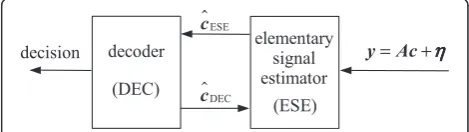
The iterative detection consists of an elementary signal estimator (ESE) for the channel constraint and a decoder (DEC) for the FEC coding constraint [36], as illustrated in Figure 8. Based on the received signal r and the a prioriinformation ofc(in the form of meanE[c] and co-variance vI), ESE first performs the standard LMMSE detection ofc, with output given by [41]
^c¼E½ þc vAHR1ðrAE½ cÞ ð28Þ
whereR≡Cov(r,r) =vAAH+σ2I. Thenc(i) can be esti-mated symbol-by-symbol using (28).
The DEC performs standard a posteriori probability decoding using the output of the ESE as a priori infor-mation. The decoding output is used to update the values of E[c] and v for the sequence c. Then ESE
performs LMMSE detection again. This process con-tinues iteratively.
From (28), we can see that the complexity of LMMSE detection mainly lies in the calculation of R–1. It can be verified that R is a block diagonal matrix withT blocks and each block has a size ofNr×Nr. This means thatR–1
can be calculated with a complexity ofO(T⋅Nr3) [42]. All
the other operations in (28) can be performed by FHT or block-by-block. Hence, the related complexity is modest for practical systems.
Note that the above LMMSE detection is suboptimal for the ESE. However, combined with the iterative detection, it can obtain near-optimal performance as shown in [43].
5.3. Diversity gains
In general, the elements of the received vectorr=r(i) in (27) have different signal-to-interference plus noise ra-tios (SINRs). This is caused by the fluctuation of channel gains and interference levels in different antenna to an-tenna links. Consequently, the elements of^c¼f^c ið Þg in (28) also have different SINRs. Such SINR fluctuation may lead to noticeable performance loss whenf^c ið Þgare used as the inputs to a decoder.
A treatment to the problem is outlined in [31,32] using a linear precoding matrix. This is the function of matrix multiplication Pc in (26a). It is shown in [31,32] that all the LMMSE estimation outputs have equal SINR when P is a Hadamard matrix with a sufficiently large size. This can be seen intuitively as follow. The ith col-umn of Pcan be regarded as a spreading sequence and so each c(i) is spread into a sequence after the matrix
multiplicationPc. This clearly has a diversity effect. No-tice that there is no redundancy involved here since Pis a square unitary matrix. Also, the related precoding and detection complexity is kept low when a Hadamard matrix is used forP, thanks to the FHT. The related dis-cussions can be found in [31,32].
Alternatively, we may also consider a conventional space–time code for diversity gain. However, this is not straightforward. Note that two stages of linear precoding are involved in (27). The first stage is the use of Pand the second is the WCMS precoding discussed in Section 4. The linear operations in these two stages are com-bined to form the overall linear transform matrix A in (27). An efficient iterative LMMSE detection algorithm is available for the system in (27) based on FHT [31,32]. On the other hand, detection complexity may become a serious problem when a conventional space–time coding technique is combined with the linear precoding tech-nique discussed in Section 4.
5.4. Simulation in LDPC-coded systems
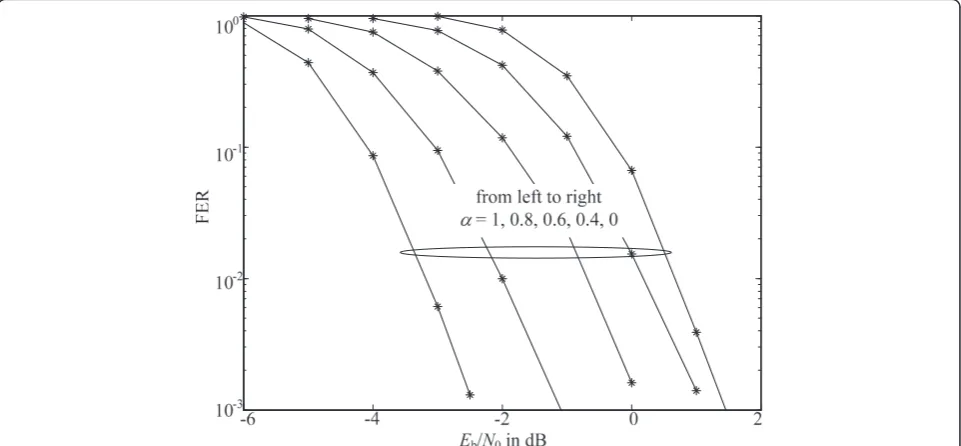
We now present some numerical examples to demon-strate the efficiency of the proposed scheme. Figure 9 shows the simulated frame error rate (FER) performance of the proposed scheme in a distributed MIMO OFDM system. The system setting is the same as in Figure 7. The number of transmitters is K= 3 and the large-scale fading factors aregLS(1) = 0.5,gLS(2) = 1,gLS(3) = 2. For
Rayleigh fading, each transmitter sees a MIMO ISI chan-nel withNt= 2 transmit antennas,Nr= 2 receive
anten-nas, andL= 4 delay taps. In simulation, the FEC code is
Figure 9Simulated FER performances of the distributed WCMS precoding in a distributed MIMO OFDM system with large-scale fading and common CSIT qualityα.Transmission rateR= 2 bits/symbol.Nt=Nr= 2.L= 4,J= 32,K= 3,Pk=P·gLS(k)/
P
gLS(k'),k= 1, 2,. . .,K.gLS(1) =
a (3, 6) regular LDPC code followed by length-4 spread-ing, random interleaving and QPSK modulation, and the transmission rate isR= 2 bits/symbol. The frame length is set to 4,096 information bits.
From Figure 9, we can see that the system perform-ance improves progressively as the CSIT quality im-proves and similar trends as in Figure 7 can be observed. Compared with the no CSIT case, a considerable per-formance gain of about 3.9 dB (at FER = 10–2) is obtained in the case of perfect CSIT, which is slightly less than the analytical result (i.e., 4.6 dB) in Figure 7. We expect that more sophisticated coding schemes can be used to improve performance and we are still work-ing on this.
6. Conclusions
In this article, a WCMS linear precoding strategy is pro-posed for distributed MIMO systems with partial CSIT. The WCMS precoder consists of two parallel modules, one for CM to obtain a coherent gain, and the other for energy scattering to provide robustness against CSIT un-certainty. Both analytical and simulation results demon-strate that the proposed demon-strategy can achieve the coherent gain proportional to the accuracy of the avail-able CSIT as well as robustness against CSIT error. The strategy is very simple and fully decentralized and thus is highly suitable for distributed MIMO systems.
Competing interests
The authors declare that they have no competing interests.
Acknowledgement
The authors thank Alcatel-Lucent Shanghai Bell Co. Ltd for supporting the research work leading to this article and appreciate the beneficial discussions with the researchers in the Research and Innovation Center of Alcatel-Lucent Shanghai Bell.
Author details
1Department of Electronic Engineering, City University of Hong Kong, 83 Tat Chee Avenue, Kowloon, Hong Kong, SAR, China.2School of Systems Engineering, University of Reading, Reading RG6 6AY, UK.
Received: 21 June 2012 Accepted: 5 January 2013 Published: 19 February 2013
References
1. S Zhou, M Zhao, X Xu, Y Yao, Distributed wireless communication system: a new architecture for public wireless access. IEEE Commun. Mag.
41(3), 108–113 (2003)
2. MK Karakayali, GJ Foschini, RA Valenzuela, Network coordination for spectrally efficient communications in cellular systems. IEEE Wireless Commun. Mag.13(4), 56–61 (2006)
3. J Mietzner, PA Hoeher, Improving the performance of mobile broadcasting systems using multiple base stations and distributed spacetime codes. IET Commun.1(3), 348–353 (2007)
4. F Adachi, K Takeda, T Yamamoto, R Matsukawa, S Kumagai, Recent advances in single-carrier distributed antenna network. Wirel. Commun. Mob. Comput.11(12), 1551–1563 (2011)
5. B Schein, RG Gallager,The Gaussian parallel relay network(Proceedings of the IEEE International Symposium on Information Theory (ISIT’2000), Sorrento, Italy, 2000), p. 22
6. JN Laneman, GW Wornell, Distributed space–time-coded protocols for exploiting cooperative diversity in wireless networks. IEEE Trans. Inf. Theory 49(10), 2415–2425 (2003)
7. G Kramer, M Gastpar, P Gupta, Cooperative strategies and capacity theorems for relay networks. IEEE Trans. Inf. Theory51(3), 765–779 (2005) 8. F Xue, S Sandhu, Cooperation in a half-duplex Gaussian diamond relay
channel. IEEE Trans. Inf. Theory53(10), 3806–3814 (2007)
9. A Goldsmith, SA Jafar, N Jindal, S Vishwanath, Capacity limits of MIMO channels. IEEE J. Sel. Areas Commun.21(5), 684–702 (2003)
10. D Tse, P Viswanath,Fundamentals of Wireless Communication(Cambridge University Press, Cambridge, 2005)
11. TL Marzetta, Noncooperative cellular wireless with unlimited numbers of base station antennas. IEEE Trans. Wirel. Commun.9(11), 3590–3600 (2010) 12. J Hoydis, S ten Brink, M Debbah,Massive MIMO: how many antennas do we
need?, in Proceedings of 49th Annual Allerton Conference on Communication, Control, and Computing (Allerton’2011)(Allerton House, Illinois, USA, 2011), pp. 545–550
13. A Bourdoux, B Come, N Khaled,Non-reciprocal transceivers in OFDM/SDMA
systems: impact and mitigation(Proceedings of the Radio and Wireless
Conference (RAWCON’03), Boston, USA, 2003), pp. 183–186
14. M Vu, A Paulraj, MIMO wireless linear precoding. IEEE Signal Process. Mag. 24(5), 86–105 (2007)
15. http://www.3gpp.org/ftp/Specs/html-info/36211.html
16. V Tarokh, N Seshadri, AR Calderbank, Space–time codes for high data rate wireless communication: performance analysis and code construction. IEEE Trans. Inf. Theory44(2), 744–765 (1998)
17. W Su, X Xia, Signal constellations for quasi-orthogonal space–time block codes with full diversity. IEEE Trans. Inf. Theory50(10), 2331–2347 (2004) 18. A Scaglione, GB Giannakis, S Barbarossa, Redundant filterbank precoders and equalizers part I: unification and optimal designs. IEEE Trans. Signal Process.47(7), 1988–2006 (1999)
19. DP Palomar, JM Cioffi, MA Lagunas, Joint Tx-Rx beamforming design for multicarrier MIMO channels: a unified framework for convex optimization. IEEE Trans. Signal Process.51(9), 2381–2401 (2003)
20. Y Jiang, J Li, WW Hager, Joint transceiver design for MIMO communications using geometric mean decomposition. IEEE Trans. Signal Process.53(10), 3791–3803 (2005)
21. F Xu, TN Davidson, JK Zhang, KM Wong, Design of block transceivers with decision feedback detection. IEEE Trans. Signal Process.
54(3), 965–978 (2006)
22. C Xiao, Y Zheng, Z Ding, Globally optimal linear precoders for finite alphabet signals over complex vector Gaussian channels. IEEE Trans. Signal Process.59(7), 3301–3314 (2011)
23. J Wang, DP Palomar, Worst-case robust MIMO transmission with imperfect channel knowledge. IEEE Trans. Signal Process.57(8), 3086–3100 (2009) 24. W Zeng, C Xiao, M Wang, J Lu, Linear precoding for finite alphabet inputs
over MIMO fading channels with statistical CSI. IEEE Trans. Signal Process. 60(6), 3134–3148 (2012)
25. A Soysal, S Ulukus, Optimum power allocation for single-user MIMO and multi-user MIMO-MAC with partial CSI. IEEE J. Sel. Areas Commun. 25(7), 1402–1412 (2007)
26. X Li, S Jin, X Gao, MR McKay, Capacity bounds and low complexity transceiver design for double scattering MIMO multiple access channels. IEEE Trans. Signal Process.58(5), 2809–2822 (2010)
27. S Venkatesan, S Simon, R Valenzuela,Capacity of a Gaussian MIMO channel
with nonzero mean(Proceedings of the IEEE 58th Vehicular Technology
Conference (VTC 2003-Fall), vol. 3, Orlando, Florida, USA, 2003), pp. 1767–1771
28. TM Cover, JA Thomas,Elements of Information Theory(Wiley, New York, 1991)
29. E Telatar, Capacity of multi-antenna Gaussian channels. Eur. Trans. Telecommun.10(6), 585–595 (1999)
30. RA Horn, CR Johnson,Matrix Analysis(Cambridge University Press, Cambridge, MA, 1990)
31. X Yuan, C Xu, L Ping, X Lin, Precoder design for multiuser MIMO ISI channels based on iterative LMMSE detection. IEEE J. Sel. Topics Signal Process.3(6), 1118–1128 (2009)
33. X Wang, HV Poor, Iterative (turbo) soft interference cancellation and decoding for coded CDMA. IEEE Trans. Commun.47(7), 1046–1061 (1999) 34. M Tüchler, R Koetter, AC Singer, Turbo equalization: principles and new
results. IEEE Trans. Commun.50(5), 754–767 (2002)
35. PA Hoeher, H Schoeneich, JC Fricke, Multi-layer inter-leave-division multiple access: theory and practice. Eur. Trans. Telecommun.
19(5), 523–536 (2008)
36. X Yuan, Q Guo, X Wang, P Li, Evolution analysis of low-cost iterative equalization in coded linear systems with cyclic prefixes. IEEE J. Sel. Areas Commun26(2), 301–310 (2008)
37. X Xiong, J Hu, X Ling, A cooperative transmission and receiving scheme for IDMA with time-reversal technique. Wirel. Personal Commun.
58(4), 637–656 (2011)
38. RK Yarlagadda, JE Hershey,Hadamard Matrix Analysis and Synthesis: With
Applications to Communications and Signal/Image Processing(Kluwer
Academic Publishers, Boston, 1996)
39. RW Heath Jr, A Paulraj, Linear dispersion codes for MIMO systems based on frame theory. IEEE Trans. Signal Process.50(10), 2429–2441 (2002) 40. B Hassibi, B Hochwald, High-rate codes that are linear in space and time.
IEEE Trans. Inf. Theory48(7), 1804–1824 (2002)
41. SM Kay,Fundamentals of Statistical Signal Processing: Estimation Theory (Prentice Hall PTR, Upper Saddle River, NJ, 1993)
42. LN Trefethen, D Bau III,Numerical Linear Algebra(Society for Industrial and Applied Mathematics, Philadelphia, 1997)
43. X Yuan, L Ping,Achievable rates of coded linear systems with iterative MMSE
detection(Proceedings of the IEEE Global Telecommunications Conference
(GLOBECOM’2009), Honolulu, HI, USA, 2009), pp. 1–6
doi:10.1186/1687-6180-2013-22
Cite this article as:Xuet al.:Linear precoding in distributed MIMO systems with partial CSIT.EURASIP Journal on Advances in Signal Processing 20132013:22.
Submit your manuscript to a
journal and benefi t from:
7Convenient online submission
7Rigorous peer review
7Immediate publication on acceptance
7Open access: articles freely available online
7High visibility within the fi eld
7Retaining the copyright to your article