Fast Pattern Detection Using Normalized
Neural Networks and Cross-Correlation
in the Frequency Domain
Hazem M. El-Bakry
Multimedia Devices Laboratory, University of Aizu, Aizu Wakamatsu 965-8580, Japan Email:[email protected]
Qiangfu Zhao
Multimedia Devices Laboratory, University of Aizu, Aizu Wakamatsu 965-8580, Japan Email:[email protected]
Received 12 January 2004; Revised 20 December 2004
Neural networks have shown good results for detection of a certain pattern in a given image. In our previous work, a fast algorithm for object/face detection was presented. Such algorithm was designed based on cross-correlation in the frequency domain between the input image and the weights of neural networks. Our previous work also solved the problem of local subimage normalization in the frequency domain. In this paper, the effect of image normalization on the speedup ratio of pattern detection is presented. Simulation results show that local subimage normalization through weight normalization is faster than subimage normalization in the spatial domain. Moreover, the overall speedup ratio of the detection process is increased as the normalization of weights is done offline.
Keywords and phrases:fast pattern detection, neural networks, cross-correlation, image normalization.
1. INTRODUCTION
Pattern detection is a fundamental step before pattern recog-nition. Its reliability and performance have a major influ-ence in a whole pattern recognition system. Nowadays, neu-ral networks have shown very good results for detecting a certain pattern in a given image [1,2,3]. But the problem with neural networks is that the computational complexity is very high because the networks have to process many small local windows in the images [4,5]. Some authors tried to speed up the detection process of neural networks [6,7,8]. They proposed a multilayer perceptron (MLP) algorithm for fast object/face detection. They claimed that applying cross-correlation in the frequency domain between the input im-age and the neural weights is much faster than using ventional neural networks. They stated this without any con-ditions and introduced formulas for the number of com-putation steps needed by conventional neural networks and their proposed fast neural networks. Then, they established an equation for the speedup ratio. It was proved in [9] that their equations contain many errors which lead to an invalid speedup ratio. Moreover, a symmetry condition is necessary and must be found either in the input image or in the neural weights so that those fast neural networks can give the same
correct results as conventional neural networks for detecting a certain pattern in a given image. Recently, we succeeded in accelerating the behavior of neural networks during the search process [10]. The speedup of the detection process is achieved by converting the input image into a symmetric one and applying cross-correlation in the frequency domain between the new symmetric image and the neural weights. Mathematical proof and simulation results for fast testing of the new proposed symmetric image using Matlab are given.
The problem of subimage (local) normalization in the Fourier space was presented in [11]. This problem was solved
in [12]. We proved that the number of computation steps
InSection 2, fast neural networks for pattern detection are described. A new symmetric form for the input image to speed up the detection process is presented inSection 3. Subimage normalization in the frequency domain through normalization of weights is introduced inSection 4. The ef-fect of weight normalization on the speedup ratio is pre-sented inSection 5.
2. THEORY OF FAST NEURAL NETWORKS BASED ON CROSS-CORRELATION IN THE FREQUENCY DOMAIN FOR PATTERN DETECTION
Finding a certain pattern in the input image is a search prob-lem. Each subimage in the input image is tested for the pres-ence or abspres-ence of the required pattern. At each pixel po-sition in the input image, each subimage is multiplied by a window of weights, which has the same size as the subimage. The outputs of neurons in the hidden layer are multiplied by the weights of the output layer. A high output implies that the tested subimage contains the required pattern and vice versa. Thus, we may conclude that this searching problem is a cross-correlation between the image under test and the weights of the hidden neurons.
The convolution theorem in mathematical analysis says that a convolution of f withh is identical to the result of the following steps: letFandHbe the results of the Fourier transformation of f andhin the frequency domain. Multiply
F andH in the frequency domain point-by-point and then
transform this product into the spatial domain via the in-verse Fourier transform. As a result, these cross-correlations can be represented by a product in the frequency domain. Thus, by using cross-correlation in the frequency domain, a speedup in an order of magnitude can be achieved during the detection process [1,2,9,10,12].
In the detection phase, a subimageIof sizem×n(sliding window) is extracted from the tested image, which has a size
P×T, and fed to the neural network. LetXibe the vector of weights between the input subimage and the hidden layer. This vector has a size ofm×nand can be represented asm×n
matrix. The output of hidden neuronshican be calculated as follows:
hi=g m
j=1 n
k=1
Xi(j,k)I(j,k) +bi
, (1)
whereg is the activation function andbiis the bias of each hidden neuroni. Equation (1) represents the output of each hidden neuron for a particular subimageI. It can be obtained from imageZas follows:
hi(u,v)=g m/2
j=−m/2 n/2
k=−n/2
Xi(j,k)Z(u+j,v+k) +bi . (2)
Equation (2) represents a cross-correlation operation. Given any two functions f andd, their cross-correlation can be ob-tained by
f(x,y)⊗d(x,y)=
∞
m=−∞ ∞
n=−∞
f(m,n)d(x+m,y+n)
.
(3)
Therefore, (2) may be written as
hi=g
Xi⊗Z+bi , (4)
wherehiis the output of the hidden neuroniandhi(u,v) is the activity of the hidden unitiwhen the sliding window is located at position (u,v) and (u,v)∈[P−m+ 1,T−n+ 1]. Now, the above cross-correlation can be expressed in terms of the Fourier transform as follows:
Z⊗Xi=F−1
F(Z)•F∗Xi
. (5)
Hence, by evaluating this cross-correlation, a speedup ra-tio can be obtained comparable to convenra-tional neural net-works. Also, the final output of the neural network can be evaluated as
O(u,v)=g q
i=1
wo(i)hi(u,v) +bo
, (6)
whereqis the number of neurons in the hidden layer.O(u,v) is the output of the neural network when the sliding window is located at the position (u,v) in the input imageZ.
The complexity of cross-correlation in the frequency do-main can be analyzed as follows [9].
(1) For a tested image ofN×N pixels, the 2D FFT
re-quires a number equal toO(N2log
2N2) of complex
compu-tation steps. Also, the same number of complex compucompu-tation steps is required for computing the 2D FFT of the weight ma-trix for each neuron in the hidden layer.
(2) At each neuron in the hidden layer, the inverse 2D FFT is computed. So,qbackward and (1 +q) forward trans-forms have to be computed. Therefore, for an image un-der test, the total number of the 2D FFT to compute is
O((2q+ 1)N2log 2N2).
(3) The input image and the weights should be multiplied in the frequency domain. Therefore, a number of complex computation steps equal toO(qN2) should be added.
(4) The number of computation steps required by fast neural networks is complex and must be converted into a real version. It is known that the 2D fast Fourier trans-form requires O((N2/2) log
2N2) complex multiplications
andO(N2log
2N2) complex additions. Every complex
multi-plication is realized by six real floating-point operations and every complex addition is implemented by two real floating-point operations. So, the total number of computation steps required to obtain the 2D FFT of anN×Nimage is [9]
ρ=O
6
N2
2
log2N2
+ 2N2log2N2 (7)
which may be simplified to
ρ=O5N2log
2N2 . (8)
(5) In order to perform cross-correlation in the frequency domain, the weight matrix must have the same size as the in-put image. So, a number of zeros equal to (N2−n2) must be
added to the weight matrix. This requires a total real num-ber of computation steps equal toO(q(N2−n2)) for all
neu-rons. Moreover, after computing the FFT2 for the weight ma-trix, the conjugate of this matrix must be obtained. So, a real number of computation steps equal to O(qN2) should
be added in order to obtain the conjugate of the weight ma-trix for all neurons. Also, a number of real computation steps equal toO(N) are required to create butterflies com-plex numbers (e−jk(2Πn/N)), where 0 < K < L. These (N/2)
complex numbers are multiplied by the elements of the input image or by previous complex numbers during the compu-tation of FFT2. To create a complex number requires two real floating-point operations. So, the total number of computa-tion steps required for fast neural networks becomes [9]
σ=O(2q+1)5N2log
2N2 +6qN2+q
N2−n2 +qN2+N
(9)
which can be reformulated as
σ=O(2q+ 1)5N2log
2N2 +q
8N2−n2 +N . (10)
(6) Using a sliding window of sizen×n for the same
image ofN×Npixels,O(q(2n2−1)(N−n+1)2) computation
steps are required when using traditional neural networks for pattern detection process. The theoretical speedup factor η
can be evaluated as follows [9]:
η=O
q2n2−1 (N−n+ 1)2
(2q+ 1)5N2log
2N2 +q
8N2−n2 +N
. (11)
(7) But as proved in [10], this cross-correlation in fre-quency domain (fast neural networks) gives the same results as conventional cross-correlation (conventional neural net-works) only in two cases. Either the weights are symmetric or the input image is symmetric. It is very complex to allow the weights to be symmetric in the required form which needs to be as follows [9]:
W=
w 0
0 wd
. (12)
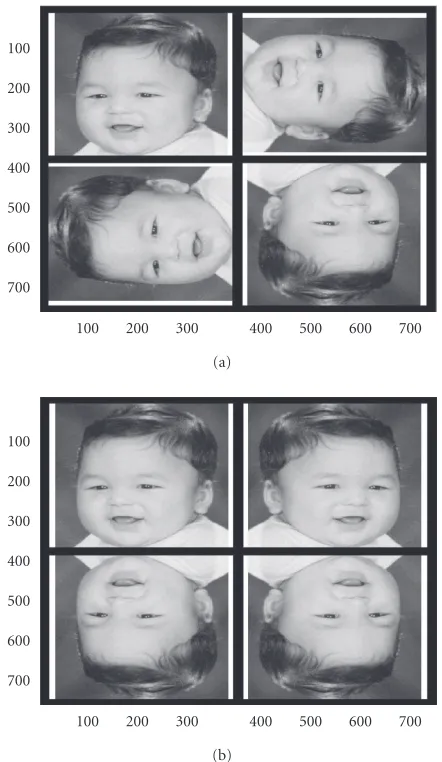
Adding this constraint to the learning rules will cause many well-known problems during the training process of the neu-ral network. Another solution is to convert the input im-age into one of the required symmetric forms as shown in
Figure 1. As the input image has a dimension of (N), the new symmetric image will have a length of (2N). In this case, the number of computation steps required for fast neural net-works can be calculated as follows [9]:
σ2N=O
(2q+1)5(2N)2log
2(2N)2 +q
8(2N)2−n2 +2N .
(13)
100 200 300 400 500 600 700
100 200 300 400 500 600 700
(a)
100 200 300 400 500 600 700
100 200 300 400 500 600 700
(b)
Figure1: Image conversion from nonsymmetric to symmetric one.
But converting the nonsymmetric input image into a sym-metric one will slow down the proposed fast neural net-works more compared to conventional neural netnet-works. In this case, for any size of the input image, dividing the num-ber of operations required for conventional neural networks by those needed by fast neural networks (11) gives a lower speedup ratio than the one listed inTable 1[9].
3. A NEW SYMMETRIC FORM FOR THE INPUT IMAGE TO SPEED UP THE PROCESS OF NEURAL
NETWORKS
In this section, another new symmetric form for the input image is presented. This form helps in reducing the number of computation steps required by neural networks for pat-tern detection. As shown inFigure 2, the input image will be converted into symmetric form by rotating it 180 degrees. Then, both the up and down images are tested as a single (symmetric) image consisting of two images. In this case,
Table1: A comparison between the number of computation steps (in millions) required for conventional and fast neural networks to manipulate images shown inFigure 1with different sizes (n=20).
Image size Conventional neural networks Fast neural networks (2N) Speedup ratio
100×100 157,267170 196,098091 0.802
200×200 785,281170 882,028364 0.890
300×300 1892,695170 2113,036584 0.896
400×400 3479,509170 3918,549456 0.888
500×500 5545,723170 6319,116413 0.877
600×600 8091,337170 9330,582337 0.867
700×700 11116,351170 12965,856005 0.857
800×800 14620,765170 17235,856005 0.848
900×900 18604,579170 21986,745146 0.846
1000×1000 23067,793170 27716,501654 0.832
50 100 150 200 250 300 350 400 450 500 100
200 300 400 500 600 700 800 900 1000
Figure2: Image conversion from nonsymmetric to symmetric one through rotation into down direction.
By substituting in (9) for the new dimensions, the number of computation steps required for cross-correlating this new image with the weights in the frequency domain can be cal-culated as follows [10]:
σ=O(2q+ 1)52N2log
2N+ 2N2log22N
+q62N2 +q2N2−n2 +q2N2 + 2N , (14)
which can be simplified to
σ=O(2q+1)10N2log
22N+log2N
+q16N2−n2 +2N.
(15)
So, the speedup ratio in this case can be calculated as
η=O
q2n2−1 N−n+ 1 2
(2q+1)10N2log
22N+log2N
+q16N2−n2 +2N
.
(16)
The theoretical speedup ratio in this case with different sizes of the input image and different in size weight matrices is
Table2: The theoretical speedup ratio in case of converting an im-age into symmetric one through rotation into down direction.
Image size Speedup ratio Speedup ratio Speedup ratio (n=20) (n=25) (n=30)
100×100 1.71 2.36 2.96
200×200 1.88 2.79 3.79
300×300 1.89 2.85 3.96
400×400 1.86 2.85 3.99
500×500 1.84 2.82 3.98
600×600 1.82 2.80 3.96
700×700 1.80 2.77 3.93
800×800 1.78 2.74 3.90
900×900 1.76 2.72 3.87
1000×1000 1.74 2.70 3.84
Table3: Simulation results for speedup ratio in case of converting an image into symmetric one through rotation into down direction.
Image size Speedup ratio Speedup ratio Speedup ratio (n=20) (n=25) (n=30)
100×100 5.29 6.74 11.16
200×200 4.46 6.24 9.94
300×300 4.17 5.08 8.66
400×400 3.59 4.78 7.45
500×500 3.40 4.34 6.87
600×600 3.30 4.42 6.16
700×700 3.12 4.20 5.74
800×800 2.60 3.58 4.76
900×900 2.97 4.10 5.38
1000×1000 2.57 3.47 4.63
listed in Table 2. Practical speedup ratio for manipulating images of different sizes and different in size weight matrices is also listed inTable 3using 700 MHz processor and Matlab. This new configuration is useful for reducing the number of patterns that the neural network will learn. This is because
up image and its rotated down version are tested together as one (symmetric) image. If a pattern is detected in the rotated down image, then, this means that this pattern is found at the relative position in the up image. So, if conventional neural networks are trained for up and rotated down examples of the pattern, fast neural networks will be trained only to up examples when using the presented configuration for the in-put image. As the number of trained examples is reduced, the number of neurons in the hidden layer will be reduced and the neural network will be faster in the test phase compared with conventional neural networks.
4. SUBIMAGE CENTERING AND NORMALIZATION IN THE FREQUENCY DOMAIN
In [11], the authors stated that image normalization to avoid weak or strong illumination could not be done in the fre-quency space. This is because the image normalization is lo-cal and not easily computed in the Fourier space of the whole image. Here, a simple method for image normalization is presented. Centering and normalizing the image can be ob-tained by centering and normalizing the weights as follows [12].
Let ¯Xrc be the zero-mean centered subimage located at (r,c) in the input imageψas follows:
¯
Xrc=Xrc−x¯rc, (17)
where ¯xrcis the mean value of the subimage located at (r,c). We are interested in computing the cross-correlation be-tween the subimage ¯Xrcand the weightsWi, that is,
¯
Xrc⊗Wi=Xrc⊗Wi−x¯rc⊗Wi, (18)
where
¯
xrc= Xrc
n2. (19)
Combining (18) and (19), we get the following expression:
¯
Xrc⊗Wi=Xrc⊗Wi−Xrc
n2 ⊗Wi, (20)
which is the same as
¯
Xrc⊗Wi=Xrc⊗Wi−Xrc⊗Wi
n2. (21)
The centered zero-mean weights are given by
Wi=Wi−Wi
n2. (22)
Also, (21) can be written as
¯
Xrc⊗Wi=Xrc⊗
Wi−Wi n2
. (23)
Table4: The speedup ratio of the normalization process for images of different sizes (n=20,q=100).
Image size Speedup ratio
100×100 62
200×200 328
300×300 790
400×400 1452
500×500 2314
600×600 3376
700×700 4638
800×800 6100
900×900 7762
1000×1000 9624
So, we may conclude that
¯
Xrc⊗Wi=Xrc⊗Wi (24)
which means that cross-correlating a centered image with the weight matrix is equal to the cross-correlation of the noncen-tered image with the cennoncen-tered weight matrix.
5. EFFECT OF WEIGHT NORMALIZATION ON THE SPEEDUP RATIO
Normalization of subimages in the spatial domain (in case of using traditional neural networks) requires 2n2(N−n+ 1)2
computation steps. On the other hand, normalization of subimages in the frequency domain through normalizing the weights of the neural networks requires 2qn2operations.
This proves that local image normalization in the frequency domain is faster than that in the spatial one. By using weight
normalization, the speedup ratio for image normalizationΓ
can be calculated as
Γ=O
(N−n+ 1)2 q
. (25)
The speedup ratio of the normalization process for images of different sizes is listed inTable 4. As a result, we may conclude the following.
(1) Using this technique, normalization in the frequency domain can be done through normalizing the weights in spa-tial domain.
(2) Normalization of an image through normalization of weights is faster than normalization of each subimage.
(3) Normalization of weights can be done offline. So, the speedup ratio in the case of weight normalization can be cal-culated as follows.
(a) For conventional neural networks
Table5: Simulation results for the speedup ratio in case of image normalization by normalizing the input weights.
Image size Speedup ratio Speedup ratio Speedup ratio (n=20) (n=25) (n=30)
100×100 37.05 41.61 46.73
200×200 43.80 58.72 71.93
300×300 53.57 55.84 70.42
400×400 55.61 61.93 75.29
500×500 53.14 56.01 82.72
600×600 51.13 64.24 78.60
700×700 58.80 60.24 73.66
800×800 52.99 55.83 57.77
900×900 60.26 62.13 64.31
1000×1000 33.93 36.88 39.39
needed by conventional neural networks with weight nor-malization, which is done offline. The speedup ratioηc in this case can be given by
ηc=O
q2n2−1 N−n+ 1 2+ 2n2N−n+ 1 2 q2n2−1 N−n+ 1 2
,
(26)
which can be simplified to
ηc=O
1 + 2n
2
q2n2−1
. (27)
(b) For fast neural networks
The overall speedup ratio equals the number of computation steps required by conventional neural networks with image normalization divided by the number of computation steps needed by fast neural networks with weight normalization, which is done offline. The overall speedup ratioηo can be given by
ηo
=O
q2n2−1 (N−n+ 1)2+ 2n2(N−n+ 1)2
(2q+1)10N2log
22N+log2N
+q16N2−n2 +2N
,
(28)
which can be simplified to
ηo
=O
(N−n+ 1)2q2n2−1 + 2n2
2q+1)10N2log
22N+log2N
+q16N2−n2 +2N
.
(29)
For the relation between the speedup ratio before (η) and after (ηo), the normalization process can be summed up as
ηo=O
η+ 2n
2(N−n+ 1)2
(2q+ 1)10N2log
22N+ log2N
+q16N2−n2 + 2N
. (30)
The overall speedup ratio with images of different sizes and different sizes of windows is listed inTable 5. We can easily note that the speedup ratio in case of image normalization through weight normalization is larger than the speedup ra-tio (without normalizara-tion) listed inTable 3. This means that the search process with normalized fast neural networks is done faster than conventional neural networks with or with-out normalization of the input image.
6. CONCLUSION
Normalized neural networks for fast pattern detection in a given image have been presented. It has been proved math-ematically and practically that the speed of the detection process becomes faster than conventional neural networks. This has been accomplished by converting the input im-age into the presented symmetric form and normalizing the weights of the neural networks. Simulation results have con-firmed this by using Matlab. Moreover, by using this new
symmetric configuration for the input image, the number of neurons in the hidden layer has been reduced. As a result, fast neural networks, based on cross-correlation in the fre-quency domain, have become faster than conventional neu-ral networks. Furthermore, we have geneneu-rally proved that the speedup ratio in the case of image normalization through normalization of weights is faster than without normaliza-tion.
REFERENCES
[1] H. M. El-Bakry, “Human iris detection using fast cooperative modular neural networks and image decomposition,” Ma-chine Graphics & Vision Journal, vol. 11, no. 4, pp. 498–512, 2002.
[2] H. M. El-Bakry, “Automatic human face recognition using modular neural networks,”Machine Graphics & Vision Jour-nal, vol. 10, no. 1, pp. 47–73, 2001.
[4] S. Srisuk and W. Kurutach, “A new robust face detection in color images,” inProc. 5th IEEE International Conference on Automatic Face and Gesture Recognition (AFGR ’02), pp. 291– 296, Washington, DC, USA, May 2002.
[5] Y. Zhu, S. Schwartz, and M. Orchard, “Fast face detec-tion using subspace discriminate wavelet features,” in Proc. IEEE Conference on Computer Vision and Pattern Recognition (CVPR ’00), vol. 1, pp. 636–642, Hilton Head Island, SC, USA, June 2000.
[6] S. Ben-Yacoub, B. Fasel, and J. Luettin, “Fast face detection using MLP and FFT,” inProc. 2nd International Conference on Audio and Video-Based Biometric Person Authentication (AVBPA ’99), pp. 31–36, Washington, DC, USA, March 1999. [7] B. Fasel, “Fast multi-scale face detection,” IDIAP-Com 98-04,
IDIAP, Eurecom, Sofia-Antipolis, France, 1998.
[8] S. Ben-Yacoub, “Fast object detection using MLP and FFT,” IDIAP-RR 11, IDIAP, Martigny, Switzerland, 1997.
[9] H. M. El-Bakry, “Comments on using MLP and FFT for fast object/face detection,” inProc. International Joint Conference on Neural Networks (IJCNN ’03), vol. 2, pp. 1284–1288, Port-land, Ore, USA, July 2003.
[10] H. M. El-Bakry and Q. Zhao, “Fast object/face detection us-ing neural networks and fast Fourier transform,”International Journal on Signal Processing, vol. 1, no. 3, pp. 182–187, 2004. [11] R. Feraud, O. Bernier, J. E. Viallet, and M. Collobert, “A fast
and accurate face detector for indexation of face images,” in Proc. 4th IEEE International Conference on Automatic Face and Gesture Recognition (AFGR ’00), pp. 77–82, Grenoble, France, March 2000.
[12] H. M. El-Bakry, “Face detection using fast neural networks and image decomposition,”Neurocomputing, vol. 48, no. 1-4, pp. 1039–1046, 2002.
Hazem M. El-Bakry received the B.S.
de-gree in electronics engineering and the M.S. degree in electrical communication engi-neering from the Faculty of Engiengi-neering, Mansoura University, Egypt, in 1992 and 1995, respectively. Since 1997, he has been an Assistant Lecturer at the Faculty of Com-puter Science and Information Systems, Mansoura University, Egypt. Currently, he is a doctoral student at the Multimedia
De-vice Laboratory, University of Aizu, Japan. In 2004, he got a re-search scholarship from the Japanese Government based on a rec-ommendation from the University of Aizu, Japan. His research in-terests include neural networks, pattern recognition, image pro-cessing, biometrics, cooperative intelligent systems, and electronic circuits. In these areas, he has published more than 35 papers as a single author in major international journals and confer-ences. He is the first author in 11 refereed international journal papers and more than 56 refereed international conference pa-pers. Engineer Hazem El-Bakry has the Patent no. 2003E 19442 DE HOL/NUR, Magnetic Resonance, SIEMENS Company, Erlan-gen, Germany, 2003. He is a referee for the International Journal of Machine Graphics & Vision and many different major interna-tional conferences. He was selected as a Chairman for sessions in many different international conferences. He was invited for a talk in the Biometric Consortium, Orlando, Fla, USA, 12–14 Septem-ber 2001, which was cosponsored by the United States National Se-curity Agency (NSA) and the National Institute of Standards and Technology (NIST).
Qiangfu Zhao received the Ph.D. degree
from Tohoku University, Japan, in 1988. He joined the Department of Electronic En-gineering, Beijing Institute of Technology, China, in 1988, first as a Postdoctoral Fel-low and then as an Associate Professor. He was an Associate Professor in October 1993 at the Department of Electronic Engineer-ing, Tohoku University, Japan. He joined