R E S E A R C H
Open Access
Dynamic partial crosstalk cancellation resource
allocation algorithms for DSL access networks
Beier Li
1*, Paschalis Tsiaflakis
1, Marc Moonen
1, Jochen Maes
2and Mamoun Guenach
2Abstract
Earlier work on crosstalk mitigation techniques for DSL access networks has focused on physical layer transmit rate maximization or transmit power minimization through static resource allocation, i.e., static allocation of transmit power and/or computational complexity to the individual user in the network. However, such static resource allocation does not allow to consider upper-layer metrics such as network throughput, stability and delay
performance. In this article, we develop a set of dynamic resource allocation algorithms for linear zero-forcing partial crosstalk cancellation that allow to include these upper-layer metrics, so as to dynamically allocate computational complexity to the individual users. A first algorithm focuses on preserving dynamic transmission queueing stability while maximizing the transmit rates. This algorithm is then extended towards budget adaptive algorithms, which improve resource efficiency, so as to obtain a trade-off between delay performance and resource consumption. The improved stability and resource efficiency of the proposed algorithms are verified by simulations.
Introduction
Digital subscriber line (DSL) technology is a popular wire-line broadband access technology with a more than 60% market share worldwide [1]. However, electromagnetic coupling between copper-lines in the same binder, also referred to as crosstalk is known to result in a huge per-formance degradation in DSL access networks. To tackle the crosstalk problem, one can resort to two types of crosstalk mitigation techniques: (1) dynamic spectrum management (DSM), also referred to as spectrum balanc-ing, which optimizes the transmit power spectra of the individual users in the network, to reduce the degrada-tion caused by crosstalk. Various DSM algorithms have been developed, including centralized algorithms [2-4], distributed algorithms [5,6], and autonomous algorithms [7,8]. (2) Crosstalk cancellation, which is also referred to as vectored DSL or signal coordination, and includes upstream crosstalk cancellation and downstream precod-ing or pre-compensation. These techniques remove the crosstalk between the users through digital signal pro-cessing (DSP). Vectored DSL is seen as a very promising technique, and is subject of a standardization procedure of
*Correspondence: [email protected]
1Department of Electrical Engineering (ESAT-SCD), Katholieke Universiteit Leuven, Leuven, Belgium
Full list of author information is available at the end of the article
the international telecommunication union (ITU) [9,10]. The vectored DSL system has been studied in [11-16]. In [12-16] simple linear zero-forcing crosstalk cancellation schemes have been proposed that reduce the crosstalk cancellation computational complexity by only removing the dominant crosstalk in the system. This is also referred to as partial crosstalk cancellation (PCC).
Considerable research on crosstalk mitigation tech-niques has been devoted to the maximization of physical layer transmit rates or the minimization of transmit pow-ers [17]. Next to these standard objectives, other quality of service (QoS) objectives should also be considered. For instance, delay performance is a very important objective for different broadband scenarios: the impact of transmis-sion delay on delay-sensitive applications in next gener-ation access networks, e.g., IPTV and online gaming, is studied in [18,19].
Considering the data transmission between the access node (AN) and the customer premises equipment (CPE), there are four types of delay: (1) processing delay: the time consumed to process the data overhead. (2) Queue-ing delay: the time that the data sits in the transmission queue. (3) Transmission delay: the time to convert the data into an electrical signal and to feed it into the copper-line. (4) Propagation delay: the time for the signal to propa-gate through the copper-line. The processing delay and transmission delay depend on the processing capability
of the chip-set, and the propagation delay is related to the physics of the copper-line. In this article we focus on the problem of controlling the queueing delay through dynamic PCC resource allocation.
Existing DSL physical layer optimization techniques generate a static resource allocation, for instance, stat-ically allocating transmit power and/or computational complexity to the individual users. And these techniques focus on basic physical layer metrics, such as transmit rates and transmit power for the individual users. One short-coming of such static allocation is that users are assumed to have an infinite data workload. This is how-ever not true in practice, where users indeed have a finite data workload. Furthermore, when a user has no data to transmit, it should be allocated with as few resources as possible. A static system model does not allow to study the network throughput statically and delay performance. Therefore we extend the system model with data queues for all users, and show how this layered system model allows to study and design dynamic resource allocation algorithms that can significantly improve the performance of the DSL network.
A similar system model is also used with DSM in [20]. Queueing proportional scheduling (QPS) [21] provides good performance in the case of broadcast channel with sum transmit power constraint and superposition code at the transmitter together with successive interference cancellation at each receiver. However in DSL networks each user has an individual power constraint. The possi-bility of integrating QPS with DSL networks is discussed in [22]. In this article we focus on the linear zero-forcing PCC [12,13], and develop a set of dynamic resource allo-cation algorithms. An initial framework was presented in our work [23], but these results are significantly extended in this article. More specifically, the contribution can be summarized as follows: A first algorithm focuses on preserving transmission queueing stability while maxi-mizing the transmit rates. The impact of channel state information (CSI) uncertainty and non-optimal resource allocation update rate to the algorithm is studied. We also propose an algorithm to reduce the resource alloca-tion complexity by the frequency selectivity of the DSL channel. The framework is then extended towards budget adaptive algorithms, which improve resource efficiency, and optimize the resource subject to a delay performance target, so as to obtain a trade-off between delay perfor-mance and resource consumption. The improved stability and resource efficiency of the proposed algorithms are verified by simulations.
The article is organized as follows: Section “System model” introduces the layered system model. Max-weight PCC algorithm is proposed in Section “Max-weight PCC”, which is a dynamic PCC resource allocation algorithm that focuses on preserving the dynamic transmission
queueing stability. In Section “Features of MW-PCC” some features of the MW-PCC are discussed, including its robustness against channel uncertainty, the frequency-selectivity of the dynamic resource allocation, and the impact of the resource allocation update rate. In Section “Budget adaptive MW-PCC” a set of budget adap-tive MW-PCC algorithms is developed, which relax the resource budget constraint and consequently improve the resource efficiency. Two extensions of the budget adaptive MW-PCC are then proposed, which can realize a specific delay performance target, with respect to the system delay or individual user delay. Section “Simulation results” con-tains simulation results, that demonstrate the improved stability and the trade-off between delay performance and resource consumption of the proposed algorithms. Conclusions are given in Section “Conclusion”.
System model
Physical layer resource allocation
The DMT based DSL system considered here consists ofN
users, where each user transmits overKorthogonal tones. We assume that accurate CSI is available at the AN. The transmission channel model on tonekis given as follows:
yk =Hkxk+ zk.
Here the vectorxk =[x1k,. . .,xNk]Tdenotes the transmit
signal fromNusers on tonek. The vectorsykandzkhave
the same structure asxk, wherezk denotes the additive
noise vector, which consists of thermal noise and other background noises, andykdenotes the received signal
vec-tor.Hkis anN×Nmatrix, whose elementhnk,mrepresents
the channel coefficient from userm’s transmitter to user
n’s receiver.
We consider linear zero-forcing PCC for upstream com-munication and precoding for downstream communica-tion, as introduced in [12,13]. Both upstream crosstalk cancellation and downstream precoding work under the same principle, jointly referred to here as PCC. When a crosstalk canceller tap is deployed on a specific tone from a disturber user to a victim user, the corresponding crosstalk will be removed. Then the resulting bit-loading on tonekof usernis as follows [14]:
bnk =log2
1+ 1 ϒ
|hnk,n|2snk
m=n(1−cnk,m)|h n,m
k |2smk +σkn
(1)
with: cnk,m ∈ {0, 1},∀m = n, where cnk,m = 1 if the crosstalk from usermto usernon tonekis removed, and
cnk,m = 0 if the crosstalk from usermto usernon tone
gap to capacity. Throughout this article we assume a fixed power spectral density (PSD) for each user, i.e., fixedsnk, ∀n,k. When all the crosstalk seen by user n on tone k
is cancelled, by allocatingN−1 crosstalk canceller taps, the maximum bit-loading is achieved, which is given as follows:
bnk,max=log2
1+ 1 ϒ
|hnk,n|2snk
σkn
,
while the minimum bit-loading corresponds to the case when no crosstalk is cancelled:
bnk,min=log2
1+ 1 ϒ
|hnk,n|2snk
m=n|hnk,m|2smk +σkn
.
For usern, the transmit rate is:
Rn=fs K
k=1
bnk,
wherefsdenotes the symbol rate. The maximum transmit rate of usernis calculated as below:
Rnmax=fs K
k=1
bnk,max. (2)
Partial crosstalk cancellation is seen to encompass a par-ticular resource allocation, when a number of crosstalk canceller taps, i.e., computational complexity, is allocated to the individual users. The crosstalk canceller taps, as specified bycnk,m,∀m = n, are constrained to a crosstalk canceller tap budget for all users in the system, denoted by
Ctotal. The PCC resource consumption is thus constrained as follows:
C= K
k=1
N
n=1
N
m=1,m=n
cnk,m≤Ctotal≤CFull, (3)
whereCFulldenotes the number of crosstalk canceller taps for full crosstalk cancellation, i.e.,
CFull=K×N×(N−1).
By distributing the crosstalk cancellers taps to different users on different tones, we can obtain different trans-mit rate vectors R =[R1,. . .,RN]T. The physical layer
rate region then characterizes the trade-off between user transmit rates, subject to a specific crosstalk canceller tap budgetCtotal. It can be defined as follows,
Definition 1.(Physical layer rate region). The physical layer rate regionR⊂RN+is constructed as the finite set of all achievable transmit rate combinations:
R= {R:C(R)≤Ctotal}, (4)
where C(R) is the number of crosstalk canceller taps consumed when the transmit rate vectorRis generated.
Dynamic transmission queueing system
For a realistic DSL scenario, the data workload represents the user behavior, and can be modeled as a time-slotted system, indexed byt. A finite first-in-first-out (FIFO) data queue is associated to each user, whose output is defined by the physical layer transmit rateRn(t)and whose input is modeled as a random data arrival processAn(t)with expected value E[An(t)]= λn. Moreover, we choose the time slot to be sufficiently small, such thatAn(t) is bounded to a constantωn, so thatAn(t) ≤ωn,∀t ≥0. In the rest of the article, the vectorA =[A1(t),. . .,AN(t)]T will be defined as theArrival process, and its expectation
=[λ1,. . .,λN]T will be defined as the Mean arrival rate vector.
Qn(t)denotes the queue length of usernat time slott, and we adopt a widely used model for queue length update [24-26]. For each time slot, the queue length of usernis updated as:
Qn(t+1)=[Qn(t)−Rn(t)]++An(t), (5)
where, [x]+=max(x, 0).
Intuitively, the longer the queue, the longer the data waits in the queue. In an extreme case, if the queue length grows to infinity, not only the transmission stalls, but also the queueing data may cause a memory overflow in the system buffer. A static resource allocation cannot react when the queues of particular users grow. By dynamically allocating the physical layer resource based on the instan-taneous queueing status, a high priority can be given to the users with a long queue, so as to improve the delay performance.
Dynamic transmission queueing stability
Definition 2.(Dynamic transmission queueing stabil-ity). A dynamic transmission queueing system is called stable, if the following is satisfied:
lim sup
t→∞
1
t t
τ=0 E
n∈N Qn(τ )
<∞. (6)
Calculating how long exactly the data stays in the queue is not possible, due to the random arrival dataAn(t)and the time-varying transmit rate Rn(t). In this article, the time average of the total queue lengths of all users is used as a metric for the system delay performance:
Definition 3.(System delay). The system delay of a dynamic transmission queueing system is defined as:
(t)= 1
t t
τ=0 E
n∈N Qn(τ )
. (7)
Constrained by the physical layer resources, the dynamic transmission queueing system will not be able to stabilize an arrival process with an arbitrarily large mean arrival rate vector. We define the set of all mean arrival rate vectors [λ1,. . .,λN]T, that can be stabilized, as the
throughput regionThroughput.
Definition 4. (Throughput region). The throughput-region Throughput ⊂ RN+ of a dynamic transmission queueing system is the set of all mean arrival rate vec-tors for which there exists a resource allocation algorithm stabilizing the system.
Intuitively, if the mean arrival rate vectoris located in the physical layer rate region, there must be a transmit rate vectorRlarger than, so that the queue cannot grow to infinity. More specifically, in [24], the throughput region is characterized as:Throughput= convex-hull(R), whereR is the physical layer rate region.
Max-weight PCC
In this section we propose a first dynamic resource allo-cation algorithm, which will be referred to as MW-PCC. This algorithm dynamically allocates the physical layer resources, i.e., the crosstalk canceller taps, based on the instantaneous queue lengths.
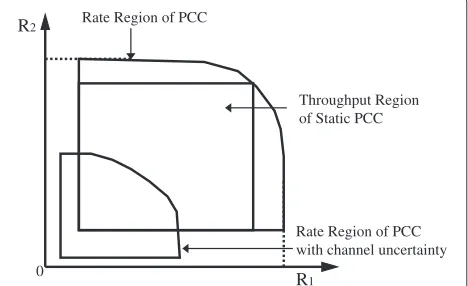
It is noted that with PCC such as in [12,13], the crosstalk canceller taps are allocated at system start-up, and this allocation then remains fixed during run-time. Such a static resource allocation corresponds to a point on the boundary of the rate region for a given crosstalk canceller tap budget Ctotal, and generates a rectangular through-put region which is only a part of the rate region. For a two-user scenario, the rate region and the rectangu-lar throughput region of a static resource allocation are
shown in Figure 1. Therefore we propose a dynamic resource allocation approach, so as to reach all points of the rate region, i.e., to maximize the throughput region.
Partial crosstalk cancellation as a static resource allo-cation algorithm, relies on the following weighted-sum optimization problem:
C = argmax
cnk,m,∀k,m,n=m N
n=1
WnRn
s.t.: K
k=1
N
n=1
N
m=1,m=n
cnk,m≤Ctotal,
whereC is the optimal crosstalk canceller allocation, and theWnis the weight or priority given to usern.
Our objective is to preserve the dynamic transmission queueing stability under the dynamic transmission queue-ing model (5). Intuitively, a user with a long queue should get a high priority in the dynamic resource allocation. In the max-weight (MW) algorithm [24], the instanta-neous queue lengths are used to represent the priority of the users in the resource allocation. Adopting this in the PCC context leads to the MW-PCC algorithm defined as follows.
Definition 5. (MW-PCC). For each time slot, the opti-mal resource allocation of the PCC is computed as:
C (t) = argmax {cnk,m,∀k,m,m=n}
N
n=1
Qn(t)Rn
s.t.: K k=1
N
n=1
N
m=1,m=n
cnk,m≤Ctotal.
(8)
Remark 1.By applying MW-PCC, the throughput region is maximized to the convex hull of the rate region for the given resource budget Ctotal. When the mean arrival rate vector is strictly interior to this throughput region, the transmission queues will not grow to infinity[24].
0 R
1
R2 Rate Region of PCC
Rate Region of PCC with channel uncertainty
Throughput Region of Static PCC
To dynamically allocate the physical layer resources based on the instantaneous queueing status, problem (8) needs to be solved for each time slot. We use a Lagrange dual decomposition approach to solve the optimization problem efficiently [14], by which the budget constraint (3) is moved into the objective function together with a Lagrange multiplierπ≥0 as follows:
min
π≥0cnk,m,∀kmax,n,(m,m=n)
N
n=1
Qn(t)Rn+π
× ⎛ ⎝Ctotal−
K
k=1
N
n=1
N
m=1,m=n cnk,m
⎞ ⎠ ⎞ ⎠.
The detailed description of the MW-PCC algorithm with dual decomposition is presented in Algorithm 1. In the inner loop, the Lagrange multiplier π is fixed, and the problem is decoupled over tones [14]. Furthermore, unlike in spectrum balancing, allocating more resources to a particular user, i.e., deploying more crosstalk canceller taps, will not cause additional crosstalk to other users. This makes a further decoupling over the users possible. Finally, since the largest crosstalk is to be removed first, with an ordering based on the crosstalk magnitudes [14], the per-tone search space is dramatically reduced from (2N−1)N to N − 1, which can be easily covered by an exhaustive search. In the outer loop, the Lagrange mul-tiplierπ is updated by a subgradient approach with an adaptive step-sizeδas presented in [27].
Algorithm 1 MW-PCC For each time slot: whileC=Ctotal
forn=1to N
fork=1to K Cnk =argmax{cn,m
k ,∀k,m,m=n}Q n(t)bn
k
−πNm=1,m=ncnk,m
end for end for
updateπ
end while C converges toCtotal Update the queue lengths by (5)
Features of MW-PCC
In this section we investigate three important features of PCC. From these features we will see that MW-PCC offers far more than a basic function of preserving dynamic transmission queueing stability.
Robustness against channel uncertainty
In the system model, we assume that perfect CSI is avail-able. For a practical vectored DSL system, the CSI is
acquired at system start-up, and is continuously tracked during run-time at low speed due to the quasi-static nature of the DSL channels [28]. This process generally leads to CSI uncertainty. Furthermore, ON/OFF events of alien crosstalk, i.e., crosstalk from uncoordinated users, during run-time can also change the CSI significantly. When an alien crosstalker begins to interfere with the coordinated users, the physical layer performance of the DSL system may be severely degraded. An exemplary rate region of PCC under channel uncertainty is given in Figure 1.
A framework of dynamic resource allocation under CSI uncertainty is presented in [29]. For a system with CSI uncertainty, the throughput region is reduced, but any mean arrival rate vector located inside the reduced throughput region is still stabilizable by the MW algo-rithm.
To observe the performance of MW-PCC under the CSI uncertainty, a set of simulations is shown in the Section VI. The result conforms to the conclusion of [29], that the stability of the queues can be preserved by MW-PCC.
Frequency selectivity of resource allocation
In MW-PCC, dynamic weights are assigned to the users, and this leads to a dynamic allocation of the crosstalk can-celler taps to the users. Observing the crosstalk cancan-celler taps allocation over the tones during a long term simula-tion, it is seen that this allocation exhibits some type of frequency selectivity.
We consider a four-user upstream VDSL2 scenario, with two long lines of 1,500 m (User 1 and 2) and two short lines of 900 m (User 3 and 4), which are all connected to the same AN. The crosstalk canceller budget is set to 30% of full cancellation, i.e.,Ctotal=0.3×CFull. Observing the crosstalk canceller taps allocation on individual tones, we find that for some tones, the allocation is rarely changed, i.e., the resource allocation for these tone is relatively
static.
Figure 2 shows the average number of crosstalk can-celler taps allocated to individual tones over 1,000 time slots. From this figure, we observe that:
• Some tones are allocated with an approximately integer average number of the crosstalk canceller taps, namely the tones with the relativelystatic resource allocation.
• Among thesestatic tones, some tones are always allocated with crosstalk canceller taps, whilst others are never allocated with any crosstalk canceller taps.
0 500 1000 1500 2000 2500 3000 0
0.5 1 1.5 2 2.5 3
Tones
Average Crosstalk Canceller Taps
User 1 User 3
Figure 2average number of crosstalk canceller taps allocated onto the tones.
This frequency selectivity of the resource allocation originates from the nature of the DSL channel. By remov-ing the 30% most dominant crosstalk, 80 to 90% of the transmit rate improvement of full crosstalk cancellation can be achieved [13]. Further increasing the crosstalk canceller tap budget will have little improvement on the transmit rates. Therefore the tones with dominant crosstalk are always allocated with crosstalk canceller taps. Removing the crosstalk on some of the remaining tones does not contribute much to the transmit rate, and hence these tones are always allocated with few crosstalk canceller taps.
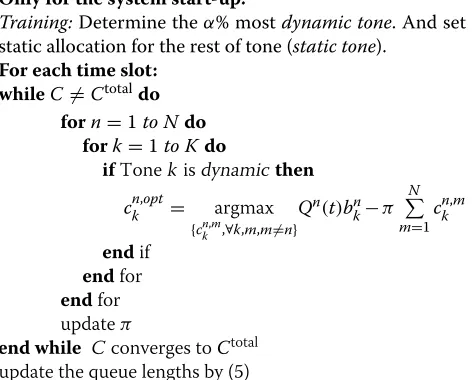
Based on the above observation, we propose a partial-dynamic MW-PCC (PD-MW-PCC) resource allocation algorithm. In this algorithm, only a subset of the tones is dynamically allocated with crosstalk canceller taps, while the other tones have a static allocation. In this way the computational complexity of the resource allocation algo-rithm is reduced. First we definestatic tones, anddynamic tones.
Definition 6.(Static tones). The static tones will be allocated with a constant numbers of crosstalk canceller taps.
Definition 7.(Dynamic tones). The dynamic tones will be dynamically allocated with crosstalk canceller taps.
As a predefined parameter, we setα% of all tones to be
dynamic tones. First, in a training phase at system start-up, a dynamic allocation is obtained, as represented in Figure 2. Thenα% of the most dynamic tones will be set asdynamic tones. The rest of the tones will be set asstatic tones. In this way, the number of MW-PCC inner loop is reduced fromKtoα%×K.
The simulation results of PD-MW-PCC show a near-optimal performance compared to the MW-PCC, where the gap to the optimal performance obviously depends on the choice ofα.
Resource allocation update rate
In order to achieve optimal performance, the resource al-location should be updated at a sufficiently high rate, such that MW-PCC can adapt sufficiently fast to the evolution of the queue lengths. Since the arrival processes are mod-eled as random processes, the optimal update rate, should be chosen to correspond to the time duration, in which the random processes can be considered as stationary. In this way, the instantaneous queue lengths accurately represent the dynamic behavior of the arrival processes.
In the current DSL system, the symbol rate is 4,000 sym-bols per second, thus the largest possible update rate is 0.25 ms. However, next to the computational complexity, the signaling overhead at such a high update rate will be enormous. Consider an AN with MW-PCC implemen-tation. The resource allocation update requires CSI and instantaneous queue length information. For the down-stream, the queue length information is available at the AN, but for the upstream, the queue lengths at the user side have to be reported from the CPEs to the AN.
For the upstream, the CSI can be updated at the AN, but for the downstream, updated CSI has to be reported from the CPE to the AN. From the implementation point of view, we thus look for a trade-off between the opti-mal resource allocation update rate and the signaling overhead.
Algorithm 2 Partial-dynamic MW-PCC Only for the system start-up:
Training:Determine theα% mostdynamic tone. And set static allocation for the rest of tone (static tone).
For each time slot: whileC=Ctotaldo
forn=1to Ndo fork=1to Kdo
ifTonek is dynamicthen
cnk,opt= argmax
{cnk,m,∀k,m,m=n}
Qn(t)bnk−π
N
m=1
cnk,m
endif
endfor
endfor updateπ
end while C converges toCtotal update the queue lengths by (5)
Simulation results will show that the delay performance under reduced update rate is near-optimal, the negative effect of reducing the update rate being minor, and that the transmission stability is not affected.
Budget adaptive MW-PCC
instantaneous transmit rate vector of MW-PCC always lies on the boundary of the rate regionR. When the mean arrival rate vector is close to the boundary of the rate region, stability is preserved but the delay performance may be poor. When the mean arrival rate vector is far from the boundary of the rate region, the delay perfor-mance may be much better. The MW-PCC is then found to lack flexibility in its resource allocation as it always allocates all the available resources. In this section we pro-pose a budget adaptive MW-PCC, in which instead of a fixed crosstalk canceller budget, an instantaneous budget is determined by the instantaneous queue lengths.
Minimum budget for stability
Considering different crosstalk canceller tap budgets smaller than a budgetCtotal, the set of all possible through-put regions can be constructed = { Throughput(C) :
C ≤ Ctotal}. For any stabilizable mean arrival rate vec-tor, there must be at least one throughput region from
that contains this vector. The throughput region with smallest crosstalk canceller tap budget, that can stabilize this mean arrival rate vector, has the shortest distance between the mean arrival rate vector and the boundary of the throughput region. A similar concept for transmit energy is introduced in [25,26].
Definition 8.(Minimum budget for stability). For a mean arrival rate vector ∈R(4), the minimum required crosstalk canceller tap budget for stability Cleastis defined as:
Cleast=min K
k=1
N
n=1
N
m=1,m=n cnk,m
s.t. R≥ ,
(9)
where R is the resulting transmit rate vector when the crosstalk cancellation is defined by the cnk,ms.
The minimum budget preserves stability, but leads to the poorest delay performance for the given mean arrival rate vector. In other words, any crosstalk canceller tap budget larger than this minimum budget can provide a better delay performance.
Budget adaptive MW-PCC
Based on the above statement, we propose a budget adap-tive MW-PCC (BA-MW-PCC) algorithm. In this algo-rithm, the instantaneous crosstalk canceller tap budget
C(t)=Nk=1Nn=1Nm=1,m=ncnk,min time slottis deter-mined by the instantaneous queue lengths. We define a cost constantV, and introduce a penalty term−V×C(t) into (8). For each time slot, we allocate the crosstalk
cancellation taps according to the following optimization problem:
C (t)= argmax {cnk,m,∀k,m,m=n}
N
n=1Qn(t)Rn−VC(t)
s.t.: C(t)≤Ctotal,
(10)
whereCtotalis the maximum crosstalk canceller tap bud-get. In order to achieve the largest possible throughput region, in the rest of the article we chooseCtotal=CFull.
In this optimization problem, the weighted transmit rate sum is penalized by the crosstalk canceller tap budget, so that the instantaneous transmit rate vector is no longer constrained to lie on the rate region boundary of a fixed budget. When the queues are short, the penalty term (the second term in the right hand side of (10)) is more domi-nant than the first term, and as a result only few crosstalk cancellers taps will be allocated. As the queues grow, the first term could take over from the penalty term, and more crosstalk cancellers taps will be allocated. In this way, the resource budget is flexible and efficient, and dependent on the instantaneous queue lengths.
The penalty term is parameterized byV. For the same arrival process, ifV is small, the penalty is insignificant, and results in high transmit rates and a good delay per-formance. If V is large, then the crosstalk canceller tap budget is tightened, and the delay performance may be poor. Hence a trade-off between delay performance and resource consumption is realized.
Remark 2.For any positive number V, the dynamic transmission queueing system is always stabilized, as long as the mean arrival rate vector is strictly interior to the throughput region corresponding to the maximum crosstalk canceller tap budget CFull. A proof of this is given in the Appendix.
Remark 3.The cost constant V is not necessarily posi-tive. If the cost constant V is not positive, the objective func-tion (10) is monotonically increasing with respect to the crosstalk canceller tap budget. This leads to full crosstalk cancellation, i.e., C(t)=CFull.
Algorithm 3 BA-MW-PCC For each time slot:
C (t)= argmax {cnk,m,∀k,m,m=n}
N
n=1
Qn(t)Rn−VC(t)
s.t. : C(t)≤Ctotal
0 0.5 1 1.5 2 x 10⁵ 0
200 400 600
Time Slot
Queue Length [Mbit]
User 1 User 3
Figure 3Dynamic queue lengths.
Total queue length tracking BA-MW-PCC
We introduce a further extension of the BA-MW-PCC algorithm. A different choice of the cost constant V is known to result in a different delay performance. How-ever, the relation between the delay performance and the resource consumption is non-analytic. In order to achieve a specific delay performance, the cost constantV
is replaced by a dynamic cost indexV(t), which is updated based on a “Total queue length”(t) = Nn=1Qn(t), as follows,
V(t)=V(t−1)+δ(target−(t)), (11)
where target is the target total queue length. δ is a constant step-size, for which we choose a small positive number. After updating the cost indexV(t), the remaining procedure is the same as BA-MW-PCC.
With this dynamic cost indexV(t), the crosstalk can-celler tap budget is regulated by the difference between the instantaneous and the target total queue length. Note that
this algorithm is only able to track the target total queue lengthtarget, but not precisely constrain to it.
The significance of this dynamic penalty term is that the highly coupled relationship between the delay perfor-mance and the resource consumption is bypassed.
Remark 4.If the transmit rates are always sufficiently large to transmit the whole queue before the new data arrives, the instantaneous total queue length is minimized and hence the long-term average of the total queue length is lower bounded by:
lim
T→∞ T
t=0
N
n=1
Qn(t)≥
N
n=1 E(An).
Hence, anytarget smaller than this bound will result in negative V(t), and full crosstalk cancellation.
Algorithm 4 Total queue length tracking bA-MW-PCC For each time slot:
Update V(t):
V(t)=V(t−1)+δ(target−
N
n=1
Qn(t))
C (t)= argmax {cnk,m,∀k,m,m=n}
N
n=1
Qn(t)Rn−V(t)C(t)
s.t. : C(t)≤Ctotal
Update the queue lengths by (5)
Individual queue length tracking BA-MW-PCC
In the total queue length tracking BA-MW-PCC, all the users in the system are considered as a whole, and the
0 0.2 0.4 0.6 0.8 1 1.2 1.4 1.6 1.8 2
x 105
6 8 10
User 1, [Mbit/s]
Time Slot
0 0.2 0.4 0.6 0.8 1 1.2 1.4 1.6 1.8 2
x 105
56.2 56.4 56.6
Time Slot
User 3, [Mbit/s]
0 2 4 6 8 10 x 104 100
200 300
Time slot
System Delay, [Mbit]
30% 40% 50%
Figure 5System delay versus crosstalk canceller tap budget.
individual delay performance of each user is not taken into account. Fairness between the users and the individual delay performance demands are not considered. Alterna-tively, we set a target queue lengthQn,targetfor each user, and correspondingly a dynamic cost indexVn(t)for each user. In each time slot, the dynamic cost indexVn(t) of each user is updated as follows,
∀n∈N:Vn(t)=Vn(t−1)+δ(Qn,target−Qn(t)), (12)
where the step-size δ is a small positive number. After updating the cost index Vn(t),∀n, the remain-ing procedure is the same as BA-MW-PCC, except that the penalty term −Nn=1(Vn(t)Cn(t)) (Cn(t) =
K
k=1
N
m=1,m=ncnk,m), is computed in per-user fashion.
As a result, the queue length of each user is always con-trolled towards the target queue length.
Remark 5.Similar to Remark 4, a target queue length Qn,target smaller thanE(An), results in full crosstalk can-cellation for user n.
Algorithm 5 Individual queue length tracking BA-MW-PCC For each time slot:
∀n: UpdateVn(t):
Vn(t)=Vn(t−1)+δ(Qn,target−Qn(t))
C (t)= argmax {cnk,m,∀k,m,m=n}
N
n=1
Qn(t)Rn− N
n=1
(Vn(t)Cn(t))
s.t. : C(t)≤Ctotal
Update the queue lengths by (5)
Simulation results
The simulations are performed for a VDSL2 upstream scenario with four users, two 1,500 m long lines (user 1
and 2) and two 900 m short lines (user 3 and 4), which are connected to the same AN. The diameter of the twisted pair lines is set to 0.5 mm. The coding gain is set to 3 dB and the noise margin is set to 6 dB. The target error prob-ability is 10−7. The tone spacing
f is 4.3125 kHz and
2,786 tones ranging from 0 Hz to 12 MHz are used. The symbol ratefs is 4, 000 Hz. We fix the transmit power at
−60 dBm/Hz on all the tones.
Performance of MW-PCC
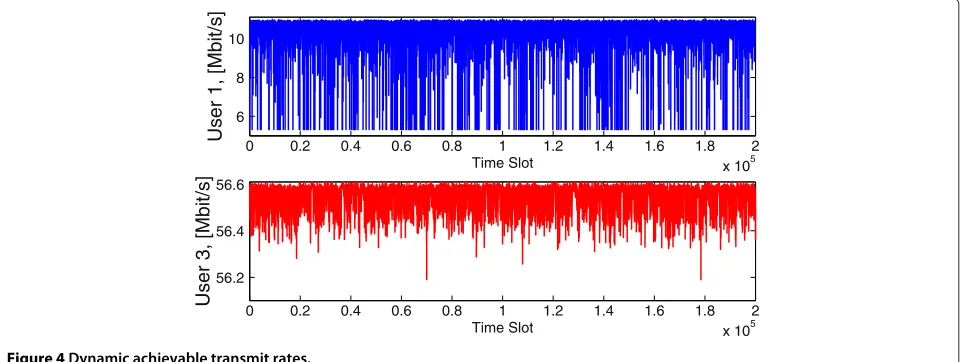
The arrival processes are randomly generated with a uni-form distribution, whose mean arrival rate vector is close to the boundary of throughput region. The queue lengths and the achieved transmit rates are shown as a function of the time in Figures 3 and 4, respectively. We can see that the dynamic transmission queueing system is stabilized by the dynamic resource allocation.
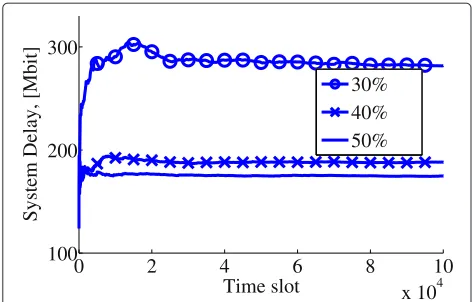
In Figure 5, the relationship between the system delay and crosstalk canceller tap budget is shown. The mean arrival rate vector is close to the throughput region boundary for a 30% crosstalk canceller tap budget. By increasing the budget from 30 to 40% and 50%, the system delay is improved.
We investigate a typical scenario of CSI uncertainty, where the channel gain|H|2is degraded by the error in CSI. The resulting degradation in SNR has a Gaussian dis-tribution over all the tones, with a mean value of−3 dB and variance of 1. In Figure 6, we can see that the system delay is slightly larger then the system delay under perfect CSI, however, stability is still preserved.
To verify the robustness against alien crosstalk, we assume that the system starts with no alien crosstalk. In the first stage of Figure 7, the dynamic transmission queueing system is stable. Then a 600 m user is added to the system, which introduces the alien crosstalk. Although the system delay increases rapidly, it converges to a new
0 0.5 1 1.5 2
x 105 100
200 300 400
Time Slot
System Delay, [Mbit]
Channel Estimiation with 3 dB error Ideal Channel Estimation
0 1 2 3 4 5 x 10⁵ 50
100 150 200 250
Time slot
System Delay, [Mbit]
Figure 7System delay under alien crosstalk.
stable level. The MW-PCC is thus seen to be robust against unknown alien crosstalk up to a certain degree.
The performance of the Partial Dynamic MW-PCC algorithm is evaluated with two settings: allocation scheme(A)is a “conservative” one, where 85% of the tones are dynamic, and allocation scheme(B)is an “aggressive” one, where only 50% of the tones are dynamic. The result-ingstatic tonesare shown in Figure 8. (Thedynamic tones
are not plotted.)
The delay performance of the Partial Dynamic MW-PCC algorithm is given in Figure 9, with the delay perfor-mance of the fully dynamic MW-PCC as reference. The “conservative” scheme has a performance very close to the reference, whilst the “aggressive” scheme has a degraded performance, but stability is still preserved.
Finally we consider the effect of a non-optimal resource allocation update rate. For reference, we adopt a 1 Hz resource allocation update rate as the optimal update rate, i.e. the arrival process is statistically time-homogenous within in the interval of one second. In non-optimal algo-rithm, the time slot is expanded by a factor of 50, i.e., the resource allocation is updated only every 50 s. The result-ing delay performance is shown in Figure 10. Despite the fact that the arrival process is no longer statistically
time-0 500 1000 1500 2000 2500 3000
0 0.5 1 1.5 2 2.5 3
Static Crosstalk Canceller Allocation
Tones
Scheme A, User 1 Scheme A, User 3
Scheme B, User 1 Scheme B, User 3
Figure 8Static crosstalk canceller tap allocation.
0 0.5 1 1.5 2
x 105 0
500 1,000 1,500
Time slot
System Delay, [Mbit]
"Aggresive Setting" "Conservative Setting" Reference
Figure 9Delay performance of PD-MW-PCC.
homogeneous within one time slot, the system delay is close to the optimal one.
Performance of BA-MW-PCC
In this section we investigate the performance of the bud-get adaptive algorithms. First we run simulations with two different mean arrival rate vectors, where one is inside the rate region of 30% crosstalk cancellation and the other is outside this rate region. In Figure 11, we can see that the fixed budget (30%) MW-PCC can only stabilize the arrival process with mean arrival rate vector inside the rate region (unstable procedure of the mean arrival rate vector outside the rate region not shown). With a ran-domly chosen cost constantV = 10, the BA-MW-PCC can stabilize both arrival processes, by adaptively tuning the instantaneous budget. On average, the BA-MW-PCC uses 22.7% of CFull to stabilize the arrival process with mean arrival rate vector inside the rate region, and uses 33.1% ofCFullfor the mean arrival rate vector outside the rate region. Therefore the BA-MW-PCC is more resource efficient than fixed budget MW-PCC, when stabilizing the same arrival process. Moreover, the throughput region is flexible for BA-MW-PCC, by adjusting the crosstalk canceller tap budget.
0 0.5 1 1.5 2
x 105 0
200 400 600 800 1000
Time Slot
System Delay, [Mbit] Update at every 50 time slot
Update at every time slot
0 0.2 0.4 0.6 0.8 1 1.2 1.4 1.6 1.8 2
x 105
0 200 400 600 800
Time Slot
System Delay, [Mbit]
a: V=10, large arrival vector b: V=10, small arrival vector c: fixed budget, small arrival vector
Figure 11Comparison of BA-MW-PCC and MW-PCC.
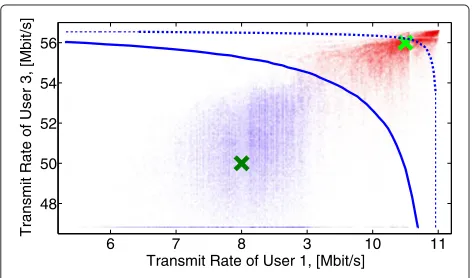
To further exploit the resource efficiency of the BA-MW-PCC, we consider a scenario with two phases with different mean arrival rate vectors. In Figure 12 two rate region contours, which are generated by 30% ofCFull(solid line) and 50% ofCFull (dashed line), and two correspond-ing mean arrival rate vectors, marked by the cross, are shown. The resulting distribution of the instantaneous transmit rate vectors are demonstrated as cloud (here V = 10). We can see that the transmit rates are no longer con-strained by the fixed budget, and distributed around the mean arrival rate vector. When the mean arrival rate vec-tor changes, the transmit rate vecvec-tors distribution adapts to the change.
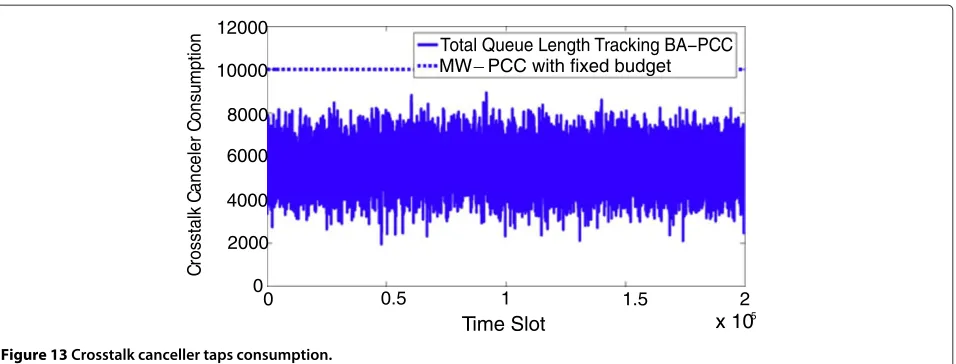
The resource efficiency of the total queue length track-ing BA-MW-PCC is demonstrated in Figure 13. First we obtain a system delay for an arrival process with MW-PCC as reference. Setting this total queue length as the target total queue length, the Total Queue Length Track-ing BA-MW-PCC can reach the same delay performance, where the resource consumption is obviously lower than for MW-PCC.
6 7 8 3 10 11
48 50 52 54 56
Transmit Rate of User 1, [Mbit/s]
Transmit Rate of User 3, [Mbit/s]
Figure 12BA-MW-PCC transmit rate distribution.
Conclusion
A dynamic PCC resource allocation algorithm has been proposed, referred to as MW-PCC, which dynamically allocates crosstalk canceller taps so as to stabilize the dynamic arrival data of the system and to maximize the throughput region. Based on the frequency selectivity of DSL network channel, we proposed Algorithm 2, which can reduce the computational complexity of resource allocation, with a slight loss in delay performance. Budget adaptive algorithms (Algorithms 3, 4 and 5) have also been proposed, which not only achieve the same delay performance as MW-PCC, but also dynamically adapt the crosstalk canceller tap budget so as to obtain a bet-ter resource efficiency. Algorithm 4 focuses on the delay performance target of the whole system, while Algorithm 5 further enables an explicit per-user delay performance target.
Appendix
BA-MW-PCC stability proof
We define the textitquadratic Lyapunov function and the
Lyapunov drift of the dynamic transmission queueing system as follows,
Definition 9.(Quadratic Lyapunov function). The quadratic Lyapunov function of the dynamic transmission queueing system is defined as the quadratic sum of the instantaneous queue lengths:
L(Q(t))=
N
n=1
(Qn(t))2.
x 10 0
0 0.5 1 1.5 2
2000 4000 6000 8000 10000 12000
Time Slot
C
rosstalk C
an
celer
C
onsumption
Total Queue Length Tracking BA−PCC MW PCC with fixed budget
5 _
Figure 13Crosstalk canceller taps consumption.
the expectation of the difference of the quadratic Lyapunov function between two consecutive time slots:
(Q(t))=E[L(Q(t+1))−L(Q(t))| Q(t)] . (13)
Considering the dynamics of the queue lengths (5), we distinguish between two cases:
if Qn(t)−Rn(t)≤0; then Qn(t+1)=An(t). (14)
or
if Qn(t)−Rn(t) >0; then Qn(t+1)=Qn(t)
−Rn(t)+An(t). (15)
In (14), the transmit rate is larger than the previous queue length. If this is the case for all time slots and all users, then the expectation of the queue length of usernis equal to the mean arrival rateλn, which is bounded byωn. Thus the queue lengths will not go to infinity, and stability is preserved.
The stability proof focuses on the second case (15) as a worst case, where the queue may have residual data from the previous time slot. The resulting instantaneous queue length could be larger than the arrival data. We assume this is the case for at least one user at each time slot, i.e., at least one user’s queue length is growing. Then (5) is simplified to:
Qn(t+1)=Qn(t)−Rn(t)+An(t). (16)
We expand the Lyapunov drift with (16) at time slott:
(Q(t))=
N
n=1
E[(Qn(t+1))2−(Qn(t))2| Q(t)]
=
N
n=1
E[(An(t))2+(Rn(t))2| Q(t)]
+
N
n=1
2Qn(t)E[(An(t)−Rn(t))| Q(t)]
−
N
n=1
2E[(An(t)Rn(t))| Q(t)] . (17)
Regardless of the time slot, the arrival rate of usernis bounded by ωn, and the transmit rate is limited by the maximum transmit rateRnmaxas defined in (2). We define a constantBto replace the first item on the right hand side of (17):
N
n=1
E[(An(t))2+(Rn(t))2| Q(t)]≤
N
n=1 (ωn)2+
N
n=1
(Rnmax)2=B.
Also,An(t)is independent ofQn(t), as the arrival pro-cess is not dependent on the instantaneous queue length
Qn(t), therefore we replaceE[(An(t)| Q(t)] with λn, and we obtain the following inequality from (17):
(Q(t))≤B+ N
n=1
2Qn(t)λn−
N
n=1
2Qn(t)E[Rn(t)| Q(t)]
−
N
n=1
Then we remove the last term of the right hand side of (18), which is negative, and introduce the instantaneous penalty function−V×C(t)of the resource consumption into (18):
(Q(t))≤B+
N
n=1
2Qn(t)λn−VE[C(t)| Q(t)]
− N
n=1
2Qn(t)E[Rn(t)| Q(t)]−VE[C(t)| Q(t)]
.
(19)
Suppose we have a vector =[12. . . n]T that
satisfies λn + n < ωn and = + ∈
Throughput. From Theorem 8, there is a Cleast, =
K
k=1
N
n=1
N
m=1,m=ncnk,m, that can stabilize . We
introduce Cleast, into the right hand side of (19), and
remove the negative term −VE[C(t)| Q(t)]). Then we take the expectation over the distribution ofQ(t):
(Q(t))=E[L(Q(t+1))−L(Q(t))]≤B+VCleast,
−2
N
n=1
nQn(t). (20)
As (20) is valid for all time slots, we sum it over all time slotst∈ {0, 1,. . .,T−1}and divide the sum byT:
1
TE[L(Q(T))−L(Q(0))]≤B+VC
least,
−2
T T−1
τ=0
N
n=1
nQn(τ ). (21)
The positive term T1E[L(Q(T))] in the left hand side of (21) can be ignored. By manipulating (21) again, we obtain:
1
T T−1
τ=0
N
n=1
Qn(τ )≤ 1 2min
B+VCleast,+ 1
TL(Q(0))
,
(22)
wheremin = min(1,2,. . .,n). The left side of (22) is the long-term average of the queue lengths, i.e., the system delay. It is bounded by the constantsB,V,and the initial status ofQ(0). If the initial statusQ(0)is not infinity, then the queue lengths will not grow to infinity, which proves the stability of BA-MW-PCC.
Remark 6.The upper bound for the system delay given in (22) is not a tight bound.
Remark 7. If the cost constant V is zero, the BA-PCC is equal to BA-PCC. Therefore the stability of MW-PCC is also proved.
Competing interests
The authors declare that they have no competing interests.
Acknowledgements
This research work was carried out at the ESAT Laboratory of the Katholieke Universiteit Leuven, in the frame of Concerted Research Action GOA-MaNet, the EC-FP6 project SIGNAL: Core Signal Processing Training Program, the Belgian Programme on Interuniversity Attraction Poles initiated by the Belgian Federal Science Policy Office IUAP P6/04 (DYSCO, ‘Dynamical systems, control and optimization’), Research Project FWO nr.G.0235.07 (‘Design and evaluation of DSL systems with common mode signal exploitation’) and IWT Project ‘iSEED: Innovation on stability, spectral and energy efficiency in DSL’ and IWT Project ‘PHysical layer and Access Node TEchnology Revolutions: enabling the next generation broadband network’ (PHANTER). Paschalis Tsiaflakis is a postdoctal fellow funded by the Research Foundation-Flanders (FWO). This article has partly appeared in the proceeding of the IEEE Global Telecommunications Conference (GLOBECOM) 2010, Miami, Florida, Dec 2010. [23]
Author details
1Department of Electrical Engineering (ESAT-SCD), Katholieke Universiteit
Leuven, Leuven, Belgium.2Alcatel-Lucent Bell Labs, Antwerp, Belgium.
Received: 23 September 2011 Accepted: 4 June 2012 Published: 19 July 2012
References
1. T Mastrangelo, Annual Market Outlook Update. www.broadbandtrends. com 2008, Report 08-1120 v1
2. R Cendrillon, W Yu, M Moonen, J Verlinden, T Bostoen, Optimal multiuser spectrum balancing for digital subscriber lines. IEEE Trans. Commun. 54(5), 922–933 (2006)
3. R Cendrillon, M Moonen, Iterative spectrum balancing for digital subscriber lines. inIEEE International Conference on Communications (ICC),
vol. 3 (2005), pp. 1937–1941
4. W Yu, R Lui, Dual methods for nonconvex spectrum optimization of multicarrier systems. IEEE Trans. Commun.54(7), 1310–1322 (2006) 5. P Tsiaflakis, M Diehl, N Moonen, Distributed spectrum management
algorithms for multiuser DSL networks. IEEE Trans. Signal Process.56(10), 4825–4843 (2008)
6. R Moraes, B Dortschy, A Klautau, J Riu, Semi-blind power allocation for digital subscriber lines. inIEEE International Conference on
Communications (ICC)(2008), pp. 1420–1425
7. R Cendrillon, J Huang, M Chiang, M Moonen, Autonomous spectrum balancing for digital subscriber lines. IEEE Trans. Signal Process.55(8), 4241–4257 (2007)
8. W Yu, G Ginis, J Cioffi, Distributed multiuser power control for digital subscriber lines. IEEE J. Sel. Areas Commun.20(5), 1105–1115 (2002) 9. V Oksmanm, H Schenk, A Clausen, J Cioffi, M Mohseni, G Ginis, C Nuzman,
J Maes, M Peeters, K Fisher, PE Eriksson, The ITU-T’s new G.vector standard proliferates 100 Mb/s DSL. IEEE Commun. Mag.48(10), 140–148 (2010) 10. International Telecommunication Union, Self-FEXT Cancellation
(Vectoring) for use with VDSL2 Transceivers. ITU-T Rec. G.993.5(G.Vector) 2009
11. G Ginis, J Cioffi, Vectored transmission for digital subscriber line systems. IEEE J. Sel. Areas Commun.20(5), 1085–1104 (2002)
12. R Cendrillon, M Moonen, G Ginis, K van Acker, T Bostoen, P Vandaele, Partial crosstalk cancellation for upstream VDSL. EURASIP J. Appl. Signal Process.2004, 1520–1535 (2004)
13. R Cendrillon, G Ginis, M Moonen, K van Acker, Partial crosstalk precompensation in downstream VDSL. Elsevier Signal Process. Spec Issue Signal Process. Commun.84(11), 2005–2019 (2004)
14. J Vangorp, P Tsiaflakis, M Moonen, J Verlinden, G Ysebaert, A dual decomposition approach to partial crosstalk cancelation in a multiuser DMT-xDSL environment. EURASIP J. Adv. Signal Process.2007(37963), 1–11 (2007)
15. AR Forouzan, LM Garth, Computationally efficient partial crosstalk cancellation in fast time-varying DSL crosstalk environments. EURASIP J. Appl. Signal Process.2007, 42–42 (2007)
17. P Tsiaflakis, Y Yi, M Chiang, M Moonen, Green DSL: energy-efficient DSM. inIEEE International Conference on Communications (ICC)(2009) 18. A Foglar, R Polig, PlaNetS QoS Solution 2007, http://www.medea-planets.
eu/QoSsolution.php?page=home
19. E Areizaga, A Foglar, AJ Elizondo, F Geilhardt, Enabling broadband as commodity within access networks: a QoS recipe. Lecture Notes of the Institute for Computer Sciences, Social Informatics and
Telecommunications Engineering, vol. 6, (2009)
20. P Tsiaflakis, Y Yi, M Chiang, M Moonen, Throughput and delay of DSL dynamic spectrum management with dynamic arrivals. inIEEE Global Telecommunications Conference(Globecom)(2008)
21. K Seong, R Narasimhan, J Cioffi, Queue proportional scheduling via geometric programming in fading broadcast channels. IEEE J. Sel. Areas Commun.24(8), 1593–1602 (2006)
22. J Cioffi, M Brady, V Pourahmad, S Jagannathan, W Lee, Y Kim, C Chen, K Seong, D Yu, M Ouzzif, H Mariotte, R Tarafi, G Ginis, B Lee, T Chung, P Silverman, Inc A, Vectored DSLs with DSM: The road to Ubiquitous Gigabit DSLs, 2008
23. B Li, P Tsiaflakis, M Moonen, J Maes, M Guenach, Dynamic resource allocation based partial crosstalk cancellation in DSL networks. inIEEE Global Telecommunications Conference(Globecom)(2010)
24. L Georgiadis, MJ Neely, L Tassiulas, Resource allocation and cross-layer control in wireless networks. Found. Trends Netw.1, 1–144 (2006) 25. M Neely, Energy optimal control for time-varying wireless networks. IEEE
Trans. Inf. Theory.52(7), 2915–2934 (2006)
26. M Neely, E Modiano, C Rohrs, Dynamic power allocation and routing for time-varying wireless networks. IEEE J. Sel. Areas Commun.23, 89–103 (2005)
27. P Tsiaflakis, J Vangorp, M Moonen, J Verlinden, K Van Acker, An efficient search algorithm for the lagrange multipliers of optimal spectrum balancing in multi-user xDSL systems. inIEEE International Conference on Acoustics, Speech and Signal Processing (ICASSP),vol. 4 (2006), pp. IV–IV 28. Alcatel-Lucent, G.vector: On the tracking speed required for changing
crosstalk channels (update). ITU-T SG15/Q4 RJ-062 2007
29. A Pantelidou, A Ephremides, A Tits, A cross-layer approach for stable throughput maximization under channel state uncertainty. Wirel. Netw. 15, 555–569 (2009)
doi:10.1186/1687-6180-2012-150
Cite this article as:Liet al.:Dynamic partial crosstalk cancellation resource allocation algorithms for DSL access networks.EURASIP Journal on Advances
in Signal Processing20122012:150.
Submit your manuscript to a
journal and benefi t from:
7Convenient online submission 7Rigorous peer review
7Immediate publication on acceptance 7Open access: articles freely available online 7High visibility within the fi eld
7Retaining the copyright to your article
![Figure 1.A framework of dynamic resource allocation underCSI uncertainty is presented in [29]](https://thumb-us.123doks.com/thumbv2/123dok_us/1139368.1142935/5.595.59.290.188.262/figure-framework-dynamic-resource-allocation-undercsi-uncertainty-presented.webp)