SUBSTITUTBD ACBTATBS AND SUBSTITt.rrEO FBRROCBNBS
Thesis by Charles Dyer Russell
In Partial Fulfillment of the Requirements For the Degree of
Doctor of PbUosophy
Caltfomta lnGtltute of Tecbnology Pasadena. Callfornta
'TI1e eutho~· \'Jtaheo to e..-:pr~Bs bts gratitude to Professor F'red C • ..t'\nson for hie eucour~ ement end asstGtunce. A debt of gratitude ts also owed many other faculty mcmooro and graduate students of tlw Caltfol"Uia Inotttute of TechnolOff:Y• none of \vhom has ever refusetJ the author .:lSGi~tance or advice when needc..<J.
Financial support by ~he National Scleu~.:;e Foundation, the Callfomll.l Xm:titute of Tl{!chnolo~y, aoo the Sloan Foui:Watt.on le certfdnly apprecia.too.
Chronopotentiometry ·,vas used to study electrode reactlona in acetonitrtle soluttons. Evidem~e l s presented for. the formation
ot
an oxide film on platinum electrodes ln acetonltrlle by reaction with traces of moisture. Oxypn dissolved tn acetonitrile solutions of tetraethylammonium perchlorate ls reduced toperoxide at the platinum electrode, although lt Ia not reduced ln solutions of alkali perob.lorates. The potential -It mltlng background react lone in
tetraethylammonium perchlorate solutions were lnvesttpted by current-reverse cbronopotentlometry.
Oxidation of acetate ton tn acetonitrile gave 91 i:6 ~current yteld of carbon dloxlde and 77±3% ethane. Acetic acid does not react below the anodlc background potential. Oxidation of substituted acetates waa studied chronopotentiometrtcally but traces ot moisture ln the solution were found to react almultaneoualy at the electrode and seriously Interfere. Water ls not oxldlzed below the background potential ln tbe absence of carboxylate ton.
Oxtdatlon potentiate for a series of aubatttuted ferrocenes were measured chronopotentlometrtcally and e.lctence wu found for a new type of netgbbortng-group tnteractlon between the lron tn ferroctntum ton and oxygen, nitrogen. or
halogen in the ring poaltlon. The same substttutuenta did not interact ln the alpha posltton.
A computer program was written for the calculation of kinetic data from totally Irreversible chronopotentlometrlc waves and used to evaluate grapbtcal methods previously proposed. New graphical and algebraic methods were also
Pa.rt
I
II
lli
Chronopotentlometry in Acetonitrile • • • o • • • • • • • o c ••••• • • • • • • • •••• General introduction •••••• ••• • • • • •••••••o••• • • • • • • ••••••••
l£tpe rl mental
Oxldatlon of Platinum Electrode Surfaces
....
.
.
..
...
.
....
..
.
.
Reduction of I:•lssolved OxygenAnodic Eacltground Reaction Cathodic Bacltground Reaction
Electrolytic Oxidation of ~.:ubstituted Acets.te"-1 in AcetonttrUe
Introduc tlon
...
.
...
.
...
.
.
Analysts of Product~; Prom the Blectrolytic Oxidationof Acetate lou tn A•::etonitrlle ....•...••...•. Bxl:)erlmental .•••••••
Results and Dl.scusslon
Chronopotenttometrlc Me<isurements
Experimental Results Dliicusalon
Blect.rolytlc Oxldatlon of Substituted Ferrocenet.. introduction
Results and •·)lscu~~lon
.
.
...
.
...
..
..
.
...
APf'ENDIX Interpro2tation of Totally Irreverl!ilble Chronopotennometrlc Waves. Application to Iodate Reduction in
Aqueous :\.iE!dlt,n1 ..•...•. . . • . . . • . . . . • • . Introduction
Experimental
:{esults and .i)lscusf;ton
2
General Introduction
~1'he first ch..r:onopotenttometric studies ln acetonitrile were the analytical
determinetlon of anthracene iJY Voorhies and Furman (1) and Geske's studies of
the oxidation of tropilldene and tetraphenylborate (2). These were follov;ed by the work of Kuwana, Bublitz and Hoh (3) and of Hoh. McEwen and Kleinberg (4) on substituent effects in the oxidation of metallocene compounds.
Part ! of this the£: is deals \\>i th three rea.ctlons of general lnterest in
acetonitrile electrochemistry. dealing with solutions vvhich contain only supporting
electrolyte and dissolved atmospheric oxygen: oxidation of platinum electrode
surfaces, reduction of dissolved oxygen, and the poteutial-limitlng cathodic and
anodic reactions. Consideration \·..,as restricted to a single electrode material,
plaLimtm, and a sing!e supporting electrolyte. tetraethylammonium perchlorate. h:.rt II deals \Vith the cbronopo'i:entlometric waves for the oxidation of substituted aceta!;;es. Part
In
is an e~r:tcnston and revision of the cited \VOrk on the oxidationof mctallocenes. An appendix discusses methods for the interp1·etation of
totally irreversible chronopotentiometrlc waves in the light of results from a
least-squares treatment by digit..U computer.
Further introductory information is given in each section, pertaining to the· topic at hand. General reviews of chronopotention:etry are given by Delahay (5)
Re<!gents. Acetonitrile. Matheson, Coleman and Bell Practical Grade
acetonitrile -,vas distUleJ three times from phosphorus pentoxide and a flt~al tlme
from Malllnclcrodt anhydrous pota.eslum carbonate. Its acetic acid content was
less than 0.0003 M (determinec1 by titration v,1th aqueous NaOH) a.nd its water
content •Nas roughly 0 . 03 M (as determined by the infrared absorption at l . 9
mlcrm:u;).
Tetraethylammonlum perchlorate. Tetraethylammonium perchlorate was
prepared by the metho<.l of Kolthoff and Goetzee (7) and r~r-ysta.llizt.>Cl from
water five times.
Nitrogen. Lindt1 ::-Jlgh Purlty Dry Nitrogen \vas used without further
purification.
Electrolysis cell. 'The electrolysis cell is Ulustrated in Figure 1-i.
Working and auxiliary electrode compa.ti:rnents were separated by a flne porosity
stntered-glass disk. The .. ·shape of the working electrode compartment was
designed to promote linear dlffusion and current flow perpenc.licubx to the
electrode surfac~ and consequently a un.iform current density over the surface (8).
I'he underside of the working electrode was e;ealed over with glass and connectio~
was macie by .:l spot-welded platinum lead \Vire passing tbrougt1 the glass. The
lead wire was insulated by a length of Teflon spaghetti sealed to the glass wlth
epoxy resin. T~1e reference electrode was connected with the vK>r! lng electrode
compartment in a manner which minimlzed ohmic drop. The electrode area was
calculated as D. 529 cm 2 from the transition time for the reduction of 0.004 M
K3 Fe(CN)6, 1.00 M KCl in water (3). The potentiostatically determined value
Ground Glass Joint
N
2 Inlet for
Deaerati on
-Fine Porosity Fritted Glass
4
Glass Tube
PI ati 11Ul:l Wire 1-+-- - + - - - -- -Auxiliary
.-Plati nu n1 Disk
Wori.<ir~.g Elect.Fode
FIG. I-1
\ ElectroJe
Ball ]vi'1t Socket
von Stackelberg, Pilgram, and Toorne (9) reported for solutions of this composition
was used in the calculation.
Reference electrodes. Two reference electrodes were used, both of which
are illustrated in Figure I -2. The Ag/0. 01 M AgN03, 0. 2 M (C2H5)4NCl04 in
CH3CN reference electrode was used for most measurements. All voltages are
given with reference to this electrode unless otherwise specified. The
silver-silver ion couple has been recommended by a number of authors as a primary
potential reference in acetonitrile (10, 11, 12). Tetraethylammonium perchlorate
was added to eliminate the liquid-junction potential between the reference
electrode and the solution in the cell; this will have affected the electrode
potential somewhat but it ensured reproducibility of the potential measurements.
Leakage from the silver nitrate reference electrode was very low, amounting
to no more than a half drop per hour. It was cleaned, dried and refilled with
fresh silver nitrate solution each day.
The Hg/Hg2S04, K2S04 (sat. aq.) electrode did not function as well in
acetonitrile solutions, its potential drifting about ~ 0. 02 V. It was used to compare
potentials for oxide film formation on the electrode surface in water and in
acetonitrile.
Electronic circuitry. Oscillographic measurements were made using the
transistor current source of Figure I -3. Its circuit was suggested by Professor
C. A. Mead of the California Institute of Technology. It delivered a preset
con-trolled current of 0 to 50 rna in a pulse of preset duration, followed by a second
pulse of independently adjusted current (0 to 50 rna) and duration with opposite
polarity. The duration of the pulses was limited only by the size of the variable
6
REFERENCE ELECTRODES
- + - · - - - - -
0. 01 M .AgN03 , 0. 2 M (C2H5)4NCI04In CH 3CN
SILVER NITRATE REFERENCE ELECTRODE
Ball Joint
--t----
Glasa Tubingr - - t - - - Pt Wire
Saturated Hg2
so
4 and K2s
o
4 ln H2o
Solid Hg2S04 and K2SO 4Hg
MERCUROUS SULFATE REFERENCE ELECTRODE
Rl
CS R6
Cl
C2
R2
B3 Rl5
R3
R9 Rll
C3 R7
OUTPUT
C6
R8 C4
RIO R12
R4
B4 R16
FIG. I-3
CONTROLLED CURRENT SOURCE
TS
8
TABLB 1-1
COMPONENTS FOR CONTROLLED CURRENT SOURCB
Batteries
Bt, B2 83, B4
Capacitors Cl, C2 CS, C4
c
s.
C6Dtodee
Dt, 02 Resistors
Rl -R5
R6 R7, R8 R9. RJO R11-Rl4
RJS, Rt6
Rt7 RJ8 Swltcbes SJ Translators Tl-T.f T5 T6
22-l/2V
1 . 34 V (mercury cell)
External c:Jecade capacitor (•ee tat)
1N1084 (slllcon)
"· 71C 22 M
22 K
l 0 K variable
l K tOO
n.
500
n.
5 K variable
Germautum awltcbloa trauetetora. Obeolete modale
donat«J by the International Buetaee• Macblnea Corporattoa were used.
2Nl13l
leas than 10 mtcrosecouda and the leakage current was leaa than 1/50 mlcroamp. The current was controlled to wltbln 2% over the duration of a pulse and over a
range
ot
outpUt voltages from 0 to 10 V• at ourrent outputs ·below 10 ma the current waa controlled to wtthtn 1%.
It should be pointed out that both the rtae ttme and the current control could be improved by making some aubatltutlons among the translators. alth.ougb tbls waa unnecessary tor the present study.A Tektronix Type 531A oscilloscope with Type D vertical amplt!ler or a Type 536 oscilloscope with Type D vertical ampllfler and Type T Time -Base Generator was used with a Polaroid Land camera to record the o&eillograma.
A Heathkit Model PS-3 variable power ~upply wu used in serles wlth a variable resistor as tb.e current source for the remaining measuremellUi. The chronopotenttograms were recorded on a Moseley Model 3S Autogrsf X-Y -tlme recorder connected to the reference electrode through a follower ampllfler of tbe DeFord type (13) constructed wtth George A. Phllbrlclc Q>mpany plug-in ampllflers.
Procedure: All measurements were performed at 25. 0 -::t: 0. 1° C. Tile ohmic drop betv:een 'WOrking and reference electrodes was measured using a method described by Anoon (14) and due correction made to tbe mea•ured
potentials. The ohmlc drop corresponded to a 4.0-ohm transfer coefficient (ohmic drop/cell current) when the cell was filled wlth 0.2M Et 4 NCI04 ln CH3CN.
Oxldatton of Platlnum Electrode Surface&
10
tmpUcatlou regardlq the nature of the platlnum-oxypu boDd. The oxide fUm formed by anodl~tng a platinum electrode ln aqueoue eolutlon to the point of
os:yaen evolution or by treattq the electrode wttb eucb cbemloal oxidants as
aqueoue certc lou or divalent ellver ls approximately a monolayer thlek (15, 16, 17).
Chronopotentlometrlc waves are observed both for ita formation aDd lta r«<uctton,
but the wave for Its formation ls poorly de!tned wlth no sllarp lnflectton marktq the
tranattlon tlme. Both waves are very lrreveretble.
A 1lmUar behavior of the platinum electrode mlgbt be expected ln nonaqueous
solution tf traces of moisture are pre•ent - and very little moteture te neceaaary to fonn a monolayer oxtde fllm. Thta ts found to be the case ln acetonltrlle.
PopoY and Geake {18) baYe obeerYed the formatlOil of o:dde fUme ou rotating platinum electrodes In "auhydroua •· acetonltrUe. Thelr resulte are confirmed
by the cbronopotentlometrlc mouurements reported bere. Conway and Dzleelucb
(t9) discovered that an anodic fUm was formed on platinum electrodea ln solutlorus of potassium formate ln formic acid and of pouaelum trltluoroacetate tn
trltluoro-acettc aetd. They ascribed tbe tUm to the formation of platinum carboxylate• on the electrode surface. but the evidence they present doee not rule out the
posatblltty that tble \8 a.n oxide fllm .
Ftgure I -4 shows chronopotenttornetrtc wavee for a platllUlm electrode Immersed tn acetoultrtle containing 0. 2 M tetraetbylammontum perchlorate and about 0. 03 M H2
o
.
Curve 1 corre•ponds to the oxidation of the electrode surface and Curve 2. a repetition lUling the already oxldlzed electrode, shows llttle additional oxldatlon. Curve 3 shows the reduction. at one fourth the currentdensity, of the oxtde film formed tn Curve 1. Curve 4, ustng the electrode
E, volts
-1
3
0
1
1
2
t
.···
.
2
4 5
Solution Comp~eition 0.2 M (C2H5)4NW0
4, 0.03 M H2
p.
Mt!rcuroua sulfate referenceelectrode
(1 ). (2)
(3)
(4)
1.85 ma/cm2
0.46 ma/cm2
1.85 ma/cm2
(5) 1. 85 ma/cm2 For Curve 5, electrode was Pre-Anodized in Aq. K2so4
1 sec
12
strlpped from the surface. This behavior closely parallels that of a platinum
electrode in aqueous solution (flg. 1-5) and results from the reaction of the
electrode wlth wa.ter present in the acetonltrUe.
A1 may be aeen from Ftrure I -4, the cbaqe couumed tn tbe anodic waye
(2 mcoul/cm 2) 11 appreciably greater than that consumed tn the cathodic waYe
(0. 8 mcoul/cm2). Tbla aame pben.omenoa baa been obaerved ln aqueous 1olutlcm
and baa been attributed to the oxldatton of water to oxygen concurrently wtth the
oxidation of the electrode surface (17). An alternative explanation (16)
te
thatthe oxide film is reduced at lea•t partly to hydropn peroxtde tn1tead of water,
cauatna the current consumed to be as llttle as half that ueed in tbe anodic
process. This agree• reaaonably wtth the cbarp magnitudes observed. No
cathodic wave was ob1erved for a solution of bydroaen peroxide tn acetonltrtle
contalnlng tetraethylammonium perchlorate supporting electrolyte,
.o
thathydrogen peroxide would not be reduced tf once formed. It does not seem likely
that an oxygen -oxygen bond would be formed ln tbe reduction of a normal metalllc
oxide so that the question of whetber water or bydrogen peroxide ts produced ls
bound up v.1th tbe question of whether the oxygen present on the ~lectrode •u.rface
retatns the oxygen•oxygen bond. No means of diatln.gutablng theae two poaatbtlttles
has yet been devised, although lt may be possible to detect hydrogen peroxide
generated at the electrode aurtace by current-reverse cbronopotenttometry.
The potential for axldatton of the platinum surface la +0.5 V. vs. tmt
Hg/Hg2
so
4 , K2so"
(sat. aqueous) reference electrode (SMS) tu aqueous te2so
4 and +2. 4 V. vs. SMS tn acetonltrlle contalntna 0. 2 M tetraethylammontum-2
-1
0
1
OXIDE FILM IN AQUEOUS K2
so
4 SOLliTION1
, 1 sec
1. Formation
2. Removal
1. 85 ma/cm2
1. 85 ma/cm2
Mercurous sulfate reference electrode
FIG. I-5
14
expected for the formation and reduction of the fUm ln acetollltrlle; water
perticlpatee ln the electrode reaction as ll proton or oxide donor and lt8
concen-tration ls far leas ln the acetoattrtle solution thaa ln aqueous aolutton. F urther-more. the apparent lrrwer•lbtllty of the reactlon Ia lncreaaed by the fact that
the solutton
le
unbufftned, and atace a areater ranp of bydxopn loa acthtty laaccea•tble ln acetonltrlle (autoprotolyata cen.atant 10 ·19 · 5) (20) tbe effeet. should be
more pronounced.
The amount of oxide reduced ln Curve 3 of Ftpre I -• corr . . ponda to 0. 8
mcoul/em2; tn Curve 2 of f'lpre I-5, 1.6 mcoul/om2. Laltlnen and Bnke (17)
haTe estimated the cbarge correapoDCitng to a monolayer to be 0. 5 mcoul/cm2
and report gu•abaorptlon meaaurementat on a platinum
aurtace
wW.cb todicatelittle difference (12~) between lts geometric area aad Ita trUe area.. The oxtde fUm can tbua be regarded at least approximately aa a mODOlayer. In acetonttrlle
aolutlon, unllk.e aqueoua solution. the electrode la not completely oxidized by
ratetng the electrode brtefiy to tba backp'oUlld potential, a• atteated by the
figure• for the cbarJe consumed tn the cathodic wave. Prolonged anodtzatlon
increased the amount of oxide.
For purpoaea of comparlaO!l a platinum electrode was oxidized by aDOdtc treatment ln aqueoUs potaa•tum sulfate solution. OYen-drted at 130°, and
transferred to a 0.2 M solution of tetraethylammonium perchlorate tn ac:etoultrUe.
'I'lle eatbodtc atrtpptna cun-e ia ahown as Curve S ln Figure I -•. It present. sub8tantlally the aame appearance •• the curve tor tbe reduction
ot
t!Je· oxide fllm formed ln acetonltrUe except that lt la somewhat longer ln accordance with theabove discua•lon. The charge conaumed waa 1. 2 mcoul/cm2 • Some loas of oxide
t:be electrode at 130° C. is sufficient ln ltself to cause the formation of a small
amount of oxide on tbe electrode surface, presumably by direct reaction with
atrnospbertc oxygen. If the electrode is oxidized and then freshly reduced
before drylng the amount of oxide formed is .appreciably greater.
Figure I ·6 shows stripping cuxves for an electx"'de which has been oxidized
in a.cctonitrUe at various controlled potentials • It ls seen tba.t no distinct
potential exists at wblcb the oxide forms, but its formation begin~; at about
+ l. 4 V vs. SMS. ~Jl anodic wave was obtained by reversing the current before the transition tlme (fig. 1-7). This probably represents the re-oxidation of the
electrode surface in the presen'-!e of hydroxyl ion generated in the cathodic process.
Reduction of Dissolved Oxzgen.
\Ve found that dissolved oxygen e.xblblts a well-formed one-step cathodic
cbronopotentiornetrtc wave at a platinum electrode J.l'l acetonitrile solutions of
tetraethylammonium perchlorate. Popov and Geske (18) l'eported, however, that dissolved oxygen le not reduced at the rotating platinum electrode in llthlum
perchlorate solution • Coetzee and Koltboff (7) stud led the reduction of oxygen at
the dropping-mercury electrode in acetonitrile solutions of sodlum perchlorate.
potassium thiocyanate, and tetraethylammonium perchlorate. They found that
reduction occurred in two steps. presumably successive reduction to hydrogen
peroxide and water. Tne half-wave potential and diffusion current for the second
E. volts
-2
-1
0
2
1.6
OXIDE FILM FORMED BY ANODIZATION
AT CONSTANT POTENTIAL
FIG. I-6
3 4 5
0. 20 M (C2H5)4NC104 in Matheson, Coleman and Bell spectral grade CH3CN solution
Stripping current density 0. 46 ma/cm 2
Anodized for 60 sec at (I) 0.60 V, (2) 0. 80 V, (3) I. 00 V, (4) 1. 40 V, (5) 1. 50 V.
Mercurous sulfate reference electrode
1 sec
-2
-1
0
1
2
· 1 sec
t
Solution Composition 0. 20M (C2H
5)4NC104, 0.06 M H2
o
Current Density 0. 47 ma/cm2CURRENT-REVERSE CHRONOPOTENTIOG RAM
FOR OXIDE FILM REDUCTION
18
A typical reductton wave for dissolved oxygen ln a 0. 2 M solution of
. tetraethylammonium perchlorate tn ncetonitrUe ls reproduced in Figure 1-8.
Data for a sertes of measurements a:re given ln table I-2.
TABLE 1-2
OXYGEN RBDUCTION \l,'AVE
l
ar
.L. 6"( '12ms/cm2
ma·sec'/g.
sec ·:-cm2
.469 5.85 1.13
.985 1.32 1.13
2.3 0.22 1.1
4.5 0.060 1.2
9.1 0.015 1.2
These data apply to an electrode v!hlch baa been anodized and eatbodlzed several
tlmes at the background potentials. the last treatment before the measurement
betn! cathodic. The oxygen reductlon wave was senaltlYe to the electrode hlatory,
as it ls in aqueous solution (21, 22). The aboYe electrode pretreatment gave reproducible transition times and a chronopotentlometrlc wave of reproducible
appearance, but lts quarter-wave potential yarled by several tenths of a volt.
Y
z
The constancy of i. 'r over a 400-fold range of transttlon time• proves that the
Current-reverse cb.ronopotendometry shows the formation of an oxidizable
product in the reduction of oxygen. A typical chronopotenttoaram la shown tn
Figure I-8 (cur-1e .2). The transition time for tile reverse wave is one thtrd the
dl.lration of c.9.tbodic current, r..s predicted for an anodlc reactlon lnvolvlng the
same number of electrons as the catltodlc reaction. Data are given ln table 1·3
for a 1.vlde range of current density and tranaltlou tlme. Tbe potential of the reverse wave was not very reproducible and E .22. Yuled from ·1.0 to ·0.4 V. The re~•erse wave '-'as always well defined. though, witlt a &harp lntlectton at tbe
trall8ttion ttme.
TABLE 1-3
REVERSE-CURRRNT WAVB FOR OXYGEN REDUCTION
I.
t,
4"'(2- a("J,Cathodic Anodic
t,
rna sec
•ec
.248
5.80
1.71 .291.526 1.37 0.43 .31
1.2 0.24 0.075 .32
2.4 .050 .013 .38
4.8 .0125 .0035 .36
The most probable reaction for the reduction of oxygen la
E,
volts
-2 -1 0
OXYGEN
REDUCTION
WAVE
FIG.
I-8
1
...,._
2
-...
Air-Saturated
0.20
M
(C
2
H5
)~NC10~
Solution.
Current
density
0.46
ma/cm
2
(1)
Cathodic
Wave
(2)
Current-Reverse
Wave
-4
E,
volts -3 -2
ls~
1
I
I
tnvOJ.vtq tho tra.eea
ot
water preaeat. Tb.ta rea.cdoote
simply reversedtn
the revorae wave. If 30$ H202 ts added to the deaerated solution, no reduction waveea.u be detected but au auodlc: \\'ave appear• at about + 1 • 5 V. This ahowe that bydropu peroxide, tt formed, would not be furtber reduced. In the usual
reactlou of molecular oxyacm the tntttal atep generally leads' to tbe formation
of petioxtdes. Tbe dt.cropancy betwen the pot•tlala of the anodtc waves t:!lln be
accocmted for by the fact that tn the rnerea wave tor oxyaen reductlOD.,
o
H
·
tont•
praent, wbllo lnme
wave for simple oxldatlon of H2o
2 , H + la prenntaa
anacttou
prodllct. 'l"lWos.ldattoa potend&l of
H202
at plattnm elootnHiea tu
aqutKM~a aollltlcm la bown to be pH-depndettt (23).
Aa altenattve aplanatloa for tM reverae•currnt wave la the ozk:tattOB of
llfdroxJlloa pnerated J.y the reactlon
o,
+2llt
0 +4e-
•
40!1 (2)The poteDttal at wblctl tbe
ox.tdattoa
takee placeappear• too low
tocorreapoftd
to the oxidation of hJdrax:yl lou,tbouJb,
bel'D8u
machu
0.a
V more nepttve tban tbe poteattal (..0:..2 V, vide tufra) tor the reduction of hydrogen loa. 'lbtanema e:xceaalve wen If
theabllormally
bJ..1b
actlYltr
of tqdroxylton tu
acefRttrllets taken tum ac:coamt. ~tbotf &1lld Coetzee ('7) found tbe potential
for cmtdtztaa me:reury metal tn tbe preNtiCe of llydroxyl ton to be 0. 9 V more
aepdYe la acetollltrUe dian lla water.) T'be dltfereuee between tbe equUtbrium
poteGttal• for the two nacttou muat be larger than 0. 8 V, p.robably by an appreciable
amount, beeauae of the overvoltqee tUYoh'ed. (The trreproductblllty mentlODed
ahoYo of the pote'Dd&l for the oztdattora of the product of OltJien reducttoo. lndtcatea
a atplflcaut overvoltap. atnee a
reversible electrode
procea• muat occur
at a22
unacceptable conclusion that the H2/H + couple ls far more oxldlzlng than tlle 0
2
/0H~ couple in acetonitrile solution.The product formed by the reduction of oxygen at platinum electrodes ln aqueous medium bas not been eatabllsl1ed and tbe reduction mech.anlsm la disputed (21, 22).
It ts interesting that Popov and Geske (18) detected no reduction wave for oxygen at the rotatlDg platinum electrode in an a.cetouitrlle solution of lithium perchlorate. The cathodic background J..10tenttal tbey rei:JOrtOO (-3.3 V) la two
volts more nega.tlve than the reduction potential for oxygen in tetraethylammonium perchlorate solution, so tile effect of the supporting electrolyte ls a drastic one. \~ie have also found that oxygen ls not reduced at platlnum tn sodium perchlorate
solutlons. The ei:planation probably rests ln an augmented electric field at the I
electrode surface resulting from adsorption of totraethylammonlum lone on the
negatively charged surface. Sucb double-layer eff~ts have been stOOled extensively the past few years (24, 25).
Anodic Background Reaction
The anodic background reaction at a platinum electrode ln acetonitrile solutions containing perchlorate supporting electrolyte was forr.1ulated by Schmldt and Noack (26) as follows:
Cl0
4- • CI04• +
e-Cl04 • + CH3CN
=
HCl04 + •CH2CN2•CH2CN : NCCH2CH2CN
(1)
Quaartcartve yteld (99·101%) of a.etd was determined by potentiometric titration wtth diethylamine and succtnonltrtle was detected tn the eleetrolysls mixture by
conversion to pyrrole. No yteld was giYel\ for tbe pyrrGle. BUloa (12) at.o
reported a quantltatlve yield (94 ~98. 5%) of acld, and '\11&1 able to titrate
dlphenylguantdtne coulometttcally to an tndtcator endpoint in anhydr"'ua acotonltrUe contatntng aodtum perchlorate as aupportlna electrolyte. BUlon (27) found the current yield
ot
eucctnonttttle less than 0.1% by vapor·phase chromatography.though. Untdenttfted peaks occurred just after that for acetonltrUe. Streull
has reported the anodtc coulometric tttratton of nitrogen bases tn acetouttrtle
contatnlng ltthtum perchlorate supporting electrolyte and 0.15 M wat~r (28). He assumed that hydrogen ton was generated at the anode by oxtdatlon of tbe
water and used a glass electrode to determine tbe endpoint. Makl lil'ld Geske (Z9) studied the anodtc background reactton for a sohatlon of llthlum perchlorate ln anhydrous acetonltrlle by performing the electrolyats tn the cavity ot an electron spin resonunce spectrometer. They obtained a spectrum whteh wts tentatively attrlbuted to the perchlorate free radlcal. Thetr retult8 were oonftrmed by Btllon (27) •
Figure t-9 sho,.ve a typical current-reverse ohronopotenttogram for the anodic background reaction producta in 0. 2 M tetra. etbYlammontum perchlorate solution. A long wave at -0. 2 V ls followed by two much aborter Ul-deftned waves at about ·0. 8 V and -1 . 3 V. Percblorte acld was reduced at
-o.
2 V ln thtasolutiOn &ad .a tbe
lou,a
wave can beat be lnte.rpreted u represem:taa Cbo reductlon of hydrogen ion. Thla agree• wltb tbe reporte of hydrogen lon formation at the anode wblcb are liated above. However, the yteld of H ... Ia le1ta thAn quantttatlTe.E
,
volts
-2 -1 0 1 2
FIG.
I-9
CURRENT-REVERSE
CHRONOPOTENTIOG
RAM
FOR
ANODIC
BACKGROUND
REACTION
0.
20
M
(C
2
H 5
)4NCl04
in
CH
3
CN.
Current
Density
7.
6
rna/crn2
Ohmic
Drop
0.16
V
1
sec
t
""
tbe lnterval of anodlc current, 11. may be calculated from tb• catbodlc
tranaltlon tlme
41'
2 and the duration of the anodic current t1 , ustq a modlfl-catlon of Delahay 8lld Berzins' equation for the transition tlme ln reverse-current cllronopotentlometry (30):
I
~
:. ( _h
+t)
1. -
I-n
~ (4)In tbe cue of Figure 1-9, yt a 0.66. For quantitative genilration of bydropm
ton
'r
2 •.J-
according to tbeory. whereas tn tbts cue a( 2 • 1 • Att 1 "
r.-
'T.T
hlgber current denaltles ""f\. tended to decrease. This reaJt ts tn confUct wttb the reports of quantitative add yield wblcb were described above.
The BSR data of Makt and Geske (29) and of Blllon (27) IGdtcate that
reaction 1 occurs to .ome extent. at lea•t. Btllon concluded from bts BSR. measurements that the "perchlorate radtcat•• bad a llfetlme on the order of a
minute. Prom tlut data of Makl and Geske one can deduce that the free radlw
they obserYed bad at leaat a 2·sec llfetlme, so abort oaly lf tt were generated
wlth 100% current efficiency. It ls unlikely that tbe percb.lorate radtcal sbould
be so stable and the observed spectrum ls more probably that of chlorlne
dloxlde. The g-factor and coupling constant reported by Makt and Geske agree
with tbose stnce reported by Cole (31) for chlorine dioxide. Nevertheless. the formation of oxides of chlorine suggests strongly the occurrence of reaction 1.
26
In conuectio1'1 vJtth reaction 3 of the Schmldt-Noack scheme, cognizance
must be taken of the recent discovery that 4:ll -cyano fr0e radicals tn solution
couple to fol."ln k.etenim ine to ;iliout the $all:l$ extent as they cOU})le to form
dinitrUc (32, 33, 34).
2 •CH
2~ CN • CH .k .. ~ C • N - CH2CN (5)
Of paxtlctu.ar relovance is th~C fact that EberElOU (34) found reaction 5 to predom-lnate over reaction 3 b<J .:i 3 to 2 ratio for t..1-Ie cyanomethyl radlcal~ generated by clectA--olytic oxidation of cyanoacerete at a platinum electrode in methanol. The
electrocbemtcal heh.avtor .)f N-cyanou:ethylketerMnine, the product of reaction 5,
I
is therefore of lnterest. U12sides its possible production in the anodic background
1·eactlon lt could be formed as a side product ln any electrode resction ia
acetonttrUe which generated free radicals ~apable of abstracting hydrogen atoms
from tbe solvent, such a.s the Kolbe oxldatlon discussed ln lta.rt ll of this thesis.
Dr. Cbin-Hua S. Wu has generously furnished e. sample of a closely
related ketcnimlne, N-(1-cyanocyclob.exyl)-pentarnethyleneketenlmine (m. p.
69-7 l
°
C) and its chronopotentlometrlc bebavlor in acetonitrile containing 0. 2 Mtetraethylammonium perchlorate has been investigated.
Thls cotn\)Ound ts not reduced at the platinum electrode but yields a well-defined oxldlzlng wave at +l.O V (0.01 M compound I, 0.2 M (C2Hs)4NCl04, l ma/cm 2). The value oft 'r 1/21c was found constant
~t
170*
2 amp-cm-sec112 for two-foldvartatton tn current deneity. Tbe pJ:Oducta of lta oxtdatlon are abo electroactlve
and Figure I -10 .ttowa the two-ttep nnrerae-current wave for tbeae products.
Tbe steps occur at -0.6 to ;&0.9 V and at •1.6 V. One mlgbt be tempted to
Identify tMm wlth the untdentlfted atepe lu the r.veree·evrrent chronopotmtlogram
for the aDOdlc baeqrouDd reactton producta (at -0. 8 and -1. 3 V) o
Tbeae data and the data of prevtoua workers cannot be reliably Interpreted
ootll all adequate aD&lyele bae been perlo:rmod of tbe anodic reaction produc:ta.
It is particularly aeceasary to ruolve the dtapute between Scbmldt and Noack (26)
and Btllon (27) OYer the formation of IUCclD.OUltrlle.
Cathodic Back&round Reacttou
The catbodle bacqrouad ra.ctlcn at platinum electrodeatn aeetonttrtle
eobatloua
of tetraalkylammontum ealte baa beea dtacuaaed by BUlon (2'7). BUlonfowd that bydro,el'l gaa wa.e evolved at the cathode and that the bactcround
potentlal waa qvtte eenstttve to the water content of the 110lutton., becomtna more
poetttve wltb tDCreaatna motature. Two reaction aequencea were •U&'a-ted:
B
20H, CB + 2e- • Bt + 2CH2 ON-OH2 ON- + CH, CN .. OH,
C•N-CBzCN
2H
2.0 +2e- '"'" H
2 +20H-OH- +
CJJ,
Clf ~ CH2 Ofr ~ H20 CHz ON- + CH, CB a CH,C•a-OB1CH
(1)
(2)
(3)
(4)
E,
volts
~3 -2 -1 0 1 2
FIG.
1-10
CURRENT-REVERSE
CHRONOPOTENTIOGRAM
FOR
OXIDATION
OF
N
~(1-cyanc:x=fclobe:xyl)-pentamethyleneketenimtue
0.0134
Min
0.20
M
(C
2
H 5 ) 4
NCI0
4
solution
.
Current
Density
0.
96
ma/cm
2
1
sec
I
I
t
Reactions 2 and 5 correspond to tbe known baaE!-cataly.?;ed condenaatlou of
acetonltrUe (35). Blllon also mE'..ntlooed the poealblltty of reduclng the tetra·
alkylammoniuin ton at tb.e electrode.
The cathodic background reaction tn eolutton. of llthlum ealts le the
deposition of metallic llthlum (18, Tl). The background reaction tn aolutlona
of aodtum salt11 lethe deposttton of sodium, which re&cte rapidly wlth the
acetonltrUe (27).
A current-reverse cbronopotentiogram for the cathodic background
reactlon products ls shown tn Figure I -1 1 . The cb.aracterlatlca of tbll reverae
cb.ronopotentloaram were found to depend on the electrode history and the one
reproduced here was selected as showing moat clearly tbe four waves observed.
SimUar reawte were obt&lned when the current deneity was high enough
(28 ma/cm 2) to ellmlnate any waves for tbe oxtdatlon of the electrOde 1urfac:e or
tor
products of the reduction of water. The alurnlna-treated apectra! grade acetonltrlle
described in Part U of this theals was ued.
Tbe first wave probably ct>rreapouda to the reduction of hydrogen gas.
Blllon (12) found hydrogen gas to be a product of tbe cathodic back&round
reaction. Since base le generated by the reaction, the byd:mgen abould be
oxldlzed at a much more negatlve potential than tbe value of 0. 0 V observed ln
acidic medium (vide lnfra). Only the ftrat wave fltl thla description. In
oscUlograpblc measurements VII th current reversal after 100 ms or lese oaly
tbta flrat wave appeared, corresponding problbly to the ample l't!'Versal of
reaction 1. Apparently some hydrogen gu le loet from eolutton ln the
meulll'e-mente at longer tra111ttlon times. Tne aame phenomenon wu observed by
E,
volts
-3 -2 -1 0 1 2
FIG.
I-ll
0.
20M
(C
2
H 5 ) 4
NC10
4
Solution
Current
density
7.
6
ma/crn2
1
sec
t
I
REVERSE-CURRENT
CHRONO-POTENTIOGRAM
FOR
CATIIODIC
BACKGROUND
REACTION
pneratlon of bydroaen aas in acettc anbydrtde and was ascribed to the low
aolubtllty of bydropn tn acetic anhydride. The solubility of hydroaeu ln
acetonltrUe (about lo-3 M (37)) le al1o low. Reverse-current chronopotentlogram•
for the reduction of percblorlc actd ln acetonltrlle
aobttton•
of tetraethylammoniumperchlorate htdloated loss of bydropu. too: the flpre etted abcri'e for the
oxidation potential ot hydrogen ln actdtc: acetonttrtle aolutlon is tbe potential
observed for tbe rner11e wave. Thus tn the meuuremente at 'Yery •bon
tranaltlon tlmea no hydrogen ta lo1t from tbe solution a~ prob&bly reaction 2
occurs to no p-eat extent either, slnce the reactants and producta wo.lld be
expected to ha'f'e different blslcltte• and cauae the oxtdatton of hydrogen to occur
tn two •tepa. In the meaauremeeta at loqer tranaltton ttmee some hydroaen ta
lost from solution and tben tbe exceea cyanomethlde ton and lta cODdnntton
product wlth acetooitrlle (reaction 1) are oxidized at the electrode. The
occurrence of tbree wave• tndlcatee tbat one of tbeee apectee reacts ln two
steps. Thts a•••• '.'-ltb the fact that tbe total reverse wave t1longer than 1/3 the duration of the cathodic current (ttg. 1·11), lmplylq tbat more electrone are
consumed l11 the anodtc proceas than ln the cathocllc one.
If tetraethylammonium ton were reduced at the cathode an expected product
ls trlethylamtne. Amlnes have been produced by electrolytic reduction of
quateru.ary ammonium 1alts ln water and lttltquld ammonia (38. 39). Trlethylamtne
was found to Jive a well-deftned axldatlon wave at + 0.6 V in acetoultrlle eolutloa•
of tetraethylammonium perchlorate. No such waV'e appears ln the currnt-rnerse
cbronopoteotlogram for the cathodic backaround. The cathodtc backp"ound
32
In conclusion, the chronopoteutlometrtc d~ta are consistent with reactlon
scheme A or D of Btllon (27) and lnconslstent with the reduction of tetraetilyl
-ammonlum ion. Of the two reaction •equencee A and B, sequence A seems more
likely since acetonitrile le too weak an acld to expect reaction 4 to go far enough
fast enough to re&enerate the water necessary to support the reaction. An
alternative scheme wblcb ts cons latent with. the known factl!l and which would
account for the sensitivity of the backJround potential to moleture content ts
2H,. 0 + 2a
-
.:~H.,....
20H-
(6)ZOH-
+2e
-
=H,
..
zo-z
(7)PARTU
34
Introduction
As early as 1834 Michael F.,:radily dlscovered that hydrocarbons were
formed on passing an electric current through acEltate solutions (40). Plfteen
years later Hermann Kolbe conducted an lnvastlg-atlon of the anodic oxldatlon of
carboxylate salts that has given his name to the coupling reaction which, thouah
only one of aeve:ral. competing procesaes ln the oxidation, bas been the one of
greatest aynthetlc value. Since then the number of publications deallna with the
anodic oxldatlon of carboxylate salts ha• run well !nto the hundreds. Aa the
characterletlcs of free-radteal reactlone became eetabllshed the carboxylate
oxidation wu found to flt well into thls class and lt ls now wtdely accepted that
the prtmary process la the discharge of tbe carboxyla~.te anton to the neutral
acyloxy radical, followed by or concomltaut with decarboxylation to the alkyl radical (41). But Important questions remain unanswered: Does decarboxylation
follow or coincide wtth discharge? Are the reactive radicals adsorbed on the
electrode or free ln solution? Can the alkyl radicals be further oxidized
electrolytically to carbonium ions? (The la•t question arises from the fact that
an important aide reaction leads to the formation of alcohol• ln aqueous aolutlon
and ethers ln alcoholic solution, often with rearrangements typical of carbonium-ion reactloua.) Dlrect answera to these questlone can, in prlnclple, be sought through the use of modern electroc:hemlcal techniques such ae tho•e rovtewed by
Vetter in a recent monograph (42). It la only necessary to flnd a •olvent sy•tem that dlaa~olves reacta·ots And products and supportlll the tlow of electric current
We found tll~t acetate lon could be oxldized in acetonltrlle at potentials ·,;veil below the potential at wl1ich the wlveot itself v .. ·as oxidlz~. Thts was
dlacoverod independently by Geske (43) who wrote, "These observations finally
perm lt a rational sy&tematlc study of the 'Kolbe synthesis' • . . " With optimism
akin to Geske's a chronopotentlometr\c study of tbe electro-oxidation of a eertes
of substituted acetates was carried out in acetonltrlle solution. after flrst
verifying that ethane ls the principal product of the oxidation of acetate. The
optlmlsm proved premature. Traces of water ln the solution, which could not
be eliminated, were found to interfere witn measurement by reacting at the
electrode when carboxylate anton was present though non-reactive otherwise.
Only certain qualitative conclusions could be reached.
A further specific objectlve ot tbts study, besides elucidating the meebantsm
of the Kolbe electrolysis. was the determination of substituent effects on the
electrocbemlcal transfer coefficient o<. for the reaction. Such a study has
never been performed and would be of great slgnlflcance since the varlous
theoretical approaches to the electron -transfer process at electrodes ln r.olutlon
have led to different interpretations of tb.e transfer coefficient. Thus Glaastone,
Laidler and Ryrtng (44) lnterpret « aa the fraction of the potential drop
between electrode and solution which affects the actlvuted complex; Randlea (.f5)
tnterpreti 0( as an lndex of tbe sywmetry of the potential barrier; Marcus (.f6)
interprets 0( as related to the vvork required to transport the lon to the
electrode before and after discharge; and Huah (47) interpret8 ()( as the
fraction of time an electron spends on the ton as it resonates between ton and
electrode in the activated complex. A study of substituent effect8 would place
the meaning of the transfer coefflclent on a firmer basis. Because of tbe Interfering
86
~tlilla of Product• from the Blectrolyttc Oddadon of .Acetate Ion tn AcetoDttrUo
To .estabUah the prtnclpal reactloo taklna place and to mate e:ertata that
ac«onltrlle serves as an inert aolTeat, an aaode product analyala waa undertaken
for the electrolysis of a solutlbn of tetrabutylammoDlum acetate ln acetonltrUe
with tetraethylammonium percblorate u tbe aupportlog electrolyte. Tbla
wort
baa boeB publlehed (48).
Re!J!Dts. The tettabutylammontum acetate used waa tn the form of
double eryatals containing 50 mole ' acetlc acld and waa prepared by neutrallzltsa
aqueous tetrabutylammonlum hydrostde wttb a larp exceas of acetic acld.
evaporating to dryness at ~
c.
and ~eeryatalllzlng from benzene to ohtatnlarge white needles. Tbese double crystals, unlike most tetraalkylammoDlwu
carboxylate aalts, are not bygroscoplc and are convenient to handle. Thetr
mtitlua
range after several recxystalll;tatlons was 113·17° C, ln agr"ment wltb u.e~meltl•
potnt of 116° reported for tetrabutylammontmn acetate prepared by a almUar
procedure (49). If &llJ loaa of acetic actd
toot
place below 113° C. lt wae DOtaccompanied
bJ
a vlalble CbaJl8e. The compoaltlon of the cryat&la wu d.cermlHdbJ
actdlmetrlc tltradon of the acetate wlth percblorlc acld ln auhydroua acetic ac:td.by tltratlon of the aeetlc aeld wtth sodium hydroxlde ln aqueoua aolutlon, AAd by
controlled·potentlal cf>ulometrlc oxtdadon of the acetate ln an ecetonltrUe
report of Geske (43), Indicated that a one-electron oxidation of the acetate takes
place. The acetic actd present dld not interfere, stnce acetic acid ls not
oxldlzed below the anodic background potential in acetonitrile solutions of
tetraethylammonium perchlorate. The anode potential waa held at ~ 1. 4 volts
vs. Hg/Hg2S04/K2SO• (eat. aq.) !or the controlled·potenttal coulometrlc analysts.
Practical grade acetonttrlle was purified by four or more dtstUlattons from
phosphorus pentoxtde. followed by one from potassium carbonate (50). It was
stored tn a siphon bottle fitted wtth a greaaelese Teflon stopcock ln the delivery
tube and protected from the atmosphere with a drying tube. Tetraethylammonium
perchlorate was prepared by the method of Kolthoff and Coetzee (1) and was
recrystallized from water ftve tlmea.
Avearatue and procedure. Tbe product& of the electrolytlc oxidation of
acetate ln acetonitrile were tdenttfted by sweeping them from the anode compart·
ment of the electrolysis cell wlth a stream of helium and analyzing the effluent
gas by adeorptlon chromatography on alltca gel. A current of 40.0 rna was
provided by a constant-current source of Llngane's deetgn (51) to a platinum
gauze anode immersed ln 20 ml of acetonltrlle to whlcb 0. 5 gram of
tetrabutyl-ammonlum acets.te·a.cettc acld double crystals and 0. 5 gram oi tetraethylammonium
perchlorate bad been added. The electrolysis was carrled out at room temperature.
The electrolysis cell le shown in Figure II-1. The anode was separated from
the cathode by a salt bridge conslattng of a 4- to 6-cm length of 6-rnm (l.d.)
Tygon tubing that had been rendered conductive by soaking it for several days tn
a solution of sodlum perchlorate tn acetontcrtle and then passtng current through
it to draw more electrolyte toto the polymer. The brtdge resistance was of the
3
FIG. Il-l
ELECTROLYSIS CELL
G 0 E
F
A. Anode compartment B. Platinum gauze anode
C. Sat. aq. K2S04 salt bridge to reference electrode
D. Helium inlet
E. Gas outlet
F. Cork sealed with epoxy resin G. Agar-aq. K2
so
4 gelH. Cathode
I. Treated Tygon tubing
J.
Solid glass plugDuring tbe eleotrolysta bellum was bubbled into the anode compartment at
a conetant rate ( i:: 2%) which was monitored by the pressure drop across a
frttted-glass plug in the gas stream. Upon leaving the anode compartment, the gas stream was passed tbrougb a sulfuric acid bath to remove acetonitrile vapor and
then to a sample-collection vessel. After the atart of the electrO~-)'ala, 5 to 10
minutes were allowed for attainment of a steady state; gas samples were then
collected at intervals and analyzed. lb.roughout the electrolysis the anode potential stayed between 1.3 and 1.5 volts vs. Hg/Hg2
so,.;K
2SO.f (sat. aq.),lncreaslng wlth the depletion of acetate ton. In thls potential range no appreciable
oxldatlon of the solvent takes place: The background current ln the absence of
tetrabutylammonlum acetate was 0. 2 ma at an electrode potential of 1. 5 volta and dtd not rlse to 0. 4 ma, or I% of the current uaed ln the electrolysla, untU a
potential of 1 . 7 volts was reached.
Results and Dlscusston
The products observed and their yields were: carbon dloxide, 91 ±. 6%;
ethane, 77 ~ 3%; and methane, 3. 7
*
0.4%. The yields, based on theoreticalyields of 1 mole per faraday for carbon dloxtde and methane and I. 5 mole per faraday for ethane, were calculated from the hollum flow rate, the per cent
eomposltlon of the offiuent gas, and the current. The Umlts of error are 95~
flductal ltmtts, assuming normal dtstrlbutton of the sample population about the
true value. The raodom error ts attributed partly to the gas analysts and partly
to fluctuations tn cell operation, due to ellaht variations ln temperature and
bellum flow rate during the eleetrolysla, which changed tbe steady-state
40
samples tn all, from ftve different runs, were analyzed.
The principal reaction that occurs ls a simple Kolbe coupllng. The
formation of ethane as the m~ln product has been observed in the electrolytic
oxidation of acetate under suitable conditions ln such varied solvents as water (52),
ethylene glycol (53), acetic acld (54, 55), methanol (56, 57, 55), ethanol (55), and even fused salts (41). Considerable evidence supports the hypothesis of a
free-radical mechanism for thta reaction
<•1).
CB1 COO- = CHJ COO• +
e
-CHJ COO• ,., CH5 • + C02
2CH;~• ::: C2~
(1)
(2)
(S)
Methane ls a commonly observed slde product ln the electrolytic oxldatlon
of acetate. Ita formation in aqueous solution has been shown by deuterium
tracer studies to lnvolve attack by methyl radicals on acetic acid or acetate ton; ethanol and methanol are preferentially attacked lt added to the electrolysis
solution (58). Therefore, ln the presence of a large preponderance of acetonitrile one might reasonably expect the acetonltrlle to serve as tbe major source of
hydrogen atoms. The follovling reaction 11 thus regarded as the probable origin
of tbe ob1erved methane:
(4)
The free radical formed tn this reaction could couple wlth other radlcale present
to form aucclnonttrlle or proplonttrlle. No attempt was made to detect theee.
The methane yield was not affected by adding enough glacial acetic acld
to the electrolyall solution to ratse the acetic acld concentration to 0. 5 M.
The lnltial concentration resulting from the acetic acld present In tbe tetrabutyl
It ls not surprising that the measured yield of carbon dioxtde ls not 100%
and thllt the sum of the yields of methane and ethane ls not equal to the carbon
dtoodde yield, In view of the free•radtcal reaction meehantam. Simple free
radlcale, because of thelr lnstablllty, are notoriously nonselective tn their
attack-: on neiahborlng molecules. The ltterature shows that a number of slde
reactions could con&ume the radical• without resulting ln the formation of the
major products. Such slde reacttotl8 could lead to the formatlon of esters
(52, 54, 57, 59), dtacyl peroxides and peroxy acids (60, 61, 62, 63), olefine
(54, 56), and alkyl perchlorate& (63). Furthermore,
the
chronopotentlometrlcdata dtscuased later tndlcate concurrent oxidation of any water present as an
\
tmpurtty.
Chronopt?tentiometrlc Measurements
Bxpertmental
R~agenu. Acetonttrlle purltled by two different procedures was used.
Some soluttons were prepared from Matheson, Coleman, and Bell Practical Grade
acetonitrile which had been washed with cold aqueous KOH, dried over anhydrous
sodlum carbonate, and dietllled from P2
o
5 three times. the last time undernitrogen (64). Others were prepared from Matheson, Coleman, and Bell
Spectroqualtty acetonitrile whlch had been passed through Merck ehromatographlc
alumina (dried at
3SOO
C) and collected under nitrogen. The product of bothprocedures contained 4 to 6 mM less water than the freshly opened spectral
grade acetoultrUe as determined by dlfterenttal infrared obaorpdon at 1. 9 )A:
42
for the spectral grade acetonltrtle and both purlftcatlon procedure• may be
presumed to yteld a product containing at most two or three mM H20. Kolthoff
and Coetzee have prepared acetonitrile by the first method and found a water
content of less than 2 mM (7). Both preparatlone were found to contain no more
than 0.3 mM acetic actd by tltratton with aqueous NaOH; the spectral ~ade
acetonltrlle contained substantially more before treatment wttb alumina. 1be
spectral grade acetonltrlle contained an untdentlfted lmpurlty which formed au
acid-soluble wbtte precipitate wtth aqueous aUver nitrate (acetate or cyanide?)
but whtch was removed by the alumina. .Acetonitrlle purlfled by the ttrst method
showed strong absorption ln the ultraviolet relative to spectral grade acetonitrile,
which ln turn abowed somewhat stronger absorption than the material wblch had
been passed through alumina. Thus tbe product of highest purlty tn the llaht of
theee tests was the spectral grade acetonltrtle whlch had been passed through
alumina. Dupllcate measurements tn both solvents fall eel to lndtcate any
difference ln their eleetrochem leal behavior. however. The acetonitrile was
stored ln all cases ln a alphon bottle protected by a drying tube, with delivery
controlled by a greaseless Teflon ato.pcock.
Tetraethylammonium perchlorate was prepared as described in Part I of
this thesls and drled over anhydrous magnesium perchlorate under oU ·pump
vacuum. The product contained less than 1 mole
%
water as indicated by theinfrared absorption of lta solution in acetoultrUe. The dry product ls eaatly
obtained and atored, atnce the c:ryatala are not wetted by water; a submerged
crystal ln a saturated solutlon may eaaUy be aet atloat wlth a pair of tweezers.
Unde Hlgb Purlty Dry Nitrogen waa, wttbout further purlftcatlon, used to
Tetrabutylammonlum salts were prepared by the exact neutrallzatlon of the
appropriate acids ln water or v,.·ater-methanol solution wlth aqueous
tetrabutyl-ammonlurn hydroxide, ualog a Leeds and Northrup Model 7664 pH meter to
detect the endpoint. Tetrabutylammonlum hydroxide wu prepared by
recrystalllzlng Matheson, Coleman and Bell tetrabutylammontum lodlde four
times from benzene, treating wi til excess freshly precipitated stlver oxide tn
water, fllterlng tb.e solution and retllterlog a week later to remove silver oxide
which pas sea as a colloid through the flr•t filtration. Tbe acids used varied in
purtty, as Hated:
Butyric, l•obutyrlc, isovaleric, cyclopropanecarboxyllc, and
cyclobexane-carboxyllc acld• were purified by preparative scale gas chromatography, followed
by simple vacuum dlatUlation to remove any valve lubricant or column "bleedlna"
from the chromatograph. Trlfluoroacetlc acld was fractionally dl~i~tWed using a
50 em vacuum -jacketed packed column with reflux head. The calculated amount
of water to form the water-trlfiuoroacetic acid azeotrope was added and tbe
mixture then refractlonated. Dichloroacetlc acid was fractionated under vacuum
using a 50 em vacuum-jacketed packed column wlth reflux head. Cyanoacetic
acid was recryetalllzed ttlree times from an ether-chloroform mixture.
Acetyl-glyclne was recryatalllzod three times from water. Malonic and dtmethyhnalonlc
aclds were wasbed wltb carbon tetrachloride and recrystallized once from ether
ln a Soxhlet extractor. The remaining aclda were commercial reagent grade
cbemlcals.
The solutions of tetrabutylammonlum salta were dehydrated under vacuum
to viscous llqulds. Portions of Uquld were then delivered to tndlvidual volumetric
fiaaka of known weight and the flaaks, together with thelr contents, drled for
44
After admitting air to the system through a drying tube tuled wlth anhydroua
magnesium perchlorate the fluks were qutckly stoppered and weighed.
Acetoul-trile and tetraetbylammonlWll perchlorate were dellverod directly to these
flasks. whicb were stored in a deslccator until uaed. A crystalline material was
formed upon drytug tbe salt except ln the case of methoxyacetato, dlchloroacetate,
and etboxyacetate wblch formed clear viscid Uqutds. The concentration of
carboxylate anion ln the solutions wae determined by acldlmetrle titration with
perchlorlc acid ln anhydrous acetic acld (65). Comparison of titration results
with tbe weight of tetrabutylammonlum salt indicated that the water content of
the salt correaponded ln moat caa•s rougbly to the monohydrate. Solutions were
made up to contain 0. 20 M (C2Hs)4NCl04 and about 0.01 M carboxylate salt.
Attempts to prepare the totrabutylammonlum salts of chloroacotic,
bromoacetlc, dlphenylacetlc, and trtphenylacetlc acids by thla procedure failed.
The chloroacetat:e and bromoacetate underwent nearly complete hydroly~is to
the halide (recognized by its caronopotentiometrlo behavior) and polyglycolllde
(recognized by its melting point) despite reported preparation of tbe
chloro-acetate by a nearly identical metbod (66). Tetrabutylammonlum trl
phenyl-acetate formed a dark greenl&b·brown material upon debydratlon. •:
Tetrabutyl-a.rnrnontum dtphenylacetate also underwent decomposltlou, as indicated by changes
ln lte chronopotentiometric beb.avlor with storage tlme.
Apparatus and Procedure
The apparatus described ln Part I was ueed, except that the Heathkit power
supply was replaced by a Wenklng potentlostat (Elektrontshe Werkatatten.
in series with the cell and hence the current through the cell. The silver nitrate
electrode deecribed tn Part I was used for all measurements.
The electrode and the cellln which tt was mounted were cleaned wlth
potassium dlchromate-sulfurtc acid cleaning solution between measurements.
rinsed with water and drled at 130° C. WhUe measurements were being made
for Tables Il-l and II-2, current was passed through the electrode only ln the
anodic dlrectlon to ensure a reproducible. tnorougbly oxldlzed surface. The
most reproducible results were obtained lltter recording a prelt:mln.ary
chronopotentlogr:J.m tn which the potential was allowed to rise all the way to the
anodlc bac.kgro-,md. (A slrnUar observation was made by Hoh, McEwen, and
Kleinberg
<•»·
Run!J on a given compound were noneonseeutlve so that anypermanent change ln the electrode surface resulting from the reactlon
ot
someparticular compound would have been detected. No such change in electrode
properties survlved the cleaning procedure. All measurements were performed
at 25.0 ::t: 0.1° C.
Results
Smooth waves wtth well·detlned transition times and no bumps or lrregu·
larlttes were obtained for salts of the following actds tn deaerated solution:
acettc, proptontc. butyric, tsobutyrlc. plvaltc, tsovalertc, t·butylaeettc,
methoxyacetlc. trlfluoroaeetlc, malonic (mono- and dt-tetrabutylammonium
salta), and dtmethylmalonlc (mono· and dt-tetrabutylammontum salts). Data
describing these waves are given ln Table II -1 . Transttlon times were found by
TABLB U·l
CHR.ONOPOTBNTIOMBTRIC DATA
FOR SALTS OF SUBSTITtJTBD ACETATBS
in CH3CN, deaerated.O. 20M (C2H5)4NC104
Current Conceu-
G'f'
E,,""
~d..m=lp
tratlonAcld mM sec volta
Acetic 1.632 11.51 6.43 1.252 .310
1.660 11.51 6.31 1.244 .307
1.651 11.51 6.05 1.250 .302
1.629 11.82 6.63 1.256
.
326
1.614 11.82 6.95 1.244 .320
1.617 11.82 6.75 1.246 .322
Proplonlc 1.448 10.77 6.94 1.202 .329
1.448 10.77 6.75 1.198 .334
1.432 10.77 6.76 1.214 .334
Butyrlc 1.350 9.66 6.38 1.253 .283
1.350 9.66 6.16 1.257 .278
1.388 9.66 5.80 1.250 .285
Isobutyric 1.353 10.05 6.17 1.125 .342
1.350 10.05 6.21 1.124 .338
Plvallc 1.731 12.38 5.52 1.140 .320
1.610 12.38 6.38 1.128 .321
1.617 12.38 6.36 1.133
.
305
Isovaleric 1.134
8.15
6.21 1.264 .2291.a2 8.15 5.85 1.258 .228
1. .flO 10.18 6.10 1.267 .232
1.407 10.18 5.78 1.272 .230
T -butylacetlc l..fl2 9.80 5.27 1.280 .255
1. 210 9.80 7.21 1.271 .255
Methoxyacetlc 1.399 10.08 5.81 1.141 .305
1.399 10.08 5.99 1.139 .304
TABLE ll-1
Current Concen- 4) E,/~~r- n O(.
Den I~ tratton
Acld ma/cm mM sec volt&
Ethoxyacetlc 1.312
9
.
50
5.12 1.193 .2671.283
9
.
50
5.88 1.173 .Z121.300 9.50 5.65 1.195 .269
Malonic (dl-(C4H9>_.N salt)
. 582
6
.
86
9.18 .983 .216.584 6.86 9.08 .981 .220
Dlmethylmalontc (dt -(C~H9)4N salt)
-
6.55 4.42 .865 • 2fJ7.874 6.55
8
.
99
.865 .208• 889 6.55
4
.
C11
.832 .200Trtfiuoroa.cettc 1.103 8.12 (a) 7.31 2.146 .193 1. 212 8.12 (a) 6.55 2.125 .17.(.
1. 204 8.12 (a) 6.38 2.135 .176
Dlmethylmalontc (mono - Bu-tN aalt)
.524 7.56
7
.39
1.836 (b).529 7.56 7.13 1.848 (b)
.520 7.56 7.35 1.825 (b)
(a) Calculated from welgbt of tetrabutylammontum trlfiuoroacetate uaecl to pre -pare solution.
48
TABLE n -2
CHRONOPOTBNTIOMBTRIC DATA
POR SALTS OF SUBSTITUTED ACETATES ln air-saturated 0.20 M (C2H5)_.NC104 ln CH3CN
·L "t'
v
~
I
c
'I' Concen- 81/4 Current cm-secl/2..
tratlon Density. amp
Acid sec mM volts ma/cm2 moles
Butyric •• 62 9.02 1.27-' 1.149 328
6.70 9.02
1.266
1.149 3295.54 9.02 1.260 1.273 332
6.10 9.66 1.254 1.350 345
6.01 9.66 1.259 1.350 343
5.61 9.66 1.244 1.388 340
Isobutyric 5.85 8.84 1.176 1.221 334
5.87 8.84 1.1'1.8 1.210 331
5.34 8.84 1.17-' 1.274 333
5.96 9.70 1.150 1.353 340
6.06 9.70 1.l5:l 1.350 342
6.00 9.70 1.158 1.350 S41
Isovaleric 5 .. 26 8.24 1.249 1.183 329
5.29 8.24 1.245 1.183 330
5.45 8.24 1.247 1.191 337
5.45 8.15 1.247 1.134 325
5.50 8.15 1.240 1.134 326
5.78 8.15 1. 239 1.142 337
5.85 10.18 1.244 1.410 335
5.
81
10.18 1.246 1.407 333Proploni.o 6.65 10.60 1.219 1.448 352
6.43 10.60 l. 219 1.448 846
6.76 10.60 1.236 1.432 351
Plvaltc 5.20 7.32 1.116 1.070 338
5.16 7.32 1.123 1.070 332
5.66 12.38 1.115 1.731 333
6.53 12.38 1.104 1.610 333
6.44 12.38 1.109 1.617 332
Acetlc 6.20 11.51 1.265 1.632 353
6.16 11.51 1.250 1.660 358
5.72 11.51 1.256 1.651 343
6.66 11.82 1.251 1.629 355
6.80 11.82 1.249 1.614 356
TABLB 11·2 \.6\Y-J./c
~ Concen- Bl/4 Current cm-sec1
12-tratlon Dena tty, amp
Acld sec mM volts ma/cm2 moles
Acetylglyclne 5.19 10.10 1. 281 1.437
s.u
5.15 9.83 1.268 1.410 325
Cyalopropanecarboxyllc
7.60 8.74 1.287 1.100 347
6.50 9.25 1.308 1.237 340
Cyclohexanecarboxyllc
5.74 8.76 1.228 1.207 330
5.65 7.56 1.214 1.028 323
Cyanoacetic 6.80 11.57 1.380 1.512 341
6.79 10.82 1.442 l.·UO 339
6.73 11.57 1.379 1.504 838
7.00 11.57 1.382 1.504 344
T-butylacetic 6.~9 1.82 1.246 1.070 343
5. 18 7.82 1.246 1.070 311
5.71 7.82 1.236 1.070 327
5.30 9.80 1.248 1.412 332
7. 15 9.~m 1.242 1.210 330
Malontc (mono-(C~H~4N aalt)
• 83 9.30 1. 728 1.412 366
5.77 9.30 1.750 1.418 366
Btboxyacetic 5.30 9.50 1.102 1.312 318
6.04 9.50 1.106 1.28S 332
5.85 9.50 1.106 1.300 331
Trlfluoroacetic 7.21 8.12 (a) 2.15.\ 1.10! 367
6.35 8.12 (a) 2.137 1.212 378
6.55 8. 12 (a) 2.143 1.204 374
Malontc (dt -(C4H2)4N salt)
7.07 6.86 .899 .582 226
7.04 6.86 .890 .584 226
Dimethylmalonlc (mono·(C4H9)4N salt)
7.39 7.56 1. 774 .990 356
7.11 7.56 1. 780 1.000 353
7.40 7.56 1. 781 .983 353
Dlmetbylmalonlc (dt -(C4H~4N salt)
3.80 6.55 .821 .874 260
50
TABLB n-2 .L ~ '1-.j C
a-r
Concen- Bl/4 Current cm-sec112-tratlon Denslt:Y. amp
Acld sec
mM
volts ma/ctn 2 molesDtchloroacetlc 6. 17 10.50 1.603 1.470 347
6.76 10.50 1.600 1.399 846
6.81 10.50 1.606 1.288 320
Glycolate 6.54 10.74 1.19 1.470 350
7.71 10.74
1.20
1.392 3607.82 10.74 1.20 1.372 357
Methoxyacetate 5.76 10.08 1.078 1.399 !33
5.76 10.08 1.074 1.399 333
6.08 10.08 1.075 1.372 335
(a) Concentration calculated from welght of tetrabutylammontum trlfluoroacetate
quarter-wave slope and the tra.nsltlon tlme as descrtbed in the Appendix. Plots
of B agalnat log [ 1 - (
~)
''1.]
deviated somewhat from llnearlty, seriously Inthe cases of mono- and dl-tetrabutylammonium malonate, mono-tetrabutyl·
ammonium dlmethylmalonate, and trlfluoroa.cetate (flga. II-2, 11-3). Cyclo· propanecarboxylate and cyclohennecarboxylate gave smooth waves whlch did
not yield llnear plots of B against log [1 -
(i)
lh]
and whlcb occurred atincreasingly anodic potentials for consecutive runs unless the electrode was
cleaned by anodizatlon at the background potential for a few seconds before each
run. The remaining salts, and the above as well in solutions containing oxygen,
gave waves of more or less irregular shape which are reproduced ln Plgures
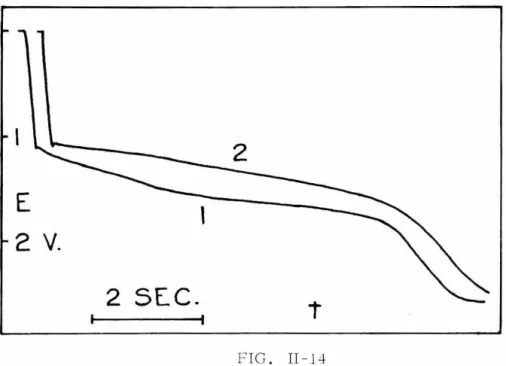
II-4 to II-15. Corresponding numertcal data are collected in table U-2.
Well-deflned transition tlmes were obtained for all salts listed ln table II-2,
unaffected by deaeratlon except for the alight increase due to evaporation of
solvent.
t.or'l~
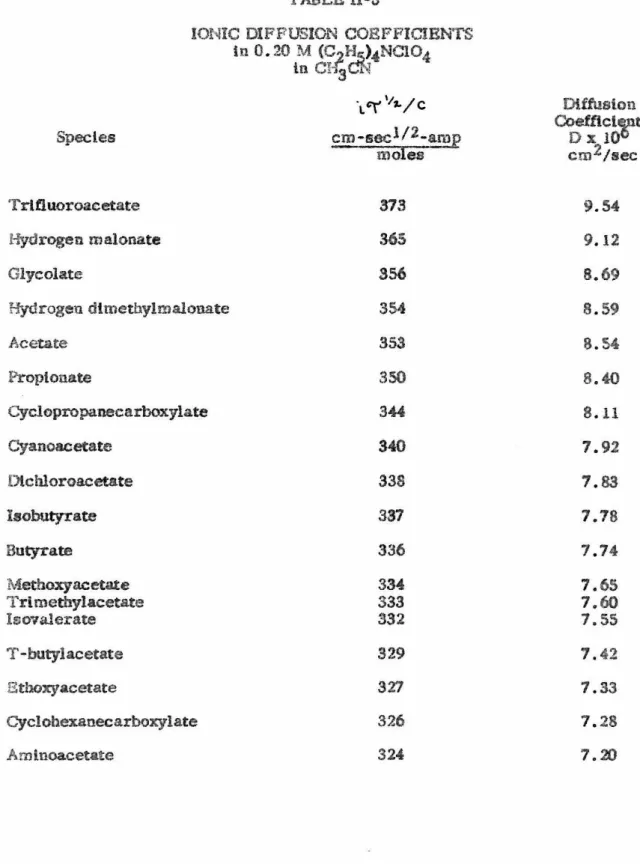
Dlftuston coefficients calculated from
c
are listed in decreasing orderi. "1"''1~
in table II-3. Constancy of
-c
(:i: 10%) over the current range from about 1.4to 14 ma/cm 2 was verified from oscllloscope traces of the waves for acetate,
dlchloroacetate, methoxyacetate, cyclopropanecarboxylate,
cyclohexanecar-boxylate, trtfiuoroacetate, dt -tetrabutylamonlum dlmethylmalonate, and
amlnoacetate and can be assumed for the remalnlng salts. Thls proves the
reaction to be dlffualon -controlled . The waves were not much affected by the
addltlon of small amounts of water (tlg. n-16) or changes in the concentration of
supporting electrolyte (table U-4) but were quite eensittve to the presence of
1.0 52
( t)
'It1- -~
1 2 3 4 5
1. Ptvalate
0.5 2. Methoxyacetate
3. I so butyrate
4. Dimethylmalonate (dl-negatlve)
5. Acetate
0.2
.01
.05
FIG. 11-2
E
vs . LOG[I
~
(;
J
y~]
.02
0.1
v
-
(
~)'/2
1. Malonate (dt -negative)
2. Trlfluoroacetate 0.5
0.2
.01
.05
FIG. II-3
E VS. LOG
L
I - (~
)'1
1-]
.02
0.1
v
1.4
E
I
.
G V.