Achieving incremental cost reduction via kaizen
costing in the Nigerian construction industry
Temitope Omotayo,
School of the Built Environment, University of Salford, Manchester, UK. ([email protected])
Udayangani Kulatunga
School of the Built Environment, University of Salford, Manchester, UK.
Abstract
Nigerian small and medium scale construction firms are facing challenges of cost and time overruns which have led to project abandonment and liquidation of some of these firms. This is also as a result of large scale dissatisfaction of clients. This study focuses on how to improve the post-contract cost management in Nigerian construction firms by using kaizen costing. Kaizen presents a better solution to cost and time overruns, and client satisfactions. This method of managing post-contract cost had been proven to create more profit, quality, value and improved relations with the stakeholders involved in construction activities. Incremental cost reduction is the key element of kaizen. The most critical activities which can influence kaizen costing implementation in the Nigerian construction industry are addressed in the paper.
This investigation identified eight crucial activities for continuous cost reduction from literature. Based on the existing literature, a Likert scale questionnaire was produced. Data was gathered from one hundred and thirty five (135) cost and project managers in Lagos, Nigeria. The Kendall’s coefficient of concordance was used to test the identified activities based on the agreement of the respondents. Important activities were ranked by respondents. The findings identified “overhead cost related to paying suppliers, sub-contractors and labourers can be reduced continually throughout the construction phase to keep the project cost within budget” as the most critical activity for continuous cost reduction during kaizen costing. Assessing the essential procedures carried out during construction creates an avenue to implement kaizen philosophy and kaizen costing in a developing economy such as Nigeria. Therefore, the benefits of kaizen are easily transferred for alleviating the challenges of cost and time overrun, effective post-contract cost controlling, profitability of small and medium scale construction firms and client satisfaction.
1. Introduction
Construction cost management in many countries have been using the same conventional cost management systems since the 1920s from inception (Kern & Formoso, 2006; Owens, Burke, Krynovich, & Mance, 2007; Rad, 2002). Johnson and Kaplan, (1993) as cited by Kern and Formoso (2006) stated that the same cost management system which has been used in the 1920s is still in use in many construction firms. Ostrenga et al., (1998) as cited by Kern and Formoso (2006) noted that traditional cost management cannot provide the precise product cost and the system cost estimation does not include managerial decision making approach which eventually brings a positive impact on the project. Traditional cost management system is the conventional cost management system used since the 1920s. This term is used because of modern systems such as value management system and earned value management system which are operation in many construction firms around the world. However, systems such as the value management system, earned value management system, expert systems, benchmarking and building information modelling have emerged over the last sixty years to redefine the art and science of construction cost management. The enormity of negative factors influencing cost estimates at the pre-tender phase as stated by Ashworth (2010); Oyedele (2015) and Samphaongoen (2010), cost estimates always have latent errors which arises during the construction phase. Therefore, the need to focus more on post-contract cost control by project managers and cost managers during a contruction project is imperative.
Cost estimation in construction has set rules by the Royal Institute of Chartered Surveyors and other Quantity Surveyor bodies in the various countries when construction cost estimates are prepared. Nonetheless, the same problems of cost and time overruns, variations during construction, construction disputes have always plagued construction activities. Ashworth (2010) noted the factors which influence the accuracy of cost estimates as being difference in design information, market conditions, experience of the project manager, project complexity and historical data. In a developing economy such as Nigeria, the challenges facing cost estimation is peculiar.
2. Literature review
This section addresses the challenges facing the conventional cost estimating system in Nigeria, the importance of kaizen costing as an effective panacea to the prevailing cost management challenges and the justifications for this investigation.
2.1 Factors affecting traditional cost estimation in the Nigerian
construction industry
The unique challenges facing most cost and project managers during estimate preparation are related to a number of factors. Oyedele (2015) highlighted the various influencing factors as:
a) Political situation: Most cost estimates are accurate during stable political times
b) Government policy: Influence of local content investment policies, importation policies, taxes, method of procurement, number of foreign contractors or expatriates are some of the policies which may affect accuracy of cost estimates at a point in time.
d) The construction season such as rainy season and dry season may affect on-going construction work
e) Geographical location of the project may also affect accuracy of estimates. In places such as the Niger Delta and Northern parts of Nigeria, the accuracy of estimates may be influenced by the topography, swamp or soil conditions
f) Risk emanating from security may also have a drastic effect on the accuracy of construction cost estimates, especially in the Northern parts of Nigeria where there is high level of Islamic insurgency.
g) Years which are close to the general elections in Nigeria have a lot of influence on the cost estimates because prices of building materials are lower and there are a lot of procurement activities and award of contracts.
h) Corruption is a factor which affects cost estimates in Nigeria. Most cases of kickback during procurement have led to inflated cost estimates.
These factors can mar a construction project during the execution phase if they are not addressed. Although, other construction cost management systems, methods and techniques such as earned value analysis, value management, building information modelling may have been applied to curb the excessive cost and time overruns.
2.2 What is Kaizen costing?
Kaizen costing is a continuous improvement technique which emanates from kaizen, a product of the lean philosophy (Barraza & Lingham, 2008; Barraza & Miguel-Dávila, 2014; Suárez-Barraza, Ramis-Pujol, & Dahlgaard-Park, 2013). Kaizen costing mean continuous improvement of the cost of production, it was first introduced in the 1960s in Toyota (Arya & Jain, 2014; Brunet & New, 2003; Prošić, 2011; Puvanasvaran, Kerk, & Ismail, 2010). Therefore, kaizen costing is the cost management aspect of kaizen which is usually utilized during the production phase. The benefits of kaizen has been transferred to other sectors such as manufacturing , business management, development of small and medium scale industries and construction (Arya & Jain, 2014; Berger, 1997; Puvanasvaran et al., 2010). Several case studies by (Puvanasvaran et al., 2010; Suárez-Barraza & Lingham, 2008; Suárez-Barraza, Ramis-Pujol, & Kerbache, 2011) concluded that kaizen is very useful for improving manufacturers’ profit in this instance contractors, enhancing the quality of products, providing more client satisfaction and encouraging better employee-employer relationship. This aspect of kaizen is the continuous improvement in the work place. However, the costing aspect involved the process which stems from a Plan-Do-Check-Action (PCDA) process. This process is based on an incremental approach of maintaining and reducing production cost.
2.3
Activities for incremental cost reduction during construction
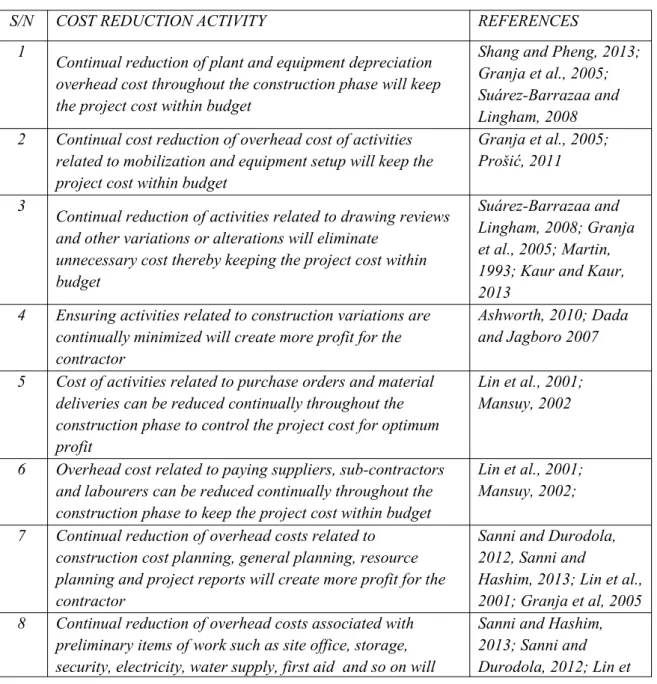
Post-contract cost control activities are based on techniques such as interim valuations, preparation of monthly statement of accounts, cash flow, variation management and monitoring of all activities related to the construction work. There is no technique for continuous cost maintenance and reduction. The traditional cost management technique available in most construction companies do not consider cost maintenance and reduction during construction. Kaizen costing during construction involves specific activities related to transportation, handling of materials on site, overhead cost monitoring and reduction, variations, equipment and plant cost, purchase orders, suppliers’ and sub-contractors’ cost, planning and preliminary items of work (IFS, 2010; Lin et al., 2001; Ashworth, 2010 $ Sanni and Hashim, 2013). These activities are very delicate and may lead to cost and time overrun if they are not monitored. In kaizen cosing, these activities are monitored for waste, irregularities and strain. The continuous cost redecution process are based on these activities. They are summarized in table 1 below.
Table 1: Cost reduction actitivities required for incremental cost reduction
S/N COST REDUCTION ACTIVITY REFERENCES
1
Continual reduction of plant and equipment depreciation overhead cost throughout the construction phase will keep the project cost within budget
Shang and Pheng, 2013; Granja et al., 2005; Suárez-Barrazaa and Lingham, 2008 2 Continual cost reduction of overhead cost of activities
related to mobilization and equipment setup will keep the project cost within budget
Granja et al., 2005; Prošić, 2011
3
Continual reduction of activities related to drawing reviews and other variations or alterations will eliminate
unnecessary cost thereby keeping the project cost within budget
Suárez-Barrazaa and Lingham, 2008; Granja et al., 2005; Martin, 1993; Kaur and Kaur, 2013
4 Ensuring activities related to construction variations are continually minimized will create more profit for the contractor
Ashworth, 2010; Dada and Jagboro 2007
5 Cost of activities related to purchase orders and material deliveries can be reduced continually throughout the construction phase to control the project cost for optimum profit
Lin et al., 2001; Mansuy, 2002
6 Overhead cost related to paying suppliers, sub-contractors and labourers can be reduced continually throughout the construction phase to keep the project cost within budget
Lin et al., 2001; Mansuy, 2002;
7 Continual reduction of overhead costs related to construction cost planning, general planning, resource planning and project reports will create more profit for the contractor
Sanni and Durodola, 2012, Sanni and
Hashim, 2013; Lin et al., 2001; Granja et al, 2005 8 Continual reduction of overhead costs associated with
preliminary items of work such as site office, storage, security, electricity, water supply, first aid and so on will
eventually help the creation of more profit and improve project delivery
al., 2001; Granja et al, 2005
The cost activities identified above were gathered from various articles related to important activities which are carried out during construction. They are also a product of the questionnaire designed for the data collection.
2.4 Research objective
The objective of this study is to assess the most critically important construction activities required for incremental cost reduction in the Nigerian construction industry. Having identified the objective of this paper, the following section discusses the research methodology adopted for this study.
3. Research Methodology
Data was obtained from one hundred and thirty five cost and project managers in Lagos, Nigeria. The questionnaire was designed in a Likert scale format. The range was from 1 to 5, spanning from strongly agree to strongly disagree respectively. The questionnaire is based table 1. This survey questionnaire was aimed at assessing the attitude and beliefs of the respondents towards the costs that might be required to reduce during the construction stage. Therefore, the questionnaire is logically designed to fit the continual cost reduction objective through kaizen costing.
Two hundred and fifty (250) questionnaires were distributed but only one hundred and thirty five (135) could be retrieved. The respondents had work experience range of two (2) to forty years (40), this is illustrated in figure 1 below. Seventy seven (77) cost managers and fifty eight (58) project managers responded to the questionnaire. Some of these respondents are from the same construction company. However, a total of eighty seven (87) companies responded to the questionnaire.
0 20 40 60 80 100 120 140 160
0 10 20 30 40
Experience
Experience Linear (Experience ) RESPONDENTS
Y
E
A
R
S
O
F
E
X
P
E
R
IE
N
C
E
In the graph above the linear years of experience for the respondents is fifteen (15). Very few respondents have experience above thirty years.
3.1 Investigating the presence of kaizen costing
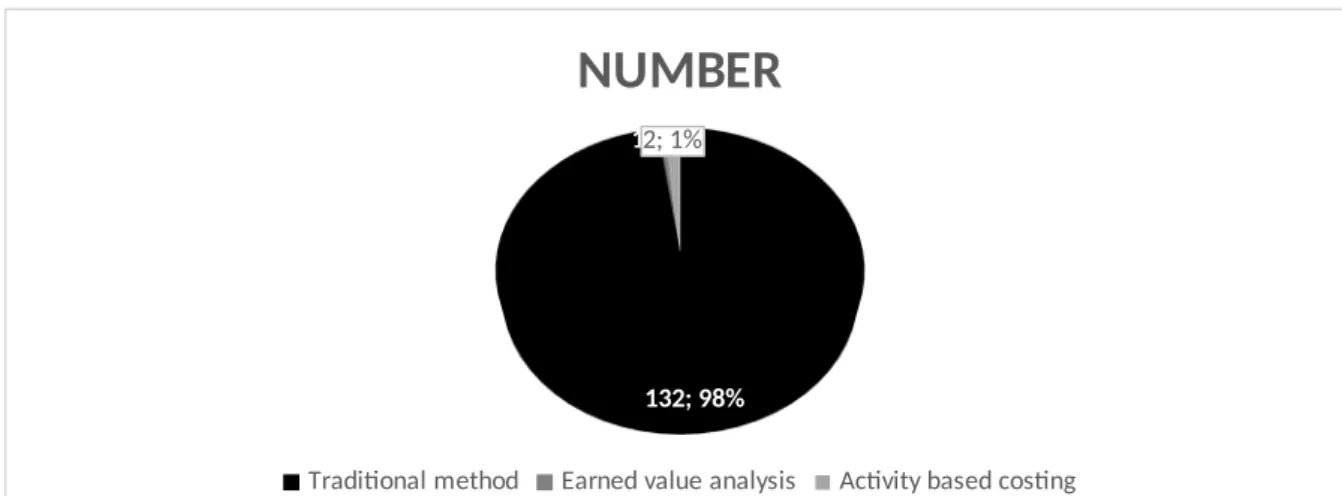
The presence of kaizen costing in Nigeria was investigated. The questionnaire distributed was aimed at identifying the type of post-contract cost control method in use in Nigeria. It included the conventional cost management system in construction, earned value analysis, value engineering, activity based costing and kaizen costing. The findings in figure 2 below show that ninety eight (98) percent of the respondents are still using the traditional post-contract cost control method, while 1.2 percent are using earned value analysis.
132; 98% 1; 1%2; 1%
NUMBER
Traditional method Earned value analysis Activity based costing
Figure 2: Pie chart showing the type of post contract cost control methods used
1.1 percent of the sample population made use of activity based costing. Kaizen costing is still very new to the construction industry in Nigeria.
3.2 Assessing the most critical post-contract cost control activities
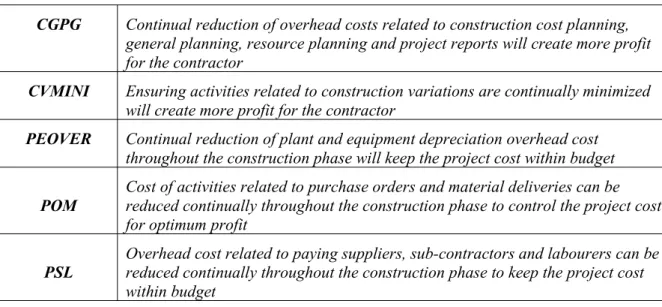
This section addressed the key critical post-contract cost control activities which enables the researcher to evaluate the critical activities which will be required for continual cost reduction on site. This will be meant for small and medium scale construction firms in Lagos, Nigeria. The critical success factors are itemised below.
Table 2: Abbreviations for the activities
Abbreviation Meaning
MESETUP Continual cost reduction of overhead cost of activities related to mobilization and
equipment setup will keep the project cost within budget
DRR Continual reduction of activities related to drawing reviews will eliminate unnecessary cost thereby keeping the project cost within budget
CGPG Continual reduction of overhead costs related to construction cost planning, general planning, resource planning and project reports will create more profit for the contractor
CVMINI Ensuring activities related to construction variations are continually minimized
will create more profit for the contractor
PEOVER Continual reduction of plant and equipment depreciation overhead cost
throughout the construction phase will keep the project cost within budget
POM
Cost of activities related to purchase orders and material deliveries can be reduced continually throughout the construction phase to control the project cost for optimum profit
PSL
Overhead cost related to paying suppliers, sub-contractors and labourers can be reduced continually throughout the construction phase to keep the project cost within budget
The critical post-contract cost control activities were carefully selected from literature review, which highlights the key areas required for continuous cost reduction during construction. It covered monitoring material, plant, labour and overheads, elimination of unnecessary activities, planning and stakeholders.
Table 4: Kendall’s W score for the most critical post-contract cost control activities
PSL POM PEOVE
R CVMINI CPGP PI DRR MESETUP
Kendall’s
W score 5.02 4.70 4.64 4.52 4.50 4.39 4.30 3.99
Table 5: Kendall’s W test for the most critical activities
Kendall's Wa .020
Chi-Square 19.077
df 7
Asymp. Sig. .008
In table 5, Kendall’s coefficient of concordance for this analysis is 0.02. This figure is very low and shows that there is almost no agreement between the respondents. Asymp. Sig. is 0.008<0.05 hence, the respondents have a significant association with the critical success factors.
4. Discussion of results
Based on the findings in figure 2, it can be inferred that kaizen costing is a new concept to the construction industry in Nigeria. This may be the case for other construction industries around the world. Although Kaizen costing is used in the manufacturing industry in Nigeria (Olabisi, Sokenfun, & Oginni, 2012), the construction industry needs to adopt this method as major approach for cost maintenance and reduction. Granja, Picchi, and Robert (2005) noted that cost control is not enough during construction, cost has to be maintained on a daily basis and adequately evaluate for waste factors. An allowable cost in construction is the target price minus the target profit (Granja et al., 2005). Therefore, the cost manager has to ensure the allowable cost is maintained. In reality, the forces of demand and supply and other activities on site influence the cost of construction. This is why the major activities which may denigrate the contractor’s plans for the construction project have to be evaluated.
Activities on the construction sites were evaluated based on their level of criticality. Overhead cost related to paying suppliers, sub-contractors and labourers can be reduced continually throughout the construction phase to keep the project cost within budget has to be taken into consideration more than any other activity. Olawale and Sun (2013) revealed that the performance of nominated sub-contractor and suppliers affects the final cost of construction projects. The incremental reduction of overheads costs resulting from the activity of suppliers, sub-contractors and labourers will definitely create more profit and value for the contractor and project. In most cases, it is very difficult to monitor the activities of the suppliers because of certain forces in the Nigerian construction industry. Such forces include, collusion with a project team member to inflate the prices of the construction materials, kick back and other vices on the construction site. Inflation, foreign exchange rate and market forces also affect the supplier’s and sub-contractors’ cost.
For most complex projects, equipment and plants are required. “Continual reduction of plant and equipment depreciation overhead cost throughout the construction phase will keep the project cost within budget” was ranked third on the scale. The plants and equipment hiring cost, depreciation and maintenance cost is highly important. This aspect is very difficult to maintain and incrementally reduce cost. This aspect is very critical to the success of the project. The final account for the project depends on these factors. Therefore the cost manager needs to address precise steps which pertain to plant and equipment hiring.
5. Conclusion and further research
The presence of kaizen philosophy is necessary for kaizen costing to be in place during construction. Although this study did not address the presence of kaizen in the management level, the findings revealed that kaizen is non-existent in the Nigerian construction industry. Cost control during construction has to go beyond monitoring. Maintenance procedures is viewed as monitoring. However identifying waste and gaps in cost during construction will invariably reduce the cost of construction. The critical activities identified in this paper has to do with external influences such as suppliers, sub-contractors, purchase orders, material handling, equipment and plant hire. These factors are very difficult to control and are critical to a project’s success. Achieving a successful incremental reduction of cost during construction depends on these factors.
The involvement of other stakeholders such as the suppliers, sub-contractors and labourer may also facilitate continual cost maintenance and reduction. A research framework may be designed to provide guidelines for a successful kaizen costing procedure in the Nigerian construction industry.
References
Ashworth, A. (2010). Cost studies of buildings (5th Ed.). London and New York: Routledge.
Arya, A. K., & Jain, S. K. (2014). Impacts of Kaizen in a small-scale industry of India: a case study. International Journal of Lean Six Sigma, 5(1), 22-24. doi: 10.1108/IJLSS-03-2013-0019
Berger, A. (1997). Continuous improvement and kaizen: standardization and organizational designs. Integrated Manufacturing Systems, 8(2), 110-117. doi: 10.1108/09576069710165792
Brunet, A. P., & New, S. (2003). Kaizen in Japan: an empirical study. International Journal of Operations & Production Management, 23(12), 1426-1446. doi:
10.1108/01443570310506704
Dada, & Jagboro. (2007). An evaluation of the impact of risk on project cost overrun in the Nigerian construction industry. Journal of Financial Management of Property and Construction, 12(1), pp. 37-44.
Imai, M. (1997). Gemba Kaizen: A common sense, low cost approach to management. USA:McGraw-Hill
Kern, A. P., & Formoso, C. T. (2006). A model for integrating cost management and production planning and control in construction. Journal of Financial Management of Property and Construction, 11(2), 75-90. doi: 10.1108/13664380680001081
Lin, B., Collins, J., & Su, R. K. (2001). Supply chain costing: an activity‐based perspective. International Journal of Physical Distribution & Logistics Management, 31(10), 702-713. doi: doi:10.1108/EUM0000000006286
Mansfield, N. R., Ugwu, O. O., & Doran, T. (1994). Causes of delay and cost overruns in Nigerian construction projects. International Journal of Project Management, 12(4), 254-260. Olabisi, J., Sokenfun, A. O., & Oginni, B. O. (2012). Kaizen Cost Management Technique and
Profitability of Small and Medium Scale Enterprises (SMEs) in Ogun State, Nigeria. Research Journal of Finance and Accounting, 3(5), pp. 103-111.
Olawale, Y., & Sun, M. (2013). PCIM: Project Control and Inhibiting-Factors Management Model. Journal of Management in Engineering, 29(1), 60-70. doi:
10.1061/(asce)me.1943-5479.0000125
Owens, J., Burke, S., Krynovich, M., & Mance, D. J. (2007). Project Cost Control Tools and Techniques.
Oyedele, O. A. (2015). Evaluation of Factors Affecting Construction Cost Estimation Methods in Nigeria. Paper presented at the From the Wisdom of the Ages to the Challenges of the Modern World, Sofia, Bulgaria, 17-21 May
Prošić, S. (2011). Kaizen Management Philosophy. Paper presented at the I International Symposium Engineering Management And Competitiveness, June 24-25, Zrenjanin, Serbia.
Puvanasvaran, A. P., Kerk, S. T., & Ismail, A. R. (2010). A case study of kaizen implemention in SMI. Paper presented at the National Conference in Mechanical Engineering Research and
Postgraduate Studies, 3-4 December, UMP Pekan, Kuantan, Pahang, Malaysia.
Rad, P. F. (2002). Project estimating and cost management. Vienna, Virginia: Management Concepts, Inc.
Samphaongoen, P. (2010). A Visual Approach to Construction Cost Estimating. (Master's Degree), Marquette University. Retrieved from http://epublications.marquette.edu/theses_open/28 Sanni, A. O., & Durodola, O. D. (2012). Assessment of contractors’ cost control practices in
Sanni, A. O., & Hashim, M. (2013). Assesing the challenges of cost control practices in the Nigerian cosntruction industry. Interdisciplinary journal of contemporary reserach in business, 4(9), 366-374.
Suárez-Barraza, M. F., & Lingham, T. (2008). Kaizen within Kaizen Teams: Continuous and Process Improvements in a Spanish municipality. Asian Journal on Quality, 9(1), 1-21. doi:
10.1108/15982688200800001
Suárez-Barraza, M. F., & Miguel-Dávila, J. A. (2014). Assessing the design, management and improvement of Kaizen projects in local governments. Business Process Management Journal, 20(3), 392-411. doi: 10.1108/BPMJ-03-2013-0040
Suárez-Barraza, M. F., Ramis-Pujol, J., & Dahlgaard-Park, S. M. (2013). Changing quality of life through the Personal Kaizen approach: a qualitative study. International Journal of Quality and Service Sciences, 5(2), 191-207. doi: 10.1108/IJQSS-03-2013-0015