Transfer Report
from MPhil to PhD
Acoustic object modeling for content based
retrieval from multimedia databases
Ioannis Paraskevas September 2001
List of figures...3
Session 1...4
1.1) Introduction...4
Session 2...6
Audio representation and analysis techniques...6
2.1) Overview of the system...6
2.2) Feature extraction of audio signals...6
2.2) a) i) Short-time energy function...7
2.2) a) ii) Short-time Average Zero-Crossing Rate...7
2.2) a) iii) Volume...9
2.2) a) iv)Linear Prediction Coefficients...11
2.2) b) i) Pitch...11
2.2) b) ii) Spectrogram...14
2.2) b) iii) iv) Frequency centroid, Bandwidth...15
2.2) b) v) Cepstral coefficients and Mel-frequency cepstral coefficients...15
Session 3...16
Transform-based signal representation and analysis...16
3.1) Overview of the method...16
3.2) The Fourier transform & the Fourier cosine transform...17
3.3) The Hartley transform...22
Definition...22
Relationship between Hartley and Fourier transforms...22
3.4) The Wigner-Ville distribution...27
3.5) The Hough transform (applied to line detection)...28
Definition...28
Comments/Conclusions...29
Comments-Discussion...30
General conclusions and discussion...31
Session 4...31
4.1) Future plans...31
References...32
Books, Ph.D. theses & Lecture Notes...32
Literature Review...33
Wigner-Ville & Wigner-Hough Transform...33
Hough...34
List of figures
Fig.1 Pattern Recognition System Model ([4])
Fig.2 Time waveforms of commercial, news and sports clips ([20])
Fig.3 Average zero-crossing rate for commercial, news and sports clips ([20]) Fig.4 Volume or commercial, news and sports clips ([20])
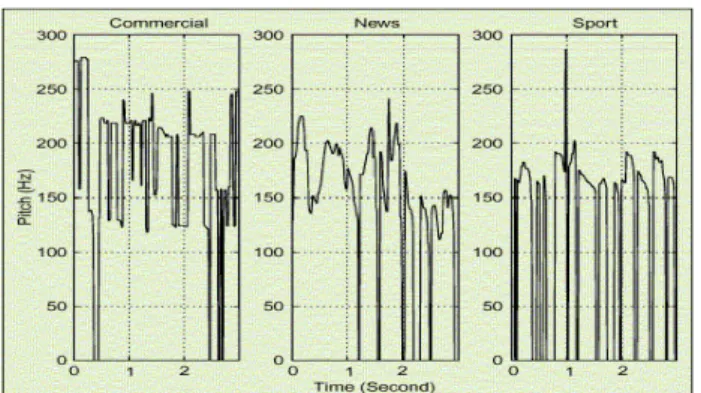
Fig.5 Autocorrelation function and AMDF of a typical male voice segment ([20]) Fig.6 Pitch curves for commercial, news and sports clips ([20])
Fig.7 Spectrograms of the commercial, news and sports clips ([20]) Fig.8 Triangular band-pass filter set ([8])
Fig.9 Spectrogram of an audio sample of Formula1 car Fig.10 DCT-2 applied on the spectrogram of the Formula1 car
Fig.11 DCT-2 (focus) applied on the spectrogram of the Formula1 car Fig.12 Phasegram of an audio sample of a Formula1 car
Fig.13 DCT-2 applied on the phasegram of the Formula1 car
Fig.14 DCT-2 (focus) applied on the phasegram of the Formula1 car Fig.15 Spectrogram of an audio sample of country atmosphere Fig.16 DCT-2 applied on the spectrogram of the country atmosphere
Fig.17 DCT-2 (focus) applied on the spectrogram of the country atmosphere Fig.18 Phasegram of an audio sample of country atmosphere
Fig.19 DCT-2 applied on the phasegram of country atmosphere
Fig.20 DCT-2 (focus) applied on the phasegram of country atmosphere Fig.21 Hartley spectrum of an audio sample of Formula1 car (H.T) Fig.22 Phasegram of an audio sample of a Formula1 car (H.T) Fig.23 DCT-2 applied on the phasegram of the Formula1 car (H.T)
Fig.24 DCT-2 (focus) applied on the phasegram of the Formula1 car (H.T) Fig.25 Hartley spectrum of an audio sample of country atmosphere (H.T) Fig.26 Phasegram of an audio sample of country atmosphere (H.T)
Fig.27 DCT-2 applied on the phasegram of country atmosphere (H.T)
Fig.28 DCT-2 (focus) applied on the phasegram of country atmosphere (H.T) Fig.29 Chirp Signal
Fig.30 Wigner-Ville distribution of the chirp signal
Session 1
1.1) Introduction
Audio is a significant type of media and forms an important part of audiovisual databases. The increasing number of digital databases has enforced the necessity of their effective management, based on the analysis of their audio content. The audio content analysis describes the computerized understanding of the semantic meanings of an audio document. Methods that materialize such an automated analysis are indispensable for the efficient access, digest and information retrieval. In a multimedia document, its semantics are embedded in multiple forms that are usually complimentary of each other. There is therefore a need to analyse all the data types: sound tracks, image frames, spoken words or even text that can be extracted from the image frames.
The automated analysis briefly described, requires the segmentation of the document into semantically meaningful units, and the classification of each unit into a predefined category. The majority of the current research approaches are focused on the visual information of the databases, which leads to a far too fine segmentation of the audiovisual sequence with respect to the semantic meaning of the data. The integration of all the multimedia components (audio, visual and textual information) will lead to a fully functional system that will achieve effective information retrieval from the databases. While much effort has been made in the area of visual recognition, general audio recognition has had less attention and it is considered that focussing on this would render some benefit to the general problem of archival retrieval. Some of the applications of audio segmentation and classification are the following: audio archive management, professional media production, commercial music usage, database surveillance, video annotation and so on.
The report is divided into three further sessions. The second one states the objective of the research and includes a review of the audio representation and analysis techniques. In the third an analytical description of the proposed transform-based method of representation and analysis is described. Finally, the fourth session consists of the future plans.
Session 2
Audio representation and analysis techniques 2.1) Overview of the system
Our system model can be divided, as for any other pattern recognition system model, into three stages: sensor, feature extractor and classifier. A schematic (Fig.1) that includes all the three stages and a brief theoretical description of each of them follows:
Audio Representation Features Decision Stream Pattern Fig.1 Pattern Recognition System Model
Sensor: its aim is to provide accurate representation of the audio stream to be classified. The performance limits of the system depend on it.
Feature extractor: it extracts the appropriate information from the representation pattern in order to reduce the dimensionality of the pattern recognition problem. Classifier & Decision-maker: the last stage of the system, forms its decision making part. The classifier assigns patterns of unknown class membership to their appropriate categories [4].
2.2) Feature extraction of audio signals
Generally, the audio signal features used can be divided into three categories. The first one consists of the features that are related to the time domain of the signal and the second one includes features that are related to the signal’s frequency domain. Features that belong to the first category (a) are: i) Short-time energy function, ii)
maker Classifier
Short-time average zero-crossing rate iii) Volume iv) Linear Prediction Coefficients to name but four.
Among the methods that belong to the second category (b) are: i) Pitch ii) Spectrogram iii) Frequency centroid iv) Bandwidth and v) Cepstral coefficients and Mel-frequency cepstral coefficients.
2.2) a) i) Short-time energy function
Definition/Mathematical expression:
The short-time energy function of a signal is defined as:
En =
1
N
∑
m [x(m)w(n-m)]2 where,x(m): discrete time audio signal
n: time index of the short-time energy
w(m): rectangle window
1, for 0 ¿n≤N−1
i.e. w(m) =
{
0,otherwise [17] Comments:
The main reasons for using the short-time energy function are:
i) it is a convenient representation of the amplitude variation over the time ii) for the special case in which the audio signal is speech, the values of En are
in general, much smaller for the unvoiced components compared to the voiced ones.
iii) it can also be used in order to distinguish audible sounds from silence when the value of the SNR is high.
iv) the way the function varies over the time, may underline the rhythm and the periodicity of the sound.
2.2) a) ii) Short-time Average Zero-Crossing Rate
Definition/Mathematical expression:
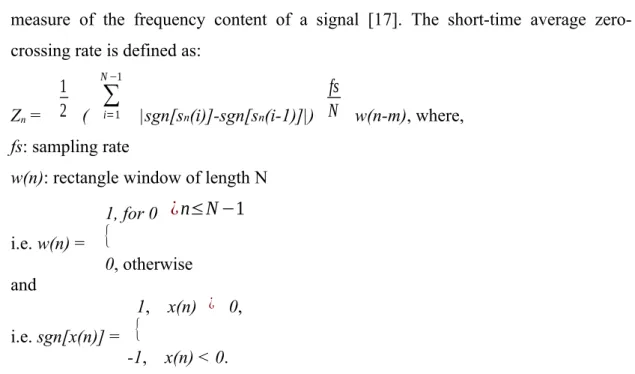
measure of the frequency content of a signal [17]. The short-time average zero-crossing rate is defined as:
Zn =
1
2 (
∑
i=1N−1
|sgn[sn(i)]-sgn[sn(i-1)]|)
fs
N w(n-m), where,
fs: sampling rate
w(n): rectangle window of length N
1, for 0 ¿n≤N−1
i.e. w(n) =
{
0,otherwise and
1, x(n) ¿ 0,
i.e. sgn[x(n)] =
{
-1, x(n) < 0.
Figure 2 (fig.2) shows the time waveforms of commercial, news and sport clips. In the first one male speech over music background is recorded. The second one contains clean male speech, while the last one includes live broadcast from a basketball match. Figure 3 (fig.3) shows the corresponding curves of the average zero-crossing rate for commercial, news and sports clips respectively.
Fig.3 Average zero-crossing rate for commercial, news and sports clips
Comments:
i) The zero-crossing rate expression is used as a measure of discrimination between voiced and unvoiced speech. Generally, the unvoiced speech components have much higher zero-crossing rate values compared to the voiced ones. For example, the zero-crossing rate curve of the news clip consists of peaks and troughs because of the unvoiced and voiced components respectively. Therefore, the curve presents large variance and a wide range of amplitudes. Finally, in general terms, the zero-crossing rate curves are characterized by a relatively low and stable baseline with high peaks above it.
ii) The zero-crossing rate curves of the commercial and sport clips have a much lower variance and average amplitude compared to the curve of the news clip. The commercial clip has a relatively smooth curve since it has a music background, whereas the one of the sports clip is even smoother due to its noisy background. Generally, the zero-crossing rate curve of music clips is characterized by an irregular waveform with a changing baseline and a relatively small range of amplitudes.
iii) In order to distinguish other kind of audible sounds, based on the zero-crossing rate criterion, it is possible to use other characteristics of its curve such as regularity, periodicity, stability and amplitude range.
2.2) a) iii) Volume
The volume (also referred as loudness) of a signal frame n is defined as:
v(n) =
√
1 N
∑
i=0N−1
sn2(i)
where,
s(i): discrete time audio signal
Figure 4 (fig.4) shows curves of volume for commercial, news and sports clips.
Fig.4 Volume or commercial, news and sports clips Comments:
i) The mean and standard deviation of the volume of an audio signal can be used as descriptors [14].
ii) An audio frame can be characterized as silent or not, based on the comparison of its volume with a threshold determined by the volume distribution of the entire audio clip. After the silence is detected, it is possible to calculate the silence ratio, which is defined as the ratio of the silence interval to the entire period. The silence ratio varies according to the content of the audio clip. In news reports the silence ratio is higher compared to the commercial clips because in the first case there are regular pauses of the reporter’s speech, whereas in the second case there is always some kind of background music.
iv) The VDR (Volume Dynamic Range) is defined as:
max(v)−min(v)
max(v)
where max(v) and min(v) are the maximum and minimum volumes within an audio clip respectively. VDR, which is a measure of the variation of an audio clip’s volume, does not change a lot in sports programs compared to news reports. This is explained, since in the first case there is usually a constant level of background sound so the volume does not change considerably, whereas in the second case, there are silent periods between speech, which result in a much higher VDR.
2.2) a) iv)Linear Prediction Coefficients
The linear predictive coefficients method has already being applied in speech analysis and coding. It is based on the digital model of a person’s vocal tract, which
can be represented by the following transfer function:
H(z)= A
1−
∑
k=1
p akz−k
This system is excited, for voiced speech, by an impulse train, whereas for unvoiced speech it is excited by random white noise. From the last equation it is deduced that
the relation between the audio samples x(n) and the excitation δ(n) is given by the
following difference equation:
x(n)=
∑
k=1
p
akx(n−k)+δ(n)
. Assuming that the
signal is processed by a linear predictor:
xp(n)=
∑
k=1
p
akx(n−k)
.So, the predictor error can be estimated using the following equation:
e(n)=x(n)−xp(n)=x(n)−
∑
k=1
p
akx(n−k)
The predictor error will be minimum, if
∑
k=1p
akx(n−k)
of x(n) and xp(n) are equal
polynomial
P(z)=1−
∑
k=1
p akz−k
is a good approximation of the denominator of the initial transfer function. The coefficients mentioned are computed for the Auto-regressive model using the Levinson-Durbin algorithm.[21]
2.2) b) i) Pitch
Definition/Mathematical expression:
Pitch is the fundamental frequency of an audio waveform and is an important parameter in the analysis and synthesis of speech and music [20]. Pitch information can be extracted by using either temporal or frequency analysis. The temporal analysis method is based on the computation of the short-time autocorrelation function Rn(l) or AMDF (Average Magnitude Difference Function) An(l), where
Rn(l) =
∑
i=0
N−l−1
sn(i)sn(i+l) and An(l) =
∑
i=0
N−l−1
| sn(i+l) - sn(i)|.
where s(i): discrete time audio signal
Based on frequency analysis methods, pitch can be determined from the periodic structure in the magnitude of the Fourier transform or cepstral coefficients of an audio frame.
Figure 5 (fig.5) shows the curves of the autocorrelation function and AMDF of a typical male voice segment.
Fig.5 Autocorrelation function and AMDF of a typical male voice segment Comments:
i) Generally, well-defined pitch characterizes only speech and harmonic music but it can still be used as a characteristic feature of the fundamental frequency of other audible waveforms.
From the autocorrelation and AMDF curves (fig.5) periodic peaks and valleys can be observed respectively. Peaks and valleys represent local maximum and minimum points. Using the local maximum/minimum points as well as the global maximum/minimum points of the curve, it is possible to specify the value of the pitch frequency. For example, from the AMDF curve of Fig.5 pitch frequency can be calculated by taking the reciprocal of the time period between the origin and the first valley. Generally, such valleys can be observed in voice and music audio clips but not in the noisy or the unvoiced ones.
iii) Pitch determination based on the frequency analysis method
When the frequency analysis method is chosen to determine the pitch, one way to do so is by calculating the maximum common divider for all the local peaks in the magnitude spectrum.
Figure 6 (fig.6) shows pitch curves for commercial, news and sports clips. The pitch contours are obtained using the autocorrelation function method.
Fig.6 Pitch curves for commercial, news and sports clips Comments:
the commercial clip. The music background of this kind of audio clips causes this characteristic.
ii) In speech, the pitch frequency basically depends on the speaker (male/female). In music signals it depends on the strongest note being played.
iii) There are three different features that are used in order to estimate the pitch variation: the standard deviation of the pitch, the smooth pitch ratio and the non-pitch ratio. The smooth pitch ratio feature estimates the percentage of music or voiced speech that exists within a clip, since only music and voiced speech are characterized by smooth pitch. On the contrary, the non-pitch ratio estimates the percentage of unvoiced speech or noise within an audio clip, since these two have no pitch.
2.2) b) ii) Spectrogram
Definition/Mathematical expression
Spectrogram is the 3-D plot that presents the magnitude spectrum (magnitude of the Fourier Transform) of a signal across time. Figure 7 (fig.7) shows the spectrograms of the commercial, news and sports clips.
Fig.7 Spectrograms of the commercial, news and sports clips Comments:
i) The distinct features between the three clips can be spotted more easily in the spectrogram compared to their time domain representations (Fig. 7 and Fig.2 respectively). Thus, the frequency domain representation of a signal may help more in the feature extraction process.
tracks of musical instruments, in their spectrograms, remain at the same frequency level and last for a certain period of time. Music may be classified into three subcategories, based again on the spectral peak track method: a) song, b) speech with music, and c) environmental sound with music background.
a) Song audio signals are characterized by one of the following three features: ripple-shaped harmonic peak tracks due to voice sound, tracks with longer duration than speech or tracks with fundamental frequency higher than 300Hz.
b) Speech with music background has its spectral peak tracks, concentrating in the lower to middle frequency bands and has lengths within a certain range.
c) Finally, the environmental sound with music background does not have any certain characteristics.
iii) The major disadvantage of the use of the spectrum as a feature extraction tool is complexity. For audio retrieval applications, it is necessary to use a more compact way of signal representation in any domain to be used.
2.2) b) iii) iv) Frequency centroid, Bandwidth
Definition/Mathematical expression:
The frequency centroid (FC) and bandwidth (BW2) of a signal are defined as:
FC(n) =
∫
0∞ω Sn(ω)dω∫
0∞Sn(ω)dωand BW2(n) =
∫
0∞(ω−FC(n)) 2Sn(ω)dω
∫
0∞Sn(ω)dωwhere,
Sn(): power spectrum (magnitude square of the spectrum) of the audio signal
n: time index Comments:
i) Let be a random variable and Sn(), normalized by the total power, be
the probability density function of . The mean and standard deviation
value of correspond to the formulas of the frequency centroid (FC(n)) and bandwidth (BW2(n)), respectively.
2.2) b) v) Cepstral coefficients and Mel-frequency cepstral coefficients
Cepstral coefficients and Mel-frequency cepstral coefficients (MFCC) are mainly applied to speech and speaker recognition. Although, both techniques provide a smoothed representation of the original spectrum the MFCC technique takes into account the nonlinear property of the human hearing system with respect to different frequencies [20]. Generally, cepstral analysis attempts to deconvolve the excitation from the transfer function (mentioned in the [1.3) a)] paragraph), without making the assumptions that were necessary for linear prediction [8].
One way to generate the cepstral coefficients is from the linear prediction coefficients:
c1=α1
cn=
∑
k=1n−1
(
1−nk
)
akcn−k+anfor
1
<
n
≤
p
where
c
i anda
i are the ith-order cepstral and linear predictor coefficientsrespectively.
Another way to generate cepstral coefficients is based on mel-scale.
Note: The mel-scale is defined in the following equation:
M=2595log10(1+
f 700 )
These coefficients can be obtained by simulating critical-band filtering with a set of triangular band-pass filters, see Figure 8 (fig.8).
Fig.8 Triangular band-pass filter set
The filters are spaced linearly in the range 0 to 1000Hz. Also, each filter’s center frequency is given by:
f
i+1=
1.148
f
i where the initial frequency (f1), is 1kHz.
cn=
∑
k=1
L
Xkcos
[
n(
k−12
)
πL
]
for n=1,2,…,Mwhere Xk is the log-energy output of the kth filter, L is the number of filters in the
desired bandwidth and M is the total number of coefficients required. [8].
Session 3
Transform-based signal representation and analysis 3.1) Overview of the method
In this paragraph a brief explanation of the proposed method will be given. The procedure can be divided into two main parts. The aim of the first part is to represent the signal in an efficient way so as to extract the information that will be useful for its correct classification. The second part has two aims. The first one is to keep the least possible necessary information extracted from the first part in order not to overload the classifier, and the second is to maximize the features that make one signal distinct from the others.
All the transforms and approaches that described before have been applied to signals and the results are presented.
3.2) The Fourier transform & the Fourier cosine transform
The Fourier transform and the Fourier cosine transform are not analysed and discussed because the reader is already familiar with both of them. Instead, in the next two pages are included the periodogram, phasegram and 2-D Cosine transform of two different audio signals. The first sound is a F1 racing car and the second is the sound of countryside atmosphere.
In the next pages are presented the graphs:
Fig.9 Spectrogram of an audio sample of Formula1 car Fig.10 DCT-2 applied on the spectrogram of the Formula1 car
Fig.11 DCT-2 (focus) applied on the spectrogram of the Formula1 car Fig.12 Phasegram of an audio sample of a Formula1 car
Fig.13 DCT-2 applied on the phasegram of the Formula1 car
Fig.14 DCT-2 (focus) applied on the phasegram of the Formula1 car Fig.15 Spectrogram of an audio sample of country atmosphere Fig.16 DCT-2 applied on the spectrogram of the country atmosphere
Fig.17 DCT-2 (focus) applied on the spectrogram of the country atmosphere Fig.18 Phasegram of an audio sample of country atmosphere
Fig.19 DCT-2 applied on the phasegram of country atmosphere
Fig.20 DCT-2 (focus) applied on the phasegram of country atmosphere
Fig.10 DCT-2 applied on the spectrogram of the Formula1 car
Fig.11 DCT-2 (focus) applied on the spectrogram of the Formula1 car
Fig.12 Phasegram of an audio sample of a Formula1 car
Fig.14 DCT-2 (focus) applied on the phasegram of the Formula1 car
Fig.15 Spectrogram of an audio sample of country atmosphere
Fig.18 Phasegram of an audio sample of country atmosphere
Fig.19 DCT-2 applied on the phasegram of country atmosphere
Fig.20 DCT-2 (focus) applied on the phasegram of country atmosphere Comments-Discussion
applied so as to compress all this information. Figures 13 and 19 show the result of applying the DCT to the phase-grams for two acoustic events. Figures 14 and 20 focus on the low order areas of interest of the 2-D Cosine transforms for each result, in order to visualise the different surface structure between the two audio signals. It is proposed that this might form the basis of a feature extraction process that would be applied to a suitable classifier.
3.3) The Hartley transform
Definition
The Hartley transform is one of a set of orthogonal transforms, which gives a real frequency domain function from a real time signal [6].
The mathematical expression of the Hartley transform and its inverse are:
H() =
∫
s
(
t
)(
cos
(
ωt
)+
sin
(
ωt
))
dt
orH(v) = Ν
−1
∑
τ=0
N−1
f(τ)cas
(
2πντN
)
(discrete version)where τ=t , ω=2πν cas (θ)=cos(θ)+sin(θ) and
s(t) =
∫
H
(
ω
)(
cos
(
ωt
)+
sin
(
ωt
))
dω
ors( τ)=
∑
ν=0N−1
H(v)cas
(
2πντN
)
(discrete version)respectively.
Relationship between Hartley and Fourier transforms The definition of the Fourier transform is:
S(
ω
)=
∫
s
(
t
)
e
−jωtdt
, S(ω
)=
∫
s
(
t
)(
cos
(
ωt
)−
j
sin
(
ωt
))
dt
and S(ω
)=
∫
s
(
t
)
cos
(
ωt
)
dt
−
j
∫
s
(
t
)
sin
(
ωt
)
dt
Let,
SR(ω)=
∫
s
(
t
)
cos
(
ωt
)
dt
andSI(ω)=
∫
s
(
t
)
sin
(
ωt
)
dt
So, S(ω)= SR(ω)−j SI(ω)
H() =
∫
s
(
t
)(
cos
(
ωt
)+
sin
(
ωt
))
dt
H(
ω
)=
∫
s
(
t
)
cos
(
ωt
)
dt
+
∫
s
(
t
)
sin
(
ωt
)
dt
Let, SR(ω)=
∫
s
(
t
)
cos
(
ωt
)
dt
and SI(ω)=∫
s
(
t
)
sin
(
ωt
)
dt
So,H(ω)= SR(ω)+ SI(ω)
Finally,
S(ω)= SR(ω)−j SI(ω) for the Fourier transform and
H(ω)= SR(ω)+ SI(ω) for the Hartley transform.
The last two mathematical expressions that relate the two transforms, are considered as a very important tool for the derivation of the Hartley transform properties through the equivalent ones of the Fourier transform set.
A summary of the basic properties of the Hartley transform is the following:
Theorem f(x) H(f)
Linearity f1(x) + f2(x) H1(f) + H2(f)
Scaling/Similarity f(kx)
|
1
k | H ( f k)
Reversal f(-x) H(-f)
Shift f(x-T) H(f)=cos(2πfT)H(f)+sin(2πfT)H(-f)
Modulation f(x) cos(2πf0T)
H(f) =
1
2 H(f - f0 ) +
1
2 H(f + f0)
Convolution f1(x) * f2(x) 1
2 [H1(f)H2(f)+H1(-f) H2(f)
+H1(f)H2(-f)-H1(-f) H2(-f)]
Autocorrelation f1(x).f1(x) 1
2 [H1(f)2+H 1(-f)2]
Product f1(x)f2(x) 1
2 [H1(f)*H2(f)+H1(-f)*H2(f)
+H1(f)*H2(-f)-H1(-f)*H2(-f)]
The Hartley magnitude and phase
M() =
√
SR2(ω)+SI2(ω) andϕ(ω)=arctan(SI(ω)
SR(ω)) respectively.
Also, S(ω)= SR(ω)+ SI(ω) (Hartley transform)
and according to complex number theory,
S(ω)= M()(cos( ϕ(ω))+jsin(ϕ(ω)))
= M()cos (ϕ(ω))+jM(ω)sin(ϕ(ω))
So, SR(ω) = M()cos( ϕ(ω) ) and
SI(ω) = M()sin( ϕ(ω) )
thus H(ω)= SR(ω)+ SI(ω)
= M()cos( ϕ(ω) ) + M()sin( ϕ(ω) )
= M()(cos( ϕ(ω) ) + sin( ϕ(ω) ))
Concluding, the Hartley transform magnitude is the same as the Fourier transform one, but the Hartley phase is defined as:
Y() =
H(ω)
M(ω) =
M(ω)(cos(ϕ(ω))+sin(ϕ(ω)))
M(ω) = cos( ϕ(ω) ) + sin( ϕ(ω) ).
The last equation is a function of the Fourier phase only and has been called the “whitened Hartley spectrum” or the “Hartley phase spectrum” [6].
The Hartley phase spectrum properties are listed as follows: i) it has zero mean
ii) it has a standard deviation of unity iii) it is a continuous function of frequency
iv) it has upper and lower bounds of
√
2
All four properties are independent of the signal statistics. In the next pages are presented the graphs:
Fig.21 Hartley spectrum of an audio sample of Formula1 car (H.T) Fig.22 Phasegram of an audio sample of a Formula1 car (H.T) Fig.23 DCT-2 applied on the phasegram of the Formula1 car (H.T)
Fig.24 DCT-2 (focus) applied on the phasegram of the Formula1 car (H.T) Fig.25 Hartley spectrum of an audio sample of country atmosphere (H.T) Fig.26 Phasegram of an audio sample of country atmosphere (H.T)
Fig.28 DCT-2 (focus) applied on the phasegram of country atmosphere (H.T)
Fig.21 Hartley spectrum of an audio sample of Formula1 car (Hartley Transform)
Fig.22 Phasegram of an audio sample of a Formula1 car (Hartley Transform)
Fig.24 DCT-2 (focus) applied on the phasegram of the Formula1 car (H.T)
Fig.25 Hartley spectrum of an audio sample of country atmosphere (H.T)
Fig.27 DCT-2 applied on the phasegram of country atmosphere (H.T)
Fig.28 DCT-2 (focus) applied on the phasegram of country atmosphere (H.T) Comments-Discussion
In order to overcome the information (phase) loss observed in the Fourier transform case, the Hartley transform was applied to the audio signal. Here, only one time-frequency surface is required to represent both magnitude and phase information. However, the phase information may be separated out and examined independently if needed. Both the magnitude and phase evolution of the signal across time were implemented but the 2-D Cosine transform was only applied to the phase surface, as an example of the compression properties of the DCT. Again, the last graph, focuses on the area of interest of the 2-D Cosine transform in order to visualise the different surface characteristics between the two audio signals. The use of these techniques with the Hartley transform are in the very early stages and these examples are presented here only as an indication of the possible lines of investigation that may be followed in the future.
3.4) The Wigner-Ville distribution
One very important property of the linear time-frequency representation using the Fourier Transform is the property of linearity. But, because of the complex nature of the spectrum, the time-frequency representation of a signal cannot be easily visualized. For that reason it is usual, to display the representation as time-frequency graphs of magnitude (squared) and phase separately. [6]
The QTFRs have important characteristics that are derived from the fact that the time-frequency function is real and relates to the distribution of signal energy
(power). Let, T(f, τ) be the QTFR of a signal s(t). Two major properties that the
QTFRs should have are:
∫
fT
(
f ,τ
)
df
=
|s(t)| 2 (instantaneous signal power) and∫
τT
(
f ,τ
)
dτ
=
|S(f)| 2 (power spectrum of the signal).These properties are called marginal properties of the QTFR. Because the spectrogram does not fulfill the marginal properties the Wigner-Ville Distribution (WD) is applied instead.
The Wigner-Ville distribution is defined as:
WD(t , f)=
∫
tx(
t+τ2
)
x¿
(
t−τ2
)
e−j2πfτdτ
and
WD(t , f )=
∫
ν X(
f+v2
)
X¿
(
f−v2
)
ej2π fvdv
Because the WD is a quadratic function, its sampling has to be done in a careful way So, let us write it as follows:
WD(t ,f)=
∫
t x(
t+τ2
)
x¿
(
t−τ2
)
e−j2πfτdτ
=
∫
−∞ ∞
x
(
t
+
τ
2
)
x
¿
(
t
−
τ
2
)
e
−j2πfτ
dτ
=
2
∫
−∞ ∞
x
(
t
+
τ
)
x
¿(
t
−
τ
)
e
−j4πfτdτ
If x is sampled with a period Te, then x[n] = x(nTe) and the WD is evaluated at the
sampling points nTe in time. So, a discrete-time expression of the WD is obtained:
WD(n , f)=2Te
∑
k
x[n+k]x¿[n−k]e−j4π fk
Except of the marginal properties some other important properties that characterize the WD are:
i) real valued
ii) time shift: if s’(t) = s(t-t’) then WD(t-t’,f)
iii) frequency shift: if s’(t) = s(t) e−j2πf ' t then WD(t,f-f’)
iv) Convolution: s(t) = x(t)*y(t) (*: denotes convolution)
v) Multiplication: s(t) = x(t)y(t)
WD(t , f )S=WD(t , f )X∗WD(t , f)Y (*: denotes convolution in
frequency)
3.5) The Hough transform (applied to line detection)
Definition
The Hough transform is a method that, in theory, can be used to find features of any shape in an image. In practice, it is generally used for finding straight lines or circles. The computational complexity of the method grows rapidly with more complex shapes.
Consider a point (xi, yi) on an image. The number of lines that can pass through this
point are infinite. However, they all can be represented by the following equation:
xcos(θ)+ysin(θ)=r where
r : represents the distance (perpendicular) of the line from the origin and
θ : represents the angle between this perpendicular and the x-axis
y-axis
r
θ x-axis
Note: 0≤θ≤2π
Assuming, in the last equation varying r and θ , and fixed x and y (i.e. Xi and Yi
respectively) then for each of the possible lines that pass through point (Xi, Yi) the
equation has coordinates r and θ in (r, θ ) space. In other words, each of the lines
that pass through point (Xi, Yi) have a unique value of r and θ . Based on the
whereas the second one is the parameter (r, θ ) space. Now, every line that passes through a point in image space is mapped to a line in parameter space.
So, the Hough transform is a mapping from image space to parameter space.
N points that belong to the same line, i.e. (xi, yi) for i = 1,2…N, are transformed into
N sinusoidal curves xcos(θ)+ysin(θ)=r in the parameter (r, θ ) space, which
intersect in the point (R, Θ ). Comments/Conclusions
i) A point in the image space corresponds to a sinusoidal curve in the parameter space.
ii) A point in the parameter space corresponds to a straight line in the image space.
iii) Points that belong to the same straight line in the image space correspond to curves through a common point in the parameter space.
iv) Points that belong to the same curve in the parameter space correspond to lines through a common point in the image space.
In the next pages are presented the graphs: Fig.29 Chirp Signal
Fig.30 Wigner-Ville distribution of the chirp signal
Fig.31 Hough Transform (Detection of straight lines) of WD
Fig.30 Wigner-Ville distribution of the chirp signal
Fig.31 Hough Transform (Detection of straight lines) of WD Comments-Discussion
The two-level transform method that is described and implemented in this paragraph, aims to visualise the difference amongst the energy distributions of various signals. The Wigner-Ville distribution provides the energy distribution of a particular signal, whereas the Hough transform detects the straight lines of the energy distribution surfaces and provides a way to visualise the difference surface characteristics between different kinds of signals. Although, the Wigner-Ville representation and is quite similar to the spectrogram technique analysed in the literature review this method has the advantage of preserving the marginal properties of the signal.
General conclusions and discussion
Session 4
4.1) Future plans
In the next time period, the project will be focused on the extraction of common characteristics between audio signals based on the feature extraction techniques described in the previous Session. The first (Fourier, Hartley and Wigner-Ville) processing level and the second (Hough and 2-D DCT) one will be combined in different ways in order to detect if there are other more effective ways of feature extraction. Also, it is planned to implement the wavelet transform so as to apply its compression properties to the signal.
The Wigner-Ville energy distribution belongs to the Cohen’s class of energy distributions. There are other members of the same category of distributions that represent the signal in a way that helps more to the extraction of distinct features between the various clips. So, another future plan is to apply the appropriate energy distribution to the signal for better feature extraction.
After the feature extraction part has finished, the next step is the signal classification. At the beginning a simple Euclidean classifier will be implemented so as to decide which combination of the feature extraction methods provides the best results. The next step will involve the implementation of a more sophisticated, self-organized classifier that will provide more accurate estimations. In the classification part it may be used a network of two simple classifiers that will be the input to a super- classifier in order to reduce the dimensionality of the input vector to each one of them.
The two-level feature extraction technique has only been applied to artificially constructed signals. Artificially constructed signals can easier be classified because there is apriory information. On the other hand, for sounds of nature and for other kinds of sounds apriory information does not exist, so the feature extraction part has to be more intensive.
Books, Ph.D. theses & Lecture Notes
[1] R. Bracewell, “The Fourier Transform and Its Applications”, Second Edition, McGraw-Hill Book Company,1986
[2] Matlab, “Signal Processing Toolbox, User’s Guide”, The MathWorks, December 1996
[3] [2] Matlab, “Signal Processing Toolbox, User’s Guide”, The MathWorks, December 1996
[4] J. Kittler, Pattern Recognition Lecture Notes, University of Surrey, 2001
[5] EHS Chilton, Digital Speech Processing Lecture Notes, University of Surrey, 2001
[6] EHS Chilton, A Continuing Education Course on Advanced Digital Signal Processing Lecture Notes, University of Surrey, 2001
[7] Peter R. Green, Digital Signal Processing Lecture Notes, UMIST, 2000
[8] H.Kelleher, Continuous, Speaker Independent, Speech Recognition for a Speech to Viseme Translator, PhD thesis, University of Surrey, 1999
[9] Alexander D. Poularikas,”The Transforms and Applications Handbook”,CRC Press&IEEE Press, 1996
[10] Alan V. Oppenheim, Ronald W. Schafer, John R. Buck,”Discrete-Time Signal Processing”,Second Edition, Prentice Hall Sinal Processing Series, 1999
[11] Petre Stoica, Randolph Moses, “Introduction to Spectral Analysis”, Prentice Hall, 1997
Publications
Literature Review
[12] Stephen Rice, Find audio and video! See the audio! Comparisonics Corporation, Grass Valley, CA 95945 USA, www.comparisonics.com
[13] Jonathan Foote, Content-based retrieval of music and audio, Multimedia Storage and Archiving Systems (II), Procee. Of SPIE, vol.3229, pages 138-147, 1997
[14] Zhu Liu, J. Huang, Y. Wang, and T.Chen, Audio feature extraction and analysis for scene classification, Workshop on Multimedia Signal Processing (Electronic Proceedings), June 23-25 1997
[16] R.Schafer and L.Rabiner, Digital representation of speech signals, Proceedings of IEEE, vol.63, No.4, pages 662-677, 1975
[17] T. Zhang and C.C. Jay Kuo, Hierarchical classification of audio data for archiving and retrieving, International Conference on Acoustic, Speech and Signal Processing 1999, volume 6, pages 3001-3004, 1999
[18] Tong Zhang and C.-C. Jay Kuo, Audio-guided audiovisual data segmentation, indexing,, and retrieval, SPIE Conference on Storage and Retrieval for Image and Video Databases (VII), pages 316-327, 1999
[19] Stan Z. Li, Content-based classification and retrieval of audio using the nearest feature line method, http://citeseer.nj.nec.com/202406.html
[20] Yao Wang, Zhu Liu, and Jin-Cheng Huang, Multimedia Content Analysis using both Audio and Visual Clues, IEEE Signal Processing Magazine, Pages 12-36, Noveber 2000
[21] M. Pandit, J. Kittler, W. J. Christmas, Audio Classification, ASSAVID project, May 2001
Wigner-Ville & Wigner-Hough Transform
[22] F. Auger and P. Flandrin, Improving the Readability of Time-Frequency and Time-Scale Representations by the Reassignment Method, IEEE Transactions on Signal Processing, 43(5):1068-89, 1995
[23] S. Barbarossa Analysis of Multicomponent LFM Signals by a Combined Wigner-Hough Transform, IEEE Transactions on Signal Processing, 43(6), June 1995
[24] J. Bertrand and P. Bertrand, A class affline wigner functions with extended covariance properties, J.Math.Phys.,33(7), 1992
[25] L. Cohen, Time-Frequency Distributions-A Review, Proceedings of the IEEE, 77(7):941-980, 1989
[26] F. Hlawatsch and F. Boudreaux-Bartels, Linear and Quadratic Time-Frequency Signal Representations, IEEE SP Magazine, pages 21-67, 1992
Hough
[27] P.V.C. Hough, “Method and means for recognizing complex patterns”, U.S. Patent 3 069 654, Dec. 18, 1962
[28] R.O. Duda and P.E. Hart, “Use of Hough Transformation to detect lines and curves in pictures”, Commun. Ass. Comput. Mach.,vol.15, Jan. 1972