EMPLOYEES’ COPING STRATEGIES AND ADAPTABILITY
IN A MULTIPLE DOWNSIZING CONTEXT
S.C. DE VRIES Twente University Faculty of Behavioral Sciences Department of Communication studies
Abstract
In a downsizing, employees have to cope with major changes. Their coping strategy influences their level of adaptability. Coping proceeds through sensemaking, and may be either reactive or proactive. This paper reports a study on employees’ sensemaking of critical incidents in a multiple downsizing context. The organization studied, experienced two downsizings in one year. Its culture was based on Life time employment, and the downsizing was expected to cause a shift in attitude. Using the Extended investment model and the Job crafting model as optional coping strategies, data of critical incidents discussed in focus groups were analyzed. Results showed that incidents have a cumulative effect. Although survivors of the first downsizing were willing to adapt to the changes, the second downsizing undermined this. Further, both downsizings showed the dominant culture in employees’ reactive attitude.
The authors discuss the influence of the dominant organizational culture on the psychological and behavioral consequences for the coping strategy and employee adaptability. The process of sensemaking showed some aspects of job crafting, but primarily aspects of the extended investment model. Theoretical and practical implications are discussed.
Keywords: coping strategy, adaptability, multiple downsizing, sensemaking, Critical
Incident Technique
Introduction
in the organization (Weick, 1993). Sensemaking processes can work as a mechanism to reduce insecurity. In a downsizing context, the individual’s coping strategy guides the sensemaking process. Coping, therefore, reflects the individual’s wellbeing during a downsizing. After a downsizing, survivors demonstrate a level of adaptability, depending on their coping strategy. That outcome is particularly relevant for the organization in light of its future success.
By studying employees’ sensemaking processes in a multiple downsizing context, their coping strategies were defined. Subsequently, this led to insight in their potential and actual adaptability. The study was conducted in an organization that had always had a culture of stability and Life Time Employment before the downsizings. Through the Critical Incident Technique, crucial events in the sensemaking process were identified and studied. Two coping strategies, focused on control and escape, were operationalized in the extended investment model (cf. Van Dam, 2005) and the job crafting model (cf. Wrzesniewski & Dutton, 2001) and applied to the data resulting from focus groups.
Theoretical framework
Making sense of downsizings
Coping strategies and adaptability
The individual’s sensemaking process and outcomes are relevant to both the organization and the individual. First, the organization’s interest lies in defining survivors’ adaptability, i.e. how well its survivors get through the downsizing and how well they adapt to the uncertainty and new organizational structure and culture. Pulakos, Arad, Donovan and Plamondon (2000) have developed an eight-dimension taxonomy of adaptive performance. One dimension is particularly relevant in a downsizing context: dealing with uncertain and unpredictable work situations. Key aspects of performance in those situations are “how easily workers adjust to and deal with the situation, how efficiently and smoothly they can shift their orientation or
focus when necessary, and to what extent they take reasonable action, in spite of
symptoms. The current study followed Armstrong-Stassen’s (2006) line of reasoning and focused on escape and control oriented coping, that also have specific implications for the adaptability. We have linked both coping strategies to theoretical models on organizational behavior.
First, we linked escape-oriented coping to Van Dam’s (2005) extended investment model which is based on Farrell and Rusbult’s (Farrell & Rusbult, 1981) investment model. Van Dam’s (2005) extended investment model consists of three structural elements that ultimately determine the attitude an employee will form towards a change. The first element is attraction, primarily constituted of job rewards relative to job costs that result in job satisfaction and ultimately affective commitment. The second is dependence, which is made up of the alternatives to the job relative to investments in the job and their influence on continuance commitment. The third consists of the negative or positive outcome expectations of the change which are expected to have an immediate effect on the attitude towards job changes.
moderating category and consists of the level and form of task interdependence and the level of monitoring, i.e. the level of control and freedom. The second moderating category is coupled to the work orientations of the employee. Three distinct relations of individuals to their work were defined (Wrzesniewski, McCauley, Rozin & Schwartz, 1997). Viewing work either as a job (focus on financial rewards), a career (focus on advancement) or a calling (focus on enjoyment) has different implications for the relationship between one’s personal needs and job crafting behavior (Wrzesniewski & Dutton, 2001). Further, the distinct change in work results in either a change of the social environment at work or the actual design of the job. Ultimately, job crafting leads to a changed work identity or an altered meaning of the work. A final aspect of the job crafting model is the feedback loop. After finishing the process of job crafting a person will again evaluate the extent to which his personal needs are fulfilled in his work and may engage in more or other job crafting activities to further shape his work meaning or work identity (Wrzesniewski & Dutton, 2001).
the goals of the two models. Job crafting aims at action undertaken by an employee, while the extended investment model aims at constituting an attitude.
Individual’s coping strategy influences the outcome of one’s sensemaking of a downsizing. That outcome is relevant for the organization, because it demonstrates employees’ adaptability. The different goals of the extended investment model and the job crafting model have different implications for employee adaptability. On the one hand, escape-oriented coping (as operationalized in the extended investment model) will not result in much adaptation to the new situation but rather in denial or, if one does face the new situation, in increased turnover (intention). Control oriented coping on the other hand, operationalized in the job crafting model, is a better predictor of adaptive behavior, with more effort put in learning to control the new situation.
Current study
Context and research questions
downsizing. In short, knowledge on the effects of multiple downsizing was limited. This study was conducted in a multiple downsizing context so as to increase that knowledge.
Second, most downsizing studies are conducted after the downsizing has occurred, thereby neglecting the ongoing aspect of sensemaking (Nathan, 2004; Weick, 1995) and the influence of hindsight bias (Mark & Mellor, 1991). This study, on the other hand, was conducted between two downsizings. The first downsizing had already occurred, and the second was about to be officially communicated (see figure 1). The current study therefore provides insight in the retrospective act of sensemaking, but also in the prospective sensemaking of future events.
Third, no previous studies have taken organizational culture into account as a possible coping constraint or resource. However, the organizational culture is generally perceived as a driver of organizational performance (Detert, Schroeder & Mauriel, 2000). Therefore, the current study has taken the organizational culture into account. It was conducted in an organization with a very strong culture of Life time employment and stability. It was expected that this non dynamic culture would play an important part in employees’ coping strategy or adaptability.
In summary, this study has attributed to downsizing research by studying the following questions:
1) How do employees in a non dynamic organization make sense of the events
in a multiple downsizing context?
a) How do the job crafting model and extended investment model fit to
that process of sensemaking?
2) To what extent do survivors in this context adapt to the uncertainty, the
3) What is the effect of the coping strategy with regard to future incidents?
Organization background
Research strategy
The current study was aimed at defining not only the effects of the downsizings, but also at clarifying the sensemaking process. Therefore, the Critical Incident Technique (CIT) was used. This was in accordance with comparable studies on sensemaking (Isabella, 1990) and general literature on methodology (Patton, 1990). In general, CIT is used to gather observations of human behavior and to explain which events are critical in a sense that they have a significant (positive or negative) impact on work performance or satisfaction (Flanagan, 1954; Goldhaber & Rogers, 1979; Zwijze-Koning & De Jong, 2006). With CIT, factual reports result in a set of descriptive behaviors (Flanagan, 1954). It has been used in many areas of research, but one study is particularly relevant in this context: Edvardsson and Stranddvik (2000) used CIT in a consumer relationship management perspective and found that consumer-organization relationships do not end due to single events, but that an effect on the relationship level is derived from the cumulative effect of incidents over time. In a multiple downsizing context, this finding is particularly relevant, because it can be imagined that the cumulative effect is also applicable to the employee-organization relationship.
In this study, using CIT resulted in studying the effects of single events on the process in general, as well as revealing underlying assumptions and sensemaking acts.
Research procedure
the organization and its employees, or their participative role in the downsizing process. In the analysis of the interviews, we defined the events that were mentioned by all participants as most critical. These were, in chronological order, (1) Announcement of first downsizing ‘Slide’, (2) Notification of redundant employees of Slide, and (3) Announcement of new study into profitability (ultimately leading to announcement of second downsizing ‘Scope’). Furthermore, these interviews showed that the cumulative effect was apparent in a multiple downsizing context. The impact of a process was formed by the impact of several critical incidents, but some critical incidents had a disproportionate effect on the overall evaluation. Figure 1 shows a timeline of the events and the timing of the study.
--- INSERT FIGURE 1 HERE ---
Based on the results of the interviews, we used focus group research to further study the Critical Incidents. Focus group research is very suitable to reveal the vulnerabilities and anxieties of group members, as well as to capture group processes (Hyde, Howlett, Brady & Drennan, 2005). Six focus groups were conducted with employees from different parts of the organization (n=36). All groups consisted of four to eight participants and were homogeneous, with employees of the same work level, work content or department. Participants were asked to contribute to the research either by their manager or directly by the researcher. Participation was on a voluntary basis. Confidentiality was guaranteed.
Rather, participants’ concerns were the main guideline, because it was expected that the topics of most concern would also have had the most impact on the employees. Detailed information on those topics would therefore provide the best insight into employees’ sensemaking process.
Analysis
To be able to answer the research questions, thorough analysis of the focus group data was required. The grounded theory approach proved useful. This consists of a constant comparison of data and theory, resulting in a refinement of coding categories until it is useful to both practice and theory (Glaser & Strauss, 1967; Isabella, 1990). Therefore, coding was done in three phases. The first phase started with a scheme based on the discussion manual. This consisted of categories of the events and processes in a chronological order and subcategories of the description and evaluation of the event and the change it caused in the employee’s attitude or behavior.
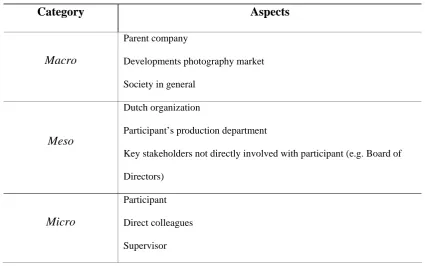
After the first coding phase, data showed a division in attribution levels of cause and consequence. Therefore, a refinement was made, coding the data in three levels of attribution. The macro level category contained data about developments or actions outside the organization; the meso level category about the organization in general; and the micro level category contained data about the participant and his immediate surroundings. Table 1 provides a detailed overview of the categories’ contents.
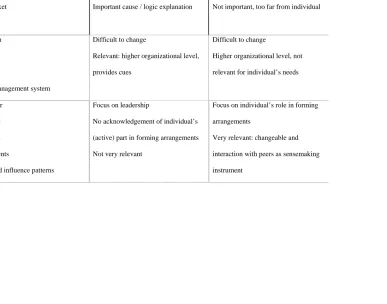
HERE---Although the second coding phase further clarified the data, it did not identify participants’ coping strategies. At this point of analysis, it appeared difficult to identify the key elements of both the extended investment model and the job crafting model. Therefore, and considering the data as grounded theory requires, the elements of both models were operationalized using five moderating and two effect variables of downsizing (cf. Brockner, 1988; Nadler & Tushman, 1980). According to general organization science, work consists of four component parts: the nature of the work, the individuals who perform the work and both the formal and the informal arrangements the organization makes to accomplish its objectives. Furthermore, an organization performs in a context, the environmental conditions (Nadler & Tushman, 19800). Brockner (1988) used the four components and the environmental conditions to define a model of downsizing effects. He stated that the psychological and behavioral effects of a downsizing are moderated by the four component parts and the environmental conditions. Although this study was not aimed at defining a model of moderators and effect, the variables were useful in identifying the key elements of and differences between the job crafting and extended investment model. Table 2 provides a detailed overview of the categories, their elements, and the implications for the two models of coping.
---INSERT TABLE 2
distance between the individual or his work and the environment. Furthermore, the unchangeable character of environmental conditions would be in line with the reactivity of the extended investment model as well.
Second, the nature of work is a moderator according to Brockner (1988). However, it was not reflected in the data and was therefore not included in the analysis.
aspect, as job crafting focuses on individual motivations and needs instead of on the organizational level.
Fourth, the organization is also built on informal organizational aspects. Although these are usually implicit an unwritten, they do influence an individual’s behavior in an organization (Nadler & Tushman, 1980). Brockner (1988) focuses on the norms, values and interpersonal relationships in general, and past experiences with downsizing procedures of the organization in particular. He stated that the informal behavior of an organization in a previous downsizing affects the attitude and behavior of survivors of a next downsizing. The aspects of the informal organizational arrangements are easier to change or shape by the individual than the more formal aspects. Emphasis on these informal aspects, and in particular on peer interaction, indicates a job crafting strategy of coping with the changes. The focus on social processes and the interactive aspect of sensemaking can then serve in a process of discovering one’s needs or making the preferred changes. If, on the other hand, the informal organizational aspects are not valued much or if the individual’s role in the shaping of these arrangements is not recognized, the extended investment model will be participants’ applied coping strategy. The emphasis will then be on leadership behavior as an unchangeable cue through which the individual forms his opinion or attitude about the events.
depending on the content. If the data show a tendency toward the individual aspects as a mere explanation for employees’ reactions, the extended investment model will be applicable. Factual information like one’s knowledge and skills, and one’s background factors will then be more important. More subjective information like one’s preferences and needs or one’s perceptions and expectations, will likely indicate the applicability of the job crafting model. In that case, data should show individual aspects as a motivational aspect or a means to change one’s work or work identity.
by the job crafting model, because an employee will try to change his or her negative attitude or view of work in order to fulfill his or her needs, or will not even develop a negative attitude due to the own (perceived) responsibility and role in the downsizing process.
The third coding phase was detailed enough to define employees’ sensemaking process, coping strategies and level of adaptability.
Results
In general, the three selected critical incidents (Announcement day Slide, Notification day Slide, Announcement new profitability study) defined in the interviews were also defined as critical in the focus groups. Furthermore, a cumulative effect of incidents was found as well as a disproportionate effect of one incident on the evaluation of the overall process.
This section will discuss, in chronological order, the main results of the critical incidents, the overall downsizing processes, and participants’ views on short-term and long-term future. We will focus on the coping strategies and level of adaptability. Table 3 provides an overview of representative excerpts from the data for all categories.
---INSERT TABLE 3
HERE---Before downsizings
digital photography. They realized measures would have to be taken, but the uncertainty about possible consequences did not greatly concern them. Employees’ attitudes were best described as awaiting management’s actions without taking any individual responsibility or actions. Only one of the 36 participants claimed to have acted in a proactive way; he decided to change from analogue film production to digital plate production which he considered a product category with more prospects. This was accepted, but wasn’t copied by others as they believed management would take care of them and the organization. In general, the extended investment model covered employees’ reactive attitude at this stage, not perceiving individual action or responsibility as a solution.
First downsizing: Slide
Slide began with its formal announcement in April and officially ended after the notification of redundant employees in May. Between these incidents, six weeks passed in which the employees demonstrated their coping strategy with the first critical incident and the prospect of uncertain future events or developments. Although the first downsizing was officially completed when the survivors and victims were ‘selected’, just then the actual coping and adapting process came into effect. Results showed mainly short-term, immediate effects of both critical incidents and a more long-term effect of the whole downsizing process. Both the results of the critical incidents and the downsizing process will be discussed below.
CI 1: Announcement of Slide
still caused a lot of consternation with the employees. Seeing the ‘hard numbers’ and realizing the downsizing would affect all departments within the organization and not just analogue film production, was confronting for employees and caused psychological effects like anxiety for their positions. Despite the anxiety, trust in management’s good arrangements for (to be) redundant employees and trust in the once-only character of the measures were still present. Despite the anxiety, too, behavior wasn’t immediately affected by the announcement. ‘No chit-chatting, back to work’, like some participants recalled, was a common remark.
Sensemaking of this incident proceeded mainly through positive evaluation of the ‘careful and thought-out’ formal communication, as well as through previous informal communication patterns that influenced the foreseeability.
Period 1: Between announcement (CI 1) and notification (CI 2)
Although the announcement did not immediately show an effect on the employees, it did require coping with the uncertainty about the actual redundancies until the second critical incident, six weeks later. Employees’ coping strategy was characterized by an awaiting attitude, i.e. denial of individual responsibility or opportunities to influence the outcomes. Not only did employees consider themselves dependent on the organization’s management and formal arrangements, they also showed a decline in job performance. Management’s formal and informal communication about procedures and consequences, that were mainly ‘focused on legal aspects’1, supported the view that individuals could not exert influence on the decision process. Despite
1
Two legal principles were applied. Last in, First out (employee with shortest tenure would be made
redundant) and Exchangeability (similar jobs, not necessarily in the same department, would be
the awaiting attitude, employees experienced an increasing level of insecurity and anxiety about individual consequences. A main concern for employees were pragmatic consequences of being made redundant, (e.g., ‘Can I still afford my mortgage when I’m unemployed?’). Strikingly, employees didn’t show any concerns about their job or the future if they were to survive the downsizing. Furthermore, they displayed a way of ‘self-protection’ by distancing themselves emotionally from the organization. This could also explain the deterioration of group relations and work atmosphere through the speculation about and accusation of possible victims in general or certain colleagues in particular. Finally, individual differences like level of proximity (in terms of product category and likelihood of becoming a victim), as well as one’s home environment provided an explanation for the experienced anxiety.
In conclusion, instead of proactively exerting influence on the decision process or already considering their job content and context if they were to survive the downsizing, employees mainly showed reactivity. Therefore, the extended investment model describes the coping strategy used in the period between the Slide’s two critical incidents. Moreover, the adapting process had not been initiated yet, probably due to the uncertainty of the outcomes.
CI 2: Notification day Slide
never deliver the message right’, some of them questioned the formal procedure during Notification day. The one-to-one conversations were very time-consuming and many people had to wait long before they were individually informed. Furthermore, procedural justice was a topic of discussion. Participants were ambiguous about the rigidity in applying the legal principles and compliance with individual qualities; some viewed the process as merely applying rules, others were of the opinion that management’s personal preferences had been of influence. Finally, not many effects of that incident were mentioned, and the effects were mainly psychological. Survivors felt relieved, but also compassionate with victims. The perceived certainty was valued very much and improved survivors’ job satisfaction.
Although these results (i.e. reactivity, no individual influence) suggest the fit of the extended investment model, the long-term effects were more important in determining the coping strategy and the resulting adaptability process.
Period 2: First weeks after Notification day (CI 2)
particular. The only significant behavioral effect was an increase in survivors’ turnover intentions, which is in line with the extended investment model. Also in line with the extended investment model is the influence of social interaction. Sensemaking proceeded through social interaction, but it was not a sign of people actively reflecting their personal needs or expectations to others and defining reality together. Rather, survivors depended on victims’ perceptions of the organization and career opportunities so as to define their own attitude. Finally, survivors’ adaptability to the ‘new organization’ was very low in this first period after the downsizing. They tried to continue their job as they had been used to before the downsizing, instead of proactively seeking opportunities in their work to increase job satisfaction or commitment.
Slide: first downsizing process
for the measures in general or their behavior towards the survivors in particular. They perceived the environment as main rationale for Slide.
Besides the focus on external causes and reactivity, the structural elements of the extended investment model can also be applied very well to employees’ coping process. First, job value was assessed. One of the discussion topics was the change in job satisfaction; some participants experienced a decline in satisfaction due to a perceived greater pressure to perform, with more work to do and with fewer resources. Others did not view a change in job satisfaction; their job ‘was and remained satisfying’. But even though not all participants agreed on the decrease of job satisfaction, they did agree that employees’ view on work had changed due to Slide; affective commitment to the organization changed, resulting in a more ‘rational and realistic’ view toward the organization. The idea of life time employment had
In conclusion, the reactive attitude, dependence on external cues, and the absence of action are typical aspects of the extended investment model. This coping strategy prevented survivors from adapting to the uncertainty or the new situation. By not introspectively looking for responsibility or opportunities, survivors were not able to proactively change or control the new situation. Therefore, they remained in a negative attitude towards the changes. However, after Slide survivors wanted to ‘get back to business’, ‘confidently move on again’ and ‘rebuild the organization’. This suggests a form of adaptability and willingness to learn how to cope with the changes. Perhaps, if it had indeed been a once-only event, survivors would have shown an adapting process characterized by job crafting. Therefore, the second downsizing,
Scope, may have had an impact on the first in retroaction. The remark that Slide was a
‘first step, followed by more changes’, would possibly not have been made if the second downsizing had not been announced only four months after the first.
Second downsizing: Scope
CI 3: Announcement new profitability study
This third critical incident appeared to be the most critical of all three, though respondents did not extensively discuss it. All participants agreed that the unexpectedness of the announcement caused anxiety, uncertainty and a great shock. Formal communication and informal leadership behavior were considered the most important aspects in the sensemaking process. Mainly the timing, so shortly after the first downsizing and the contrast with the first downsizing in terms of communication, presentation and organizational support afterwards, caused the negative effects of this incident. Trust in management sharply decreased. Employees felt deceived and viewed management’s actions as amateurish. These were signs of a plunge in perceived organizational support. Despite the eminent psychological effects, behavioral effects were not mentioned often. The only destructive behavior mentioned were verbal curses toward management. ‘Business as usual’ seemed to remain employees’ motto; performance did not suffer from the incident.
After announcement (CI 3)
Employees just ‘waited to see what would happen; there was nothing [they] could do about it’.
Like with Slide, coping with the uncertainty of Scope could be described by the extended investment model. Some aspects were different. Employees still felt dependent of management for their sensemaking, but formal communication was not appreciated as much anymore. Informal leadership behavior and communication or influence patterns seemed to be more important than communication about the status of the study. For example, a manager of the analogue film production line was transferred to a digital product line. Employees perceived this as the informal message that Scope was inevitable and that the analogue film department would be shut down. Furthermore, this negatively affected perceived organizational support (‘A captain should leave his ship last’)
In conclusion, the reactive attitude supports the fit of the extended investment model as coping strategy for the aftermath of the third critical incident. Employees’ view on short-term as well as long-term future supported this.
Future
Short-term future incidents
would not decrease potential future effects. It did decrease the insecurity toward the announcement.
Long-term future
prospective sensemaking. For example, further developments in the photographic industry would ultimately lead to ‘a closure of the entire organization; within 15 years they can make this a residential area’. Finally, individual background factors appeared important, yet unchangeable: employees’ age would force them to make choices about their future, and their home environment would also determine the impact of future developments.
In conclusion, prospective sensemaking proceeded on the basis of earlier experiences and was guided by coping strategies employees had used before. The prospect of uncertainty did not evoke attempts to change future events or developments. The extended investment model thus describes employees’ expected coping strategy.
Discussion
Main conclusions
In accordance with the escape-oriented coping strategy, survivors’ adaptability to uncertain situations appeared to be low. The uncertainty during the first and second downsizing processes didn’t evoke taking effective action, as is required for a higher level of adaptability (Pulakos et al., 2000).
Influence context on coping and adaptability
The research questions in this study considered organizational culture as a possible coping resource or constraint. Results have shown that this was correct. The organization studied, had been used to a culture defined by stability, ideas about work as a production activity, and control, coordination and responsibility centralized at a higher organizational level. Appropriate behavior was thus described as stable, non-innovative and relying on management to take responsibility. Shared values that underline low individual responsibility and innovativeness in general reduce the chance that employees are inclined to engage in an adaptability process (Detert et al., 2000). The non dynamic context changed due to the downsizings and results showed that survivors of the first downsizing were willing to adapt to the new situation. However, the second downsizing undermined this process, because values were communicated like the parent company’s control and responsibility. Therefore, employees did not perceive individual responsibility and action as grounds of a successful organization and focused their coping on escape rather than control. Results have thus showed that organizational culture can affect employee adaptability.
the conclusion that single downsizing organizations are able to recover from the negative effects, but that multiple downsizing survivors are not able to overcome those repeat negative consequences (Gilson et al., 2004), is also apparent in this study. Apparently it is difficult for employees (and organizations, for that matter) to rapidly and continuously adapt to new situations when they are not used to change and uncertainty.
Theoretical implications
Many studies on downsizing have provided insight in the broad range of possible effects (e.g. Armstrong-Stassen, 2004; Brockner, 1992), but only few have linked downsizings to Latack’s (1986) different coping strategies (one exception is Armstrong-Stassen, 2006). This study has not only addressed the issue of coping strategies in a downsizing context, but has also linked them to two theoretical models. Results have shown that the extended investment model (Van Dam, 2005) and job crafting model (Wrzesniewski & Dutton, 2001) are well applicable to downsizing contexts. Thus, using the structural elements of both models has proven to provide detailed insight in individual’s coping processes in a downsizing. Furthermore, the differences between the models have also provided insight in the consequences of coping strategies for employee adaptability.
clarified the process of coping with and adapting to changes. Moreover, the Critical Incident Technique also contributed to that insight. CIT was the appropriate method to define the effects of single events as well as to survey individual’s sensemaking process. CIT therefore contributed to the conclusion that the accumulation of events and the contrast between events or procedures has a greater impact on employees than a single event, though one single event can be the last straw.
In conclusion, this study has greatly attributed to the theoretical knowledge on (multiple) downsizing and coping and adaptability processes. Not only did we study coping strategies from a different angle than many other downsizing studies, we also clarified the relationship between coping strategies and the potential and actual adaptability processes. Finally, the timing of performing during a multiple downsizing process has attributed to the understanding of individual sensemaking and coping processes during a downsizing.
Limitations and future research
While this study has attributed to knowledge on multiple downsizing, it may be expected that some limitations exist. Future research would therefore be needed to further explore the results from this study.
thus be aimed at further exploring those constructs in different organizational settings. Quantitative research methods could be used to this goal. A model of adaptability to uncertain situations could be developed by testing and exploring different determinants, antecedents and consequences in several kinds of organizations. The current study can serve as a first starting point for such a conceptual model.
Second, this study was conducted only at one moment in time. Results from this study have shown that events can affect each other in retrospect (i.e. the first downsizing would have been evaluated differently if the second hadn’t followed or had been executed differently), and it would be interesting to see how coping and adaptability processes develop over time. Thus, despite the attribution of this study to the field of multiple downsizing research, longitudinal research on the effects of multiple downsizing would be recommended.
Management implications
status, goals and developments. This study has shown that careful communication contributes greatly to a positive evaluation of an, in effect, negative incident.
A final implication of this study is that downsizing should never be underestimated. However logical it may seem, employees will never respond to it with indifference and it will always change an organization. It is up to both the organizations and employees to make this change a success.
References
Allen, T.D., Freeman, D.M., Russell, J.E.A., Reizenstein, R.C., & Rentz, J.O. (2001). Survivor reactions to organizational downsizing: Does time ease the pain?
Journal of Occupational and Organizational Psychology, 74, 145–164.
Armstrong-Stassen, M. (1997). The effect of repeated management downsizing and surplus designation on remaining managers: an exploratory study. Anxiety, Stress and Coping, 10, 377-384.
Armstrong-Stassen, M. (2004). The influence of prior commitment on the reactions of layoff survivors to organizational downsizing. Journal of Occupational Health Psychology, 9, 46-60.
Armstrong-Stassen, M. (2006). Determinants of how managers cope with organisational downsizing. Applied Psychology: An international review, 55
(1), 1-26.
Armstrong-Stassen, M., Wagar, T.H., & Cataneo, R.J. (2004). Work-group membership (in)stability and survivors’ reactions to organizational downsizing.
Brockner, J. (1988). The effects of work layoffs on survivors : Research, theory and practice. Research in organizational behavior. An annual series analytical essays and critical reviews, 10, 213-255.
Brockner, J. (1992). Managing the effects of layoffs on survivors. California Management Review, 34 (2), 9-28.
Brockner, J., Grover, S., O’Malley, M.N. Reed, T.F., & Glynn, M.A. (1993). Threat of future layoffs, self-esteem, and survivors’ reactions: evidence from the laboratory and the field. Strategic Management Journal, 14, 153-166.
Brockner, J., Grover, S., Reed, T.F., & DeWitt, R.L. (1992). Layoffs, job insecurity, and survivors’ work effort: evidence of an inverted U-relationship. Academy of Management Journal, 35, 413-425.
Brockner, J., Wiesenfeld, B.M., Reed,T., Grover, S., & Martin, C. (1993). Interactive effect of job content and job context on the reactions of layoff survivors.
Journal of Personality and Social Psychology, 64, 187-197.
Detert, J.R., Schroeder, R.G., & Mauriel, J.J. (2000). A framework for linking culture and improvement initiatives in organizations. Academy of Management Review, 25, 850-863.
Edvardsson, B., & Strandvik, T. (2000). Is a critical incident critical for a customer relationship? Managing Service Quality, 10, 82-91.
Farrell, D., & Rusbult, C.E. (1981). Exchange variables as predictors of job satisfaction, job commitment, and turnover: The impact of rewards, costs, alternatives, and investments. Organizational Behavior and Human Performance, 27, 78-95.
Flanagan, J.C. (1954). The critical incident technique. Psychological Bulletin, 51,
Gilson, C., Hurd, F., & Wagar, T. (2004). Creating a concession climate: The case of the serial downsizers. International Journal of Human Resource Management, 15, 1056-1068.
Glaser, B.G., & Strauss, A.L. (1967). Discovery of grounded theory: Strategies for qualitative research. Chicago: Aldine.
Goldhaber, G.M., & Rogers, D.P. (1979). Auditing organizational communication systems: The ICA communication audit. Dubuque: Kendall/Hunt.
Grunberg, L., Moore, S.Y., & Greenberg, E. (2001). Differences in psychological and physical health among layoff survivors: The effect of layoff contact. Journal of Occupational Health Psychology, 6, 15-25.
Hyde, A., Howlett, E., Brady, D., & Drennan, J. (2005). The focus group method: Insights from focus group interviews on sexual health with adolescents. Social Science & Medicine, 61, 2588-2599.
Isabella, L.A. (1990). Evolving interpretations as a change unfolds: how managers construe key organizational events. The Academy of Management Journal, 33, 7-41.
Jalajas, D.S., & Bommer, M. (1999). A comparison of the impact of past and the threat of future downsizings on workers. Journal of Social Behavior and Personality, 14, 89-100.
Kalimo, R., Taris, T.W., & Schaufeli, W.B. (2003). The effects of past and anticipated future downsizing on survivor well-being: An equity perspective. Journal of Occupational Health Psychology,8, 91–109.
Kickul, J., Lester, S.W., & Finkl, J. (2002). Promise breaking during radical organizational change: Do justice interventions make a difference? Journal of Organizational Behavior, 23, 469–488.
Kiefer, T. (2005). Feeling bad: Antecedents and consequences of negative emotions in ongoing change. Journal of Organizational Behavior, 26, 875-897.
Latack, J.C. (1986). Coping with job stress: Measures and future directions for scale development. Journal of Applied Psychology, 71, 377-385.
Lee, G. & Teo, A. (2005). Organizational restructuring: Impact on trust and work satisfaction. Asia Pacific Journal of Management, 22, 23–39.
Luthans, B.C., & Sommer, S.M. (1999). The impact of downsizing on workplace attitudes. Differing reactions of managers and staff in a health care organization. Group & Organization Management, 24, 46-70.
Mark, M.M., & Mellor, S. (1991). Effect of self-relevance of an event on hindsight bias: The foreseeability of a layoff. Journal of Applied Psychology, 76, 569-577.
McElroy, J.C., Morrow, P.C., & Rude, S.N. (2001). Turnover and organizational performance: A comparative analysis of the effects of voluntary, involuntary, and reduction-in-force turnover. Journal of Applied Psychology, 86, 1294-1299. Nadler, D.A., & Tushman, M.L. (1980). A model for diagnosing organizational
behavior. Organizational Dynamics, 9 (2), 35-51.
Parker, S.K., Chmiel, N., & Wall, T.D. (1997). Work characteristics and employee well-being within a context of strategic downsizing. Journal of Occupational Health Psychology, 2, 289-303.
Patton, M.Q. (1990). Qualitative Evaluation and Research Methods (2nd ed.). California: Sage Publications, Inc.
Pulakos, E. D., Arad, S., Donovan, M. A., & Plamondon, K. E. (2000). Adaptability in the work place: Development of a taxonomy of adaptive performance.
Journal of Applied Psychology, 85, 612–624.
Pulakos, E.D., Schmitt, N., Dorsey, D.W., Arad, S., Hedge, J.W., & Borman, W.C. (2002). Predicting adaptive performance: further tests of a model of adaptability. Human Performance, 15, 299-323.
Schroeder, R.G., Van de Ven, A.H., Scudder, G.D., & Polley, D. (1989). The development of innovation ideas. In A.H. van de Ven, H.L. Angle, & M.S. Poole (Eds.), Research in the management of innovation: The Minnesota studies. (pp 107-134). New York: Ballinger.
Spreitzer, G., & Mishra, A.K. (2002). To stay or to go: Voluntary survivor turnover following an organizational downsizing. Journal of Organizational Behavior, 23, 707–729.
Starbuck, W.H., & Milliken, F.J. (1988). Executives’ perceptual filters: What they notice and how they make sense. In D.C. Hambrick (Ed.), The executive effect: Concepts and methods for studying top managers (pp 35-65). Greenwich, CT: JAI.
of a workforce reduction strategy. Management Communication Quarterly, 17, 485-516.
Van Dam, K. (2005). Employee attitudes toward job changes: An application and extension of Rusbult and Farrell’s investment model. Journal of Occupational and Organizational Psychology, 78, 253-272.
Weick, K.E. (1993). The collapse of sensemaking in organizations: The Mann Gulch disaster. Administrative Science Quarterly, 38, 628-652.
Weick, K.E. (1995). Sensemaking in organizations. London: Sage.
Wolfe Morrison, E., & Robinson, S.L. (1997). When employees feel betrayed: A model of how psychological contract violation develops. Academy of Management Review, 22, 226-256.
Wrzesniewski, A., & Dutton, J.E. (2001). Crafting a job: revisioning employees as active crafters of their work. Academy of Management Review, 26, 179-201. Wrzesniewski, A., McCauley, C., Rozin, P., & Schwartz, B. (1997). Jobs, careers and
callings: people’s relations to their work. Journal of research in personality, 31,
21-33.
Zwijze-Koning, K.H., & De Jong, M.D.T. (2006). The critical incident technique as a communication audit tool: A study in to the quality of organizational
Table 1. Categories second coding phase
Category Aspects
Macro
Parent company
Developments photography market
Society in general
Meso
Dutch organization
Participant’s production department
Key stakeholders not directly involved with participant (e.g. Board of
Directors)
Micro
Participant
Direct colleagues
Table 2. Categories third coding phase and implications for coping strategies
Relevance and implications for Category Aspects
Extended investment model Job crafting model
Environmental conditions Parent company
Developments market
Society in general
Unchangeable
Important cause / logic explanation
Unchangeable
Not important, too far from individual
Formal organizational
arrangements
Organization design
Job design
Work environment
Human resource management system
Difficult to change
Relevant: higher organizational level,
provides cues
Difficult to change
Higher organizational level, not
relevant for individual’s needs
Informal organizational arrangements Leadership behavior Intergroup relations Intragroup relations Informal arrangements
Communication and influence patterns
Focus on leadership
No acknowledgement of individual’s
(active) part in forming arrangements
Not very relevant
Focus on individual’s role in forming
arrangements
Very relevant: changeable and
interaction with peers as sensemaking
Table 2 (Continued)
Relevance and implications for Category Aspects
Extended investment model Job crafting model
Individuals Knowledge and skills
Preferences and needs
Perceptions and expectations
Background
Self-esteem
Explanation for effects
Focus on factual data (knowledge,
background factors)
Motivation for change
Focus on subjective data (preferences,
perceptions)
Psychological effect Negative stress-related emotions
Depression
Job satisfaction
Commitment
Trust
Perceived Organizational / Supervisor Support
Focus on negative effects
Cause / responsibility of higher
organizational level (external
attribution)
Focus on positive effects
Cause / responsibility of individual
(internal attribution)
Behavioral effect Performance
Destructive behavior
Short-term absence
Turnover (intention)
Turnover (intention) only behavioral
effect
No turnover (intention) as behavioral
effect
Table 3. Excerpts from data for Critical Incidents and time periods
Events in chronological order Elements of
coping process
and effects Before downsizings CI 1: Announcement day
Slide
CI 2: Notification day Slide
Downsizing 1 (Slide)
Environmental conditions
We all know how things went with digital photography
My job involves the developments in the
market…that announcement is just a confirmation of what we already knew
X
When we saw the reasons: analogue film disappears because of the digital camera…of course, everybody understands. It made great sense
Formal organization
We had already had 100 days without any production…that was so boring
It was presented with great confidence, very clear…you just knew ‘if I’m made redundant, that will happen and it will stop there’
We were placed in a big room and had to come in one by one. We had to wait very long that day
It is fair, actually [Lifo]…but they didn’t take individual quality into
account…some people worked so hard for this organization but were made redundant because they didn’t work here long enough
Informal organization
I asked them twice about digital photography, but [management]
denied it…If I can see it, someone else can too, right?
It’s fairest to involve the whole organization…it fit my sense of ‘group feeling’
It all depended on your manager, how he had described ‘exchangeability’ in the job profiles
I think they selected people on beforehand. When you see that some didn’t get a promotion before Slide…at least, that is how you interpret it in retrospect
Individual
X
It didn’t concern me personally, because I’m not involved in
[that technique]
There were two groups: one that had worked here shortly and one that had worked here for 20 years…it was most difficult for them
Table 3. (Continued)
Events in chronological order Elements of coping
process and effects
Before downsizings CI 1: Announcement day
Slide
CI 2: Notification day Slide Downsizing 1 (Slide)
Psychological effect We just knew something had to be done. We just didn’t know what would happen
It was shocking, because we were confronted with the numbers and the facts…you were anxious, because of the exchangeability
That day, we had the emotional peak.
You knew that we’d continue for some while, although you don’t get a guarantee for 10 years
Cynicism has increased
My job didn’t change, but my view on the organization did…You came here with the idea of LTE and ‘boom, gone’
Now I know, it’s just a job
It’s a pity: you’ve worked on it with heart and soul, and suddenly it’s as if it’s worthless
Behavioral effect I decided in January 2005 to quit my job in the analogue film department and start somewhere else. My first intention was to find something internally
We talked about it for half an
hour and went back to business X
Back to business…only the workload increased
It has been a turning point, I just try to make the most of it and to enjoy going to work
Table 3. (Continued)
Events in chronological order Elements of coping
process and effects
CI 3: Announcement new profitability study
Second downsizing (Scope) Short-term future events Long-term future
Environmental
conditions X
I think this downsizing will be mainly the [parent company’s]
message
How will they deal with this downsizing? Lifo regulations have changed since Slide
It’s just a current curve until
[parent company] tells us to close
How long will that Board of Directors of [parent company] continue this?
Developments continue. Within 10 years [digital product] will be gone as well
When even a company like [name]
can’t provide long-term employment, then that will probably be the general trend for the future
Formal organization
Something had to be done, but it’s more the way they did it…that was just a major failure
I think it depends on how the entire organization will be restructured
Are we waiting to hear the status over and over again? No. We just want to know what we’ll hear next Tuesday [A’day Scope]
I don’t know what it will mean for our career opportunities; promotions and those things to keep you inspired. That will also be gone
Informal organization
They should have communicated their new communication policy first, before announcing this. Then it would have been clear
The problem is there [in analogue film department], still. That does play a part
X
Last week our manager told us that there would probably also be trouble in [the digital production department]
Table 3 (Continued)
Events in chronological order Elements of coping
process and effects
CI 3: Announcement new profitability study
Second downsizing (Scope) Short-term future events Long-term future
Psychological effect It starts all over again...the anxiety
There was no more
understanding for management, no more trust
Maybe it’s strategic…we’ve been fooled
Still, there is the fear of being next
X
My job is still nice, and it will stay nice
I just hope they will take decision for me. I find it very hard to take the decision to leave. I’ve had 15 great years here.
Behavioral effect Business as usual…it was just the timing that was bad
I’ll just wait till they give me my Social Plan
Just wait and see…there’s nothing I can do about it
If it goes down [on A’day], I don’t want any other job within the organization anymore
I accept it the way it is now, but if something happens, I’m out. The day will come that I leave.
If something crosses my path, I will use it