Volume 2007, Article ID 82160,13pages doi:10.1155/2007/82160
Research Article
A Near-Lossless Image Compression Algorithm Suitable for
Hardware Design in Wireless Endoscopy System
Xiang Xie, GuoLin Li, and ZhiHua Wang
Department of Electronic Engineering, Tsinghua University, Beijing 100084, China
Received 12 September 2005; Revised 28 February 2006; Accepted 7 April 2006
Recommended by Liang-Gee Chen
In order to decrease the communication bandwidth and save the transmitting power in the wireless endoscopy capsule, this paper presents a new near-lossless image compression algorithm based on the Bayer format image suitable for hardware design. This algorithm can provide low average compression rate (2.12 bits/pixel) with high image quality (larger than 53.11 dB) for endo-scopic images. Especially, it has low complexity hardware overhead (only two line buffers) and supports real-time compressing. In addition, the algorithm can provide lossless compression for the region of interest (ROI) and high-quality compression for other regions. The ROI can be selected arbitrarily by varying ROI parameters. In addition, the VLSI architecture of this compression algorithm is also given out. Its hardware design has been implemented in 0.18µm CMOS process.
Copyright © 2007 Hindawi Publishing Corporation. All rights reserved.
1. INTRODUCTION
Compared to the conventional endoscopy system, the wire-less capsule endoscopy allows us to directly study the entire small intestine and does not require any sedation, anesthesia, or insufflation of the bowel. There is the only clinic device
made by Israel in the world [1]. However, it can only work
for less than eight hours (generally, it costs capsule about 10–48 h, typically 24 h, on moving from mouth to
evacua-tion [1]) and the image frame rate is slow (2 frames/second),
which results in the fact that there is not enough time for the capsule to check the large intestine, and some regions inter-esting to the doctors are often missed. By analyzing power consumption in capsule, it can be known that the power of transmitting image data occupies about 80% of the total power in capsule. In the digital wireless endoscopy capsule system designed by us, the power is supplied by two
batter-ies and a CMOS image sensor is used [2]. In order to reduce
the communication bandwidth and the transmitting power in the capsule, the image compression has to be applied. Al-though the CMOS sensors will bring some noises to the cap-tured images, it does not affect the doctor’s diagnosis. Once the lossy compression is used, some information contained in the original images will be lost, which results in the error diagnosis. So a new low-complexity and high-quality image compression for digital image sensor with Bayer color filter
arrays needs to be used [2]. Figure 1shows the simplified
block diagram of our wireless endoscopy capsule system. The output image data from a CMOS image sensor is compressed first and then coded by channel coding module. Finally, the data are transmitted by a wireless transceiver to the outside of the body. The transmitted data will be received and decom-pressed for subsequent diagnosis. The control unit in capsule controls the compression module according to the received commands from the external remote control.
Some compression algorithms for Bayer format image data have been reported to get higher-compression
perfor-mance [2–7]. However, all those algorithms are proposed for
lossy compression and are not suitable for the medical im-age compression in the wireless endoscopy system. Toi and Ohita applied the subband coding technique in the
com-pression first scheme [4]. The technique cannot be used for
near-lossless or lossless image compression because the dia-mond filter used cannot be reconstructed perfectly. Lee and
Ortega [5] gave a reversible image transformation. The RGB
is transformed to YCbCr firstly. Then Y data array is rotated into a rhombus. Finally the rotated Y data, original Cb, and Cr data are compressed by JPEG separately. However, since the rotated Y data is not rectangular, the standard encoder, such as JPEG-LS, JPEG, and JPEG2000, cannot be applied
directly. Recently, Koh et al. [6] presented two new
COMS image sensor
Bayer
data Image compression
Channel coding
Wireless transceiver
Channel decoding Control
unit
Figure1: Block diagram of system architecture inside wireless endoscopic capsule.
R G R G
G B G B
R G R G
G B G B
Figure2: Bayer pattern color filter array (CFA).
computational complexity of structure conversion method is lower than that of structure separation method. The struc-ture separation method is unsuitable for near-lossless or loss-less image compression because of the nonreversible
dia-mond filter. Although [8] presents a new lossless
compres-sion based on wavelet transformation, its computation com-plexity is so high for wireless endoscopy application. This paper presents a new near-lossless image compression algo-rithm for the wireless endoscopy system. It has low complex-ity hardware implementation and supports real-time
com-pressing. In this paper, PSNR larger than 46.37 dB and no
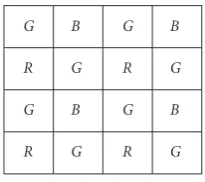
more than 2 intensity levels error for a pixel is defined as near-lossless. This strict definition assures high image qual-ity, which is safe for patient diagnosis. The color filter arrays (CFAs) data discussed in this paper is the most popular Bayer pattern [9] as illustrated inFigure 2.
2. PROPOSED NEAR-LOSSLES COMPRESSION ALGORITHM
2.1. Algorithm structure
A simple structure for the proposed near-lossless
compres-sion algorithm is illustrated inFigure 3(a). In this algorithm,
before image compression, there is a data preprocessing part which includes image format transformation and a low-pass filter. First, the Bayer pattern CFA data is transformed into a format suitable for image compression as well as for hard-ware design. The data is then low-pass filtered directly in
RGB space. JPEG-LS [10] is used here for low complexity
of hardware implementation and high efficient compression
performance. Some other lossless compression coders such
as CALIC [11] have better compression performance, but
they have much more computational complexity than JPEG-LS, which is not suitable for the low-power design inside
the wireless endoscopic capsule. Although there are some other lower complexity lossless compression algorithms such
as FELICS algorithm [12], those algorithms have no good
compression performance for Bayer image data. The com-parison results between FELICS and JPEG-LS for Bayer
im-age data will be given inSection 4. The introduction of the
low-pass filters leads to a small loss of high frequency, but a low-compression rate with high fidelity can be obtained. The reconstructed image quality can be adjusted by chang-ing the quality control factor. Moreover, the specified ROI can be coded without loss by adjusting the ROI parameters. The quality control factor and ROI parameters are used as the input parameters of the low-pass filter.
The corresponding decompression algorithm is shown in
Figure 3(b). It is a simple reverse procedure of the compres-sion.
2.2. Analysis of the algorithm structure
There are two compression methods for the Bayer format im-age data. The first method is to compress Bayer data directly,
and the other is to compressG,B, andRcomponents,
respec-tively. The proposed algorithm illustrated inFigure 3belongs
to the first method. In general, in the second method,G,B,
andRcomponents of Bayer data are preprocessed and then
compressed, respectively, as in [2–8]. This method
struc-ture can be shown inFigure 4. Two major structures of this
method are illustrated in this figure. One is the “serial struc-ture” in which three components are compressed one by one, and the other is “parallel structure” in which three compo-nents are compressed parallel. Only from the viewpoint of the compression performance, the second method is better than the first method because this method makes full use of the correlation between neighbor pixels in the same color plane. However, the second method needs much more hard-ware overhead than the first method. The reason is illustrated in the following.
In a CMOS image sensor, there are some different read-out modes such as progressive scan and interlaced scan.
As-sume the size of the raw Bayer data is 4∗4, take the
progres-sive scan as an example, the raw Bayer image data are read
out as shown inFigure 5. In serial structure ofFigure 4(a),
whenGcomponent is being compressed, the other two
Raw Bayer data
Preprocessing Quality control factor
ROI parameter Image format
transformation Low-passfilter
JPEG-LS encoding
Compressed data (a)
Restored
Bayer data Image format transformation
Quality control factor ROI parameter
Reconstruction filter
JPEG-LS decoding
Compressed data (b)
Figure3: Block diagrams: (a) the proposed near-lossless compression algorithm and (b) the corresponding decompression algorithm.
Raw Bayer data
G Preprocessing
Switch
Lossless or lossy encoding
Compressed data
B&R Preprocessing RAM (half image size) (a) Serial compression structure
Raw Bayer data
G
B
R
Preprocessing
Preprocessing
Preprocessing
Lossless & lossy encoding (1) Lossless & lossy
encoding (2) Lossless & lossy
encoding (3)
Compressed data
(b) Parallel compression structure
Figure4:G,B, andRare compressed, respectively.
G R G R
B G B G
G R G R
B G B G
Figure5: Progressive scan sequence of a CMOS image sensor.
structure” needs more additional buffer with half image size
to storeRandBcomponents, and moreover, it is not suitable
for real-time compressing. As the captured image size be-comes larger, the buffer size also bebe-comes larger. In our
en-doscopy system, the captured image size is 640∗480∗8 bits
and the designed endoscopic capsule size is smaller than
9∗20 mm. Even if we use the 0.18µm CMOS process to
de-sign the chip inside the capsule, the ram buffer with 640∗
480∗8∗0.5=1 228 800 bits size is too large to be installed
in that miniature capsule. The “serial structure” illustrated inFigure 4(a)limits the captured image size. Moreover, the fact that three components have to be compressed one by one limits image processing speed and makes it very difficult to realize real-time endoscopic image monitoring. In the
“par-allel structure” illustrated inFigure 4(b), three same
encod-ing modules have to be used. Compared to the first method
hardware overhead and about triple power consumption. So, the first method is used in our system.
2.3. Algorithm description
There are more high-frequency components in the horizon-tal and vertical directions of the Bayer CFA data than that in the full-color image data, which is disadvantageous to image compression. In order to avoid this problem, first, the
data format is transformed as illustrated inFigure 6. All the
quincunx Gcomponents are moved to the left side to
de-crease the high frequency in raw Bayer data. Although the
BandRcomponents are interlaced after transformation, the
compression performance is affected very little. Note that the buffer expenditure of the transformation is only two lines at most. Here, one line length equals image width. Then the raw Bayer data should be smoothed to further decrease the high-frequency components as follows.
The pixels of the first row are not filtered while other pixels are filtered row by row. The array of the low-pass
fil-ter is described in (1), but its filtering operation is different
from the regular operation. The low-pass filter scans from the second row until the last row is reached, as illustrated inFigure 7. The scan sequence is the same as that of
read-out mode of the image sensor. The virtual pixel(n)of the left
boundary is equal to its nearest right pixel in the first col-umn, and the virtual pixel of the right boundary is equal to its nearest left pixel in the last column. Those virtual pixels are used to compute left and right boundary points in the filtering operation. The circled number in this figure repre-sents the scan sequence of the filter operation. Note that the filtered pixels are used for the filtering operation of the
fol-lowing next neighboring rows. For example, inFigure 7(b),
the filtered pixels of the second row are used for the filter-ing operation of the third row. After the filterfilter-ing operation, Bayer data arrays will become smoother. So the compression rate can be improved. The proposed low-pass filter has three key merits. The first is its simplicity. For example, compared
with the filter used in [4,8], the proposed filter has much
lower complexity. The second is its low-pass character. The last merit is its perfect reconstruction:
Hbr=14
⎡ ⎢ ⎢ ⎢ ⎢ ⎢ ⎣
1 1 1
0 1 0
0 0 0
⎤ ⎥ ⎥ ⎥ ⎥ ⎥
⎦. (1)
Moreover, the perfect and simple reconstruction filter can be obtained for high image quality. The reconstruction
matrix isHbr and the reconstruction filtering operation can
be illustrated inFigure 8:
H br = ⎡ ⎢ ⎢ ⎢ ⎢ ⎢ ⎣
−1 −1 −1
0 4 0
0 0 0
⎤ ⎥ ⎥ ⎥ ⎥ ⎥
⎦. (2)
2.4. Rounding operation
The coefficient in matrix (1), 1/4, makes the division
oper-ation or shift operoper-ation unavoidable in the filtering process. Its residual values are 0, 1, 2, or 3. To reduce the residual er-ror, the rounding operation is applied. It is described simply in the following equation:
y=
1
4(x+ 1) . (3)
Here, “•” is the integer-valued operator (• ≤ •),xandy
are integers, andyis the rounded result. In this compression
algorithm, (3) is expanded into a matrix equation as follows:
Om×n=
1
4×
Im×n⊗Hm×n+Em×n
m×n. (4)
In (4),Xm×nrepresents the integer-valued operator of the
m×nmatrixX. The integer value of every element in the
matrixXm×nis not larger than that of the element of
cor-responding position in the matrixX, that is,Xm×n ≤ X.
Om×n denotes the matrix of the filtered data,Im×ndenotes
them×nmatrix of original CFA data,H denotes the
low-pass filter, andEm×ndenotes anm×nmatrix in which the
values in the location of all filtered elements are ones.
2.5. Error analysis
In the proposed algorithm, the implementation precision is 8-bit. The error is generated only by the division operation in the low-pass filter. If there is no rounding operation, the absolute error between the original CFA data and the filtered data is expressed in the following equation:
e1=
x−4×
1
4×x
. (5)
Here, x is an integer and e1 is the absolute error. From
this equation, e1 ≤ 3 can be deduced, that is, the
max-imum absolute error is three. Table 1 shows the residue
value distribution in seven-color images with Bayer CFA
pat-tern and size 512×512. These images are generated from
seven standard test images. Because the size of each image
is 512×512, the summation of every column inTable 1is
262 144. FromTable 1, statistical analysis yields the
approxi-mate probability distribution ofe1:
p(0)=p(1)=p(2)=p(3)=1
4. (6)
When the rounding operation is used, the absolute
error,e2, between the original data and filtered data can be
described as follows:
e2=
x−4×
1
4×(x+ 1)
. (7)
From (7),e2 ≤2 is obtained. After the rounding operation,
R81G82R83G84R85G86 R87G88 G82 G84G86G88R81 R83R85 R87
G71B72 G73B74 G75B76 G77B78 G71 G73G75G77B72 B74B76 B78
R61G62R63G64R65G66 R67G68 G62 G64G66G68R61 R63R65 R67
G51B52 G53B54 G55B56 G57B58 G51 G53G55G57B52 B54B56 B58
R41G42R43G44R45G46 R47G48 G42 G44G46G48R41 R43R45 R47
G31B32 G33B34 G35B36 G37B38 G31 G33G35G37B32 B34B36 B38
R21G22R23G24R25G26 R27G28 G22 G24G26G28R21 R23R25 R27
G11B12 G13B14 G15B16 G17B18 G11 G13G15G17B12 B14B16 B18
Image format transformation
(a) Bayer pattern CFA data (b) Transformed pattern data Figure6: Image transformation operation.
9 10 11 12
5 6 7 8
1 2 3 4
(a)
1
5 6 7 8
1 2 3 4
9 10 11 12 4
. . .
(b)
5 5 6 7 8 8
1 2 3 4
9 10 11 12 (c)
Figure7: Filtering operation.
distribution with rounding operation is shown in Table 2.
From this table, the approximate probability distribution of
e2,p(e2), can be obtained as follows:
p(0)=p(2)=1
4, p(1)=
1
2. (8)
In fact, after filtering a large amount of images, the same sta-tistical probability distribution of the errors can be gotten. The error value is focused on one and zero after rounding operation.
In this paper, we define PSNR in the near-lossless com-pression, the measure of image quality, as follows:
PSNR=10 log10
⎛
⎝ 2552
(1/H×W)Wx=1Hy=1I1(x,y)−I2(x,y)
2
⎞
⎠; (9)
I1andI2are original and reconstructed images with height
H and widthW, respectively, and are expressed in integer
values between 0 and 255, andxandyare locations of pixels.
According to the error distribution in (8) and the defined
PSNR equation (9), the statistic image quality after filtering
is
PSNR=10 log10
2552
1/(H×W)•p(1)•(H×W)•12+p(2)•(H×W)•22
9 10 11 12
5 6 7 8
1 2 3 4
(a)
5 6 7 8
1 2 3 4
9 10 11 12
. . .
(b)
5 5 6 7 8 8
1 2 3 4
9 10 11 12 (c)
Figure8: The reconstruction filtering operation.
Table1: Residue distributions of Bayer data without rounding operation. These Bayer CFA data are generated from seven standard test color images with size 512×512
e1 Airplane Baboon House Lake Lena Peppers Splash
0 65586 65855 65233 66065 65747 66012 66119
1 65712 65250 66234 65317 65106 65130 65245
2 65365 65520 65942 65307 65526 65867 65712
3 65481 65519 64735 65455 65765 65135 65068
2.6. Adjustable image quality and compression rate
By decreasing the number of CFA data to be filtered, the im-age quality, PSNR, can be increased. In the proposed
algo-rithm, the percent of the data to be filtered in CFA raw data is used as an input parameter, that is, the quality control
fac-tor inFigure 4. The PSNR can be described in the following
equation:
PSNR=10 log10
2552
(1/H×W)•p(1)•(H×W×q)•12+p(2)•(H×W×q)•22
=46.37−10 log10q. (11)
Here, “q” is the quality control factor and 0≤q≤1. When
q =0, there is no low-pass filter in the algorithm. Equation
(10) shows the minimum PSNR whenq=1. From (11), any
PSNR larger than 46.37 dB can be gotten by changing the
in-put parameterq. In theory, the worst case is that the error
of every filtered pixel is 2, the PSNR is larger than 42.11 dB.
In the practical natural images captured by the image sen-sor, the neighbor pixels have very strong correlation, so the PSNR in statistics is larger than 46.37, which is shown as
il-lustrated in (11). A simple way that the selection of rows to
be filtered instead of the selection of pixels is used. Those se-lected rows are distributed equally in CFA raw data. For
ex-ample, inFigure 9(a), assuming that the size of CFA data is
eight by eight and q = 0.5, the pixels in odd rows except
for the first row, that is, pixels in the 3rd, 5th, and 7th rows, are filtered and other original pixels are compressed directly
by JPEG-LS, and the PSNR of the reconstructed CFA data is 46.37−10 log100.5=49.37.Figure 9(b)shows the selection
of the rows to be filtered whenq=0.25. The flow of the
pro-posed near-lossless and lossless compression algorithm can
be described inFigure 10.
2.7. Lossless compression of ROI
In the proposed algorithm, the processing of ROI is very sim-ple. The lossless compression of ROI is realized by this way that the pixels in ROI are not filtered by the low-pass filters according to the ROI parameters which contain the
informa-tion of locainforma-tion and shape of ROI. For example, inFigure 11,
assuming that the size of CFA data is eight by eight and the
ROI is in a 2∗2 dashed rectangle, so the pixels in the dashed
Table2: Residue distributions of Bayer data with rounding operation. These Bayer CFA data are generated from seven standard test color images with size 512×512
e2 Airplane Baboon House Lake Lena Peppers Splash
0 65586 65855 65233 66065 65747 66012 66119
1 131193 130769 130969 130772 130871 130265 130313
2 65365 65520 65942 65307 65526 65867 65712
R81G82R83G84 R85G86R87G88
G71B72 G73B74 G75B76G77B78
R61G62R63G64 R65G66R67G68
G51B52 G53B54 G55B56G57B58
R41G42R43G44 R45G46R47G48
G31B32 G33B34 G35B36G37B38
R21G22R23G24 R25G26R27G28
G11B12 G13B14 G15B16G17B18
Filt
er
ed
co
lumns
(a)
R81G82R83 G84R85 G86R87G88
G71B72 G73B74 G75B76 G77B78
R61G62R63 G64R65 G66R67G68
G51B52 G53B54 G55B56 G57B58
R41G42R43 G44R45 G46R47G48
G31B32 G33B34 G35B36 G37B38
R21G22R23 G24R25 G26R27G28
G11B12 G13B14 G15B16 G17B18
Filt
er
ed
co
lumns
(b)
Figure9: (a) When q=50%, (b) when q=25%, dashed lines are in the filtered columns.
Start
Specify reconstructed image quality, PSNR Get quality control factorqfrom equation (11)
Select the rows to be filtered Filtering and transformation operation
JPEG-LS End
Figure10: Flow of the proposed compression algorithm.
3. VLSI ARCHITECTURE OF THE PROPOSED IMAGE COMPRESSION ALGORITHM
The VLSI architecture of the proposed image compression
al-gorithm is shown inFigure 12. The Bayer CFA raw data from
the image sensor is firstly preprocessed, which includes im-age format transformation and low-pass filtering operation. Then the filtered data is compressed by JPEG-LS. Finally, all
R81 G82 R83 G84 R85 G86 R87 G88
G71 B72 G73 B74 G75 B76 G77 B78
R61 G62 R63 G64 R65 G66 R67 G68
G51 B52 G53 B54 G55 B56 G57 B58
R41 G42 R43 G44 R45 G46 R47 G48
G31 B32 G33 B34 G35 B36 G37 B38
R21 G22 R23 G24 R25 G26 R27 G28
G11 B12 G13 B14 G15 B16 G17 B18
Figure11: The ROI is in the 2∗2 dashed rectangle.
the compressed data is stored into the SRAM. The clock man-agement is applied here to gate the clocks of those modules when they are in idle state. The compressed data is stored back to the SRAM so that the ARQ communication scheme can be used to assure the high-quality image communication
[13]. In this architecture, SRAM is needed to store the
com-pressed image data, and a dual port block memory is used as
Communication with control unit
Control unit of JPEG-LS Synchronization
and format transformation Bayer image data
& synchronous signal
Two line buffer Preprocessing
part
Clock management
Buf for variableN
Buf for variableC
Buf for variableB
Buf for variableA
Update variables
JPEG-LS
SRAM
G
B
R
Golomb coding Error
prediction
Run scanning & Run-length coding Regular mode
Run mode Context determination Filtering
Figure12: The VLSI architecture of the proposed image compression algorithm.
8
8 +
Registers
Image format transformation 8
8 RD WE 8 Data Addr
8 Bayer image data Synchronization
Two line buffer
Mux JPEG-LS
Synchronous signal & Bayer image data
Column counter
Row counter
Control unit of JPEG-LS
Figure13: The VLSI architecture of the preprocessing part.
The detail VLSI architecture of the preprocessing part is
proposed as illustrated in Figure 13. The synchronous
sig-nals from the COMS image sensor include vertical and hor-izontal synchronous outputs and pixel clock output. The synchronous signals are used to count the location of cur-rent pixel, that is, the column and row sequence number. According to the synchronous signal, the “control unit of JPEG-LS” controls which pixels should be filtered or not to realize lossless compression of ROI. The filtered or un-filtered data are then stored into SRAM. Only one eight-bit adder is used here to implement filtering operation. Three eight-bit registers to store three values of the neigh-bor filtered pixels are needed. The hardware overhead of im-age format transformation and low-pass filter is very low. So, compared with the VLSI architecture of lossless image
compression, the proposed VLSI architecture needs only very small additional hardware expenditure for filtering mod-ule.
The JPEG-LS includes the following modules.
(a) “Control unit of JPEG-LS”: it implements the control of acquisition and storage of input raw Bayer data as well as the storage of the compressed data. It also controls how the clock management module managements the input clock of every module in JPEG-LS.
(b) “Context decision”: this module will implement local gradient computation and quantization, quantized gradient merging, and mode selection. The decision result will be sent to “control unit of JPEG-LS.”
Table3: Compression results for test image. CR means compression rate andmeans infinity
Image (512×512) Airplane Baboon House Lake Lena Peppers Splash
Proposed algorithm (q=1) PSNR (dB) 46.3798 46.3875 46.4073 46.3996 46.3898 46.5354 46.5320 CR (bits/pixel) 2.9845 4.8923 3.4873 4.0380 3.5192 3.5344 2.7825
Proposed algorithm without PSNR(dB) 42.6656 42.7137 42.6672 42.7166 42.7032 42.8919 42.8609
rounding operation CR(bits/pixel) 2.9845 4.8926 3.4870 4.0387 3.5193 3.5344 2.7826
JPEG-LS lossless compression PSNR (dB)
CR (bits/pixel) 4.7071 6.8816 5.2397 5.9125 5.3632 5.3141 4.5685
JPEG-LS near lossless PSNR (dB) 45.1718 52.3809 45.1541 45.1337 45.1239 45.2419 45.2670
compression (1) CR(bits/pixel) 3.0123 6.6935 3.9325 4.4080 4.8955 5.2372 4.8723
FELICS with the proposed PSNR (dB) 46.4160 46.3914 46.4328 46.4011 46.4099 46.5528 46.5374
low-pass filter (q=1) CR(bits/pixel) 4.1916 5.6328 5.4711 5.5309 6.5132 7.0018 6.8462
G,B, andRrespective compression PSNR (dB) 46.4160 46.3914 46.4328 46.4011 46.4099 46.5528 46.5374
method CR (bits/pixel) 2.9669 4.7781 3.4221 3.9098 3.3040 3.3564 2.5938
prediction error and modulo reduction of the prediction er-ror in the regular mode.
(d) “Update variables”: the variablesA,B,C, andNare
updated and saved in the corresponding buffers in this
mod-ule. The required memory is 368∗16 (for variableA) +
368∗6 (for variableB) + 368∗8 (for variableC) + 368∗6
(for variableN) = 13 248 bits. So, the JPEG-LS hardware
module consumes about 13.248 kbits memory to store those
variables.
(e) “Golomb coding” [14]: it encodes the mapped
pre-diction residual by using the parameterkand performs the
code word length limitation procedure.
(f) “Run scanning and run length coding”: this module implements reading the Bayer image data and determining the run length as well as encoding the value of the length.
4. EXPERIMENTAL RESULTS AND DISCUSSIONS
4.1. Compression performance comparison
The performance of the presented near-lossless compres-sion algorithm is evaluated by comparing it with the JPEG-LS near-lossless compression with near-parameter. In this experiment, the CFA raw data are generated from the
seven standard 24-bit color test images with size 512×512
which includes “lena,” “baboon,” “airplane,” “house,” “lake,”
“peppers,” and “splash.”Table 3illustrates a comparison of
the following compression algorithms.
(a) “Proposed algorithm (q=1)”: in the proposed
algo-rithm, the input parameter,q, equals 100%, and Bayer data
are filtered directly.
(b) “JPEG-LS lossless compression”: when the input
pa-rameter,q, is set to zero in the proposed algorithm, there is
no low-pass filter and only JPEG-LS is used.
(c) “JPEG-LS near-lossless compression algorithm (1)”:
Bayer data are compressed directly by JPEG-LS near-lossless compression algorithm in which near-parameter equals two. In this algorithm, no pixel has an error of more than 2 inten-sity levels, which is the same as the proposed algorithm.
(d) “FELICS with the proposed low-pass filter (q=1)”:
the input parameter, q, equals to 100%, Bayer image data
is filtered by the proposed low-pass filter, and FELICS algo-rithm is used as a lossless encoder.
(e) “G,B, andRrespective compression method”: in this
compression method, G, B, and R components are
com-pressed, respectively, as illustrated inFigure 4. The
prepro-cess before image compression uses a filter which is the same as the low-pass filter in the proposed algorithm.
The PSNR, compressed size and compression rate of each
image with CFA pattern are shown inTable 3. Among the
can provide the lowest compression rate (bit/pixel) as well as
very high PSNR, which is larger than 46.37 dB. The average
compression rate is 3.6 bits/pixel in seven standard test
im-ages whenq=100%. Compared to the JPEG-LS near-lossless
compression, the new algorithm improves about 23% com-pression rate as well as larger than 1 dB gain of PSNR. The
experimental results also verify the theory analysis of (10).
Note that when three components in Bayer data are com-pressed, respectively, the compression rate is lower only 3.4% than the proposed algorithm at the same PSNR. But the hardware overhead and power consumption of the proposed
algorithm is much lower than that of the “G,B, andR
respec-tive compression method.” Compared with JPEG-LS lossless compression, although the proposed compression algorithm needs small hardware overhead of preprocessing part
illus-trated inFigure 13, the average compression rate of the
pro-posed algorithm is lower 36% than that of JPEG-LS loss-less compression. So the proposed compression algorithm is much better than JPEG-LS lossless compression for wireless endoscopy application.
Table 3also shows that the rounding operation can
pro-vide at least 3.5 dB gain of PSNR at the same compression
rate. So the rounding operation is very important in this al-gorithm.
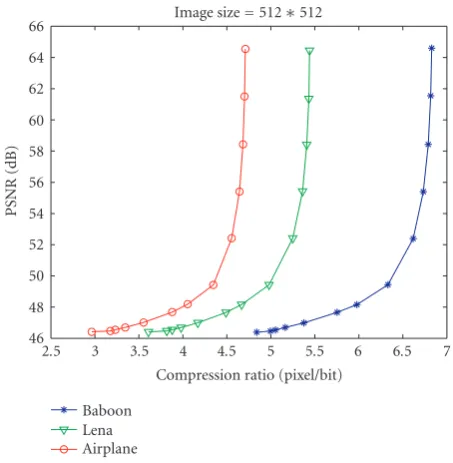
Moreover, this algorithm can provide adjustable image quality and compression rate. When the quality control fac-tor varies from 1 to 0, the relation between the PSNR and compression rate in three images, “airplane,” “lena,” and
“ba-boon,” are illustrated inFigure 14. The columns to be filtered
are always distributed equably in CFA raw data. In this
fig-ure, the PSNR is varied from 46.37 dB to infinity as well as
the compression rate from 2.9 bits/pixel to 6.9 bits/pixel. The
figure also shows that the more low-frequency contents there are in an image, the lower compression rate can be gotten.
This near-lossless compression algorithm has been used in our designed wireless endoscopy system design. Six
typ-ical digestive tract images with 256∗256 size illustrated in
Figure 15are compressed with this algorithm.Table 4shows that the proposed algorithm can provide higher compression
performance than JPEG-LS near lossless compression (1)
and (2). The average compression rate is about 2.12 bits/pixel
with about PSNR 53.11 dB. The reason that the PSNR is
larger than theoretical value, 46.37 dB, is that the images have
been cut into a circle view and there is no rounding error in the black color location. The compression results in this table
are better thanTable 3because the digestive tract images
con-tain more low-frequency components. Note that the com-pression rate of the proposed algorithm is almost as same as
that of the “G,B, andRrespective compression method” at
the same PSNR. So, this new near-lossless image compres-sion algorithm is very suitable for the wireless endoscopy capsule system because the new algorithm makes full use of the characteristics of the medical images.
4.2. ASIC design implementation results
The 0.18µm CMOS process technology is used for the
dig-ital IC inside capsule. The digdig-ital IC photo is shown in
2.5 3 3.5 4 4.5 5 5.5 6 6.5 7 Compression ratio (pixel/bit)
46 48 50 52 54 56 58 60 62 64 66
PSNR
(dB)
Image size=512512
Airplane Lena Baboon
Figure14: PSNR versus compression rate when the quality control factor varies from one to zero.
(a) (b)
(c) (d)
(e) (f)
Figure15: Six typical digestive tract images with 256∗256 size.
Table4: Compression results for the six digestive tract images. CR means compression rate
Image (256×256) (a) (b) (c) (d) (e) (f)
Proposed algorithm (q=1) PSNR (dB) 53.121 53.103 53.100 53.135 53.083 53.128 CR(bits/pixel) 1.904 2.135 2.107 2.273 2.005 2.318
JPEG-LS near lossless PSNR (dB) 51.3548 51.718 51.601 51.314 51.585 51.641
compression(1) CR(bits/pixel) 2.7536 2.833 2.2784 3.302 2.489 2.892
JPEG-LS near lossless PSNR (dB) 48.387 48.734 48.736 48.219 48.581 48.592
compression(2) CR(bits/pixel) 2.168 2.411 2.189 2.631 2.063 2.415
G,B, andRrespective PSNR (dB) 53.132 53.111 53.101 53.135 53.083 53.129
compression method CR(bits/pixel) 1.900 2.116 2.023 2.246 1.981 2.265
SRAM SRAM SRAM
Logical circuits
SRAM
SRAM
SRAM Dual port
memory SRAM
Figure16: Die photograph.
size is 640 ∗480 ∗2.4=92.16 KB) and JPEG-LS
parame-ters with about 1.65 KB. One dual port block memory
on-chip is applied to store two line image data with 1.28 KB
for image format transformation. The on-chip memory oc-cupies about 70% area of the chip. The work clock fre-quency is 40 MHz. The power consumption shows that the total power consumption of the digital IC core is about
7.5 mW with 8 fps and 320∗288 image size or 2 fps and
640∗480 image size at 1.8 V. Table 5shows the ASIC
de-sign comparison results of three different compression meth-ods. The testing results of the proposed compression
algo-rithm inTable 5come from the real chip. The testing results
of the other two compression algorithms are from the simu-lation by using the Synopsys tools such as Primetime, Astro, and DesignCompiler. The comparison results illustrate that the proposed compression algorithm has the lowest power
consumption, the smallest area, and the shortest processing time.
Therefore considering the tradeoff between the
com-pression rate and the hardware expenditure, the proposed compression algorithm is more suitable for our wireless en-doscopy system.
5. CONCLUSION
A low-complexity and highly efficient image compression al-gorithm suitable for ASIC design based on the Bayer format image applied in wireless endoscopy system has been pre-sented. The reconstructed quality of seven standard color
images can be changed from 46.37 dB to infinity as well
as the compression rate which ranges approximately from 3.6 bits/pixel to 6.9 bits/pixel by adjusting the quality control factor. Furthermore, the average compression rate can reach
2.12 bits/pixel with the PSNR larger than 53.11 dB when the
digestive tract images are compressed. Note that the new near-lossless compression algorithm provides lossless com-pression for the region of interest (ROI). Compared to the compression methods in which three components are com-pressed, respectively, although the proposed algorithm has
3.4% higher compression rate, from the hardware
imple-mentation viewpoint, it needs only two lines buffers, which
is much simpler than those methods of G, R, and B
re-spective compression. The VLSI architecture of the proposed
compression algorithm has been implemented in 0.18µm
Table5: Comparison results of hardware cost, power dissipation, and processing time.
Proposed compression algorithm Serial compression structure Parallel compression structure
Work clock frequency 40 MHz 40 MHz 40 MHz
Image size 640∗480 640∗480 640∗480
Logical gates 70 k gates 150 k gates 70 k gates
Memory consumption 93.81 KB + 1.28 KB 86.48 KB 195.84 KB
Power consumption 7.5 mW 19.2 mW 9.8 mW
Processing time 30.72 ms 30.72 ms 46.38 ms
Hardware area 12.6 mm2 14.7 mm2 23.1 mm2
ACKNOWLEDGMENTS
This work is partly supported by the National Nature Science Foundation of China (no. 60372021) and partly supported by the National High Technology Research and Development Program of China (no. 2003AA1Z1100).
REFERENCES
[1] G. Iddan, G. Meron, A. Glukhovsky, and P. Swain, “Wireless capsule endoscopy,”Nature, vol. 405, no. 6785, pp. 417–418, 2000.
[2] X. Xie, G. Li, X. Chen, et al., “A novel low power IC design for bi-directional digital wireless endoscopy capsule system,” inProceedings of IEEE International Workshop on Biomedical Circuits and Systems (BIoCAS ’04), pp. S1.8-5–S1.8-8, Singa-pore, Republic of SingaSinga-pore, December 2004.
[3] Y. Ti. Tsai, “Color image compression for single-chip cameras,”
IEEE Transactions on Electron Devices, vol. 38, no. 5, pp. 1226– 1232, 1991.
[4] T. Toi and M. Ohita, “A subband coding technique for image compression in single CCD cameras with Bayer color filter ar-rays,”IEEE Transactions on Consumer Electronics, vol. 45, no. 1, pp. 176–180, 1999.
[5] S.-Y. Lee and A. Ortega, “A novel approach of image compres-sion in digital cameras with a Bayer color filter array,” in Pro-ceedings of IEEE International Conference on Image Processing (ICIP ’01), vol. 3, pp. 482–485, Thessaloniki, Greece, October 2001.
[6] C. C. Koh, J. Mukherjee, and S. K. Mitra, “New efficient meth-ods of image compression in digital cameras with color fil-ter array,”IEEE Transactions on Consumer Electronics, vol. 49, no. 4, pp. 1448–1456, 2003.
[7] S. Battiato, A. Buemi, L. Della Torre, and A. Vitali, “A fast vec-tor quantization engine for CFA data compression,” in Pro-ceedings of IEEE-EURASIP Workshop on Nonlinear Signal and Image Processing (NSIP ’03), Grado, Italy, June 2003.
[8] N. Zhang and X. Wu, “Lossless compression of color mosaic images,” inProceedings of IEEE International Conference on Im-age Processing (ICIP ’04), vol. 1, pp. 517–520, Singapore, Re-public of Singapore, October 2004.
[9] B. E. Bayer, “Color imaging array,” US patent no. 3,971,065, 1976.
[10] M. J. Weinberger, G. Seroussi, and G. Sapiro, “The LOCO-I lossless image compression algorithm: principles and stan-dardization into JPEG-LS,”IEEE Transactions on Image Pro-cessing, vol. 9, no. 8, pp. 1309–1324, 2000.
[11] X. Wu, “Lossless compression of continuous-tone images via context selection, quantization, and modeling,”IEEE Transac-tions on Image Processing, vol. 6, no. 5, pp. 656–664, 1997. [12] P. G. Howard and J. S. Vitter, “Fast and efficient lossless
im-age compression,” inProceedings of the IEEE Data Compression Conference (DCC ’93), pp. 351–360, Snowbird, Utah, USA, April 1993.
[13] X. Xie, G. Li, C. Zhang, and Z. Wang, “An efficient control strategy of adaptive packet length for ARQ in wireless en-doscopy system,” inProceedings of International Symposium on Communications and Information Technologies (ISCIT ’05), vol. 2, pp. 1121–1123, Beijing, China, October 2005.
[14] S. W. Golomb, “Run-length encodings,”IEEE Transactions on Information Theory, vol. 12, no. 3, pp. 399–401, 1966.
Xiang Xie was born in Hunan province, China, in 1971. He received his B.S. and M.S degrees from Navy Electronic Engineering College in 1993 and 1996, respectively. He is currently working towards his Ph.D. degree at the Tsinghua University, Beijing, China. His research interests include wireless com-munication, image processing, biomedical electronics, and digital IC design.
GuoLin Lireceived his Bachelor’s, Master’s, and doctor degrees from the Electronic En-gineering Department of Tsinghua Univer-sity in 1993, 1998, and 2002, respectively. Now he is a Lecturer of Tsinghua Univer-sity. From 1993 to 1996, he had participated in a 1.8 GHz-transceiver design for digital microwave communication. His current re-search interest is the analysis of intercon-nections and design of RFICs.
ZhiHua Wang was born in Shandong province, China, in 1960. He received the B.S., M.S., and Ph.D. degrees from the Department of Electronic Engineering, Ts-inghua University, Beijing, China, in 1983, 1985, and 1990, respectively. He became a Professor in the Department of Electronic Engineering and Vice Director of the Insti-tute of Microelectronics of Tsinghua Uni-versity in 1997 and 2000, respectively. He