1620 USERS GROUP
WESTERN REGION
MINUTES OF THE MEETING
JUNE
17-19, 1964
DENVER, COLORADO
ROBERT R. WHITE
,,~,.Millld'Hlilillit _ ' M iIIIIIiIq"'Hsd"'b~t" _h*,*_tt _MlMilitt***_" :_* _ _ ·+tt& .... t*nst_ttW*_* 1IiIIIIIIIiIIM ... ~~HIllliMtrt!tt_" = ___ ... 1' '""",'·b_MIIIiiiiiIooIIoI _ _ _ "_bt"iIoIiIiH ... , _ _ _ _ _ _ _ _ _ _ _ _ _ _ _ ...
o
CONTENTS
o
1. Roster of Attendees
2. Minutes of the Eighth Meeting of the Western Region 1620
Users Group
3.
Sound-off Session
4.
Agenda
5.
A Least Squares Solution tor
a
Range Measuring
Instrumenta-tion System; Oliver
Lee
Kingsley and Burton L. Williams
6.
Boundary Value Problems in Ordinary Differential Equations
with Constant Coefficients; Riohard Rosanoft and Gordon
Nab
7.
a) Reader;
R. C.
Steinbaoh
b) A 519 Simulator; R. C. Steinbach
8.
Simultaneous Linear Equations with Complex Coefficients;
H.
Kuffel
9.
Applications of Numerical Filters in the Power Spectral
Analysis of Stationary Time Series; Alexander A. J. Hoffman
10.
IBM
1620 Assists Student Counselors at Junior College;
Paul S. Chan
11. 1620 Computer Utilization in a Wind Tunnel Data Acquisition
System; Stanley E. Wisniewski
12. 1620 1PL-V; Wendell T. Beyer
13.
Petroleum Exploration and Production Application for the
IBM 1620 and Plotter; Jack L. Morrison
14. A Control System Approach to Automatic Jet Engine Testing;
Aubrey D. Wood
15. Generalized Filter Hetwork A/C Steady State Analysis
Program; D. H. O'Herren
16. FORTRAN II - Debugging Techniques and Aids; Leon P. Goldberg
17 • FORTRAN II and the 1443;
Lanny
L. Hotfman
18. A Survey ot the Beginning Programming
Cou~se;Clarence B.
Germain
19. FORTRAN "Teach" Problems; Wendell L. Pope
1
-.. ---.--,~~~~~~----.---~--~----
._---...•
,-20. A Load-and-Go SPS with Monitor Control; Kenneth M. Lochner
and Glenn R. Ingram
21.
22.
23.
Examples of
1620
Use in College Administration; Noel T. Smith
Automatic Processing of Autospot and Automap Programs with
the
1620-1311
Disk System; Jack T. Dunn and Ernie G. Moore
General Ray Trace Program; D. H. O'Herren (presented at
Tempe, Arizona, December
1963)
.
?
".
---~IH_NtWtMM"1~f"e_'t."*!_'i_illfI'_!tt:u_',,,_naM.aU--M· . . . ·· .. ·· _ _ _ _ .z.·n ... S.eer _ _ _ _ HNJ . . . WI~ ••• - -_ _ _ _ _ _ _ _ _ _ _ _ _ _ _ _ _ _ _ _ _ _ _ _ _ _ _
~
o
o
o
1,620· USERS GROUP WESTERN' REGION
SUMMER MEET J NG
.JUL. Y 1:7. 18. 1.9. 1·964 DlENYER.CfLOR,AOO
ROSTER OF ATT9C)EES
1032 MRS. BETTY CJLSICl(
GEORGIA STATE COLL.
ATLANTA ,GA.
1118 NANCY PAQUIN
PUeL l'e tEAL TH SERV.
ROCKVILLE.MO.
1170 LANNY L. HOFFMAN
GUGGENHEIM LABS f'JRINCETONtN • ...J.
1238 RENe: SEUIGNY ..JR.
HAYES INTERNATIONAL.
HUNTSVILLE-ALA.
1258 FRANCES K. DURKAN
U. S .,A.E.C. NEW YORK.N.Y.
1.290 ROBERT D. WEEMS
N.C,. STATE CQL.LEGE
RALE I,GH. N.C.
3016 THOMAS P. SODANO
ITT FEDERAL L.ABS
FORT WAYNEtlNO.
3053 EUGENE C. EWING
NAT cooP REFINERY AS
Me PHERSON.KAN.
3059 ..J. RICHARD BURROWS
H.O.+R ••
ENG!
NEERSOMAHA. NE:a.
30S2E. N. BRANDT JR.M.,O.
ou
MEO RES COMP CNTROKLAHOMAC I TV. OKLA.
3089 CL.ARENCE B,.GERMA I N
CARTE
.CORPST.PAUL.MINN.
3107
S.THOMAS PARKER
KANSAS
STATE
UNIV.MANHATTANtKAN.
3118 ..J.
o.
PENDERGRASSSOUTHWESTER POWER AO
TUL.S,A. ()I(LA.
3206 L.OL.AFAYE COYNE
MENNINGER FOUNDATION
TopEkAtKAN.
1084 LONA HECKART
AEROSPACE CORP •
PATRICK
~.·.FLA,.1118 ~AMES E.DAL.V
PUBLIC HEAL TH SERV,. ROCKV I L.LE.,MO.
1177 L.EON P.wOLOBERG
PRINCTON U. PROJ ACe
PRINCETON,N • ..J.
1238
w.
S. HAMERHAYES INTERNATIONA'L..
HUNTSVILLE,ALA.
1273 ..JUDITH KOERNER
ARGONNE NAT. L.AB.
IDAHO FALLS • l'OAtiO
1352
WALKER
R. HURD
OP I ,BOARO OF EOUC.
MEMPHIS.
TENN.3041
ARTHUR P. WOODS 4R.
ARMCO STEEL CORP
M IDOL..ETOWN.
orn
03055 BARNEY T. WATSON
VA
HO:SPITAl..OMAHA ,NEB.
3082 PAUL A,. BlCIiCFORO
. OU MED RES COMP CNTR Ot<LAHOMA CITY. OKLA,.
30132 LEE HENDERSON
OU MED RES COMP CNTR
OKLAHOMA CITY. OKLA.
3096
FLOYD M. CORE
SEISMOGRAPH SERVICE TULSA. OKt..A·.
3108 L.EORA THOMAS
PIONEER
HI-BRED
CORNDES MOINES. IOWA
3136
EVERETT
L..COOK
UNIV. OF
WICHITA
WICHITAtKAN.
'-32J6 ..J. ROBERTS BRITTON
HAWAIIAN ELEC. CO.
HONOLULU. HAWA~I I
aa2il1. a i.J.
3
3820 t;8U·1S,: • • .,ITZ· I
.. _ I : . . ··· AMA' ,TECK.·
MiBBI.G .... I ....
3827 . . . ··".'FOECKE .
1C..c.. :aGARD"OF ;Bf)UC:.
ICUfSAS:·c·t n;. NO.
381M . . . ~. ·AII.GREE
... V.·OF' . . . A
· .... 11 . . . .
38*2 JACK ' ... . - , , . .
_ • • ,OFOlCLMta4A
• SI . . . f.': . . . . A·.·
a D . • • III..ES · . . :1 . .
.IPClMRT
+
INFOST....,'I ...
3107 . . . : . . . L.A¥ETT£CL.lNtc
DETRO,'I'T.""'"
LAB.
. . . etA . . .
·
..J..8ILLtN6HAM
. . . OREF·l':Ml!RI·ES
. . . 1 . .
:D26 ,JACK' .. T, •... . , . . ,
AVCOC_ilRATION
. . . V:1LLE .. :AL.A.
.00t ••• ··.: . . .
. . . . ~IES
~:
..•..•.
se.
~'·••
:{""'TeRLA08llM1Y E"";NEERS
LOS · ... t.JE$.'CA~.
•• ao
seal JAMES . e;..
.."J.M· '
us
AaYI.C"-S· ·DIGR·.·...
. 1fGZ7 . JIlAAWfl;.:;"'~El N
LaC"'_.·.TI~CiAL
SYS·
·,.AS; .... ,.A.,~·
•. ;
so.
Dw,··-; . . ,CAMt.atERsr.- ....
GER.:'¢ . . .,....t;C-..:_
3220 W J LL IAM.J... M~GRAW
H,l'B8I,NG 'AR£ATECJi;e' K·r_INGtMINN .•
. 3238 WALTER G.:, ELWELL NEB. WESLEYAN UNI V • LlltlC01LII1t :NEB.
3242 GEORGE A.SPRADL lNG,
UNfV. OF OICLAHOMA
NOAMA·N.e:GlCLA.·· i
3260 .aoMN. C. HARVEY
IBM .
AOCMESTEA·.M·l:NN •
3ZT1 JAMES L.· GAl SEL.l.PHO
LAFAYETTE CLIHIC DETROJ· •• M leN-.
3283 JOE I);. PEGRAM
....SMPKIS STATE
UNIV.
_EJiFM'I:$. TENN.
3302 ARNE ·GARHESS
CONCORD!A COLLEGE
....HIEAD·.MINN.
331'9 RAYMOND T.MCNAMARA
DEF&NSE.SUBSUPPLY
at:I,CAGO. J LL •
3337 L ENYEDY
D,fAMOND AL.KALI CO • PA:JNfiSV I Ll.E. OH J 0
5014 DAYEN:'I£LS~
GD/ASTROHAtlT f'CS
SAND.I·EGO. CAL.
5020 MARU .. YN DOles
CCLGRAOOSTATE UNIV. f'GRT COLL I NS,.COLO.
80'20 LARRY .. ..IACKS,,"
COLORADO STATE ·UNIV.
FORT COLLI~NS.CCLO.
5026 MARV 1-N·.J., CARR
DOUGLAS AIRCRAFT
CO.
SANTA . . . . lCA .CAL.:
5Q2B
a.
P. 'DUNCAN.STEA~8ER . CORP_
~DEWER:t·C~~. ".'
5028
ED .
-JUAACEK;STEARN-IlOGER c~.·
DENWER.,Co.-Q.
c'
()
c
~~rlttiiri'*$b* #
o
o
-n "' ,."'" X "!III
Q
-5032aoe ...IIIA ... ·ING
GOODYEAR
AEROSPACELITc:tPI:ELOPARK.ARI Z
5032 MRS.". A.· KUFFEL..
GOODYeAR AEROSPACE
LIT'OPIELD
PARK.ARIZ5041
.'''u)
E. WILDER,MOTGAGLA SEM:ICONDUCT 1Itt0EH1 X,.AR t
z.
5058 L.L .• , KOPPIN
SUNDSTAAND AV·IATION
DENWEReCOLO.
5060 CHARLES A. BETTINGER
UNIV. Opr Te;XAS
AUSTI N·.TE)( •
5075 WENlJELL T • BEYER
UNI
v.
OF OREGONEUGENE_ORE.
50n
PAULBAGWNE
UNI_ OIL CO.
aR"tCAL.
.086 8.:CH CRANT
PIOHEERNATURAL. .AS
AMAAlLLO.TEX.
!S095
LOWELL A. RASMUSSEN
~AMAUSERCO.
TACCMA ••
ASH.
S098 BURTON L. WILL'lAMS
WHJ-TE SANDS .... R.
WHiJT£ SANDS.N.M.
• ,108 ELT . .
:w.
,CHASE JR.CLAIII< C~GE
"AMCGUYER • WASH>.
!S,1a6 WEteELL ·,·L. 'POPE
UT AH·~T.ATE tIN IV.
L.08AN=.UTAH
$131 A08I!A'HOfI'lI'MAN
MAR·TIN: CO.
DEMVEA'::.COLO.
5131 . . . ·.8·ISENIWS
MARTIN
ca.
.000000t
CQL.:O.5133 LEWIS:· • • • OMSLE
MAS . .
'+ ....
tJAt«iiER. AIIARtLLO.·:FEtC.
5032 D . . . . OiNEAREN
GOODYEAR AEROSPACE
LIT~ULD
PARK.ARIZ
5033 JOHN A.;F£ALING
CLARE...-rT 'JIIEN' $ COLL.
CLAREMUNT:t CAL.
5043 GL;DMR •.. INGRAM
MONTANA STATECGLL.
BOZEIIfA ...
1IlWJNT.
!50!58 TED J. NCKE ... A
SUNl)STRAND AVIATION
DENVERtCOLO.
5073 PAULICLEEWEI N
CAf'PUS Nt: . . SCHOOL WI'aRT-AtKAN.
5076 ~AJIIES N. BOLES
U •. C •. SEAkELEY
BERKELEY ,·CAL..
5086 MARRY CASTLE -'R.
PIEIN!EA'NATUAAL GAS
AIJIIAR>lLLO. TEX.
5089
DAVID ·IMER
u.s.P' .... s· •
. LAS YEGAS.NEV.
5096 BOYD·c. ,NORA I S
BUREAU OF· RE,C.
SACRAMENTO, CAL.
5;104 DR. ~i.R • • U:t ...
TEXAS. GOL1.... OF A • •
KI:NGSVILL.EtTEX •
5'117 ASTRtlC 1E'1RIIIEHDJlAN
NAT eTA .ATMOS RES
BOULDER" COLO"
5'130 A.A • .J ..NOP'FMAN
TEXAS CMRISTlAN 'UNIV
FORT WOR:fit.,TEX.
51.3:1 E.d, • . SVANS
MART!:"
co.
D£NVER.·COLO.
51:33 RALPH.D·.····,.,.J'NE
MAsaI+_NGER AfllARl'WO • rEX •
. 51';43 GERALD W. LeCKE
TEXAS ·.T·EGM:. i::CGLLEGe:
·LtJIIBOCk
.·TEx •
&&wuuuaaw=",aa:4a:::a:::uiS .!£I£AXi! I lill!;g !i.t. (.£44 MM. 41
5
. . . . ..iiDSEPN:·:A.· STRML
·U.S •. · . . . T_R·BUREAU
.aCflAMMrO.CAL.
•• )~7.J"R8AO:SA"PF
NDFtTH,··AM&RI,CttNAWI:,A. oewNEY, .• ·CAL •
• t'SO 1!UGDE"8AKEA
MALL·t._TON CG·. DUNCaN,.'GKt.,A.
'_SO _ _ _ ·A.·.LAR:¢ADE.·
~ . • UJltT,"'CO,.
. .
ca ...
A.
5'IU J . . . S:.··.' •. ··IIAUCE
aAHDI"Ce··;AO . DEPT SAM :;.&:&0 .• CAL.
SI_ JAMS' M. AMDERSON
:t.e~ PllmPULSI·ON
~S.CAI..
·INJ69 ___ :;.LMl!LER
SliJRVEY 'R&:S' 'eTR
tiI.e.
...-sL,EV.CAL .•
512' ~&·MAUDLI:N-JR •
.-.tV,;.OFGlCL.AHOMA
.., •
.,.Ot«.A.
'.''J'2. • . . . . ··SURER
_.A:EL:ECTRIC ·CO.
~:.GAL •
•• 74 .L,".~P:_tlCE·LoseRG
C~E""TJ!NC.
. . . . MI8EL.;ES.CAL.
_ 8 , . . , . . T ":11 •.• "'·TE
:LA,IEPT ,WATER"POWER
..s,
·.NGELES, •. CAL.5'_. ...
·T.:SMJ·TM:INDIAMa STA;fECOLL. ••
T . . . .
~:_tA'l!::.I:ND·._OOLT:.c'~IC,kEEN
USAA',fJE.PENSEBD
ttT·,.,, ·8LI5S.:TEX.
" 2 .,....··.·L •. TAYU)R
• • • 'acrLA. .·A+.M.·CaJ...
.IU,%.:-=:LA ..
520S . . . ::_TJERlMGTOH
~ .. Sf.Aft[COIWL.
. . . . :I:.'s.:.·CQbe,.
5,I'E IIQB£RT) C. STE,I'NBACH'
GROSSMONT CCLt...EGE
SPIlI'MG' ~ALJ...EY.CAL.
5150 JOHN . • ::.. QOODE
MALLIBtlRTOM CG .•
DtJNCAN.·CllCLA·.·
5;1:50 GEORGE V.COPLAND
MALLr,tattRTGN CO'.
IJUNCAN,.~OI<LA,.
5,i?!i2 CAAL.J
.AEt:Qt
MONTEREY PEN.COLL •
MONTE·REV. CAL. •
064 KENNETHW..JONES
COLO DEPT H'l:GHWAYS
DENVER·. COLO.
f5,t'68 W,AROCROWL.EY
UHI·V.OF IDAHO
MOSC:OW.r.oAHO
!SIt' '1 ~I\lERBENsON
UN1V.OF OKL.AMOMA ,...ANtOKl.A.
5:1"7'1
DAVE ASHBAUCHER
,..R.UNIV. OF OKLAHOMA
...-..AN'. OKLA.
5173 Rl,,,Roa. SCHERER
CENTRAL.IA
COLLEGE
CENTR:ALIA.WASK.
51.77 R,.C. WAEDEMON
TEXACO INC •
PeAT ARTHUR.TEX.
5189 L.£.HARVEY
FOOTHILL COLLEGE LOS ALTOS H;l LLS. CAL..
5200 AGNES
w., ...
PRUSZKAUSAAOJ!F:ENSE.BD
FT., BLISS.TEX.
5201 JONII.ftt: •. PaARSQN
SPR.IN."fEL.D SCH OI'ST
SPR,I'N6FJ:El.D. MO.
52(1)2 WALTERE·.~E
N.E. OtCLA.A+M·C&LL.
M.,AM'I·,Ot!tLA,.
5214 WJ'LLIAM ¢'. PIQUETTE
OTERO·.:·.~lGR COLLEGE
LA·~'tA·.COLO •
c·':
, .o
c
,1M:: .: eM) *ddd * **#rt!*rt*t# ! ' "
o
o
!S2tS AOSENARY PET'ERSEN
WDPC...uCLA
LOS ANGELES,teAL.
fS2'~'7 MAURI:CIt,H .. WI'TT£N
FT"MAYS KANSST eLL HAYS.KAN.
!52~1. _ _ _ ·eN TOWN
SEATTL.E
,UNIVERSITY
s ••
Ttl..E..,:WASH.5223 STANLIEY WlSNI£WSKI
NORTHIIGP CORP.
lIE . . . . Y H,:lLLS,.·,CAL.
5226 8,.,5 •. 'SHA~ . .JR
'WADLEY RESEARCH IN~T
DAtLAS;t;:TE)( •
70.21 P.,,.J,.REDBE,RGER
RES cOUN ,OF ALBERTA
...
TON.ALBERTA
PAUL
s.,
¢HAN
Al:YEASI:8EC,1 TV COlJ....
A1WltSI'Dt[.CAL.
,.. ... ,El£ST
LID!DL[N cO.
~'ACkSONVIU.E .'FLA.
RUTH
c:'.
MOSSMANISM
DEN'tEA-t
COLO,._'ItO R .• OYE
IBM
WHITE' ·PLA;lNS4N.V.
RONALD II. LAKE
}:8M
GLENDALE' CAL.
w ••• ·
.SCOTT.1:8M
SAN"SE.eAL.~.
DI'CK WltL,IAMS
.8M
~OS ,ANGELES.eA,L..
A"BREY D. WOOD
leM
~ CITY1.GkLA.
5215 .JOHN W. RETTENMAYER
WDPC-UCLA
L:OS ANGELES. CAL,.
*
5217 JOHN· 8,.0 "L.:C>UGHL t N
FT RAYS t<ANS ST COLL.
MA yS, •. t(AN,.
5222 ROBIN YOUNG
UNIV.OF ;N'EW MEXICO
ALBUQU,EMU.E tH.M.
5225 VICTOR W..M:OFiFMAN
us
WEATHER BUREAUFORT
WORTH.
TEX.
5226 ~'.M. KI'LLM.c.
WAOLEY'RESEARCH IMST DALLAS.TEX,.
PAUL L. W'AN
UNIVE,RS t TV OF UTAH
SALT ·.LAKE etTV.U7TAH
REX TURCO
US BUREAU ·OF RECL.
8'1LLJ:MGStMOHT.
GERALD W. CALL IBM
D£N'YE.R.
cOt-e.
J. MlCRMit.. H,UHTA JR. I;e",
DENVER • COLO.
STEVE LOPEZ
IBM
W,HITE PLAtMS.N. Y.
GORDON W.· .GOESCH
IBM
SAN ..lOSE. CAL..
DOROTHY·MCGOWAN IBM
LOS ANGELES,.C,AL.
CHARLES
e.
,BERRY
IBM
LOS APllGELES,. CAL.
c
imtlh'f t ' t " "fttf'WIilWfhlHW+t"3' I 'hMwd • Itt n# rt*
c'
o
MINqTES OF THE MEETiNG -
JUNE
17-19,
1964
The general meeting was opened en Wednesday, June
17,
1964,
at the Brown Palace Hotel in Denver, Colorado, by the
Western Region President, Paul Bickford. After opening remarks
by Paul and the IBM representatives, the meeting was turned over
to presentat10n
or
papers and workshops in parallel technical
sessions. New users were welcomed to the group in a session
held Wednesday evening. This was followed by the regular
sound-otf session which is reported on elsewhere in the minutes.
The technical sessions were held as scheduled in the
agenda with the exceptIon of changes in rooms.
Copies of those
papers available are included with these minutes.
The .keynote speaker at the luncheon on Thursday, June 18,
was Dr. E. N. Brandt, Jr., M.D., Ph.D. The subject of the very
well-received talk was, tiThe Future of Computers in Medicine.
1IAt the last general session on June
19,
Dick Williams,
Dave Dye, and Chuck Berry of
IBM
responded to the sound-orr
session. Paul Bickford announced that the next meeting will be
a j01nt meeting of the Westem and Mid-western regions and will
be held on the campus of the University of eklahoma in Norman,
Oklahoma, on November
9,
10,
and 11,
1964.
The meeting was then
adjourned.
ROBERT R. WHITE
Western Region Secretary
8
QU-o
o
"''''t'7#' tIM'" ,\ t # t tt • • d*_ " ) r ..
o
SOUND-OFF SESSION
The sound-off session was held Wednesday, June
17, 1964,
with Chuck Maudlin as Chairman. The following is a report on
most of the pOints made and the response from IBM representatives
on Friday, June
19.
The question was raised about the speed of the IBM
supplied FORTRAN compilers. It was stated that the old Bell
Interpretive System for the 650 was faster than
c~rrentcompiler
systems for the 1620. IBM's reply was that the oompilers are
relatively slow because they incorporate extensive source
lan-guage error checking at compilation. The FORTRAN/FORMAT compiler
is the fastest of the current IBM Fortrans for the 1620 because
most of the error checking is done by the pre-compiler. Changes
have been made to some of the FORTRAN compilers, notably II-D,
VerSion 2, to provide for in-line compilation and allow error
checking of mathematical operations at object time.
A request was made for an advanced monitor workshop
which would supply enough information 'so that users can modify
the Monitor program. Dick Williams stated that it might be
possible to hold such a class for advanced systems programmers
on a limited enrollment basis. Coincident with this request
was a strong request for much more complete documentation on
the software systems. Dick Williams stated that an operator's
guide for changing Monitor will probably be available from his
office and suggested that the Users Group bring more pressure
to bear on IBM, through the Users Group Executive Council, to
supply better documentation.
The complaint was made that some Systems Engineers are
not filling out APAR forms when requested. It was stated that
this is part of their job and if it is not done, the user should
contact his branch manager.
Inquiries were made regarding possible future software
systems and the answers were as follows:
FORTRAN IV - not being planned.
Report Program Generator - not being planned.
A non-disk loader for Monitor programs - not likely
because of complexity.
A disk-independent SPS with all disk and printer
op codes - not being planned.
Network Analysis - near future release.
Linear Programming Package - release in July.
Non-variable subroutines for FORTRAN II - now available
on FTN II-D, Version II.
9
$:;-Requests for hardware additions were made and the
answers to these 'were as follows:
'R!!~et,
oll''l'ypewrlter 'and 1622 - RPQ
. ,Punoh and Read start on oonso1e - RPQ
Programmable, time olock -::RPQ
Teleprocessing RPQ 834308; approximate price
-$600/mo. includ1ng a 1026 adapter which 'can
handle up to 26 - 1050 consoles on line.
There was sOme'oomment about the· 1620 failing to operate
properly ,outs+de of a temperature range of 70-80 degreeslP. IBM
representatives reqUested that users riotif'y their C .• E.so that
correctIve action can be taken.
In answer to a request for a flexible rental schedule
for the first yearot use, the reply from IBM was that no changes
trom present prIcing policies are planned.
It was explained that the machine characteristic of not
destroying the contents of the read buffer on a reset operation
was designed on purpose. It was felt that the bes.tmethod was
to require'posittve action to destroy this intormation.
o
Inquiries about excessive down-time on the
1443
or the
punch-read teed feature were answered by other users. Apparently
this is not a general problem.
C
IBM announced the availability of COOO-ID.
It is
described in'BulletinH20-42l9-0. The program number is
1620-UG-05X and
it
requires a 20K 1620 with one 1311 disk pack.
This concluded the sound-orf session.
{ (,
',rew tt t r $*1 ri*#t#rtttriitttfttt II ( """IHt""·tRIW·WW·tf't
o
WED~ESDAY - JUNE 17, 1964
Registration Out~ide Central .city Room
8:30 Welcome and Opening Remarks • • . Paul Bickford, Regional President
IBM Announcements. • • • • • Dick Williams~Chuck Berry," Angelo Arena
, R. P. Paterniti Index Registers . . • • • • • • . Miss Dor.bthy"McGowan, IBM
10:00 Coffee
Session B Session" A
Central City Room Leadville
&
E'ilver Plume Rooms10:30 A Least Squares Solution for A
Range Measuring Instrumentation System -- Oliver Lee Kingsley and Burton L. Williams (5098)
11:00 Boundary Value Problems in
Ordinary Differential Equations with Constant Coefficients --Richard Rosanoff and Gordon Mah
(5157)
11:30 (1)
(2)
A program to check elementary machine" language laboratory exercises
A 519 Simulator
--R. C. Steinbach (5145)
IBM Monitor I 'Worksh~p
IBM Monitor I Workshop (Continued)
IBM Monitor I Workshop
(COntinued) .
12:00 Lunch ---On ¥our own
1:15 3:00 3:30 4:00 4:30 5:00 7:30 8:15
Introduction to Matrices
--C. E. Maudlin, Jr. (517l)
IBM Monitor I Workshop
Coffee
Simultaneous Linear Equations with Complex Coefficients
--Nancy C. Kuffel (5032)
Applications of Numerical Filters in the Power Spectral Analysis of Stationary Time
Series -- A. J. Hoffman (5130)
The Acquisition and utilization
of an IBM 1620 Computer in the
U. S. Public Health Service
--James A. Daly and Nancy A.
Paquin (1118)
IBM Monitor I Workshop (Continued)
IBM Monitor I Workshop (Continued)
IBM Monitor I Workshop
(Continued)
Adjournment of Day's Sessions
New Users Session.
Sound-off Session. • • • • •
.Paul Bickford.
• • .C. E. Maudlin.
_aWAiu::a: Xiii ;;, Ii.l
Stratton Room
&)
Tabor Room )
1 1
---.-.-.. --.--~---~~---... -~~---....-..-
...
-THURSDAY - JUNE 18, 1964
8:00
8:30
9:00
9:15
10:00
Late Registration
Session A Ballroom B
How the IBM 1620 Assists.Student Counselors at Junior College
--Paul S. Chan, IBM
(Continued)
AD-APT -- Bill Rogers, IBM
Coffee
10:30 1620 Computer Utilization in a
Wind Tunnel Data Acquisition
System -- Stanley Wisniewski (5223)
10:~0 Linear Programming
--Dr. S. T. Parker (3107)
Promenade Area
Session B
Tabor
&
Stratton RoomsGeneralized Filter Network
Alc
Steady Analysis ProgramDavis
a.
Q'Herren (5032)FORTRAN II ... Debugging Techniques and Aids -- Leon P. Goldberg (1177)
FORTRAN II (Continued)
FORTRAN II (Continued)
FORTRAN II (Continued)
12:00 Luncheon • . • . • BallIOom
1:45
3:00
3:30
4:00
5:00
Keynote Address:
Future of Computers in Medicine.
IPL V -- Wendell T. Beyer (5075)
Petroleum Exploration and
Production Applications for the IBM 1620 and Plotter
Jack L. Morrison (5171)
A Control Systems Approach to Automatic Jet Engine Testing
--Aubrey D. Wood, IBM
Coffee
.Dr. E. N. Brandt, Jr., M. D., Ph. D.
IBM Disk File Applications
FORTRAN II and The 1443 L. Hoffman (1177)
FORTRAN II and The 1443 (Continued)
Adjournment of Day's Sessions
j
2
- - - ---~ .. - - - . - - - -
-()
o
o
' " !
8:00
8:30
10:00
t I ' j . trii bt. *ti 0' rth'ffltf,l.
ft._.t
*w j " ' V i jiWFRIDAY - JUNE 19, 1964
Registration
Session A Ballroom B
SPS Tutorial Workshop Clarence B. Germain
Session B Onyx Room
Panel on Education:
Coffee
Chairman: Richard V. Andree
University of Oklahoma
Members: Charles A. Bettinger
University of Texas
Noel T. Smith
Indiana State College
Donald L. Ferguson Campus High School
10:30 SPS Tutorial (Continued) Automatic Processing of AUTOSPOT
and AUTOMAP Programs with the 1620-131 Disc System
--12:00
l:QO
1:55
2:30
3:15
FORTRAN Teaching Techniques Wendell L. Pope
A Load and Go SPS with Monitor Control -- Kenneth M. Lochner and Glenn R. Ingram (5043)
How The 1620 is Used at Colorado State University
--Franklin A. Graybill
Jack T. Dunn (3326)
Lunch. • .On your own
Workshop on 10:30 Paper
Workshop on 10:30 Paper
Workshop on 10:30 Paper
IBM Reply From Sound-Off Session. • 0 • • .Ballroom B
Meeting Adjournment
1 3
I .!
--~---ilA Least 3quares So lut ion
for a
Range t-feasuri ng Instrumentati on System"
by
Oliver Lee Kingsley and
Burton L.
-,a
11 i amsRange Instrumentation Systems Office
~hite Sands Missile aange
NevI i"rex i co
June 17, 1964
o
o
tt t 'WWeNW'HIY'" "'" ¢tOt t t t t H "teMtHnditt ¥ f " - j t
o
A Least Squares Solution
for a
Range Measuring Instrumentation System
A3STRACT
A
brief development of the least squares equations for aninstrumen-tation system that measures a set of ranges to obtain an estimate of
the space position of a s?ace vehicle. In addition, a method for
obtaining the precision of that space position is included.
I n~ TRODUCTI ON
---At ~Jhite Sands \fissile '~ange, the instrument that measures the radial
ranze to an object in space is called a "Distance >leasuring Squipment
or s i 7TIp 1 y D>~~. An ins trune nta t ion Ry ste.:n cap.1;) 1 e <)f gi vi ng Sue 1 i dean
three s?ace position 2sti::1ates is termed as a :xr?tJ~'·!E system. A
typi-ca 1 ;):'m/D>;'~ system usually consi sts of three non-coli near instrument
or eq'.lip:11e'l1t si tes used to neasure range.
The typical solution equations are the classical deterministic set
that rejects th,c minor image solution. A four or more T)?-1E system
presents a problem because a slisht error in any range ~ea~urenent
~ill not produce a set of ho~ogeneous space position estimates
by
theclassical approach. There is a need for a good method to combine
1 5
the set of overdetermined measurements into a single space paint
estimate. The least squares method will provide the required space
point estimate if the set of measurements are unhiased.
The least squares equations developed ~inimize the sumS of squares of
the error set of range measurements.
The observational equation from "C:.]hich the error equati.on is derived
is written:
(1) R •
=
R. + E .ml 1 ml
where R • denotes the measured range from the i -th 'J:··18 to the
ml
tracked vehicle.
~. denotes the true range frdm the i -.th DHZ to the tracked
1
vehicle.
B i denotes the measurement error associ ated vli th th·e
observa-Tn
tion taken from the i-th
D>fE.
The error equation is easily obtained from the ob~ervational equation,
thus:
(2)
E .
= :l . -R
ml ml i
The true value needs to be replaced by so~e suitable spproximation.
Later, the true value td 11 be estimated by t1:'? fin:!l soilltion or
. - - - -....• --~ . . . -... ~ .. ---.-~.--.-... - - -... ~ . . .
o
o
10
I I
reduction equ.qtions. The assu:nption is made that the true value can
be represented by the linear terms of a Taylor series about some
nearby poi nt R , 'o1here:
o
(3)
R
=
~(X, Y , Z )
0 0 0 0 0From the i-th DHE, the range to the point (X , Y , Z ) is written:
0 0 0
(4a)
R . a/1/(X _ Xi)2
+ (y _ 1.)2+
(z _Z )2
01 0 0 1 0 i
For any space position (X, Y, Z), the equation becomes:
1\, .-
-:r
(4b) Ri
=
'veX - Xi):! +(Y:
Yi)~
+ (Z ... Zi)The linear Taylor series representation is written:
(5) :to
=.~. +~1i
I
(x- X)+~RIH
1 01
2>
X 0-o d Y 0
where
~ TU~
(.'j x" 0
=
(X - X.) /R .o 1 01
(Y - Y. )/R i
0 1 0
=
;~
Ri/
c;:: Z 0 =
(z - z )
o 0/Po. •
01The '~ighted error sums of squares for k measurements from k DME
sites is written:
(6a) k
~
i-1
... 2 J!,mi =
k
2
i-1 2I
o(Z-~)
01 7
o
where
wi
is the weight given to each measurement.
The errors sums of
squares for equally weighted measurements is written:
(6b) k
E2.
k
-~
2~
=
:2-
~i
i·1
mt
i=l
Generally, the components of the instrumentation system are near enough
alike in performance and behavior that equation (6b) is applicable.
For a system that consists of heterogeneous distance measuring
equip-ment (system components), each weight that would be inversely
propor-tional to the equipments range variance would be appropriate.
The error sums of squares are minimized
~vith respect to the range
measurement parameter which is a function of the three orthogonal
com-ponents X, Y and Z.
The three resulting equations thus formed are
o
A '" ~
called the normal equations from which the estimates X, Y and Z are
obtained:
~x ~l
-Ria
(7a)
(R .ml
=0(7b)
d
~l
(R . -Ri~
';;>Y
mt
=
0(7c)
~~l
(R . -R.0
~z
ml
1=
0
o
I I '",HlltP '9IWt"i"' \
o
o
t 7$ e »t htHtt :!!indtt t'dtritt*HWt:dYitf tl .. j - '"¥tnar!
The constant terms not involving (X-So), (Y-Y ) and (2-2 ) are placed
o
0on the rig~t hand side of the equation:
(8a)(f,2
Ex
-K. )(X-x.
)~X
+ (Y -11 )(X -X.) 61 + (.Z
-z.
)(X -X.)j)-;;~
~~:?. 0 1 0 1 0 0 1 . 0 1 0 1
J
01
~
if}
(Sb
--. K
T,2r(X
-:\i)(Y -Yo ).6X + (y -Yo )(Y -y.) 61 + (Z-Z~)(Y..-l.)6-;)
~.
:\oiC"
0 0 1 0 1 0 1 0 1 0 1:J
(')282
rz;.
-X.)(.2-,~.)A
X+
(Y -Y.)( 7, -3.).6 Y+
(2 -ZI )(Z -Zi)A~1j<'.
C>
t.
'''0 1 0 1 0 1 0 1 0 0:J
f'\. •
01
'ti.lere
1<
[
d
C
1 =~
" ' ) • U' D
(., . - -.. i) (X -1\. ) / I.. .
i=l m1 0 0 1 01
k
C
2
=i
f
.-R .}(y -Y.)/?.J
i=l
ml 01 0 1 01
k
r~
. -;:
.}(.7. -2. ) /'lJ
,..
=.t
.... 3
i =1 ro1 01 0 1 01
/"\,
L~ ~{
=
.... ,"'
-
X0
'"
L\ Y
=
Y..
Ya
/'0
l\ . .,
=
?;-
7'''0
=c
2=c
31 9
- --- ----"-~---~--.--~~~ ...
--...-...--The equations can be written
in
coapact fora by matrix notation:
(9a)
--or
(9b)
AA
-
c
So
lYing
tor
If . . equation (9b):
(10)
The
final solution tor
X, Y,
and
Z
can be written:
(11)
The necessar,r start point (X.'Yo,Zo') can be obtained fram a
deterministic solution for three range measureaents*.
The
region for convergent solutions has not been tully explored
at
this tiae.
*
Armijo,
Larry, "Determination
of
Trajectories Using Range
Data from Three Non-Co1inear Radar Stations", Technical
Memo-randua
,.66,
USASMSA, Sept. 1960, WSMR,N.M.
o
0'
o
o
o
III A NEr~OD FOR ESrrIAT.l!N-; IN~ENTA.TION SYSTErvl PRECISION
The term precision estimate refers to the standard deviation estimates
for the coordinate data X, Y and Z from the instrumentation system.
If
there exi sts a cormnon range measur.ement vari ance
(II"~),
then by use of
-1
the relative variance-covariance matrix,
A ,from equation
(10)esti-mates of the component variances can be obtained.
The diagonal elements
from the
A
-1
are used to estimate the
(12)
=
-1
vlhere '\11' A22 and A33 are from the matrix A •
0
A22
0
component
0
0
The total variance estimate is defined
bythe equation:
(13)
<7T
A 2=
t-v
1\. 2 +&y2
+d:!2
variance:
/\2
<rm
In terms of the matrix
A,
the total variance estimate is
\~itten:A /\2
(14) CiT2 d m
Tr
where Tr denotes the trace of the inverse of the matrix
A.2 1
THE BOUNDARY VALUE PROBLEM IN ORDINARY DIFFERENTIAL EQUATIONS
WITH CONSTANT COEFFICIENTS
By
Ri chard Rosanoff ·and Gordon Mah
*
INTRODUCTION
In the process of solving seventh and eleventh order boundary value problems in closed form, the authors experienced an improvement in their understanding of the requirements of good formulation for a digital computer. Better control of numerical error and easier programming and debugging were the products of improved formulation.
The specific problems programmed were boundary value problems in ordinary differential equations with constant coefficients. The general solution of the ordinary differential equations with constant coefficients
was known in 1739. It is mathematically simple. Its nature has been
thoroughly explored • . Perhaps just because of this, it provides an
o
excellent vehicle for the study of the consequences of restrictions imposed
0
by automatic digital computation.
To put together a good computer pro gram, one must consider several ideas and points of view. Thus, although we shall be concerned with simple material, the structure of our paper is mildly complex. We include, therefore, the following outline of the material to be covered:
1. Mathematical preliminaries
a. The finite nature of the computer number system
b. The implications of the finite number system
c. A definition of linear dependence
d. Linear dependence .in a finite number system
2. The computationally significant features of the physical problems
used as illustrations. The equations and boundary conditions to be solved are also presented.
*Senior Engineers, Apollo Structures Analysis, SpElce and Information Systems Division, North American Aviation, Inc., Downey, California.
... 1
-22
"jjP'tt
o
o
3. Characteristic polynomials and their roots
4. Basis functions and boundary conditions
a. Definition of a basis and the mathematical requirements
for their selection
b. The Wronskian
c. Boundary conditions in terms of the Wronskian
5. Selecting a basis
a. A group of bases
b. Physical criteria
c. Linear independence
d.
(1) Wronskian
(2) Gramian
The effect on conditioning number of a dual coordinate system
6.
Remarks and conclusions2
-23
1. MATHEMATICAL PRELIMINARIES
The set of numbers which can be represented in a digital computer is not the set of real numbers. It is not even the set of rational numbers. In fact, it is a finite set. It is bounded from above and below, and it is nowhere dense on the real number system. It is not a field. For brevity, let us speak of the computer number set to mean the set of numbers available on a particular computer. For the real number system, it is true that if:
A x B
=
Cand if A and B belong to the real number system, so does C. This is the
property of closure~ Closure does not hold for the computer number set.
Both factors on the left are members of the set of numbers with which the IBM 1620 Computer operates. Their product is not a member of the set.
The equation:
Defines a unique zero in the real number system. But notice with eight significant figure arithmetic defining the computer number set:
9.3 -9.3 00 4242 0 8 0 9.3
e
+
e=
10938. 019+ •
0 091 31=
1 93 • 19=
eyet e -9.3 is not zero because
e9•3 x e-9•3
=
.99999997It will be seen that this difference in the number systems lies at the root of many numerical difficulties. The propertie s of functions must be reviewed in light of the number system available for the calculation.
3
-o
o
o
o
n=
One of the properties of sets of functions which is important to our discussion is the property of linear independence. By way of review we
state that N functions <Pi i
=
1, n are said to be linearly dependent ifthere exists a set of N constants Ci i
=
1, n not all zero such that:n
2
c·
14>.
1 = 0i
=
1If no such set of C i exist the functions <Pi are said to be linearly independent.
As an example, we might consider three vectors in a physical space of three dimensions. If the vectors are not coplanar, then they are
linearly independent. There are, at most, three linearly independent
vectors in the space. Therefore, ~ny fourth vector in the space can be
completely described in terms of three linearly independent bases or
coordinate vectors in the space. If, by some accident, a coplanar set of
basis vectors were taken, we should be unable to completely represent a general vector in the space. We have a deficiency perpendicular to the plane of our base vectors.
The geometrical ideas are carried beyond a physical three space to
N dimensional spaces in a very useful manner (Ref1s. 5, 17). Further, a
function itself, defined in Some region, may be considered as a vector in a space of infihite dimensions, i. e., a function space. The directions in
the space are associated with the real numbers in the region (Ref1s. 18,
19) •
Linear independence is essentially the same idea in these extensions to higher spaces. The complete description of some desired function as a linear combination of the members of a set of functions requires that these
functions "spanl1 the space. If anyone of them can be represented by a
finite linear combination of the others, it adds nothing to the description of the space.
On the other hand, linear independence over the real number system does not insure linear independence in a finite number system. For example:
C l sinh(X)
+
C2 cosh(X)=
,6& may not be zero in the real number system, but 6
=
0 on a computer,if X is large enough, and
4
-25
II. THE PHYSICAL PROBLEM
We have seen that the number system available to us for computation is limited and lacks some of the characteristics of the real number system in which we think. Later, we shall be faced with a choice of basis func.;. tions between bases which are completely equivalent in the mathematics of the set of real and complex numbers. Although we shall find adequate
numerical arguments to justify a choice, there is also a physical argument.
It is our point of view that the formulation which represents the physical
problem most directly will probably be the best formulation from every point of view.
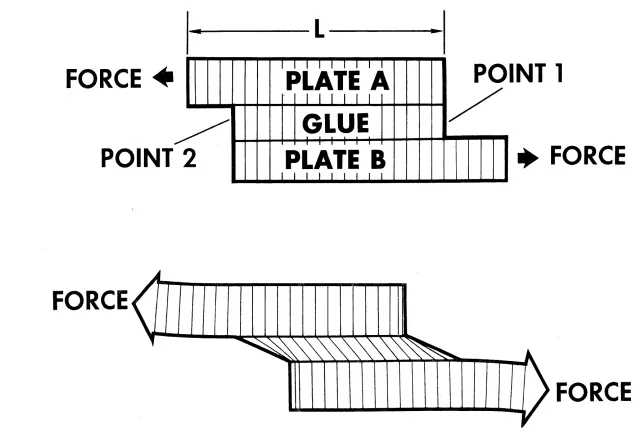
With this objective in mind,we need not spend the time required for the derivation of equations. We have a seventh order problem and an eleventh ord'er problem which have been solved on our 1620. The seventh order problem arose in the calculation of stresses developed in the glue line of a lap joint such as is shown in Figure 1.
Two metal plates, A and B, (see Figure 1) of unequal thickness are
joined by gluing in a lap joint of Length L. If the plates are pulled by
forces at some distance from the joint the load must be transmitted from
one plate to the other by shear stres ses in the glue. Further, the
C
eccentricity of the joint will introduce some bending, and the resulting rotation of the joint will result in a transverse component of the force at the edge of the joint. If the plate s were completely rigid, one would expect the loads to be uniformly distributed along the glue line. In fact, however, the plates are not rigid but will elongate and bend in response to the loads they are carrying. Here lies the crux of the problem. At Point 1, Plate A is elongated. Plate B is not. We have almost a
discontinuity in deformation. This requires a relative motion which is
resisted by the glue. The resistance in the glue results in the transfer of
load from Plate A to Plate B. The transfer of load eventually brings the plates to the same extension at some interior point. The situation at Point 2 is identical to that at 1 except that the roles of the plates are interchanged.
The important thing to remember, as we construct the solution, is that stresses arise at the boundaries due to the elastic deformation of the plates. These stresses are damped out as one moves to the interior. Once the two plates have developed equal extensions, the solution should be very similar to the solution for infinitely rigid plates.
5
-26
---,,---"-"---N
a..J
o
0'
o
o
14
L
~I
POINT~
FORCE.
IPLATE A
I I I I I I I IPO
-
I I I I I I
/
GLUE
I II I I I I
PLATE B
INT 1
• FORCE
I I I I I I I I I
FORCE
[image:30.792.71.709.75.512.2]FORCE
The shear stress in the glue is labeled T. The extension stress,
transverse to the joint is labeled 0- •
The analysis is an extension of a classical paper by Goland and Reissner (Ref. 2). The equations of equilibrium (under Some simplify-ing as sumptions) are:
d3T
£1 dT
£ 2 0- 0
- - -
- -
=
dx3 d~·
d4o- dT
d·x 4
+
£ 3(J'
+
£4 dX
=
0 (2.1)which together give the homogenous differential equation:
-dx. 7
d
5T
3t t ~ _ t t t t dT
~
1 - . -5+
~
3 3(~
1~
3 -~
2~
4) dXdx dx
=
0
(2. 2)The parameters
£ .
are related to the elastic properties of the plates andglue line. We do riot wish to burden the discus sion with definitions of the
notation. Instead, permit us to state the fact about the
£ .
which issignificant to the subj ect at hand. All of the
£
i represenl purely passiveelements. They are geometric and elastic quantities.
The boundary conditions ar e given in the form of six inhomo genous differential equations of equilibrium which must be met, three at each boundary and one integral condition of equilibrium to be met over the domain. These may be written as:
and
L
'\b.
~ 1,
J
T (x) dx=
o
=
F.1
EXTERNAL SHEAR (2. 3)
We shall summarize the 11 th order problem more rapidly. The
physical problem is once again the determination of stresses in a glued joint. For this problem however, we consider a section of honeycomb
7
-28
- - - . - - - _ . . . _._ .. -_ .... _---_._-_ ..•. _-_.--_._._ ... _ ... .
o
_ rhh t t
~
0 '
. ~Jo
t t ht t 1M st$. hI t ., " I 1 , 1"'1" 8 "twl!!rI l t 1 l t
W""'¥MtIJ"'PII
UH'H""llf!""' u'W'f'LWitM'*WLw'WleI!iU""B" I?'WH ' !!,uri
' . 'M#"',M.w'" .. , " , 'g,"" t1ut¥' •. 1 't
sandwich material. It consists of a core with face plates A, shown in
Figure 2. The section is assumed spliced to a similar honeycomb section through splice plates equal in thickness to the face plate.
The three equations of equilibrium are:
4
d cr·
l ' C h dT
cr
b
=
-P --4-3 d.x+
cr c+-2
-d· x4
d cr b
dx4
+
2P 2 IT b - P 2 IT C = 0A consequence of these equations is:
dJ)T 2PI d
9
T+
(2P+
P ) d7
T _ PI
(4P .
+
5P
3 .) d5
T
dxll - 3 dx 9 2 3
dx·7 3 2 4 dx.5
=
0
The boundary conditions are similar in form to those of'the 7th order
problem.
8
-(2.4)
(2.5)
29
'-0
~:;
c:::
o
LINE OF
SYMMETRY
SPLICE PLATE
GLUE
FACE PLACE
CELLULAR CORE
. FORCE
I
I
I
HONEYCOMB SECTION
Figure 2. Physical Problem Represented by Eleventh Order Equation
tiM'tb't
o
o
n'%w, , t, "'"., "I' ' " I , !n't ! , " 'WI' "t'!!ll'Illtff'1I '''t'!'!I¥'lf''fMJHJH'H'frn llWf't* lLt iRdW%tl'¥te"t,,'StJ!'IUIt'Wwff',' nit' I'tWHtl"'tt"''ti'?I W UWUtU,!1%¥tl ttWf ' " g' !lUI! fI''N' ·'tI"ftt:I'!t't'I!!t"¥J''t'' wUt'''"w'' ''fttttM!!W'f' RIP 1 I "me" t, " t,
III. THE CHARACTERISTIC POLYNOMIAL
From the differential equations it is po s sible to write characteristic polynomials of seventh and eleventh order, re spectively. As will be seen later, the roots of the characteristic polynomial provide a wealth of
information concerning the natureo'! the solution, the relative importance of the various solution components in. the derivative, hence;, the boundary conditions. Even measures of the maximum stress and physical realism of the· solution are provided in a qualitative way. They provide the best link between the physical parameters which occur in the coefficients of
the differential equation and the solution. .
Unfortunately, (Ref's. 3,
6
and 11) polynomials are .subject toill-conditioning and their roots may be poorly determined. In Reference
3 it is shown that the relative error in a root a of a polynomial
P(x')
=
~
ai Xi due to an error oas in the coefficient as is given bys-1
= a as
P'(a)
Th\ls, it is only necessary for
s-1
a a
s
P'(a)
oa s a
s
to be large to have a great magnification of relative error in the root as
compared
to
the coefficient. There is a gr.eat proliferation of methods forobtaining polynomial roots (Ref's. 3,4,
6,
7, 11, 12, and 13). The reasonfor this great number of methods is that none of them are generally satisfacto ry.
For the two problems solved, use was made of the easily variable pr'ecision of the 1620 version of Fortran. In the first place, the poly-nomials were studied throughout the data range of the problem, and solutions at different levels of machine precision were compared.
The zero root of the two polynomials is, of course, precisely known and removed without any contribution to error. The reduced polynomials. both consist of even ordered terms only so that we may solve polynomials
10
of fifth and third rather than tenth and sixth 0 rder. The constant
coefficient is negative so that the fifth and third order polynomial have at least one positive realr()ot each. Thus, our original equations are known to have a pair of real roots which are equal in magnitude and
opposite in sign. Following Lanczos (Ref. 5), we obtain this root, either directly or as a reciprocal, between zero .and one. The method used was to repeatedly evaluate the polynomial by synthetic division and test to isolate the root in one of the half intervals.
To minimize contributions to error in subsequent roots due to the removal of the real roots, we requested a special synthetic division
subroutine from our systems programmers. We wish to acknowledge the excellent job done by John Sherman of our Division in this respect. Mr. Sherman provided us with a compact subroutine which performs the entire synthetic division iteration at 28 decimal digit floating point. In this
routine the numbers stored at 28 digits include only those currently needed in the calculation to provide a full high precision iteration so that any
order polynomial may be handled without additional storage. The net storage required was less than required for the Fortran version of the same routine. The routine is now part of our 1620 Fortran library.
Investigation throughout the data range showed the remaining roots to be complex. We obtained the remaining roots of the 11th order
polynomial by the use of Muller's Method, which, so far in our experience,
has never failed to converge (Ref's. 6 and 7). We would welcome com-
C
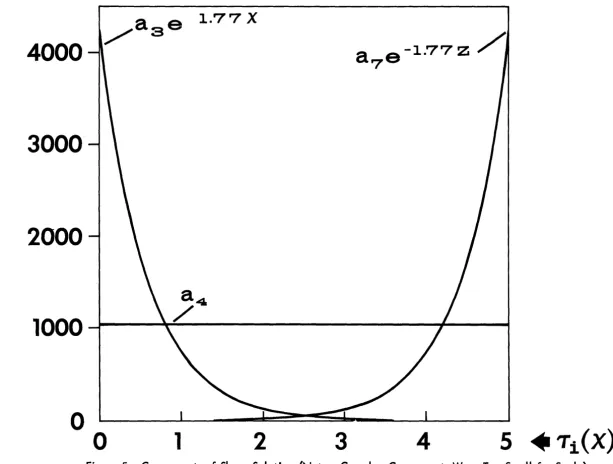
ments based on the experience of the audience in this regard. Because the roots may be obtained as the square roots of roots of a lower ordered polynomial, they are symmetrically distributed about the origin as shown in Figure 3.
-htij . . . . tstnt 11M dt . , . de tt is . . . . vI.' H t l' TIfP' :Nt:Wt'WWN .:1,
I'
!"'''3!1IW I . IWp ,'"MY'".,,""!' tt t t 1$ tit NniM"tt'" Ic
.2
-
0 ::>( )
w
X
X
s-a>-0
s-O
..c
-ca>
>
a> V')
I
a>
C
0
a::
X
a>
a..
CI
E0 U
a>
..c
-
Cen
-
0 0 0::::~
0
Q.
0
~
X
X
M.
~
::>
.2'
u..
o
12
IV. BASIS FUNCTIONS AND BOUNDARY CONDITIONS
The solution of a homogenous fourth order ordinary differential equation' with constant coefficients whose characteristic polynomial has the
roots ± a ± i (3 can be represented as a linear combination of the functions.
t
(a+
i(3)x' (a -i~)x
(- Q'+
i~)x
(- a - iB)x\e . " e , e " e (4. 1.)
Of course, this is not the only set which could have been selected. Such a set is called a system or basis of functions if the member functions are linearly independent. A test for the linear independence is provided by
the Wronskian determinant. This is a determinant whose first row is the
system itself and whose jth row is made up of J-Ist derivative of the function in the corresponding column.
We shall have a great deal more to say about linear independence in the next section of the paper. For the present, we wish to show how the programming and del?ugging of the problem are simplified by writing the derivative boundary conditions in terms of the Wronskian. Recall the form of the derivative boundary conditions.
We see that
n - 1 . 1
L
h . . dJ -. T~x)
=i
=
1 1, J dxJ-F.
1
j
=
2, n at x=
0 and x=
L. 1
dJ - T (x)
j - 1
dx
(4. 2)
(4.2a)
is a column vector. We also see that recognition of the boundary conditions
in the form (4. 2) permits us to deal separately 'with the specification of boundary conditions (bij) and the determination of the vector (4.2a). For our 11 th order problem the matrix (bi , j) was computed from a coded
input. This provided a flexibility which waf? most useful when numerical
difficulties were seen in the boundary conditions themselves. Such a scheme suggests the pos sibility of writing a generalized program.
13
-33
0
11
1
c
C"
o
Notice the vector (4.2a) is a function of X and exists in an N space. On the other hand, the matrix (bi , j) can be written as N linearly
independent conditions at either X
=
0 or, X=
L. Thus~ for the two-pointboundary value, problem N conditions must be selected from 2N derivative
conditions and possibly some integral conditions. This draws attention to
the fact the boundary conditions selected must be such as to specify a unique solution. We shall not give adequate coverage to this problem in this paper. Let us now examine the vector (4. 2a). It has a physical meaning without regard to the basis or coordinate system in which the
solution is written. That is to say it could be written at various values
of X as a table of numbers which would be independent of the manner in
which it was obtained. To analyze it symbolically, however, we must
assume a basis of functions, say
{¢iJ.
The first element of (4. 2a)(j
=
1) is the zeroth derivative, or the functionwhere the a
K are the constants of integration to be determined by the
equations 4. 2. But:
n . 1
. 1 dJ - CP'k (x)
d J - T (x)
2:
= a
k = W{x)ak
j - I
j -
Idx k = 1 dx
(4. 3)
(4.4)
where W{x) is the matrix of functions from the Wronskian determinant.
The recognition of these matrix products is the key to relieving the program of unmanageable detail. As will be seen later, a factor in the choice of the basis is the ease with which the Wronskian may be developed
by a simple set of do loops. The (bi, j) matrix may be checked separately.
Any linear independence may be displayed in easier-to-recognize form. The program has pattern.
As we have indicated, the specification of boundary conditions which are sufficient and compatible involves more than we can discuss here. The reader is referred to Ref. 19·
-II "ill
"'I
v.
SELECTION OF THE SYSTEM ORBASIS FUNC TIONS FOR THE SOL UT10N
Given an ordinary differential equation whose characteristic
poly-nomial contains the non-repeated roots ± a ± iB there are many choice s of
functions for the solution. Consider, for example, the se four base s or systems:
{a
+
iB}x {Q' - iB)x {- a+
iB}x e{- a - iB}xI
e e e
Cosh(ax} Cos(Bx}, Sinh{ax} Cos(6x}, Cosh(ax}Sin{Bx},
Sinh{ax} Sin{ Bx}
I
I
and: Z
=
L - Xf
e -ax cos{Bx), e - a x , -az sin(Bx}, e cos{Bz}, e -az sin{Bz} J(5. t)
{5. ~}
{5. 3}
(5.4)
The question arises, is there a choice? If these functions are
mathematically equivalent, which they are, can one set be superior to
another for digital programming? The answer is yes. Let us first
dispose of (5. 1) on the arbitrary basis that we prefer not to.perform
complex arithmetic if we can avoid it.
The usual textbook treatment is to point out that the functions must
be linearly independent. For the mathematician, this con,dition is me t for
all of the bases under discussion. For the digital programmer, however, this situation may be quite different. If the domain L of the solution is large enough, all of the sets of functions expressed in the computer number
set become linearly dependent:
Lim
aL -co
-aL
e cos(6L} =
Lim
aL . - co
sinh{aL} = 1
cosh{aL}
Lim -aL. (({L)
L e SIn tJ
=
a, _ co
15
-Lim -aL ± iBL
e
=
0aL - co
(5. 5)
35
, I
o
o
o
In the machine , this breakdown in linear independence becomes exact.
That is to say, we may have coshaL = sinhaL to the last digit. Of course
one may expect computational difficultie s long before the los s of the last tragic digit.
Is there any way out of this dilemma? Again the answer is yes. The
moment we realize that the finite number of digits in the calculation limits our ability to produce the "exact" solution we begin to consider analogies
with approximate methods. We seek functions to represent our solution
which "look like" the solution. Clearly basis (5.4) is greatly superior in
this light. Only (5.4) of the bases considered, directly represents a
function which arises at disturbances at the boundaries and is damped as it proceeds to the interior of the region.
Comparing basis (5.4) with basis (5.2) it is seen that the functions of (5. 2) approach each other in exactly the range in which they become
large. The functions of (5.4), on the other hand, approach each other in
exac tly the range in which they drop out of the solution.
It is not surprising that the basis (5.4) is superior when we take note of the fact that it contains more physical information. Only basis (5.4) is cognizant of the location of the disturbance caused by mismatching
strains at X = L.
Let us inquire into the physical significance of positive real parts of characteristic polynomial roots. In the initial value problem, with time as the independent variable, positive real parts have been used as criteria of stability. When space is made the independent variable, and the
problem is formulated as an initial value problem, a numerical instability is quickly associated with positive real parts. Consider for example, the differential equation
(5. 6)
which is the homogenous equation for the deflection of a railroad track. In Ref. 15, the solution is shown in several form s including the me thod of initial conditions.
16
-36
e
y(;x)
=
y c osh(A. x) co's (A. ;x)o
+
2~'
fcoS h (>-";x) sin{>-..;x)+
sinh{>-";x) cos{>-..X)}
~Q
o 0 {
I
2 s inh(>-";x) s in{>-..;x) - 3 c osh(>-";x) sin(>-,,;xl - sinh(>-";x) cos {>-.. ;xl
2>-" EI 4>-.. EI
(5. 7)
where
Yo
=
displacement at origine
=
slope at origin0
~
=
bending moment at origin0
Q
=
shear ,at origin0
In fac t, the solution is damped as one in ove s away from a local load or
disturbance. The method of initial conditions, however, requires that
this damped function be composed of a linear combination of rapidly e;xpanding func tions.
In the finite arithmetic of the digital computer, this means that if I a fly settles on the railroad track in Denver and the initial conditions are determined to the full capacity of the computer number set some place this side of Los Angeles, the railroad tracks will be ripped and torn in the most terrible carnage since World War II.
With time as the independent variable, the model is realis tic.
Positive e;xponentials mean positive feedback. The rate of growth of the
function is proportional to the function with a positive coefficient of
proportionality. lilt takes money to make money. II "Population growth
is e;xplosive in a favorable environment"-"chemical reactions become e;xplosive if the rate of the reaction increases with the reaction products"
(including the final ene-rgy as a product). But time moves on. Functions
do not have causes today and develop into effects yesterday.
Space coordinate s, however, are quite arbitrary. One does not
need to establish a coordinate system to pull a glued joint. Thus, the
physical meaning of the positive e;xponential in our glue line problem is seen to be a stereotyped pattern of coordinate system specification.
17
-.. - - - -.. ---
.~~~--~~-37
o
c
o
o
o
'$
It is well known that the choice of a coordinate system can make the solution of a problem easier or more difficult (Ref. 21). In at least some problems it has great numerical consequences (Ref. 5). Interest-ingly enough, since the boundary conditions supply the information for the evaluation of the constants of integration, we see that they contain vital information about the origion of the coordinate system. One of the problem s in specifying boundary conditions is to make sure they produce a unique solution in a defined coordinate system.
Stres s analysts have traditionally handled positive exponentials by
testing such a parameter as a over the domain. If aL is large (say
aL
>
6),
he uses basis (5.3) as a special b~sis. He sets the arbitrary constants associated with positive exponentials equal to zero (whenaL> 6) and calls his solution the semi-infinite case. We think the
choice of basis (5.4) is superior for several reasons. For one thing,
the characteristic polynomial may contain more than one set of complex roots with positive real parts. One set may correspond to a
semi-infinite case and another to a short case. This situation actually occurs in our 11 th order problem. Additionally, we should like to pick one basis and avoid programming more than one basis of functions.
If our mission in this paper were only to show that the basis (5.4) is superior for our problem, we could certainly bring this discussion
to a close now. Our interest, however, is broader. We wish to explore
the relative merits of bases in hopes that we may obtain criteria whic