PROCEEDINGS OF THE MEETING OF THE EASTERN REGION OF THE
1620 USERS GROUP
•
•
TABLE
OF
CONTENTS
PAPERS TO BE PRESENTED AT 1620 USERS GROUP MEETING
MIAMI - CAI~ILLON HOTEL MAY 9, 10, 11. 1965
Session A-I
Unattended Operations of the 1620, C. S. Schrodel
(Sun Oil Company, U. G. Code 1298) (Intermediate) ••••••••••••••••••••••••••••• l Time Sharing on the 1620, E. W. Channen
(University of Windsor, U. G. Code 7042) Simulation of Program
Interrupt for Time Sharing Under Monitor I (Intermediate) •••••••••••••••••••• lO The Compleat FOHTRAl{, J. A. Haag
(Purdue University) Description and Discussion of a New 1620
Textbook on FORTRM~ II (General Interest) •••••••••••••••••••••••••••••••••••• ll _ Undefined Variable Detector for FORTRAN II, T. J. Scott
(Sun Oil Company, U. G. Code 1298) A Debugging Aid to Locate Undefined Variables at Object Time in a FORTHAN II, V. 2 Program
(All FORTRAN users) •••••••••••••••••••••••••••••••••••••••••••••••••••••••••• 19
Music Programs as an Aid to Debugging, P. J. Jutsum
(University of the West Indies) (General Interest) ••••••••••••••••••••••••••• 22 Session B-1
Financial Evaluation by Discounted Cash Flow, Leslie Parker (IBM - Poughkeepsie) 20K 1620· Financial Analysis Program
(Intermediate) ••••••••••••••••••••••••••••••••••••••••••••••••••••••••••••••• 26 CD 4 - PDQ, G. Lilly
(Jones and Laughlin Steel Corp.) An Extended Disk Version of
PDQ FORTRAN (Intermediate, Systems Programmers) •••••••••••••••••••••••••••••• 38
uw -
M 1620 WISAL, C. Mackenna(Uni v. of Wis consin - l-1ilwaukee) A Simple Instructional Programming
Language for Accounting (Intermediate) ••••••••••••••••••••••••••••••••••••••• 42 1620 Support for a Document Writing System, C. M. Thatcher
(Pratt Institute) A 1620 Program Insert Control Symbols Into the Input
for an 870 Document Writing System (Elementary - Intermediate) ••••••••••••••• 54 Session C - 1
Use of 1620 Model I for Simplification of Boolean Algebra Expressions, C. Plesums
o
(Union College, U. G. Code 1302) A Discussion of a Program for Boolean C · ~ ..•
Simplification with Emphasis on Programming "Tricks" Used
•
c
TABLE OF CONTENTS, contd.
Plot a Block Diagram, Mrs. S. Young
(U. S. Dept. of Health, Education
&
Welfare, U. G. Code 1118) Program to Use CalComp Plotter to Prepare Block Diagrams forSPS Source Programs (General Interest) ••••••••••••••••••••••••••••••••••••••• 65 Assembling SPS 1 Programs with Monitor 1, T. I. Markland
(IBM - Poughkeepsie) (Intermediate) •••••••••••••••••••••••••••••••••••••••••• 77 PROGRAM TEAM SESSIONS
1620 Back Panel Wiring Program, Peter Dunham
( Raytheon) ••••••••••••••••••••••••••••••••••••••••••••••••••••••••••••••••••••
*
1620 Electronic Circuit Analysis Package, Herbert Wall(IBM) •••••••••••••••••••••••••••••••••••••••••••••••••••••••••••••••••••••••• 86
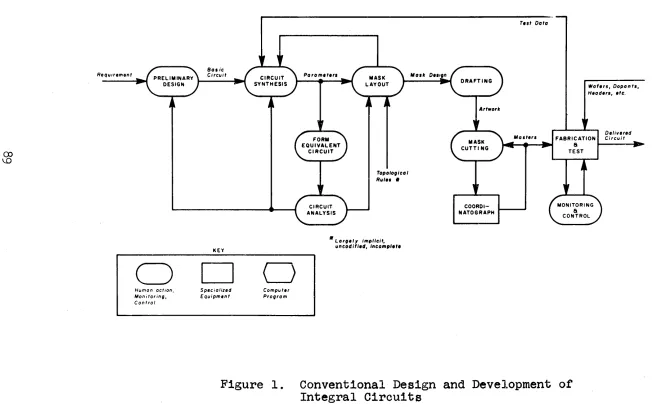
Computer Aided Design of Integrated Circuits, A. Spitalny
(Norden) ••••••••••••••••••••••••••.••••••••••••••••••••••••••••••••••••••••••• 87 D. C. Automatic Electric Network Analysis, H. Pachon
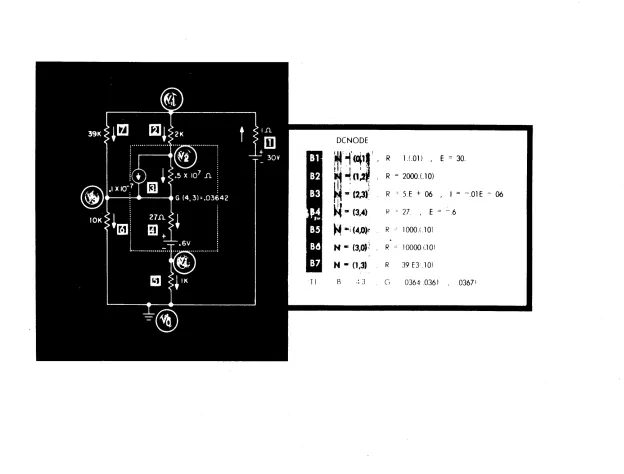
(Automatic Electric Labs, Inc., U. G. Code 3182) A Program to Perform Automatic D. C. Analyses of Electronic Circuits
(Advanced) •••••••••••••••••••••••••••••••••••••••••••••••••••••••••••••••••• 108 Traverse Adjustment by Weighted Least Squares, R. L. Kenngott
(Chas. H. Sells, Inc., U. G. Code 1377) Employs the Full Theoretical Rigor of Least-squares in Traverse Adjustment Without Artifice or
Approximation (Intermediate) •••••••••••••••••••••••••••••••••••••••••••••••• 120 3-Dimensional COGO, J. W. Madden
(Electronic Data Processing, Inc.) A 3-Dimensional Set of COGO
Routines for Use in Highway and Bridge Design (Intermediate) •••••••••••••••• 123 Design of Single, Double, Triple Cell Box Culverts, Leno Morris
(New York Sta~e Dept. of Public Works) •••••••••••••••••••••••••• ~ ••••••••••• l33 Hore-Less, CPM & PERT System for Disk and Printer, A. D. Johnson
(NASA, U. G. Code 3306) (Intermediate) •••••••••••••••••••••••••••••••••••••• l47 Session A - 2
Fitting Straight Lines to X-Y Data When Both Variables are Subject to Error, F. K. Durkam
(u.
S. Atomic Energy Commission) Three Methods (Scarborough, Wald, Bartlett) for Estimating Functional Relations of Two Variable Dataare Compared With the More Commonly Used Regression Relationships Fitted
•
•
TABLE OF CONTENTS, eontd.
Curve Fitting by Finite Sums of Exponentials, R. Meshelof
(State University of Nev York. U. G. Code 1283) (Advanced) •••••••••••••••••• 175
Session B-2
TYGO - Load and Go SPS for Paper Tape, R. C. Head Be P. J. Jutsum
(University of the West Indies) ••••••••••••••••••••••••••••••••••••••••••••• 187
SPAS - Load and Go SPS for
4o-6oK
Card System. G. G. Billin(Clarkson College) (Advanced - Intermediate) •••••••••••••••••••••••••••••••• 188
Session C - 2, SessionC - 3 Understanding FORTRAN II (Workshop) I L. Hoffman
(Princeton University-Guggenheim Labs) A Presentation of FN II Subprograms Written in SPS Will be Made With an Bxtensive
Coverage of the Internal Communication of fll II for the 1620 •••••••••••••••• 196
Session A - 3
Non-Linear Estimation "by !,·10dified Gauss-Newton 1·1ethod t Jerry Kemp
(U. S. Naval Ammunition Depot, U. G. Code 3073) Program Uses Gauss-Newton Hethod for the Fitting of Non-Linear Regression
Functions by Least Squares •••••••••••••••••••••••••••••••••••••••••••••••••• 197
The Autolog-Digiklok System, E. F. Staiano. D. E. Atkins
(Bucknell University) A Digital Clock for the 1620 and Software Modifications to Monitor I to Incorporate the Clock in
an
AutomaticLogging System (Intermediate) ••••••••••••••••••••••••••••••••••••••••••••••• 213 Disk Version of FORTRM~ II Incremental Plotter Subroutine
(Plotter Users), P. Larrea
(Princeton-Pennsylvania Accelerator, U. G. Code 1177) A General
FORTRAN II Subroutine for a Complete Drawing With Only One Subroutine
and a Minimum Number of Statements (Intermediate) ••••••••••••••••••••••••••• 235 Session 13 - 3
Planning and Running a Short Term Workshop on Computer Orientation and Programming. Mrs. Joyce Fodor
(University of Wisconsin, U. G. Code 3155) (General Interest
-particularly those responsible for education and training programs) ••••••••• 256
A Ten-Year Budget Projection for Educational Institutions, J. A. Ferling (Claremont Men's College, U. G. Code 5033) The Use of the 1620 in
Planning for Educational Institutions (Elementary) •••••••••••••••••••••••••• 263
Junior College Instructional Testing Program, D. G. Owen
(Miami-Dade Junior College) Description of Test Scoring System
Used at Miami-Dade Junior College (General Interest; Educators) ••••••••••••• 268
*Not available at time of publication. iii
6:00 p.m. - 8:00 p.m. 8:00 p.m. - 10:00 p.m.
11:30 p.m.
7:30 a.m. - 8:30 a.m.
8:00 a.m. - 9:00 a.m.
y:oo a.m. - 12 Noon
PROGRAI'4 1620 USERS GROUP MEETING
CARILLON HOTEL Miami Beach, Florida
May
9,
10, 11. 1965SUNDAY - MAY 9
REGISTRATION SOUND-OFF SESSION
Chairman: Dr. James R. Oliver SHOW
HONDAY - HAY 10 REGISTRATION
NEW USERS BREAKFAST OPENING SESSION
Chairman: Dr. Oliver
(1)
Official opening and welcomeMedallion Room
Cafe Le Can Can
Burgundy Foyer Sugar tn Spice Room Carillon Hoom
by President J. R. Oliver
(2) Users Group announce'ments 10:00 a.m.
10:30 a.m.
12:00 noon - 1:15 p.m.
(3) IBI'-1 announcements COFFEE BREAK
"1130 Computer"
D. N. Leeson LUNCHEON
Speaker: Mr. Rudolf Heyer "Education and the 1620" SESSION A-I
1:30 p.m. - 2:00 p.m. Paper "Unattended Operations of 1620"
Upper Lobby Carillon Room Burgundy Room
- - - - ---_._---_. __ ..
• _ _ _ ._. _ _ _ ~~~ _ _ • _ _ _ • _ _ _ _ _ r •• ""'~"'··~
2 20 2 "50 P m Paper "The Compleat FORTRlIlIT
ff
: p.m. - • • • ~
J. A. Haag
(General Interest) 2:50 p.m. - 3:10 p.m. Paper "Undefined Varia.ble Detector
for FORTRAN II" T. J. Scott
(General Interest)
3:10 p.m. "" 3:30 p.m. Paper "Husic Programs as an Aid to Debugging"
P. J.Jutsum
(General Interest)
SESSION B-1 Dominion Room
1:30 p.m. - 2:20 p.m. Paper "Financial Evaluation by Discounted
C ash Flow" Leslie Parker
(Inter.)
2 :20 p.m. - 2 :·50 p.m. Paper "cD4-PDQ (Disk PDQ)" G. Lilly
(Inter., Systems Programmers)
2:50 p.m. - 3:10 p.m. Paper "1620 Support for a Document Writing System"
C. 1>1. Thatcher (Inter. )
3:10 p.m. - 3:30 p.m. Paper "UW-N 1620 WISAL" (new language) C. MacKenna
(Inter.)
SESSION C - 1 Empire Hoom 1:30 p.m. - 2:00 p.m. Paper "Use of 1620 t..fod I for Simplification
of Boolean Algebra Expressions" C. Plesums
2:00 p.m. - 2:30 p.m. Paper "Plot a (SPS) Block Diagram" Mrs. S. Young
(General Interest)
2:45 p.m. - 3:15 p.m. Paper "Assembling SPS I Programs with r·ioni tor I"
3:30 p.m. - 4:00 p.m. PROGRM4 TE~1 MEETINGS:
4:00 p.m. - 5:30 p.m.
T. I. Harkland (Inter. ) COFFEE BREAK
(1)
ELECTRONICS PGM TEAMA. Spi t alny. Chai man
v
Upper Lobby
en
o
--
Hr. h st. rtrtM tt tznnzPaper "1620 Back Panel Wiring Program" Peter Dunham
Paper "1620 Electronic Circuit Analysis P,ackage" Herbert Wall
Paper "Computer Aided Design of Integrated Circuits"
A. Gpi t ulny
Paper "D. C. Automatic Electric Network Analysis"
H. Pachon
( 1/2 hr. Ad v. )
4:00 p.m. - 5:30 p.m. (2) STRUCTURAL & CIVIL ENGINEERIUG PGH TEAM
T. J. Scott, Chairman Paper "Gimmik-free Adjustment of
Survey Traverse" R. L. Kenngott
(20-30 min. Inter.) Paper "3-Dimensional COGO"
J. H. Madden
(4') min.)
Paper "Design of Single. Double, Triple Cell Box Culverts"
Len 0 Horri s
(30 min.)
4:00 p.m. - 5:30 p.m. ( 3) PROCESS & C']ElvlICAL EHGINEERING
PGH TEAM
4:00 p.m. - 5:30 p.m.
C. S. Schrodel, Chairman (4) OPERATIons RESEARCH PGHTEAH
J. R. Oliver, Chairman Paper "ePN & PERT System for Disk and
Printer" A. D. Johnson·
(20 min. Inter.) 5:30 p.m. - ~~:30 p.m. COCKTAIL HOUR
Dominion Room
Sales Board Room
Carillon Room
/
9:30 p.m.
9:30 p.m.
EXECUTIVE COUNCIL f.fEETING
RECENT FIil-1S of, IUTEREST to 1620 Users
lUESDAY - HAY 11 SESSION A - 2
9:00 a.m. - 9:15 a.m. Paper "Fitting Straight Lines to
x-y
Data ~len Both Variables are Subject to Error"~. K. ,Durkam
9:15 a.m. - 9:30 a.m. Paper "Use of Orthogonal Polynomials for Curve Fitting"
S. S. Kuo (Inter. )
9:30 a.m. - 10:00 a.m. Paper "Curve Fitting by Finite Gums of Exponentials"
R. Meshelof (Adv.) ,SESSION B-2
9:00 a.m. - 9:30 a.m. Paper "TYGO - Load
&
Go- BPS for Pape.r Tape"R. C. Read
&
P. J. Jutsum 9:30 a.m. - lO:OQa.m. Paper. "SPAS - Load & Go SPS9:00 a.m. - 10:00 a.m.
10:00 a.m. - 10:30 a.m.
for
4o-6oK
Card System"G. G. Bi11in. (Adv. - Inter.) :SESSIOH C - 2
WORKSHOP:
"Understanding FORTRAN II" (FORTRAN II sub-programs
written in SPS)
L. Hoffman (Adv. ) COF'}i'EE BREAK
Dr. Oliver's Suite No. 1604
Empire Room
Carillon Room
Dominion Room
Empire Room
Upper Lobby
SESSION A- 3 Carillon Room
10:30 a.m.' - 11:00 a.m. Paper "Fitting of Non Linear Regression FunctiQns by Least .Squares"
h~h~
C
J /
(Inter.)
SESSION B-3
10:30 a.m. - 10:50 a.m. EDUCATION TEAM SESSIO~1
Paper "Planning & Running Short Term Workshop on Comp. Orient. & Prog."
10:50 a.m. - 11:20 a.m.
Mrs. Joyce Fodor (General Interest)
Paper "A Ten Year Budget Projection for Educational Institutions"
10:30 a.m. - 12:00 noon
11:00 a.m. - 11:30 a.m. Paper
11:30 a.m. - 12:00 noon Paper
11:20 a.m. - 11:50 a.m.
J. A. Ferling (Elem.) SESSION C - 3
WORKSHOP CO:~TINUATI au
L. Hoffman SESSIOH A - 3
"Autolog Digiklok Nod for 1620 t10ni tor I System" E. F. Staiano. D. E. Atkins
(Inter.)
"Disk Version of FORTRAN II Incremental Plotter Subroutine"
P. Larrea
(Plotter 'i.lsers) SESSION il - 3
Paper "Test Scoring System" D. G. Owen
12:00 noon - 1:15 p.m. LUNCHEON
Dominion Room
Empire Room
Carillon Room
Dominion Hearn
Burgundy Room 1:30 p.m. - 3:00 p.m. "1-1. P. L. " Cari lIen Room
(!4ultipurpose Programming Language)
Im,ts. M
o
, 1 _ it timnddrsszrtt
SUN OIL QOMPANY RESEARCH AND EN GINElmING
ENGINEERING DIVISION
UNATTENDED OPERATION OF THE 1620 COMPUTER
by
C. S. Schrodel
'For presentation at th~ Eastern Region, l620 Users Group Meeting
May 10, 1965'
UNATTENDED OPERi:TION' OF THE 1620 COMPUTER
---'----
--
---
----
---SUMMARY
. The unattended operation system was designed to allow running of an IBH 162:)' for long periods without need of
an
operc~,tor and without the limitation of the card read and punch hoppers. Tf,(;) syst.em can execute and compile Fortr2.Tl II-Version 2 programs, using .t.he 1311 Disk Drive as the input~output device for data and programs. Se[iarDte programs used by the system are:1. A program to load the data and source decks onto the disk.
2. A program to load the object programs.
3.
A rrogram to control compilation.4.
A program to control execution.5.
A pro:y,ram to dump the output from the disk.6.
Nodified cOTilpiler and subroutLles.Present reciuircments for use of the system are a
69J
core, a 1311Disk Drive, SJUI'ce pro~~ rruns in Fortran II, and prograrn~-'"~ihich 'do no t use
cOl'e location5 S~2.9~.2 to 59,999.
~"'~;;"w'-"""-';:~.7":'"'.
USE OF THE SYSTEH
T118 normal use of the system is to load the data and pI',Jt~;rams onto
the diEk dU"Y':in:·~ the late oiter-noon, allow unattended op8rDtion during the
n:: :;ht, a.10 dump the output from the disk trie following morning. In order
to properly load the disk, it is necessary to know the following aoout
thp -jist: layo11 t.:
1. The data and source decl-cs ;reloaded tl:0 sectors par card from tne sector speci.:.'J.ed upwi::,rd. The sector CJdciress is specified ;It load time and must be gre['ter than 600 and also ar' ~VGn number.
2. The objectpr·)grams are loaded three cylinders per program from the sector specified upward. 'fhe sector address of the first program is specified at load time and must be a multiple of 200.
3.
The program output followed by the symbol tables of the compiled programs are written two sectors per record (card) starting Cl.t 00000.2
(
,4.
The compiler (passes I, II and intermediate output) uses sectors18800
to19999.
5.
Compiled object decks are written on the disk one sector per card starting at18799
downward.Sectors should be specified for the input and programs so that the work 'can be fit on the disk in sectors 0 to
18199,
and so that generated output will not overlap data not yet used. Efficient usage is to load first the programs ~th the highest ratio of input to output. The starting address of the programs should be18800
minus 600 times the number of programa. Data followed by source decks are loaded below the object programs. Oper~ting in this manner, it is possible to have theoutput overlap data already used, have the s,ymbol tables overlap the source. decks, and finally have the compiled object decks overlap the programs
which had been previously run.
Each data set and source program must be preceded by a oard with a record mark in column one. If it is desired that the same program be reloaded for the next data set, any digit should be placed in column two of the record mark card. For example, if the same program is. to be used for three data sets, then the first two data sets must be preceded with cards having a record mark in column one and a digit in colwnn two. A card with a double record mark is placed after the last source deck as an indication to stop. It· should be obvious that data and object programs must be loaded in the same order and that compilations are last. The system cannot be used to compile and execute directly.
"LOAD
DATAII PROGRAMThe "Load Data" program is loaded into core, followed by the data and source programs. The ADD tables must be in core. During loading, the program types the message DATA START and reads from the typewriter the sector address at which the data is to begin. This location is recorded on the disk in· sector
00598.
The data is then read in and written on the disk, two sectors per card, starting at the specified location."LOAD PHOGRAM" PROGRAM
This program is used to load onto the disk those programs-which are to be executed. ATter loading, the program types the message PROGRM4 START and reads from the typewriter the sector address from which the programs are to be stored. 'This location is recorded in sector
00599,
and the program stops. The first program to be executed is then loaded . into core, together with its subprograms m,1d subroutines. After loading,
a branch to
59000
causes the program to be wr1ttenont,0 disk at the proper location. The second program is then loaded into core, &ld the process repeated.· .•. -.~-.---... -..•.. -•.. -.--...
--.----flagged zeros, restore the add tables, and record this "clear core" in sectors
0
to00590
before the initial load. This. II clear core" is thento be read into core between each loading tor a fresh start.
"EXECUTION"
PROGRAMThis· routine is essentially a monitor and controls the execution of the object programs.
The
program is loaded into core when the unattended operati.on is to be initiated and resides in 59000 to 59900. This routine operates in conjunction with a modified subroutine deck to perform the following functions:1. Load object programs from disk into core.
2. Read through data cards until a record mark card is found, indicating a new data set.
3.
Read or write a record on disk whenever a card would have been read or written by an unmodified subroutines set.4.
Terminate execution and go to the next job whenever an error F7 occurs, or25
errors other than F7 andF8,
or a record mark card is read for a data card.5.
Type OLAP and stop if an input record is to be read from a sector lower than the current output sector.6.
Write a record between jobs to control the dumping of the output.This routine reads a program into core locations 0 to
58999
whenever a branch to 59000 occurs. After loading the program, it reads through the input records until it finds a record mark card. If the record markcard does not contain a digit in column two, it increments the program counters by
600
so that the next program will be read into core on the next branch to 59000. The counters are not incremented when column two contains a digit. The routine then types START and executes a4900409.
"COMPILE"
PROGRAMThis routine works in conjunction with a modified compiler to allow compilation without use of the card reader .or punch. Compiler, source statements, intermediate output, symbol table, and object decks are all .
read from or written on the disk. This program is loaded on the disk by
the "Load Programs" routine following the last program to be executed. After termination of the executions, this program is read into core and
takes control. The routine requires about 2000 core posit.ions. FW1ctions of this routine are as follows:
1.
Read in PassI
orPass II
at the appropriate time.'\
2. Read or write source statements, ·intermediate output or object deckus1ng disk instead ,pi cards. Intermediate' output starts at sector 19171 for each job.
\
4
•
c
II
c
o
3.
Write symbol tables statements on the disk rather than the typewriter.4.
Type OLAP and stop if source statements are to be read from a higher sector than object deck is to be written.5.
Write a control record for use of "Dump Disk" routine between symbol tables and object decks.6.
Between jobs, read through source statements until a record mark card is found. Stop if it is a double record mark.ItDUIJIP DISK" PROGRAM
This routine is used to dump the results of the unattended operation from disk onto cards. One alphameric card is punched for each two
sectors starting at sector 0 and continuing through the number of sectors written for output and symbol tables. The program then punches out all
Gompiled object decks one card per sector, strrting at
18799
andcontinuing down through the number of records written for object decks. The program stops after pUllching the output of each job to allow
separation of cards. Depressing start causes a continuati.on to the next Job. After plllching the last record written, the program types the message
'END.
HODIFIED COMPILER
,Changes were made to both passes of the Fortran II-Version 2 compiler. The changes are oS follows:
1. Every card read or written has been converted to a branch into the IICompile" program for the reading or writing of disks.
2. All halts have been removed. Those which had been terminal now generate a branch to the next job.
3.
The header card appears only in front of the symbol tables.4.
The use of sense s\Ii tches is eliminated. Symbol tablesand traces are standardw Customary batch compiling is
eliminated. Source listings are not avai12ble. Subrout.ines are no t punched.
5.
PAUSE, STOP, and END statements generate a275900059899
---~ ~--~--~-.. -.~-.~~~-.. -- .. __ .... __ ... _---_._ .. _---_._-_ .... _ ...•.•••..
_--.-.----and the listing of the error message other than F8. Error F8 messages have been modified so that they appear only on the typewriter.
c.
S. Schrodel6
APPENDIX: OPERATING TECHNIQUE FOR UNATTmDED OPERATION
Load Data
-1. Load add tables if core has been cleared to zero. 2. Load "Load Data" Program.
3. Type sector address at which data is to start; must be greater than 00600 and must be an even address.
4.
Stack data followed by source programs, and readinto core.
5.
Each data set and source program must be preceded by a oard with an 028 punch in column one. This card must have a punch in column two if the same program is to be reloaded fOF the next data set. The last card must have an 028 in both columns one and two.Load Programs
Execution
1. Clear core with a 310000300002 command. 2. Load add tables.
3.
Store this clear core on the disk with the "Lo~d (jon Disk" routine •
. 4.
Load ttLoad Programs" routine.5.
Type sector address at which programs are to begin. Must be a multiple of 200. Normally, 18200-600 times the number of programs to be executed.6.
Load 1st program to be executed and branch to 59000. The Version 2 unattended subroutines must be included.7.
Clear core with the tlRead'0
from Disk" routine.8.
Repeat6
and7
for each program.9.
Load "Compile" Program.Dump Disk . . , . . .
-1. Load "Dump Disk" routine.
2. Remove cards from punch hopper. 3. Press START.
4.
R~peat 2 and 3 until END is typed.In case processing was interrupted because of error, proceed as follows:
1. Read 18000 into 36825-36829 and 00000 into 37657-37661. 2. Execute steps.l~3 above.
3. Branch to 59824 after the last symbol table has been punched to punch object decks.
When dumping the disk using this latter procedure, the operator must use the typewriter sheet to know what output is being punched. One job is punched each time the start button is pressed. Do not count compilations which are Pass I only.
If the contents of 36825~36829 and 37657-37661 are recorded after execution, the normal dump procedure can occur anytime simply by
restoring the recorded values. Set-Up Example
i
Five programs are to be executed and three programs compiled. The second program is to be run four times.
Program 1 has 1000 cards input and 1500 output,
Program 2 has 50 cards input and 250 output for each data set .• Program 3 has 100 cards input and 500 output.
Program
4
has 10 cards input and 100 output. Program5
has 10 cards input and 150 output.To~a1 output
=
3250 cards.Total input
=
1320 cards.Load programs in orcier of increasing ratio of output to input (Lowest output/input first). Output of the last can safely overlap input
of
the next to last. (provided last output is greater tqan next to last input) •. Data -Start • 2(,3250-13l0) .. 3880 Program Start
=
18200-5(600)=
15200Data should be stacked as follows:
Record mark card followed by Program 1 input.
Record mark card with a digit in column two followed by first data set of Program 2.
Record mark card with a digit in column two follo~ed by second data set of Program 2.
Record mark card with a digit in colunm two followed by
third data set of Program 2.
Record mark card followed 'by fourth data set of Program 2. Record ma.rk card followed by Program
3
input.Record mark card followed by Program
4
input. Record mark card followed by Progrrm5
input.Record mark card followed by first source program •. Record mark card followed by second source program. Record mark card followed by third source program. Double record mark card to stop.
(a) Title and Author: Time Sharing on the 1620 by
Eric W. Channen,
Department of Chemistry, University of Windsor.
(b) Company and Users Code:
University of Windsor, User No. 7042. (c) lime Required for Presentation: 20 minutes
Cd) Spt:!cial Equipment Required: Any 1620 using Monitor I (e) 'I\;;chnical Level of Presentation: Mt:::dium
(f) Audience for whom it is intended: Computer Center Staff
(g) ABSTRACT
The Monitor I system has been adapted to permit routine compucation to proceed automatically between jobs, thus utilizing idle computer time. The routine or lengthy computation can be interrupted at any time, by the use of a console switch, to allow a short job to be run, and will automatically be resumed when the interrupting job is complete. The effect is accomplished by stor-ing the contents of memory on disc, together with a restart address. The system should be particularly valuable at installations where routine data processing tends to conflict with an oJ:>t:!u-sho(:
operation.
0"
c
o
ij"'j'j
COMPREHENSIVE FORTRAN PROGRAMMING-A NEW TEXT"qOOK
James
N.
Ha.ag
Purdue university
Indi an8polis, Ind.
1620 Users Group Miami MeetlnE, May 9-11, 1965
I. Introduction
II. Historical Background
III. Computer Technology Curriculum
IV. Compiler
Langu'~3geProgramming
(FORTRAN)V. Design Criteria For The Textbook
*.1\ B STRA CT ~~
This talk will de81 with the arrangement, contents, and
underlying philosophy of a new book on computer programming
in the
FORTR.4.Nlanguage.
The pert 1nent port ion of the
pre-face from the book is given below:
.
"This textbook is intended as an introduction to computer
pro-grs.mming for those intereRted in one of the so-c911ed
BEST-SAMa.re(as:
Business, Eng ineerinp: , Science, Technology, Soci[11 science,
llgriculture,
8na M,<lt~ema.tics."'he
m~themntic,sllevel of this
materi?l presupposes only the comnletion of one yesr of hip:h
school
Dl~ebr3. ' \ f t e r
m~lsteringthis
mnteri~l,n person sho'Jld
be 8ble, independently, to solve m3ny problems
bycomputer methods.
The book is desir-ned
t~te:)chthe
'!:i'ORrr'R·~NII l1ngu1ge.
Its
objective is to instruct
8high school or colleFe student
en-rolled in a
proFr~mmingcourse how to progrpm
Acomputer in
this l(1ngu'Jge.
!'~n,gdult
m':Jyutilize this book
8.Sa
self-te'~chlnp:device to attnin the same objective.
No previous experience
with a. computer 1s assumed.
For the IDPstery of the
m~teri?l,the a,va,11ability of a com'9uter is desir8ble,
~qlthoughnot
necess~ry.The
FORTR4NII
langu~gegiven here is thqt for a 20,000-digit
memory
I~M1620 comnuter with an atta,ched 1311 Disk Drive.
This
is one of the most widely
av~i13blecomouter systems thqt
cus-tom,~:'rily
utilizes the
FORTR,;'~NII
langur~ge.Since there ore some
two thousand 1620 computers in use, and not
~llof them
h~veqn
att3ched 1311 Disk Drive, this m9terin.l hRs been written so that
it is a1'plicable [:lIsa to this situation.
Portions of the book
which a.re not a.pplicable to the latter system are denoted with
either an asterisk or
a.stetement to this effect.
Furthermore,
in order to make this book more widely useful, the fe8tures of
the more comorehens ive
FORTR1NIV languAge for the IBM 7090 gnd
7094 computers are included in an appendix.
Trie educational philosophy underlying the presentgtion of the
materigl is to introduce the student to a smnll portion of
FORr:'R/\N
II, t",-len h'?ve him immedi.stely use this knowledge in
writing
D.comolete
proerr~mbefore continuing on to
r~notherpor-tion of
~ORF1.:'R:~NII.
Acommon f1ult, in this
~;\.uthor'sopinion,
has been 8voided by this method.
'
The entire book may be covered with more intensive work in a
two-hour per week one-semester course.
A
les8 intensive appro!:3ch
for mastery of the
m3teri~1requires a three- or four-hour per
week one-semester course which includes, where feasible,
1 ) Graded exere ises H,t theena of e·1 en chapter. 2) Answers to all even~numbered exercises.
3) Seven com9lete lnborn toryexerc ises with s~m91e
computer input 9nd output.
4)
100 review questions ~nd nnswers.5)
Numerous completely solved FOR~RAN II progrnms.6)
Flowchorting symbols which, unlike older texts, ~renot inconsistent with the stnndnrds defined
by
theAmerie~n St~nd~rds AS8oei8tion.~
I. INTRODUC~ION
Textbooks on FORTRAN prop"r~mminp- rise ~;nd they f?ll. ~helr lifetimes v~ry from months to ve8rs. In
1961,
~cCr~cken relensed ',lis book, A Guide to ~ort,r!?n Prop.-rnm'l1inp. Tn1903,
Or~r:n1.ckre-Ie: ~3ed lis book,-A-"~ort~np.rrrner:--In-r965, nurner')us books on
?OH'T'r-PN, consider,::}hly uqd'lted, ~ire being rele"sed '",lith deea, emo-t ion'~l, per:;:>lexed, fe'~rful expect~3ne ies in tIle hope th~'lt 8nother book may join tue long-lifetime rRnks of these two bo~ks. One should note th~t in history or in economics, ~ lonp lifetime ~~y :TIe\in 2"H~-4 yenrs, wflile in our cisci'Jline, f:': lonp- lifetime m')y
me'] n 0 nly 2 ~H:-2 y e<' r s .
I wish to tell you of t:l6 rise of'lnot.r!er textbook on T.;'10R'rRf, N
prosr.~3mlling ~iS of July 1, 1965. 'gesed on this t'llk, you Sh01J10
be :Jble to 'Jredic't v!hen it will f~lll, <lnrl hO\'-I h"rd this f~ll will be.
fj1 ,1e t it Ie of t 'le book is Ccm'Jrehens _i ve Fort!",;~pr~e:.!"~~'!:!.E. Tt s
;'-lutlor is myself, :-;ilt.-10Up-h the contributors consist of severr·l Purdue f'~culty ':nd numerous ';1en in lndustry, pll of whose n"rnes 'Ire p'iven
in t,he Drefr ' c e. mhe pub 1 i s':J.er, H~Jyd en -qook Comp'1 n 1 es, 1s opt 1m is tic
cind ql'-1QS to re1ea13~ the bOJk in tv.!O models: 'In economy 'P'~per-1Jound edition :3nd f
) luxurious cloth-bound edition. rrhe contents of the
book "Y>e t:lreefQld: ~O~"'R,'\~ ,:,!lth ~O~~:'~~ for tl-J.e 1620, "t:;'Io~rrr:::!\N TT.-T)
for tne 1620, :;lnd "t:;'IOR~Ri~N IV for the 7Q9J/7094.
II • }-IIS~o.RTCX\L Bi\ CKGROTT'~1)
In 1962, PU.rdlJe University dectded to t..'~ke 'Jction bnsed on 'l
Feder'1l re'Jort which st1ted th"t the t~en current 1,1:)0, JOO jobs relnted directly toEDP would eX~'lnd expone~ti""11\T until 3,C:;I)Q,CY1,)
jobs would be .'iV:-311eble in 1978. 'Oy wPy of b'3ckp"rollnd, T mip'~1t
f
s t::3te th.'l t rno st of you, when ~ ct ine- in t :le C ,-' t el70rv ~I.,h i ch we c ':111 ~
"progrnmmer", ,:::tre of n speci')l breed c'llled HK5: :}rop.-r'lmmers, w1-:ere ,
'-IKE is ,gn acronym for Ifh~.rd knocks of eXijerience". qKE proprr'mmers
are widelv accepted ~:lS 1-:leing quine t<'lented tOlnd crlpr~l;le. On the • other h.'Jnd, the system which gives rise to T{KS 'JrC)P-r'l1nmers is one
I
8f the lowest ef~~>iciency systems knov.rn to r.1'lnki.no. Ver:rs oftr"in-inez, oc(':)sion~Jl1.y wi.th r,'lndom dis'lstrous occurences to m"n 'lnd/or
1
ffi1C:line, el~?pse ~)efore an HKE 0roFrr'mmer 'Jrises from the to'TIb, •truly c lad in t>le stl i_ni ng grJrment S of hi r ref ined Rki l'_s . "'h'lnk he'lvens th':~t our medic'll doctors ;~re not forced, by def·1ult, to
obt~in their tr~ininE in 0n ana1agous m1nner!
purd ue hr3 s nlrefJdy deve10:Jed, thnnks to men such :1S Sam Ijonte
3nd S3ul Rosen, three degrees in ComDuter ScieQces, o. Computer
Sci en c e SO? t ion for. 3. B. S. in. l~a them.':l tic s, a .1\IT • S. inC; om n 1...1 t e r Sci en c esC'
nd J. Ph.D. in Gomr)uter Sciences. However, gr'ldu'1tes of these ./
c
rt rizriW
progrRms are destined to be systems analysts, tea.chers, a.nd
re-senrchers, not programmers.
rr.'he1r progr
rlmm1ng is of a secondnry
nature in their ca.reers.
As a. result, Purdue decided in 1962 to
immedi3tely set up a 2-year non-college credit curriculum in
com?uter Technology to efficiently train students in either a
commerci,'3l or a scientific
progr~.mm1ngoption.
Three Model I
1620 computer centers with disks, card in9ut/output, and the full
ga.mut of unit record equipment were lnstF.llled 8t Purdue's
re@:ion~lcnmpuses at Indi8napolis, Hammond, and Ft. Wayne, Indiana.
I at
Indin.n3polis, Johl'l
Man.i9!.~s c?:.~...
_J1~~lP:~ond,nnd la.ter, Maurice
H~lseyat Ft.
\~layne, tind''''a.b6~ut}O industriAl representatives
~ndfaculty
were given the responsibility of'developing the two options' course
sequence and content in the 2-yeBr curriculum in Computer
Technolo~y.In
t~1e1962-63 a.ca.demic year, 100 persons holding down
40-hour-per-week positions started the initinl curriculum
~s p~rt-timestudents.
The classes were all held in the evenings.
In the 1963-64 academic
year, the revised curriculum
W3Sopened to full-time daytime
stu-dents as well as being continued in the evenings for
gnoth~r100
part-time students. As of now, over 300 students have started the
2-yenr program.
On the support of all concerned p13rties, in
M~y,1965, Purdue converted the entire Computer Tecl1nolop:y progr')m into
a fulJ ...
~,q.!l..
E?.g ..
~... _qredit curriculum a.nd t:,1US our first
grp.du~tes t~isJune will receive an
Associ~teDegree in Computer
~echnology.Also,
in
M~Y,1965, Purdue opened up a Junior and a Senior year in
Tech-nology to round out the educRtion of those Associate Degree holders
who desired to tr:1ke a
B.S.
in Technology.
Current stBtistics indi-'
cate that of
e~ch100 students who begin this progr9m, about 50 will
receive the AS20ciDte Degree.
It is too soon to B!1y how m')ny of these
will go on for
t~e ~.S.It is interesting to note
t~8tof the entering
students in Computer
Technolo~y,over 15% alre1dy h1ve a
B.S.
degree.
III. COMPUTER TECHNOLOGY mERRICULUM
The commercial and scientific options of the Associate DeFree
in Computer Technology e9.ch consist of 20 one-semester courses, aver-
4aging sligntly/over
3credit-hours per course.
~~eobjectives of this
curriculum and of these courses are listed in Aooendix A.
~he cur~icuiam
mtUteHf 1iber~~.1use of the course contents ;ndsequences
devel-oped by other universities and the
progr~mmer t~qining proFr~msof
a.
number of comouter mnnufBcturers and commercial and scientific
installations. The course names convey the course contents.
The
co~montechnical core of courses for both options is this
7-course sequence of titles: Unit Record DRta Processing, Compiler
L8ne-'u~ge
Progr
1lmrhing (FORTRAN), Ma.chine
Lf1ngu':l~e Progr~mming,As-sembly Lnngur)ge Progrnmming, Utility Progr.'3ms, Systems Annlysis, and
Computer Project.
Of the.
13
remaining courses, these
5
a.re common
to both opt ions: English Composition, Tec(lnical Report 'I',"1ri ting,
Econom ics, Algebra, 8.nd Sta.t ist ics.
rrhe rema.ining 8 courses are
different for" the two options.
The commercial option includes two
semesters of accounting, computer mRth,
d~taprocessing
applic~tions,COBOL
proe-ramming, industr1al organ1za.tion, and two electives.
The'
scientific option includes two semesters
ot
ca.lculus, two semesters
ot
physics, two semesters of numerical ana.lysis, and two electives.
The reason for the frequent changes is
straightforw~rd:better
textbooks are newly published or are brought to our a.ttention.
You
will recognize among these a.uthors ma.ny familinr names: ; McCracken,
Leeson, Germain, and Dodes.
IV. COMPILER LANGUAGE PROGRAMMING (FORTRAN)
Textbook selection is always
a dif~lcultprocedure.
You know
from your own experience tha·t no perfect textbook on any subject
exists. One must a.lways compromise.
En.ch
aut~or,including myself,
ha.s either
aconscious or an unconscious "Drum to be'3t", or a.t leAst
this is what the oS'ycholog1sts c18im.
Our most difficult textbook
selection at Purdue
w~sfor the course in
FORTR~N,Compiler Lgngu1ge
Progr1mming.·
'VIehave used six different texts and hr.:lve found them
guilty of one or both of these major faults as far as teaching
be-ginninfl progr8mmers:
the "dot-d ot-dot" a,ppro,') ch a.nd the ttfr8 ctured
i'lickers" a.pproach.
I might a.dd thAt
Ido not feel
th~.tthese two
appr09ches are necessa.rily fa.ults when instructing intermedi'lte or
advanced
progr~mmers.The "OQt-<JQt-dQ,t" a.ppro'1 ch is one which exp18ins a FOR"!'RAN
sta.tement which is directly related to one or more other
FOR~RANstatements in
acontext where the rel8.ted st,9 tementsare
sep~rAtedby one
or
more sets of
3
dots. An example of this 1s the following
representation showing the relationship of
aDO
st~tementto
aCONTINUE statement:
DO 99 J=1,50
99
CONTINUE
Another exa.mple of this is the following representation showing
the reaationship of a
FORTR.~N IVDIMENSION sta.tement with adjusta.ble
d imens ions to
1ts s ubprogr8m :
SUBROUTINE DOT ( ••• ,A, I
,J, ... )
DIMENSION ••• ,A(I,J), •••
.
DO
22 K=l,I
DO 22 L=l,J
In this latter eX8mple, one not only contends with two
vertic~lsets
of dots, but with four
horizont~.lsets of dots.
Granted, the ltd
ot-dot-dot" a.pproa.ch is excellent for conveying a
lqg1c~1 rel~tionshipto an intermediate or experienced progra.mmer, but it is ridiculous
to enmesh a beginning programmer in a. sea of
18
dots a.s in this latter
example.
Ca.n you picture an OC'casional sincere programmer punching
this, his first subprogram, into a source deck where the second, third,
fourth, sixth, seventh, and eighth ca.rds contain only a period in
column 121
The "fractured flickers" approach 1s one which explains a 'FORTRAN
statement as--an'
l.ndlv1dii~il--·ent1tywith little or no regFlrd for the
logical relationship of this entity to the rest of the FORTRAN
state-c'
menta 1n the program.
T~isis by far the more serious error of
"
o
omission in textbooks on FORTRAN progra.mming.
The more trivifll
exa.mple of this approGch is stating thnt "the
PAUSE
statement may
be plnced anywhere in
11. FORTRAN progr~mexcept as the lAst
physi-c11 statement" and sa.ying no more a.bout the
PAUSE
statement.
Shouldn't one point out that if the
PAUSE
statement is the
next-to-l:Jst physic.'11 st..,tement in the
progr~m,then pushing the START
button will not transfer control to
nnr.
st~tementin the proe-rRm?
As far a.s trR.inlng beginninp; progrnmmers, the ultimate
ex-ample of the "fractured flickers
llapproa.ch is typified by those
textbooks a.nd mnnufacturersi manuals which p.resent the first
complete FORTRAN program, righ.t down to the END st'1tement, on
page N, where t'-J.e text consists 'of a total of N pages or so.
I
would hnte to tr8in a freshm'1.n engineer to design nn a.utomobile
by spending X hours studying wheels,
Y
hours studytng pistons,
a.nd Z hours studying windshield wipers, 'l,vhere the entire C'lr wns
not mentioned until the last day of the course.
If the resulting
car didn't just plain collapse at the end of the assembly line,
it would proba bly run s idewa ys with its bumper in the air a.nd
the windshield wipers sticking out of the tailpipe.
On the positive side, I will reGdily admit th1t there is an
important place and a need for clear, precise Innguage specification
texts.
I might add, a.nd this is a person3.1 opinion,
th~tmy contncts
with other users' groups have convinced me that
I~Mdoes a relatively
commendable job in
prepr~ringits manua ls, both of the reference ty,?e
and of the
progr~lmmedinstruction type.
On the other hand, no
doub~many of you kno\v of cases where manuf:Jcturer XXX's reference manual·
sta.ted "so-and-so
ttand when "so-a.nd-se" wns compiled and executed, the
result
w~sX unha.ppy hours of down-time for unclob
rer1ng the
clob-bered conf igura.t ion.
On the negative side, I will say that very, very, few, in
f~ct,a miniscule percentnge of Ruthors have not violated an educational
principle
w~ichhas severa.l thousand yeqrs of seniority.
It is:
1I0ne masters a discipline by leArning about
a.small
port~onof it
and-firimedia.tel
, ",." ,,_.'" .. _"._ ... "". __ ... ___ '''-. .. _X ___ .... _ 'i~.o·') .. ___ ..1-
y_ ..r - t h
_ng., ... , .. _~ .. ~_~~w_is
..
,=~,~. _,~ b-rt=O~"Kno'WJ:'ea"-"e"'~~t;(jwa:rd'a"full __ ~,.,,,.-. '" ., ' .. ' ". . .g. . . . , ... .. .... , ''''sol uti on
of a lim1 ted problem before learning the next sma.ll portI'O"ilof the
d·fsc"r?·lliie'.1t"Jf
FORTRAN
progr~rilis acknowledged by All to be grenter
tnan·-t·hEj''' ....
sU'm
of its component ?tlrts, the
FORTR~Nsta.tements
t
Con-sequently, shouldn't a beginning programmer apply each new bit of
knowledge to the full solution of
a. sm~lland complete
FORrrR~~Npro-gram before proceeding on the route to the next 'Portion of the
lan-gUAge?
In physics, and ma.thematics,
andengineering, one alWAYS
follows this method of fully solving limited problems before
pro-ceeding onwards in the text.
I think the problem in FORTR!'IN books,
as in all programming books, lies in the fact that our profession 1s
so young and so ra.pidly ch8nging that no textbook, including my
own, fully can capture this time-tested method used in
m~thematics,engineering, and the physica.l sciences.
v •
DESIGN CRITERIA FOR TaE TEXTBOOKThose of us associ'=Jted with the Computer Technology pt:ogram at
Purdue University decided tha.t another book on
FORTR~N progr~mmingshould be written for the Compiler
Langu~geProgrA.mming course.
r-lebeen used and rigorously "de-bugged" by severa.lhundrad students
over the past year and a half.
The book was prepared with the
point of view that the following occurences should be held to a
mJ.:t1i~L!~
or ant irely el iminated if poss ible:
i
r"~'tl1'e·'u'Cl6-:f:"(fot;-':-aot;'t--Iftfpr6a.ch ; .
2) the "fractured flickers" approach;
3)
the failure to mention 1n whlch statements the rules of
FORTRAN commonly change when one writes
progr~msfor the
computets of other manufacturers or other models of the
same m8nufacturer;
4)
the fail:ure to utilize flowcharting symbols which have
been defined as standnrde by the American Standards
Associntion.
5)
the failure to include all of the more commonly used
input/output devices.
6)
the failure to include all of the more cO!Innonly used
versions of FORTRAN.
In order to avoid the "dot-dot-dot" approa.ch, all of the
many FORT::1.AN progra.ms are given in the ir ent iretv as mean
ing-ful
exam~lesof some calculation often performed on
a com~uter.For eX3.mple, when the DO statement is discussed, it i8 shown
in ma.ny dif::
.... erent progrA.ms both with and without the CONTINUE
statement.
To avoid the "fr:lctured flickers
It appro~ch, the first entire,
complete,
w~10le FORT&~Nprogra.m occurs on page
2of the book.
It
1s :
SUM=2
+
21, SUM
1
FOfu'L:.\T (FlO.
0)END
Note tha.t in this program one h.') s introduced a.n ari throetic
sta.te-ment, an output statesta.te-ment, a specification stntesta.te-ment, a.nd a control
statement.
Obviously, none of these classe's of stAtements is
cov-ered in any great depth in ChRpter
1,but immedia.tely
the empha.sis
is on an integr[1ted
ap~roachwhere every FORTRAN stnteroent is tre:3ted
in the context of an entire pro!rnm.
Note that one m8Y rearr-9nge
this progr9m above into 24 poss ule sequences of the four
FORTR:~Nstatements. Thus, Ch.1.pter
1explores which of these 24 sequences
a.re valid a.nd invalid and, inall cases, the rea.sons for th is. The
student, for exa.mple, C9.n clearly comprehend tha.t this sequence is
invalid because the computer"can't output a v.91ue for a
vari~bleuntil it has found out wha.t that value 1s":
SUM= 2
+
21
FORMAT (FIO.O)
END
A
com~leteprogram is given and explained every few pRges
through-out the book.
Furthermore, each chapter is built around
a.parti-cular progro.m, with the level of complexity
g~adually incre~singuntil, in
~j;,_e~...
_J,
the progrgm conSists of over 100 sto;tements,
comprising a ma.inline progr,')m and severa.l FUNCTION and SUt3ROUTINE
subprograms.
This large number of programs ha.s led to an uncommonly
lengthy book, as far as FORTRAN books go, of over 200 pages.
In
c
the final chapter, Chapter 8, all of the emphases is on optimizing
FORTRAN programs wi t}l-'-'r'esp"ect to Size', execut ion time, a.nd generali
tyC
c
o
As rega.rds the thirdpo~nt B.00Ve, I might make t3. brief com-ment. At my latest count', there were
18
or so d if.f~r~.ntc9YTt'·)uterma.nufacturers in the U.S. who routinely~··c·o-ul·d"··proi.rIdea FOR'T1Rb.N II compiler with one or more of their computer models. Since the'
FORTR(\N II in Comprehensive Fortran Programming is written
spec1-f ically spec1-for the
1620,
it Wp s necessary to select a design c.ri tarionas to just how to indicate the changes in FORrrRAN II as utilized by the
17
other mrrnuf1 cturers and by other r~W[ computers. Authorssuch a.s Orgnnick in the "good old dAyS ", ba ck in 1963, could spell out eXDct1y the ch[J.nges in the lanFu-=!ge for each of the four or five different manuf cturers l computers. Tod~y, unless you wish
a book to have, say, 50( of its words enclosed in parentheses or mB·rked by asterisks, t h'is is not ree.d ily fensi ble. Thus, t he
de-sign criterion was C'~losen to be this:· W~1en a FORTR~N st.,tement IS
form or uS'lge wrJS different for severAl computers, this \",~s pointed
out und the most common alternAtive form w·'1s usu!]llll ~i',en • . As!?n eXD,mple, the book points out th~.t when output st.'ltements utilize Bn E-type specific'ltion in 1620 FORTR"'N, t'1e vrlue of d in E'ttT.d must always be less thnn or equal to w-6, but for the 7090/94 and severgl
other computers, d in Ew.d mURt always be less thon or equ0l to w-7. With re?,ect to the fourth_pq1nt, certainly
my
co~ments c~n shed no lifht. M~ny of you h~ve priv~tely and publicly expressed yourself stron~ly in fnvor of stand~rds in our rAinbow-splnttered profession. At one time, ifRCA
did their flowc~~rts this way, then GE felt comoelled to do their flowcharts th'1t way and so on.i~S you ;<.now, the ASA has adODted and publicized a limited number of flowcharting symbols as standArds. ~he more enlightened mamu-facturers, including fortunntely our own, h!lve included the A.s~~ sym-bols a.long with their O'ffi more specific eymbols in their 1ntest
plr:s-tic temp1f1tes. Certain manuf3cturers and authors r~re still p:oing their own'V'!8.·Y, using symbols from the Middl, Ages (applied, not to n.istory, but to our profession, this mea.ns the
1950'
S 9.nd early1960's). Comprehensive Fortr~n Programming uses only the 10 pro-gr!Jm flowcharting symbOlS given by the lntest I~M templ.'lte and none of these symbols are currently inconsistent with the ASA
standaraS:-In order to meet the fifth criterion above, the book includes, with eX:Jlan,')tions ,9.nd examnles, theF·OR:'r1"R.AN input/outD1Jt stgtements correspond tng to these devices: console t,1Toewri tel', pa.per tape
reeder, paper ta.pe punch, card rea.d punch, magnetic disk drive,
magnetic drum drive, and ma.gnetic t8pe drive, and on- and off-line prin-ters. The sixth ~3nd final point is quite import!3nt in my opinion.
~~lthough .ihe,·--t:hree more common levels of FORr"f1tt'N nre included in the book, that is, FORTRAN with FORM,~·T, FORTRAN II-D, ,qnd "t;"O!1m
-qAN IV, it was felt necessory to choose one of these levels for the
main-stre~lm of the text. T'1e FORTRAN II-D level W9 s chosen for these
rensons:
1) More compilers are available for this level than for the other two levels.
2) This level is intermediate in complexity between the other two levels.
3) This level includes almost a.l1 of the ~ORTRi\N lBngu·'ge. 4) The 1620 wi th 1311 is a widely used configur,'=lt ion.
cri-... -.-~-.--.-
-no fbot-notes a.nd very few logical bret3ks. SO it W·'l S dec id ed to
0s~ a~teb1sks to denote which of the
49
FORT~AN II statements did not a.pply to FORTRAN with FORMATa,nd also add a. sentence. in . .D:@.t'en-theses when they d 1d a.pply but with changes. Thes e c·rl:--.lrl.@-":~s':Uil;~reindicated, for examale, by saying that only
4
genera.lfcH:~rps. :c.f subscripts are permi tted in 'f:i10R'T'R/\N with FORM.AT inste'Jd ofiT
genernl forms a.s in FORTRAN II and FORTRAN IV. It w~s decioed'th~Jt the FORrt1R:~N IV lanp-uage insertions would damage the smooth flow of the
text.
Asa
result, AppendixA
is a~'-ol:" so-pnrre presentation of FORTRAN IV which is bnsed in its exposit.ion on the 2t)
0 .... 01 u s p.:J g e s 0 f 1:4'0 RTtzAN I I m a, tel' i a 1 • Th ism e tho d perm itsone to learn the ~OR"'R·tI.\T IV lwngUt:1fes in just a few hours after the co~pletion of the body of the book. Rec11l that ~ne only need le~)rn about toe DAT1~ and logicf-~l IF stntements, the Type st:;tements, logical, double-qrecision, And complex const'lnts, bd"itiona,l specific'3tions, l.?beled common, adjustrl~le dimensions, and a f e":{ more p-enern 1 iz ed 1fORTRt, N II s tnt ement s . The FORTt:?~
1\:
TV '\\lhich is included is that for the IPM7090/94.
It Wt~s included not only to wide~ the m8rkejf for the book toSHARE
users, but to fD.cilit'lte the chengeover of a. number of 1620 users from t~1e1620 to either ttle 113.0 or thaSystem 360 since tl~}elr ~ORrrR(\N
compilers ure similare to the
7090/94
FORTq'.NIV
compilers in certain respects, although not in all ~esgects.In conclu~ion, I Migbt remark that it is cert9inly easier
to make a switch to the New Programming Langu'lge by WAy of FO.Rrn":""·N I"\T
th:Jn directly from FORrrRXN II. Thus, this Ap~endix ~~ mierht he19 some programmers to bridrr·e t~'le gape hetween FOR'T'RAN II and the
eventu~ll NE~['T Progr~Jmm:~ng La.nr:U:1€,e, whic>. keey)s chanptnp: its acronvm from NPL to MPLto N(PPL
to
PL/! and 1.,.,rho kno\,rs T.vh~3.t else. I he,~rda bomplete~y unconfirmed rumor that two more acronyms, or ~0re
correctly, n:)mea; are circul~3tinB in priv~lte convers1tions:"'T'tA"'SONH
:J nd
"9 -
EDGE" •r tmr • • • _ Hr rt_ rzrrt
SUN OIL COMPANY RESEARCH AND ENGINEERING
ENGINEERING DIVISION
UNDEFINED VARIABLE DETECTOR
by
Thomas
J.
ScottFor presentation at the Spring,
1965 1620
Users Group MeetingUNDEFINED VARIABLE DETECTOR
INTRODUCTION
The Undefined Variable Detector program (UVD) is written in S.P.S.-II to be an aid in debugging other ~rograms that are written in Fortran 11-Version II. Basically, the UUVDtt checks to see that the arithmetic subroutines and the output portion of the I/O subroutines of the Fortran II-Version II package do not get an opportunity to manipulate improperly defined fields. A total of nineteen of these subroutines are altered by the "UVD", in order that this field definition check may be made in every case where control is passed to a subroutine that might, in normal
operation, encounter an undefined variable. A list of these altered subroutines may be fQund on page 2.
The "UVD" is loaded begind the Fortran II-Version II program at object time, and in no way affects the results normally obtained from the program. GENERAL DISCUSSION
Undefined variables do not always indicate their presence in the same manner. The most obvious rlleans of detection is the sudden and
shocking appearance of the check-stop light on the console. The displaying of the contents of IR-2 will indicate the return address from the
subroutine package, but this does not alvJay-s define the portion of the program in which the undefined variable was encountered. Dependine upon the length of the field transferred, the program may have been terminated abruptly, or it may have solved several problems before feeling the
effect of the undefined variable. The latter case may create a tedious searching problem for the programmer.
The most potentially dangerous situation, however, is the one in which the undefined variable remains undetected.
The "UVDII will identify an undefined variable the instant it is
encountered, and will type a lnessage indicating its symbol table location. the prograruner may then define the variable via the typewriter, and return control to the "UVD."
The program requires
1200
core positions. It utilizes the indirect addressing feature. '. It. may be re-assembled at any location in CQl'eI
simply by changing the "define origin" card at the very beginning of the source deck.
TIMING
Swnple runs have indicated an increase of approximately
50%
in run time. This is based on a Mod-I, without the floating point hardware feature.SUBROUTINES ALTERED BY THE UVD
c~
o
Title:
Music Programs as an Aid to Debugging
Aut~.ors
:
Ronald C. Read and Peter
J.
Jutsum
Direct enquirip.s to:
Hon.q,ld
C. head
Computing Centre
Mathematics Department
University 0f
t~H::,Vest indies
K0na, ~ing8ton ~, J~~aicao
The problem of dp.bu?;[';lng a
ni:.~v"pr0gram
C8.nat times be very
tedious and frustrating, and any aid to the operator to 8nable
hi~to r'ollow what is going on in tbe computer when he is trying to
find
~fault j.n a program must
beof some value.
The constructlcn
of the
1620enables tr,e state of certain of
the rei~iste:rsto be
exa~lined wi
t:r
the
qjcof the indicator lit£hts, but these are of very
Ii t';'J18 value except in the static C8.se with t he machine halted.
Tr.is
halt can he rna.de manually, but frerluently in
tr:ecourse of
debug~ing
it is a check stop, and either
way,the addresses of the
~alt
does not always leRd very raDidly to the cause of the fault.
It iE the pur90se of this paper to suggest that
trlergg..i.§:.j;tgnS from
thp core
stora~pof the computer, which can ARsily be made audible,
cB.n'·"'h~"'·avaluable
tool to aid the programmer in th e debuggi ng stage.
A
sm~llrarlio set is
~ll thRtis needed in the
wayof extra
cql~ipment,
a.nd if
trisis nl8.ced on top of the Machi
YlP.immediately
ahov-e the program switches, and tuned away fr0m a broadcast
transmission but as close to the clock frequency
~i8nossible, this
is sufficient to hear all
th~tis
ne~ded.(The clock frequency of
the Tilodel i is 1 .Mc/s).
1'heclock pulse is ftloduld.ted
bythe
ari thrleticaI'anG:"Ofl1er operations and tLis,
whender.1odulatcd by
tr'eradio receiver, gives a noise
In th~ au~itlp ranceoThe sounds picked up
bythis
m~thodvary
cr;n3ic1erA.bl~,r accordinf\to the nature of the operation that is going on at the time, and it
requires a certain amount of practice to
reco~nisethp sounds and
interpret them in a useful
way.
To Gain a little experience, it is
quite a good idea to "listen" to some programs with which one is
fA.miliar.
However some of the noises are very characteristic, particularly
fairly tight loaDs, and if these occur in the program, either
intentionally or because of some faul t of pro.;ra:':min,J', they are very
easily reco;Q"nisc:i.
The dismal sound of cleari
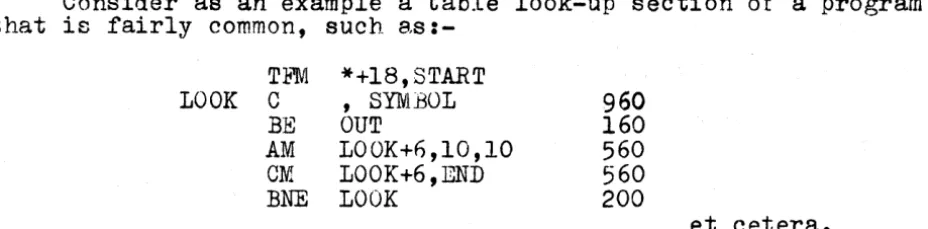
n~me':lory is one of
Consider as an example a table look-up section of a program
that is fairly common, such
8S:-T~lJl
*+18,
START
LOOK
C , SYMBOL960
BE
OUT
160
AM
LO OK +n ,10,10
560
CM
LOOK+6,END
560
BNE
LOOK
200
et cetera.
This has an execution time for the cycle, assuming that the entries
in the table are all of ten digits and positive, of 2,440 microseconds,
and this means that a note of frequency 1,000,000/2,440 c.p.s. will
be generated.
(The timings are for the Modell) i.e. about
410
c.p.s.
or about
G
above middle
C.
Less pure notes, or perhaps they should be
c~llednoises, come
from loops whose execution times are not constant.
Jor
example,in
the loop above, if the stored entries in the table are not all of the
same length, and not all positive, the instruction LOOK will not lave
A.
constant execution time, but it will vary between
960 anrt
280microseconds.
The
noise of this loop will have fundamental frequency
cO'11ponents between 410 ann 570 c.p.s., but also many harmonics, Rnd
the result is not at all musical.
(Demonstration on tane recorder
of thesptwo sounds)
Parts of
aprogr3.m that are
r~petiti.
vein tl'is sort of
way canusually