Aligning tagged bitexts
R a q u e l M a r t l n e zD e p a r t a m e n t o de Inform~itica y Programaci6n. F a c u l t a d de Matem~iticas U n i v e r s i d a d C o m p l u t e n s e de Madrid, 28040 M a d r i d , S p a i n
r a q u e l @ e u c m o s , sim. ucm. es
J o s e b a A b a i t u a
F a c u l t a d de Filosofla y Letras, Universidad de D e u s t o 4808,0 Bilbao, Spain
a b a i t u a @ f i l , deusto, es A r a n t z a C a s i l l a s
D e p a r t a m e n t o de Autom~itica, Universidad de Alcal~t d e H e n a r e s 28871 Alcalh de Henares, Spain
a r a n t z a @ a u t , alcala, es A b s t r a c t
This paper describes how complementary tech- niques can be employed to align multiword ex- pressions in a parallel corpus or bitext. The bitext used for experimentation has two main features: (i) it contains bilingual documents from a dedicated domain of legal and admin- istrative publications rich in specialized jar- gon; (ii) it involves two languages, Spanish and Basque, which are typologically very distinct (both lexically and morpho-syntactically). The former feature provides a good basis for testing techniques of collocation detection. The latter presents quite a challange to a number of re- ported algorithms, in particular to the align- ment of sentence internal segments.
1 T a g g e d b i t e x t s a s l a r g e l a n g u a g e r e s o u r c e s
Much literature has been produced in the area of sentence alignment of parallel biligual corpora or bitexts. Fewer references con- cern the alignment of intra-sentential segments such as word or multiword collocations (Eijk 93), (Kupiek 93), (Dagan & Church 94), and (Smadja et al. 96). The difficulty of aligning bi- texts depends of a number of factors such as the quality of the bitext (whether is truely parallel or not), the proximity between the languages (either structurally, morpho-syntactically or al- phabetically), the additional coded information that bitexts may have (richer or poorer mark- up), among others.
While stuying bitext alignment techniques it was decided that an optimal approach was to
tag the corpus. Descriptive annotations can account for linguistic information at all levels, from discourse structure to phonetic features, as well as semantics, syntax and morphology. The process of annotating the corpus in this man- ner is very labour intensive, even when largely automated, however it produces rewarding re- sults. Thoroughly tagged bitexts become rich and productive language resources (Abaitua et al. 98). SGML based T E I conformant mark-up (Ide & Veronis 95) has been the adopted mark- up option and it was discussed in (Martinez et al. 97).
Continuing with the work of (Martinez et al. 98), where sentence alignment b a s e d on rich mark-up was described, we present here two further achievements. Section 2 shows how proper names have been aligned, and Section 3 presents the techniques employed in attempting the aligning of multiword collocations. Results are evaluated in Section 4 and Section 5 offers some discussion.
2 P r o p e r n a m e a l i g n m e n t 2.1 P r o p e r n a m e t a g g i n g
inside the proper name chain, see examples in Table 1. A collection of heuristics discard up- percase initial words in sentence initial position or in other exceptional cases.
Just us (Smadja et al. 96) distinguished be- tween two types of collocations, we too distin- guish between:
F i x e d n a m e s : C o m p o u n d proper names labeled 'fixed', such as Boletin Oficial de Bizkaia, are rigid c o m p o u n d s . Spanish proper names all correspond to this type.
F l e x i b l e n a m e s : C o m p o u n d proper names labeled 'flexible' are c o m p o u n d s that can be separated by intervening
text elements such as in Adrninistrazio
Publikoetarako Ministeritzaren < d a t e > . . < / d a t e > Agindua, where a date splits the tokens within the c o m p o u n d . There is a small b u t significative n u m b e r of these in Basque, as has been previously noted by (Aduriz et al. 96b).
After proper names have been successfully identified (Table 2), the next step is their align- ment. Two types of alignment can take place:
• 1 t o 1 a l i g n m e n t : one to one correspon- dence between fixed names in the source and target documents.
• 1 t o N a l i g n m e n t : one to none or more t h a n one correspondences between fixed names in the source language and flexible names in the target language.
Alignment has been achieved by resorting to:
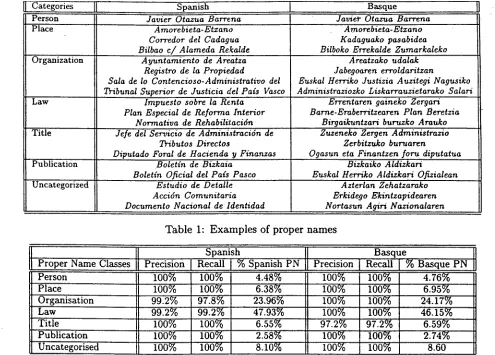
1. Proper name categorization, as shown in Table 1.
.
.
.
Reduction of the alignment space to previ- ously aligned sentences,
Identification of cognate nouns, aided by a set of phonological rules t h a t apply when Basque loan terms are directly derived from Spanish terms.
T h e application of the TasC algorithm
(Martinez et al. 98) a d a p t e d to proper name alignment.
2.2 I d e n t i f i c a t i o n o f c o g n a t e s
Points one and two above m a y suffice to work up the alignment of fixed p r o p e r names belonging to a single category that shows u p only once in the alignment space (i.e. in the sentence). Nevertheless, there can be sentences with flexi- ble proper names or more t h a n one fixed proper name belonging to the same category. There- fore it may be necessary to d e t e r m i n e the cor- rect alignment a m o n g possible candidates. As additional criteria in these cases we reinforce the identification of lexical cognates with a set of phonological correlation rules.
These are two examples of phonological cor- relation rules:
(i) T h e Spanish prefix 'tel-' always correlates with the prefix 'erl-' in Basque loans (e.g. reloj / erloju; relacidn / erlazio)
(ii) The Spanish suffix '-cidn' often correlates with the suffix '-zio' in Basque loans (e.g. nocidn / nozio; adrninistracidn / adminis- trazio)
We use a set of up to 33 rules of this type. For
some loan terms in Basque e.g. universidad /
unibertsitate), several of these rules may apply: -v- ~ -b- ;-rs- ~ -rts- ;-dad ~ -tare.
Although the application of these phonolog- ical rules for identifying Basque loan words is quite regular, not every new term in Basque is derived in this way. In m a n y other cases a Spanish term has a genuine Basque counterpart, (e.g. sociedad / elkarte). In any case, this set of phonological rules provides a very efficient aid for the identification of a high proportion of Spanish/Basque cognates (86.45 % on average, as shown in Table 3).
Therefore, when aligning proper names, cog- nate identification will help not only in obvious cases such as personal or place names, b u t also in categories of proper names such as organiza- tion, law or title.
2.3 C a l c u l a t i n g t h e s i m i l a r i t y b e t w e e n
B a s q u e a n d S p a n i s h p r o p e r n a m e s
Categories ]1" Spanish Basque
Person Javier Otazua Barrena Javie~" Otazua Barrena
Place Amorebieta-Etzano Arnorebieta-Etzano
Corredor del Cadagua Kadaguako pasabidea
Bilbao c / Alameda Rekalde Bilboko Errekalde Zumarkaleko
Organization Ayuntamiento de Areatza Areatzako udalak
Registro de la Propiedad Jabegoaren erroldaritzan
Sala de lo Contencioso-Administrativo del Euskal Herriko Justizia Auzitegi Nagusiko Tribunal Superior de Justicia del Pals Vasco Administraziozko Liskarrauzietarako Salari
Law Impuesto sobre la Renta Errentaren gaineko Zergari
Plan Especial de Reforma Interior Barne-Eraberritzearen Plan Beretzia Norrnativa de Rehabilif, aei6n Birgaikuntzari buruzko Arauko
Title Jefe del Servicio de Administraci6n de Zuzeneko Zeryen Administrazio
Tributos Directos Zerbitzuko buruaren
Diputado Foral de Hacienda y Finanzas Ogasun eta Finantzen foru diputatua
Publication Boletln de Bizkaia Bizkaiko Aldizkari
Boletin Oficial del Pals Pasco Euskal Herriko Aldizkari Ofizialean
Uncategorized Estudio de Detalle Azterlan Zehatzarako
Acci6n Comunitaria Erkidego Ekintzapidearen
Documento Nacional de ldentidad Nortasun Agiri Nazionalaren
Table 1: E x a m p l e s of proper n a m e s
Proper Name Classes [ Person
Place Organisation Law
Title Publication Uncategorised Total
Precision
I Recall 1%
Spanish PN PrecisionI rtecall 1%
Basque PN100% 100% 4.48%
100% 100% 6.38%
99.2% 97.8% 23.96%
99.2% 99.2% 47.93%
100% 100% 6.55%
100% 100% 2.58%
lOO%
lOO%
8.10%
99.4% 199.1% 100%
100% 100% 4.76%
100% 100% 6.95%
100% 100% 24.17%
100% 100% 46.15%
97.2% 97.2% 6.59%
100% 100% 2.74%
100% 100% 8.60
99.8% 99.8% I 100%
Table 2: Results of p r o p e r n a m e identification
1. In the first level, each token in t h e source proper n a m e is c o m p a r e d w i t h all t h e to- kens in the target p r o p e r n a m e . In or- der to d e t e r m i n e w h e t h e r two tokens are cognates, bigrams are c o m p a r e d t r y i n g to apply, if they are not equal, t h e rules of phonological derivation. O n l y w h e n t h e re- sulting coefficient is bigger t h a n a thresh- old, the tokens are considered cognates. T h e threshold has been established in 0.5 as a result of different e x p e r i m e n t a l tests.
2. In t h e second level, given a source a n d a target proper name, their similarity is de- t e r m i n e d according to the n u m b e r of cog- n a t e tokens t h a t exist b e t w e e n t h e m . Fig- ure 2 we illustrates an instance of t h e ap- plication of Dice's coefficient at b o t h levels.
Spanish proper name - - Basque proper name
Boletin Oficial de Bizkaia - - Bizkaiko Aldizkari O fizialean
First level of similatity: Boletin ~ none
OJicial - - - Ofizialean (-c- --~ -z-) 2 × 6
DC= ~ = 0.8 > 0.5
Bizkaia - - - Bizkaiko (no rule) DC= 2×5 = 0.76 > 0.5
Second level of similatity:
Number of cognate tokens is 2, then: DC = ~,,2 = 0 . 6 6
Figure 2: E x a m p l e of similarity calculation be- tween two p r o p e r n a m e
2.4 A l g o r i t h m f o r p r o p e r n a m e a l i g n m e n t
[image:3.596.65.560.38.393.2]Spanish sentence: Basque Sentence:
< s id=sESdocl2-2 > Segundo: Notificar la <s icl=sEUdocl2-3 > Bigarrena: Honako
presente <rs type=law> O r d e n Foral < / r s > erabakia <rs type=organisation > B a r -
al < r s t y p e = o r g a n i s a t i o n > Ayuntamiento rikako Udalari < / r s > jakinerazi eta < r s
de Barrika < / r s > , publicarla en el < r s t y p e f p u b l i c a t i o n > Bizkaiko Aldizkari
t y p e = p u b l i c a t i o n >Bolet{n Oficial de Bizkaia Ofizialean < / r s > argitaratzea eta < r s type=law < / r s > y proceder a la autentificacidn del < r s >Plan Partziala < / r s > aurkeztua izan den eran id= type=law > Plan Parcial < / s e g > tal como kautotzea. < / s >
ha sido presentado. < / s >
Figure 1: E x a m p l e of non-literal translation
r i t h m can be applied. T h e alignment algorithm has been borrowed from (Martinez et al. 98) with minor differences.
• T h e first difference is t h e criteria by means of which the similarity a m o n g s t alignable candidates is determined. While sentences are aligned on the basis of the similarity of the annotations they contain, p r o p e r names are aligned on the basis of their belonging to the same category as well as by matching cognate tokens.
• T h e second difference is the relevance of the order of alignable elements in t h e bitext. While in sentence alignment there are con- straints regarding ordering a n d grouping to reduce the number of cases to be evaluated, in the aligning of proper names constraints cannot be applied because ordering is not predictable.
Due to non-literal translations, 12% of the identified proper names have no exact counter- part in the other language (see Figure 1). In this case, the Basque sentence does not have the proper name of the law Orden Foral b u t the
anaphoric nominal honako erabakia, 'this reso-
lution'. In the corpus, there are 6% more proper name in the Spanish side of the bitext t h a n in the Basque side.
Table 3 shows the accuracy of this alignment
strategy. Proper names with no counterpart
have not been considered. Figure 3 illustrates an instance of how aligned proper names are tagged in the bitext.
3 A l i g n m e n t o f c o l l o c a t i o n s
(Smadja et al. 96), (Dagan ~ Church 94),
(Kupiek 93) and (Eijk 93) approach t h e align- ment of multiword collocations resorting to a number of complementary techniques:
(i) N o u n
(ii)
(iii)
p h r a s e collocations: All but
Smadja narrow the scope of collocations to noun phrases. Smadja is the only one that attempts to treat other phrases (such as verb phrases as well what he labels 'flex- ible phrases').
Delimited search space: All but Church
delimit the search space to already aligned sentences. Church in t u r n departs from a corpus of aligned words.
P O S t a g g i n g : All b u t Smadja employ Part of Speech (POS) taggers.
We also employ techniques (ii) and (iii), b u t
we introduce three additional resources: A
bilingual glossary, a bilingual contrastive gram- mar, as well as the structural m a r k u p which alredy exists in the bitext. In addition, we also consider verb prases.
T h e approach discribed below illustrates work in progress on how we try to optimize the alignment process by combining those tech- niques. Collocations are aligned in six steps. T h e first three steps are m e a n t to detect can- didate collocations in both languages. T h e last three axe directly involved in the alignment.
. W o r d cooccurrence frequency: D u e to the specialized nature of the bitext, any word cooccurrence that superates a given threshold is considered to be a collocation candidate. This threshold depends on the size of the corpus, but even a low figure
as 2 can be considered significative enough.
Categories ] % Alignable PN Precision Recall
Person ]LO0%
Place Organisation Law
Title Publication Uncategorised
89.28% 79.38% 915.68% ~;6.2%
100% 5.4.54%
Total
II
8,5.45%100% 100% 96.7% 100% 100% 100% 93.4% 98.5%
100% 92% 76.6% 88.2% 72.3% 100% 85.7% 87.82% Table 3: Results of proper name alignment
Spanish Sentences: Basque Sentences:
<s id=sES734 corresp=sEU740> <num <s id=sEU740 corresp=sES734> < n u m 'num=l> I. </num> Suspender la aprobaci6n num=l> I. </num> <rs type=place id=UEUI41 definitiva de ]a <rs type=law id=LES367
corresp=LES367>Araneko Auzoan
</rs>, corresp=UEU141,LEU342>Modificaci6n
<rs type=law id=LEU342 corresp=LES367>P u n t u a l de las Norrna8 Subsidiarias de Gernika-£urnoko Udal Egitarnuketazko
P l a n e a m i e n t o Municipal de G e r n i k a - L u r n o Ordezko A r a u e . P u n t u z k o A l d a k e t a r e n
en el B a r r i o de A r a n a < / r s > , en base a l a s < / r s > behin betirako onarpena etetzea, jarraian
deficiencias que a continuaci6n se expresan y que adierazten diren eta zuzendu egin beharko diren debe~in subsanarse <colon> : < / c o l o n > < / s > akatsetan oinarrituta < c o l o n > : < / c o l o n >
</s>
Figure 3: Sample of 1 to N alignment of proper names tions in Spanish and 1,483 in Basque have
been detected .
2. P O S t a g g i n g : A tagged version of the Spanish text was supplied by the Natural Language Research Group at the Univer-
sitar Polit~cnica de Catalunya ( M ~ q u e z &
Padr6 97). The Basque text was tagged by the IXA group from the Euskal Herriko
Unibertsitatea (Aduriz et al. 96a), (see Fig-
ure 5).
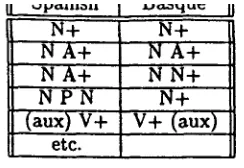
3. N P , V P g r a m m a r s : Simple noun phrase and verb phrase patterns have been used to detect candidate collocations and to fil- ter out inapproppriate word cooccurrences. By means of this technique, 80% of the de- tected word cooccurrences are discarded. Basque and Spanish phrases show great di- vergences, and for the alignment procedure to succed, it has been necessary to imple- ment an additional resource: a correspon- dence table with grammatical patterns for Spanish and Basque phrases (see Table 4). 4. B i l i n g u a l g l o s s a r y l o o k u p : This is a very useful resource containing over 15,000 aligned entries. The glossary was devel- oped by the same translators that were in
charge of the corpus we are working with. Yet, the glossary, although it is available on-line, translators have not applied it sys- tematically and frequent divergences arise (compare Figure 4 with Figure 6).
5. S e a r c h w i t h i n a l i g n e d s e n t e n c e s : Aligned senteces delimit the search space thereby reducing the complexity of the alignment.
6. H u m a n v a l i d a t i o n : The final step in- volves human intervention, so that detected collocations can be validated and thus in- corporated into the glossary. The posibility of enriching the glossary with contextual information has not yet been implemented, but holds great potentiallity ( < d o c t y p e > , < d i v > , < p > and < s > tags could be used to locate collocations in context and index them through their correspondig i d tag at- tributes).
4 E v a l u a t i o n
[image:5.596.87.540.34.323.2]U Spanish I
BasqueII
N +N A+ N A'+ N P N
(aux) V +
etc.
N+ N A+ N N+ N+'
v + (aux)
Table 4: Correspondence table
been the case. We still do not have definite esti- mations on the performance of collocations not present in the glossary. As we discuss below, we are still sceptic about the results of the cor- respondence table with current version of the Basque lemmatizer.
5 D i s c u s s i o n
We have not yet calculated how many detected collocations are included in the glossary, al- though it has become clear that a high pro- portion of these detected collocations have not been considered by the translators who created the dictionary. These tend to include only col- locations which have a clear terminological ap- pearance. It is hard to discriminate between general language collocations and domain spe- cific terminology and this discussion is beyond the scope of this paper.
The correspondence table with Spanish and Basque grammatical patterns is at present prob- lematic. This is due to the lack of morphological information in the output of the Basque lemma- tizer. Basque is an aglutinative language which has postpositions and other functional elements added as suffixes. The information such suf- fixes provide is not shown by the lemmatizer and this inevitably hinders the efficiency of the correspondence table. However we are confi- dent that future versions of both the Basque and Spanish lemmatizers will become closer be- cause they are currently developed within the same project team. When their output becomes more homogeneous, the efficiency of the corre- spondence table will be greately increased.
6 Acknowledgements
This research is being partially supported by the Spanish Research Agency, project ITEM, TIC-96-1243-C03-01. We greately appreciate the help given to us by Felisa Verdejo, director of the project. We are particulary endebeted
" agotar" ; "agortu"
"agotar el plazo";'epea agortu" "agotar l a v a administrativa~; " administrozio bidea agortu"
" agoiarse las reservas " ; " erreserbak agortu "
. . .
"defender " ;" defendatu "
"defender los derechos";"eskubideak defendatu"
" d e f e n s a " ; " d e f e n t s a "
"defense civil";ndefentsa zibil"
. . .
" i n t e r p o n e r "; n j a r r i "
"interponer un recur.o" ;'errekurtsoa jarri" "interponer una reclamaci6n" ;"erreklamazioa jarri" "interpretaci6n" ;" interpretazio"
"medidor" ;"neurgailu"
" m e d i o ' ; " l ) bids; 2 ) e s k u a r t e " '.
"medio audiovisualn ;"ikusentzunezko heibide"
"medio de comunicacin n ; "komunikabide "
" recurso administrotivo " ; " administrozio errekurts o " "reeurso c o n t e n c i o s o a d m i n i s t r a t i v o ";
" A d m i n i s t r a z i o a r e k i k o a u z i b i d e - e r r e k u r t s o " "recurso de abuso " ; " abusu errekurtso "
"veto";" geben"
"u(a a d m l n i s t r a t i v a " ; " a d m i n i s t r a z i o bide" "v(a administrativa, por~;"administrazio bidetik"
Figure 6: Glossary sample
to developers of the Spanish (M~irquez & Padr6 97) and the Basque (Aduriz et al. 96a) lemma- tizers. W e thank C R L for allowing us the use of their premises and to Begofia Farwell for the reviewing of the text.
R e f e r e n c e s
(Abaitua et al. 97) J. Abaitua, A. Ca, ilia., R. Martfnez. Value Added Tagging for Multillngual Resource Man- agement. Proceedings of the First International Con- ference on Language Resources ~ Evaluation, ELRA,
1003-1007, 1998.
(Aduriz et al. 96a) I. Aduriz, I. Aldezabal, I. Alegrla, R. Urizar. EUSLEM: A lemmatiser/tagger for Basque.
E U R A L E X T 6 , Gotteborg, Sweden, 1996.
(Aduriz et al. 96b) I. Aduriz, t. Aldezabal, X. Artola, N. Ezeiza, and R. Urizar. MultiWord Lexical Units in EUSLEM, a lemmatiser-tagger for Basque Papers in Computational Lezicography COMPLEX'g6, 1-8. Bu- dapest 1996.
[image:6.596.85.207.37.121.2]• . . ? t
Spanish Sentence:
< p > < s > C o n t r a dicha < r s type---'law
id=LES546 corresp=LEU540> Orden Foral
< / r s > , que a g o t a l a <'eerm i d f X l c o r r e s p f X l > v i a a c l m i n l s t r a t i v a < / t e r m > <texan
idfX2 correspfX3> p o d r & i n t e r p o n e r s e
</term> <germ id=X3 corresp=X2>recl~rso e o n t e n e i o s o - a d m i n i s t r a t i v o </term>
ante la <rs type=organization id=OF2;867
c o r r e s p = 0 E U 8 5 6 > Sala de lo Contencioso- Adminiatrativo del Tribunal Superior de Justicia del Pa(s Vasco < / r s > , en el plazo de dos m ~ e s , e ~ t a d o desde el dia siguiente a esta notifi- caci6n, sin-perjuicio de la utilizaci6n de otros < t e r m id=X4 c o r r e s p f X 4 > m e d i o s de defensa
< / t e r m > que estime oportunos. < / s > < / p >
Basque Sentence:
< p > < s > < r s t y p e f l a w id=LEU540 c o r r e s p = L E S 5 4 6 > Foru Agindu < / r s > horrek amaiera eman clio <term idfXl corresp=Xl> a d m i n i s t r a z i o bideari < / t e r m > ; e t a be- raren aurka <1;erm id=X2 correnp=X3> ad- m i n i s t r a z i o a r e k i k o a u z i b i d e - e r r e k u r t s o a </term> <term idfX3 corresp=X2>jarri ahal i z a n g o zaio </term> <rs type=law id=OEU856 corresp=OES867> Euskal Herriko Justizi Auzitegi Nagusiko Administrazioarekiko Auzibideetarako Salari < / r s > , bi hilabeteko epean; jakinarazpen hau egiten den egunaren biharamunetik zenbatuko d a epe hori; hala e t a guztiz ere, egokiesten diren b e s t e < t e r m i d f X 4 e o r r e s p = X 4 > d e f e n t s a b i d e a k < / t e r m > ere erabil litezke. < / s > < / p >
F i g u r e 4: E x a m p l e o f a l i g n e d c o l l o c a t i o n s Spanish lemmatization output:
. . .
que que B3323 PR3CN000
agora agotar 6202030 VMIP3S0
la la 810 TDFS0 via via 010 NCFS000
administrativa admiuistrativo 110 AQOFS00
podrd poder 6202330 VMIF3S0
interponerse interponer 6223503 VMN0000
recurso recurso 000 NCMS000
eontencioso-adminiatrativo
contencioso-admiaistrativo NOMASK AQ00000
ante ante A1 SPS00 la la 810 TDFS0
. . .
sin-perjnicio.de sin-perjuicio-de A1 SPS00 /a la 810 TDFS0
utilizacidn utilizaci6n 010 NCFS000 de de A1 SPS00
otros otto 3012 DI3MP00
medios medio 001 NCMP000 de de A1 SPS00
defensa defensa 010 NCFS000 que que B3323 PR3CN000
e~time estimar 6202032 VMMP3S0
oportunos oportuno 101 AQOMP00
. . •
Basque lemmatization output:
. . .
amaieru amaiera IZE-ARR
eman eman ADI-SIN
dio *edun ADL .
adminiatrazio administrazio IZE-ARR
bideari bide IZE-ARR ; EOS = PUNT-PUNTU
eta BOS eta LOT-JNT
beraren hera IOR-PER
aurka anrka IZE-ARR
administrazioarekiko adminiRtrazio IZE-ARR
auzibide-errekurtsoa anzibide-errekurtso IZE-ARR
jarri jar ADI-SIN
ahal ahal ADI-ADP izango izan ADI-SIN zaio izan ADL
• ° .
hala BOS hala ADB-ADO
eta eta LOT-JNT 9u~t/z guztiz MAI ere ere LOT-LOK = PUNT-EZPUN
J
egoldesten (egokiesta) IZE-ARR
diren izan ADT
beste beste DET-DZG
defentsabideak defentsabide IZE-ARR. ere ere LOT-LOK
erabil erabil ADI-SIN
litezke *edin ADL • EOS = PUNT-PUN
F i g u r e 5: O u t p u t o f b o t h S p a n i s h a n d B a s q u e l e m m a t i z a t i o n s
(Dice 45) L. R. Dice. Measures of the Amount of Ecologic Association Between Species. Ecology, 26, 297-302. (Eijk 93) P. van der Eijk. Automating the Acquisition
of Bilingual Terminology. Proceedings Sixth Confer-
ence of the European Chapter of the /~ssoc~ation for Computational Linguistic, Utrecht, The Netherlands,
113-119, 1993.
(Ide & Veronis 95) N. Ide, J. Veronis. The Tezt Encod- ing Inttiative: Backpround and Contezts. Dordrecht: Kluwer Academic Publishers, 1995•
[image:7.596.67.558.14.603.2]i.gs of the 31si Annual Meeting ol ihe ACL, Colum-
bus, Ohio, 17-22. Association for Computational Lin-
guistics 1993.
(M~trquez & Padr6, 97) L. Mfi.rquez, L. Padr& A Flexible POS Tagger Using an Automatically Acquired Lan o guage Model. Proceedings of the joint BACL/A CL97,
Madrid, Spain, 1997.
(Martfnez et al. 97) R. Martfnez, A. Casillas and J. Abaitua. Bilingual parallel text segmentation and tag- ging for specialized documentation. Proceedings of the International Conference Recent Advances in Natural
Language Processing, RANLP'97, 369-372, 1997.
(Martlnez et al. 98) R. Martinez, A. Casillas and J. Abaitua. Bitext Correspondences through Rich Mark-
up~ Proceedings of the 17th International Conference
on Computational Linguistics
(COLING'gS)
and 36thAnnual Meeting of the Association for Computational
Linguistics (ACL'98), Montreal, Canada, 1998.
(Smadja et al. 96) F. Smadja, K. McKeown, V. Hatzivas- siloglou. Translating Collocations for Bilingual Lexi- cons: A Statistical Approach. Computational Linguis-