Memory-based morphological analysis generation and
part-of-speech tagging of Arabic
Erwin Marsi, Antal van den Bosch
ILK, Tilburg University P.O. Box 90153 NL-5000 LE Tilburg
The Netherlands
{E.C.Marsi,Antal.vdnBosch}@uvt.nl
Abdelhadi Soudi
Center for Computational Linguistics Ecole Nationale de L’Industrie Min´erale
Rabat, Morocco,
[email protected]/[email protected]
Abstract
We explore the application of memory-based learning to morphological analy-sis and part-of-speech tagging of written Arabic, based on data from the Arabic Treebank. Morphological analysis – the construction of all possible analyses of isolated unvoweled wordforms – is per-formed as a letter-by-letter operation pre-diction task, where the operation encodes segmentation, part-of-speech, character changes, and vocalization. Part-of-speech tagging is carried out by a bi-modular tag-ger that has a subtagtag-ger for known words and one for unknown words. We report on the performance of the morphological an-alyzer and part-of-speech tagger. We ob-serve that the tagger, which has an accu-racy of 91.9% on new data, can be used to select the appropriate morphological anal-ysis of words in context at a precision of 64.0 and a recall of 89.7.
1 Introduction
Memory-based learning has been successfully ap-plied to morphological analysis and part-of-speech tagging in Western and Eastern-European languages (van den Bosch and Daelemans, 1999; Daelemans et al., 1996). With the release of the Arabic Treebank by the Linguistic Data Consortium (current version: 3), a large corpus has become available for Ara-bic that can act as training material for
learning algorithms. The data facilitates machine-learned part-of-speech taggers, tokenizers, and shal-low parsing units such as chunkers, as exemplified by Diab et al. (2004).
However, Arabic appears to be a special challenge for data-driven approaches. It is a Semitic language with a non-concatenative morphology. In addition to prefixation and suffixation, inflectional and deriva-tional processes may cause stems to undergo infixa-tional modification in the presence of different syn-tactic features as well as certain consonants. An Arabic word may be composed of a stem consist-ing of a consonantal root and a pattern, affixes, and clitics. The affixes include inflectional markers for tense, gender, and number. The clitics may be ei-ther attached to the beginning of stems (proclitics) or to the end of stems (enclitics) and include pos-sessive pronouns, pronouns, some prepositions, con-junctions and determiners.
Arabic verbs, for example, can be conjugated ac-cording to one of the traditionally recognized pat-terns. There are 15 triliteral forms, of which at least 9 are in common. They represent very subtle dif-ferences. Within each conjugation pattern, an entire paradigm is found: two tenses (perfect and imper-fect), two voices (active and passive) and five moods (indicative, subjunctive, jussive, imperative and en-ergetic). Arabic nouns show a comparably rich and complex morphological structure. The broken plu-ral system, for example, is highly allomorphic: for a given singular pattern, two different plural forms may be equally frequent, and there may be no way to predict which of the two a particular singular will take. For some singulars as many as three further
statistically minor plural patterns are also possible. Various ways of accounting for Arabic morphol-ogy have been proposed. The type of account of Arabic morphology that is generally accepted by (computational) linguists is that proposed by (Mc-Carthy, 1981). In his proposal, stems are formed by a derivational combination of a root morpheme and a vowel melody. The two are arranged accord-ing to canonical patterns. Roots are said to inter-digitate with patterns to form stems. For exam-ple, the Arabic stem katab (”he wrote”) is com-posed of the morpheme ktb (”the notion of writ-ing”) and the vowel melody morpheme ’a-a’. The two are integrated according to the pattern CVCVC (C=consonant, V=vowel). This means that word structure in this morphology is not built linearly as is the case in concatenative morphological systems.
The attempts to model Arabic morphology in a two-level system (Kay’s (1987) Finite State Model, Beesley’s (1990; 1998) Two-Level Model and Ki-raz’s (1994) Multi-tape Two-Level Model) reflect McCarthy’s separation of levels. It is beyond the scope of this paper to provide a detailed description of these models, but see (Soudi, 2002).
In this paper, we explore the use of memory-based learning for morphological analysis and part-of-speech (PoS) tagging of written Arabic. The next section summarizes the principles of memory-based learning. The following three sections describe our exploratory work on memory-based morphological analysis and PoS tagging, and integration of the two tasks. The final two sections contain a short discus-sion of related work and an overall concludiscus-sion.
2 Memory-based learning
Memory-based learning, also known as instance-based, example-instance-based, or lazy learning (Aha et al., 1991; Daelemans et al., 1999), extensions of thek -nearest neighbor classifier (Cover and Hart, 1967), is a supervised inductive learning algorithm for learning classification tasks. Memory-based learn-ing treats a set of labeled (pre-classified) trainlearn-ing instances as points in a multi-dimensional feature space, and stores them as such in an instance base in memory. Thus, in contrast to most other ma-chine learning algorithms, it performs no abstrac-tion, which allows it to deal with productive but
low-frequency exceptions (Daelemans et al., 1999). An instance consists of a fixed-length vector of
nfeature-value pairs, and the classification of that particular feature-value vector. After the instance base is stored, new (test) instances are classified by matching them to all instances in the instance base, and by calculating with each match the distance, given by a distance kernel function. Classification in memory-based learning is performed by the k -NN algorithm that searches for thek‘nearest neigh-bours’ according to the∆(X, Y)kernel function1.
The distance function and the classifier can be refined by several kernel plug-ins, such as feature weighting (assigning larger distance to mismatches on important features), and distance weighting (as-signing a smaller vote in the classification to more distant nearest neighbors). Details can be found in (Daelemans et al., 2004).
3 Morphological analysis
We focus first on morphological analysis . Training on data extracted from the Arabic Treebank, we in-duce a morphological analysis generator which we control for undergeneralization (recall errors) and overgeneralization (precision errors).
3.1 Data
3.1.1 Arabic Treebank
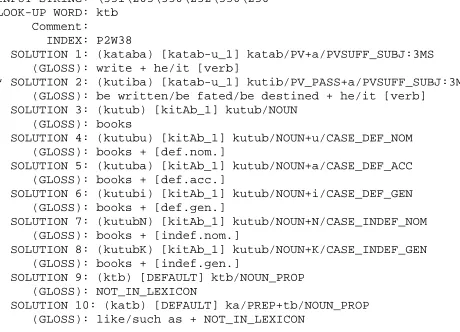
Our point of departure is the Arabic Treebank 1 (ATB1), version 3.0, distributed by LDC in 2005, more specifically the “after treebank” PoS-tagged data. Unvoweled tokens as they appear in the orig-inal news paper are accompanied in the treebank by vocalized versions; all of their morphological analyses are generated by means of Tim Buckwal-ter’s Arabic Morphological Analyzer (Buckwalter, 2002), and the appropriate morphological analysis is singled out. An example is given in Figure 1. The in-put token (INPUT STRING) is transliterated (LOOK-UP WORD) according to Buckwalter’s transliteration
sys-tem. All possible vocalizations and their morpho-logical analyzes are listed (SOLUTION). The analysis is rule-based, and basically consists of three steps. First, all possible segmentations of the input string
1
INPUT STRING: \331\203\330\252\330\250 LOOK-UP WORD: ktb
Comment: INDEX: P2W38
SOLUTION 1: (kataba) [katab-u_1] katab/PV+a/PVSUFF_SUBJ:3MS (GLOSS): write + he/it [verb]
* SOLUTION 2: (kutiba) [katab-u_1] kutib/PV_PASS+a/PVSUFF_SUBJ:3MS (GLOSS): be written/be fated/be destined + he/it [verb] SOLUTION 3: (kutub) [kitAb_1] kutub/NOUN
(GLOSS): books
SOLUTION 4: (kutubu) [kitAb_1] kutub/NOUN+u/CASE_DEF_NOM (GLOSS): books + [def.nom.]
SOLUTION 5: (kutuba) [kitAb_1] kutub/NOUN+a/CASE_DEF_ACC (GLOSS): books + [def.acc.]
SOLUTION 6: (kutubi) [kitAb_1] kutub/NOUN+i/CASE_DEF_GEN (GLOSS): books + [def.gen.]
SOLUTION 7: (kutubN) [kitAb_1] kutub/NOUN+N/CASE_INDEF_NOM (GLOSS): books + [indef.nom.]
SOLUTION 8: (kutubK) [kitAb_1] kutub/NOUN+K/CASE_INDEF_GEN (GLOSS): books + [indef.gen.]
SOLUTION 9: (ktb) [DEFAULT] ktb/NOUN_PROP (GLOSS): NOT_IN_LEXICON
[image:3.612.74.304.59.225.2]SOLUTION 10: (katb) [DEFAULT] ka/PREP+tb/NOUN_PROP (GLOSS): like/such as + NOT_IN_LEXICON
Figure 1: Example token fromATB1
in terms of prefixes (0 to 4 characters long), stems (at least one character), and suffixes (0 to 6 characters long) are generated. Next, dictionary lookup is used to determine if these segments are existing morpho-logical units. Finally, the numbers of analyses is fur-ther reduced by checking for the mutual compatibil-ity of prefix+stem, stem+suffix, and prefix+stem in three compatibility tables. The resulting analy-ses have to a certain extent been manually checked. Most importantly, a star (*) preceding a solution in-dicates that this is the correct analysis in the given context.
3.1.2 Preprocessing
We grouped the 734 files from the treebank into eleven parts of approximately equal size. Ten parts were used for training and testing our morphological analyzer, while the final part was used as held-out material for testing the morphological analyzer in combination with the PoS tagger (described in Sec-tion 4).
In the corpus the number of analyses per word is not entirely constant, either due to the automatic generation method or to annotator edits. As our ini-tial goal is to predict all possible analyses for a given word, regardless of contextual constraints, we first created a lexicon that maps every word to all anal-yses encountered and their respective frequencies From the 185,061 tokens in the corpus, we extracted 16,626 unique word types – skipping punctuation to-kens – and 129,655 analyses, which amounts to 7.8 analyses per type on average.
= = = = = k t b = = = ka/PREP+;ka;k;ku = = = = k t b = = = = a/PREP+t;uti;ata;t;utu = = = k t b = = = = = ab/PV+a/PVSUFF_SUBJ:3MS+;
b/NOUN_PROP+;ub/NOUN+i/CASE_DEF_GEN+; ub/NOUN+a/CASE_DEF_ACC+;
ub/NOUN+K/CASE_INDEF_GEN+; ib/PV_PASS+a/PVSUFF_SUBJ:3MS+; ub/NOUN+N/CASE_INDEF_NOM+;ub/NOUN+; ub/NOUN+u/CASE_DEF_NOM+
Figure 2: Instances for the analyses of the word ktb in Figure 1.
3.1.3 Creating instances
These separate lexicons were created for training and testing material. The lexical entries in a lexi-con were lexi-converted to instances suitable to memory-based learning of the mapping from words to their analyses (van den Bosch and Daelemans, 1999). In-stances consist of a sequence of feature values and a corresponding class, representing a potentially com-plex morphological operation.
The features are created by sliding a window over the unvoweled look-up word, resulting in one in-stance for each character. Using a 5-1-5 window yields 11 features, i.e. the input character in focus, plus the five preceding and five following characters. The equal sign (=) is used as a filler symbol.
The instance classes represent the morphological analyses. The classes corresponding to a word’s characters should enable us to derive all associated analyses. This implies that the classes need to en-code several aspects simultaneously: vocalization, morphological segmentation and tagging. The fol-lowing template describes the format of classes:
class = subanalysis; subanalysis; ...
subanalysis = preceding vowels & tags + input character +
following vowels & tags
sec-ka ku
ata utu
ab/PV+a/PVSUFF_SUBJ:3MS ub/NOUN+u/CASE_DEF_NOM --- + --- + katab/PV+a/PVSUFF_SUBJ:3MS kutub/NOUN+u/CASE_DEF_NOM
Figure 3: Illustration of how two morphological analyses are reconstructed from the classes in Fig-ure 2.
ond class, which in turn matches the
subanaly-sisab/PV+a/PVSUFF SUBJ:3MSfrom the third
class; together these constitute the complete analysis
katab/PV+a/PVSUFF SUBJ:3MS.
3.2 Initial Experiments
To test the feasibility of our approach, we first train and test on the full data set. Timbl is used with its de-fault settings (overlap distance function, gain-ratio feature weighting, k = 1). Rather than evaluating on the accuracy of predicting the complex classes, we evaluate on the complete correctness of all recon-structed analyses, in terms of precision, recall, and F-score (van Rijsbergen, 1979). As expected, this results in a near perfect recall (97.5). The precision, however, is much lower (52.5), indicating a substan-tial amount of analysis overgeneration; almost one in two generated analyses is actually not valid. With an F-score of only 68.1, we are clearly not able to reproduce the training data perfectly.
Next we split the data in 9 parts for training and 1 part for testing. Thek-NN classifier is again used with its default settings. Table 1 shows the results broken down into known and unknown words. As known words can be looked up in the lexicon derived from the training material, the first row presents the results with lookup and the second row without lookup (that is, with prediction). The fact that even with lookup the performance is not perfect shows that the upper bound for this task is not 100%. The reason is that apparantly some words in the test ma-terial have received analyses that never occur in the training material and vice versa. For known words without lookup, the recall is still good, but the preci-sion is low. This is consistent with the initial results mentioned above. For unknown words, both recall and precison are much worse, indicating rather poor generalization.
To sum up, there appear to be problems with both the precision and the recall. The precision is low for known words and even worse for unknown words.
#Wrds Prec Rec F Known with lookup 3220 92.6 98.1 95.3 Known without lookup 3220 49.9 95.0 65.5
[image:4.612.331.523.188.239.2]Unknown 847 22.8 26.8 24.7
Table 1: Results of initial experiments split into known and unknown words, and with and without lookup of known words.
#Wrds Prec Rec F
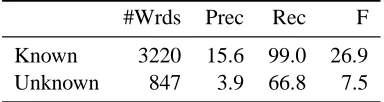
Known 3220 15.6 99.0 26.9 Unknown 847 3.9 66.8 7.5
Table 2: Results of experiments for improving the recall, split into known and unknown words.
Analysis overgeneration seems to be a side effect of the way we encode and reconstruct the analyses. The recall is low for unknown words only. There appear to be at least two reasons for this undergen-eration problem. First, if just one of the predicted classes is incorrect (one of the pieces of the jigsaw puzzle is of the wrong shape) then many, or even all of the reconstructions fail. Second, some generaliza-tions cannot be made, because infrequent classes are overshadowed by more frequent ones with the same features. Consider, for example, the instance for the third character (l) of the word jEl:
= = = j E l = = = = =
Its real class in the test data is:
al/VERB_PERFECT+;ol/NOUN+
When the k-NN classifier is looking for its nearest neighbors, it finds three; two with a “verb imperfect” tag, and one with a “noun” tag.
{ al/VERB_IMPERFECT+ 2, ol/NOUN+ 1}
Therefore, the class predicted by the classifier is
al/VERB IMPERFECT+, because this is the majority
class in the NN-set. So, although a part of the cor-rect solution is present in the NN-set, simple major-ity voting prevents it from surfacing in the output.
3.3 Improving recall
Prec Rec F
[image:5.612.76.296.57.121.2]Known 58.6 (0.4) 66.6 (0.5) 62.4 (0.3) Unknown 28.7 (3.7) 37.2 (1.2) 32.2 (2.5) All 53.4 (1.2) 62.2 (0.6) 57.5 (0.8)
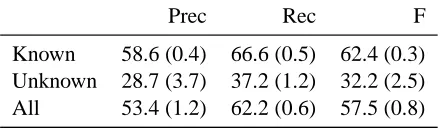
Table 3: Average results and SD of the 10-fold CV experiment, split into known and unknown words
but rather than relying on the classifier to do the ma-jority voting over the (possibly weighted) classes in thek-NN set and to output a single class, we perform a reconstruction of analyses combining all classes in thek-NN set. To allow for more classes ink-NN’s output, we increase kto 3 while keeping the other settings as before. As expected, this approach creases the number of analyses. This, in turn, in-creases the recall dramatically, up to nearly perfect for known words; see Table 2. However, this gain in recall is at the expense of the precision, which drops dramatically. So, although our revised ap-proach solves the issues above, it introduces massive overgeneration.
3.4 Improving precision
We try to tackle the overgeneration problem by fil-tering the analyses in two ways. First, by ranking the analyses and limiting output to then-best. The ranking mechanism relies on the distribution of the classes in the NN-set. Normally, some classes occur more frequently than others in the NN-set. During the reconstruction of a particular analysis, we sum the frequencies of the classes involved. The result-ing score is then used to rank the analyses in de-creasing order, which we filter by taking then-best. The second filter employs the fact that only cer-tain sequences of morphological tags are valid. Tag bigrams are already implicit in the way that the classes are constructed, because a class contains the tags preceding and following the input charac-ter. However, cooccurrence restrictions on tags may stretch over longer distances; tag trigram informa-tion is not available at all. We therefore derive a frequency list of all tag trigrams occurring in the training data. This information is then used to filter analyses containing tag trigrams occurring below a certain frequency threshold in the training data.
Both filters were optimized on the fold that was used for testing so far, maximizing the overall
F-score. This yieled an n-best value of 40 and tag frequency treshold of 250. Next, we ran a 10-fold cross-validation experiment on all data (except the held out data) using the method described in the pre-vious section in combination with the filters. Aver-age scores of the 10 folds are given in Table 3. In comparison with the initial results, both precision and recall on unknown words has improved, indi-cating that overgeneration and undergeneration can be midly counteracted.
3.5 Discussion
Admittedly, the performance is not very impressive. We have to keep in mind, however, that the task is not an easy one. It includes vowel insertion in am-biguous root forms, which – in contrast to vowel in-sertion in prefixes and suffixes – is probably irreg-ular and unpredictable, unless the appropriate stem would be known. As far as the evaluation is con-cerned, we are unsure whether the analyses found in the treebank for a particular word are exhaus-tive. If not, some of the predictions that are currently counted as precision errors (overgeneration) may in fact be correct alternatives.
Since instances are generated for each type rather than for each token in the data, the effect of to-ken frequency on classification is lost. For exam-ple, instances from frequent tokens are more likely to occur in the k-NN set, and therefore their (par-tial) analyses will show up more frequently. This is an issue to explore in future work. Depending on the application, it may also make sense to optimize on the correct prediction of unkown words, or on in-creasing only the recall.
4 Part-of-speech tagging
We employMBT, a memory-based tagger-generator and tagger (Daelemans et al., 1996) to produce a part-of-speech (PoS) tagger based on theATB1 cor-pus2. We first describe how we prepared the corpus data. We then describe how we generated the tag-ger (a two-module tagtag-ger with a module for known words and one for unknown words), and subse-quently we report on the accuracies obtained on test material by the generated tagger. We conclude this
2
In our experiments we used the MBT software pack-age, version 2 (Daelemans et al., 2003), available from
w CONJ
bdA VERB_PERFECT styfn NOUN_PROP knt NOUN_PROP
nHylA ADJ+NSUFF_MASC_SG_ACC_INDEF
jdA ADV
, PUNC
AlA ADV
>n FUNC_WORD ...
Figure 4: Part of anATB1 sentence with unvoweled words (left) and their respective PoS tags (right).
section by describing the effect of using the output of the morphological analyzer as extra input to the tagger.
4.1 Data preparation
While the morphological analyzer attempts to gener-ate all possible analyses for a given unvoweled word, the goal of PoS tagging is to select one of these analyses as the appropriate one given the context, as the annotators of the ATB1 corpus did using the
*marker. We developed a PoS tagger that is trained to predict an unvoweled word in context, a concate-nation of the PoS tags of its morphemes. Essentially this is the task of the morphological analyzer with-out segmentation and vocalization. Figure 4 shows part of a sentence where for each word the respective tag is given in the second column. Concatenation is marked by the delimiter+.
We trained on the full ten folds used in the previ-ous sections, and tested on the eleventh fold. The training set thus contains 150,966 words in 4,601 sentences; the test set contains 15,102 words in 469 sentences. 358 unique tags occur in the corpus. In the test set 947 words occur that do not occur in the training set.
4.2 Memory-based tagger generator
Memory-based tagging is based on the idea that words occurring in similar contexts will have the same PoS tag. A particular instantiation, MBT, was
proposed in (Daelemans et al., 1996). MBThas three modules. First, it has a lexicon module which stores for all words occurring in the provided training cor-pus their possible PoS tags (tags which occur below a certain threshold, default 5%, are ignored). Sec-ond, it generates two distinct taggers; one for known words, and one for unknown words.
The known-word tagger can obviously benefit from the lexicon, just as a morphological analyzer
could. The input on which the known-word tag-ger bases its prediction for a given focus word con-sists of the following set of features and parameter settings: (1) The word itself, in a local context of the two preceding words and one subsequent word. Only the 200 most frequent words are represented as themselves; other words are reduced to a generic string – cf. (Daelemans et al., 2003) for details. (2) The possible tags of the focus word, plus the pos-sible tags of the next word, and the disambiguated tags of two words to the left (which are available be-cause the tagger operates from the beginning to the end of the sentence). The known-words tagger is based on ak-NN classifier withk = 15, the modi-fied value difference metric (MVDM) distance func-tion, inverse-linear distance weighting, and GR fea-ture weighting. These settings were manually opti-mized on a held-out validation set (taken from the training data).
The unknown-word tagger attempts to derive as much information as possible from the surface form of the word, by using its suffix and prefix letters as features. The following set of features and param-eters are used: (1) The three prefix characters and the four suffix characters of the focus word (possi-bly encompassing the whole word); (2) The possible tags of the next word, and the disambiguated tags of two words to the left. The unknown-words tag-ger is based on ak-NN classifier withk = 19, the modified value difference metric (MVDM) distance function, inverse-linear distance weighting, and GR feature weighting – again, manually tuned on vali-dation material.
The accuracy of the tagger on the held-out cor-pus is 91.9% correctly assigned tags. On the 14155 known words in the test set the tagger attains an curacy of 93.1%; on the 947 unknown words the ac-curacy is considerably lower: 73.6%.
5 Integrating morphological analysis and part-of-speech tagging
All words Known words Unknown words Part-of-speech source Precision Recall Precision Recall Precision Recall
Gold standard 70.1 97.8 75.8 99.5 30.2 73.4
Predicted 64.0 89.7 69.8 92.0 23.9 59.0
Table 4: Precision and recall of the identification of the contextually appropriate morphological analysis, measured on all test words and split on known words and unknown words. The top line represents the upper-bound experiment with gold-standard PoS tags; the bottom line represents the experiment with predicted PoS tags.
amounts to predicting the solution that is preceded by “*” in the original ATB1 data. For this purpose, the PoS tag predicted by MBT, as described in the previous section, serves to select the morphological analysis that is compatible with this tag. We em-ployed the following two rules to implement this: (1) If the input word occurs in the training data, then look up the morphological analyses of the word in the training-based lexicon, and return all mor-phological analyses with a PoS content matching the tag predicted by the tagger. (2) Otherwise, let the memory-based morphological analyzer produce analyses, and return all analyses with a PoS content matching the predicted tag.
We first carried out an experiment integrating the output of the morphological analyzer and the PoS tagger, faking perfect tagger predictions, in order to determine the upper bound of this approach. Rather than predicting the PoS tag with MBT, we directly derived the PoS tag from the annotations in the tree-bank. The upper result line in Table 4 displays the precision and recall scores on the held-out data of identifying the appropriate morphological analysis, i.e. the solution marked by *. Unsurprisingly, the recall on known words is 99.5%, since we are us-ing the gold-standard PoS tag which is guaranteed to be among the training-based lexicon, except for some annotation discrepancies. More interestingly, about one in four analyses of known words matching on PoS tags actually mismatches on vowel or conso-nant changes, e.g. because it represents a different stem – which is unpredictable by our method.
About one out of four unknown words has mor-phological analyses that do not match the gold-standard PoS (a recall of 73.4); at the same time, a considerable amount of overgeneration of analy-ses accounts for the low amount of analyanaly-ses that
matches (a precision of 30.2).
Next, the experiment was repeated with predicted PoS tags and morphological analyses. The results are presented in the bottom result line of Table 4. The precision and recall of identifying correct anal-yses of known words degrades as compared to the upper-bounds results due to incorrect PoS tag pre-dictions. On unknown words the combination of heavy overgeneration by the morphological analyzer and the 73.6% accuracy of the tagger leads to a low precision of 23.9 and a fair recall of 59.0. On both known and unknown words the integration of the morphological analyzer and the tagger is able to nar-row down the analyses by the analyzer to a subset of matching analyses that in about nine out of ten cases contains the “* SOLUTION” word.
6 Related work
The application of machine learning methods to Arabic morphology and PoS tagging appears to be somewhat limited and recent, compared to the vast descriptive and rule-based literature particularly on morphology (Kay, 1987; Beesley, 1990; Kiraz, 1994; Beesley, 1998; Cavalli-Sfora et al., 2000; Soudi, 2002).
the Viterbi algorithm to select a maximally-likely part-of-speech tag sequence over a sentence. Diab et al. (2004) describe a part-of-speech tagger based on support vector machines that is trained on tok-enized data (clitics are separate tokens), reporting a tagging accuracy of 95.5%.
7 Conclusions
We investigated the application of memory-based learning (k-nearest neighbor classification) to mor-phological analysis and PoS tagging of unvoweled written Arabic, using the ATB1 corpus as training
and testing material. The morphological analyzer was shown to attain F-scores of 0.32 on unknown words when predicting all aspects of the analysis, including vocalization (a partly unpredictable task, certainly if no context is available). The PoS tag-ger attains an accuracy of about 74% on unknown words, and 92% on all words (including known words). A combination of the two which selects from the set of generated analyses a subset of anal-yses with the PoS predicted by the tagger, yielded a recall of the contextually appropriate analysis of 0.90 on test words, yet a low precision of 0.64 largely caused by overgeneration of invalid analy-ses.
We make two final remarks. First, memory-based morphological analysis of Arabic words ap-pears feasible, but its main limitation is its inevitable inability to recognize the appropriate stem of un-known words on the basis of the ambiguous root form input; our current method simply overgener-ates vocalizations, keeping high recall at the cost of low precision. Second, memory-based PoS tagging of written Arabic text also appears to be feasible; the observed performances are roughly comparable to those observed for other languages. The PoS tagging task as we define it is deliberately separated from the problem of vocalization, which is in effect the prob-lem of stem identification. We therefore consider the automatic identification of stems as a component of full morpho-syntactic analysis of written Arabic an important issue for future research.
References
D. W. Aha, D. Kibler, and M. Albert. 1991. Instance-based learning algorithms. Machine Learning, 6:37–66.
K. Beesley. 1990. Finite-state description of Arabic morphol-ogy. In Proceedings of the Second Cambridge Conference:
Bilingual Computing in Arabic and English.
K. Beesley. 1998. Consonant spreading in Arabic stems. In
Proceedings of COLING-98.
T. Buckwalter. 2002. Buckwalter Arabic morpho-logical analyzer version 1.0. Technical Report LDC2002L49, Linguistic Data Consortium. available fromhttp://www.ldc.upenn.edu/.
V. Cavalli-Sfora, A. Soudi, and M. Teruko. 2000. Arabic morphology generation using a concatenative strategy. In
Proceedings of the First Conference of the North-American Chapter of the Association for Computational Linguistics,
Seattle, WA, USA.
T. M. Cover and P. E. Hart. 1967. Nearest neighbor pattern classification. Institute of Electrical and Electronics
Engi-neers Transactions on Information Theory, 13:21–27.
W. Daelemans, J. Zavrel, P. Berck, and S. Gillis. 1996. MBT: A memory-based part of speech tagger generator. In E. Ejerhed and I. Dagan, editors, Proceedings of Fourth Workshop on
Very Large Corpora, pages 14–27. ACL SIGDAT.
W. Daelemans, A. van den Bosch, and J. Zavrel. 1999. For-getting exceptions is harmful in language learning. Ma-chine Learning, Special issue on Natural Language Learn-ing, 34:11–41.
W. Daelemans, J. Zavrel, A. van den Bosch, and K. van der Sloot. 2003. MBT: Memory based tagger, version 2.0, ref-erence guide. ILK Technical Report 03-13, Tilburg Univer-sity.
W. Daelemans, J. Zavrel, K. van der Sloot, and A. van den Bosch. 2004. TiMBL: Tilburg memory based learner, version 5.1, reference guide. ILK Technical Report 04-02, Tilburg University.
E. Daya, D. Roth, and S. Wintner. 2004. Learning Hebrew roots: Machine learning with linguistic constraints. In
Pro-ceedings of EMNLP’04, Barcelona, Spain.
M. Diab, K. Hacioglu, and D. Jurafsky. 2004. Automatic tag-ging of arabic text: From raw text to base phrase chunks. In
Proceedings of HLT/NAACL-2004.
A. Freeman. 2001. Brill’s POS tagger and a morphology parser for Arabic. In ACL/EACL-2001 Workshop on Arabic
Lan-guage Processing: Status and Prospects, Toulouse, France.
M. Kay. 1987. Non-concatenative finite-state morphology. In
Proceedings of the third Conference of the European Chap-ter of the Association for Computational Linguistics, pages
2–10, Copenhagen, Denmark.
S. Khoja. 2001. APT: Arabic part-of-speech tagger. In
Pro-ceedings of the Student Workshop at NAACL-2001.
G. Kiraz. 1994. Multi-tape two-level morphology: A case study in semitic non-linear morphology. In Proceedings of
COLING’94, volume 1, pages 180–186.
J. McCarthy. 1981. A prosodic theory of non-concatenative morphology. Linguistic Inquiry, 12:373–418.
A. Soudi. 2002. A Computational Lexeme-based Treatment of
Arabic Morphology. Ph.D. thesis, Mohamed V University
(Morocco) and Carnegie Mellon University (USA). A. van den Bosch and W. Daelemans. 1999. Memory-based
morphological analysis. In Proceedings of the 37th Annual
Meeting of the ACL, pages 285–292, San Francisco, CA.
Morgan Kaufmann.