CoNLL 2008: Proceedings of the 12th Conference on Computational Natural Language Learning,pages 135–142
Context-based Arabic Morphological Analysis for Machine Translation
ThuyLinh Nguyen
Language Technologies Institute School of Computer Science
Carnegie Mellon University Pittsburgh, PA 15213, USA [email protected]
Stephan Vogel
Language Technologies Institute School of Computer Science
Carnegie Mellon University Pittsburgh, PA 15213, USA
Abstract
In this paper, we present a novel morphol-ogy preprocessing technique for Arabic-English translation. We exploit the Arabic morphology-English alignment to learn a model removing nonaligned Arabic mor-phemes. The model is an instance of the Conditional Random Field (Lafferty et al., 2001) model; it deletes a morpheme based on the morpheme’s context. We achieved around two BLEU points im-provement over the original Arabic trans-lation for both a travel-domain system trained on 20K sentence pairs and a news domain system trained on 177K sentence pairs, and showed a potential improvement for a large-scale SMT system trained on 5 million sentence pairs.
1 Introduction
Statistical machine translation (SMT) relies heav-ily on the word alignment model of the source and the target language. However, there is a mismatch between a rich morphology language (e.g Arabic, Czech) and a poor morphology lan-guage (e.g English). An Arabic source word of-ten corresponds to several English words. Pre-vious research has focused on attempting to ap-ply morphological analysis to machine translation in order to reduce unknown words of highly in-flected languages. Nießen and Ney (2004) rep-resented a word as a vector of morphemes and gained improvement over word-based system for
c
2008. Licensed under the Creative Commons
Attribution-Noncommercial-Share Alike 3.0 Unported
li-cense (http://creativecommons.org/licenses/by-nc-sa/3.0/). Some rights reserved.
German-English translation. Goldwater and Mc-closky (2005) improved Czech-English translation by applying different heuristics to increase the equivalence of Czech and English text.
Specially for Arabic-English translation, Lee (2004) used the Arabic part of speech and English parts of speech (POS) alignment probabilities to retain an Arabic affix, drop it from the corpus or merge it back to a stem. The resulting system outperformed the original Arabic system trained on 3.3 million sentence pairs corpora when using monotone decoding. However, an improvement in monotone decoding is no guarantee for an im-provement over the best baseline achievable with full word forms. Our experiments showed that an SMT phrase-based translation using 4 words dis-tance reordering could gain four BLEU points over monotone decoding. Sadat and Habash (2006) ex-plored a wide range of Arabic word-level prepro-cessing and produced better translation results for a system trained on 5 million Arabic words.
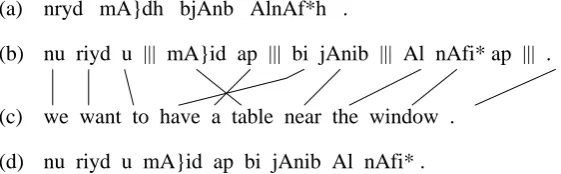
What all the above methodologies do not pro-vide is a means to disambiguate morphologi-cal analysis for machine translation based on the words’ contexts. That is, for an Arabic word anal-ysis of the form prefix*-stem-suffix* a morpheme only is either always retained, always dropped off or always merged to the stem regardless of its surrounding text. In the example in Figure (1), the Arabic word “AlnAfi*h”(“window” in English) was segmented as “Al nAfi* ap”. The morpheme “ap” is removed so that “Al nAfi*” aligned to “the window” of the English sentence. In the sentence “hl ldyk mqAEd bjwAr AlnAf*h ?” (“do you have window tables ?” in English) the word “AlnAfi*h” is also segmented as “Al nAfi* ap”. But in this sentence, morphological preprocessing should re-move both “Al” and “ap” so that only the
nu riyd u ||| mA}id ap ||| bi jAnib ||| Al nAfi* ap ||| .
we want to have a table near the window .
nu riyd u mA}id ap bi jAnib Al nAfi* . nryd mA}dh bjAnb AlnAf*h .
(c) (a)
(b)
(d)
Figure 1: (a) Romanization of original Arabic sentence, (b) Output of morphological analysis toolkit— words are separated by ‘|||’, (c) English translation and its alignment with full morphological analysis (d) Morphological analysis after removing unaligned morphemes.
ing morpheme “nAfi*” aligned to the word “win-dow” of the English translation. Thus an appropri-ate preprocessing technique should be guided by English translation and bring the word context into account.
In this paper we describe a context-based mor-phological analysis for Arabic-English translation that take full account morphemes alignment to En-glish text. The preprocessing uses the Arabic mor-phology disambiguation in (Smith et al., 2005) for full morphological analysis and learns the remov-ing morphemes model based on the Viterbi align-ment of English to full morphological analysis. We tested the model with two training corpora of 5.2 millions Arabic words(177K sentences) in news domain and 159K Arabic words (20K sentences) in travel conversation domain and gain improve-ment over the original Arabic translation in both experiments. The system that trained on a sub-sample corpora of 5 millions sentence pairs cor-pora also showed one BLEU score improvement over the original Arabic system on unseen test set. We will explain our technique in the next section and briefly review the phrase based SMT model in section 3. The experiment results will be presented in section 4.
2 Methodology
We first preprocess the Arabic training corpus and segment words into morpheme sequences of the form prefix* stem suffix*. Stems are verbs, adjec-tives, nouns, pronouns, etc., carrying the content of the sentence. Prefixes and suffixes are func-tional morphemes such as gender and case mark-ers, prepositions, etc. Because case makers do not exist in English, we remove case marker suffixes from the morphology output. The output of this process is a full morphological analysis corpus. Even after removing case markers, the token count
of the full morphology corpus still doubles the original Arabic’s word token count and is approx-imately1.7times the number of tokens of the En-glish corpus. As stated above, using original Ara-bic for translation introduces more unknown words in test data and causes multiple English words to map to one Arabic word. At the morpheme level, an English word would correspond to a morpheme in the full morphology corpus but some prefixes and suffixes in the full morphology corpus may not be aligned with any English words at all. For ex-ample, the Arabic article “Al” (“the” in English) prefixes to both adjectives and nouns, while En-glish has only one determiner in a simple noun phrase. Using the full morphological analysis cor-pus for translation would introduce redundant mor-phemes in the source side.
The goal of our morphological analysis method for machine translation is removing nonaligned prefixes and suffixes from the full morphology cor-pus using a data-driven approach. We use the word alignment output of the full morphology corpus to the English corpus to delete morphemes in a sen-tence. If an affix is not aligned to an English word in the word alignment output, the affix should be removed from the morphology corpus for better one-to-one alignment of source and target corpora. However, given an unseen test sentence, the En-glish translation of the sentence is not available to remove affixes based on the word alignment out-put. We therefore learn a model removing non-aligned morphemes from the full morphology Ara-bic training corpus and its alignment to the English corpus. To obtain consistency between training corpus and test set, we applied the model to both Arabic training corpus and test set, obtaining pre-processed morphology corpora for the translation task.
[image:2.595.154.435.77.164.2]• Apply word segmentation to the Arabic train-ing corpus to get the full morphological anal-ysis corpus.
• Annotate the full morphological analysis cor-pus based on its word alignment to the En-glish training corpus. We tag a morpheme as “Deleted” if it should be removed from the corpus, and “Retained” otherwise.
• Learn the morphology tagger model.
• Apply the model to both Arabic training cor-pus and Arabic test corcor-pus to get prepro-cessed corpus for translation.
2.1 Arabic Word Segmentation
Smith et al. (2005) applies a source-channel model to the problem of morphology disambiguation. The source model is a uniform model that de-fines the set of analyses. For Arabic morphology disambiguation, the source model uses the list of un-weighted word analyses generated by BAMA toolkit (Buckwalter, 2004). The channel model disambiguates the morphology alternatives. It is a log-linear combination of features, which capture the morphemes’ context including tri-gram mor-pheme histories, tri-gram part-of-speech histories and combinations of the two.
The BAMA toolkit and hence (Smith et al., 2005) do not specify if a morpheme is an affix or a stem in the output. Given a segmentation of an original Arabic word, we considered a morpheme ai as a stem if its parts of speech pi is either a noun, pronoun, verb, adjective, question, punctua-tion, number or abbreviation. A morpheme on the left of its word’s stem is a prefix and it is a suffix if otherwise. We removed case marker morphemes and got the full morphology corpus.
2.2 Annotate Morphemes
To extract the Arabic morphemes that align to English text, we use English as the source cor-pus and aligned to Arabic morpheme corcor-pus us-ing GIZA++ (Och and Ney, 2003) toolkit. The IBM3 and IBM4 (Brown et al., 1994) word align-ment models select each word in the source sen-tence, generate fertility and a list of target words that connect to it. This generative process would constrain source words to find alignments in the target sentence. Using English as source corpus, the alignment models force English words to gen-erate their alignments in the Arabic morphemes.
GIZA++ outputs Viterbi alignment for every sen-tence pair in the training corpus as depicted in (b) and (c) of Figure (1). In our experiment, only 5% of English words are not aligned to any Arabic morpheme in the Viterbi alignment. From Viterbi English-morpheme alignment output, we annotate morphemes either to be deleted or retained as fol-lows:
• Annotate stem morphemes as “Retained”(R), in dependant of word alignment output.
• Annotate a prefix or a suffix as “Retained” (R) if it is aligned to an English word.
• Annotate a prefix or a suffix as “Deleted” (D) if it is not aligned to an English word.
Note that the model does not assume that GIZA++ outputs accurate word alignments. We lessen the impact of the GIZA++ errors by only using the word alignment output of prefix and suf-fix morphemes.
Furthermore, because the full morphology sen-tence is longer, each English word could align to a separate morpheme. Our procedure of annotating morphemes also constrains morphemes tagged as “Retained” to be aligned to English words. Thus if we remove “Deleted” morphemes from the mor-phology corpus, the reduced corpus and English corpus have the property of one-to-one mapping we prefer for source-target corpora in machine translation.
2.3 Reduced Morphology Model
The reduced morphology corpus would be the best choice of morphological analysis for machine translation. Because it is impossible to tag mor-phemes of a test sentence without the English ref-erence based on Viterbi word alignment, we need to learn a morpheme tagging model. The model estimates the distributions of tagging sequences given a morphologically analysed sentence using the previous step’s annotated training data.
LetA={(A,T)}be the full morphology train-ing corpus whereA=a1|p1a2|p2 . . . am|pmis a morphology Arabic sentence,aiis a morpheme in the sentence andpiis its POS;T=t1 t2 . . . tmis the tag sequence ofA, eachti is either “Deleted” or “Retained” . The CRF model estimates param-eter θ∗ maximizing the conditional probability of the sequences of tags given the observed data:
θ∗ = argmax
θ
X
(A,T)∈A
(1)
e
p((A,T)) logp T|A, θ
where pe((A,T)) is the empirical distribution of the sentence(A,T)in the training data,θare the model parameters. The model’s log conditional probability logp T|A, θ is the linear combina-tion of feature weights:
logp T|A, θ=X
k
θkfk((Aq,Tq)) (2)
The feature functions{fk}are defined on any sub-set of the sentenceAq ⊂ AandTq ⊂T. CRFs can accommodate many closely related features of the input. In our morpheme tagging model, we use morpheme features, part-of-speech features and combinations of both. The features capture the local contexts of morphemes. The lexical mor-pheme features are the combinations of the current morpheme and up to 2 previous and 2 following morphemes. The part-of-speech features are the combinations of the current part of speech and up to 3 previous part of speeches. The part of speech, morpheme combination features capture the de-pendencies of current morphemes and up to its 3 previous parts of speech.
2.4 Preprocessed Data
Given a full morphology sentence A, we use the morpheme tagging model learnt as described in the previous section to decodeAinto the most proba-ble sequence of tagsT∗=t1t2 . . . tm.
T∗ = argmax
T Pr
T|A, θ∗ (3)
If atiis “Deleted”, the morphemeaiis removed from the morphology sentence A. The same pro-cedure is applied to both training Arabic corpus and test corpus to get preprocessed data for transla-tion. We call a morphology sentence after remov-ing “Deleted” tag a reduced morphology sentence.
In our experiments, we used the freely available CRF++1toolkit to train and decode with the mor-pheme tagging model. The CRF model smoothed the parameters by assigning them Gaussian prior distributions.
3 Phrase-based SMT System
We used the open source Moses (Koehn, 2007) phrase-based MT system to test the impact of the preprocessing technique on translation results. We kept the default parameter settings of Moses for translation model generation. The system used the “grow-diag-final” alignment combination heuris-tic. The phrase table consisted of phrase pairs up to seven words long. The system used a tri-gram lan-guage model built from SRI (Stolcke, 2002) toolkit with modified Kneser-Ney interpolation smooth-ing technique (Chen and Goodman, 1996). By de-fault, the Moses decoder uses 6 tokens distance re-ordering windows.
4 Experiment Results
In this section we present experiment results using our Arabic morphology preprocessing technique.
4.1 Data Sets
We tested our morphology technique on a small data set of 20K sentence pairs and a medium size data set of 177K sentence pairs.
4.1.1 BTEC Data
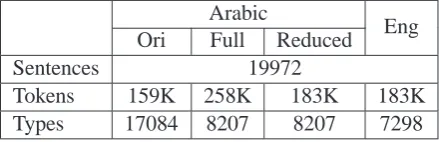
As small training data set we used the BTEC corpus (Takezawa et al., 2002) distributed by the International Workshop on Spoken Language Translation (IWSLT) (Eck and Hori, 2005). The corpus is a collection of conversation transcripts from the travel domain. Table 1 gives some
de-Arabic
Eng Ori Full Reduced
Sentences 19972
[image:4.595.306.526.597.668.2]Tokens 159K 258K 183K 183K Types 17084 8207 8207 7298
Table 1: BTEC corpus statistics
tails for this corpus, which consists of nearly 20K sentence pairs with lower case on the English side. There is an imbalance of word types and word to-kens between original Arabic and English. The
1
original Arabic sentences are on average shorter than the English sentences whereas the Arabic vo-cabulary is more than twice the size of the English vocabulary. The word segmentation reduced the number of word types in the corpus to be closed to English side but also increased word tokens quite substantially. By removing nonaligned mor-phemes, the reduced corpus is well balanced with the English corpus.
[image:5.595.331.497.252.309.2]The BTEC experiments used the 2004 IWSLT Evaluation Test set as development set and 2005 IWSLT Evaluation Test set as unseen test data. Table 2 gives the details of the two test sets. Both of them had 16 reference translations per source sentence. The English side of the training corpus was used to build the language model. To optimize the parameters of the decoder, we performed min-imum error rate training on IWSLT04 optimizing for the IBM-BLEU metric (Papineni et al., 2002).
4.1.2 Newswire Corpora
We also tested the impact of our morphology technique on parallel corpus in the news domain. The corpora were collected from LDC’s full Ara-bic news translation corpora and a small portion of UN data. The details of the data are give in Table 3. The data consists of 177K sentence pairs, 5.2M words on the Arabic and 6M words on the English side.
Arabic
Eng Ori Full Reduced Sentences 177035
Tokens 5.2M 9.3M 6.2M 6.2M
[image:5.595.76.290.519.592.2]Types 155K 47K 47K 68K
Table 3: Newswire corpus statistics
We used two test sets from past NIST evalua-tions as test data. NIST MT03 was used as devel-opment set for optimizing parameters with respect to the IBM-BLEU metric, NIST MT06 was used as unseen test set. Both test sets have 4 references per test sentence. Table 4 describes the data statis-tics of the two test sets. All Newswire translation experiments used the same language model esti-mated from 200 million words collected from the Xinhua section of the GIGA word corpus.
4.2 Translation Results
4.2.1 BTEC
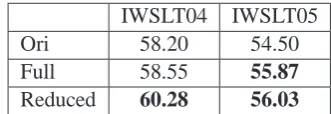
We evaluated the machine translation accord-ing to the case-insensitive BLEU metric. Table 5 shows the BTEC results when translated with de-fault Moses setting of distance-based reordering window size 6. The original Arabic word trans-lation was the baseline of the evaluation. The second row contains translation scores using the full morphology translation. Our new technique of context-based morphological analysis is shown in the last row.
IWSLT04 IWSLT05
Ori 58.20 54.50
Full 58.55 55.87
Reduced 60.28 56.03
Table 5: BTEC translations results on IBM-BLEU metrics(Case insensitive and 6 tokens distance re-ordering window). The boldface marks scores sig-nificantly higher than the original Arabic transla-tion scores.
The full morphology translation performed sim-ilar to the baseline on the development set but outperformed the baseline on the unseen test set. The reduced corpus showed significant improve-ments over the baseline on the development set (IWSLT04) and gave an additional small improve-ment over the full morphology score over the un-seen data (IWSLT05).
So why did the reduced morphology translation not outperform more significantly the full mor-phology translation on unseen set IWSLT05? To analysis this in more detail, we selected good full morphology translations and compared them with the corresponding reduced morphology trans-lations. Figure 2 shows one of these examples. Typically, the reduced morphology translations
Figure 2: An example of BTEC translation output.
sen-IWSLT04 (Dev set) IWSLT05 (Unseen set) Arabic
English Arabic English
Ori Full Reduced Ori Full Reduced
Sentences 500 8000 506 8096
[image:6.595.83.514.74.159.2]Words 3261 5243 3732 64896 3253 5155 3713 66286 Avg Sent Length 6.52 10.48 7.46 8.11 6.43 10.19 7.34 8.18
Table 2: BTEC test set statistics
MT03 (Dev set) MT06 (Unseen set) Arabic
English Arabic English
Ori Full Reduced Ori Full Reduced
Sentences 663 2652 1797 7188
[image:6.595.347.481.321.381.2]Words 16268 27888 18888 79163 41059 71497 48716 222750 Avg Sent Length 24.53 42.06 28.49 29.85 22.85 39.79 27.1 30.98
Table 4: Newswire test set statistics
tence length is slightly higher than the correspond-ing ratio for IWSLT04. Uscorrespond-ing the parameters op-timised for IWSLT04 to translate IWSLT05 sen-tences would generate hypotheses slightly shorter than the IWSLT05 references resulting in brevity penalties in the BLEU metric. The IWSLT05 brevity penalties for original Arabic, reduced mor-phology and full mormor-phology are 0.969, 0.978 and 0.988 respectively. Note that the BTEC corpus and test sets are in the travel conversation domain, the English reference sentences contain a large num-ber of high frequency words. The full morpho-logical analysis with additional prefixes and suf-fixes outputs longer translations containing high frequency words resulting in a high n-gram match and lower BLEU brevity penalty. The reduced translation method could generate translations that are comparable but do not have the same effect on BLEU metrics.
4.2.2 Newswire results
Table 6 presents the translation results for the Newswire corpus. Even though morphology seg-mentation reduced the number of unseen words, the translation results of full morphological anal-ysis are slightly lower than the original Arabic scores in both development set MT03 and unseen test set MT06. This is consistent with the result achieved in previous literature (Sadat and Habash, 2006). Morphology preprocessing only helps with small corpora, but the advantage decreases for larger data sets.
Our context dependent preprocessing technique
MT03 MT06 Ori 45.55 32.09 Full 45.30 31.54 Reduced 47.69 34.13
Table 6: Newswire translation results on IBM-BLEU metrics(Case insensitive and 6 tokens dis-tance reordering wondow). The boldface marks scores significantly higher than the original Arabic translation’s scores.
shows significant improvements on both develop-ment and unseen test sets. Moreover, while the ad-vantage of morphology segmentation diminishes for the full morphology translation, we achieve an improvement of more than two BLEU points over the original Arabic translations in both develop-ment set and unseen test set.
4.3 Unknown Words Reduction
A clear advantage of using morphology based translation over original word translation is the reduction in the number of untranslated words. Table 7 compares the number of unknown Arabic tokens for original Arabic translation and reduced morphology translation. In all the test sets, mor-phology translations reduced the number of un-known tokens by more than a factor of two.
4.4 The Impact of Reordering Distance Limit
mor-Reorder Window 0 2 3 4 5 6 7 8 9
IWSLT04
Ori 57.21 57.92 58.01 58.31 58.16 58.20 58.20 58.12 58.01 Full 56.89 57.54 58.62 58.39 58.32 58.55 58.55 58.55 58.57 Reduced 58.36 59.56 60.05 60.70 60.32 60.28 60.46 60.30 60.55
MT03
[image:7.595.77.520.75.174.2]Ori 41.75 43.84 45.24 45.61 45.40 45.55 45.21 45.22 45.19 Full 41.45 43.12 44.32 44.71 45.30 45.80 45.88 45.82 Reduced 44.08 45.28 46.50 47.40 47.41 47.69 47.59 47.75 47.79
Table 8: The impact of reordering limits on BTEC ’s development set IWSLT04 and Newswire’s devel-opment set MT03. The translation scores are IBM-BLEU metric
[image:7.595.111.256.231.304.2]Test Set Ori Reduced IWSLT04 242 100 IWSLT05 219 97 MT03 1463 553 MT06 3734 1342
Table 7: Unknown tokens count
phemes. The full morphology translation with a 6-word reordering window has the same impact as a 3-word reordering when translating the orig-inal Arabic. To fully benefit from word reorder-ing, the full morphology translation requires a longer reorder distance limit. However, in current phrase based translations, reordering models are not strong enough to guide long distance source-word movements. This shows an additional advan-tage of the nonaligned morpheme removal tech-nique.
We carried out experiments from monotone de-coding up to 9 word distance reordering limit for the two development sets IWSLT04 and MT03. The results are given in Table 8. The BTEC data set does not benefit from a larger reordering win-dow. Using only a 2-word reordering window the score of the original Arabic translations(57.92) was comparable to the best score (58.31) obtained by using a 4-word reordering window. On the other hand, the reordering limit showed a signifi-cant impact on Newswire data. The MT03 original Arabic translation using a 4-word re-ordering win-dow resulted in an improvement of 4 BLEU points over monotone decoding. Large Arabic corpora usually contain data from the news domain. The decoder might not effectively reorder very long distance morphemes for these data sets. This ex-plains why machine translation does not benefit from word-based morphological segmentation for large data sets which adequately cover the
vocabu-lary of the test set.
4.5 Large Training Corpora Results
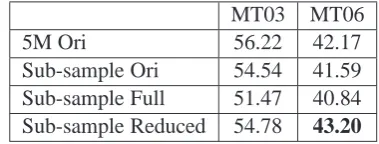
We wanted to test the impact of our preprocess-ing technique on a system trained on 5 million sentence pairs (128 million Arabic words). Un-fortunately, the CRF++ toolkit exceeded memory limits when executed even on a 24GB server. We created smaller corpora by sub-sampling the large corpus for the source side of MT03 and MT06 test sets. The sub-sampled corpus have 500K sen-tence pairs and cover all source phrases of MT03 and MT06 which can be found in the large cor-pus. In these experiments, we used a lexical re-ordering model into translation model. The lan-guage model was the 5-gram SRI lanlan-guage model built from the whole GIGA word corpus. Table 9
MT03 MT06
5M Ori 56.22 42.17
Sub-sample Ori 54.54 41.59 Sub-sample Full 51.47 40.84 Sub-sample Reduced 54.78 43.20
Table 9: Translation results of large corpora(Case insensitive, IBM-BLEU metric). The boldface marks score significantly higher than the original Arabic translation score.
[image:7.595.319.509.479.551.2]5M sentence pairs.
5 Conclusion and Future Work
In this paper, we presented a context-dependent morphology preprocessing technique for Arabic-English translation. The model significantly out-performed the original Arabic systems on small and mid-size corpora and unseen test set on large training corpora. The model treats morphology processing task as a sequence labelling problem. Therefore, other machine learning techniques such as perceptron (Collins, 2002) could also be applied for this problem.
The paper also discussed the relation between the size of the reordering window and morphol-ogy processing. In future investigations, we plan to extend the model such that merging morphemes is included. We also intent to study the impact of phrase length and phrase extraction heuristics.
Acknowledgement
We thank Noah Smith for useful comments and suggestions and providing us with the morphol-ogy disambiguation toolkit. We also thank Sameer Badaskar for help on editing the paper. We also thank anonymous reviewers for helpful comments. The research was supported by the GALE project.
References
Brown, Peter F., Stephen Della Pietra, Vincent J. Della Pietra, and Robert L. Mercer. 1994. The Mathematic of Statisti-cal Machine Translation: Parameter Estimation.
Compu-tational Linguistics, 19(2):263–311.
Buckwalter, T. 2004. Arabic Morphological Analyzer ver-sion 2.0. LDC2004L02.
Chen, Stanley F. and Joshua Goodman. 1996. An Empirical Study of Smoothing Techniques for Language Modeling. In Proceedings of the ACL, pages 310–318.
Collins, Michael. 2002. Discriminative Training Methods for Hidden Markov Models: Theory and Experiments with Perceptron Algorithms. In Proceedings of EMNLP ’02, pages 1–8.
Eck, M. and C. Hori. 2005. Overview of the IWSLT 2005 Evaluation Campaign. In Proceedings of IWSLT, pages 11–17.
Goldwater, Sharon and David Mcclosky. 2005. Improv-ing Statistical MT through Morphological Analysis. In
Proceedings of HLT/EMNLP, pages 676–683, Vancouver,
British Columbia, Canada.
Koehn, et al. 2007. Moses: Open Source Toolkit for Sta-tistical Machine Translation. In Annual Meeting of ACL,
demonstration session.
Lafferty, John, Andrew McCallum, and Fernando Pereira. 2001. Conditional Random Fields: Probabilistic Models for Segmenting and Labeling Sequence Data. In
Proceed-ings of 18th ICML, pages 282–289.
Lee, Young S. 2004. Morphological Analysis for Statistical Machine Translation. In HLT-NAACL 2004: Short Papers, pages 57–60, Boston, Massachusetts, USA.
Nießen, Sonja and Hermann Ney. 2004. Statistical Ma-chine Translation with Scarce Resources Using Morpho-Syntactic Information. Computational Linguistics, 30(2), June.
Och, Franz Josef and Hermann Ney. 2003. A System-atic Comparison of Various Statistical Alignment Models.
Computational Linguistics, 29(1):19–51.
Papineni, Kishore, Salim Roukos, Todd Ward, and Wei-Jing Zhu. 2002. BLEU: a Method for Automatic Evaluation of Machine Translation. In Proceedings of the 40th ACL, pages 311–318, Philadelphia.
Sadat, Fatiha and Nizar Habash. 2006. Combination of Ara-bic Preprocessing Schemes for Statistical Machine Trans-lation. In Proceedings of the ACL, pages 1–8, Sydney, Australia. Association for Computational Linguistics.
Sha, Fei and Fernando Pereira. 2003. Shallow Parsing with Conditional Random Fields. In Proceedings of NAACL
’03, pages 134–141, Morristown, NJ, USA.
Smith, Noah A., David A. Smith, and Roy W. Tromble. 2005. Context-Based Morphological Disambiguation with Ran-dom Fields. In Proceedings of HLT/EMNLP, pages 475– 482, Vancouver, British Columbia, Canada, October. As-sociation for Computational Linguistics.
Stolcke, A. 2002. SRILM – an Extensible Language Model-ing Toolkit. In Intl. Conf. on Spoken Language
Process-ing.
Takezawa, Toshiyuki, Eiichiro Sumita, Fumiaki Sugaya, Hi-rofumi Yamamoto, and Seiichi Yamamoto. 2002. Toward a Broad-Coverage Bilingual Corpus for Speech Transla-tion of Travel ConversaTransla-tions in the Real World. In