WikiRank:Improving Keyphrase Extraction Based on Background Knowledge
Yang Yu, Vincent Ng
Human Language Technology Research Institute University of Texas at Dallas
{yangyu,vince}@hlt.utdallas.edu
Abstract
Keyphrase is an efficient representation of the main idea of documents. While background knowledge can provide valuable information about documents, they are rarely incorporated in keyphrase extraction methods. In this paper, we propose WikiRank, an unsupervised
method for keyphrase extraction based on the background knowledge from Wikipedia. Firstly, we construct a semantic graph
for the document. Then we transform the keyphrase extraction problem into an optimization problem on the graph. Finally, we get the optimal keyphrase set to be the output. Our method obtains improvements over other state-of-art models by more than 2% in F1-score.
Keywords:Keyphrase Extraction, Knowledge Graph, Semantic Graph
1.
Introduction
As the amount of published material rapidly increases, the problem of managing information becomes more difficult. Keyphrase, as a concise representation of the main idea of the text, facilitates the management, categorization, and retrieval of information. Automatic keyphrase extraction concerns “the automatic selection of important and topical phrases from the body of a document”. Its goal is to extract a set of phrases that are related to the main topics discussed in a given document(Hasan and Ng, 2014).
Existing methods of keyphrase extraction could be divided into two categories: supervised and unsupervised. While supervised approaches require human labeling, at the same time needs various kinds of training data to get better gen-eralization performance, more and more researchers focus on unsupervised methods.
Traditional methods of unsupervised keyphrase extraction mostly focus on getting information of document from word frequency and document structure(Hasan and Ng, 2014), however, after years of attempting, the performance
seems very hard to be improved any more. Based on
this observation, it is reasonable to suspect that the docu-ment itself possibly cannot provide enough information for keyphrase extraction task.
To get good coverage of the main topics of the document, Topical PageRank (Liu et al., 2010) started to adopt topical information in automatic keyphrase extraction. The main idea of Topical PageRank is to extract the top topics of the document using LDA, then sum over the scores of a can-didate phrase under each topic to be the final score. The main problems with Topical PageRank are: First, The top-ics are too general. Second, since they are using LDA, they only classify the words to several topics, but don’t know what the topics exactly are. However, the topical informa-tion we need for keyphrase extracinforma-tion should be precise. As shown in Figure 1, the difference between a correct keyphrasesheep diseaseand an incorrect keyphrase incur-able diseasecould be small, which is hard to be captured by rough topical categorization approach.
To overcome the limitations of aforementioned ap-proaches, we propose WikiRank, an unsupervised
auto-matic keyphrase extraction approach that links semantic meaning to text
The key contribution of this paper could be summarized as follows:
1. We leverage the topical information in knowledge bases to improve the performance of keyphrase extrac-tion.
2. We model the keyphrase extraction as an optimization problem, and provide the corresponding solution as well as a pruning approach to reduce the complexity.
2.
Existing Error Illustration with Example
Figure 1 shows part of an example document1. In this fig-ure, the gold keyphrases are marked with bold, and the keyphrases extracted by the TextRank system are marked with parentheses. We are going to illustrate the errors exist in most of present keyphrase extraction systems using this example.
Overgeneration errorsoccur when a system correctly pre-dicts a candidate as a keyphrase because it contains a word that frequently appears in the associated document, but at the same time erroneously outputs other candidates as keyphrases because they contain the same word(Hasan and Ng, 2014). It is not easy to reject a non-keyphrase contain-ing a word with a high term frequency: many unsupervised systems score a candidate by summing the score of each of its component words, and many supervised systems use unigrams as features to represent a candidate. To be more concrete, consider the news article in Figure 1. The word Cattle has a significant presence in the document. Conse-quently, the system not only correctly predictBritish cattle
as a keyphrase, but also erroneously predictcattle industry,
cattle feed, andcattle brain as keyphrases, yielding over-generation errors.
1
Document from DUC-2001 DatasetAP900322-0200
Govern-ment Boosts Spending to Combat Cattle Plague
2Prefix “wiki” represents the namespace
(
wiki:Bovine spongiform encephalopathy Mad cow disease) has
wiki:Death
killed 10,000
wiki:Cattle
cattle , restricted the
wiki:Export
disease poses only a remote
wiki:Risk
risk to human
wiki:Health
health , but
wiki:Scientist
scientists still aren’t certain what
wiki:Causality
causes the disease or h
wiki:Transmission (medicine)
ow it is transmitted
wiki:Bovine spongiform encephalopathy
. . . (Mad cow disease) , or
wiki:Bovine spongiform encephalopathy
Bovine Spongiform Encephalopathy, or
wiki:Bovine spongiform encephalopathy
BSE, was diagnosed only in 1986. The
wiki:Symptom
symptoms are very much like
wiki:Scrapie scrapie, a
(
wiki:Sheep
sheep disease) which has been in
wiki:Great Britain
Britain since the 1700s. The (
wiki:Cure
incurable disease)
wiki:Cannibalism
eats holes in the
wiki:Human Brain
brains of its victims;
in late stag
wiki:Disease
es a sick
wiki:Animal
animal may act skittish or stagger drunkenly . . . The
wiki:Government government
wiki:Ban (law)
banned the use of sheep
wiki:Offal
offal in
(cattle feed) in June 1988, and later banned the use of (cattle
wiki:Brain
cattle) older than 6 months
wiki:Bovine spongiform encephalopathy
. . . has complained of “BSE
wiki:Mass hysteria
hysteria” in the
wiki:Mass media
media and has insisted that the
wiki:Risk
Creutzfeldt Jakob disease). About two dozen cases were reporte
wiki:Great Britain
d in (Britain
last year).
Figure 1: Part of the Sample Document2
Bold: Gold Keyphrase In parentheses: Keyphrase generated by TextRank algorithm Underlined: Keyphrase annotated to Wikipedia Entity by TagMe
Redundancy errorsoccur when a system correctly iden-tifies a candidate as a keyphrase, but at the same time out-puts a semantically equivalent candidate (e.g., its alias) as a keyphrase. This type of error can be attributed to the failure of a system to determine that two candidates are semanti-cally equivalent. Nevertheless, some researchers may argue that a system should not be penalized for redundancy errors because the extracted candidates are in fact keyphrases. In our example, bovine spongiform encephalopathyand bse
refer to the same concept. If a system predicts both of them as keyphrases, it commits a redundancy error.
Infrequency errorsoccur when a system fails to identify a keyphrase owing to its infrequent presence in the associ-ated document. Handling infrequency errors is a challenge because state-of-the-art keyphrase extractors rarely predict candidates that appear only once or twice in a document. In theMad cow diseaseexample, the keyphrase extractor fails to identifyexportandscrapieas keyphrases, resulting in infrequency errors.
3.
Proposed Model
The WikiRank algorithm includes three steps: (1) Con-struct the semantic graph including concepts and candidate keyphrases; (2)(optional) Prune the graph with heuristic to filter out candidates which are likely to be erroneously pro-duced; (3) Generate the best set of keyphrases as output.
3.1.
Graph Construction
3.1.1. Automatic Concept Annotation
This is one of the crucial steps in our paper that connects the plain text with human knowledge, facilitating the un-derstanding of semantics. In this step, we adopt TAGME
(Ferragina and Scaiella, 2010) to obtain the underlying con-cepts in documents.
TAGMEis a powerful topic annotator. It identifies mean-ingful sequences of words in a short text and link them to
a pertinent Wikipedia page, as shown in Figure 1. These links add a new topical dimension to the text that enable us to relate, classify or cluster short texts.
3.1.2. Lexical Unit Selection
This step is to filter out unnecessary word tokens from the input document and generate a list of potential keywords using heuristics. As reported in (Hulth, 2003), most man-ually assigned keyphrases turn out to be noun groups. We follow (Wan and Xiao, 2008a) and select candidates lexi-cal unit with the following Penn Treebank tags: NN, NNS, NNP, NNPS, and JJ, which are obtained using the Stan-ford POS tagger (Toutanova et al., 2003), and then extract the noun groups whose pattern is zero or more adjectives followed by one or more nouns. The pattern can be repre-sented using regular expressions as follows
(J J)∗(N N|N N S|N N P|N N P S)+
where JJ indicates adjectives and various forms of nouns are represented using NN, NNS and NNP .
3.1.3. Graph building
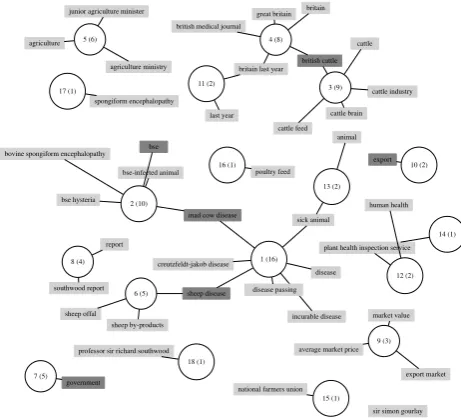
We build a semantic graphG= [V;E]in which the set of vertices V is the union of the concept setC and the can-didate keyphrase set P—i.e., V = P ∪C. In the graph, each unique conceptc∈Cor candidate keyphrasep∈P
average market price
plant health inspection service 14 (1)
junior agriculture minister britain
4 (8)
professor sir richard southwood 18 (1) british medical journal
7 (5) government
cattle brain agriculture ministry britain last year
animal
Figure 2: Part of the Semantic Graph of the Sample Document
Circle: Concept Rectangle: Candidate Keyphrase
Dark Rectangle: Gold Keyphrase
# Concept Frequency
1 Disease 16
2 Bovine spongiform encephalopathy 10
3 Cattle 9
4 Great Britain 8
5 United States Department 6
of Agriculture
6 Sheep 5
7 Government 5
8 Report 4
9 Market (economics) 3
10 Export 2
11 Last year 2
12 Health 2
13 Animal 2
14 Animal and Plant Health 1
Inspection Service
15 National Farmers Union 1
of England and Wales
16 Poultry feed 1
17 Transmissible spongiform 1
encephalopathy
18 Professor 1
Table 1: Part of the Concepts Annotated from the Sample Document
3.2.
WikiRank
3.2.1. Optimization Problem
According to (Liu et al., 2010), good keyphrases should be relevant to the major topics of the given document, at the same time should also have good coverage of the major top-ics of the document. Since we represent the topical infor-mation with concepts annotated withTAGME, the goal of our approach is to find the setΩconsisting ofkkeyphrases,
to cover concepts (1) as important as possible (2) as much as possible.
Letwc denote the weight of conceptc ∈C. We compute
wc as the frequencycexists in the whole documentd. To quantify how good the coverage of a keyphrase setΩis, we compute the overall score of the concepts thatΩcontains. Consider a subgraph of G, Gsub, which captures all the concepts connected toΩ. InGsub, the set of verticesVsub is the union of the candidate keyphrase set Ω, and the set
AdjΩof concepts that nodes in Ωconnect to. The set of
edgesEsubofGsubis constructed with the edges connect nodes inΩwith nodes inAdjΩ.
We set up the score of a conceptcin the subgraphGsubas following:
where wc is the weight of c as we defined before, and
deg(c)is the degree ofcin the subgraphGsub. Essentially,
deg(c)is equal to the frequency that conceptcis annotated in the keyphrase setΩ.
The optimization problem is defined as:
max
The goal of the optimization problem is to find the candi-date keyphrase setΩ, such that the sum of the scores of the concepts annotated from the phrases inΩis maximized.
3.2.2. Algorithm
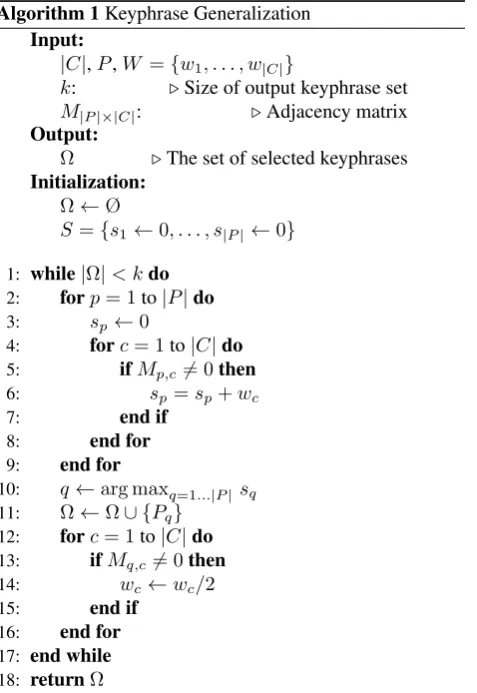
We propose an algorithm to solve the optimization problem, as shown in Algorithm 1. In each iteration, we compute the scoresp for all candidate keyphrasesp∈ |P|and include thepwith highest score intoΩ, in whichsp evaluates the score of concepts added to the new setΩby addingpinto
Ω.
3.3.
Approximation Approach with Pre-pruning
In practice, computing score for all the candidate
keyphrases is not always necessary, because some of the candidates are very unlikely to be gold keyphrase that we can remove them from our graph before applying the algo-rithm to reduce the complexity.
In this section, we introduce three heuristic pruning steps that significantly reduces the complexity of the optimiza-tion problem without reducing much of the accuracy.
Step 1. Remove the candidate keyphrasepfrom original graphG, if it is not connected to any concept.
The intuition behind this heuristic is straightforward. Since our objective function is constructed over concepts, if a can-didate keyphrasepdoesn’t contain any concept, adding it to
Ωdoesn’t bring any improvement to the objective function, so pis irrelevant to our optimization process. Pruning p
DUC Inspec ICSI Nus
P R F score P R F score P R F score P R F score
SingleRank 26.21 24.45 25.30 25.21 24.10 24.64 3.42 2.49 2.88 0.23 0.98 0.37
Topical PageRank 27.33 23.92 25.51 25.58 24.31 24.93 3.98 2.68 3.20 0.64 1.38 0.87
Our System 28.72 26.44 27.53 28.14 25.97 27.01 4.71 3.96 4.30 7.27 12.16 9.10
Table 2: The Result of our System as well as the Reimplementation of SingleRank and Topical PageRank on four Corpora
Algorithm 1Keyphrase Generalization
Input:
|C|,P,W ={w1, . . . , w|C|}
k: .Size of output keyphrase set
M|P|×|C|: .Adjacency matrix
Output:
Ω .The set of selected keyphrases
Initialization: Ω←Ø
S={s1←0, . . . , s|P|←0}
1: while|Ω|< kdo
2: forp= 1to|P|do
3: sp ←0
4: forc= 1to|C|do
5: ifMp,c6= 0then
6: sp=sp+wc
7: end if
8: end for
9: end for
10: q←arg maxq=1...|P|sq
11: Ω←Ω∪ {Pq}
12: forc= 1to|C|do
13: ifMq,c6= 0then
14: wc←wc/2
15: end if
16: end for
17: end while
18: returnΩ
Step 2. Remove the candidate keyphrasepfrom original graphG, if it is only connected to one concept that only exists once in the document
If a candidate keyphrase contains fewer concepts, or the concepts connects to it barely exist in the document, we think this candidate keyphrase contributes less valuable in-formation to the document. In practice, there are numerous
(c, p)pairs in graphGthat is isolated from the center of the graph. We believe they are irrelevant to the major topic of the document.
Step 3. For a concept c connecting to more than m
candidate keyphrases, remove any candidate keyphrase
p ∈ Adj(c)which(1)Does not connect to any other con-cept. AND (2)The ranking is lower than mth among all candidate keyphrases connect toc.(In practice,mis usu-ally 3 or 4.)
According to equation 1, if there are alreadyminstances of conceptcin theGsub, adding them+ 1th instance ofcwill only contribute wc
2m toS(c). At the same time, among all
the candidate keyphrases connected to conceptc, our
opti-mization process always chooses the ones that connect to other concepts as well over the ones that do not connect to any other concept. Combining these two logic, a candidate satisfying the constrains of Step 3 is not likely to be picked in the best keyphrase setΩ, so we can prune it before the optimalization process.
4.
Experiments and Results
4.1.
Corpora
The DUC-2001 dataset (Over, 2001), which is a collec-tion of 308 news articles, is annotated by (Wan and Xiao, 2008b).
TheInspecdataset is a collection of 2,000 abstracts from journal papers including the paper title. This is a relatively popular dataset for automatic keyphrase extraction, as it was first used by (Hulth, 2003) and later by Mihalcea and (Mihalcea and Tarau, 2004) and (Liu et al., 2009).
TheNUS Keyphrase Corpus(Nguyen and Kan, 2007) in-cludes 211 scientific conference papers with lengths be-tween 4 to 12 pages. Each paper has one or more sets of keyphrases assigned by its authors and other annotators. The number of candidate keyphrases that can be extracted is potentially large, making this corpus the most challeng-ing of the four.
Finally, the ICSI Meeting Corpus (Janin et al., 2003), which is annotated by Liu et al. (2009a), includes 161 meet-ing transcriptions. Unlike the other three datasets, the gold standard keys for the ICSI corpus are mostly unigrams.
4.2.
Result
For comparing with our system, we reimplemented Sin-gleRank and Topical PageRank. Table 2 shows the result of our reimplementation of SingleRank and Topical PageR-ank, as well as the result of our system. Note that we pre-dict the same number of phrase (k= 10) for each document while testing all three methods.
The result shows our result has guaranteed improvement over SingleRank and Topical PageRank on all four corpora.
5.
Conclusion and Future Work
We proposed an unsupervised graph-based keyphrase ex-traction method WikiRank. This method connects the text with concepts in Wikipedia, thus incorporate the back-ground information into the semantic graph and finally construct a set of keyphrase that has optimal coverage of the concepts of the document. Experiment results show the method outperforms two related keyphrase extraction methods.
task. Introducing the results of dependency parsing or se-mantic parsing (e.g., OntoUSP) in intermediate steps could be helpful.
6.
Bibliographical References
Ferragina, P. and Scaiella, U. (2010). Tagme: On-the-fly annotation of short text fragments (by wikipedia en-tities). In Proceedings of the 19th ACM International Conference on Information and Knowledge
Manage-ment, CIKM ’10, pages 1625–1628, New York, NY,
USA. ACM.
Hasan, K. S. and Ng, V. (2014). Automatic keyphrase ex-traction: A survey of the state of the art. InProceedings of the 52nd Annual Meeting of the Association for Com-putational Linguistics (Volume 1: Long Papers), pages 1262–1273, Baltimore, Maryland, June. Association for Computational Linguistics.
Hulth, A. (2003). Improved automatic keyword extrac-tion given more linguistic knowledge. In Proceedings of the 2003 Conference on Empirical Methods in Natu-ral Language Processing, EMNLP ’03, pages 216–223, Stroudsburg, PA, USA. Association for Computational Linguistics.
Liu, Z., Li, P., Zheng, Y., and Sun, M. (2009). Cluster-ing to find exemplar terms for keyphrase extraction. In
Proceedings of the 2009 Conference on Empirical Meth-ods in Natural Language Processing: Volume 1 - Volume 1, EMNLP ’09, pages 257–266, Stroudsburg, PA, USA. Association for Computational Linguistics.
Liu, Z., Huang, W., Zheng, Y., and Sun, M. (2010). Auto-matic keyphrase extraction via topic decomposition. In
Proceedings of the 2010 Conference on Empirical Meth-ods in Natural Language Processing, EMNLP ’10, pages 366–376, Stroudsburg, PA, USA. Association for Com-putational Linguistics.
Mihalcea, R. and Tarau, P. (2004). Textrank: Bringing or-der into texts. InProceedings of Empirical Methods for Natural Language Processing, pages 404–411.
Nguyen, T. D. and Kan, M.-Y. (2007). Keyphrase ex-traction in scientific publications. In Proceedings of the 10th International Conference on Asian Digital Li-braries: Looking Back 10 Years and Forging New Fron-tiers, ICADL’07, pages 317–326, Berlin, Heidelberg. Springer-Verlag.
Over, P. (2001). Introduction to DUC-2001: An intrinsic evaluation of generic news text summarization systems. In Proceedings of the 2001 Document Understanding Conference.
Toutanova, K., Klein, D., Manning, C. D., and Singer, Y. (2003). Feature-rich part-of-speech tagging with a cyclic dependency network. InProceedings of the 2003 Con-ference of the North American Chapter of the Associa-tion for ComputaAssocia-tional Linguistics on Human Language Technology - Volume 1, NAACL ’03, pages 173–180, Stroudsburg, PA, USA. Association for Computational Linguistics.
Wan, X. and Xiao, J. (2008a). Collabrank: Towards a collaborative approach to single-document keyphrase ex-traction. InProceedings of the 22Nd International Con-ference on Computational Linguistics - Volume 1,
COL-ING ’08, pages 969–976, Stroudsburg, PA, USA. Asso-ciation for Computational Linguistics.