Balancing Expressiveness and Simplicity
in an Interlingua for Task Based Dialogue
Lori Levin, Donna Gates, Dorcas Wallace,
Kay Peterson, Alon Lavie
Language Technologies Institute
Carnegie Mellon University
Pittsburgh, PA 15213
email:
[email protected]
Fabio Pianesi, Emanuele Pianta,
Roldano Cattoni, Nadia Mana
IRST-itc, Italy
Abstract
In this paper we compare two interlin-gua representations for speech transla-tion. The basis of this paper is a distri-butional analysis of theC-starII and Nespoledatabases tagged with inter-lingua representations. TheC-starII database has been partially re-tagged with the Nespole interlingua, which enables us to make comparisons on the same data with two types of interlin-guas and on two types of data ( C-star II and Nespole) with the same interlingua. The distributional infor-mation presented in this paper show that the Nespole interlingua main-tains the language-independence and simplicity of theC-starII speech-act-based approach, while increasing se-mantic expressiveness and scalability.
1
Introduction
Several speech translation projects have chosen interlingua-based approaches because of its con-venience (especially in adding new languages) in multi-lingual projects. However, interlingua design is notoriously difficult and inexact. The main challenge is deciding on the grain size of meaning to represent and what facets of mean-ing to include. This may depend on the do-main and the contexts in which the translation system is used. For projects that take place at multiple research sites, another factor becomes important in interlingua design: if the interlin-gua is too complex, it cannot be used reliably by
researchers at remote sites. Furthermore, the in-terlingua should not be biased toward one fam-ily of languages. Finally, an interlingua should clearly distinguish general and domain specific components for easy scalability and portability between domains.
Sections 2 and 3 describe how we balanced the factors of grain-size, language independence, and simplicity in two interlinguas for speech translation projects — the C-star II Inter-change Format (Levin et al., 1998) and the Ne-spole Interchange Format. Both interlinguas are based in the framework of domain actions as described in (Levin et al., 1998). We will show that the Nespole interlingua has a finer grain-size of meaning, but is still simple enough for collaboration across multiple research sites, and still maintains language-independence.
Section 4 will address the issue of scalabil-ity of interlinguas based on domain actions to larger domains. The basis of Section 4 is a dis-tributional analysis of the C-star II and Ne-spole databases tagged with interlingua repre-sentations. The C-star II database has been partially re-tagged with the Nespole interlin-gua, which enables us to make comparisons on the same data with two types of interlinguas and on two types of data (C-star II andNespole) with the same type of interlingua.
2
The
C-star
II Domain, Database,
and Interlingua
there’s a three fifty nine flight that arrives at four fifty eight ...
what time would you like to go
c: I would take the last one that you mentioned ...
a: what credit card number would you like to reserve this with
c: I have a visa card
and the number is double oh five three three one one six
ninety nine eighty seven a okay
c: the expiration date is eleven ninety seven ...
a okay they should be ready tomorrow c: okay thank you very much
Figure 1: Excerpt from aC-starII dialogue
with six participating research sites. The seman-tic domain was travel, including reservations and payments for hotels, tours, and transporta-tion. Figure 1 shows a sample dialogue from the C-star II database. (C is the client and a is the travel agent.) The C-star II database contains 2278 English sentences and 7148 non-English (Japanese, Italian, Korean) sentences tagged with interlingua representations. Most of the database consists of transcripts of role-playing conversations.
The driving concept behind the C-star II interlingua is that there are a limited num-ber of actions in the domain — requesting the price of a room, telling the price of a room, requesting the time of a flight, giving a credit card number, etc. — and that each utter-ance can be classified as an instutter-ance of one of these domain actions. Figure 2 illustrates the components of the C-star II interlingua: (1) the speaker tag, in this case c for client, (2) a speech act (request-action), (3) a list of concepts (reservation, temporal, hotel), (4) arguments (e.g.,time), and (5) values of ar-guments. The C-star II interlingua specifica-tion document contains definispecifica-tions for 44 speech acts, 93 concepts, and 117 argument names. The domain action is the part of the interlin-gua consisting of the speech act and concepts, in
clude the list of argument-value pairs.
First it is important to point out that main actions are created compositionally. A do-main action consists of a speech act followed by zero or more concepts. (Recall that argument-value pairs are not part of the domain action.) The Nespole interlingua includes 65 speech acts and 110 concepts. An interlingua specifi-cation document defines the legal combinations of speech acts and arguments.
The linguistic justification for an interlingua based on domain-actions is that many travel do-main utterances contain fixed, formulaic phrases (e.g., can you tell me; I was wondering; how about; would you mind, etc.) that signal domain actions, but either do not translate literally into other languages or have a meaning that is suffi-ciently indirect that the literal meaning is irrele-vant for translation. To take two examples,how about as a signal of a suggestion does not trans-late into other languages with the words corre-sponding to how and about. Also, would you mind might translate literally into some Euro-pean languages as a way of signaling a request, but the literal meaning of minding is not rel-evant to the translation, only the fact that it signals politeness.
The measure of success for the domain-action based interlingua (as described in (Levin et al., 2000a)) is that (1) it covers the data in the C-starII database with less than 8% no-tag rate, (2) inter-coder agreement across research sites is reasonably high: 82% for speech acts, 88% for concepts, and 65% for domain actions, and (3) end-to-end translation results using an an-alyzer and generator written at different sites were about the same as end-to-end translation results using an analyzer and generator written at the same site.
3
The
Nespole
Domain, Database,
and Interlingua
Fig-I would like to make a hotel reservation for the fourth through the seventh of july
c:request-action+reservation+temporal+hotel (time=(start-time=md4, end-time=(md7, july)))
Figure 2: Example of a C-star II interlingua representation
ure 3 shows a Nespole dialogue. The Ne-spoledomain does not include reservations and payments, but includes more detailed inquiries about hotels and facilities for ski vacations and summer vacations in Val di Fiemme, Italy. (The tourism board of the Trentino area is a partner of theNespole project.) Most of the database consists of transcripts of dialogues between an Italian-speaking travel agent and an English or German speaker playing the role of a traveller.
There are fewer fixed, formulaic phrases in the Nespoledomain, prompting us to move toward domain actions that are more general, and also requiring more detailed interlingua representa-tions. Changes from the C-star II interlingua fall into several categories:
1. Extending semantic expressivity and syntactic coverage: Increased coverage of modality, tense, aspect, articles, fragments, coordinate structures, number, and rhetor-ical relations. In addition, we have added more explicit representation of grammati-cal relations and improved capabilities for representing modification and embedding.
2. Additional Domain-Specific Con-cepts: New concepts include giving directions, describing sizes and dimensions of objects, traveling routes, equipment and gear, airports, tourist services, facilities, vehicles, information objects (brochures, web pages, rules and regulations), hours of operation of businesses and attractions, etc.
3. Utterances that accompany multi-modal gestures: The Nespole system includes capabilities to share web pages and draw marks such as circles and arrows
on web pages. The interlingua was ex-tended to cover colord, descriptions of two-dimensional objects, and actions of show-ing.
4. General concept names from Word-Net: The Nespole interlingua includes conventions for making new concept names based on WordNet synsets.
5. More general domain actions replac-ing specific ones: For example, replacing
hotelwithaccommodation.
Interlinguas based on domain actions con-trast with interlinguas based on lexical seman-tics (Dorr, 1993; Lee et al., 2001; Goodman and Nirenburg, 1991). A lexical-semantic interlingua includes a representation of predicates and their arguments. For example, the sentenceI want to take a vacation has a predicate want with two arguments I and to take a vacation, which in turn has a predicate take and two arguments,I and a vacation. Of course, predicates like take may be represented as word senses that are less language-dependent likeparticipate-in. The strength and weakness of the lexical-semantic approach is that it is less domain dependent than the domain-action approach.
and I wanted to ask what would be the best way for me to get there
a: okay I’m gonna show you a map that and then describe the directions to you okay so right so you will arrive in the train station in Trento
the that is shown in the middle of the map stazione FFSS and just below that here is a bus stop labeled number forty so okay on the map that I’m showing you here
the hotel is the orange building off on the right hand side ...
c: I also wanted to ask about skiing in the area once I’m in Panchia a: all right just a moment and I’ll show you another map
c: okay
a: okay so on the map you see now Panchia is right in the center of the map c: I see it
Figure 3: Excerpt from a Nespole dialogue
represented as adverbs or suffixes on verbs. Fig-ure 4 shows the Nespole interlingua represen-tation corresponding to the C-star II interlin-gua in Figure 2. The specification document for theNespoleinterlingua defines 65 speech acts, 110 concepts, 292 arguments, and 7827 values grouped into 222 value classes. As in the C-star II interlingua, domain actions are defined compositionally from speech acts and arguments in combinations that are allowed by the interlin-gua specification.
3.1 Comparison of Nespole and C-star II Interlinguas
It is useful to compare the Nespole and C-starII Interlinguas in expressivity, language in-dependence, and simplicity.
Expressivity of the Nespole interlingua,
Argument 1: The metric we use for expres-sivity is the no-tag rate in the databases. The no-tag rate is the percentage of sentences that cannot be assigned an interlingua representation by a human expert. The C-star II database tagged with C-star II interlingua had a no-tag rate of 7.3% (Levin et al., 2000a). The C-star II database tagged with Nespole in-terlingua has a no-tag rate of 2.4%. More than 300 English sentences in theC-starII database that were not covered by theC-starII interlin-gua are now covered by the Nespole interlin-gua. (See Table 2.) We conclude from this that
the Nespole interlingua is more expressive in that it covers more data.
Language-independence of the Nespole
interlingua: We do not have a numerical measure of language-independence, but we note that interlinguas based on domain actions are particularly suitable for avoiding translation mismatches (Dorr, 1994), particularly head-switching mismatches (e.g., I just arrived and Je vient d’arriver where the meaning of recent past is expressed by an adverb just or a syn-tactic verb vient (venir).) Interlinguas based on domain actions resolve head-switching mis-matches by identifying the types of meanings that are often involved in mismatches — modal-ity, evidentialmodal-ity, disposition, and so on — and assigning them a representation that abstracts away from predicate argument structure. In-terlinguas based on domain actions also neu-tralize the different ways of expressing indirect speech acts within and across languages (for ex-ample, Would you mind..., I was wondering if you could...., andPlease.... as ways of request-ing an action). AlthoughNespole domain ac-tions are more general than C-star II domain actions, they maintain language independence by abstracting away from predicate-argument structure.
Simplicity and cross-site reliability of the
I would like to make a hotel reservation for the fourth through the seventh of july
C-star II Interlingua:
c:request-action+reservation+temporal+hotel (time=(start-time=md4, end-time=(md7, july)))
Nespole Interlingua:
c:give-information+disposition+reservation+accommodation (disposition=(who=i, desire),
reservation-spec=(reservation, identifiability=no), accommodation-spec=hotel,
object-time=(start-time=(md=4), end-time=(md=7, month=7, incl-excl=inclusive)))}
Figure 4: Example of Nespole interlingua representation
inter-coder agreement and end-to-end transla-tion performance. At the time of writing this pa-per we have not conducted cross-site inter-coder agreement experiments using the Nespole in-terlingua. We have, however, conducted cross-site evaluations (Lavie et al., 2002), in which the analyzer and generator were written at differ-ent sites. Experimdiffer-ents at the end of C-star II showed that cross-site evaluations were compa-rable to intra-site evaluations (analyzer and gen-erator written at the same site) (Levin et al., 2000b). Nespoleevaluations so far show a loss of cross-site reliability: intra-site evaluations are noticeably better than cross-site evaluations, as reported in (Lavie et al., 2002). This seems to indicate that developers at different sites have a lower level of agreement on the Nespole in-terlingua. However there are other possible ex-planations for the discrepancy — for example developers at different sites may have focused their development on different sub-domains — that are currently under investigation.
4
Scalability of the
Nespole
Interlingua
The rest of this paper addresses the scalability of the Nespole interlingua. A possible criti-cism of domain actions is that they are domain dependent and that the number of domain ac-tions might increase too quickly with the size of the domain. In this section, we will examine
the rate of increase in the number of domain ac-tions as a function of the amount of data and the diversity of the data.
Differences in theC-starandNespole
Do-mains: We will first show that the C-star andNespoledomains are significantly different even though they both pertain to travel. The combination of the two domains is therefore sig-nificantly larger than either domain alone.
In order to demonstrate the differences be-tween the C-star travel domain and the Ne-spole travel domain, we measured the overlap in vocabulary. The numbers in Table 4 are based on the first 7900 word tokens in theC-star En-glish database and the first 7900 word tokens in the Nespole English database. The table shows the number of unique word types in each database, the number of word types that occur in both databases, and the number of word types that occur in one of the databases, but not in the other. In each database, about half of the word types overlap with the other database. The non-overlapping vocabulary (402C-starword types and 344Nespoleword types) indicates that the two databases cover quite different aspects of the travel domain.
Nespole English 687
Word types in both CSTAR and Nespole 343
Words types in CSTAR not in Nespole 402
[image:6.612.74.494.73.156.2]Words types n Nespole not in CSTAR 344
Table 1: Number of overlapping word types in the C-starEnglish and NespoleEnglish
databases
SA Con. Snts. Domain Ac-tions
Old C-star English 44 93 2278 358
New C-star English 65 110 2564 452 Nespole English 65 110 1446 337
Nespole German 65 110 3298 427
Nespole Italian 65 110 1063 206
Table 2: Number of unique domain actions in interlingua databases
speech acts and concepts in the combined C-star/Nespole domain. The C-star II in-terlingua, designed for coverage of the C-star travel domain, included 44 speech acts and 93 concepts. The Nespole interlingua, designed for coverage of the combined C-star and Ne-spoledomains, has 65 speech acts and 110 con-cepts. Thus a relatively small increase in the number of speech acts and concepts is required to cover a significantly larger domain.
The increased size of the C-star/Nepsole domain is reflected in the number of arguments and values. TheC-starII interlingua contained definitions for 117 arguments, whereas the Ne-spoleinterlingua contains definitions for 292 ar-guments. The number of values for arguments also has increased significantly in theNespole domain. There are 7827 values grouped into 222 classes (airport names, days of the week, etc.).
Distributional Data: number of domain actions in each database: Next we will present distributional data concerning the num-ber of domain actions as a function of database size. We will compare several databases: Old C-star English (around 2278 sentences tagged with C-star II interlingua), New C-star En-glish (2564 sentences tagged with Nespole in-terlingua, including the 2278 sentences from Old
C-star English), Nespole English, Nespole German, and Nespole Italian. Table 2 shows the number of sentences and the number of do-main actions in each database. The number of domain actions refers to the number of types, not tokens, of domain actions.
Distributional data: Coverage of the top 50 domain actions: Table 3 shows the per-centage of each database that is covered by the 5, 10, 20, and 50 most frequent domain actions in that database. For each database, the do-main actions were ordered by frequency. The percentage of sentences covered by the top-n domain actions was then calculated. For this experiment, we separated sentences spoken by the traveller (client) and sentences spoken by the travel agent (agent). C-star data in Ta-ble 3 refers to 2564 English sentences from the C-star database that were tagged with Ne-spole interlingua. Nespole data refers to the English portion of theNespoledatabase (1446 sentences). Combined data refers to the combi-nation of the two (4014 sentences).
Domain Actions Top 5 Top 10 Top 20 Top 50 Client
C-star data 33.6 42.7 53.1 66.7 Nespole data 31.7 43.5 53.9 66.5
Combined data 31.6 40.0 50.3 62.9
Agent
C-star data 33.8 42.8 54.1 67.3 Nespole data 39.0 47.8 56.1 71.4
[image:7.612.160.454.71.201.2]Combined data 33.6 41.5 51.7 64.0
Table 3: DA Coverage usingNespole interlingua on English data for both C-star and Nespole
only a small amount of English agent data and it was spoken by non-native speakers. Second, the combined data has a slightly lower cover-age rate than either the C-star or Nespole databases alone. This is expected because, as shown above, the combined domain is signifi-cantly more diverse than either domain by itself.
Scalability: Argument 2: Table 3 provides additional evidence for the scalability of the Ne-spole interlingua to larger domains. In the combined C-star and Nespole domain, the top 50 domain actions cover only slightly less data than the top 50 domain actions in either domain separately. There is not, in fact, an ex-plosion of domain actions when the twoC-star and Nespoledomains are combined.
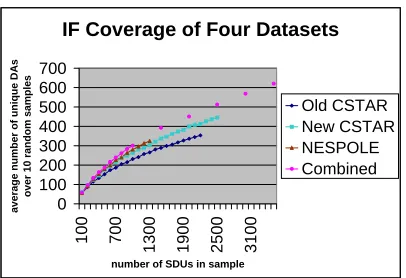
Distributional Data: domain actions as a function of database size: Table 3 shows that in each of our databases, the 50 most fre-quent domain actions cover approximately 65% of the sentences. The next issue we address is the nature of the “tail” of less frequent domain actions covering the remainder of the data.
Figure 5 shows the number of domain actions as a function of data set size. Sampling was done for intervals of 25 sentences starting at 100 sen-tences. For each sample sizesthere was ten-fold cross-validation. Ten random samples of size s
were chosen, and the number of different domain actions in each sample was counted. The aver-age of the number of domain actions in each of the ten samples of sizesare plotted in Figure 5. The four databases represented in Figure 5 are
IF Coverage of Four Datasets
0 100 200 300 400 500 600 700
100 700
1300 1900 2500 3100
number of SDUs in sample
average number of unique DAs
over 10 random samples
Old CSTAR New CSTAR NESPOLE Combined
Figure 5: Number of domain actions as a function of database size
the C-star English database tagged with C-star II interlingua, the C-star II database tagged withNespoleinterlingua, theNespole English database, and the combined C-star and NespoleEnglish databases.
[image:7.612.326.529.272.411.2]interlin-star data with Nespole interlingua indicates improved expressivity of the Nespole interlin-gua — it covers more of the infrequent domain actions. The highest curve in Figure 5 repre-sents the combined C-star and Nespole do-mains. This curve is higher than the others be-cause, as shown above, the two travel domains are significantly different from each other.
Expressivity and Simplicity, the right bal-ance: Comparing Table 3 and Figure 5, we ar-gue that theNespoleinterlingua strikes a good balance between expressivity and simplicity. Ta-ble 3 shows evidence for the simplicity of the Ne-spole interlingua: Only 50 domain actions are needed to cover 60-70% of the sentences in the database. Figure 5 shows evidence for expressiv-ity: because domain actions are compositionally formed from speech acts and concepts, it is pos-sible to form a large number of low-frequency domain actions in order to cover the domain. Over 600 domain actions are used in the com-bined C-starand Nespoledomains.
5
Conclusions
We have presented a comparison of a purely domain-action-based interlingua (theC-starII interlingua) and a more expressive, but still domain-action-based interlingua (the Nespole interlingua). The data that we have presented show that the more expressive interlingua has better coverage of the domain (a decrease from 7.3% to 2.4% uncovered data in the C-star II domain) and can also scale up to larger domains without an explosion of domain actions. Thus we have a reasonable compromise between sim-plicity and expressiveness of the interlingua.
Acknowledgments
We would like to acknowledge Hans-Ulrich Block for first proposing the domaaction-based in-terlingua to the C-starconsortium. We would also like to thank all of the C-star and Ne-spolepartners who have participated in the de-sign of the interlingua. This work was supported
References
Bonnie J. Dorr. 1993. Machine Translation: A View from the Lexicon. The MIT Press, Cambridge, Massachusetts.
Bonnie J. Dorr. 1994. Machine Translation Diver-gences: A Formal Description and Proposed Solu-tion. Computational Linguistics, 20(4):597–633.
Kenneth Goodman and Sergei Nirenburg. 1991. The KBMT Project: A Case Study in Knowledge-Based Machine Translation. Morgan Kaufmann, San Mateo, CA.
Alon Lavie, Florian Metze, Roldano Cattoni, and Er-ica Constantini. 2002. A Multi-Perspective Eval-uation of the NESPOLE! Speech-to-Speech Trans-lation System. InProceedings of Speech-to-Speech Translation: Algorithms and Systems.
Young-Suk Lee, W. Yi, Clifford Weinstein, and Stephanie Seneff. 2001. Interlingua-based broad-coverage korean-to-english translation. In Pro-ceedings of HLT, San Diego.
Lori Levin, Donna Gates, Alon Lavie, and Alex Waibel. 1998. An Interlingua Based on Domain Actions for Machine Translation of Task-Oriented Dialogues. In Proceedings of the International Conference on Spoken Language Processing (IC-SLP’98), pages Vol. 4, 1155–1158, Sydney, Aus-tralia.
Lori Levin, Donna Gates, Alon Lavie, Fabio Pianesi, Dorcas Wallace, Taro Watanabe, and Monika Woszczyna. 2000a. Evaluation of a Practical In-terlingua for Task-Oriented Dialogue. In Work-shop on Applied Interlinguas: Practical Applica-tions of Interlingual Approaches to NLP, Seattle.