A Priority Model for Named Entities
Lorraine Tanabe
W. John Wilbur
National Center for Biotechnology Information
National Center for Biotechnology Information
Bethesda, MD 20894 Bethesda, MD 20894
[email protected] [email protected]
Abstract
We introduce a new approach to named entity classification which we term a Pri-ority Model. We also describe the con-struction of a semantic database called SemCat consisting of a large number of semantically categorized names relevant to biomedicine. We used SemCat as train-ing data to investigate name classification techniques. We generated a statistical lan-guage model and probabilistic context-free grammars for gene and protein name classification, and compared the results with the new model. For all three meth-ods, we used a variable order Markov model to predict the nature of strings not represented in the training data. The Pri-ority Model achieves an F-measure of 0.958-0.960, consistently higher than the statistical language model and probabilis-tic context-free grammar.
1
Introduction
Automatic recognition of gene and protein names is a challenging first step towards text mining the biomedical literature. Advances in the area of gene and protein named entity recognition (NER) have been accelerated by freely available tagged corpora (Kim et al., 2003, Cohen et al., 2005, Smith et al., 2005, Tanabe et al., 2005). Such corpora have made it possible for standardized evaluations such as Task 1A of the first BioCreative Workshop (Yeh et al., 2005).
Although state-of-the-art systems now perform at the level of 80-83% F-measure, this is still well below the range of 90-97% for non-biomedical NER. The main reasons for this performance dis-parity are 1) the complexity of the genetic nomen-clature and 2) the confusion of gene and protein names with other biomedical entities, as well as with common English words. In an effort to allevi-ate the confusion with other biomedical entities we have assembled a database consisting of named entities appearing in the literature of biomedicine together with information on their ontological categories. We use this information in an effort to better understand how to classify names as repre-senting genes/proteins or not.
2
Background
NER is a difficult task because it requires both the identification of the boundaries of an entity in text, and the classification of that entity. In this paper, we focus on the classification step. Spasic et al. (2005) use the MaSTerClass case-based rea-soning system for biomedical term classification. MaSTerClass uses term contexts from an annotated corpus of 2072 MEDLINE abstracts related to nu-clear receptors as a basis for classifying new terms. Its set of classes is a subset of the UMLS Semantic Network (McCray, 1989), that does not include genes and proteins. Liu et al. (2002) clas-sified terms that represent multiple UMLS con-cepts by examining the conceptual relatives of the concepts. Hatzivassiloglou et al. (2001) classified terms known to belong to the classes Protein, Gene
and/or RNA using unsupervised learning, achieving accuracy rates up to 85%. The AZuRE system (Podowski et al., 2004) uses a separate modified Naive Bayes model for each of 20K genes. A term is disambiguated based on its contextual similarity to each model. Nenadic et al. (2003) recognized the importance of terminological knowledge for
biomedical text mining. They used the C/NC-methods, calculating both the intrinsic characteris-tics of terms (such as their frequency of occurrence as substrings of other terms), and the context of terms as linear combinations. These biomedical classification systems all rely on the context sur-rounding named entities. While we recognize the importance of context, we believe one must strive for the appropriate blend of information coming from the context and information that is inherent in the name itself. This explains our focus on names without context in this work.
[image:2.612.76.548.353.662.2]We believe one can improve gene and protein entity classification by using more training data and/or using a more appropriate model for names. Current sources of training data are deficient in important biomedical terminologies like cell line names. To address this deficiency, we constructed the SemCat database, based on a subset of the UMLS Semantic Network enriched with categories from the GENIA Ontology (Kim et al, 2003), and a few new semantic types. We have populated Sem-Cat with over 5 million entities of interest from
standard knowledge sources like the UMLS (Lindberg et al., 1993), the Gene Ontology (GO) (The Gene Ontology Consortium, 2000), Entrez Gene (Maglott et al., 2005), and GENIA, as well as from the World Wide Web. In this paper, we use SemCat data to compare three probabilistic frame-works for named entity classification.
3
Methods
We constructed the SemCat database of biomedical entities, and used these entities to train and test three probabilistic approaches to gene and protein name classification: 1) a statistical language model with Witten-Bell smoothing, 2) probabilistic con-text-free grammars (PCFGs) and 3) a new ap-proach we call a Priority Model for named entities. As one component in all of our classification algo-rithms we use a variable order Markov Model for strings.
3.1 SemCat Database Construction
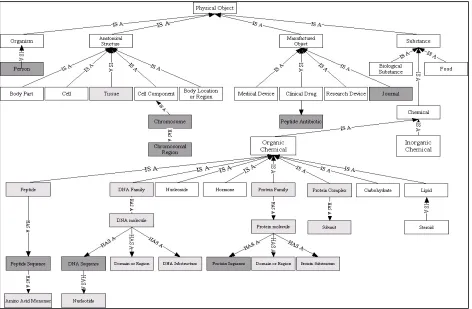
The UMLS Semantic Network (SN) is an ongoing project at the National Library of Medicine. Many users have modified the SN for their own research domains. For example, Yu et al. (1999) found that the SN was missing critical components in the ge-nomics domain, and added six new semantic types including Protein Structure and Chemical Com-plex. We found that a subset of the SN would be sufficient for gene and protein name classification, and added some new semantic types for better cov-erage. We shifted some semantic types from suboptimal nodes to ones that made more sense from a genomics standpoint. For example, there were two problems with Gene or Genome. Firstly, genes and genomes are not synonymous, and sec-ondly, placement under the semantic type Fully Formed Anatomical Structure is suboptimal from a genomics perspective. Since a gene in this context is better understood as an organic chemical, we deleted Gene or Genome, and added the GENIA semantic types for genomics entities under Or-ganic Chemical. The SemCat Physical Object hier-archy is shown in Figure 1. Similar hierarchies exist for the SN Conceptual Entity and Event trees. A number of the categories have been supple-mented with automatically extracted entities from MEDLINE, derived from regular expression pat-tern matching. Currently, SemCat has 77 semantic types, and 5.11M non-unique entries. Additional
entities from MEDLINE are being manually classi-fied via an annotation website. Unlike the Ter-mino database (Harkema et al. (2004), which contains terminology annotated with morpho-syntactic and conceptual information, SemCat cur-rently consists of gazetteer lists only.
For our experiments, we generated two sets of training data from SemCat, Gene-Protein (GP) and Not-Gene-Protein (NGP). GP consists of specific terms from the semantic types DNA MOLECULE, PROTEIN MOLECULE, DNA FAMILY, PROTEIN FAMILY, PROTEIN COMPLEX and PROTEIN SUBUNIT. NGP consists of entities from all other SemCat types, along with generic entities from the GP semantic types. Generic enti-ties were automatically eliminated from GP using pattern matching to manually tagged generic phrases like abnormal protein, acid domain, and
RNA.
Many SemCat entries contain commas and pa-rentheses, for example, “receptors, tgf beta.” A better form for natural language processing would be “tgf beta receptors.” To address this problem, we automatically generated variants of phrases in
GP with commas and parentheses, and found their counts in MEDLINE. We empirically determined the heuristic rule of replacing the phrase with its second most frequent variant, based on the obser-vation that the most frequent variant is often too generic. For example, the following are the phrase variant counts for “heat shock protein (dnaj)”:
• heat shock protein (dnaj) 0
• dnaj heat shock protein 84
• heat shock protein 122954
• heat shock protein dnaj 41
Thus, the phrase kept for GP is dnaj heat shock protein.
After purifying the sets and removing ambigu-ous full phrases (ambiguambigu-ous words were retained),
GP contained 1,001,188 phrases, and NGP con-tained 2,964,271 phrases. From these, we ran-domly generated three train/test divisions of 90% train/10% test (gp1, gp2, gp3), for the evaluation.
3.2 Variable Order Markov Model for Strings
repre-sents a string of characters. In order to estimate the probability that x x x1 2 3...xn belongs to we apply Bayes’ Theorem to write
C
(
)
(
1 2 3(
) ( )
)
1 2 3
1 2 3
... | | ... ... n n n
p x x x x C p C
p C x x x x
p x x x x
= (1)
Because p x x x
(
1 2 3...xn)
does not depend on theclass and because we are generally comparing probability estimates between classes, we ignore this factor in our calculations and concentrate our efforts on evaluating
p x x x
(
1 2 3...
x
n|
C p C
) ( )
. First we write(
1 2 3... |)
1(
| 1 2 3... 1,n
n k k
p x x x x C =
∏
= p x x x x xk− C)
)
(2)
which is an exact equality. The final step is to give our best approximation to each of the num-bers
p x
(
k|
x x x
1 2 3...
x
k−1,
C
. To make these ap-proximations we assume that we are given a set ofstrings and associated probabilities
{
(
)
}
1
,
Mi i i
s p
=where for each i,
p
i>
0
andp
i is assumed to represent the probability that belongs to theclass
C
. Then for the given stringi
s
1 2 3
...
nx x x
x
anda given we let be the smallest integer for which
k
r≥11 2
...
r r r kx x
+x
+x
is a contiguous substring inat least one of the strings
s
i. Now letN
′
be the set of all i for whichx x
r r+1x
r+2...
x
k is a substring ofs
i and letN
be the set of all for which i1 2
...
1 r r r kx x
+x
+x
− is a substring ofs
i. We set(
| 1 2 3... 1,)
i i N k k i i N p
p x x x x x C
p ′ ∈ − ∈ =
∑
∑
. (3)
In some cases it is appropriate to assume that
( )
p C
is proportional to∑
iM=1p
i or there may beother ways to make this estimate. This basic scheme works well, but we have found that we can obtain a modest improvement by adding a unique start character to the beginning of each string. This character is assumed to occur nowhere else but as the first character in all strings dealt with including any string whose probability we are estimating. This forces the estimates of probabilities near the
[image:4.612.312.536.167.382.2]beginnings of strings to come from estimates based on the beginnings of strings. We use this approach in all of our classification algorithms.
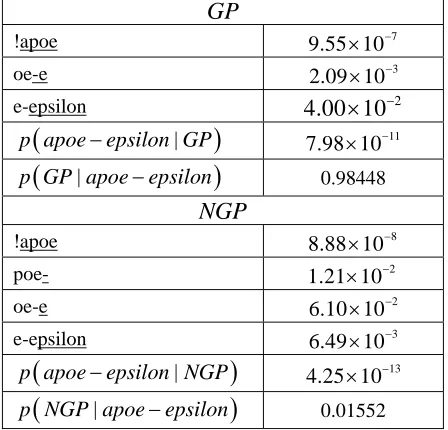
Table 1. Each fragment in the left column appears in the training data and the probability in the right column represents the probability of seeing the underlined por-tion of the string given the occurrence of the initial un-underlined portion of the string in a training string.
GP
!apoe 7
9.55 10× −
oe-e 3
2.09 10× −
e-epsilon 4.00 10× −2
(
|)
p apoe−epsilon GP 11
7.98 10× −
(
|)
p GP apoe−epsilon 0.98448
NGP
!apoe 8
8.88 10× −
poe- 2
1.21 10× −
oe-e 2
6.10 10× −
e-epsilon 3
6.49 10× −
(
|)
p apoe−epsilon NGP 13
4.25 10× −
(
|)
p NGP apoe−epsilon 0.01552
In Table 1, we give an illustrative example of the string apoe-epsilon which does not appear in the training data. A PubMed search for apoe-epsilon gene returns 269 hits showing the name is known. But it does not appear in this exact form in SemCat.
3.3 Language Model with Witten-Bell Smooth-ing
A statistical n-gram model is challenged when a bigram in the test set is absent from the training set, an unavoidable situation in natural language due to Zipf’s law. Therefore, some method for assigning nonzero probability to novel n-grams is required. For our language model (LM), we used Witten-Bell smoothing, which reserves probability mass for out of vocabulary values (Witten and Bell, 1991, Chen and Goodman, 1998). The dis-counted probability is calculated as
) ... ( ) ... ( # ) ... ( # ) ... ( ˆ 1 1 1 1 1 1 1 − + − − + − + − − + − = + i n i i n i i n i i n i w w D w w w w w w
where is the number of distinct
words that can appear after in the
training data. Actual values assigned to tokens out-side the training data are not assigned uniformly but are filled in using a variable order Markov Model based on the strings seen in the training data.
)
...
(
w
i−n+1w
i−1D
1 1
...
−+ −n i
i
w
w
3.4 Probabilistic Context-Free Grammar
The Probabilistic Context-Free Grammar (PCFG) or Stochastic Context-Free Grammar (SCFG) was originally formulated by Booth (1969). For technical details we refer the reader to Charniak (1993). For gene and protein name classi-fication, we tried two different approaches. In the first PCFG method (PCFG-3), we used the follow-ing simple productions:
1) CATP → CATP CATP 2) CATP → CATP postCATP 3) CATP → preCATP CATP
CATP refers to the category of the phrase, GP
or NGP. The prefixes pre and post refer to begin-nings and endings of the respective strings. We trained two separate grammars, one for the positive examples, GP, and one for the negative examples,
NGP. Test cases were tagged based on their score from each of the two grammars.
In the second PCFG method (PCFG-8), we combined the positive and negative training exam-ples into one grammar. The minimum number of non-terminals necessary to cover the training sets
gp1-3 was six {CATP, preCATP, postCATP, Not-CATP, preNotNot-CATP, postNotCATP}. CATP represents a string from GP, and NotCATP repre-sents a string from NGP. We used the following production rules:
1) CATP → CATP CATP 2) CATP → CATP postCATP 3) CATP → preCATP CATP 4) CATP → NotCATP CATP 5) NotCATP → NotCATP NotCATP 6) NotCATP → NotCATP postNotCATP 7) NotCATP→ preNotCATP NotCATP 8) NotCATP → CATP NotCATP
It can be seen that (4) is necessary for strings like “human p53,” and (8) covers strings like “p53 pathway.”
In order to deal with tokens that do not ap-pear in the training data we use variable order Markov Models for strings. First the grammar is trained on the training set of names. Then any to-ken appearing in the training data will have as-signed to it the tags appearing on the right side of any rule of the grammar (essentially part-of-speech tags) with probabilities that are a product of the training. We then construct a variable order Markov Model for each tag type based on the to-kens in the training data and the assigned prob-abilities for that tag type. These Models (three for PCFG-3 and six for PCFG-8) are then used to as-sign the basic tags of the grammar to any token not seen in training. In this way the grammars can be used to classify any name even if its tokens are not in the training data.
3.5 Priority Model
There are problems with the previous ap-proaches when applied to names. For example, suppose one is dealing with the name “human liver alkaline phosphatase” and class represents
pro-tein names and class anatomical names. In that
case a language model is no more likely to favor than . We have experimented with PCFGs
and have found the biggest challenge to be how to choose the grammar. After a number of attempts we have still found problems of the “human liver alkaline phosphatase” type to persist.
1
C
2
C
1
C
C
2The difficulties we have experienced with lan-guage models and PCFGs have led us to try a dif-ferent approach to model named entities. As a general rule in a phrase representing a named en-tity a word to the right is more likely to be the head word or the word determining the nature of the entity than a word to the left. We follow this rule and construct a model which we will call a Priority Model. Let be the set of training data (names)
for class and likewise for . Let
1
T
1
C
T
2C
2{ }
t
α α∈Adenote the set of all tokens used in names con-tained in
T
1∪
T
2. Then for each tokent
α,
α
∈
A
, we assume there are associated two probabilitiesprobability that the appearance of the token
t
α in aname indicates that name belongs to class
C
1 andq
α is the probability thatt
α is a reliable indicatorof the class of a name. Let be
composed of the tokens on the right in the given order. Then we compute the probability
( ) ( )1 2 ( )k
n
=
t
αt
α…
t
α( 1| ) ( )1 2
(
1 ( ))
2 ( ) ( ) 1(
1 ( ))
.k k
j i i i
j
p C n =pα
∏
= −qα +∑
=qα pα∏
k= −q jj i+ α
(5)
This formula comes from a straightforward in-terpretation of priority in which we start on the right side of a name and compute the probability the name belongs to class stepwise. If is
the rightmost token we multiple the reliability times the significance
1
C
t
α( )k( )k
q
αp
α( )k to obtain , which represents the contribution of. The remaining or unused probability is
and this is passed to the next token to the
left, . The probability is scaled by
the reliability and then the significance of
( )k ( )k
q
αp
α( )k
t
α( )
1
−
q
α k( )k 1
t
α −1
−
q
α( )k( )k 1
t
α − toobtain , which is the
contri-bution of toward the probability that the
name is of class . The remaining probability is
now and this is again
passed to the next token to the left, etc. At the last token on the left the reliability is not used to scale because there are no further tokens to the left and only significance
( ) ( )1 ( )
(1
−
q
αk)
q
αk−p
αk−1)
k
α
( )k 1
t
α −1
C
( )
(
1
−
q
α −k 1)
(
1
−
q
( )( )1
p
α is used.We want to choose all the parameters
p
α andq
α to maximize the probability of the data. Thus we seek to maximize(
)
(
)
(
(
)
)
1 1 2
log | log 2 |
n T n T
F =
∑
∈ p C n +∑
∈ p C n.
(6)
Because probabilities are restricted to be in the interval
[ ]
0,1
, it is convenient to make a change ofvariables through the definitions
,
1
1
x y
x
e
p
q
e
e
α α
y
e
α α
α
=
+
α=
+
. (7)Then it is a simple exercise to show that
(
1)
,(
1dp dq
p p q q
dx dy
α α
)
α α α
α α
= − = − α . (8)
From (5), (6), and (8) it is straightforward to com-pute the gradient of F as a function of
x
α andy
αand because of (8) it is most naturally expressed in terms of
p
α andq
α. Before we carry out the op-timization one further step is important. Let Bdenote the subset of
α
∈
A
for which all the oc-currences oft
α either occur in names in or alloccurrences occur in names in . For any such
1
T
2
T
α
we set
q
α=
1
and if all occurrences oft
α are innames in
T
1 we setp
α=
1
, while if all occur-rences are in names in we set . These choices are optimal and because of the form of (8) it is easily seen that2
T
p
α=
0
0
F F
xα yα
∂ = ∂ =
∂ ∂ (9)
for such an
α
. Thus we may ignore all theα
∈
B
in our optimization process because the values ofp
α andq
α are already set optimally. We thereforecarry out optimization of F using the
, ,
x
αy
αα
∈ −
A
B
. For the optimization we have had good success using a Limited Memory BFGS method (Nash et al., 1991).When the optimization of is complete we will have estimates for all the
F
p
α andq
α,α
∈
A
.We still must deal with tokens tβ that are not
in-cluded among the
t
α. For this purpose we trainvariable order Markov Models
MP
1 based on the weighted set of strings{
(
,
)
}
A
t
αp
α α∈ andMP
2based on
{
(
,1
)
}
A
t
α−
p
α α∈ . Likewise we train1
MQ
based on{
(
,
)
}
A
t q
α α α∈ andMQ
2 based on(
)
{
,1
}
A
t
α−
q
α α∈ . Then if we allow mp ti( )
β torepresent the prediction from model
MP
i and( )
i( )
( )
1( )
( )
( )
( )
1 2 1 2
,
mp t mq t
p q
mp t mp t mq t mq t
β
β β
β β β
= =
+
1 β
β +
(10)
This allows us to apply the priority model to
any name to predict its classification based on
equation 5.
4
Results
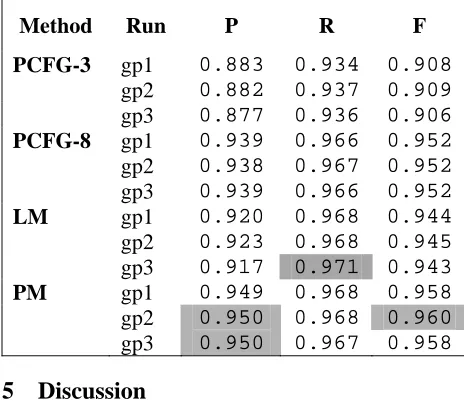
We ran all three methods on the SemCat sets gp1, gp2 and gp3. Results are shown in Table 2. For evaluation we applied the standard information retrieval measures precision, recall and F-measure.
_
(
_
_
)
rel
ret
precision
rel
ret
non rel
ret
=
+
−
_
( _ _ _ )
rel ret recall
rel ret rel not ret
=
+
2 * *
( )
precision recall F measure
precision recall
− =
+
[image:7.612.71.303.465.667.2]For name classification, rel_ret refers to true posi-tive entities, non-rel_ret to false positive entities and rel_ not_ret to false negative entities.
Table 2. Three-fold cross validation results. P = Preci-sion, R = Recall, F = F-measure. PCFG = Probabilistic Context-Free Grammar, LM = Bigram Model with Wit-ten-Bell smoothing, PM = Priority Model.
Method Run P R F
PCFG-3 gp1 0.883 0.934 0.908
gp2 0.882 0.937 0.909 gp3 0.877 0.936 0.906
PCFG-8 gp1 0.939 0.966 0.952
gp2 0.938 0.967 0.952 gp3 0.939 0.966 0.952
LM gp1 0.920 0.968 0.944 gp2 0.923 0.968 0.945 gp3 0.917 0.971 0.943
PM gp1 0.949 0.968 0.958 gp2 0.950 0.968 0.960 gp3 0.950 0.967 0.958
5
Discussion
Using a variable order Markov model for strings improved the results for all methods (results not
shown). The gp1-3 results are similar within each method, yet it is clear that the overall performance of these methods is PM > 8 > LM > PCFG-3. The very large size of the database and the very uniform results obtained over the three independ-ent random splits of the data support this conclu-sion.
The improvement of PCFG-8 over PCFG-3 can be attributed to the considerable ambiguity in this domain. Since there are many cases of term over-lap in the training data, a grammar incorporating some of this ambiguity should outperform one that does not. In PCFG-8, additional production rules allow phrases beginning as CATPs to be overall NotCATPs, and vice versa.
The Priority Model outperformed all other meth-ods using F-measure. This supports our impres-sion that the right-most words in a name should be given higher priority when classifying names. A decrease in performance for the model is expected when applying this model to the named entity ex-traction (NER) task, since the model is based on terminology alone and not on the surrounding natural language text. In our classification experi-ments, there is no context, so disambiguation is not an issue. However, the application of our model to NER will require addressing this problem.
SemCat has not been tested for accuracy, but we retain a set of manually-assigned scores that attest to the reliability of each contributing list of terms. Table 2 indicates that good results can be obtained even with noisy training data.
6
Conclusion
Acknowledgements
This research was supported in part by the Intra-mural Research Program of the NIH, National Li-brary of Medicine.
References
T. L. Booth. 1969. Probabilistic representation of for-mal languages. In: IEEE Conference Record of the 1969 Tenth Annual Symposium on Switching and Automata Theory, 74-81.
Stanley F. Chen and Joshua T. Goodman. 1998. An empirical study of smoothing techniques for lan-guage modeling. Technical Report TR-10-98, Com-puter Science Group, Harvard University.
Eugene Charniak. 1993. Statistical Language Learn-ing. The MIT Press, Cambridge, Massachusetts.
K. Bretonnel Cohen, Lynne Fox, Philip V. Ogren and Lawrence Hunter. 2005. Corpus design for biomedi-cal natural language processing. Proceedings of the ACL-ISMB Workshop on Linking Biological Litera-ture, Ontologies and Databases, 38-45.
The Gene Ontology Consortium. 2000. Gene Ontology: tool for the unification of biology, Nat Genet. 25: 25-29.
Henk Harkema, Robert Gaizauskas, Mark Hepple, An-gus Roberts, Ian Roberts, Neil Davis and Yikun Guo. 2004. A large scale terminology resource for bio-medical text processing. Proc BioLINK 2004, 53-60.
Vasileios Hatzivassiloglou, Pablo A. Duboué and An-drey Rzhetsky. 2001. Disambiguating proteins, genes, and RNA in text: a machine learning ap-proach. Bioinformatics 17 Suppl 1:S97-106.
J.-D. Kim, Tomoko Ohta, Yuka Tateisi and Jun-ichi Tsujii. 2003. GENIA corpus--semantically annotated corpus for bio-textmining. Bioinformatics 19 Suppl 1:i180-2.
Donald A. Lindberg, Betsy L. Humphreys and Alexa T. McCray. 1993. The Unified Medical Language Sys-tem. Methods Inf Med 32(4):281-91.
Hongfang Liu, Stephen B. Johnson, and Carol Fried-man. 2002. Automatic resolution of ambiguous terms based on machine learning and conceptual relations in the UMLS. J Am Med Inform Assoc 9(6): 621–636.
Donna Maglott, Jim Ostell, Kim D. Pruitt and Tatiana Tatusova. 2005. Entrez Gene: gene-centered informa-tion at NCBI. Nucleic Acids Res. 33:D54-8.
Alexa T. McCray. 1989. The UMLS semantic network. In: Kingsland LC (ed). Proc 13rd Annu Symp Com-put Appl Med Care. Washington, DC: IEEE Com-puter Society Press, 503-7.
Ryan McDonald and Fernando Pereira. 2005. Identify-ing gene and protein mentions in text usIdentify-ing condi-tional random fields. BMC Bioinformatics 6 Supp 1:S6.
S. Nash and J. Nocedal. 1991. A numerical study of the limited memory BFGS method and the truncated-Newton method for large scale optimization, SIAM J. Optimization1(3): 358-372.
Goran Nenadic, Irena Spasic and Sophia Ananiadou. 2003. Terminology-driven mining of biomedical lit-erature. Bioinformatics 19:8, 938-943.
Raf M. Podowski, John G. Cleary, Nicholas T. Gon-charoff, Gregory Amoutzias and William S. Hayes. 2004. AZuRE, a scalable system for automated term disambiguation of gene and protein Names IEEE Computer Society Bioinformatics Conference, 415-424.
Lawrence H. Smith, Lorraine Tanabe, Thomas C. Rind-flesch and W. John Wilbur. 2005. MedTag: A collec-tion of biomedical annotacollec-tions. Proceedings of the ACL-ISMB Workshop on Linking Biological Litera-ture, Ontologies and Databases, 32-37.
Lorraine Tanabe, Natalie Xie, Lynne H. Thom, Wayne Matten and W. John Wilbur. 2005. GENETAG: a tagged corpus for gene/protein named entity recogni-tion. BMC Bioinformatics 6 Suppl 1:S3.
I. Witten and T. Bell, 1991. The zero-frequency prob-lem: Estimating the probabilities of novel events in adaptive text compression. IEEE Transactions on In-formation Theory 37(4).
Alexander Yeh, Alexander Morgan, Mark Colosimo and Lynette Hirschman. 2005. BioCreAtIvE Task 1A: gene mention finding evaluation. BMC Bioinformat-ics 6 Suppl 1:S2.