Multilingual Lexicon Bootstrapping
-Improving a Lexicon Induction System Using a Parallel Corpus
Patrick Ziering1 Lonneke van der Plas1 Hinrich Sch ¨utze2
1Institute for NLP, University of Stuttgart, Germany 2CIS, University of Munich, Germany
{Patrick.Ziering, Lonneke.vanderPlas}@ims.uni-stuttgart.de
Abstract
We address the task of improving the qual-ity of lexicon bootstrapping, i.e., of ex-panding a semantic lexicon on a given cor-pus. A main problem of iterative boot-strapping techniques is the fact that lex-icon quality degrades gradually as more and more false terms are added. We propose to exploit linguistic variation be-tween languages to reduce this problem of semantic drift with a knowledge-lean and language-independent ensemble method. Our results on English and German show that lexicon bootstrapping benefits signifi-cantly from the multilingual symbiosis.
1 Introduction
High-quality semantic lexicons are an essen-tial resource for many natural language process-ing (NLP) tasks like information extraction or anaphora resolution. Methods for automatically bootstrapping semantic lexicons given a seed list often struggle with lexicon accuracy decrease in higher iterations depending on corpus size (Igo and Riloff, 2009). One reason for this issemantic drift, which occurs when erroneous terms and/or contexts are introduced into and then dominate the iterative process (Curran et al., 2007). For instance, the ambiguity found in female names such asIrisandRosemay cause the induced terms to drift into flower names (McIntosh and Curran, 2009). Examples from the patent domain, that we are focusing on in this work, arePROCESSESthat may drift into the semantic class ofOBJECTSwhen terms such asenergy storageandspring coupling are induced.
Previous work has used the cross-lingual corre-spondence between variations in linguistic struc-ture and variations in ambiguity as a form of natu-rally occurring supervision in unsupervised learn-ing for a number of tasks (Dagan et al., 1991;
Snyder and Barzilay, 2010). On the lexical level, cross-lingual variations proved to remedy prob-lems related to polysemy for synonym acquisition (Van der Plas and Tiedemann, 2010) and word sense disambiguation (Lefever and Hoste, 2010).
We hypothesize that cross-lingual divergences will be preeminently suitable to remedy problems related to semantic drift in iterative bootstrapping, where lexical and structural ambiguity give rise to erroneous terms and/or contexts. Languages are not isomorphic: ambiguous terms and con-texts are frequently language-specific. In our ex-ample above, the English termenergy storage is ambiguous, however, in German, each reading has its own translation. Energy storage is translated with Energiespeicher in the OBJECT reading and Energiespeicherungin thePROCESSreading.
Our multilingual ensemble lexicon bootstrap-ping system is inspired by Basilisk (Thelen and Riloff, 2002). Previous work has addressed se-mantic drift in Basilisk by conflict resolution be-tween several classes (Thelen and Riloff, 2002), by using web queries (Igo and Riloff, 2009) and by combining Basilisk in an ensemble with an SVM tagger and a coreference resolution system (Qadir and Riloff, 2012). These approaches are mono-lingual. Instead we use a multilingual ensemble method where the induced lexicons of several lan-guages constrain each other.
Apart from addressing semantic drift, the mul-tilingual setting we propose has several other ad-vantages. First, one language may leave im-plicit what another expresses directly in linguis-tic forms. In German, common nouns are capital-ized and compound nouns are written as one word. We propagate German noun information via word alignment to English and thereby learn both sin-gle words as well as most multiword expressions (MWEs) without the need for a noun chunker or MWE recognizer.
Second, as a result of the multilingual
ble method we are able to induce lexicons for any language given a parallel corpus. We do not need seed lists for all languages, which are often sparse. Translating1the English seed list automat-ically results in high-quality lexicons for all other languages.
Finally, many pattern-based lexicon bootstrap-ping methods use pdefined patterns which re-quire language- and domain-specific syntactic analyses. Our multilingual approach makes use of a parallel corpus and tools from phrase-based machine translation that substitute for the neces-sity of pattern definition and once more guarantees a knowledge-lean and language-independent pro-cess.
2 Multilingual Lexicon Bootstrapping
Monolingual bootstrapping
1: lexicon←seed
2: forinti= 0;i < m;i++do
3: patterns←patternsOf(lexicon) 4: score(patterns)
5: patterns←return-top-k(patterns,20 +i) 6: terms←termsOf(patterns)−lexicon 7: score(terms)
8: lexicon←lexicon∪return-top-k(terms,t) 9: end for
10: return lexicon
Figure 1: Basilisk (Thelen and Riloff, 2002)
Our basic algorithm is inspired by Basilisk (Thelen and Riloff, 2002), an algorithm developed for monolingual lexicon bootstrapping as shown in Figure 1. The starting point is a lexicon initial-ized with a given seed set. Then the lexicon is ex-panded iteratively. First Basilisk ranks all patterns containing terms from the lexicon (lexicon terms) (lines 3-4) based on the RlogF score:
RlogF(patterni) =Fi/Nilog2(Fi)
where Fi is the number of lexicon terms occur-ing in patterni and Ni is the total number of terms occuring in patterni. Then Basilisk ranks all non-lexicon terms that occur in the 20+i highest-ranked patterns (wherei+ 1is the number of per-formed iterations) (lines 5-7) based on the AvgLog score:
AvgLog(termi) = 1/PiPPj=1i log2(Fj+ 1)
1Potential ambiguity in translated seeds will be taken care of, because our ensemble learning prevents false terms result-ing from erroneous seeds to be added to the lexicon.
where Pi is the number of patterns containing termi. Finally Basilisk adds the t (originally 5) highest-ranked terms to the lexicon (line 8) and process repeats.
Multilingual ensemble framework
1: forLiin{L1, . . . , Ln}do 2: Bi ←initialize Basilisk for Li 3: Bi.final← {}
4: end for
5: while∃i(size(Bi.final)< l)do 6: forBiin{B1, . . . , Bn}do 7: Bi.iterate(m,t)
8: end for
9: consensusCheck({B1,. . . ,Bn}) 10: end while
11: return (B1.final,. . . ,Bn.final)
Figure 2: Multilingual bootstrapping
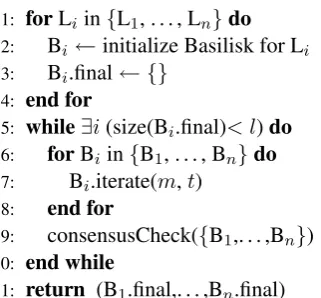
We adapted Basilisk to a multilingual setting as shown in Figure 2. Key to the framework is the multilingual consensus check. In the consen-susCheck, for each Basilisk process Bi we inter-sect its lexicon with the translations of the lexicons of all other Basilisk processes Bk. We translated the lexicons from Lkto Liusing the bilingual dic-tionaryDICTk↔iextracted from the corresponding phrase table. If the lexicon intersection is non-empty, the consensus terms are added to the final list of Bi and the temporary lexicon is reset to the seed terms and the final list. If the intersection is empty, the lexicons are maintained completely leading to a higher chance of non-emptiness in the subsequent multilingual iteration.
We first initialize a Basilisk process Bifor each language Li (Figure 1, line 1; Figure 2, lines 1-4). For each Basilisk process, we introduce a fi-nallist, that contains only lexicon terms that sur-vived the consensus check. As long as at least one Basilisk process has a final list containing less than l terms, each Basilisk process performsm itera-tions of learning the top tterms2 each (Figure 1, line 2-9; Figure 2, lines 6-8). Multilingual boot-strapping is finished, when all Basilisk processes have a final list of at leastl terms (Figure 2, line 11).
2
3 Experiments
Although our method is multilingual and language-independent we restrict our demonstra-tion of its potential to two languages: German and English.
The parallel corpus. We use patent data dis-tributed by the European Patent Office (EPO3) be-tween 1998 and 2008. Most European patents provide their claims (the part of a patent defining the scope of protection) in German, English and French. We constructed a German-English paral-lel corpus out of 177,317 patent documents.
Creation of Moses phrase table. For each unordered language pair, we create a MOSES (Koehn et al., 2007) phrase table in several steps. We first apply sentence alignment (GARGANTUA Braune and Fraser (2010)), then word alignment (MGIZA++ Gao and Vogel (2008)) to the data. And finally, we apply the statistical machine trans-lation tool MOSES to the parallel word-aligned data. The resulting data structure is a phrase ta-ble of word-aligned phrases in two languages as shown in Figure 3, where the third line indicates the word alignment.
Verfahren zur selektiven Fl¨ussigphasenhydrierung the process for selective liquid phase hydrogenation 0-0 0-1 1-2 2-3 3-4 3-5 3-6
Figure 3: Main content in a phrase table entry
Extracting terms and patterns. For term ex-traction, we define one language as the term-specifying language Lterm(i.e., the language that specifies the set of candidate terms for all lan-guages) – in our case, we choose German since it expresses term boundaries very directly in its lin-guistic forms (capitalized nouns, single word com-pounding). German terms are defined as a capi-talized token with at least 4 letters. For each un-ordered language pair{Lterm,Li}, we define each term in Lias a sequence of tokens that are aligned to a term in Lterm. In Figure 3, “liquid phase hy-drogenation” is defined as term since it is aligned to “Fl¨ussigphasenhydrierung” .
For reducing errors due to poor word align-ment4, we apply MATE (Bohnet, 2010) part of speech (PoS) tagger on phrases in languages other
3www.epo.org
4Since our corpus is not large enough for perfect word alignment, it can be supported by a part of speech tagger. To keep the process completely language-independent, this step may also be skipped.
than Lterm and define a PoS filter that removes spurious tokens at the left and right boundaries. Figure 4 shows the PoS filter for English, that is adapted from Justeson and Katz (1995) to the task of filtering tokens. The aligned terms that pass the filtering are stored in a dictionaryDICTterm↔i.
English (JJ|VBG|NN)* NN (IN NN+)?
Figure 4: PoS pattern for term filtering
Patterns are extracted from the phrase tables as well. For each phrase in Ltermand Li we use the remaining tokens surrounding each term as boot-strapping pattern associated with this term (e.g., “Verfahren zur selektiven<X>” is defined as pat-tern for “Fl¨ussigphasenhydrierung”).5
Our final data set contains roughly 19 million German and English term-pattern pairs. The dic-tionary DICTDE↔EN comprises 1.8 million en-tries.
Translating seed sets. We define one corpus language as the seed-definining language Lseed – in our case, we choose English since it provides the richest lexical resources. Then, for all other languages Li we translate each seed term from Lseed to Li using the most frequent translation in DICTseed↔i.
Evaluation. We evaluated the multilingual bootstrapping system on two semantic classes mo-tivated by the technical field of patents: PROCESS andTECHNICAL QUALITY.
PROCESS: A method or event that results in a
change of state (e.g.,stretching,molding pro-cess,redundancy control, . . . ).
TECHNICAL QUALITY: A basic or essential
at-tribute which is measurable or shared by all members of a group (e.g., power consump-tion,piston speed,light reflection index, . . . ).
The sources for the English seed sets have been WordNet lexicographer classes (Ciaramita and Johnson, 2003) and Wikipedia6word lists.
For each semantic class and language we in-duced lexicons of 2000 terms. For each lexicon we evaluated a sample of 200 terms. Two anno-tators first rated 50 terms for each language and class asTRUEorFALSE. Then they discussed dis-agreements. Afterwards, they rated the remaining terms in each lexicon sample. We achieved a total inter-annotator agreement of κ = .701(Cohen’s
5
We remove unique patterns because they do not con-tribute to lexicon bootstrapping.
Kappa). For the results, we used the labeled lexi-cons of the annotator that finalized the task first.
4 Results
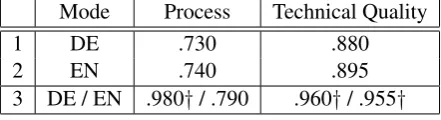
In our experiments we compare two methods. The first is the monolingual bootstrapping method7and the second is the bilingual ensemble bootstrap-ping method. For a proper comparison both meth-ods make use of the same data as described in Section 3. Table 1 shows the accuracy of the induced lexicons for German and English when learned separately (lines 1-2) and when induced with the bilingual ensemble bootstrapping method (line 3)8.
Mode Process Technical Quality
1 DE .730 .880
2 EN .740 .895
3 DE / EN .980†/ .790 .960†/ .955†
Table 1: Results of lexicon evaluation
Bilingual ensemble bootstrapping outperforms monolingual bootstrapping in both classes and languages. For the class TECHNICAL QUALITY there is a significant improvement in both lan-guages (German: +.080; English: +.060). For the classPROCESSthere is a significant improvement for German (+.250), whereas there is a nonsignif-icant improvement for English.
Analysis and discussion. To give the reader a better idea of how the bilingual ensemble method remedies semantic drift, we will comment on the asymmetric impact on performance, when high levels of ambiguity are present in one of the two languages.
We know from linguistic research (Ehrich and Rapp, 2000) that the German ung-ending is sub-ject to sortal ambiguity. Words ending in -ung can be of various semantic types: processes, ob-jects, events, and states. Many terms in thePRO -CESSclass are described by nouns ending in -ung. Their sortal ambiguity gives rise to semantic drift fromPROCESStoTECHNICAL QUALITY(e.g., Be-lastung can mean charging or burden), and to PROCESS-RELATED DEVICE(e.g.,Steuerung can meansteeringorcontroller). This sortal ambigu-ity of nouns in thePROCESSclass does not have its 7Although the first method relies on a parallel corpus and multilingual preprocessing, we refer to it as the monolingual method because the learning is done monolingually.
8We mark each number with † if it significantly out-performs monolingual bootstrapping (z-test for proportions; p < .05).
counterpart in the English lexicon. It is therefore not surprising that we see a large improvement in the quality of the German lexicons, when English is used in the ensemble bootstrapping method. We achieve an improvement in German of +.250, the largest improvement overall.
In the present bilingual setting, we cannot pre-vent the ambiguity found in the German terms to influence the English terms. We believe that this is the reason for the asymmetric impact of bilingual bootstrapping on the classPROCESS, where we see only a small improvement in English (+.060). The positive effects from ensemble learning for the En-glishPROCESSclass is partly wiped out by the in-fluence of high levels of ambiguity in German. In future work, we plan to add several languages to be able to prevent ambiguity in one language to overshadow the multilingual ensemble.
5 Conclusion
We address the problem of semantic drift in iter-ative bootstrapping. We propose a multilingual ensemble learning method for lexicon bootstrap-ping, in which lexicons for several languages are induced in parallel and constrain each other. This method exploits linguistic variation between lan-guages to reduce the impact of lexical and struc-tural ambiguity within one language. In a case study on German and English and the two seman-tic classes TECHNICAL QUALITY and PROCESS, we show that bilingual lexicon bootstrapping out-performs monolingual bootstrapping in all classes and languages.
In addition, our multilingual approach to lexi-con bootstrapping is particularly knowledge-lean and language-independent. A parallel corpus, language-independent machine translation tools and seed lists of one single corpus language suf-fice to extract patterns, determine term boundaries and provide seed lists for an in principle unlimited number of languages.
Acknowledgments
This research was supported by the project TOPAS9 (Tool platform for intelligent Patent Analysis and Summarization), its team members and the European Commission with its FP7-SME Program. The TOPAS Consortium is composed of five partners: Br¨ugmann Software Inc., IALE Inc., Intel-lisemantic Inc., Pompeu Fabra University and University of Stuttgart. We thank all colleagues for their support. This re-search was further supported by the German Rere-search Foun-dation (Deutsche Forschungsgemeinschaft) as part of the SFB 732. Thanks also to Sebastian Ebert for conducting the creation of the phrase tables.
References
Bernd Bohnet. 2010. Top accuracy and fast dependency parsing is not a contradiction. InCOLING 2010. Fabienne Braune and Alexander Fraser. 2010. Improved
un-supervised sentence alignment for symmetrical and asym-metrical parallel corpora. InCOLING ’10.
Massimiliano Ciaramita and Mark Johnson. 2003. Super-sense tagging of unknown nouns in wordnet. InEMNLP 2003.
J. R. Curran, T. Murphy, and B. Scholz. 2007. Minimising Semantic Drift with Mutual Exclusion Bootstrapping. In
PACLING 2007.
Ido Dagan, Alon Itai, and Ulrike Schwall. 1991. Two lan-guages are more informative than one. InACL 1991. Veronika Ehrich and Irene Rapp. 2000. Sortale
Be-deutung und Argumentstruktur: ung-Nominalisierungen im Deutschen. Zeitschrift f¨ur Sprachwissenschaft, 19(2):245–303.
Qin Gao and Stephan Vogel. 2008. Parallel implementations of word alignment tool. InACL 2008 Software Engineer-ing, TestEngineer-ing, and Quality Assurance Workshop.
Sean P. Igo and Ellen Riloff. 2009. Corpus-based seman-tic lexicon induction with web-based corroboration. In
NAACL 2009, pages 18–26.
J. Justeson and S. Katz. 1995. Technical terminology: some linguistic properties and an algorithm for identification in text. Natural Language Engineering, pages 9–27. Philipp Koehn, Hieu Hoang, Alexandra Birch, Chris
Callison-Burch, Marcello Federico, Nicola Bertoldi, Brooke Cowan, Wade Shen, Christine Moran, Richard Zens, Chris Dyer, Ondˇrej Bojar, Alexandra Constantin, and Evan Herbst. 2007. Moses: open source toolkit for statistical machine translation. InACL ’07.
Els Lefever and V´eronique Hoste. 2010. Semeval-2010 task 3: Cross-lingual word sense disambiguation. InSemEval 2010.
Tara McIntosh and James R. Curran. 2009. Reducing se-mantic drift with bagging and distributional similarity. In
ACL-IJCNLP 2009.
Ashequl Qadir and Ellen Riloff. 2012. Ensemble-based se-mantic lexicon induction for sese-mantic tagging. In *SEM-2012.
Benjamin Snyder and Regina Barzilay. 2010. Climbing the tower of babel: Unsupervised multilingual learning. In
ICML 2010.
Michael Thelen and Ellen Riloff. 2002. A bootstrapping method for learning semantic lexicons using extraction pattern contexts. InEMNLP 2002.