Dual Constrained Question Embeddings with Relational Knowledge
Bases for Simple Question Answering
Kaustubh Kulkarni and Riku Togashi and Hideyuki Maeda and Sumio Fujita Yahoo Japan Corporation,
Tokyo, Japan
{kkulkarn,rtogashi,hidmaeda,sufujita}@yahoo-corp.jp
Abstract
Embedding based approaches are shown to be effective for solving simple Ques-tion Answering (QA) problems in recent works. The major drawback of current ap-proaches is that they look only at the sim-ilarity (constraint) between a question and a head, relation pair. Due to the absence of tail (answer) in the questions, these mod-els often require paraphrase datasets to ob-tain adequate embeddings. In this pa-per, we propose a dual constraint model which exploits the embeddings obtained by Trans* family of algorithms to solve the simple QA problem without using any additional resources such as paraphrase datasets. The results obtained prove that the embeddings learned using dual con-straints are better than those with single constraint models having similar architec-ture.
1 Introduction
Recent progress in Knowledge Bases (KB) related technologies enable us to enhance an atomic fact repository of inter-entity relationship. For exam-ple KB comexam-pletion aims to infer unknown entities in atomic facts, which is represented in the form of triplets (h, r, t) whereh,r,trepresent a head en-tity, relationship and a tail entity respectively, e.g. (Barack Obama, Nationality, USA) which corre-sponds to the factual knowledge that “the nation-ality of Barack Obama is USA”. Freebase1 and
DBPedia2 contain such atomic facts about
enti-ties in the real world. However, the real chal-lenge for leveraging such knowledge in practical applications consists of mapping natural language
1https://developers.google.com/freebase/ 2http://wiki.dbpedia.org/
questions to their corresponding entries in thus en-hanced KBs.
Current embedding based QA models such as (Bordes et al., 2014a,b, 2015; Golub and He, 2016) are focusing on a sequential inference of predicting the pair of (h,r) from the given question (q), then inferring (t) corresponding to the pre-dicted pair (h,r) using any KB completion models e.g. Trans* family models. This is a reasonable approach since such a type of questions contain information about both the head entity and the re-lation. However, once the first step of inference fails to match the correct (h,r) pair, it is hopeless for the second step to answer the correct entity. In order to avoid this problem, they use additional resources such as question paraphrases or entity aliases.
In this paper, we propose a completely differ-ent approach which uses a Trans* family based scoring function to predict the pair of (h,r) fromq, and also mapsqtotsimultaneously. We learn em-beddings for question words, entities and relations from the KB simultaneously bringing them into an euclidean space. Proposed dual constraint concur-rent inference achieved better performance on a standard dataset than single constraint sequential inference methods without using any additional resources.
2 Related Work
Our work is inspired by the recent advances in solving simple QA problems using embedding ap-proaches such as (Bordes et al., 2014a,b, 2015) which show that these approaches are very ef-fective in mapping natural language questions to the corresponding triplet in a KB. They learn the embeddings for each question by a Bag Of Words (BOW) representation. (Jain, 2016) fo-cuses on the positions of the question words and
incorporate them into the model. Some models such as (Yih et al., 2015; Dai et al., 2016) fo-cus on deep networks to encode question words and KB constituents. (Dai et al.,2016) have mod-eled the probability of predicting head and relation jointly, proposing two neural networks for learn-ing the embeddlearn-ings. (Golub and He, 2016) in-troduced attention mechanism for character level LSTM encoding of questions and entities for em-bedding question words and KB constituents. (Yin et al., 2016) proposed to use char-CNN to en-code the entities and word-CNN with maxpooling to encode relations. (Yu et al.,2017) focused on the different granularity of relation representation. (Lukovnikov et al.,2017) have used rich entity in-formation to get more powerful KB constituents encodings. Note that all these models focused on a single constraint sequential inference that uses similarities betweenqand (h,r) pairs to learn em-beddings. Our method applies a dual constrained concurrent inference that uses similarities between
qandton top of (h,r) pairs while leveraging em-beddings pre-trained by the Trans* family of algo-rithms.
Various Trans* family models such as TransE (Bordes et al., 2013),TransH(Wang et al., 2014),TransR (Lin et al., 2015) are proposed to learn low dimension embeddings of KB con-stituents using relations in KB as translations over entity embedding space.
3 Proposed Method
We propose an embedding based approach where both question words and KB constituents are mapped into a common low dimensional embed-ding space.
Single Constrained Sequential Inference: In the common euclidean space of question and KB constituents embeddings, assume d1 to be
eu-clidean distance between question embedding (q) and additive vector of head entity and relation (h+r). As shown in Figure1[a] current QA mod-els try to minimized1 so as to predict head entity
and relation pair (h,r) from the question(q), con-sequently they have a single constraint such that correspondingqandh+rshould be closer to each other. Assumed2 to be an euclidean distance
be-tween tail entity embedding (t) and (h+r). Trans* family of algorithms try to minimize d2 so as to
predict tail entity (t) from a pair of (h,r). Cur-rent models minimized1andd2in the two distinct
Figure 1: [a]Single constrained QA models min-imize the distance (d1) between Question
Embed-dings (q) and head entity, relation pair (h,r) and Trans* family of algorithms minimize distance (d2) between tail entity (t) and (h,r).[b]Our model
minimize the distance (d3) between q and t along
withd1thus applying the second constraint on q.
steps, indirectly bringingqcloser tot.
Dual Constrained Concurrent Inference: A QA system is preferably able to directly retrieve an answer entity upon a submission of a question. The problem here is that a simple factoid question does not contain sufficient information of the an-swer entity by definition. Thus our model should learn question embeddings such thatq should be closer to t as well as (h+r). Assume d3 to be
an euclidean distance between (q) and (t) in the same vector space as earlier model, as can be seen in Figure1[b], our model minimizesd1+d3 i.e.
bringing q closer to both h+randt. This is im-plemented as a dual constraint in objective func-tion when learning q, which reduces the degree of freedom of q, resulting in a better euclidean space in comparison with single constrained mod-els. Thanks to these constraints we do not need any additional resources such as question para-phrase datasets while achieving on a par perfor-mance with the current models.
3.1 TransR
TransR(Lin et al.,2015) is an algorithm to learn low dimensional vector representations of entities and relations in the Knowledge Base. TransR adopts a score function fr to measure the
credi-bility of a KB triplet (h, r, t) such that the score is low when (h, r, t)is likely to be true and high otherwise.
TransR represents entities and relations in dis-tinct vector spaces i.e. entity space andrelation space. For each triplet, let h ∈ Rk,t ∈ Rk be
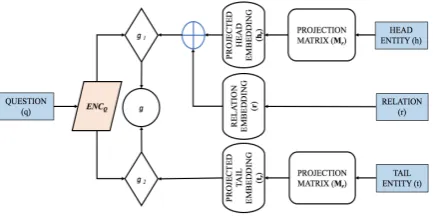
[image:2.595.308.524.62.174.2]respec-Figure 2: Overview of our learning diagram
tively andr∈Rdbe a relation embedding, where kanddare the dimensions of embeddings of enti-ties and relations respectively. It also trains a rela-tion specific projecrela-tion MatrixMr∈Rk×d, which
projects entities from the entity space to a corre-sponding relation space. With this projection ma-trix, projected vectors of entities are defined as,
hr =hMr,tr=tMr.
The score function is defined as:
fr =khr+r−trk22.
Constraints are enforced on the norms of em-beddings h, r, t and projection matrices, i.e. ∀h, r, t we have khk2 ≤ 1,krk2 ≤ 1,ktk2 ≤
1,khMrk2 ≤1,ktMrk2≤1.
Margin based score function is defined as objec-tive for training purpose which is as follows:
C= P
(h, r, t)∈S P
(h0, r, t0)∈S0max(0,fr(h,t)+γ−fr(h
0,t0))
where max(x,y) returns the larger value between
xandy,γ is the margin parameter, Sis the set of correct triplets from dataset andS0is the set of
cor-rupted triplets generated by using various negative sampling methods for training purpose.
3.2 Model
As shown in Figure2, our model pre-trains the en-tity (h,t) and relation (r) embeddings with TransR, whereas encoding questions into q ∈ Rd where d is the size of question embedding. Questions should be closer to the sum of (h) and (r) of the corresponding triplet in the KB, similarly the an-swer of the question should be closer to the vec-tor of tail entity (t). We propose a score function
g(h, r, t, q)such that the score is low if(h, r, t)is the triplet corresponding to the question (q) and high otherwise. Scores of the question embedding are defined as:
1. This indicates how close a question is to the combination of head entity (h) and relation (r) embeddings in TransR relation space
g1=khr+r−qk22
2. This indicates how close a question is to the tail entity (t) embedding in a TransR relation space.
g2 =ktr−qk22
Then the final score of the question is defined as:
g=g1+g2.
Additional constraints are enforced on norms of embeddings such that kqk2 ≤ 1. Due to a dual
constraint mentioned above on the question em-bedding (q), the degree of freedom is reduced con-siderably, which leads to fast training.
3.3 Training
Similar to previous studies involving embedding models (Bordes et al.,2014a,b,2015), our model is trained with a ranking criterion. The objective of the learning is that the positive triplet should be closer to the natural language question than any other negative triplet by a certain marginγ in the embedding space. Thus we adopt a margin-based objective function for training purpose as follows:
L= P
(h, r, t, q)∈S P
(h0, r0, t0,q)∈S0max(0, g1(h, r, q) +
γ−g1(h0,r0, q)) +max(0, g2(t,q) +γ−g2(t0,q))
where max(x,y) andγ are same as defined earlier.
Sis the set of correct pairs of a triplet and a ques-tion from the dataset andS0is the set of pairs of a
negative triplet and a question asS.
3.4 Negative Triplet generation
For generating negative triplets we use a method known ascandidates as negatives, which is pro-posed by (Bordes et al., 2015). In this method, non-supported triplets are chosen randomly from the set of candidate triplets.
4 Experiments
4.1 Knowledge Base and Dataset
[image:3.595.74.291.66.174.2]5k relations. We use SimpleQuestions3 dataset
introduced by (Bordes et al., 2015) for training and testing purposes. This dataset consists of a total of 108,442 natural language questions in En-glish written by human EnEn-glish speaking annota-tors each paired with a corresponding triplet from FB2M that provides the answer. Out of whole data 75,910 data points were used for Training, 10,845 for validation and 21,687 for testing purpose. 4.2 Experimental Setup
TransR embeddingsTransR embeddings of size 64 initialized randomly with uniform distribution were pre-trained with Probabilistic Negative Sam-pling method proposed by (Kanojia et al.,2017). Question EncodingQuestion is represented as se-quence of words (x1,x1, ...,x|q|). Low dimension
vectors for each word in vocabulary are learnt and each word xi is mapped to its vector. Word
em-bedding size was set at 64 and initialized with ran-dom uniform distribution. We experimented with two methods to encode questions from individual question word embeddings:
Bag-of-Words (BOW): It is a sum of individ-ual word embeddings i.e.
q=P|q|i=1xi
Long Short Term Memory (LSTM)(Hochreiter and Schmidhuber, 1997): Each question is encoded using LSTM with dynamic RNN units with hidden layer size of 64 and forget bias as 1.0. Output of the last LSTM unit was taken as the question encoding.
We experimented with Batch size as 512, margin (γ) at 0.1 and Adam optimizer with learning rate of 0.001.
Candidate Pruning: Calculation of score for all triplets from the dataset is an memory and time wise prohibitive operation. Thus, at first we prune the facts to generate candidate facts similar to (Jain,2016). Then only these candidate facts are scored by feeding them as input to our network. To generate these candidate facts, we match all possible n-grams of words of the question to Freebase entities and discard all n-grams (and their matched entities) that are a subsequence of another n-gram. All facts having one of the remaining entities as subject are added to candidate fact list. Facts with lowest score (g) out of candidates is retrieved as answer to the question. We evaluate our model based on
3https://research.fb.com/downloads/babi/
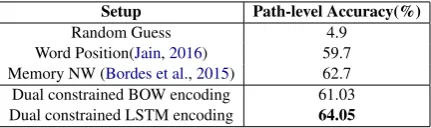
Setup Path-level Accuracy(%) Random Guess 4.9
[image:4.595.308.524.62.126.2]Word Position(Jain,2016) 59.7 Memory NW (Bordes et al.,2015) 62.7 Dual constrained BOW encoding 61.03 Dual constrained LSTM encoding 64.05
Table 1: Experimental Results on SimpleQues-tion dataset for FB2M settings.
path-level accuracy in which prediction is correct if the head entity (h) and relation (r) of retrieved triplet are correct.
5 Results
The results of our experiments are shown in Ta-ble1. We observe that our model gains 2-5% im-provement in the path level accuracy than single constrained word level embeddings approaches by (Bordes et al.,2015;Jain,2016) who have similar architecture to ours. Note that they use additional resources such as question paraphrase dataset and entity aliases while our model uses original dataset only. There are recent studies such as (Yin et al., 2016; Lukovnikov et al., 2017; Yu et al., 2017) which reported better accuracies on the same test set, by adopting either char-level CNNs or richer representations of entities/relations. Note that our dual constraint concurrent inference can be easily incorporated into such methods thus our method is complementary to their methods. We also report comparisons between different question encoding methods of our model. LSTM encoding outper-forms BOW as it captures syntactic clues to map question onto the KB.
6 Conclusion and Future Work
better results.
In future, we hope to apply this method to richer embeddings obtained using deep networks. As shown in (Golub and He, 2016) character level encodings based models have been proven to be more precise compared to word level models for a simple QA task. We hope to extend our model to character level ones. Also the entity accuracy is comparatively lower than the relation accuracy which can be improved by using better entity link-ers in questions.
References
Antoine Bordes, Sumit Chopra, and Jason Weston.
2014a. Question answering with subgraph
embed-dings. InEMNLP, pages 615–620. ACL.
Antoine Bordes, Nicolas Usunier, Sumit Chopra, and
Jason Weston. 2015. Large-scale simple
ques-tion answering with memory networks. CoRR, abs/1506.02075.
Antoine Bordes, Nicolas Usunier, Alberto Garcia-Duran, Jason Weston, and Oksana Yakhnenko.
2013. Translating embeddings for modeling
multi-relational data. InAdvances in Neural Information Processing Systems 26, pages 2787–2795.
Antoine Bordes, Jason Weston, and Nicolas Usunier.
2014b. Open question answering with weakly
su-pervised embedding models. In ECML/PKDD (1),
volume 8724 ofLecture Notes in Computer Science,
pages 165–180. Springer.
Zihang Dai, Lei Li, and Wei Xu. 2016. CFO:
condi-tional focused neural question answering with large-scale knowledge bases.CoRR, abs/1606.01994.
David Golub and Xiaodong He. 2016.
Character-level question answering with attention. CoRR, abs/1604.00727.
Sepp Hochreiter and J¨urgen Schmidhuber. 1997. Long
short-term memory. Neural Comput., 9(8):1735– 1780.
Sarthak Jain. 2016. Question answering over
knowl-edge base using factual memory networks. In Pro-ceedings of NAACL-HLT, pages 109–115.
Vibhor Kanojia, Hideyuki Maeda, Riku Togashi, and
Sumio Fujita. 2017. Enhancing knowledge graph
embedding with probabilistic negative sampling. In
Proceedings of the 26th International Conference Companion on World Wide Web, WWW ’17 Com-panion, pages 801–802. International World Wide Web Conferences Steering Committee.
Yankai Lin, Zhiyuan Liu, Maosong Sun, Yang Liu, and
Xuan Zhu. 2015. Learning entity and relation
em-beddings for knowledge graph completion. In Pro-ceedings of the Twenty-Ninth AAAI Conference on
Artificial Intelligence, AAAI’15, pages 2181–2187. AAAI Press.
Denis Lukovnikov, Asja Fischer, Soeren Auer, and Jens
Lehmann. 2017. Neural network-based question
an-swering over knowledge graphs on word and char-acter level. InProceedings of the 26th international conference on World Wide Web.
Zhen Wang, Jianwen Zhang, Jianlin Feng, and Zheng Chen. 2014. Knowledge graph embedding by
trans-lating on hyperplanes. InAAAI, pages 1112–1119.
AAAI Press.
Scott Wen-tau Yih, Ming-Wei Chang, Xiaodong He,
and Jianfeng Gao. 2015. Semantic parsing via
staged query graph generation: Question answering with knowledge base. ACL Association for Com-putational Linguistics.
Wenpeng Yin, Mo Yu, Bing Xiang, Bowen Zhou, and
Hinrich Sch¨utze. 2016. Simple question answering
by attentive convolutional neural network. CoRR, abs/1606.03391.
Mo Yu, Wenpeng Yin, Kazi Saidul Hasan, C´ıcero Nogueira dos Santos, Bing Xiang, and
Bowen Zhou. 2017. Improved neural relation
detection for knowledge base question answering.
![Figure 1: [a] Single constrained QA models min-dimize the distance (d 1 ) between Question Embed-dings (q) and head entity, relation pair (h,r) andTrans* family of algorithms minimize distance( 2 ) between tail entity (t) and (h,r)](https://thumb-us.123doks.com/thumbv2/123dok_us/800155.1094151/2.595.308.524.62.174/constrained-distance-question-relation-andtrans-algorithms-minimize-distance.webp)