Selecting Systemic Features for Text Classification
Casey Whitelaw and Jon Patrick Language Technology Research Group Capital Markets Co-operative Research Centre
School of Information Technologies University of Sydney
{casey, jonpat}@it.usyd.edu.au
Abstract
Systemic features use linguistically-derived language models as a basis for text classification. The graph structure of these models allows for feature repre-sentations not available with traditional bag-of-words approaches. This paper explores the set of possible represen-tations, and proposes feature selection methods that aim to produce the most compact and effective set of attributes for a given classification problem. We show that small sets of systemic fea-tures can outperform larger sets of word-based features in the task of identifying financial scam documents.
1 Introduction
Text classification is among the most widespread applications of computational linguistics. The range of services that offer text classification con-tinue to grow, and include such mainstream appli-cations as email and web content filtering. The classification of documents by machine learning techniques requires a representation of each doc-ument as a set of features; almost without excep-tion, these features are based on the presence, ab-sence, or frequency of words in the text. This ‘bag-of-words’ model is popular both due to its ease of implementation, and its excellent performance
on many tasks. Topic-based classification, such as newswire or newsgroup tasks, is well-suited to this automated keyword-spotting approach. These are cases in which the presence of a topic-related word such as ‘wheat’ is a very strong indicator of a document’s class.
The bag-of-words model makes large simplify-ing assumptions about a document. It assumes that there is no textual structure; no ordering of paragraphs in the text, sentences in a paragraph, clauses in a sentence, or words in a clause. In addition, it assumes that the occurrence of each word is independent of each other word. These assumptions, in providing a much simpler picture of the document, destroy much of the text’s mean-ing. Work has been done to restore this infor-mation using semantic resources such as Word-Net (Scott and Matwin, 1998) or using syntactic information (Carr and Estival, 2002). There is also growing interest in classifying texts on non-denotational meaning, such as writing style, au-thorship identification (van Halteren, 2004) and sentiment analysis (Pang and Lee, 2004). These new areas highlight the properties of a document that are currently slipping through the cracks.
rep-resentations that more accurately capture charac-teristic linguistic differences. In Section 2 we enu-merate these representations and discuss how their semantics differ. Section 3 describes the Scam-seek project and the use of systemic features in the identification of financial scams. The results provided in Section 4 show that smaller number of systemic features can outperform larger numbers of word-based features in text classification.
2 Systemic Features
Systemic Functional Linguistics (SFL) is a lin-guistic theory that approaches language as a social resource for meaning-making (Halliday, 1994). Language is not seen as a collection of discrete phrase production rules working upon a deeper syntactic structure, but as an interwoven collection of systems realising a deeper semantic structure and functional intention. SFL explicitly deals with three types of meaning (metafunctions) in text: the
ideational (content of the text), the textual
(organ-isation of the text), and the interpersonal (social positioning of the text) meanings, each of which contribute to the formation of a document.
SFL uses system networks as a way to represent the patterns of language choice related to a partic-ular meaning. A system network is defined both graphically and algebraically (Matthiessen, 1995) as a hierarchy of choices: at the most delicate level, these choices result in particular lexical or grammatical artifacts. SF linguists have proposed standard system networks for most aspects of the English language.
SFL has been applied in natural language pro-cessing since the 1960s, but has been adopted most widely within the field of text generation (Matthiessen and Bateman, 1991). Most re-cently, systemic analysis has been used with ma-chine learners in more statistical NLP tasks such as functional clause classification (O’Donnell, 2002). The increased interest in attitude and af-fect has also seen SFL’s theory of appraisal used to augment sentiment classification (Taboada and Grieve, 2004).
Systemic features are a way to describe the us-age of a system network within the document as a whole. Systemic features were introduced as a way of identifying the interpersonal distance of
documents (Whitelaw et al., 2004), using only a single system network. Features from multiple system networks have been used together to clas-sify different styles of academic writing (Argamon and Dodick, 2004). These types of grammar mod-els have been shown to be well suited to the task of describing the non-denotational or stylistic proper-ties of writing (Whitelaw and Argamon, 2004).
2.1 Types of System Networks
Two types of system network are used in this pa-per, both constructed using Systemic Functional Linguistic theory. The first, grammar models, are based on the general linguistic descriptions pro-vided in linguistics texts, eg. (Matthiessen, 1995), and are similar to those used previously for stylis-tic text classification. The specific systems used here include:
• CONJUNCTION: models how clauses expand on their context through elaboration (that is), extension (moreover), or enhancement (then,
next).
• PRONOMINAL/DETERMINATION: models the way in which referents are identified in a text. This system has been used to classify texts on the basis of interpersonal distance (Whitelaw et al., 2004)
• COMMENT: describes the status of a clause within the context as eg. evaluative/judging (sensibly), desiderative (unfortunately), or assertive (certainly).
• MODALITY: is a rich system that describes the likelihood (probably), frequency (might), and necessity (should) of events.
9
0 7 2
4 1
4
9
Figure 1: Aggregating counts smooths differences at greater delicacy
Register models, in contrast to the general ap-plicability of the grammatical models, describe specific linguistic traits that are characteristics of individual registers. Register models are com-piled manually by trained SF linguists based on their analysis of a training corpus. A register, in SFL terminology, is a group of texts whose lan-guage selections vary from the general lanlan-guage system in similar ways; a skewing ‘of probabili-ties relative to the general systemic probabiliprobabili-ties’ (Matthiessen, 1993). In the absence of a fully de-veloped system network for English, register mod-els each define portions of language use that are characteristic and discriminatory within the cur-rent classification task.
2.2 Leveraging Systemic Structure
In a standard ‘bag-of-words’ approach, the con-tribution of a word to a document is given by its relative frequency; how rarely or often that word is used. This implicitly uses a language model in which all words are independent of each other. Crucially, this does not and cannot take into ac-count the choice between words, since there is no representation of this choice. Placing words within a system network provides a basis for richer and more informative feature representa-tion. There are two main advantages to be gained from systemic information.
Firstly, it allows for categorical features that are based on semantically-related groups of words, at all levels in the network. By collecting aggre-gate counts, individual variations within a cate-gory are ignored. Figure 1 shows the raw counts of the same system in two documents; at the lower level, closer to lexis, the distributions of counts are highly dissimilar. At the higher level, these dif-ferences have been smoothed, and the documents
20 15 5
38% 12% 25% 25%
40
4 2 2
8
[image:3.612.332.554.36.119.2]50% 50%
Figure 2: Proportional features are a local and size-independent measure
look the same. This aggregation also helps alle-viate the problems associated with representations containing large numbers of very sparse features.
For a given register, it may be the case that im-portant and characteristic language choice occurs at a very fine level, distinguishing between usage of individual words. This word-level information is kept intact, as in a bag-of-words approach. In another register, it may be the usage of a category, such as interactant, that is characteristic. The us-age of any words within the category may appear random while maintaining consistent category us-age. These higher-level features are not avail-able in a traditional bag-of-words approach, hence these patterns may be lost as noise.
67% 10 1.2% 67%
interactant
33% 5 0.6% 33%
non−interactant
60% 6 0.7% 40%
speaker
10% 1 0.1% 6.6%
speaker−plus
30% 3 0.4% 20%
addressee 100%
15 1.8% 100% determination
system contribution system %
term frequency count
19% 6 0.6% 13%
speaker−plus
44% 14 1.4% 31%
addressee
29% 13 1.3% 29%
non−interactant
71% 32 3.2% 71%
interactant
38% 12 1.2% 27%
speaker
100% 45 4.5% 100%
determination
Document A: 800 words
[image:4.612.102.541.74.543.2]Document B: 1000 words
2.3 Representing Systemic Features
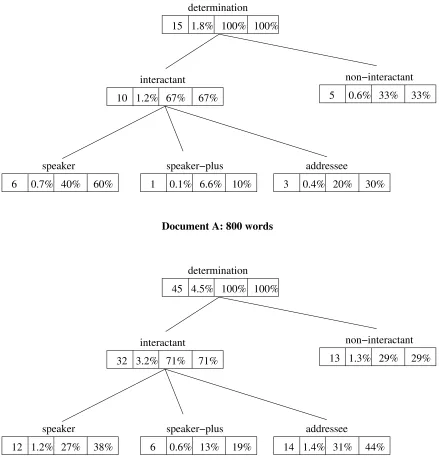
Figure 3 shows a portion of the DETERMINATION system for two documents of different sizes, be-longing to the same register. Four possible fea-ture representations are given: from left to right, each node shows the total count, term frequency, system percentage, and system contribution. Each feature representation captures a different aspect of system usage in a document and register.
Raw counts (term frequency) (first column). The summed feature count, shown in the leftmost column, presents these two documents as highly dissimilar. Note also that this is only the top por-tion of the system, and that multiple levels exist below those shown. Raw term counts are usually not used directly as features, as they are heavily influenced by document length.
Document percentage (second column) is the standard basis for bag-of-words representations; it gives the proportion of the document accounted for by this term. It is commonly used since it normalises for document length; most topic-based document classification rightly assumes that the document length is not important (Sebastiani, 2002). In creating features for each sub-system, this representation can still take advantage of the aggregation and smoothing provided by the sys-tem, but does not take further advantage of the known structure.
System percentage (third column) gives the proportion of total system usage made up by this sub-system. In Document A, addressee occurs three times from a total of fifteen occurrences of determination in the document, giving it a tem percentage of 20%. Within a document, sys-tem percentage is directly proportional to term fre-quency, but is independent to system density in the document. If another 800 words were added to Document A, but no more uses of DETERMINA-TION, the term frequency for a feature would halve while the system percentage remained constant. This makes it a suitable representation where dis-tinctions are made not on how often a feature oc-curs, but the manner of its use. The system per-centage of speaker is higher in Document A than Document B, despite higher term frequency in the latter. System percentage is also useful when the area of interest is a constant-size subsection of a
variable-length document.
System contribution (fourth column) shows the ratio of sub-system to super-system occur-rence. Again in Document A, speaker occurs six times and its super-system, interactant, occurs ten times, giving a system contribution of 60%. This is a strictly local measure of usage, and captures most directly the systemic notion of choice: once the decision to use a given super-system has been made, how often was this sub-system chosen as the realisation? This is a relative feature, and as such is independent of document length, total system usage, and usage of other portions of the system (see Figure 3). Despite the differences in lower-level choices, and in the raw counts of sys-tem usage, the syssys-tem contribution of interactant in Documents A and B are very similar.
System contribution is not proportional or strongly correlated to document percentage, and the two measures provide useful and complemen-tary information. Within a system instance, doc-ument percentage can be used to report the fre-quency not just of terms but of systems as well. System contribution does not capture how often a system is used, but rather its usage in relation to the other possible choices. In the same way as a register may be characterised by choice, it may also be characterised by frequent usage of a partic-ular system, which will be highlighted by system percentage. The four complementary representa-tions given here may each be useful in discerning characteristic system usage.
In implementing these representations, it is worth noting that not all system contribution fea-tures are necessary, and some can be removed. Features from a node which is an only child do not add information since there is no choice. In a system with a binary choice, either one of the fea-tures may be discarded since they have unit sum. Both system percentage and system contribution are meaningless at the root level, and system per-centage and system contribution are identical at the first level below the root. These feature re-ductions can be performed deterministically be-fore any further feature selection.
reducing the number of attributes used in machine learning systems, in comparison to broader bag-of-words methods. This should produce smaller feature sets with equal or better performance.
2.4 Selecting Systemic Features
We have presented four potential feature represen-tations for systemic features. Depending on the behaviour of a system network in a particular clas-sification task, the most appropriate representation may vary. In addition, the best feature type may change within a single system. We propose a sim-ple feature selection method for systemic features. For a given task, the attribute significance of each possible feature representation can be mea-sured using a method such as information gain. By ranking the options for a single node upon an information metric, the best feature type for each node can be selected. This reduces the number of features, reduces the chance of performance loss through correlated features, and should combine the strengths of each feature type.
3 Scamseek: Identifying Financial Scams
We tested this range of possible systemic feature representations using models and data compiled as part of the Scamseek project1. Scamseek aims to identify a variety of criminal financial scams on the internet, using a combination of automatically and linguistically derived criteria.
The entire Scamseek corpus, collected and man-ually classified by ASIC experts, contains 7556 documents in a total of 58 registers. These reg-isters fall into four broader classes which group financial scams, other scams, legitimate financial documents, and all other web pages. This coarser classification is of the most interest to the client, as potential scams are investigated regardless of scam type. For these experiments we used 1896 documents from 22 registers with a minimum of 20 documents per register.
As well as existing grammar models, a register model was developed by SF linguists for each of
1Scamseek is a joint project funded by The University
of Sydney, the Capital Markets Cooperative Research Cen-tre, the Australian Securities & Investments Commission and Macquarie University.
41 42 43 44 45 46 47 48 49 50 51
0 50 100 150 200 250 300
% accuracy
# features best, SVM
[image:6.612.341.554.42.188.2]gram+reg(comb) gram+reg(ind) reg(ind) reg(comb) grammar baseline
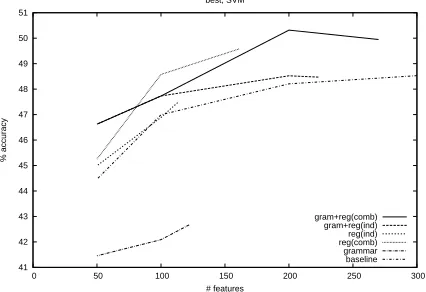
Figure 4: Results for each set of models, selecting the best feature at each node
the Scamseek registers. These were treated in two ways.
Each register model can be considered as a se-lection from a full systemic description of English. Taken individually, a register model aggregates all topic- and genre-specific features, producing an overall picture of the ‘topicality’ of a text. The register models can also be combined to form a single system network, which is more complete but not topic-specific. In this case, it should func-tion more like a grammar model in that the relative usage of systems should become more important. Both of these options were tested.
As well as testing grammar models and regis-ter models independently, the two types of system networks were combined. In all cases, features with no variation or no occurence in the corpus were removed. The systemic features were ex-tracted from documents using an efficient partial parsing method (Whitelaw and Argamon, 2004). Each of the feature representation methods given in Section 2.3 were tested individually and in com-bination (‘all’). The best-feature-per-node feature selection method (‘best’) was also tested for each feature set.
im-gram reg (ind) reg (comb) term frequency 24% 19% 14%
document % 20% 36% 30%
system % 18% 18% 27%
[image:7.612.108.332.38.104.2]sys. contribution 38% 27% 29%
Table 1: Proportion of each feature type selected for ‘best’ sets
plementation used in the WEKA machine learning environment (Witten and Eibe, 1999)2
[image:7.612.343.555.42.190.2]4 Results
Figure 4 shows the results from selecting the best combination of feature types. This also shows the best overall result achieved at 50.4%, using 200 features selected from the grammar and combined register models. This outperforms the full baseline result by two percent. The grammar models alone perform much lower than any of the register mod-els, which is to be expected on this register-based classification.
Table 1 shows what types of features were se-lected in the best-feature-per-node process. As expected, the densely populated grammar models select more system contribution features. When register models are used individually they are very sparse, and there is less benefit from including rel-ative features. In this case, document percentage makes up 36% of the feature set. The combined register model, which forms a single more fully-specified system network, selects equally from all feature types except term frequency. All represen-tations were used by all models, and it is through this corpus- and system-specific selection that the best combination of feature types is found.
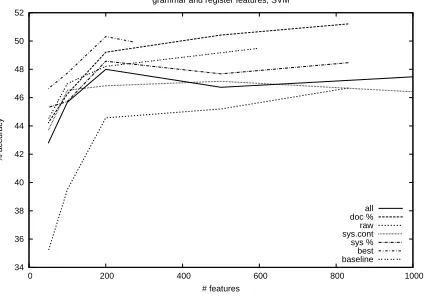
The relative performance of each feature type can be seen in Figure 5. As in most text classifica-tion, raw counts do not work as well as normalised features. Including all features from all nodes re-gardless of potential correlations, as shown by the solid line, produces worse results than using only the best combination of features.
As discussed in Section 2.2, features higher in a system network aggregate and smooth the features below it. When it is the use of semantic categories
2Each experiment was also run using J48 decision trees
and Naive Bayes, but produced consistently poorer results.
34 36 38 40 42 44 46 48 50 52
0 200 400 600 800 1000
% accuracy
# features grammar and register features, SVM
all doc % raw sys.cont sys % best baseline
Figure 5: Results for each feature type
features accuracy baseline 594 82.2% grammar 200 82.4% combined 200 84.4% Scamseek >5000 >90%
Table 2: Class-based accuracy results.
of words that is important, these internal features will be favoured over lexis. This is the case for all the models tested: of the top hundred features in grammar models, 83 are internal. Experimen-tal results bear out the advantage, with better per-formance for systemic features than the lexis-only baseline when both use document percentage.
Table 2 shows the class-based accuracy results for the best feature sets obtained. Registers are more similar to other registers in the same class, resulting in much higher performance than when classifying by register. The best set of 200 sys-temic features performed 2% better than the base-line bag-of-words system. Grammar models also outperformed the baseline despite poor register ac-curacy. This is evidence of the stylistic differences between these categories. The full Scamseek sys-tem, which combines bag-of-words features with more systemic features and other processing such as entity recognition, uses many more features and achieves much higher performance.
5 Conclusions
[image:7.612.369.528.224.299.2]con-tinue to expand beyond topic detection, we must move towards a richer representation of a docu-ment. SFL provides one such linguistic model, and the representation of system models as fea-tures presented here shows the efficacy of a the-oretically motivated approach. Systemic features allow for the production of smaller, denser fea-ture sets that contain more sophisticated feafea-tures than traditional methods. Grammar models can help build stylistic profiles of texts; register mod-els supplement these with genre-specific linguis-tic phenomena. Through their combination, and a combination of new feature representations such as system contribution and system percentage, we have shown increased performance on the difficult task of identifying financial scams.
The system networks used in this research are still heavily tied to lexical realisations. The sys-temic feature extraction process can be efficiently expanded to include morphosyntactic and simple grammatical relationships; this will allow for the description of linguistic phenomena related to the logogenesis or unfolding of a text, such as the rel-ative ordering of features. As more system net-works are constructed for core sections of English SFL grammar, these models will be beneficial to a wide range of tasks including the classification of style, sentiment, attitude and affect.
References
Shlomo Argamon and Jeff T. Dodick. 2004. Linking rhetoric and methodology in formal scientific writ-ing. In Proceedings of the 26th Annual Meeting of
the Cognitive Science Society.
Oliver Carr and Dominique Estival. 2002. Text clas-sification of formatted text documents. In
Proceed-ings of the 2002 Australian Natural Language Pro-cessing Workshop.
Michael A. K. Halliday. 1994. Introduction to
Func-tional Grammar. Edward Arnold, second edition.
M. A. Herke-Couchman. 2003. Arresting the scams: Using systemic functional theory to solve a hi-tech social problem. In ASFLA03.
C. M. I. M. Matthiessen and J. A. Bateman. 1991. Text
generation and systemic-functional linguistics: ex-periences from English and Japanese. Frances
Pin-ter Publishers and St. Martin’s Press, London and New York.
C. M. I. M. Matthiessen. 1993. Register analysis: the-ory and practice. In Register in the round: diversity
in a unified theory of register, pages 221–292. Pinter,
London.
Christian Matthiessen. 1995. Lexico-grammatical
car-tography: English systems. International Language
Sciences Publishers.
M. O’Donnell. 2002. Automating the coding of se-mantic patterns: applying machine learning to cor-pus linguistics. In Proceedings of the 29th
Interna-tional Systemic FuncInterna-tional Workshop. University of
Liverpool.
Bo Pang and Lillian Lee. 2004. A sentimental edu-cation: Sentiment analysis using subjectivity
sum-marization based on minimum cuts. In
Proceed-ings of the ACL 2004, Main Volume, pages 271–278,
Barcelona, Spain, July.
J. Platt, 1998. Advances in Kernel Methods -
port Vector Learning, chapter Fast Training of
Sup-port Vector Machines using Sequential Minimal Op-timization. MIT Press.
Sam Scott and Stan Matwin. 1998. Text classification using WordNet hypernyms. In Sanda Harabagiu, ed-itor, Use of WordNet in Natural Language
Process-ing Systems: ProceedProcess-ings of the Conference, pages
38–44. Association for Computational Linguistics, Somerset, New Jersey.
Fabrizio Sebastiani. 2002. Machine learning in au-tomated text categorization. ACM Computing
Sur-veys, 34(1):1–47.
M. Taboada and J. Grieve. 2004. Analyzing appraisal automatically. In AAAI Spring Symposium of
Ex-ploring Attitude and Affect in Text. AAAI.
Hans van Halteren. 2004. Linguistic profiling for au-thorship recognition and verification. In
Proceed-ings of the 42nd Meeting of the Association for Computational Linguistics (ACL’04), Main Volume,
pages 199–206, Barcelona, Spain, July.
Casey Whitelaw and Shlomo Argamon. 2004. Sys-temic functional features in stylistic text classifica-tion. In Proceedings of AAAI Fall Symposium on
Style and Meaning in Language, Art, and Music.
AAAI.
Casey Whitelaw, Maria Herke-Couchman, and Jon Patrick. 2004. Identifying interpersonal distance using systemic features. In Proceedings of AAAI
Workshop on Exploring Attitude and Affect in Text: Theories and Applications. AAAI Press.
Ian H. Witten and Frank Eibe. 1999. Data Mining: