IJEDR1601031
International Journal of Engineering Development and Research (www.ijedr.org)176
Performance Analysis of Radio over Free Space
Optical Link under the Effect of different Attenuation
Factors Using Advanced Modulation Formats
1 Rajdeep Kaur,2 Ramandeep Kaur,3 Rajandeep Singh 1 M. tech student,2 Assistant Professor,3 Associate professor
1 Electronics department, Punjabi University Patiala, India
________________________________________________________________________________________________________
Abstract -Radio Over Free space optics is a promising and under developed technique in a optical communication system to increase capacity and decreasing the system costs for future broadband communication. In this work, analyzed the performance of radio over free space optical communication system in the effect of various atmospheric conditions. A signal of 10Gbps is transmitted through Radio Over Free Space Optical Link and proposed system has to be evaluated in terms of Q-Factor, BER and Eye Opening Factor. The various advanced modulation formats NRZ, CSRZ, DPSK have been investigated in Radio over free space optical link. Among them, it is ensured that DPSK is the most accurate, well suited and simplest technique for RO-FSO channel. It has been observed that DPSK performs better at long range than CSRZ, NRZ techniques. Superior performance shows that DPSK which has simple design and less cost, perform best at a higher transmission range at the data rate of 10Gbps. All the results are observed using NRZ, RZ, CSRZ, DPSK modulation Formats and amplifier is not incorporated in this work.
IndexTerms - RO-FSO (Radio over Free space optics), RF (Radio Frequency), DPSK (Differential Phase Shift Keying), Q-Factor.
________________________________________________________________________________________________________
I.INTRODUCTION
The global telecommunication network has seen many brilliant inventions and discoveries over the last few years. Instead of new technologies optical networks are the remarkable medium for high bandwidth communications. Radio over Free Space Optics (Ro-FSO) and Radio over Fiber (RoF) are two new technologies in optical communication systems. These days the problem faced by the developers of Radio over fiber optical communication systems is that to provide separate fiber optic line to each end user is very costly [1]. The installation cost of optical fiber is so high and also takes lot of time such as taking grant from the government, trenching, labour cost etc. On the other hand, the microwave and RF frequencies are used to transfer the information but they suffer from serious drawbacks like less bandwidth, congestion problem, radiations penetrate through walls and less data rate transfer due to losses [2], if information is transmitted through R.F communication then it occupies large part of the spectrum and as well as provides less security [3]. In order to remove the problem of optical fiber communication and R.F communication, researchers invented a new system known as Ro-FSO. Ro-FSO use the light from the optical fiber and use free space from the R.F communication which means Ro-FSO transmit the information in the form of light and use the free space as a medium but the main requirement of Ro-FSO is that it needs a proper line-of-site in between transmitter and receiver [4]. Ro-FSO has many advantages over wired and Wireless communication.
IJEDR1601031
International Journal of Engineering Development and Research (www.ijedr.org)177
The system consists of a laser beam modulated with data and is transmitted through free space with less attenuation than microwave and RF links as light travels faster in vacuum and can travel a long distance with minimum bit error rate [15]. The system is outstanding until the atmospheric disturbances are not present and effect of atmospheric attenuation is different for different modulation formats [16].The other parameters which affect the transmission properties include transmission aperture diameter, receiver aperture diameter and power of the operating laser source. The system needs more power when operated at large distances. So the advanced modulation schemes are investigated for the Ro-FSO optical wireless communication for the better performance. Further, the best scheme is observed under different power levels and analyzed the performance of the system at different atmospheric conditions. In this paper, the comparative study of various advanced modulation techniques has been carried out. The advanced modulation techniques under investigation include CSRZ, NRZ and DPSK. The article presents the simulation set up of different modulation schemes in single channel RO-FSO system. Section 2 describes the system description of Ro-FSO transmitter and receiver using various advanced modulation formats. Section 3 focuses on the performance of Ro-FSO system using various advanced modulation formats by varying the transmission range, followed by simulation results of DPSK at different power levels. Also evaluate the performance of the FSO system using various advanced modulation formats during different atmospheric conditions by taking the attenuation factors 4dB/Km, 22dB/km, 40dB/km, 64dB/km and 100dB/Km [18]. The simulation results are discussed in section 4 with the conclusion drawn..
II.SYSTEMDESCRIPTION
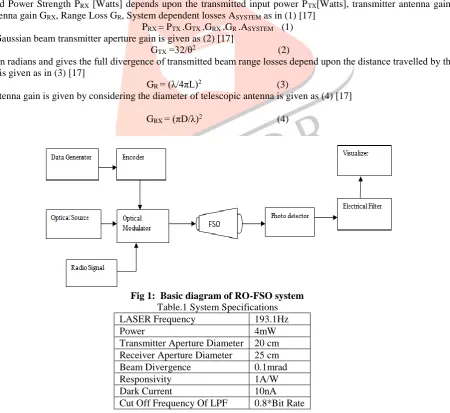
Ro-FSO system has been modeled and performance characterization by OptiSystem7.The RO-FSO basic diagram is shown in Fig 1. In this proposed system, the transmitter (Tx) consists of Pseudo-Random Binary Sequence (PRBS) generator, it represents the data which is to be transmitted. A continuous wave (CW) laser source which operates on 1552 nm because of low attenuation in optical communication in this wavelength region, is externally modulated with an encoder. Receiver (Rx) consists of Photo detector followed by low pass Bessel Filter. In this section of system, the optical signal is converted back into electrical signal. APD (avalanche photo-diode) is used because of its high gain property. When signal propagates from the channel then it is easily affected by the atmospheric effects so in order to remove high frequency components signal passes through the LPF which remove the non linear and high frequency components. The last subsystem is BER tester which gives the Quality factor and BER measurement.
The received Power Strength PRX [Watts] depends upon the transmitted input power PTX[Watts], transmitter antenna gain GTX, receiver antenna gain GRX, Range Loss GR, System dependent losses ASYSTEM as in (1) [17]
PRX = PTX .GTX .GRX .GR .ASYSTEM (1) Assuming Gaussian beam transmitter aperture gain is given as (2) [17]
GTX =32/θ2 (2)
Where θ is in radians and gives the full divergence of transmitted beam range losses depend upon the distance travelled by the light which is given as in (3) [17]
GR = (λ/4πL)2 (3)
Receiver antenna gain is given by considering the diameter of telescopic antenna is given as (4) [17]
GRX = (πD/λ)2 (4)
Fig 1: Basic diagram of RO-FSO system
Table.1 System Specifications
LASER Frequency 193.1Hz
Power 4mW
Transmitter Aperture Diameter 20 cm Receiver Aperture Diameter 25 cm
Beam Divergence 0.1mrad
Responsivity 1A/W
Dark Current 10nA
IJEDR1601031
International Journal of Engineering Development and Research (www.ijedr.org)178
The system works on data rate of 10Gbps at a link range of 100 to 3000 m. Experimental set up of different advanced modulation formats are shown in Fig 2.(a)Generation diagram NRZ
(b)Generation diagram CSRZ
(c)Generation diagram DPSK
(d)Generation diagram RZ
Figure.2: Generation diagrams of advanced modulation formats at 10Gbps data rate (a) NRZ (b) CSRZ (c) DPSK (d) RZ
III.RESULTS AND DISCUSSION
In this system, different advanced modulation formats have been evaluated on a single channel Ro-FSO link and OWC system. A comparative study of advanced modulation schemes CSRZ, RZ, NRZ and DPSK has been carried out. The different parameters at which the FSO system works are: Data rate 10Gbps, transmitter wavelength 1550 nm, varying distances from 1km to 5km, transmitter aperture diameters 20cm, receiver aperture diameter 25cm, attenuation factor 022dB/km and beam divergence is 0.1mrad .The best scheme among them is DPSK and This scheme is also used to evaluate the performance of FSO link under the impact of different attenuation factors.
IJEDR1601031
International Journal of Engineering Development and Research (www.ijedr.org)179
Fig.3: Graphical Representation of different advanced modulation Formats in Ro-FSO System
By Using DPSK Modulation Format without integrating amplifier at 22dB/km attenuation factor, the RO-FSO link can cover a distance of 2500m at acceptable BER and Q-Factor, While CSRZ, RZ and NRZ can cover only 1100m, 1100m and 1200m at acceptable BER and Quality Factor. The eye diagrams for these modulation formats at maximum distance with acceptable BER and Q-Factor have been shown in Fig.5, which shows the comparison among these.
(a) (b)
(c) (d)
Fig.4Eye diagrams of different modulation formats at 10Gbps data rate at maximum distance with acceptable BER and
Q-Factor in Ro-FSO link (a) NRZ at a distance 1200m (b) RZ at a distance 1100m (c) CSRZ at a distance of 1100m (d) DPSK at a distance of 2500m
IJEDR1601031
International Journal of Engineering Development and Research (www.ijedr.org)180
(b) (c) (a)
(d) (e)
Fig. 5: Evaluation of RZ modulation format at different attenuation factors using FSO (a) 4dB/Km (b) 22dB/Km (c)40dB/Km (d) 64dB/Km (e) 100dB/km.
From Fig 5, it reveals that Ro-FSO link using RZ modulation Format prolongs to 4100 m, 1100m, 600m, 400m and 260 m at attenuation factors 4dB/km, 22dB/km, 40dB/km, 64dB/km and 100dB/km with acceptable BER and Q-factor.
(b) (c) (a)
(d) (e)
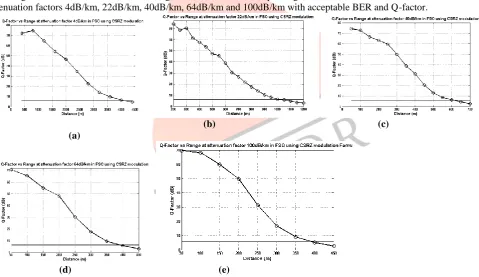
Fig. 6: Evaluation of CSRZ modulation format at different attenuation factors (a) 4dB/Km (b) 22dB/Km (c)40dB/Km (d) 64dB/Km (e) 100dB/km.
IJEDR1601031
International Journal of Engineering Development and Research (www.ijedr.org)181
(b) (c) (a)
(d) (e)
Fig. 7: Evaluation of NRZ modulation format at different attenuation factors (a) 4dB/Km (b) 22dB/Km (c)40dB/Km (d) 64dB/Km (e) 100dB/km.
From Fig 7, it reveals that RO-FSO link using NRZ modulation Format prolongs to 4800 m, 1200m, 700m, 450m and 280 m at attenuation factors 4dB/km, 22dB/km, 40dB/km, 64dB/km and 100dB/km with acceptable BER and Q-factor.
(b) (c) (a)
(d) (e)
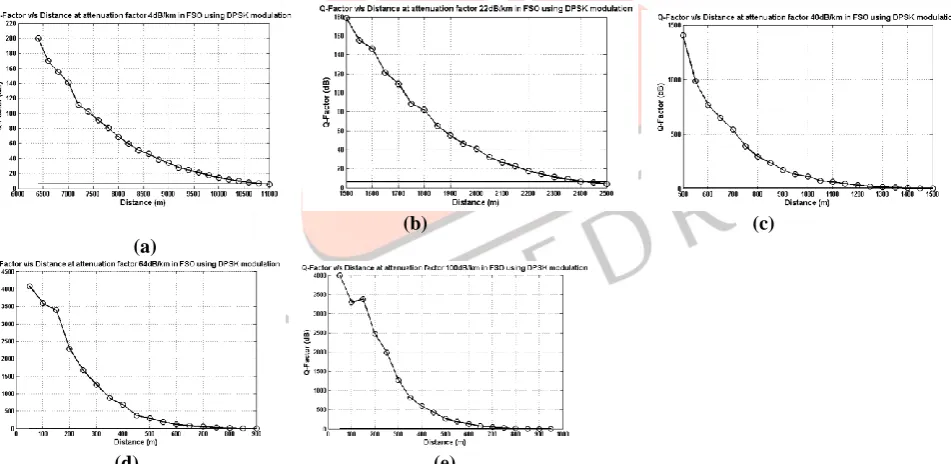
Fig.8: Evaluation of DPSK modulation format at different attenuation factors (a) 4dB/Km (b) 22dB/Km (c)40dB/Km (d) 64dB/Km (e) 100dB/km.
From Fig 8, it reveals that RO-FSO link using DPSK modulation Format prolongs to 11000m, 2500m, 1500m, 1000m and 900m at attenuation factors 4dB/km, 22dB/km, 40dB/km, 64dB/km and 100dB/km with acceptable BER and Q-factor.
In this paper, results are observed in terms of Q-factor, BER and Eye Opening Factor by transmitting 10Gbps signals through RO-FSO link using different modulation techniques and under the effect of different atmospheric conditions. It is revealed from Fig 4, Fig 5, Fig 6 and Fig 7 that DPSK performs better than other techniques, at long distance with acceptable BER and Q-Factor. Fig 8, Fig 9, Fig 10, Fig 11 shows that system performs better with less attenuation factor, as a attenuation increases Q-Factor decreases.
IV CONCLUSION
IJEDR1601031
International Journal of Engineering Development and Research (www.ijedr.org)182
performance is evaluated under the effect of different atmospheric attenuation factors in terms of Q-Factor and BER at 10Gbps data rate. Hence, it is concluded that DPSK is the best for long transmission distance and high data rate applications with minimum bit error rate and good quality factor.REFERENCES
[1] S. A. Al-Gailani, A.B.Mohammad,R.Q.Shaddad, " The Enhancement of a free space optical link in heavy rain attenuation using multiple beam concept", Elsevier, Optik 124 (2013) 4798-4801.
[2] Rajandeep Singh, Meera Handa, Maninder Lal Singh,”Performance analysis of optical WDM system based on unequal spaced channel allocation scheme “, Elsevier Science, Optik , June 2014.
[3] Maninder Lal Singh, Rajandeep Singh, Harpreet Gill,”A novel full duplex 16Gbps SCM/ASK radio over fiber WDM-PON sharing wavelength up and downlink using bidirectional reflective filter”, Elsevier Science, Optik ,June 2014
[4] Jitender Singh,Naresh Kumar, " The Performance analysis of different modulation format on a free space optical communication system",Elsevier, Optik 124 (2013) 4651-4654.
[5] S.Vigneshwaran, I.Muthumani, A.S. Raja, "Investigations on Free space optics communication system", Information Communication & Embedded Systems (lCICES), IEEE Conference Publication, 2013.
[6] Md. Tawabur Rahman,S. Iqbal,M.M Islam, "Modeling and the Performance Analysis of a Free Space Optical Communication System", International Conference on Informatics, Electronics and Visions, IEEE 2012.
[7] Samir A. Al.Gailan,A.B.Mohammad,R.Q.Shaddad,M.Y.Jamaludin, " The Single and Multiple Transceiver Simulation Modules for a Free-Space Optical channel in a Tropical Malaysian Weather", Business Engineering and Industrial Applications Colloquium (BEIAC), IEEE 2013.
[8] Hakki H. Refai,James J. Sluss,Hazem H.Refai, “Optical interference on free-space optical transceivers,” Frontiers in Optics – 87th Optical Society of America Annual Meeting, Tucson, AZ., (2003).
[9] Hakki H. Refai, James J. Sluss, Hazem H Refai,“The use of a free-space optical links for CATV applications,” accepted to SPIE opto Ireland, Dublin, Ireland, April 4-5, 2005.
[10] Ratna Kalos Zakiah Sahbudin, Mazlin Kumarulzaman, Salasiah Hitam,Makhfudzah Mokhtar,Siti Barirah Ahmad Anas," The Performance of a SAC OCDMA-FSO Communication Systems",Elsevier, Optik 124 (2013) 2868-2870.
[11] Vishal Sharma, Gurimandeep Kaur, " The High speed, long reach OFDM FSO transmission Link incorporating the OSSB and OTSB schemes", Elsevier, Optik 124 (2013) 6111-6114.
[12] Gary Shaulov, J. Patel, B.Whitlock,P.Mena, "The Simulation-Assisted Design of a Free Space Optical Transmission Systems", Military Communications Conference (MILCOM), IEEE 2005.
[13] Hilal A. Fadhil, Angela Amphawan,Hasrul A.B.Shamsuddin " The Optimisation of free space optics parametes: An optimum solution for the bad weather conditions", Elsevier, Optik 124(2012) 3969-3973.
[14] M. Ijaz, Z.Ghassemlooy, S.Rajbhandari, H.Le Minh, "Comparison of 830 nm and 1550 nm based Free Space Optical Communications link under Controlled Fog Conditions", 8TH lET international Symposium on Communication Systems, Networks and Digital Signal Processing, IEEE 2012.
[15] H. A. Willebrand and B. S. Ghuman, “Fiber optics without fiber,” IEEE Spectrum, Volume: 38, No: 8, Aug. 2001, pp.43. [16]Hemani Kaushal, V.K.Jain, Kar Subrat “ The Effect of Atmospheric Turbulence on Acquisition Time of Ground to the Deep Space Optical Communication System” World Academy of Science, Engineering and Technology, Vol. 3 2009-02-25, International Scholarly and Scientific Research & Innovation 3(2) 2009.
[17] S.Arnon and N.S. Kopeika,” Effect of particulates on performance of optical communication in space and an adaptive method to minimize such effects,” Appl. Opt.,vol.33,no. 21,pp. 4930-4937,July 1994