Subspace Clutter Removal Techniques in GPR Images
Mohanad Abd Shehab1, Mohammed Abdulridha Sahib Al Obaidi2,
˙Ilknur Ho¸s3, and Saeid Karamzadeh4, *
Abstract—In many modern GPR systems, it is desired to detect the presence of targets in the interference which includes clutter and noise. Detection of water leaks using GPR has been aimed in this work. Pipe and soil are known as the clutter of data in this scenario. Various signal processing techniques like multivariate subspace-based algorithms are proposed to effectively suppress the clutter and increase the signal to interference ratio. Combining Independent Component Analysis (ICA) and Principal Component Analysis (PCA) as a unique algorithm has demonstrated the ability to eliminate the GPR clutter and extract the target signal.
1. INTRODUCTION
GPR is a non-destructive method that generates EM pulses to record, locate, and evaluate the depth of buried objects or subsurface features that cannot be seen visually. It is extensively used for target imaging, detection, and localization, health care applications, indoor motion detection, civil engineering applications, etc. [1].
It is well known that target detection process in GPR is highly affected by clutter. Clutter degrades the detection performance and may increase the false alarms in a non-target region, and it can be caused by the intervention between the transmitting and receiving antennas, reflection from the ground which is called ground bounce and scattering response from non-mine objects (roots, small rocks, non-uniform terrain and so on) [2]. Since the targets are buried near the surface which consist of minimum metal contents, clutter suppresses target signal because amplitude of reflected signal from the target is weaker than ground bounce. Therefore, clutter removal techniques can increase the detection probability of the buried objects.
In GPR system, the reflected signal is composed of target, clutter, and system noises. As the system noise has less importance than the other components, clutter reduction algorithms aim to decompose the reflected signal as target and clutter. There are different approaches that can remove the clutter in the GPR images. Among those, the subspace-based methods such as principal component analysis (PCA) [3–5], independent component analysis (ICA) [6, 7], singular value decomposition (SVD) [8–10], and the possible combination between them. These techniques are based on eigen values to perform matrix decomposition on the GPR image with different constraints. After the GPR image decomposes into multiple sub-images by these methods, the first sub-image (most dominant one) is prevailed as clutter, and the remaining ones construct the target components. PCA, ICA, and SVD indeed can construct multivariate subspace bases for separating the clutter from the target.
Many researches prove that subspace-based methods are the best to obtain an ideal target shape (hyperbola) [11, 12]. They can successfully remove clutter part of the GPR image.
Received 25 March 2019, Accepted 19 June 2019, Scheduled 2 July 2019
* Corresponding author: Saeid Karamzadeh ([email protected]).
In addition to above clutter removal methods and in the case of rare inhomogeneous soil medium where its statistical properties vary with position along the surface, it can apply mean subtraction/removal (MS) [13], whereby the background signal is estimated as the mean of the unprocessed ensemble of GPR signals without a buried object [14]. MS is the simplest clutter reduction technique and is most effective if the ground is flat and uniform over the antenna path which is an ideal situation. However, subtracting the average may not lead to sufficient clutter reduction [15].
In this work, we have applied MS, SVD, PCA, ICA, and the combination of PCA/ICA which is called PICA methods on the B-scan GPR data. ICA based method components are reconstructed using corresponding Joint Approximate Diagonalization of Eigen matrices (JADE) [16]. GPR signals are almost of non-Gaussian distribution and above the second order moments, and as a result ICA is effective to process this type of signals. Moreover, PCA is simple and adequate for dimensionality reduction, therefore combining PCA and ICA, i.e., PICA, can produce an efficient method that handles both dimensionality reduction with suitable GPR clutter removal. The results of all these methods will be compared and show that our new method is the best one.
2. MULTIVARIATE TECHNIQUES
Similar to speech, biomedical and seismic signals, GPR is a mixture of signals with unknown mixing coefficients. As a result, it needs to employ Blind Source Separation (BSS) [17, 18] approaches that can separate a set of signals called source signals from their mixture signals, without acquaintance of any information (or with very little information) about mixing background and sources. The most BSS problem is studied under the linear data model. Different methods have been employed to find such a linear representation, including conventional methods, singular value decomposition, principal components analysis, and independent component analysis.
The simplest conventional clutter removal algorithm is the mean subtraction (MS) which can be expressed as Eq. (1)
Xij =Aij−mean(Aij) =Aij− 1 n
n
j=1
Aij (1)
The subspace-based methods are non-parametric methods that can extract significant features from a mixture of data and convert the correlated mixture data variables into a set of linearly uncorrelated variables. GPR image can be represented as a matrix X with m ×n dimension that includes both clutter and target signals, i.e.,X =Xclutter +Xtarget.
Ais also anm×ntransformation matrix that contains eigen vectors in decreasing order. After the transformation matrixAis found depending on some rules like orthogonality, the subspace matricesSi, Ai, and X can be decomposed and formulated according to the subspace method as:
PCA
X =AT1S1+
n
i=2
ATi Si (2)
ICA
X =A1S1+
n
i=2
AiSi (3)
SVD
Since X =UDVT, where Um×m, Vn×n are orthogonal matrices, andDm×n is a diagonal matrix with singular values arranged in descending order of magnitude, i.e., D= diag(σ1, σ2, . . . , σn).
X=
n
i=1
σiuivTi =σ1u1vT1 +
n
i=2
σiuiviT (4)
3. EXPERIMENTAL RESULTS
The main objective of this work is to reduce the amount of clutter and other unwanted signals present in the GPR data which are not related to the target characteristics. Two metrics are used to evaluate performance of the proposed algorithms, which are Peak Signal-to-Noise Ratio (PSNR) and Structural Similarity Index (SSIM).
SNR is the ratio of average energy of the image matrix after removing the clutter and noise to the average of matrix containing clutter and noise:
SNR = Pclutter and noise removal
Pclutter and noise (5)
SSIM indicates and assesses the similarity between the base image and the processed image with values between 0 and 1, where 1 represents the identical images.
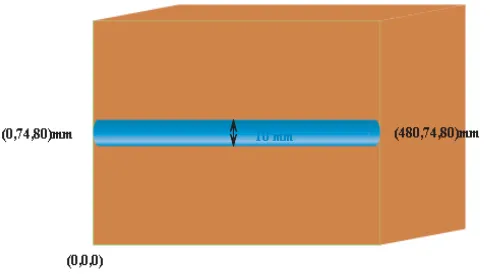
The simulated dataset is constructed by using gprMax simulation tool which has the ability of simulating real commercial antennas. In all simulations, Geophysical Survey Systems Inc. (GSSI) 1.5 GHz (Model 5100) antenna is used. It can implement various scenarios with different objects, different soil types, and different burial depths. Therefore, a huge dataset including many GPR images is easily constructed. Here, we use gprMax to implement and study a simple and general case, which is:
A wet sandy box with (x, y, z) dimension (480 mm, 148 mm, 170 mm).
A metallic pipe which starts at (0 mm, 74 mm, 80 mm), ends at (480 mm, 74 mm, 80 mm) coordinate alongx-axis with 10 mm radius.
Antenna 5 mm upper than sandy box and 5 mm distance scan.
GSSI 1.5 GHz antenna frequency. The gprMax commands are:
Figure 1 depicts the geometrical structure of the case under studying.
Figure 1. The geometrical structure of the GPR model.
During simulation, the antenna has been moved 54 times for scanning the whole box. In each step, A-scan data have been collected to provide the row B-scan data.
The simulated B-scan and A-scan the GPR model are shown in Fig. 2.
The pipe is the most prominent background of our row data that should be subtracted.
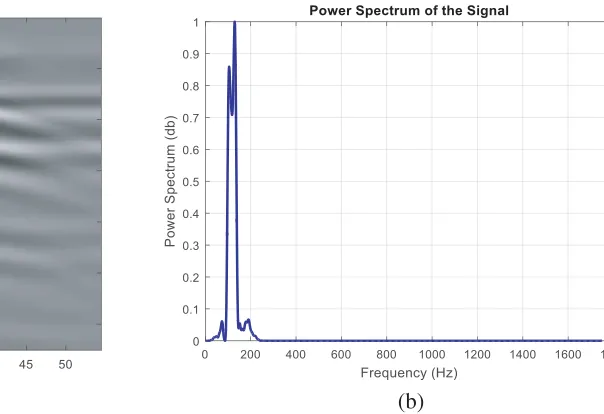
Utilizing FFT, the power spectrum of the whole data can be estimated as shown in Fig. 3. It is obvious that the spectrum is composed of two peaks with different amplitudes and frequencies which are corresponding to the background with the surface barrier and metallic pipe.
(a) (b)
Figure 2. GPR (a) B-scan and (b) A-scan signal.
Figure 3. The power spectrum of the GPR
signal.
Figure 4. Eigen spectra of the GPR signal.
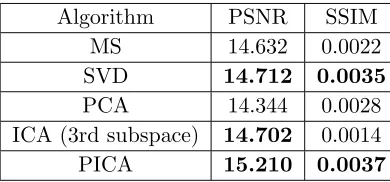
Table 1. PSNR and SSIM values for the different described clutter reduction algorithms.
Algorithm PSNR SSIM
MS 14.632 0.0022
SVD 14.712 0.0035
PCA 14.344 0.0028
ICA (3rd subspace) 14.702 0.0014
(a) (b)
Figure 5. (a) Decluttered image using MS, (b) the power spectrum.
(a) (b)
Figure 6. (a) Decluttered image using SVD, (b) power spectrum.
matrix of the GPR image in SVD method or the first principal component in the PCA and ICA based methods. Fig. 4 illustrates that the most discriminative features are within the first 20 dimensions; therefore, it can ignore the low significant features of the GPR image and reduce the dimension of the data to 325×20.
Without using any prior information, the easiest clutter removal method is the mean subtraction (MS) method. Figs. 5(a) and 5(b) explain the decluttered GPR and its corresponding power spectrum using mean subtraction method.
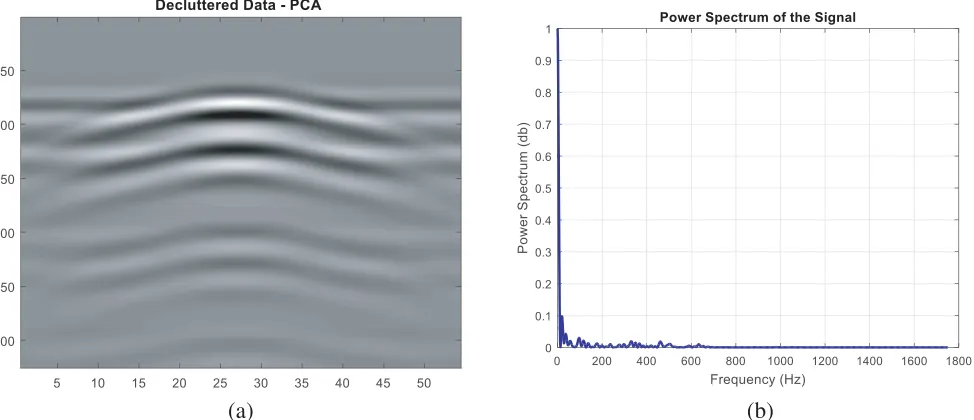
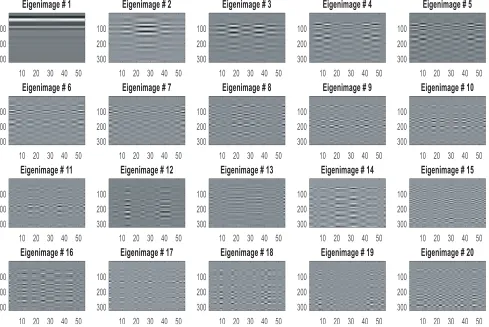
Figures 6–9 show the performance results of the SVD, PCA, 3rd principal of ICA, and the proposed PICA clutter removal methods on the real data. The signal reconstruction using 20-ICA Eigen image components is illustrated in Fig. 10.
Table 1 summarizes the PSNR and SSIM performances of all decluttering techniques.
state-of-(a) (b)
Figure 7. (a) Decluttered image using PCA, (b) power spectrum.
(a) (b)
Figure 8. (a) Decluttered image of the 3rd component using ICA, (b) power spectrum.
the-art clutter removal methods.
All subspace algorithms are simulated and realized using MATLAB 8.6 (R2015b) software tool and performed on an (Intel Core i5, 2.4 GHz CPU, 4GB RAM) computer.
The running time performance of the all subspace-based GPR clutter removal algorithm is as shown in Table 2.
Table 2. Time performance of the different clutter reduction algorithms.
Algorithm Time (msec)
SVD 3.73
PCA 4.10
ICA (3rd subspace) 6.78
(a) (b)
Figure 9. (a) Decluttered image using PICA, (b) power spectrum.
For all the decomposition methods, the results are satisfactory, and they can remove the background and surface clutter successfully. In addition, it can reduce the dimensionality of the processed data.
4. CONCLUSION
Various well-known approaches such as mean subtraction (MS), singular value decomposition (SVD), principal component analysis (PCA), independent component analysis (ICA), and the combination (PICA) are tested and examined for GPR clutter reduction purpose. They have been applied to GPR data with the aim to improve image quality by removing target uncorrelated features from the image and prepare reduced data for further processes like the classification tasks which is envisaged to be the next stage after clutter reduction. Consequently, the data representations handled by various feature spaces in GPR significantly enhance the trace and object detection efficiency.
For various GPR data samples, PCA, SVD, and PICA methods demonstrate that they are suitable for the uniform or near to uniform clutter reduction. Meanwhile, for the non-uniform clutter reduction, PCA, ICA, and PICA are also significant algorithms.
REFERENCES
1. Daniels, D. J., “Ground penetrating radar,” IET Radar, Sonar, Navigation and Avionics, Series 15, Vol. 1, London, UK, 2004.
2. Liu, J. X., B. Zhang, and R. B. Wu, “GPR ground bounce removal methods based on blind source separation,” PIERS 2006 in Cambridge Proceedings, 256–259, USA, March 26–29, 2006.
3. Zhu, J., W. Xue, X. Rong, and Y. Yu, “A clutter suppression method based on improved principal component selection rule for ground penetrating radar,”Progress In Electromagnetics Research M, Vol. 53, 29–39, 2017.
4. Abujarad, F. and A. Omar, “GPR data processing using the component-separation methods PCA and ICA, imagining systems and techniques,”Proceedings of the 2006 IEEE International Workshop on [Imagining read Imaging], 60–64, IEEE, 2006.
5. Karlsen, B., J. Larsen, H. Sorensen, and K. B. Jakobsen, “Comparison of PCA and ICA based clutter reduction in GPR systems for anti-personal landmine detection,” Proceedings of the 11th IEEE Signal Processing Workshop on Statistical Signal Processing, 2001, 146–149, IEEE, 2001. 6. Karlsen, B., H. B. Sorensen, J. Larsen, and K. B. Jakobsen, “Independent component analysis
for clutter reduction in ground penetrating radar data, detection and remediation technologies for mines and minelike targets VII,” International Society for Optics and Photonics, Vol. 4742, 378–390, 2002.
7. Verma, P. K., A. N. Gaikwad, D. Singh, and M. J. Nigam, “Analysis of clutter reduction techniques for through wall imaging in UWB range,”Progress In Electromagnetics Research B, Vol. 17, 29–48, 2009.
8. Abujarad, F., G. Nadim, and A. Omar, “Clutter reduction and detection of landmine objects in ground penetrating radar data using singular value decomposition (SVD),”Proceedings of the 3rd
International Workshop on Advanced Ground Penetrating Radar, IWAGPR 2005, 37–42, IEEE,
2005.
9. Cagnoli, B. and T. Ulrych, “Singular value decomposition and wavy reflections in ground-penetrating radar images of base surge deposits,” Journal of Applied Geophysics, Vol. 48, No. 3, 175–182, 2001.
10. Riaz, M. M. and A. Ghafoor, “Information theoretic criterion based clutter reduction for ground penetrating radar,”Progress In Electromagnetics Research B, Vol. 45, 147–164, 2012.
11. Karamzadeh, S., M. Kartal, S. Kent, and A. Abed Ashtiyani, “Optimal signal processing method in UWB radar for hidden human detection,”10th European Conference on Synthetic Aperture Radar,
EUSAR 2014, 1–3, VDE, 2014.
12. Kumlu, D. and I. Erer, “A comparative study on clutter reduction techniques in GPR images,”
13. Khan, U. S. and W. Al-Nuaimy, “Background removal from GPR data using eigen values,” 13th International Conference on Ground Penetrating Radar, 2010.
14. Abujarad, F., A. Jostingmeier, and A. S. Omar, “Clutter removal for landmine using different signal processing techniques,” Proceedings of the Tenth International Conference on Ground Penetrating Radar, Vols. 1 and 2, 697–700, 2004.
15. Van der Merwe, A. and I. J. Gupta, “A novel signal processing technique for clutter reduction in GPR measurements of small, shallow land mines,” IEEE Transactions on Geoscience and Remote Sensing, Vol. 38, No. 6, 2627–2637, 2000.
16. Thu, H., D.-T. Pham, and C. Ah-Soonl, “Mutual information based independent component analysis of array data,” 2005, http://www.math-info.univ-paris5.fr/map5/publis/PUBLIS05/2005-17.pdf.
17. Cichocki, A. and S. Amari,Adaptive Blind Signal and Image Processing: Learning Algorithms and Applications, John Wiley & Sons, West Sussex, UK, 2003.