Electronic Thesis and Dissertation Repository
11-7-2017 1:00 PM
Prime Ministers and Public Expectations: A Study of Institutional
Prime Ministers and Public Expectations: A Study of Institutional
Change
Change
Kenny William Ie
The University of Western Ontario Supervisor
Cristine de Clercy
The University of Western Ontario Graduate Program in Political Science
A thesis submitted in partial fulfillment of the requirements for the degree in Doctor of Philosophy
© Kenny William Ie 2017
Follow this and additional works at: https://ir.lib.uwo.ca/etd Part of the Comparative Politics Commons
Recommended Citation Recommended Citation
Ie, Kenny William, "Prime Ministers and Public Expectations: A Study of Institutional Change" (2017). Electronic Thesis and Dissertation Repository. 5130.
https://ir.lib.uwo.ca/etd/5130
This Dissertation/Thesis is brought to you for free and open access by Scholarship@Western. It has been accepted for inclusion in Electronic Thesis and Dissertation Repository by an authorized administrator of
i Abstract
This study concerns the institutional bases of prime ministerial power and
leadership. Specifically, it investigates institutional development in the prime ministerial
civil service organizations in Australia, Canada, New Zealand, and the United Kingdom,
from the 1970s to the present. The study asks two basic questions. First, to what extent,
and how, have the institutional bases of prime ministerial power grown? Second, what
explanations can account for the institutional change observed?
The study is framed theoretically in two ways. In terms of general approach, the
study adopts the lens of historical institutionalism, and especially Mahoney and Thelen’s
(2010) characterization of patterns of change over time. In terms of specific empirical
theory, I construct and test an original theory called the Theory of Public Expectations.
This theory locates the impetus for institutional change in the gradual but transformative
shift in public values since the 1970s, captured in the notion of “assertive citizenship”.
Assertive citizenship generates increased public expectations of leaders which, in turn,
incentivize prime ministers to centralize power through institutional enhancement.
Methodologically, the study employs an innovative mixed methods approach to testing
this theory, including quantitative modelling and qualitative case-study analysis.
Overall, the analysis demonstrates that, where the assumptions of both increasing
assertive citizenship and institutional centralization are met, the Theory of Public
Expectations receives some support. Thus, the study reveals the crucial role of the public
in shaping prime ministerial leadership. As importantly, though, the study finds that the
centralization of power in the prime ministership, at least vis-à-vis institutional
development, is not a universal, consistent phenomenon. Contrary to prevailing accounts,
ii between the public and prime ministerial power.
Keywords
Prime ministers; Prime ministerial branch; Political leadership; Institutional change;
Canada; Great Britain; Australia; New Zealand; Political values; Assertive citizenship;
iii
guidance and patience that any doctoral student could hope for, even when I was not the model supervisee. Her belief in me as a scholar kept me working on this project through difficult times, and her insistence on rigour and clarity improved this work immensely. At crucial points, her facility with metaphors helped me to move the writing forward. Of course, any errors and omissions are wholly my own.
I thank Drs. Cameron Anderson and Peter Ferguson, my dissertation committee members, for their feedback at various stages. Dr. Anderson’s comments on the work in its entirety were tremendously appreciated. I am also grateful to Drs. Chris Alcantara and Laura Stephenson at Western, Dr. Paul Nesbitt-Larking at Huron University College, and Dr. David Stewart from the University of Calgary for agreeing to serve as thesis examiners. Their constructive criticism has been invaluable.
I’d like to mention two other faculty members who have made my time here just that much better. Nigmendra Narain has been unfailing in his friendship, support for us graduate students, and good humour. Joanna Quinn let me in to the club. I’m sincerely proud of my honorary TJ certificate and will bring it with me wherever I end up.
Anne Shaw of the Department of Prime Minister and Cabinet in New Zealand was instrumental in this project having solid data in that case. I acknowledge Western, the Ontario Graduate Scholarship, the Social Science and Humanities Research Council, and the Canadian Study of Parliament Group for their financial support.
I thank friends in the ether, in London, and in the department. It has been a most stressful, most depressing, and most anxiety-filled time, but because of you also the best and happiest years of my life. Ludwig, Maurice and Bob got me through many tough moments. My gaming friends are responsible for much time wasted and infinitely more time enjoyed. And to Tammy Lambert, Andy Chater, Dianne Lalonde, Alison Shott, and Tamara Hinan: wherever you are now, I would not be here without your friendship and support over the past six years. I would not be anywhere.
Finally, I am immensely grateful to my brother, sister, mom and dad for their unconditional love, support, and patience. I know it has been hard my being away for so long. Mom and Dad, I am amazed and so thankful that you arrived in this country forty years ago and made lives for yourselves and for your children. I don’t know if you ever imagined you’d have a son with a PhD in Canadian politics but I know you’re proud.
iv
Abstract ... i
Acknowledgments... iii
Table of Contents ... iv
List of Tables ... vii
List of Figures ... viii
PART ONE: CONTEXT AND THEORY ... 1
Chapter 1 Prime Ministers and Modern Politics ... 2
1.1 Contributions of the Study ... 10
1.2 Plan of the Study ... 13
Chapter 2 Context and Literature ... 16
2.1 A Primer on Westminster and the Westminster Prime Ministership ... 17
2.2 Prime Ministerial Roles and Powers ... 27
2.3 Prime Ministers and Executive Power ... 36
2.4 Prime Ministerial Change in Westminster and Beyond ... 42
2.5 From “Allegiant” to “Assertive” Citizenship ... 54
Chapter 3 Prime Ministers and Public Expectations: A Theory ... 61
3.1 Institutionalization and Institutional Theory ... 63
3.2 The Theory of Public Expectations ... 77
3.2.1 Theoretical Antecedents ... 78
3.2.2 The Logic of the Theory ... 80
3.2.3 Empirical Expectations ... 98
3.2.4 Theoretical Implications ... 100
3.3 Alternative Theories of Prime Ministerial Institutionalization ... 104
3.3.1 Economic Trends ... 105
3.3.2 Political Conditions ... 107
3.4 Conclusion ... 111
Chapter 4 Research Design and Methodology ... 114
4.1 Methodology in the Literature ... 115
4.2 Research Design... 118
4.2.1 A Causal Model of Prime Ministerial Institutionalization ... 119
v
4.4 Research Design: Limitations ... 135
PART TWO: EMPIRICAL ANALYSIS ... 139
Chapter 5 Prime Ministerial Branches and Budget Appropriations ... 140
5.1 Appropriations to the Prime Ministerial Branches ... 141
5.2 Empirical Expectations ... 151
5.3 Preliminary Assessments ... 156
5.4 Regression Model Specification and Estimation ... 165
5.5 Regression Results ... 172
5.5.1 Discussion ... 181
5.6 Patterns of Institutional Change ... 183
Appendix to Chapter 5 ... 188
Chapter 6 Staff Resources in the Prime Ministerial Branches ... 199
6.1 Staff Resources in the Prime Ministerial Branches ... 201
6.2 Empirical Expectations ... 210
6.3 Preliminary Assessments ... 213
6.4 Regression Model Specification and Estimation ... 220
6.5 Regression Results ... 222
6.5.1 Discussion ... 232
6.6 Patterns of Institutional Change ... 235
Appendix to Chapter 6 ... 239
Chapter 7 Institutional Complexity in New Zealand and Canada ... 248
7.1 Concepts and Methodology ... 250
7.1.1 Measuring Complexity: Units in Prime Ministerial Branches ... 253
7.1.2 Empirical Approach ... 260
7.1.3 Hypotheses ... 263
7.1.4 Data Sources ... 265
7.2 New Zealand: The Department of Prime Minister and Cabinet, 1990-2015 ... 267
7.2.1 Proliferation and Specialization in the New Zealand DPMC ... 268
7.2.2 Assessing Theories of Change in Institutional Complexity ... 273
7.2.3 Institutional Complexity and Change in the New Zealand DPMC ... 278
vi
7.4 Discussion and Conclusion ... 299
Chapter 8 Institutional Complexity in the UK and Australia ... 301
8.1 Concepts and Methodology ... 302
8.2 United Kingdom: the Cabinet Office, 1978-2015 ... 305
8.2.1 The Cabinet Office: Origins and Development ... 306
8.2.2 Institutional Complexity in the Cabinet Office since 1978 ... 309
8.2.3 Unit Proliferation and Specialization in the Cabinet Office ... 323
8.2.4 Explaining Change in Institutional Complexity in the Cabinet Office ... 325
8.3 Australia: The Department of Prime Minister and Cabinet, 1978-2015 ... 330
8.3.1 The Australian DPMC prior to 1978 ... 330
8.3.2 Unit Proliferation and Specialization in the DPMC ... 333
8.3.3 Explanations for Change in Institutional Complexity ... 342
8.3.4 Institutional Complexity and Change in the Australian DPMC ... 349
8.4 Discussion and Conclusion ... 350
PART THREE: CONCLUSION ... 352
Chapter 9 Public Expectations and Institutional Change in the Prime Ministerial Branches ... 353
9.1 Summary of the Study ... 353
9.2 Theoretical Assessment ... 356
9.3 Institutional Change in the Westminster Democracies ... 363
9.4 Contributions and Limits ... 369
9.5 Directions for Future Research ... 373
Bibliography ... 376
Appendices ... 413
Appendix 1 - Prime Ministerial Terms from 1945 to 2015 ... 413
Appendix 2 - Summary Statistics and Explanatory Variable Description ... 417
Appendix 3 - Measuring Assertive Citizenship ... 423
Appendix 4 - Assertive Citizenship Index: Survey Items ... 430
vii
3.1 Summary of the Theory of Public Expectations 97
4.1 Sources of Data for Assertive Citizenship Measures 130
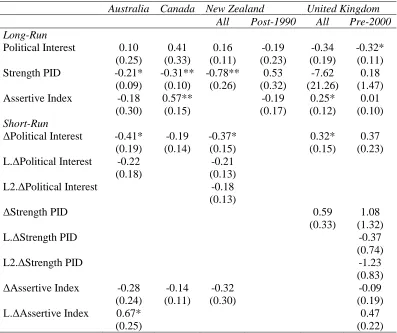
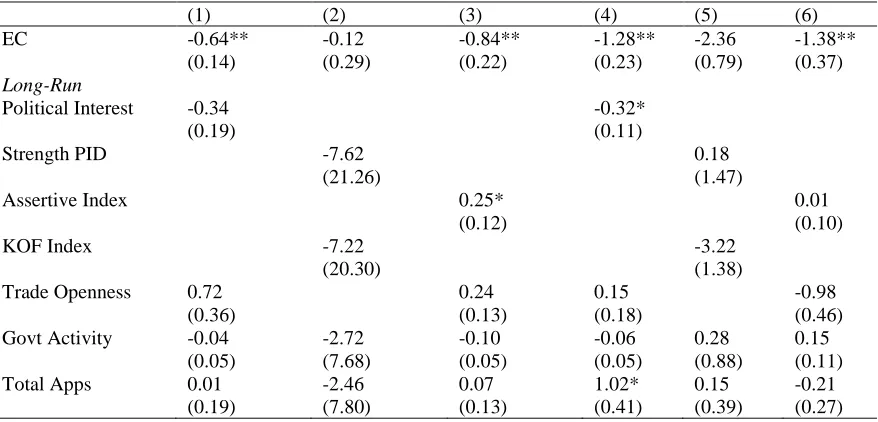
5.1 Summary of Hypotheses for Prime Ministerial Branch Appropriations 151 5.2 Effects of Assertive Citizenship on Prime Ministerial Branch Appropriations 175 5.3 Summary of Findings: Prime Ministerial Branch Appropriations 182 A5.1 Assertive Citizenship and Prime Ministerial Branch Appropriations,
Correlations
188
A5.2 Determinants of Prime Ministerial Branch Appropriations, Australia 188 A5.3 Determinants of Prime Ministerial Branch Appropriations, Canada 190 A5.4 Determinants of Prime Ministerial Branch Appropriations, New Zealand 191 A5.5 Determinants of Prime Ministerial Branch Appropriations, United Kingdom 192
A5.6 Post-Estimation Tests 194
A5.7 Interaction Effects for Prime Ministerial Branch Appropriations 195 6.1 Summary of Hypotheses for Prime Ministerial Branch Staff 211 6.2 Effects of Assertive Citizenship on Prime Ministerial Branch Staff 225
6.3 Summary of Findings: Prime Ministerial Branch Staff 233
A6.1 Assertive Citizenship and Prime Ministerial Branch Staff, Correlations 239 A6.2 Determinants of Prime Ministerial Branch Staff, Australia 239
A6.3 Determinants of Prime Ministerial Branch Staff, Canada 240
A6.4 Determinants of Prime Ministerial Branch Staff, New Zealand 242 A6.5 Determinants of Prime Ministerial Branch Staff, United Kingdom 243
A6.6 Post-Estimation Tests 244
A6.7 Interaction Effects for Prime Ministerial Branch Staff 245
7.1 Types of Units in Prime Ministerial Branches 253
7.2 Units in the New Zealand DPMC, 1990-2015 270
7.3 Units (Branches) in the Privy Council Office, Canada, 1985-2015 288 9.1 Summary of Institutional Change in the Westminster Cases 365
A1 Prime Ministerial Terms since 1945 414
A2 Summary Statistics for Explanatory Variables 417
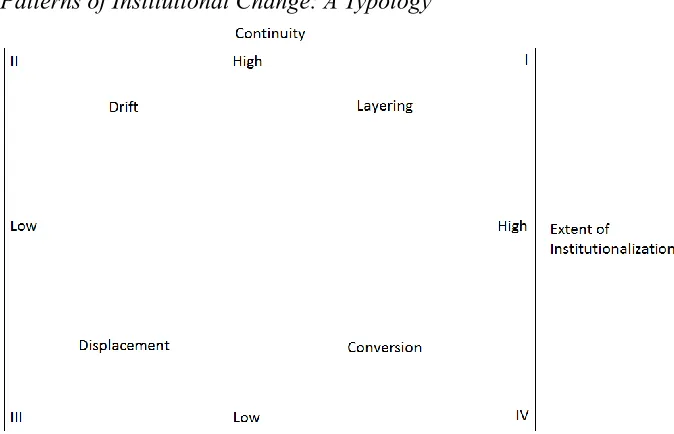
A3 Stationarity Tests for Dynamic Variables 421
A4 Assertive Index Correlation with other Measures of Assertive Citizenship 428 A5 Assertive Index, Eigenvalue Estimates and Percent of Variance Explained 429
viii
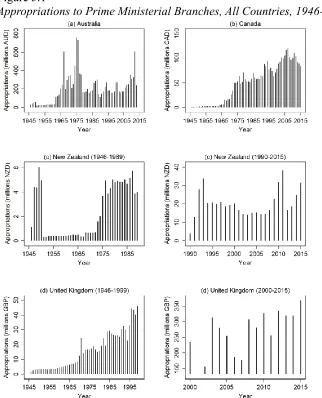
4.1 A Causal Model of Prime Ministerial Branch Institutionalization 120 5.1 Appropriations to Prime Ministerial Branches, All Countries, 1946-2015 147 5.2 Appropriations to Prime Ministerial Branches, Percent of Total, All
Countries, 1946-2015
150
5.3 Marginal Effects of Party Identification, Australia and Canada 176 5.4 Patterns of Institutional Change: Prime Ministerial Branch Appropriations 184
A5.1 Political Interest and Appropriations, All Countries 196
A5.2 Strength of Party Identification and Appropriations, All Countries 196
A5.3 Assertive Index and Appropriations, All Countries 197
A5.4 Assertive Citizenship and Appropriations Time Series, All Countries 198
6.1 Staff in Prime Ministerial Branches, All Countries 206
6.2 Staff in Prime Ministerial Branches, % of Total Civil Service, All Countries 209 6.3 Marginal Effects of Political Interest on Prime Ministerial Branch Staff 227 6.4 Marginal Effects of Assertiveness on Prime Ministerial Branch Staff 228 6.5 Patterns of Institutional Change: Prime Ministerial Branch Staff 235
A6.1 Political Interest and Staff Resources, All Countries 246
A6.2 Party Identification and Staff Resources, All Countries 246
A6.3 Assertive Index and Staff Resources, All Countries 247
A6.4 Assertive Citizenship and Staff Time Series, All Countries 247 7.1 Units in the New Zealand DPMC, Total and by Type, 1990-2015 269 7.2 Assertive Citizenship and Units in the New Zealand DPMC, 1990-2015 274 7.3 Unit Proliferation in the Privy Council Office, Canada, 1985-2015 287
7.4 Organizational Structure of the PCO, 2005 291
7.5 Organizational Structure of the PCO, 2015 292
7.6 Unit Proliferation and Assertiveness, Canada, 1985-2015 295
8.1 Organizational Structure of UK Cabinet Office, 1991 312
8.2 Organizational Structure of UK Cabinet Office, 2000 315
8.3 Organizational Structure of UK Cabinet Office, 2014 322
8.4 Units in the Australian DPMC, 1979-2013 334
8.5 Organizational Structure of the Australian DPMC, 1979 335
8.6 Types of Divisions in the Australian DPMC, 1979-2015 338
8.7 Types of Branches in the Australian DPMC, 1979-2015 341
Chapter 1
Prime Ministers and Modern Politics
I make no apology for having a strong centre... in today's world there is a lot more that needs to be done at the prime ministerial level. I am saying this is the right thing to do.
Tony Blair, 2002
This study is about institutional change in prime ministerial organizations in four
Westminster countries: Australia, Canada, New Zealand, and the United Kingdom. It
focuses on the centre of government bureaucracies that advise and support prime
ministers in their role as chief executives: the Department of Prime Minister and Cabinet
in Australia and New Zealand, the Privy Council Office in Canada, and the Cabinet
Office in the United Kingdom. A key focus concerns how these institutions have
responded to the transformations of modern democratic politics.
The study is motivated by the broader question of how institutional change
reflects change in the nature of prime ministerial leadership. Prime ministers are the
central figures in modern politics; what they do matters a great deal. This centrality is a
good reason to care about the enhancement of prime ministerial leadership as suggested
in the epigraph above. Prime Minister Blair’s candid defence of centralization reflects a
common assessment that prime ministerial power has grown significantly in recent years.
If this claim is accurate, what is driving these changes? My answer in this study is
predicated on four key suppositions that are neatly captured in Blair’s argument.
The first supposition is that the “job description” of prime ministers has changed
in recent decades. Prime ministers face more difficult tasks and obligations than ever
before. Policy issues are more complex and policy problems are more intractable.
Traditional levers of power are often ineffective in bringing about change. Governments
scrutiny of an aggressive media and sceptical public. In these headwinds, the
effectiveness of prime ministers depends greatly on the institutional resources at their
command. The idiosyncratic personal qualities of prime ministers - leadership skills,
personality traits, experiences, and so on – always partly determine success and failure.
However, institutional capacity can increase opportunities for leadership success. Such
capacity is relatively stable and enduring, and it is passed to successive prime ministers.
Thus, one response to the changing job description facing modern leaders is to build the
capacity of organizations that support them. This makes an incredibly difficult job
somewhat more manageable.
The second supposition posits that change in the prime ministerial job description
is a reflection and consequence of the politics of “today's world”. First, politics has never
been as inclusive, in a sense, as it is now. Although the democratic bona fides of modern
politics are more open to question than ever before, the number and the intensity of
voices in the political discourse are greater than ever before. Moreover, this inclusivity is
accompanied by an ‘individuation’ of politics: group political identities are more fluid
and groups themselves, as a channeling and filtering factor between citizens and elites,
have lost much of their authority. Thus, prime ministers face a cacophony of
heterogeneous opinion, creating extraordinary, yet diffused, demands on leaders. The
inclusivity and individuation of modern politics is aided and abetted by dramatic
innovations in media and communications technologies, such as the rise of the
continuous news cycle and, more recently, social media.
A second characteristic of modern politics that has transformed the prime
World War II, national economies have undergone profound shifts and dislocations
associated with the rise of the welfare state and globalization. Modern economies are
more dependent on each other and on international financial flows. This has generated
great wealth and raised standards of living, but it has also ‘hollowed out’ entire economic
sectors and regions as well as the state’s capacity to intervene in the economy.1 At the
same time, post-war prosperity and the expanded role of government in ensuring
economic stability and ‘cradle to grave’ social safety nets generate greater expectations
for what government can and should do. However, governments often may not have
access to the tools or capacities necessary to meet those expectations. These economic
changes make the prime minister’s job of driving meaningful change more
resource-intensive, the tools for doing that job less effective, and the prospects for success less
certain.
The third supposition in Prime Minister Blair’s remarks is that the prime minister,
uniquely among other contending actors, needs “to do a lot more” than was the case
heretofore. This disruption in traditional arrangements of power vis-à-vis actors such as
political parties, cabinets, legislatures, and the civil service is troubling to democrats who
value restraints on power and collective decision-making. As prime ministers do more,
other actors not only do less but expect to do less, and are perceived as doing less: the
norms and expectations of actor behaviour change.
This is most evident in concerns about the concentration of power and the shift
from cabinet government to ‘prime ministerial’ government. Cabinet government was the
byword of Westminster government: in Walter Bagehot’s famous expression, cabinet was
1 There is, of course, a voluminous literature on globalization and serious disagreements about its positive
“the buckle that fastens” the legislative power to the executive power. The prime
minister’s role in this system was to constitute cabinets and oversee the cabinet
decision-making process. Some prime ministers, such as Mackenzie King or Robert Menzies, led
through consensus or expertise, while leaders like David Lloyd George in Great Britain
or R.B. Bennett in Canada were perceived as autocratic and domineering. However, the
language and practice of government was collective, and cabinet had a central role in
decision-making. Legislatures and the civil service also played important roles. In
addition to policy-making itself, these other actors played representative and
informational roles. They were the primary means by which the opinions of diverse
societal interests could be aggregated and communicated to the political executive. As
tasks are moved to “the prime ministerial level”, however, the importance of cabinet and
other actors in policy-making, representation, and informational support has declined.
Against this decline stands the fourth supposition: the normative case for a
“strong centre”. Rather than seeing a strong centre as an understandable but undesirable
outgrowth of modern politics, it should be seen as a positive development. A strong
centre is conducive to effective, responsible, and responsive governance, while a weaker
centre undermines it. Governments should be able to generate and implement a policy
agenda that addresses public needs, for which they can be held accountable. Doing so in
the face of the centrifugal forces of modern politics is extraordinarily burdensome. In this
view, the concentration of power in the prime minister and the centre is a way to counter
these tendencies and enable greater policy coordination, oversight, and active
intervention. It does not guarantee good governance but it makes ineffective governance
Not seeking out these means is an abdication of responsibility for which the prime
minister, most of all, will be blamed.
These four suppositions form the backdrop of ideas upon which I paint a portrait
of the prime ministerships in Australia, Canada, New Zealand, and the United Kingdom.
This study comparatively examines institutional change in these prime ministerships, and
investigates two simple questions. First, to what extent have these institutions changed?
Second, what systematic factors of modern politics account for change in prime
ministerships?
To answer these questions feasibly within this study, I narrow its scope in two
ways. First, I limit the concept of the prime ministership by focusing on what I call the
“prime ministerial branch”, an explicit analog with the concept of the “executive branch”
in the United States. This choice of term is deliberate: it directs our attention away from
the prime minister as an individual and towards the institutional extensions of the prime
minister. These are what Anne Tiernan calls prime ministers’ “deep structure” of support
and advice (2006, 311): organizations surrounding prime ministers which are directly
subordinate to them and which support them predominantly, if not exclusively.
This “deep structure” includes both political and bureaucratic extensions of the
prime minister. The former refers to an office, generically referred to as the Prime
Minister’s Office (PMO), which is staffed mostly by partisan advisors, chosen by the
prime minister and not subject to merit appointment. The PMO’s primary role is to
support the prime minister in her political capacity: much of its work involves political
strategizing and issues management. Where it deals with public policy, its role is to
minister is the civil service office that provides administrative and policy support to the
prime minister. It serves the prime minister in her executive capacity: it provides advice
on and management of the machinery of government and policy-making support. Career
civil servants mostly staff these offices. Although political neutrality of civil servants is a
strong Westminster convention, the fact that civil servants in the prime ministerial branch
serve a political master means that they must account for political considerations: they
are said to provide “politically-sensitive” policy advice.
In this study, the “prime ministerial branch” refers almost exclusively to
bureaucratic extensions of prime ministers, specifically, the Department of the Prime
Minister and Cabinet (DPMC) in Australia and New Zealand, the Privy Council Office
(PCO) in Canada, and the Cabinet Office (CO) in the UK. In practice, this is justified
methodologically, as explained later in chapter four, but is also reasonable conceptually.
As Lee et al. note in the case of the UK Cabinet Office, these organizations are “the
prime minister’s instrument for enabling government to reach collective decisions”
(1998, 37). They are central to how prime ministers govern, if not central to how they
campaign. Thus, while this study is about prime ministers and political leadership
broadly, its empirical scope is more focused. It is a study of the prime ministerial branch,
not of particular prime ministers, decisions, or leadership styles: it is about the ship, not
just the captain. Within that scope, it focuses on the bureaucratic engines of prime
ministerial power, that is, the civil service offices that support them, rather than their
political support.
Second, the analytical scope is narrowed in terms of the kind of change it
institutionalization. In its original sociological guise, institutionalization explained the
persistence of social institutions as effective responses to a collectively perceived need.
Samuel Huntington imported the concept to characterize large-scale processes of political
development, defining it as “the process by which organizations and procedures acquire
value and stability” (1965, 394). Huntington elaborated the concept without the
structural-functionalism embedded in its sociological origins. Political
institutionalization, in this view, is deeply subject to contestation and choice, and thus is
not inevitable or irreversible. Political context and actors’ preferences matter. This is
embedded in the perspective of this study that institutionalization is a rational choice of
individuals, namely, prime ministers.
Thus, the study conceives of centralization and intensification of prime ministerial
power in terms of the bureaucratic institutional capacity attached to the prime minister’s
position. This is a very well-established, if debatable, notion in the literature. Heffernan
(2003) and Bennister (2007) make this argument adroitly in their discussion of the actual
exercise of prime ministerial power being related to the effective combination of
‘personal’ and ‘institutional’ power resources. Clearly, institutional capacity is not the
be-all and end-be-all of prime ministerial power, but the effect that an institutionalized base of
support can have on a leader’s ability to project power should not be underestimated.
Institutional resources can allow an ‘unassuming’, personally passive prime minister to
strengthen their grip on the levers of power. Moreover, when such resources are directly
associated with prime ministers rather than other, perhaps rival, power centres, they
Finally, the concern that institutional change in the prime ministerial branches
reflects not centralization in the prime ministership but bureaucratic aegis is, in my view,
unfounded. If there is evidence that bureaucrats in the prime ministerial branches are
systematically enlarging their ‘empires’ without regard to prime ministerial intentions,
this study does not uncover it. Rather, this study shows that prime ministers have used
their bureaucratic offices intentionally and explicitly to pursue their substantive and
governance goals as a regular matter of course. Moreover, I would argue that senior
officials in prime ministerial branches, as a rule, do not face the same kinds of incentives
that the typical bureaucrat in the ‘budget-maximizing’ mold face. They do not administer
spending programs to any significant degree, and as “centre of government” actors they
are already at the apex of ‘status’ and ‘prestige’ that the ‘budget-maximizing’ model
suggests are reasons for bureaucratic empire-building. In my view, bureaucrats in prime
ministerial branches are as close to ideal agents for prime ministerial principals as is
likely to be achieved in government.
The study’s second overarching question elucidates the factors that foster
institutionalization in the prime ministerial branches. As its starting point, it takes James
Simeon’s claim that “[t]he rise of the welfare state and the commensurate growth in the
size and scope of government, coupled with growing public demands and expectations
facilitated the emergence of the political executive as the dominating force in
government” (1991, 559). Simeon identifies two key factors: growth in government
activity and public attitudes. This study builds a robust theory around the second of these
factors. In chapter three I develop a Theory of Public Expectations that arises from the
advanced democratic political culture where modern citizens are more critical,
dissatisfied, and elite-challenging; and in the growing institutional concentration of
power in centres of government. I argue that a shift from “allegiant” to “assertive”
citizenship increases expectations about what government can deliver, and how it should
do so. This causes prime ministers to respond by strengthening their own institutional
capacity.
As well, this study also considers alternative explanations to the main theory. The
first looks to the significant economic transformations in post-war advanced economies,
owing notably to globalization and the social welfare state, which have markedly
increased the role of governments in national economic activity. In different ways, both
trends generate incentives for prime ministers to bolster the centres of government in
pursuit of greater control over policy-making. The second alternative emphasizes
short-term variation in political contexts. It looks to political factors, such as legislative support
and ideology, as potentially enabling or constraining the decision space for prime
ministers, thus conditioning their institutionalization choices.
1.1 Contributions of the Study
Within this broad analytical scope, this study systematically compares prime
ministerial branch institutionalization in Australia, Canada, New Zealand, and the United
Kingdom. In doing so, it makes four notable contributions. The existing literature is
impressive in many ways, but it is largely anecdotal and focused on single cases.
Comparisons are synthetic and impressionistic. There is a richness of information, but a
lack of rigorous comparative investigation. We do not have robust answers to address
dissertation informs some trenchant theoretical and methodological gaps in the literature
and contributes grounded knowledge to public discourse about fundamental issues such
as the operation of executive power, the expectations democratic citizens have of leaders,
and the institutional consequences of contemporary democratic behaviour.
My first contribution is theoretical. The study contributes to the theorization of
prime ministerships at the conceptual level by treating institutional change in prime
ministerships as general phenomena with general causes. In addressing the possibility of
systematic effects, I treat these prime ministerships not as unique but as cross-cultural
phenomena that can be studied comparatively. We begin from the premise that the
Westminster prime minsterships are essentially similar, not just in form but in function,
and that they are all subject to comparable cultural, economic, and political forces and so
change in similar ways. While this perspective is not entirely new, this study takes more
seriously the notion that executives in different national contexts are not sui generis.
While the extant literature tends to begin from the premise that national contexts are
unique and then proceeds to find shared elements of comparability, this study proceeds in
the reverse order.
In terms of theoretical paradigms, my elaboration of a cultural explanation for
institutional change also locates the study at the intersection of two different lines of
inquiry. Scholars of value and attitude change in publics have generally not engaged
questions of how such changes bear on institutional outcomes, focusing instead on other
effects. In the other camp, institutional theorists have struggled to explain institutional
change, which is challenging because most institutional theories expect institutional
contextual impact that long-term changes in political culture represent. These theories
have missed an opportunity to have a useful conversation, especially considering the
meaningful, sustained links between citizen and elite behaviour in democracies.
This study also makes a significant contribution to existing knowledge with
regard to methodology and research objectives. This involves three specific elements.
First, the “custom built” datasets constructed for this project are themselves valuable to
future researchers studying executives, political leadership, and the effects of executive
power on other political outcomes. Specifically, chapters five and six are based on a
dataset containing yearly observations of budget appropriations and staff resources in
each country, along with relevant explanatory variables. Chapters seven and eight are
based on both qualitative and quantitative data tracking internal organizational changes
within prime ministerships. These datasets do not presently exist in an organized,
coherent form. The hope is that, in addition to their use here, they will be used to advance
the comparative analysis of prime ministerships in future research.
As well, the specific relationships examined in this study provide benchmarks for
elaboration, refutation and replication using other data. The field lacks a coherent
research agenda with a clear set of research questions, so the identification and
assessment of clearly testable hypotheses is ideal fodder for building such an agenda. In
this way, it builds a foundation for tying together the disparate literatures on executive
governance, modern public management and democratic leadership. Finally, the
methodological ambition of this study also contributes to the literature by expanding the
scope and standards for future work. The research design invokes a ‘mixed-methods’
My particular innovation is to employ serious quantitative methods to the comparative
study of prime ministerships, which results in new kinds of knowledge in the field. This
is a substantial contribution to the literature on prime ministers and prime ministerial
power, which is overly dominated by qualitative methodologies.
The third area in which my study contributes is in its concrete empirical results.
The study goes beyond simple descriptive arguments about institutional change in prime
ministerships to identify and test specific theories of the causes of change: the Theory of
Public Expectations and its alternatives. Finally, the study contributes to the broader
public discourse about prime ministerial power and the practice of political leadership in
modern politics. It draws attention to the ways in which modern politics has transformed
how prime ministers do their job. It invites discussion about how citizen expectations and
the broader political culture shape institutions and motivate political leaders. My study
urges a broader consideration of the role that citizens play in conditioning how leaders
behave: the kinds of demands and expectations we place upon leaders and what kinds of
political leadership these pressures produce. The contributions of this study are manifold
and significant.
1.2 Plan of the Study
The study is organized in three main parts, and nine individual chapters. This
introduction and the next three chapters constitute Part I, which set out the context and
theory of the work. Chapter two reviews the historical and institutional context of the
Westminster prime ministership and the relevant literature. The first two sections of the
chapter trace the evolution of the prime ministership in the United Kingdom historically,
highlight major themes in the broader literature on prime ministers and executives and
review work on prime ministerships in the four Westminster cases. Finally, since my
primary theoretical explanation, the Theory of Public Expectations, is premised on
theories of social and cultural change, particularly the rise of post-materialism and shift
from “allegiant” to “assertive” citizens, in this chapter I review the literature which
describes these trends and identifies their effects.
Chapters three and four set out the theory and methodology of the study. In
chapter three, I elaborate the key theoretical aspects. First, I discuss institutionalization in
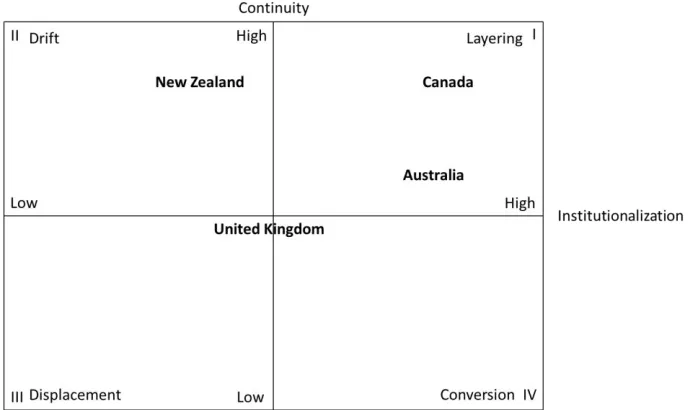
greater depth, and the study’s framing of institutional change, which adapts Streeck and
Thelen’s (2005) typology of incremental change. Second, the Theory of Public
Expectations is introduced. I trace its theoretical antecedents, narrative logic, and
implications. Finally, the chapter discusses alternative theories of prime ministerial
institutionalization. In chapter four, I discuss the methodology of the study: the overall
research design, data sources and variable construction, and the analytical techniques of
the empirics in subsequent chapters. In summary, Part I of the study sets out the
theoretical and analytical foundations for the rest of the work.
Part II of this study, chapters five through eight, empirically assesses the theories
discussed in Part I. These chapters investigate two dimensions of institutional change in
prime ministerial branches: institutional autonomy and complexity. Chapters five and six
examine autonomy. I measure autonomy using the budgetary resources (chapter five) and
the staff resources (chapter six) of the prime ministerial branches, two measures that
accurately reflect institutional capacity. This capacity is a crucial component of the
both descriptive statistics and time series regression to investigate the particular
hypotheses.
Chapters seven and eight continue empirical assessment of the theories of prime
ministerial branch institutionalization. They do so by examining the institutional
complexity of the prime ministerial branches, and tracing changes in the organizational
structures of the branches over time, in a series of small case studies. Chapter seven
examines the two branches where change has been least evident: New Zealand and
Canada. Chapter eight examines the more robust change found in the United Kingdom
and Australia. My approach here is to identify trends in the proliferation and
specialization of units within these branches and qualitatively analyze the relationships
between the theoretical factors and these measures of institutional complexity. Thus,
chapters five through eight offer an analytically varied and mixed-methods study of how
and why prime ministerial branches have changed over time.
In Part III I summarize the results. Chapter nine summarizes and discusses the
findings of the empirical chapters, and presents an overall evaluation of the core theory
and its alternatives. After the sustained theoretical and empirical explorations of the first
two parts of the study, the concluding chapter returns to some of the broader themes
discussed in this introduction. I discuss the more general implications of my study’s
arguments and findings for studying public discourse and political leadership. I reiterate
the contributions of the study to the literature and acknowledge several issues in the
study’s design and analysis. Lastly, some promising avenues for future research are
discussed. Turning now to the next chapter, Two, I review the historical and institutional
Chapter 2 Context and Literature
The executive power is the moving force of a government. It represents in the political system that mysterious principle which, in moral man, unites action to the will... [T]he adjustments of its limits, and the accurate adaptation of its means to its end, offer to the human mind one of the most comprehensive subjects of reflection.
Jacques Necker, Chief Minister and Director General of Finance to Louis XVI (1792)
The study’s comparative analysis of the prime ministerships in Australia, Canada,
New Zealand, and the United Kingdom is situated in deep historical and analytical
contexts. The chapter sets out these contexts in three ways. First, it sets out the historical
and institutional foundations of the Westminster prime ministership. It gives a brief
account of its long evolution in the United Kingdom and its adaptation to colonial
contexts. The section also describes the institutional roles that prime ministers play
within these systems. In the second section of the chapter, I explicate the literature
pertaining to prime ministerial power and institutional growth. Two central themes in the
broader prime ministerial literature - the core executive, and the concept of
presidentialization - are discussed. Building on these concepts, I review work on the
prime ministerships in the four countries.
The third way in which this chapter elaborates the study’s context is a discussion
of the shift towards more “assertive” political cultures evident in many modern advanced
democracies. This shift is the basis for the study’s primary theoretical explanation for
institutional change in prime ministerial branches: the Theory of Public Expectations.
This theory, explicated at length in chapter three, begins with the premise that there has
well-documented by scholars such as Ronald Inglehart, Pippa Norris, Neil Nevitte, and
Russell Dalton. I discuss this literature generally and, more specifically, Dalton and
Welzel’s (2014) characterization of “allegiant” versus “assertive” citizens. I explicate
these fundamentally different notions of democratic citizenship and their wide-ranging
effects on political behaviour in modern advanced democracies. The contribution of the
Theory of Public Expectations is to extend the scope of these effects to include
institutional change in the Westminster prime ministerships, to which we now turn.
2.1 A Primer on Westminster and the Westminster Prime Ministership
This section explores the rich historical and institutional context of the
Westminster prime ministership, giving an account of its evolution and its various roles
within these political systems. First, however, it would be well to explicate the terms
Westminster and prime ministership. Each involves a deep set of cultural traditions,
understandings, and practices. Westminster systems are a subset of parliamentary systems
and specifically refer to institutional arrangements modelled on British conventions and
traditions, exported to the British colonies.2 The classification of political systems into
presidential and parliamentary types is based on the relationship between the legislative
and executive powers. In presidential systems, legislative and executive members are
elected separately to fixed terms. In parliamentary systems, only the legislature is directly
elected; the executive is then selected from and by the legislature. Terms are not fixed:
because the legislature chooses the executive, it can also withdraw its support, resulting
in either a change of government or an election. The most salient aspect of this distinction
is that its implications for heads of government (that is, presidents or prime ministers) are
2 The term ‘Westminster’ itself is a metonym, referring to the Palace of Westminster, where the UK
different. Presidential systems create separation between the executive and legislative
branches and induce conflict between them; presidential power is primarily a reflection of
this relationship. Parliamentary systems create a fusion between the branches and induce
conflict between government and opposition, and between prime ministers and other
political executive actors.
Westminster’s defining characteristics are surprisingly elusive. The term delimits
a set of countries which are culturally and institutionally similar to each other, and
dissimilar to other countries with parliamentary systems. Used in this way it is a common
basis for comparison in a diverse set of studies.3 Rhodes et al. (2009) identify five very
different senses of ‘Westminster’: 1) a “narrative” arising from a common heritage which
provides precedent for action and a source for nostalgic appeal, 2) a political instrument
for defending oneself and denigrating opponents, 3) a set of norms and practices which
legitimate the roles and powers of actors, 4) a cluster of institutional arrangements, and 5)
a byword for efficient, decisive government (222-232). As a set of institutional
arrangements, Arend Lijphart equates the Westminster model with majoritarian
democracy, as opposed to consensus democracy, and produces a set of ten characteristics
which differentiate the two forms (2012, 9).4 Palmer and Palmer associate it with Walter
Bagehot’s “efficient secret of the English Constitution”: the near complete fusion of
3 For example, Kam (2009) looks at determinants of legislative dissent while Aucoin (2012) examines
changing relationships between ministers and public servants. It serves as a scope-defining term in non-institutional work as well: for instance, Ailsa Henderson’s (2008) work on citizen satisfaction with democracy and Sawer et al.’s (2006) volume on women’s legislative representation. In other studies, one of these countries is taken as an exemplar of the model, with the implication that findings extend to the other Westminster cases (e.g., Eichbaum and Shaw 2008, Goodyear-Grant and Croskill 2011). Finally, Weller’s (1985) seminal work on prime ministerships also uses Westminster to define its comparative context. 4 Concentration of executive power in a one-party cabinet, cabinet dominance over parliament, a two-party
executive and legislative power in the cabinet (2004, 9). At other times, it is equated
simply with broad traditions of parliamentary sovereignty.
However, institutional divergences among the Westminster countries also are
significant. Australia and Canada are federal states, while New Zealand is a unitary state.
The United Kingdom is also a unitary state although recent governments have
increasingly devolved power to its constituent countries. One reason for this difference is
that Australia and Canada are much larger and diverse in area than New Zealand and the
United Kingdom, and have different founding histories.5 Canada and the United
Kingdom have strictly adhered to the single member plurality electoral system to select
their lower houses, the House of Commons, and have retained appointed upper houses
(the Senate and the House of Lords, respectively). In contrast, Australia and New Zealand
have moved to forms of proportional representation. Australia’s House of Representatives
has single member districts but uses preferential balloting, while its Senate is elected
under a single transferable vote system. After significant electoral reform in 1993, New
Zealand’s unicameral legislature now employs a mixed member proportional system.
So, to employ the term ‘Westminster’ to denote a coherent cluster of institutions is
problematic. What separates Australia, Canada, and New Zealand from other Westminster
systems such as India and South Africa? Rhodes et al. (2009) argue that the crucial
difference is whether the system was “transplanted” or “implanted” (11). The
transplanted Westminster systems are those in which British-originating settler societies
deliberately adopted British institutions and conventions. Implanted systems were
imposed by the British as colonizers on a non-British population. Australia, Canada, and
5 In both Australia and Canada, the country’s constitutional union was a result of agreement among
New Zealand belong to the first type as predominantly English-speaking settler societies
with relatively long and stable democratic traditions and cultural understandings inherited
from the United Kingdom. India and many of the other commonwealth countries belong
to the second type. Although Rhodes et al. consider South Africa to be a case of
transplantation, its comparability with the other transplanted cases is suspect. On a host
of dimensions from levels of economic and democratic development to demography,
South Africa is simply too different to provide any reasonable basis for comparison.
The Westminster prime ministership historically and constitutionally is rooted in
the absolute power of the British crown, an often forgotten fact in our more democratic
age. The place of the prime ministership in the constitutional order is in historical terms
an outcome of a democratizing process in which the unbounded authority of an unelected
monarch gradually passed to elected persons responsible to Parliament. Walter Bagehot
proclaimed in 1867 that the monarch was the “dignified” element of the executive while
the prime minister was the head of the “efficient” element (1867, 80). This was not
always the case. The monarch ruled absolutely until parliamentarians challenged this
authority, leading to the English Civil War (1642-1651). The parliamentarian victory
ultimately secured the right of Parliament to be consulted and its consent, particularly in
financial matters such as the raising of revenue through taxation, was required. These
parliamentary gains were cemented in the Glorious Revolution of 1688 and the passage
of the Bill of Rights in 1689.6
Notwithstanding this shifting of power towards parliament, executive power was
retained by the monarch prior to the 18th century. The monarch would employ ministers
as their agents and advisors for as long as they retained their confidence (Hughes 1976,
3). However, at times the monarch was simply too young or weak to effectively govern,
allowing ministers the opportunity for greater influence. On occasion, monarchs and
particularly favoured advisors would form mutually beneficial relationships of counsel
and trust, as with Elizabeth I and William Cecil (Baron Burghley).7 Indeed, F.W.G.
Benemy argues that the office of prime minister essentially begins with Cecil’s time as
chief advisor (1965, 3). When the monarchy was restored in 1660, Edward Hyde (Lord
Clarendon) became “chief minister”, and was instrumental in developing the institution
of the Privy Council as a smaller committee of the body of royal advisors that separated
the “active” part, which became the cabinet, from the larger, honorific part (Carter 1956,
17). Under Queen Anne (1702-1714), ministerial meetings became regularized if
embryonic: she decided whom to invite and what to discuss, while retaining the right to
decide on public matters without ministerial consultation.
Robert Walpole served as First Lord of the Treasury from 1721 to 1742, and from
this position he dominated Westminster. Although Walpole is regarded by many to be the
first prime minister, the job was still in the mould of William Cecil: serving at the
pleasure of the monarch. As Bagehot notes, Walpole had still to “manage the palace”
(1963, 11). In Walpole’s case, however, prime ministerial power was reinforced by the
convergence of an indifferent monarch with his own talent and personality. It was
therefore an “accident of history” that allowed Walpole to become the prototype first
minister (Thomas 1998, 1).
George I (1714-1727), the first Hanoverian monarch, of which Queen Victoria
was the last, spent much of his time in his native Germany and was not otherwise
disposed to actively exercise sovereign power in a ‘foreign’ country (whose native
language he could not speak). By necessity, then, Walpole and his allies guided the
ordinary activities and made decisions of government. His brilliance in managing party
and parliament, and his control over the purse strings, generated the job description for
future prime ministers. The prime ministership receded in importance after Walpole left
the post in 1742, although practices continued to evolve.8 Lord North’s resignation in
1782, over the loss of the American colonies, resulted in the resignation of the entire
ministry, cementing the precedent of collective responsibility and the notion that the
“supervision” of ministers was the prime minister’s duty, not the monarch’s (Berkeley
1968, 28). By and large, though, the office remained relatively unchanged and
unimportant until further developments in the 19th century.
The great change in the Westminster prime ministership in the 19th century is a
manifestation of what has been called the “first wave of democratization” (Huntington,
1993). In the United Kingdom, this took the form of mass enfranchisement through the
Reform Acts of 1832 and 1867 and the Representation of the People Act 1884. The
average Member of Parliament in 1830 represented only 330 voters; by 1966, the number
was 56,000 (Berkeley 1968, 31).9 With the expansion of the franchise, political parties
8 In leaving, Walpole also set the precedent that the prime minister should resign after losing a vote of
confidence in the House of Commons, and his tenure also strengthened the status of the Commons vis-à-vis the Lords (Carter 1956, 24).
9 Among other measures, the 1832 act eliminated most of the ‘rotten boroughs’, constituencies which had
became more significant, and parties began to operate outside of the narrow corridors of
the House of Commons. The nationalization of parties had two important effects.
First, appealing to a broader electorate necessitated some centralization of party
operations, which increased the power of the leadership of the party, including the prime
minister, at the expense of party Members of Parliament. The second effect of the
nationalization of parties was that mass politics magnified the role of the leader. As
Berkeley writes, “from the moment the electorate achieved any significant size, one man
came in the mind of the nation to represent an entire government and that man had of
course to be the Prime Minister” (1968, 38). This personalization of politics was
intensified by the larger than life rivalry between William Gladstone and Benjamin
Disraeli, the great Liberal and Conservative archetypes, respectively (Carter 1956, 37).
Disraeli himself recognized that the real source of power in the British system was
shifting from the monarch to the people, and that it involved a relationship of delegation:
“all power is a trust that we are accountable for its exercise – that from the people and for
the people, all power springs and all must exist” (Berkeley 1968, 37).10 The prime
ministership of Robert Peel (1834-1835; 1841-1846) also established the prerogative of
the prime minister to intervene in any portfolio that she wishes, although certainly prime
ministers must be cautious in doing so.
By the end of the 19th century, the basic template of the prime ministerial job had
been established, its constitutional position and customary practices largely settled, its
centrality to electoral campaigning increasing. However, as Carter concludes, the position
had not yet made “complete use of all facets of its latent powers” because the political
environment did not provide the pressure to do so (1956, 40). Government did relatively
little and policy issues were relatively simple, the means of adducing public political
opinion still rudimentary and indirect. In the 20th century, the Westminster prime
ministership would evolve from a personal office into an institutional one.
The first step in this development was the creation of the Cabinet Office,
necessitated by the administrative burdens of World War I. Just as Robert Walpole is the
generally agreed ‘first prime minister’, David Lloyd George’s prime ministership
(1916-1922) is seen by some as the beginning of prime ministerial government and the eclipse
of collective cabinet government (Thomas 1998, 4). Exigencies of the war effort – the
tremendous amount of information processing, coordination, and decision-making
involved – caused Lloyd George to attach the Committee of Imperial Defence Secretariat
to the cabinet as a whole, creating the Cabinet Secretariat and eventually the Cabinet
Office. Under Lloyd George also came the first stirrings of a ‘prime minister’s
department’: the ‘Garden Suburb’ of a handful of political aides who met in the garden of
no. 10 Downing Street. This set the precedent for the expanding role for special advisors
in the latter half of the century.
Thus, under David Lloyd George, the institutional capacities of the prime
ministership, through the creation of the Cabinet Secretariat, became a permanent part of
the machinery of government. This development set the power of the prime minister on a
more secure institutional footing. Before this point, prime ministerial dominance had
“even an apparently unassuming Prime Minister like Attlee possessed immense powers…
by virtue of the office which he held and the staff which serviced it" (1968, 47).11
As with many “temporary” measures whose permanent usefulness becomes
apparent, the Cabinet Office was not only institutionalized but grew in importance. Its
coordination and information roles proved themselves in the crises of war and post-war
state expansion. And, of course, though nominally the support system for the cabinet, the
Office had always in fact answered to the prime minister as the “chairman” of cabinet.
The agglomeration of institutional capacities continued through the latter 20th century,
particularly in terms of its policy support and implementation roles. Prime ministers
continued to create mechanisms through which they could better fulfill their duties. This
is seen in the continual creation of policy support centres, such as the Central Policy
Review Staff by Prime Minister Heath in 1971 and the Policy Units of recent prime
ministers, to implementation-focused groups such as the Cabinet Office’s Implementation
Unit and the Prime Minister’s Delivery Unit established by Tony Blair.
Thus, the development of the modern Westminster prime ministership is a long,
historical agglomeration of sources of prime ministerial power, stretching from the
confidence of monarchs to the confidence of Parliament, to popularity among the people
as electorally expressed, to enhanced institutional support within government. This
institutional lineage was transplanted to the distant colonies in British North America and
the Pacific. As in the original British case, the role and powers of the prime ministerships
in the colonies are based on convention and tradition. Neither the British government nor
the colonial founders felt any need to write down the explicit constitutional rules defining
the prime ministerial position. Indeed, they had the opportunity to do so when each
country was established formally with a written constitution, unlike the essentially
unwritten fundamental law of the UK.
In Australia and Canada, whose constitutions were written by colonial delegates at
series of founding conferences, neither the prime minister nor the cabinet are mentioned
in the clauses defining executive power in the Commonwealth of Australia Constitution
Act 1900 (ss. 61-70) or the British North America Act 1867 (ss. 9-16). In New Zealand
neither the Constitution Act 1986, nor the British statute it replaced, the New Zealand
Constitution Act 1852, mention those terms. Thus, the prime ministership in each of these
countries is a distinct combination of the inheritance of British practice and adaptation to
local cultural, political, and geographical contexts.12
12 Hughes describes the Australian prime ministership as being shaped by two historical factors: the lack of
party structure which feeds factionalism; and the lack of aristocracy (1976, 6-7). We see the first reflected in the strength of internal party factions and the second in a political culture of egalitarianism, the idea of “mateship”. This idea of a social cohesion borne of “self-recognition of [Australians’] dependence upon one another” is one of the central tenets of the Australian radical tradition (Curran 2004, 180, 244). This tradition is one Hartz (1964) described in fragment theory as arising from the settlement pattern of Australia: the peculiar mix of literal prisoners, social reformers dedicated to the Chartist movement of mid-19th century England, and gold prospectors. The lack of an established aristocracy also meant that Australian reform politics did not have to “struggle” in the same way it did elsewhere, creating a more utilitarian “socialisme sans doctrine” that emphasized pragmatism and consensus building (Rosecrance 1964; Collins 1985). Bennister argues that the Australian prime ministership is characterized by its constraints: federalism, a strong Senate, the size of Parliament, and the leadership election process which is heavily influenced by the factionalism described above (2007, 329).
In Canada, the British North America Act’s (1867) guarantee of a constitution “similar in principle to that of the United Kingdom” formalizes the inheritance of British practice. The prime ministership that Canada acquired in 1867 was also essentially a continuation of the same pre-Confederation role in the province of Canada, present day Ontario and Quebec. The experience of governing the pre-confederation Province of Canada reflects the distinctiveness of the Canadian prime ministership in one special respect: the significance of the prime minister in managing French and English relations, and regional difference more generally. Historically, successful prime ministers have been those who were able to maintain national unity. Those prime ministers and parties who could, mostly the Liberal party, were rewarded with long tenures in office, periodically punctuated in a pattern Leduc et al. (2010) call “dynasties and interludes”. In no other Westminster country is the significance of regionalism as profound or as impactful on the prime ministership as in Canada.
2.2 Prime Ministerial Roles and Powers
The last section traced the evolution of the Westminster prime ministership in the
United Kingdom. In doing so, it touched on the office’s roles and powers, enshrined in
convention and historical practice. So now this section explicates these roles and powers
in some detail. It considers the extent to which there is a standard job description for the
Westminster prime ministership. What are the roles that prime ministers are expected to
play? There is a view that “the prime ministership is what the prime minister does”. This
view suggests that there is no fixed job description: that there are very few things the
prime minister must do and many things they may choose to do. The task is to identify
what they want to do and how to do those things most effectively. I argue that the modern
prime ministership is expected to do much, and its true discretion is limited. Prime
ministers cannot simply ignore what they have no interest in engaging, if they wish to be
successful. These heightened expectations are not formal or constitutional ones, since
these have not significantly changed in the modern prime ministerial era. Rather, they are
public and political expectations, arising from a confluence of factors which tends to
increase the prominence of prime ministers.
What are these expectations that bear upon prime ministers? I identify seven
distinct yet interrelated constitutional, administrative, and political roles that prime
ministers play in Westminster systems.13 The constitutional expectations of the prime
ministerial institution have not changed significantly since the emergence of the modern
Westminster prime ministership, as recounted above. First, by constitutional convention
2013, 292). Given these considerations, the New Zealand case offers a distinctive contrast both in terms of the empirical story of prime ministerial institutionalization and an opportunity to fill a significant gap in the literature.