36
Evaluation of different factors on Dyeing of
Polyester and Cotton Blend processing using
pigment produced by Aspergillus nidullans
S.A. Rashed P
1
P
, Hanaa. Y. Ahmed P
2
P
, M.A. Elbadry P
3
P
1
P
Faculty of industrial education, Beni Suef university, Egypt
P
2
P
The Regional Center for Mycology and Biotechnology- Al-Azhar University, Cairo, Egypt
P
3
P
Botany and Microbiology Department, Faculty of Science, Al-Azhar University, Cairo, Egypt
U
Abstract
Pigment produced by fungi considers one of the most emerging fields of research in more safe
products for textile industry with less degradable dye and eco-friendly natural pigment products.
Fungi have a precious origin of pigments due to they are able to produce high variety yields of
the pigments using the cheap culture medium, making the bioprocess economically viable on the
industrial scale.
In this work, Aspergillus nidulans pigment produced was extracted by methanol and
evaluated its ability to dye both of polyester and cotton. Infra red (IR) analysis for function
groups for natural Dye with polyester and cotton blends to explain the main function group
which responsible for dye both of cotton and polyester at the same process
So, effect of Various Parameters on Dyeing of Polyester Cotton Blend was applied in textile
as One-bath dyeing of polyester/cotton blends natural pigment produced by A. nidulans.
One-bath dyeing of polyester/cotton blends was successful. The dyeing behavior was applied on
cotton, polyester fabrics and finally applied onto polyester/cotton blends. The result of fastness
properties were good to poor. One-bath dyeing of polyester/cotton blends was also successful.
The aim of this work was produced natural pigment used for dying polyester/cotton blends
otherwise chemical dyes which used to cotton and polyester separately. Also natural dye low
cost and less toxicity for human rather than chemical dyes which cause some hypersensitivity in
some cases
Keywords: Polyester/Cotton blends, Aspergillus nidullans, natural pigment, Textile application,
U
Corresponding Author:
Mohamed Ali El-Badry Hafez Amin, Botany and Microbiology Department, Faculty of Science, Al-Azhar
37
U
Introduction
Side effects of synthetic dyes on human being health and harmful effects on the
environment leads to development ways for obtaining pigments from microbial natural sources
was considered as significant urge all worldwide. Fungal pigments production has great
attention for textile industry due to its safer products, easily degradable, eco-friendly and do not
cause side effects. Natural pigment produced by fungi was considered more advantageous due to
it is a more efficient and less cost than synthetic chemical pigments process. Fungi also more
tendency sources of natural pigments when compare with pigments produced by animals and
plants as fungi do not effect by seasonal restrictions, also, natural dye produced by fungi do not
need limited farming land with actual foods, and natural pigment produced by it is easily and by
using cheap fungal culture medium to produce high yields (Akilandeswari and Pradeep, 2016)
Pigments produced by fungi are considered as secondary metabolites structurally
heterogeneous with low molecular weight not essential for fungal growth especially fungi that
produces this pigments. Large different species of fungi produce different natural pigments as
secondary metabolites (Berdy 2005)
Pigments produced from fungi is considered as the most important alternative way of
traditional chemical synthetic dyes and pigments which may fall in the broad classification of
carotenoids, as the concern has become high for their harmful effects like hampering the
environmental and human health (Khan et al. 2013). Specifically, textile industry that uses large
quantity of chemical dye stuff with the effluents of different process, is polluting our soil and
water sources. They are also listed as mutagenic, carcinogenic, allergic and cytotoxic agents
posing threats to all life forms (Khandare & Govindwar 2015). Recent research trends which are
focused on pigments for textiles reveal significant advancements. ( Devi et al.,2014)
The results in this work will be useful and encourage a greater number of researches on
fungal pigment production to apply innovative and sustainable solutions for human health and
the environment especially in textile industry to reduce usage of synthetic dye production.
Natural pigment produced by microbial origin especially fungi as sources of textile dying
industry open new gate for new interdisciplinary filed between microbiology and textile industry.
38 Materials and Methods
Strains and growth conditions
A. nidullans used in this study was kindly provided from Culture Collection of The Regional
Center for Mycology and Biotechnology- Al-Azhar University, Cairo, Egypt
Cultivation medium
Czapek Dox agar medium with the following composition was used as cultivation medium,
NaNO3, 2.0 g, K2HPO4, 1.0 g, KCl, 0.5 g, MgSO4·7H2O, 0.5 g, FeSO4·7H2O, 0.001 g,
sucrose, 20 g, agar, 20 g. The pH was adjusted at 6.5 – 7.0. This medium was inoculated with 10P 6
P
conidia/ml and incubated at 28P o
P
C in a rotary shaker at 220 rpm. After growth for ten dayes, the
mycelium was collected by vacuum filtration and the pigment present in the mycelium and
culture medium was then extracted.
Pigment extraction
A. nidullans was cultured in 500 ml Czapek Dox broth flasks. The culture flask was
incubated at temperature 28 ±2°C for 10 days. Then the pigment was extracted. The extraction
process of pigment was done by by boiling both the mycelium and the fungal culture broth media
in methanol at 98°C showing color together and then filtered.
Effect of Various Parameters on Dyeing of Polyester Cotton Blend
Fabrics:
Mill desized , kier boiled and bleached cotton ,was supplied by Misr Company for Spining And
Weaving – Mehala El-Kobra .-Polyester fabric and cotton/polyester fibers blend (50:50), were
supplied by Elshorbagy co.
pre mordanting
Cotton and polyester samples in aqueous solution contine (3%) ferrous ammonium sulphate
solution for 30 min at 60 ̊ C with L:R 1:50 than dried with washing
Dyeing process
the mordant samples were dyed in freshly prepared aqueous 10 g/l NaCL and 3% A.
nidulans ( fungal pigment ) .The dyeing process was carried out at 80 ̊ C temperature for 45
min then the fabric washed with distilled water and dried at ambient condition.
The dyed samples were thoroughly rinsed and washed in a bath containing 1g/l non-ionic
39 Testing and Analysis
Measurement of colour strength (K/S)
The color strength of the dyed samples was evaluated by light reflectance technique using
ICS-TEXICON computerized spectrophotometer; model M 520220 (produced by ICS – ICS-TEXICON
Limited Co. England.
The color strength expressed as K/S value was assessed directly by the Spectrophotometer
according to kubelka-Munk equation P (1)
P
.
K/S = (1-R)P 2
P
/2R- (1-RR0R)P 2
P
/2RR0
K/S is directly related to the color intensity of the obtained dyeing, where K is the light
absorption coefficient, S is the scattering coefficient; R is the decimal fraction of the reflectance
of the dyed samples, RR0R is the decimal fraction of the reflectance of the undyed samples.
Evaluation of color Fastness properties
Colour fastness to washing
It was determined according to the AATCC test 61-1975P (2)
P
using launderometer
Color fastness to rubbing
It was determined according to the AATCC test 8-1996P (2)
P
using crock meter under controlled
conditions to determine dry and wet crocking fastness.
Color fastness to perspiration
Two artificial perspiration solutions were made as follow; acidic solution and alkaline solution,
this test was carried out according to the AATCC test method 15-1997P (2)
P
.
Color fastness to light
This test was evaluated according to the AATCC test method 16-1998 P T
P
in order to determine the
degree of color resistance to photo –degradation.
Test organisms for Antimicrobial assay:
Staphylococcus aureus ATCC 29213, Escherichia coli ATCC 25922 and Candida albicans
MTCC183
Antimicrobial activity of Polyester Cotton Blend by diffusion method (Garrod &
Waterworth, 1971):
Overnight broth cultures of test organisms ( staphylococcus aurues, Escherichia . coli and
candida albicans ) were freshly prepared, Nutrient agar plates 15 ml were prepared and then
surface dried at 37 o C for 30 min. the bacterial or fungal inoculum were spread over the surface
of the dried agar plates using a sterile glass spreader. The plates were dried, inverted at 37 o C
40 PolyesterCotton Blend and another not pigmented as control to assay their antimicrobial activity
and was placed onto the agar plate and incubated at 37 o C for 24 h for bacteria and at 28 o C for
48 h, in case of fungal species. The diameter of the inhibition zone for each was recorded in mm.
Result and discussion
Dyeing process is addition of color on textile products. The principle objective of the
dyeing on textile object may be maximized value addition, progress of the achievement and
fulfill of the needs of customer. At present Textile dyeing industry uses massive quantity of
synthetic chemical dyes to overcome the required coloration of global consumption of textiles
due to cheaper prices, wider ranges of bright shades, and considerably improved fastness
properties in comparison to natural dyes. Dyeing is considered as an ancient art which predates
written records. Its practice could be traced back during the Bronze Age in Europe (Ado etai.,
2014)
Chemical synthetic dyes used in textile industries and their wastes are considered the worst
polluters for water and soil. Search for alternative sources of natural pigments was more interests
due to the toxicity produced by synthetic dying agents. Plants are used for natural pigments but
inadequate yield of those sources hampered the progression. Microbial pigment production
especially by fungi will provide a readily available alternative source of more safe and less
expensive natural pigments by fermentation process and biotechnology
But the production of synthetic dyes is dependent on petrochemical source, and some of these
dyes contain carcinogenic amines. The uses application of synthetic chemical dyes leads to
serious dangerous health hazards and effect bad effect on the ecosystem of nature. Moreover,
many countries already imposed stringent environment standards over these dyes. In this
situation, a higher demand is put towards the greener alternatives or agricultural residues. As a
result, natural dyes are among the promising options for developing a greener textile dyeing
process and such interest is reflected to the increased number of recent publications (Samanta &
Konar 2009)
Fungi produce a huge number of pigments as secondary metabolites, which have roles in a
range of cellular processes such as transcription, development and intercellular communication.
In addition, many of these compounds have been found to have important applications, for
41 Effect of Various Parameters on Dyeing of Polyester Cotton Blend
Study of mordant concentration
(Effect of FeP ++
P
concentration)
The effect of Ammonium ferrous sulphate (FeP ++
P
) concentration of the mordanting solution was
studied since different conc. Of FeP ++
P
were used (0 , 1. 3 , 5 , and 7 % ( of weight of fabric) than
Cotton and polyester samples were dyed with 3% A. nidulans fungal pigment ,10 g/l NaCL , for
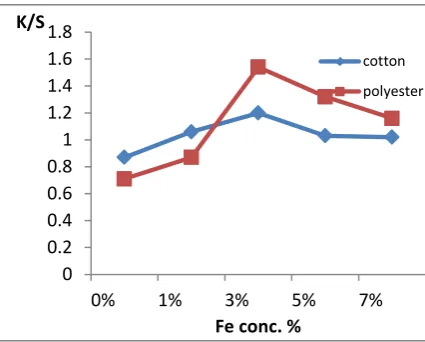
45 min at 80°C and L.R.1:50 . the result are reported in figure (1) showed that the K S of both
fabrics increased with increasing (Fe++ ) up to 5% but it decreased above 5% .
Fig. 1 : Effect of Fe concentration
Study of dyeing parameters
Effect of pH of grafting
After mordanted of cotton and polyester samples with (3%) ferrous ammonium sulphate solution for 30 min at 60 ̊ C with L:R 1:50 than dried with washing.
The effect of pH level of the dyeing medium was studied since different levels of pH were used
(3, 5,7,9 and 11) in presence of 3% A. nidulans ( natural dye) , 10 g/l NaCL, for 45 min at
80°C and L.R.1:50.
the result are reported in figure (2). showed that the K/ S of both fabrics increased with
increasing pH up to 7 but it decreased above 7 0
0.2 0.4 0.6 0.8 1 1.2 1.4 1.6 1.8
0% 1% 3% 5% 7%
K/S
Fe conc. %
42 Fig. 2: Effect of different pH of grafting
Effect of dyeing temperature
In order to study the effect of dyeing temperature dyeing process was carried out at different
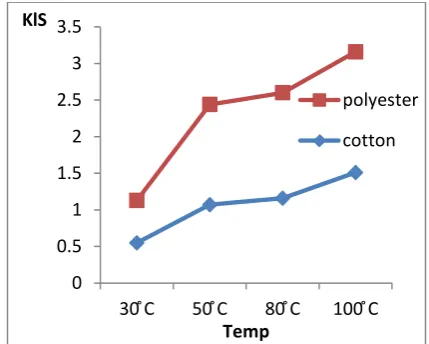
temperatures (30, 50, 70, and 90°C) in presence of 3% A. nidulans , 10 g/l NaCL, , at pH 7 , the
dyeing was performed for 45 min using L.R.1:50, followed by soaping and rinsing. the result are
reported in figure (3) showed that the K/ S of both fabrics increased with increasing temperature
up to 100°C
Fig. (3)Effect of different dying temperature
Effect of dyeing time
The effect of time of dyeing in the presence of of 3% A. nidulans , 10 g/l NaCL,, at pH 7 at
90°C using different times ( 30,45, 60,and 90 min) at L.R. 1:50, followed by soaping and rinsing.
the result are reported in figure (4) showed that the K/ S of both fabrics increased with increasing
time up to 90'
0 0.5 1 1.5 2 2.5 3 3.5 4 4.5
3 5 7 9 11
k/s
pH
polyester cotton
0 0.5 1 1.5 2 2.5 3 3.5
30 ̊C 50 ̊C 80 ̊C 100 ̊C
KlS
Temp
43 Fig.(4)Effect of different dying time
Effect of different NaCL concentration
The effect of time of dyeing in the presence of of 3% A. nidulans at pH 7 at 90°C for 90 min at
L.R. 1:50, using different concentration of NaCL (0,10,30 and 50 g/L ), followed by soaping and
rinsing. the result are reported in figure (5) showed that the K/ S of both fabrics increased with
increasing NaCL concentration.
Fig.(5)Effect of NaCL concentration
Color fastness
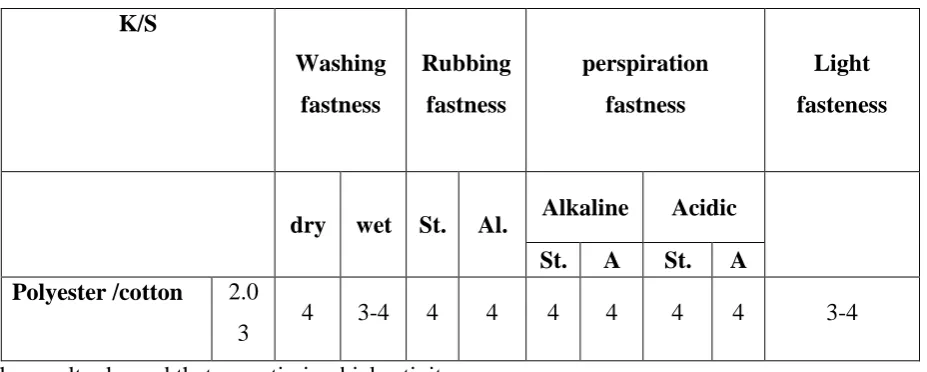
The color fastness of the dyed polyester/cotton blend fabrics to washing, rubbing, perspiration
and light were shown in table 1. The rubbing and perspiration and dry washing fastness
properties of dyed polyester /cotton blended fabrics were good, wet washing and light fastness
were poor.
0 0.5 1 1.5 2 2.5
30̍ ' 45 ' 60 ' 90 '
KlS
Time sec.
cotton polyester
0 0.5 1 1.5 2 2.5 3 3.5 4 4.5
0 5 10 30
KlS
NaCL Conc
44 Antimicrobial activity of Polyester Cotton Blend by diffusion method:
The antimicrobial activity of Polyester Cotton Blend was evaluated by diffusion methods and
the results showed that no antimicrobial activity
Table 1: color fastness of polyester/ cotton blended fabric dyed with A. nidulans
IR Results of A. nidulans pigmrnt:
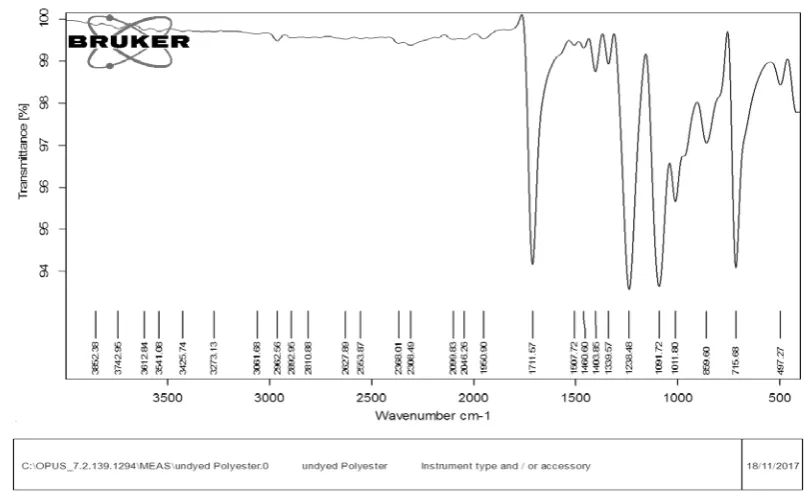
Infra red was evaluated for pigment produced by A. nidulans compared with dyed cotton and
polyester to dtermine the the acive group which lead this pigment to dye both cooton and
polyester. Also undyed cotton and polyester were evaluated by IR as control and to explain the
diffrence between undyed and dyes cotton and polyester as shown in fig. (6,7,8,9 and 10). As
shown in fig.6 the IR results of pigment produced by A. nidulans showed variety in chemical
functional groups as 3254 cmP -1
P
of N-H stretch refers to presence of amine group from Amino
acidsP ,
P
at peak of 2925 cmP -1
P
referes to C-H weak stretch bond of alkanes group. In addition 2860
cmP -1
P
refers to aldehyde group with stretch in its bond with H-C= O: C-H. at peak of 1730 cmP -1
P
indicates that presence of Ester group in this pigment. At peak of 1604 cmP -1
P
for C-C stretch
bond in aromatic ring. At peak of 1445 cmP -1
P
CH3 of methyl group with bend medium bond of
alkanes. At peaks 1259, 1071 and 1021 cmP -1
P
refer to C-N with stretch bond of aliphatic amine of
amino acids indicate that the presence of aliphatic amino acids which highly hydrophobic and
branched side chain. At peak 932 refers to presence of OH group of carboxylic.
With compare between IR results of dyed cotton with dyed cotton peaks at fig 7 and 8 the
results showed that no obvious changes between dyed and undyed cotton except in dyed cotton
presence new peak at 2307 cmP -1
P
refer to carbon triple bond with nitrogen C≡ N with stretch K/S Washing fastness Rubbing fastness perspiration fastness Light fasteness
dry wet St. Al. Alkaline Acidic
St. A St. A
Polyester /cotton 2.0
45 bonds of nitrile group which means that conversion of C-N group in dye to C≡ N in aliphatic
amino acid chain of pigment
Whereas, in case of polyester dyed and undyed IR results fig. 9, 10 showed that obvious changes
in chemical structure of pigment due to chemical reaction between natural pigment and polyester
Polyester is a synthetic polymer made of purified terephthalic acid (PTA) or its dimethyl ester
dim ethyl and monoethylene glycol. Polyester is hydrophobic in nature and quickly dry. The lack
of polarity and the very crystalline structure resists the entry of water molecules into the polymer
system. So, when polyester fiber colourant with natural dyes, it should be pre treated. So the
hydrophobic activity of pigment produced by A. nidulans and non-polarity of lead to dyed the
polyester with this natural pigment
Little work has been carried out on dyeing of synthetic fiber with natural dyes produced by
fungi. Synthetic fabric requires pretreatment process before dyeing with natural dyes. Among
pretreatment process majority of the work is carried out on mordant process. The natural dye
along with mordant gives good fastness properties. There is need to carry out more research
work to improve the fastness properties of natural dye on synthetic fabrics. There is need to
develop data base with production of appropriate shade card for synthetic fabrics. I this work the
effect of A. nidulans extracted pigment was effective in both of cotton and polyester dying also
all factor effect on pigment efficacy in dying both of cotton and polyester was evaluated
46 Fig. 7 showed the IR results of dyed cotton with A. nidulans extracted pigment
47 Fig. 9 Showed the IR results of dyed polyester with A. nidulans extracted pigment
Fig. 10 Showed the IR results of undyed polyester
48
References:
Ado A, Yahaya H, Kwalli AA, Abdulkadir RS. (2014). Dyeing of textiles with
eco-friendly natural dyes: A review, International Journal of Environmental Monitoring
and Protection.
Samanta AK, Konar A, (2009). Dyeing of Textiles with Natural Dyes: A review,
Indian Journal of fiber and textile research, 34
Akilandeswari P, Pradeep BV. 2016 Exploration of industrially important pigments
from soil fungi. Appl Microbiol Biotechnol.;100(4):1631–1643
Berdy J. (2005). Bioactive microbial metabolites. J Antibiot. 58:1–26
Brakhage Aaas V. 2011. Fungal secondary metabolites–strategies to activate silent
gene clusters. Fungal Genet Biol. 48:15–22
Devi SS, Sreenivasulu Y, Rao KB. 2014. Talaromyces verruculosus, a novel marine
fungi as a potent polyhydroxybutyrate degrader. Res J Pharm Technol. 7:433–438
Garrod, L.P. and Waterworth, P. M. (1971). A study of antibiotic sensitivity testing
with proposals for simple uniform methods. J. of Clinical Pathology; 724:779.
https://en.wikipedia.org/wiki/Polyester
Khan R, Bhawana P, Fulekar MH. 2013. Microbial decolorization and degradation
of synthetic dyes: a review. Rev Environ Sci Biotechnol. 12:75–97
Khandare RV, Govindwar SP. 2015. Phytoremediation of textile dyes and effluents: