IJISET - International Journal of Innovative Science, Engineering & Technology, Vol. 2 Issue 9, September 2015.
www.ijiset.com
ISSN 2348 – 7968
Distribution Patterns Of Gold And Ore Elements In The
Bed Rocks And Stream Sediments, Umm-Gheig District,
Egypt
Ibrahim. Abu El Leil1 Mahmoud, Hassaan1 Talaat Ramdan2 Mohamed Fahi3 Adel Ali3
1.Faculty of Science, Al-Azhar University. Cairo, Egypt
2.National Authority for Remote Sensing and Space Sciences. Cairo, Egypt 3.Egyptian Mineral Resources Authority. Cairo, Egypt
Abstract
Stream sediments and bed rock survey were undertaken to reveal gold potential of Umm Gheig District at Kab-Moussa, Gabal Nusla, Khor Abu-Merewa, Wadi El Sherm El Bahari, Khor Abu-Harida, and Hamrat-Ghannam localities. Representative samples were collected from stream sediments and bed rocks. The grain size < 2mm obtained by sieving , subjected to panning to obtain the heavy concentrate. Both the stream sediments concentrate and bed rock were pulverized and subjected to Fire assay (F.A), and Atomic absorption (AAS). The study recorded promising gold and silver contents in the stream sediments as well as the bed rock pointing to promising gold potential of Umm Gheig District recommended for detailed studies.
1. Introduction
The present study deals with geochemical distribution patterns of gold in stream sediments and source Pan African bed rock types cropping out at Wadi Umm Gheig district a part of the Central tectonic domain of the Eastern Desert. This district includes W. Umm Gheig, Kab Musa, W. El El Sherm El Bahari, Khor Abu Merewa, Khor Abu Harida, and Gabal Hamrat Ghannam as well as Gabal Nusla (Fig. 1,2). The Central Eastern Desert is characterized by arid climate, hot in Summer and warm in Winter. Very rare rainfall and occasionally some flood hazard occur at the early weeks of both spring and Autumn. The area is mainly occupied by mountainous rugged topography chain the famous of which are Gabal Umm Shaddad (∆ 776 m.), Gabal Murayr (∆ 582 m.), Gabal Umm Lassaf ( ∆ 597 m.), Gabal Nusla (∆ 528 m.) characterized by gentle slope. The area is dissected by structurally controlled several wadies ( dry valleys), most of them are draining eastward from these mountains to the Red Sea. All these wadies are easily accessible by 4×4 light cars. According to Hassaan classification(1974, 1979, 1980, 1984, 1993) of Quaternary continental sediments in the Eastern Desert. The detrital overburden comprises eluvial-diluvium approximately matching the area of occurrence of source rocks, and diluvial colluvium the top of which is linked with source rocks formed through the action of secular gravitational shifting of loose clastic materials run down along a slope. Their top is linked with the primary source, the front of the diluvial train may go as far as the foot of the slope where it becomes colluvial. Colluvial forms the complex of loose deposits accumulating at the foot of mountains through the washing down of clastic materials from the slopes by temporary streams characteristic of them are debris cones. Alluvial are the valley fillings deposits are confined to the bottom of the valley (wadi). Ali, (2006) recorded placer gold in the sandy grain size of alluvial type at Sukkari area. Abnormal gold contents were recorded by Sakr, (2006) and Hassaan el al (2009). Therefore the main aim of the study is to carry out lithochemical exploratical for gold in the stream sediment, and bed rock survey to reveal the distribution patterns and associated elements. These methods are considered feasible in the Eastern Desert climatic conditions for Au,Pb-Zn, Sn-W, Mo-W, Nb-Ta, REE, Cu, Mn, U and Mo-Ag by Hassaan, (1974, 2009) Hassaan and El Hawary, (1979), Hassaan and Kaoud, (1980), Hassaan et al., (1984), Hassaan, (1990), Nassar, (1992), Azzaz et al., (1993), El Bakry et al., (1995), Sakr, (1998), Hassaan et al 1999 Hassaan (2006). and Hassaan (2009). The bedrock lithochemical survey is able to reveal the main ore metals and geochemical association, level of weathering crust relative to the ore body and probable new sites of mineralization, (Hassaan, , 2001,2006).
1.1 Methodologies
In order to achieve these goals the following studies were conducted:
* Collection of 119 bed rock samples to estimate gold contents and associated elements to reveal the geochemical associations.
* A total of 56 stream sediment samples were collected at 50-60 cm depth to avoid the intake of the aeolian materials to reveal gold and associated elements content in the grain size classes <2mm of the stream sediment.
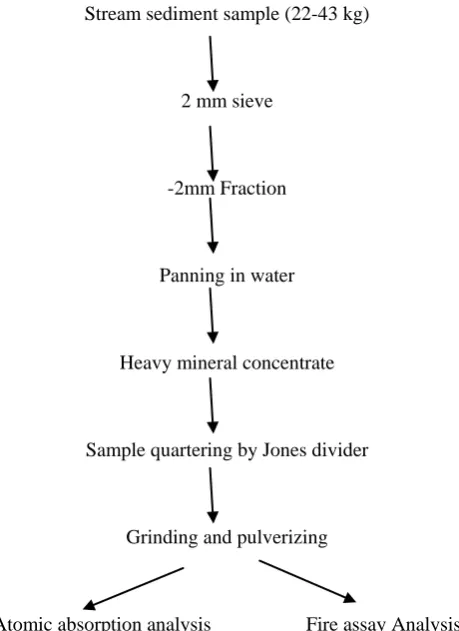
* Panning of the stream sediment samples was undertaken and the obtained panning concentrates from the grain size < 2mm (Fig. 3) as well as the bed rock samples were pulverized and subjected to fire assay and atomic absorption analyses.
IJISET - International Journal of Innovative Science, Engineering & Technology, Vol. 2 Issue 9, September 2015.
www.ijiset.com
ISSN 2348 – 7968
In the concentration operations, only fractions less than 2 mm were taken for gold exploration, the chances of finding gold larger than this size are rare, and even if it is present in a gravel in the larger size range it would be well represented in the smaller fractions, in which caused a change in the applied procedure.
Fig.No.1: Photo-geological map of Hamrat Ghannam area after Al Alfy 1992.Modified by the author.
IJISET - International Journal of Innovative Science, Engineering & Technology, Vol. 2 Issue 9, September 2015.
www.ijiset.com
ISSN 2348 – 7968
Fig.(2-2 ): Geological map of Umm Gheig area modified by the author ( after EGSMA 1973).
One of the major features in the discovery of disseminated gold deposits is the further developments in gold geochemistry. The recognition of gold deposits depends on the ability of detect fine-grained gold. As this is usually in the micron size class it does not often form grains large enough to be separated by panning. On the other hand most but not all gold deposits have concentrations of pathfinder elements associated with the gold (Evans 1997). The most elements associating Au mineralizations in the Eastern Desert are Ag, As, Cu,Co, Sb, Hg, Pb and Zn. A total of 119 bed rock samples were subjected to fire assay analysis (F.A.) for gold. Of these 45 samples were analyzed for the associating elements using atomic absorption spectroscopy (AAS) methods. The Concentrates of 56 stream sediment samples after panning were analyzed using fire assay for gold. Of these, 32 panning concentrate represent Kab-Moussa area were analyzed for the associated elements using atomic absorption (AAS).S The analysis was carried out at the Central Laboratories of EMRA.
The obtained results will be discussed to reveal the distribution pattern of gold and the associated elements in the source bed rock and in the panning concentrate to detect whether the alluvial sediment could be regarded as placer gold.
IJISET - International Journal of Innovative Science, Engineering & Technology, Vol. 2 Issue 9, September 2015.
www.ijiset.com
ISSN 2348 – 7968
Stream sediment sample (22-43 kg)
2 mm sieve
-2mm Fraction
Panning in water
Heavy mineral concentrate
Sample quartering by Jones divider
Grinding and pulverizing
Atomic absorption analysis Fire assay Analysis
Fig. 3: Flow sheet showing preparation of stream sediment samples
2. Alluvial Sediment Survey
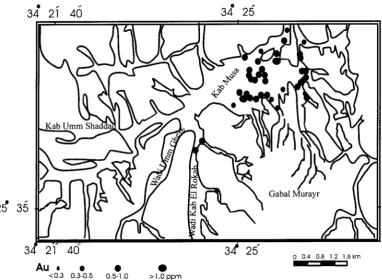
The prepared maps showing the distribution of each Au and Ag in the stream sediments at Kab Moussa area are given in Figs., (4, 5). From table (1) the Au values range from 1.05 to 0.19 ppm, while the Ag is detected only in 26 samples ranging from 1.4 to 0.01 ppm.
From the distribution maps Figs., (4, 5) the samples located nearby the foot of slope of the outcrops representing colluvial recorded higher gold and silver contents than the other samples. This distribution points to that the outcropping rock types are Ag- Au -bearing.
From table (1) both the Co and Mo recorded extra-ordinary high contents ranging from 70-28 ppm averaging 43 ppm, and from 93-4 ppm averaging 34 ppm respectively. Similarly Ni recorded high content in some samples ranging from 36-9 ppm averaging 16 ppm. The elements Cu, Pb, and Zn are also detected. By calculating the correlation coefficient between copper and other elements of zinc and cobalt are uncorrelated relationship, while the silver, gold, lead, and molybdenum are weakly correlated, finally the nickel with copper recorded confident and significant highly correlated (0.736521) in the alluvial samples which also appears from the correlation field (Fig. 6).
The calculated correlation coefficient (r) values between gold and other elements recorded that only silver is moderately confident and significant negatively correlated (-0.579480), while the lead and nickel are weaky correlated (Fig. 7).
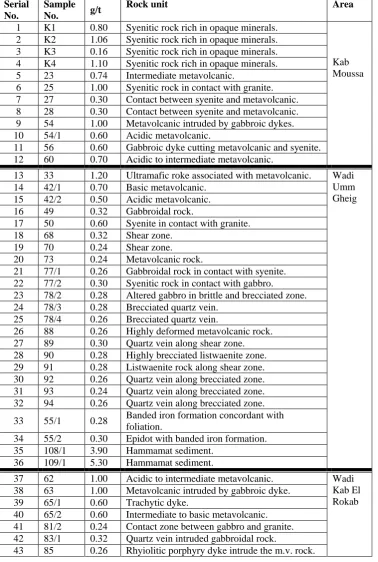
The fire assay results of gold of 24 panning concentrates range from 1.0 to 0.28 g/t, at Wadi Umm Gheig area, and from 0.12 to 0.1 g/t at Gabal Nusla, at Khor Abu Merewa from 1.08 to 0.1 g/t, finally from0.54 to 0.14 g/t at Wadi El Sherm El Bahari (Table, 2)
IJISET - International Journal of Innovative Science, Engineering & Technology, Vol. 2 Issue 9, September 2015.
www.ijiset.com
ISSN 2348 – 7968
Table, 1: Elements content in the alluvial samples at Kab-Muossa area.
Sample No.
F.A AAS.
Au Ag Cu Pb Zn Co Ni Mo
P1 0.81 0.9 19 30 223 31 11 61
P2 0.19 0.8 24 28 262 36 13 41
P3 0.63 0.4 11 19 137 31 9 18
P4 0.64 0.5 17 21 122 53 14 20
P5 0.66 0.4 24 21 148 42 16 32
P6 0.74 0.4 24 24 156 46 17 42
P7 0.85 0.3 14 24 150 46 13 43
P8 0.85 0.3 17 29 153 50 15 93
P9 0.62 0.1 14 19 107 55 12 18
P10 0.92 0.05 11 20 107 51 11 83
P11 1.05 0.26 20 25 147 49 13 54
P12 0.87 N.D 15 20 89 60 13 19
P13 0.63 0.1 22 19 65 70 21 12
P14 0.7 N.D 33 19 34 65 36 4
P15 0.88 0.03 31 23 103 48 25 17
P16 0.67 0.3 61 28 275 40 20 25
P17 0.6 0.02 27 25 119 56 22 15
P18 0.84 N.D 23 23 134 45 20 24
P19 0.66 0.04 19 25 152 42 17 38
P20 0.62 0.3 31 31 237 45 24 29
P21 0.78 0.2 18 20 136 37 17 22
P22 0.88 N.D 12 25 249 34 14 38
P23 0.84 0.01 14 25 218 30 10 37
P24 0.83 0.2 11 26 298 31 11 44
P25 1.02 0.2 13 24 238 28 12 32
P26 0.68 N.D 18 25 202 32 12 22
P27 0.83 N.D 11 23 227 35 12 23
P28 0.78 0.09 13 23 242 36 13 28
P29 0.77 0.3 13 19 257 32 13 22
P30 0.34 0.7 27 22 151 33 15 26
P31 0.48 1 63 27 99 42 33 16
P32 0.44 1.4 18 35 317 37 16 91
Range 1.05- 0.19
1.40-0.00
63-11 35-19
317-34 70-28 36-9 93-
4 Average 0.72 0.29 21.5 24.0 173.6 43.0 16.2 34
AAS: Atomic Absorption Spectroscopy- F.A: Fire assay analyses
3. Bed Rock Survey
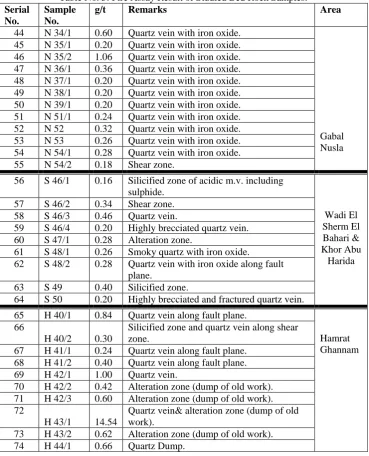
The analyses of mineralized zones representing alteration, shear zones, and quartz veins in the area of study (G. Nusla, Khor Abu Merewa, W.El Sherm El Bahari, Khor Abu Harida, Hamret Ghannam) are shown in Tables (4 , 5). From tables (4,5) The results of fire assay analyses of total 74 samples show several caracteristics.
3.1 At Kab Moussa and Wadi Umm Gheig area
The gold content (Table, 4) ranges from 5.3-0.16 g/t. Most of these samples represent the syenitic rocks rich in iron oxides and opaque minerals. Meanwhile the high values of gold, 3.9 and 5.3 g/t are detected in the alluvial fans representing the cementing materials accumulated at the foot of the slope of the Hammamat sediments exposed at the upper stream of Wadi Umm Gheig.
IJISET - International Journal of Innovative Science, Engineering & Technology, Vol. 2 Issue 9, September 2015.
www.ijiset.com
ISSN 2348 – 7968
Table, 2: Fire assay result of alluvial samples at the studied area. Area g/t
Sample No. Serial
No.
Wadi Umm Gheig 0.36 P33 1 0.30 P34 2 0.60 P36 3 0.50 P35 4 0.30 P37 5 1.00 P38 6 0.80 P39 7 0.28 P40 8 Gabal Nusla 0.10 P3/1 9 0.12 P5/1 10
Khor Abu Merewa 0.12 P6/3 11 0.40 P7/1 12 0.10 P8/1 13 0.22 P10/1 14 0.52 P11/1 15 1.08 P12/3 16 0.20 P13/1 17 0.12 P14/1 18
Wadi Sharm El Bahari & Khor Abu
Harida 0.54 P18/1 19 0.32 P21/1 20 0.14 P22/1 21 0.30 P25/1 22 0.46 P26/1 23 0.52 P28/1 24
Fig. 4: Showing the distribution of gold in the stream sediment at Kab- Moussa.
IJISET - International Journal of Innovative Science, Engineering & Technology, Vol. 2 Issue 9, September 2015.
www.ijiset.com
ISSN 2348 – 7968
Fig. 5 : Showing the distribution of silver in the stream sediment at Kab- Moussa.
IJISET - International Journal of Innovative Science, Engineering & Technology, Vol. 2 Issue 9, September 2015.
www.ijiset.com
ISSN 2348 – 7968
Fig.6 : Scatter plots showing the correlation between copper and other elements in the stream sediment samples at Kab-Moussa area.
IJISET - International Journal of Innovative Science, Engineering & Technology, Vol. 2 Issue 9, September 2015.
www.ijiset.com
ISSN 2348 – 7968
Fig.7 : Scatter plots showing the correlation between gold and other elements in the stream sediment samples at Kab-Moussa area.
3.2 At Gabal Nusla the mineralized zones are represented by discontinuous quartz veins intruding metavolcanic and granitoid rocks, where gold is detected in all samples ranging from 1.2 to 0.2 g/t. The associated elements are Co, Zn, Cu, Pb where the contents reach up to 156, 96, 93, 71 ppm respectively (Tables 3, 5). Old workings exist nearby the quartz vein cutting the granitoid rocks.
3.3 Khor Abu Merewa area
The quartz veins are invading the metavolcanic rocks where the samples were collected from the shear zones and quartz veins. The gold content ranges from 61.64 to 0.25 g/t. The elements of Co, Zn, and Cu, are recorded in some samples where the contents reach up to 259, 96, 37 ppm respectively (Table, 3). Old workings also recorded in this area.
3.4 Wadi El Sherm El Bahari and Khor Abu-Harida
IJISET - International Journal of Innovative Science, Engineering & Technology, Vol. 2 Issue 9, September 2015.
www.ijiset.com
ISSN 2348 – 7968
The mineralized zones are related to quartz veins, alteration and shear zones. The area is covered by mafic & ultramafic rocks, metavolcanics, and granitoide rocks. The old works are exist at two localities, the first one at Khor Abu Harida where the products of silicification, carbonitization, and ferrugination as well as the hosted quartz veins in this area. The second exists at the southern side of Wadi El Sherm El Bahari, where the granitic rocks are intruding the metavolcanics. The product of pyritization is very clear in this area. The gold values in this area range from 2.0 to 0.18 g/t, high Ni contents are recorded in this area due to the mafic and ultramafic rocks, which reaches up to 1700 ppm (Tables, 3,5)
Table, 3:The Contents of Gold and Associating Elements in the Bed Rock Samples.
Sample No
F.A. g/t AAS.(ppm)
Area Au Cu Pb Zn Co Ni Mo
N 1/1 0.30 93 N.D 18 83 N.D N.D
Gabal Nusla N ½ 0.30 10 48.8 8 N.D N.D 160
N 1/3 1.08 11 N.D 11 72 N.D N.D N ¼ 0.30 34 N.D 86 24 N.D N.D N 2/1 0.44 81 N.D 96 25 N.D N.D N 2/2 0.84 13 N.D 21 86 N.D N.D N 2/3 0.84 13 71 26 N.D N.D N.D N 4/1 1.20 N.D N.D 12 156 N.D N.D N 4/2 0.20 10 N.D 16 22 N.D N.D N 4/3 0.25 19 N.D 25 13 26 N.D M 6/1 0.35 N.D N.D 10 224 N.D N.D
Khor Abu Merewa M 6/2 0.35 N.D N.D 7 259 N.D N.D
M 9/1 0.50 34 N.D 40 18 10 N.D M 12/1 61.64 37 N.D 96 44 N.D N.D M 12/2 0.30 N.D N.D 18 119 N.D N.D M 12/4 0.40 26 N.D 26 96 N.D N.D M 12/5 0.30 10 N.D 11 216 N.D N.D M 15/1 0.25 N.D N.D 25 70 N.D N.D M 15/2 0.35 N.D N.D 15 150 N.D N.D S 16/1 0.26 61 36 55 80 1522 N.D
Wadi El Sherm El
Bahari & Khor Abu
Harida S 16/2 0.25 20 68 76 72 1700 N.D
S 16/3 0.30 46 70 60 87 1630 N.D S 17/1 0.32 421 N.D 13 75 50 N.D S 19/1 0.30 119 21 109 30 230 N.D S 19/2 0.40 5 N.D 7 152 20 N.D S 20/1 2.00 343 N.D 31 125 600 N.D S 20/2 0.44 431 N.D 31 70 15 N.D S 20/3 0.40 40 N.D 10 85 N.D N.D S 20/4 0.25 30 N.D 7 183 N.D N.D S 20/5 0.24 144 N.D 96 25 20 N.D S 20/6 0.30 340 N.D 38 105 80 N.D S 20/7 0.30 335 N.D 23 270 101 N.D S 23/1 0.20 116 N.D 8 163 N.D N.D S 23/2 0.20 110 N.D 14 47 912 N.D S 24/1 0.18 44 N.D 32 124 130 N.D S 24/2 0.18 664 N.D 35 130 1561 N.D S 24/3 0.24 37 N.D 27 65 160 N.D S 26/3 0.92 163 N.D 18 35 63 N.D S 26/4 0.24 N.D N.D 22 82 174 N.D S 27/1 0.20 N.D N.D 20 110 55 N.D S 27/2 0.20 39 N.D 7 200 N.D N.D S 27/3 0.20 N.D N.D 8 115 25 N.D
H 29/1 0.18 N.D N.D 37 210 N.D N.D Hamrat Ghannam H 29/2 0.18 110 21 110 240 N.D N.D
H 29/3 0.24 84 N.D 9 220 N.D N.D
IJISET - International Journal of Innovative Science, Engineering & Technology, Vol. 2 Issue 9, September 2015.
www.ijiset.com
ISSN 2348 – 7968
3.5 Hamrat Ghannam area
Gold mineralization is detected in the quartz veins and alteration zones. This mineralization is associated with the shear zones in the granitoidic rocks. Gold contents are recorded by fire assay range from 14.54 to 0.18 g/t. High values of Co are detected by the atomic absorption analyses in the quartz veins cutting the granitoid rocks which reaches up to 240 ppm (Tables, 3, 5). Old workings exist in this area where quartz dumps are accumulating.
Table No. 4: Fire Assay Result of Studied Bed Rock Samples.
Area Rock unit g/t Sample No. Serial No. Kab Moussa Syenitic rock rich in opaque minerals.
0.80 K1
1
Syenitic rock rich in opaque minerals. 1.06
K2 2
Syenitic rock rich in opaque minerals. 0.16
K3 3
Syenitic rock rich in opaque minerals. 1.10 K4 4 Intermediate metavolcanic. 0.74 23 5
Syenitic rock in contact with granite. 1.00
25 6
Contact between syenite and metavolcanic. 0.30
27 7
Contact between syenite and metavolcanic. 0.30
28 8
Metavolcanic intruded by gabbroic dykes. 1.00 54 9 Acidic metavolcanic. 0.60 54/1 10
Gabbroic dyke cutting metavolcanic and syenite. 0.60
56 11
Acidic to intermediate metavolcanic. 0.70 60 12 Wadi Umm Gheig Ultramafic roke associated with metavolcanic.
1.20 33 13 Basic metavolcanic. 0.70 42/1 14 Acidic metavolcanic. 0.50 42/2 15 Gabbroidal rock. 0.32 49 16
Syenite in contact with granite. 0.60 50 17 Shear zone. 0.32 68 18 Shear zone. 0.24 70 19 Metavolcanic rock. 0.24 73 20
Gabbroidal rock in contact with syenite. 0.26
77/1 21
Syenitic rock in contact with gabbro. 0.30
77/2 22
Altered gabbro in brittle and brecciated zone. 0.28
78/2 23
Brecciated quartz vein. 0.28
78/3 24
Brecciated quartz vein. 0.26
78/4 25
Highly deformed metavolcanic rock. 0.26
88 26
Quartz vein along shear zone. 0.30
89 27
Highly brecciated listwaenite zone. 0.28
90 28
Listwaenite rock along shear zone. 0.28
91 29
Quartz vein along brecciated zone. 0.26
92 30
Quartz vein along brecciated zone. 0.24
93 31
Quartz vein along brecciated zone. 0.26
94 32
Banded iron formation concordant with foliation.
0.28 55/1
33
Epidot with banded iron formation. 0.30 55/2 34 Hammamat sediment. 3.90 108/1 35 Hammamat sediment. 5.30 109/1 36 Wadi Kab El Rokab Acidic to intermediate metavolcanic.
1.00 62
37
Metavolcanic intruded by gabbroic dyke. 1.00 63 38 Trachytic dyke. 0.60 65/1 39
Intermediate to basic metavolcanic. 0.60
65/2 40
Contact zone between gabbro and granite. 0.24
81/2 41
Quartz vein intruded gabbroidal rock. 0.32
83/1 42
Rhyiolitic porphyry dyke intrude the m.v. rock. 0.26
85 43
IJISET - International Journal of Innovative Science, Engineering & Technology, Vol. 2 Issue 9, September 2015.
www.ijiset.com
ISSN 2348 – 7968
Table No. 5: Fire Assay Result of Studied Bed Rock Samples.
Area Remarks g/t Sample No. Serial No. Gabal Nusla Quartz vein with iron oxide.
0.60 N 34/1
44
Quartz vein with iron oxide. 0.20
N 35/1 45
Quartz vein with iron oxide. 1.06
N 35/2 46
Quartz vein with iron oxide. 0.36
N 36/1 47
Quartz vein with iron oxide. 0.20
N 37/1 48
Quartz vein with iron oxide. 0.20
N 38/1 49
Quartz vein with iron oxide. 0.20
N 39/1 50
Quartz vein with iron oxide. 0.24
N 51/1 51
Quartz vein with iron oxide. 0.32
N 52 52
Quartz vein with iron oxide. 0.26
N 53 53
Quartz vein with iron oxide. 0.28 N 54/1 54 Shear zone. 0.18 N 54/2 55 Wadi El Sherm El Bahari & Khor Abu Harida Silicified zone of acidic m.v. including
sulphide. 0.16 S 46/1 56 Shear zone. 0.34 S 46/2 57 Quartz vein. 0.46 S 46/3 58
Highly brecciated quartz vein. 0.20 S 46/4 59 Alteration zone. 0.28 S 47/1 60
Smoky quartz with iron oxide. 0.26
S 48/1 61
Quartz vein with iron oxide along fault plane. 0.28 S 48/2 62 Silicified zone. 0.40 S 49 63
Highly brecciated and fractured quartz vein. 0.20
S 50 64
Hamrat Ghannam Quartz vein along fault plane.
0.84 H 40/1
65
Silicified zone and quartz vein along shear zone.
0.30 H 40/2
66
Quartz vein along fault plane. 0.24
H 41/1 67
Quartz vein along fault plane. 0.40 H 41/2 68 Quartz vein. 1.00 H 42/1 69
Alteration zone (dump of old work). 0.42
H 42/2 70
Alteration zone (dump of old work). 0.60
H 42/3 71
Quartz vein& alteration zone (dump of old work).
14.54 H 43/1
72
Alteration zone (dump of old work). 0.62 H 43/2 73 Quartz Dump. 0.66 H 44/1 74
4.Conclusions
The distribution patterns of gold and associated elements in the bed rock and panning concentrates of the stream sediments occurring at Umm Gheig district recorded the following conclusions.
1.The recorded gold contents in the panning concentrates of the stream sediments point to consider it placer gold.
2.The bed rock survey recorded abnormal gold contents in the mineralized zones, quartz veins, and other rock units.
3.The highest gold contents are recorded at Khor Abu-Merewa- from 61.64 to 0.25 g/t , at Hamrat Ghannam- from 14.54 to 0.18 g/t, and at Kab-Moussa- from 5.3 to 0.16 g/t, while the moderate contents are recorded at Wadi El Sherm El Bahari- from 2.0 to 0.18 glt, and at Gabal Nusla- from 1.2 to 0.2 g/t.
4. The obtained results point to gold anomalies in both the stream sediments and bed rocks at Umm Gheig District.
5.Further detailed studies is recommended for economic evaluation of gold in this district.
IJISET - International Journal of Innovative Science, Engineering & Technology, Vol. 2 Issue 9, September 2015.
www.ijiset.com
ISSN 2348 – 7968
References
1. Ali,A.M. (2006): Mineralogical and geochemical Studies on perspectives of formation of gold placers in the area of Sukkari Gold Mine, Central Eastern Desert, Egypt. Msc, pp 133.
2. Azzaz, SA ; Hassaan , MM ; Soliman , MM ; El-Badawy, S, 1993- Geochemical orientation survey for gold, Sukkari area ,Eastern Desert , Egypt , Bull, Fac., Sci., Al Azhar Univ., Cairo, Egypt, 1993, v.4, no.2, p.455-467.
3. El Bakry, A. Hassaan M. M., Abd El Ghany Kh. (1995): Geochemical Orientation survey for molybdenum in arid conditions of the Egyptian Eastern Desert: Al Azhar Bull. Sci; Vol. 6, No. 2 (Dec.), p. 1887-1904. 4. Evans, M.A., (1997): Introduction to mineral exploration, text book, b-Black well science. pp. 396.
5.Hassaan, M. M; (1974): Geochemical methods of prospecting for lead-zinc ore deposits, Eastern Desert, Egypt. Ph. D. Dissertation. Leningrad Mining Institute, Leningrad, 204 pp. (In Russian).
6.Hassaan, M. M; Al Hawary, M.A., (1979): Geochemical orientation survey for manganese deposits in arid conditions, Eastern Desert, Egypt. Proceeding of the 7th. International Geochemical Exploration symposium, pp. 93-101.
7.Hassaan, M. M., Al Badary, O, and Zein El Din, M. Y., (1980): Facies model of arid continental clastic sediments. Eastern Desert, Egypt. Bull. Fac. Sci. Zagazig University, pp 1-12.
8.Hassaan, MM; Soliman, MM; Azzaz, SA, (1984): Geochemical behaviour of gold and some associated metals in Sukkari, UmUd, and Samut rock units, Eastern Desert, Egypt, 3rd Symp on Precambrian & Develop, Cairo, Egypt, Abstr, Oct., 1984, p.7.
9.Hassaan, MM; Soliman, MM; Azzaz, S.A., (1990): Geological studies on gold mineralization at Sukkari, UmUd, and Samut, Eastern Desert, Egypt. Ann. Geol. Surv. Egypt, Cairo, vol. XVI, pp. 89-95. 10.Hassaan, M.m., ElMezayen,A.M., Dardir,A.A. and Hassanein,M.M., (1993): Primary distribution pattern of
gold and associated elements in Abu Marawat mine, NED and significance of exploration. Abstracts, Conf. Mineral. Soc. Egypt, Dec. 1993.
11. Hassaan, M.M.(2001): The required parameters for lithogeochemical Survey for dispersion aureoles of main metallic deposits, arid Eastern Desert, Egypt. J. Sediment. Soc. Egypt, Vol. 9, pp. 1-13.
12.Hassaan, M.M., (2006) Gold Deposits in Egypt a renewing Resouce for National Income, The Ninth Arab Conference for Mineral Resouces, pp: 3,(Nov).
13.Hassaan, M.M, El Sawy, E, K, (2009): Tectonic Environments and Distribution of Gold Deposits in the Pan African Nubian Shield, Egypt. Australian Journal of Basic and Applied Sciences, 3 (2): 797-809, 2009 ISSN 1991-8178 © 2009, INSI ent Publication, 3(2): 371-384. 2009.
14.Nassar, YZH, (1992): Geological and geochemical studies on the gold placer deposits in the Central Eastern, Desert, Egypt, Ph D Geol, Fac., Sci., Al Azhar Univ., 1992, 272 p.
15.Sakr, S. M. M. (1998): Mineralogical and Geochemical studies on the secondary dispersion patterns of some ore elements in Central Eastern Desert, Egypt. Msc. Thesis, Al Azhar Univ. Cairo, Egypt, pp. 265.