An Experimental study on partial replacement for coarse
aggregate by Granite Waste.
R.Siva Kumar,H.Mohammed yousuff,M.Haripriya Third Year
Department Of Civil Engineering SNS College of Engineering
Abstract
:In developing countries where concrete is widely used, the high and steadily increasing cost of concrete has made construction very expensive. This coupled with deleterious effect of concrete production on the environment has led to studies on various materials which could be used as partial replacement for coarse aggregate. This project is experimented to reduce the cost of concrete. The only way to reduce and tackle these problems is reuse and recycles. In this project work, experiments have been conducted with the collection of materials required and data required for mix design are obtained. The M30 grade concrete is designed as per Indian standard code for conventional concrete. The water cement ratio is maintained for this mix design is 0.45. The granite wastes were properly cut down to the size of coarse aggregate and then they were mixed with the concrete in 10%, 20%, 30%, 40%, 50%. Cubes were casted with these concrete mixes and subjected to curing of 7 days, 28 days and their strength is determined. The determined compressive strength was compared with the conventional concrete cube’s strength. Of the above percentage mixes, the perfect percentage mix of granite with coarse aggregate is found and can be brought to use. Key words: coarse aggregate, granite waste.
INTRODUCTION
:Concrete is a composite material composed of aggregate bonded together with the fluid cement which hardens over time. Most use of the term concrete refers to Portland cement concrete or to concrete made with other hydraulic cements. In Portland cement concrete and other hydraulic cement concrete, when aggregate is mixed together with dry cement and water, they form a fluid mass that is easily moulded into shape. The cement reacts
chemically with water and other ingredient to form hard matrix which binds all the materials together into a durable
stone-like material that has many uses. Often additives like pozzolans and superplastiziers are included into the mixture to improve the physical properties of wet mix or the finished material. Most concrete is poured with reinforcing material such as rebar embedded to provide tensile strength, yielding reinforced concrete. Today, large concrete structures like dams and multi-storey buildings are usually made with reinforced concrete. Modern tests show that opus cementicium had as much compressive strength as modern Portland cement concrete. However, due to absence of the reinforcement, its tensile strength was far lower than modern reinforced concrete, and its mode of application was so different. There are many types of concrete available, created by varying the proportions of main ingredients. In this way or by the substitution for the cementitious and aggregate phases, the finished product can be tailored to the application with varying strength, density, or chemical and thermal resistance properties. The cement concrete has attained the status of a major building material in all branches of modern construction. Since, it is possible to control the properties of cement concrete within a wide range by using appropriate ingredients and by applying special possessing techniques-mechanical, physical and chemical.
EXPERIMENTAL SETUP
:In this stage collection of materials required and data required for the mix design are
obtained by sieve analysis and specific gravity. Sieve analysis is carried out from various fine aggregate (FA) and coarse aggregate (CA) samples and the samples which suits the requirement is selected. Specific gravity tests are carried out for fine and coarse aggregate. The various materials used were tested as per Indian standard specification.
MATERIALS:
Raw materials required for the concreting operations of present work are cement, fine aggregate, coarse aggregate, granite waste and water.
Cement:
Cement is used as binding material in the concrete where the strength and durability re significant important. The ordinary Portland cement of 53 grades conforming to IS: 12269-1987 is used to manufacture the concrete. Also some tests were conducted such as consistency test, setting time test, specific gravity test.
Property
IS Code (IS
8112:1989)
Specific gravity 3.12
Consistency 33
Initial setting time Not less than 30 minutes
Final setting time Not greater than 600 minutes
Aggregate:
The size of aggregates used is 20mm and the grain size of sand is used. The aggregate tests are performed and results are as follows.
(1)Fine aggregate
:
It consists of small angular or grounded grains of silica (SiO2) and is formed by decomposition of sand stone under the effect weathering agencies. The size which is less than 4.75mm is called as fine aggregate. River sand is used as fine aggregate conforming to the requirements of IS 383. Before using that, it can
be properly cleaned by sieving and washing to eliminate the impurities.
(2)Coarse aggregate:
Coarse aggregate may be in the form of irregular broken stones or naturally occurring rounded gravel. Materials which are large to be retained on 4.75mm sieve size called as coarse aggregate. It acts as a main filler, and forms the main bulk of concrete. Of which the materials adhere in the form of film. Aggregates balance the shrinkage and volume changes of concrete conforming to IS: 383 are used.
Physical properties of fine aggregate and coarse aggregate:
Property Fine
aggregate
Coarse aggregate
Fineness modulus 3.35 7.54
Specific gravity 2.38 2.76 Bulk density(gm/cc) 1753 1741 Water absorption (%) 1.20 1.83
Water:
Water plays an important role in mixing, laying, and compaction, setting and hardening of concrete. Water influences the strength development and durability of concrete. Ordinary drinking water can be used for preparing concrete. guidance of examine the suitability of the available water for construction can be obtained from the following specified data in IS 456-2000.The pH value of water should be generally not be less than 6.
Granite waste:
In granite quarries, the granites were digged until the quality granite stones were obtained. The former granite digged were wastes and hence they were piled and put up. Due to piling of such granite wastes more lands were acquired. These heaped granites are called granite wastes. In this project these granite wastes were crushed and used in the place of 20mm coarse aggregate.
Fig 1 - Granite waste
DESIGN MIX:
The concrete is designed for M30 grade by using the procedure as per Indian standard (IS10262:2009). This proportion is used to prepare the samples. The mix proportions are shown in table.
Design mix proportions
W C FA CA
By weight in kg/mP
3
462 1028 1439 2261
By volume (mP
3
P
)
0.45 1 1.4 2.2
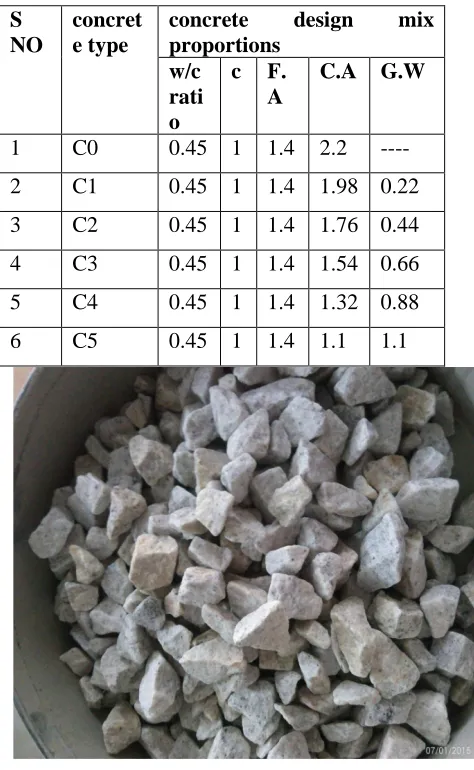
Replacement proportions for various concrete
S.NO concrete
type
coarse aggregtae replacement with granite waste
1 C0 Standard concrete
2 C1 10% replacement
3 C2 20% replacement
4 C3 30% replacement
5 C4 40% replacement
6 C5 50% replacement
EXPERIMENTAL SETUP:
Experiment methodology:
The evaluation and replacement of granite waste for coarse aggregate are done by using concrete testing. The ingredients of concrete is added and the test is conducted. In this experiment we replace the granite waste for coarse aggregate partially in the percentage of 10%, 20%, 30%, 40%, 50%. The replaced concrete is compared with the normal concrete. For this cube samples of size 150mm*150mm*150mm are casted for each percentage of replaced concrete and normal concrete. The cubes are prepared in the proportions of 1:1.4:2.2 and the water cement ratio of 0.45. After 24 hours the cubes are remoulded and they are cured in the curing tank for 7 and 28 days. Totally two set of cubes are prepared for each proportion of replacement. First set is taken for compressive test after 7 days curing and second set is for 28 days curing.
S
NO
concret e type
concrete design mix proportions
w/c rati o
c F. A
C.A G.W
1 C0 0.45 1 1.4 2.2 ----
2 C1 0.45 1 1.4 1.98 0.22
3 C2 0.45 1 1.4 1.76 0.44
4 C3 0.45 1 1.4 1.54 0.66
5 C4 0.45 1 1.4 1.32 0.88
6 C5 0.45 1 1.4 1.1 1.1
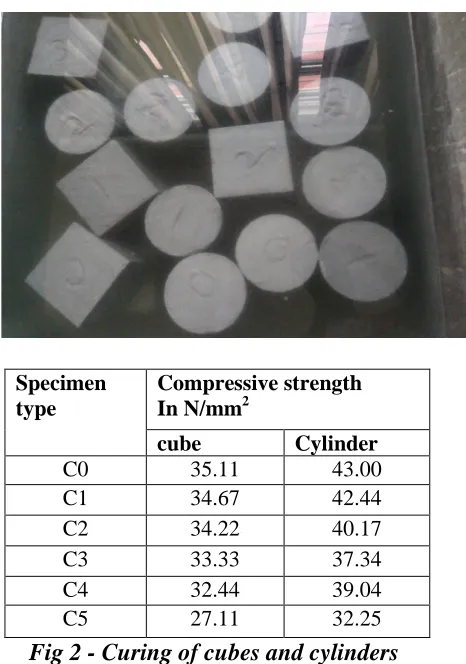
Fig 2 - Curing of cubes and cylinders
MECHANICAL PROPERTIES:
Compressive strength test:
The compressive strength of cubes and cylinders are tested by using the compressive testing machine by applying the load at the rate of 30N/mm2 per minute. The average test result values are tabulated and comparative studies were made on the both normal and partially replaced concrete cubes of 10%, 20%, 30%, 40% and 50%.
Fig 3 - Curing of cubes and cylinders
Compressive strength values for 7 days curing
Specimen type
Compressive strength in N/mm2
cube Cylinder
C0 23.55 27.16
C1 22.66 26.59
C2 22.23 26.03
C3 22.27 24.89
C4 21.77 26.03
C5 19.55 23.76
Compressive strength values for 28 days curing
GRAPH:
Compressive strength of cubes Specimen
type
Compressive strength In N/mmP
2
cube Cylinder
C0 35.11 43.00
C1 34.67 42.44
C2 34.22 40.17
C3 33.33 37.34
C4 32.44 39.04
C5 27.11 32.25
Compressive strength of cylinders
CONCLUSION:
Based on these research investigations the following observations were made.
The compressive strength of concrete is same with the conventional concrete only at 10%, 20%, 30% replacement of granite waste. The strength is gradually decreasing at 40% and 50%.
Moreover by using granite waste and its applications reduces the solid waste dumping and increases the sustainable development of the construction industry in the most efficient way and also address the high value of usage of such waste.
So we conclude that the coarse replaced with granite waste at 30% in concrete is suitable for construction.
REFERENCES
:[1] Olateju,(1992) The efficacy of lightweight aggregate from palm kernel shells”, Journal of Housing Science (4), pp. 263–276.
[2] Exploratory Study of Periwinkle Shells as Coarse Aggregates in Concrete Works” A. P. Adewuyi and T. Adegoke -ARPN Journal of Engineering and Applied Sciences, December 2008.
[3] Adewuyi, A. P., Adegoke, T. 2008. Exploratory Study Of Periwinkle Shells As Coarse Aggregate In Concrete Works. Journal of Applied Sciences Research, 4(12): 1678-1681.
[4] Shetty M.S. “Concrete Technology heory and Practice” S.Chand& Company New Delhi.
[5] Shi Cong Kou, Chi Sun Poon, Dixon Chan, “Influence of Fly Ash as Cement Replacement on the Properties of Recycled Aggregate Concrete.” J. of Mater. In Civil Engg. ASCE, 709 (2007).
[6] Abbott, R. Tucker, 1986, Seashells of North America, St. Martin's Press, New York.
[7] Kamang, E. E. and O. F. Job (1997).The relationship between the strength and non-destructive parameters of periwinkle shell concrete.African Journal of Natural Sciences, 1:96-100.
[8] Osadebe, N. N., and O. M. Ibearugbulem (2009).Application of scheffe’s simplex model in optimizing compressive strength of periwinkle shell granite concrete.The Heartland Engineer, 4 (1): 27 – 38.
[9] Vignesh S A partial replacement for coarse aggregate by seashell and cement by fly ash in concrete.
0 5 10 15 20 25 30 35 40
0% 10% 20% 30%40% 50%
7 days curing 28 days curing
0 20 40 60
0% 10%
20
%
30
%
40
%
50
%
7 days curing 28 days curing