A Black-Box Construction of a
CCA2
Encryption Scheme from a
Plaintext Aware Encryption Scheme
Dana Dachman-Soled University of Maryland [email protected]
October 14, 2013
Abstract
We present a construction of aCCA2-secure encryption scheme from a plaintext aware, weakly sim-ulatable public key encryption scheme. The notion of plaintext aware, weakly simsim-ulatable public key encryption has been considered previously by Myers, Sergi and shelat (SCN, 2012) and natural encryp-tion schemes such as the Damg˚ard Elgamal Scheme (Damg˚ard, Crypto, 1991) and the Cramer-Shoup Lite Scheme (Cramer and Shoup, SIAM J. Comput., 2003) were shown to satisfy these properties.
Recently, Myers, Sergi and shelat (SCN, 2012) defined an extension of non-malleableCCA1security, calledcNM-CCA1, and showed how to construct acNM-CCA1-secure encryption scheme from a plaintext aware and weakly simulatable public key encryption scheme. Our work extends and improves on this result by showing that a fullCCA2-secure encryption scheme can be constructed from the same assumptions.
1
Introduction
The basic security requirement for public key encryption schemes is Chosen Plaintext Attack (CPA) security [GM84] (also known as semantic security), which ensures security against apassive, eavesdropping adversary. A stronger security requirement for public key encryption schemes, which ensures that they remain secure even in the face of an active adversary, is known as Adaptive Chosen Ciphertext Attack (CCA2) security. More specifically, a CCA2-secure encryption scheme is guaranteed to be secure even against an adversary who has access to a decryption oracle and may use it to decrypt any ciphertext of its choice except for the challenge ciphertext itself. This captures real-life scenarios where the adversary has control over network traffic which allows the adversary, in effect, to decrypt all ciphertexts of its choice.
There is a significant body of work on constructing CCA2-secure encryption schemes from specific computational hardness assumptions (c.f. [CS02, HK08, CKS09, HJKS10]), as well as from various lower level primitives (c.f. [DDN00, CHK04, Kil06, PW11, RS10, KMO10, Wee10]). Nevertheless, the central question in this area remains open: To determine the relationship betweenCCA2 andCPA-secure encryption—whether a CCA2-secure encryption scheme can be constructed assuming only the existence of a CPA-secure encryption scheme, or whetherCCA2-security requires stronger assumptions. Although a partial answer was given in [GMM07], the larger question remains open for both black-box and non-black-box constructions. Moreover, several important variants of the question such as whether a CCA2 secure encryption scheme can be constructed from a CCA1-secure encryption scheme1 remain open.
In this paper, we consider a strong type of CPA-secure public key encryption scheme which is also plaintext aware,weakly simulatable, and enjoysperfect correctness2and show how to construct fullCCA2 -secure public key encryption schemes from such a CPA-secure encryption scheme. Moreover, the CCA2 construction presented is black-box in the underlying CPA-secure scheme.
Although the required assumptions are strong—we discuss and provide more details on the assump-tions of plaintext awareness and weak simulatability below—we view our new construction of CCA2 encryption from plaintext aware, weakly simulatable PKE as meaningful progress since our underlying assumption is an assumption which was not previously known to imply CCA2 security. Moreover, to the best of our knowledge, this is the first construction of a CCA2 scheme from encryption schemes with seemingly weaker or incomparable security to CCA2 and requiring no additional assumptions. Finally, we present new proof techniques for proving CCA2security, which may be useful for constructing CCA2 secure encryption from other lower-level primitives.
1.1 Our Assumptions
Our work relies on a strong assumption on the underlyingCPA-secure encryption scheme calledplaintext awareness. The notion of a plaintext aware encryption scheme was first introduced in the seminal paper of Bellare and Rogaway [BR94] and the notion was further studied by Bellare et al. [BDPR98]. Both of these works dealt with the notion of plaintext awareness in the Random Oracle model. Subsequently, Bellare and Palacio [BP04b] considered extending the notion of plaintext awareness to the plain model3.
In this work, we are also interested in the notion of plaintext awareness in the plain model without random oracles. Informally, an encryption scheme is plaintext aware (called sPA1in [BP04b]) if for every efficient ciphertext creator, C, there exists an efficient plaintext extractor, C∗, that outputs the same value as the decryption algorithm on ciphertexts outputted by C. This type of assumption is known as
1
ACCA1-encryption scheme is one where the adversary has oracle access to the decryption oracle up to the point that it receives the challenge ciphertext.
2
We can remove the requirement of perfect correctness by using the transformation of [DNR04] to transform a public key encryption scheme with decryption error to a public key encryption scheme with perfect correctness. Note that each transformation in the sequence of transformations given in the proof of Theorem 3 of [DNR04] preserves both simulatability and plaintext awareness of the underlying encryption scheme.
3We note that prior to the work of [BP04b], Herzog et al. [HLM03] considered a notion of plaintext awareness in the key
a knowledge assumption (other examples of knowledge assumptions include the knowledge of exponent assumption [HT98, BP04a] and extractable collision resistant hash functions [BCCT12]) and is thus a non-falsifiable assumption. Despite the strength of the assumption, the notion of plaintext awareness is meant to capture an intuitive property of certain encryption schemes that an efficient adversary cannot create a valid ciphertext without ”knowing” the corresponding plaintext.
It is not hard to see that any plaintext aware encryption scheme is itself alsoCCA1-secure, since the plaintext extractor can be used to simulate the decryption oracle in the CCA1 experiment. However, plaintext aware encryption does not directly implyCCA2-secure encryption since the plaintext extractor is not guaranteed to work correctly when the ciphertext creator receives a valid encryption as input. Thus, when the adversary queries the CCA2 decryption oracle after receiving the challenge ciphertext
CT∗ in the CCA2experiment, the extractor may not be able to simulate the decryption oracle. In fact, since we are given no guarantees on the output of the plaintext extractor when the ciphertext creator receives CT∗ as input, it would seem that constructing CCA2-secure encryption from plaintext aware encryption is just as hard as constructingCCA2-secure encryption fromCCA1-secure encryption; we have the extra guarantee of a plaintext extractor, but the extractor seems useless for queries made after the challenge ciphertext is received.
Recently, a fascinating result by Myers, Sergi and shelat [MSS12], showed that by adding an additional assumption that the plaintext aware public key encryption scheme is also weakly simulatable, the above problem can be partially overcome. Essentially, they present a new construction and show that the plaintext extractor can still be useful for simulating the decryption oracle for a constant number of parallel queries made after the adversary receives the challenge ciphertext when the underlying plaintext aware public key encryption scheme is also weakly simulatable.
The notion ofsimulatable public key encryption was first introduced by Damg˚ard and Nielsen [DN00] in the context of non-committing encryption. Loosely speaking, [DN00] define a simulatable public key encryption scheme to be an encryption scheme with special algorithms for obliviously sampling public keys and random ciphertexts without learning the corresponding secret keys and plaintexts; in addition, both of these oblivious sampling algorithms should be eficiently invertible. An incomparable notion of simulatable public key encryption was introduced by [Den06] and was shown to imply CCA2-secure encryption. Here, the public key encryption scheme has an invertible algorithmf for obliviously sampling random ciphertexts (but not public keys) and in addition, f(r), where r is a random string r and C, whereCis an honestly generated ciphertext are indistinguishable,even when given access to a decryption oracle. The weakly simulatable encryption schemes used in this work are strictly weaker than both of the above notions. They are weaker than the [DN00] notion since only the ciphertext and not the public key has an invertible oblivious sampling algorithm and they are weaker than the [Den06] notion since the attacker is not given access to the decryption oracle.
In their work, [MSS12] defined an extension of non-malleableCCA1security, calledcNM-CCA1, where an adversary can makecadaptive parallel decryption queries after seeing the challenge ciphertext. Then, [MSS12] showed how to construct cNM-CCA1 encryption from plaintext aware and weakly simulatable public key encryption for any constantc. Similar assumptions of plaintext aware and weakly simulatable public key encryption were previously made by [Den06]. Moreover, as shown by Myers, Sergi and she-lat [MSS12] natural encryption schemes such as the D˚amgard Elgamal encryption scheme (DEG) and the lite version of Cramer-Shoup encryption scheme (CS-lite) satisfy both of these properties under the DDH assumption and a suitable extension of the Diffie-Hellman Knowledge (DHK) assumption (see [BP04b] for discussion of the DHK assumption).
Following the work of [MSS12], it is interesting to explore how far we can take the assumption of the existence of a plaintext aware and weakly simulatable public key encryption scheme and what the power of this assumption is relative to the assumption of the existence of a CCA2-secure encryption scheme.
1.2 Our Results
Theorem 1.1 (Informal) There is a black-box construction of CCA2-secure encryption from plaintext aware and weakly simulatable public key encryption with perfect correctness.
Our result extends the work of [MSS12] by showing that plaintext aware and weakly simulatable public key encryption can, in fact, be used to achieve full CCA2security.
Finally, the assumption of a plaintext aware encryption scheme can be viewed as an assumption that allows us to use strong non-black-box techniques on the adversary in the security reduction. More specifically, we leverage the code of the adversary by using it to extract crucial information that the adversary must ”know.” This raises the intriguing question of whether we can present a construction of CCA2fromCPAwhere the security proof uses non-black-box access to the adversary. Such reductions are known to be more powerful than black-box reductions in the setting of multiparty computation as first shown in the seminal work of Barak [Bar01]. But it has not been clear how to leverage these techniques in the non-interactive setting of public key encryption.
1.3 Technical Overview
We adapt and combine many of the techniques of [HLW12], [MSS12] and, in addition, we introduce new techniques as discussed in detail below.
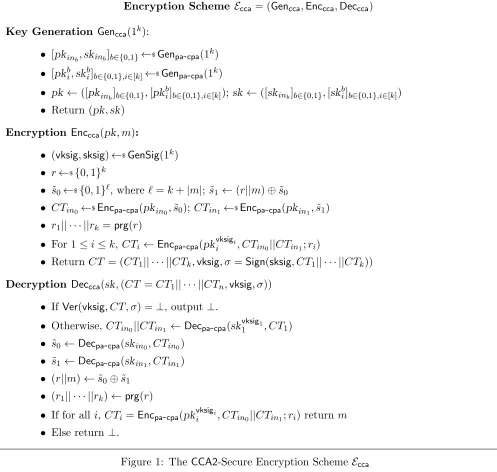
The construction. On security parameterk, the scheme will consist of a one-time signature as well as both inner and outer ciphertexts, with corresponding public keys. More specifically, two inner ciphertexts will be encrypted under public keyspkin0,pkin1, andkouter ciphertexts will be encrypted usingkpublic keys chosen out of k pairs of public keys (pk01,pk11), . . . ,(pkk0, pkk1). The selection of the k public keys
pkb1
1 , . . . ,pk
bk
k will depend on bits of the verification key, vksig, chosen for the one-time signature (as in [DDN00, MSS12]).
In particular, a ciphertext will consist of the following:
Verification key: A verification key,vksig, for the one-time signature scheme, generated by GenSig.
Inner ciphertexts: Two ciphertexts CTin0 = Enc(pkin0,˜s0), CTin1 =Enc(pkin1,s˜1) where ˜s0,˜s1 are
additive secret shares ofm||r,mis the message to be encrypted,ris the randomness used to encrypt the outer ciphertexts (as described below), and|| denotes concatenation.
Outer ciphertexts: k ciphertexts CT1, . . . , CTk computed the following way: r1|| · · · ||rk ← prg(r), where prgis a pseudorandom generator. EachCTi=Enc(pkivksigi, CTin0||CTin1;ri).
Signature: A signature σ=Sign(sksig, CT1|| · · · ||CTk).
The security reduction. We consider a modified CCA2 experiment where the decryption oracle is
queries), which immediately implies the CCA2 security of the scheme. To show (1), we use techniques similar to those of [MSS12]. To show (2), we build upon the sequence of hybrids used by [HLW12].
The main new technical challenge in this work is showing that property (2) holds for each pair of consecutive hybrids. More specifically, in the final two hybrids, which we denote here by ˜H0,H˜1, we
run theCCA2 experiment with theCCA2adversary, but use the plaintext extractor to decrypt the inner ciphertexts CTin0, CTin1. Additionally, in ˜H0, the value ˜s0⊕s˜1 is set to a random string, while in ˜H1,
value ˜s0⊕˜s1 is set honestly to (r||mβ). Note that if a bad extraction event does not occur, then the view of the adversary in ˜H1 is identical to its view in the originalCCA2 experiment. By previous arguments,
we have that the probability of a bad extraction event is negligible in ˜H0. To argue that the probability of
bad extraction event occurring differs by a negligible amount in these final two hybrids, we must reduce to the semantic security of the inner encryption scheme. However, a bad extraction event—in which the plaintext extractor disagrees with the decryption oracle—cannot be detected unless the adversary has the secret keys corresponding to the inner encryptions and if this is the case, it seems that we cannot hope to reduce to semantic security.
Thus, we consider a modified experiment where at the beginning of the experiment we fix a bit
b←${0,1} and a modified bad extraction event defined as the event that the plaintext extractor and
decryption oracle disagree specifically on the decryption of CTinb for a query submitted by the adversary A. Sinceb←${0,1} is chosen uniformly at random, independent of all other variables, we show that the
probability that the first bad extraction event occurs on CTinb is exactly half the probability that the
first bad extraction event occurs on either CTin0 or CTin1. Now, if the first bad extraction event occurs
on CTinb, then the semantic security adversary successfully detects the first bad extraction event. In the
following, we will give additional details on the semantic security adversary.
An adversary attempting to break the semantic security of the inner encryption simulates the modified experiment in the final two hybrids by fixing b←${0,1}, embedding its challenge public key in place of
pkin1−b and embedding a public key with a known secret key in place ofpkinb. Now, due to the additive
secret sharing of the inner plaintexts, we have that in both hybrids ˜H0and ˜H1, each of the inner plaintexts
˜
s0,s˜1 are individually uniformly distributed. Leveraging this property, the semantic security adversary
chooses a random plaintext ˜sb and computes an honest encryptionCTin∗b of ˜sb. To embed the remaining
inner ciphertext, the adversary chooses β ∈ {0,1} and computes: ˜s01−b←${0,1}`,˜s1
1−b = (r||mβ)⊕˜sb wherem0, m1 are the plaintexts submitted by the internalCCA2adversary, and submits ˜s10−b,˜s11−b to the external semantic security experiment. The semantic security adversary receives in return a ciphertext
CTpa-cpa, which is an encryption of either ˜s01−b or ˜s11−b and sets CT
∗
in1−b =CTpa-cpa. Note that when the
external experiment returns an encryption of ˜s01−b, the generated ciphertext is identically distributed to the challenge ciphertext in ˜H0 and when the external experiment returns an encryption of ˜s11−b, the generated ciphertext is identically distributed to the challenge ciphertext in ˜H1. Finally, since the adversary has the
secret key corresponding to pkinb, it will successfully detect the case that a bad extraction event occurs
for the first time on CTin∗
b. Thus, we have that the occurrence of modified bad extraction event with
non-negligible probability in ˜H1, implies an attack on the CPA security of the underlying scheme.
1.4 Related Work
-secure encryption scheme from a plaintext aware, weakly simulatable public key encryption scheme. A different line of work introduced new low-level primitives and showed how to construct CCA2 encryption from these low-level primtives. Examples are constructions ofCCA2-secure encryption from the primitives of identity-based encryption [CHK04], tag-based encryption [Kil06], lossy trapdoor functions [PW11], correlated products [RS10], adaptive trapdoor functions [KMO10], and extractable hash proofs [Wee10].
Finally, several works [CS02, HK08, CKS09, HJKS10] constructCCA2-encryption directly from various number-theoretic assumptions.
2
Preliminaries
2.1 CCA2 Security
Definition 2.1 (CCA2 Security) LetE = (Gen,Enc,Dec)be an encryption scheme and let the random variable CCA2-Exprβ(E, A, k) where β ∈ {0,1}, A = (A1, A2) are ppt algorithms and k ∈ N, denote the
result of the following probabilistic experiment:
CCA2-Exprβ(E, A, k)
• (pk, sk)←$Gen(1k)
• (m0, m1, stateA)←$ADec(sk,·)
1 (pk)
• y←$Enc(pk, mβ)
• D←$ADec(sk,·)
2 (y, stateA)
We require that the output of A1 satisfies |m0|=|m1|and that A2 does not query y to its oracle.
(Gen,Enc,Dec) is CCA2-secure if for any ppt algorithms A = (A1, A2) the following two ensembles
are computationally indistinguishable:
{CCA2-Expr0(E, A, k)}k∈N≈ {c CCA2-Expr1(E, A, k)}k∈N.
2.2 Plaintext Awareness for Multiple key Setup
We follow [MSS12] for the following definition.
sPA1`(E, C, C∗, k):
• Let R[C],R[C∗] be randomly chosen bit strings for C and C∗.
• ((pki, ski))i∈[`(k)]←$Gen(1k)
• st← (pki)i∈[`(k)], R[C]
• CC∗(st,·) (pki)i∈[`(k)]
• LetQ={(qi = (pkji, ci), mi)}be the set of queriesCmade toC
∗ until it halted andC∗’s responses
to them. Return ∧|iQ=1|(mi =Decskji(ci)).
In the above experiment, C is a ciphertext creator, and C∗ is a stateful ppt algorithm called the extractor that takes as input the state information st and a ciphertext given by the ciphertext creator
C, and will return the decryption of that ciphertext and the updated state st. The state information is initially set to the public key pk and the adversary C’s random coins. It gets updated by C∗ as C∗
Definition 2.2 (sPA1`) Let ` be a polynomial. Let E = (Gen,Enc,Dec) be an asymmetric encryption
scheme. Let the ciphertext-creator adversary C and the extractor C∗ be ppt algorithms. For k∈N, the sPA1-advantage ofC relative to C∗ is defined as:
AdvsPA1`(E, C, C∗) = Pr[sPA1(E, C, C∗, k) = 0]
The extractor C∗ is a successful sPA1`-extractor for the ciphertext-creator adversary C if for all k ∈N,
the function AdvsPA1`(E, C, C∗) is negligible. The encryption schemeE is called sPA1
` multi-key secure if
for any ppt ciphertext creator there exists a successful sPA1`-extractor.
As shown by [MSS12], both the Damgard Elgamal encryption scheme (DEG) and the lite version of Cramer-Shoup encryption scheme (CS-lite) aresPA1`secure under a suitable generalization of the DHK1 assumption.
2.3 Weakly Simulatable Encryption Scheme
As in [MSS12], we consider a notion of simulatability similar to the one of Dent [Den06], but where the attacker is not given access to the decryption oracle. If an encryption scheme satisfies this weaker notion of simulatability, we say it is weakly simulatable.
Definition 2.3 (Weakly Simulatable Encryption Scheme) An asymmetric encryption scheme(Gen,
Enc, Dec) is weakly simulatable if there exist two poly-time algorithms (f, f−1) where f is deterministic and f−1 is probabilistic, such that for all k∈Nthere exists the polynomial function p(·) where l=p(k), we have the following correctness properties:
• f on inputs of public key pk(in the range ofGen) and a random string r∈ {0,1}l, returns elements
in C, where C is the set of all possible ”ciphertext”-strings that can be submitted to the decryption oracle (notice that C ∈ C might not be a valid ciphertext).
• f−1 on input of a public key pk (in the range of Gen) and an element C ∈ C outputs elements of
{0,1}l.
• f(pk, f−1(pk, C)) =C for allC ∈ C.
And the following security properties. No polynomial time attacker A has probability better than 1/2 +µ(k) of winning the following experiment, where µ is some negligible function.
• The challenger generates a random key pair (pk, sk)←$Gen(1k), and chooses randomly b∈ {0,1}.
• The attacker A executes on the input 1k and the public key pk outputs m ∈ M. The challenger sends A the pair(f−1(pk, c=Enc(pk, m)), c) if b= 0, or (r, f(pk, r))for some randomly generated element r ∈ {0,1}l if b= 1. The attacker A terminates by outputting a guess b0 for b. A wins if
b=b0 and its advantage is defined in the usual way.
Lemma 2.4 If E is a weakly simulatable encryption scheme, then E is CPA-secure.
2.4 PA1+–An Extension of Plaintext Awareness
[MSS12] additionally consider an augmented notion of plaintext awareness in which the ciphertext creator has access to an oracle that produces random bits,PA1+. The extractor receives the answers to any queries generated by the creator, but only at the time these queries are issued. This oracle is meant is to model the fact that the plaintext extractor might not receive all of the random coins used by the ciphertext creator at the beginning of the experiment. By introducing this oracle, we require the extractor to work even when it receives the random coins at the same time as the ciphertext creator. This modification has implications when the notion of plaintext awareness is computational. However, in our case, as in [MSS12], we require statistical plaintext awareness, and as argued by [MSS12], allowing access to such an oracle does not affect the sPA1` security.
Any encryption scheme that issPA1` secure is alsosPA1+` secure.
Definition 2.5 Define thesPA1+` experiment in a similar way to thesPA1` experiment. The only
differ-ence between the two is that during the sPA1+` experiment, the ciphertext creator has access to a random oracleO that takes no input, but returns independent uniform random strings upon each access. Any time the creator accesses the oracle, the oracle’s response is forwarded to both the creator and the extractor.
If an encryption scheme would be deemedsPA1` secure, when we replace the sPA1` experiment in the
definition with the modified sPA1+` experiment, then the encryption scheme is said to be sPA1+` secure.
Lemma 2.6 (Appeared in [MSS12].) If an encryption scheme E is sPA1` secure, then it is sPA1+`
secure.
2.5 Strong One-Time Signature Scheme
We follow here the definition of [CDSMW08]. Informally, a strong one-time signature scheme (GenSig,Sign,Ver) is an existentially unforgeable signature scheme, with the restriction that the signer signs at most one message with any key. This means that an efficient adversary, upon seeing a signature on a message
m of his choice, cannot generate a valid signature on a different message, or a different valid signature on the same message m. Such schemes can be constructed in a black-box way from one-way functions [Lam79, Rom90], and thus from any semantically-secure encryption scheme (Gen,Enc,Dec).
3
The Scheme
We present a CCA2-secure encryption scheme Ecca = (Gencca,Enccca,Deccca) from any scheme Epa-cpa =
(Genpa-cpa,Encpa-cpa,Decpa-cpa) which is a plaintext aware, weakly simulatable public key encryption
scheme with perfect correctness and any scheme (GenSig,Sign,Ver), which is a strong one-time signa-ture scheme and any pseudorandom generator prg. See Figure 1.
Theorem 3.1 Encryption schemeEcca, presented in Figure 1, isCCA2-secure under the assumptions that
Epa-cpa = (Genpa-cpa,Encpa-cpa,Decpa-cpa) is a plaintext aware, weakly simulatable public key encryption
scheme with perfect correctness, the scheme (GenSig,Sign,Ver) is a strong one-time signature scheme and prg is a pseudorandom generator.
Note that the Damgard Elgamal encryption scheme (DEG) and the lite version of Cramer-Shoup encryption scheme (CS-lite) are plaintext aware, weakly simulatable and have perfect correctness.
Since strong one-time signature schemes and pseudorandom generators can be constructed in a black-box manner fromCPA-secure public key encryption (and hence plaintext aware, weakly simulatable public key encryption) we have the following corollary:
Encryption Scheme Ecca = (Gencca,Enccca,Deccca)
Key Generation Gencca(1k):
• [pkinb,skinb]b∈{0,1}←$Genpa-cpa(1
k)
• [pkbi,skbi]b∈{0,1},i∈[k]←$Genpa-cpa(1k)
• pk ←([pkin
b]b∈{0,1},[pk
b
i]b∈{0,1},i∈[k]);sk ←([skinb]b∈{0,1},[sk
b
i]b∈{0,1},i∈[k])
• Return (pk,sk)
Encryption Enccca(pk, m):
• (vksig,sksig)←$GenSig(1k)
• r←${0,1}k
• s˜0←${0,1}`, where `=k+|m|; ˜s1←(r||m)⊕s˜0
• CTin0←$Encpa-cpa(pkin0,s˜0);CTin1←$Encpa-cpa(pkin1,s˜1)
• r1|| · · · ||rk=prg(r)
• For 1≤i≤k,CTi←Encpa-cpa(pk vksigi
i , CTin0||CTin1;ri)
• Return CT = (CT1|| · · · ||CTk,vksig, σ=Sign(sksig, CT1|| · · · ||CTk))
Decryption Deccca(sk,(CT =CT1|| · · · ||CTn,vksig, σ))
• If Ver(vksig, CT, σ) =⊥, output ⊥.
• Otherwise,CTin0||CTin1 ←Decpa-cpa(sk
vksig1
1 , CT1)
• s˜0 ←Decpa-cpa(skin0, CTin0)
• s˜1 ←Decpa-cpa(skin1, CTin1)
• (r||m)←s˜0⊕˜s1
• (r1|| · · · ||rk)←prg(r)
• If for all i,CTi=Encpa-cpa(pkivksigi, CTin0||CTin1;ri) return m
• Else return ⊥.
Figure 1: TheCCA2-Secure Encryption SchemeEcca
4
Security Analysis
We begin by defining an experiment which is different than the regular CCA2 experiment, but will be useful in our analsysis of Ecca:
Nested Indistinguishability Experiment for scheme Ecca: We define the exprimentNested-Expr(β, z) for β, z∈ {0,1}.
For every adversaryA = (A1, A2) participating in a CCA2 experiment, we consider a corresponding
ciphertext creator CA (described below) and ciphertext extractorC∗ (as guaranteed by the security of the encryption schemeEpa-cpa), interacting with an oracleO (described below). Let the random variable Nested-Exprβ,z(Ecca, A, k), where β, z ∈ {0,1} and k∈N, denote the result of the following probabilistic
experiment:
Nested-Exprβ,z(Ecca, A, k):
• CA receives public keys [pkinb]b∈{0,1},{pk
b
• CAchooses (sksig∗,vksig∗)←$GenSig(1k;rsksig), wherersksigconsists of the firstkbits ofCA’s random
tape.
• CA setspk= [pkinb]b∈{0,1},{pk
b
i}b∈{0,1},i∈[n].
• CA chooses a random tape for Aand begins an emulation of A1 on inputpk.
• Whenever CA receives query CT = (CT1|| · · · ||CTk,vksig, σ) from A, CA checks Ver(vksig, CT1||
· · · ||CTk, σ) = 1. If not, CA returns ⊥. If so, CA submits CTi, where i is the first index s.t.
vksig∗i 6=vksig, to the extractor to obtain (CTin0||CTin1). If there is no such index, CA returns ⊥
and halts. Otherwise, CAsubmitsCTin0 andCTin1 to the extractor to obtain ˜s0,˜s1. CAcomputes
r||m= ˜s0⊕s˜1 and checks thatCT1, . . . , CTnwere computed correctly. If not,CA returns⊥. If so, CA returnsm. EventuallyA1 returns (m0, m1, st) and halts. CA outputs (m0, m1).
• CAqueries its oracleOandOreturnsr1, . . . , rkwhere (r1, CT1∗) =f−1(pk
vksig∗1
1 , CT1∗), . . . ,(rk, CTk∗) = f−1(pkvksig
∗
k
1 , CTk∗) and whereCT1∗, . . . , CTk∗ are computed in the following way:
1. r←${0,1}k, r1, . . . , rn←prg(r).
2. (sksig,vksig)←$GenSig(1k)
3. ˜s0←${0,1}`
4. If z= 0 then ˜s1←${0,1}`.
5. Else if z= 1 then ˜s1 ←(r||mβ)⊕s˜0 .
6. CTin∗
0←$Encpa-cpa(pkin0,s˜0);CT
∗
in1←$Encpa-cpa(pkin1,s˜1)
7. For 1≤i≤k,CTi∗ ←Encpa-cpa(pk vksig∗i
i , CTin∗0||CT
∗
in1;ri)
• CAcomputesCTi∗=f(xi) for eachiand the signatureσ
∗. C
AreturnsCT∗ = (CT1∗|| · · · ||CTk∗,vksig
∗, σ∗)
toA
• Whenever CA receives query CT = (CT1|| · · · ||CTk,vksig, σ) from A, CA checks Ver(vksig, CT1||
· · · ||CTk, σ) = 1. If not, CA returns ⊥. If so, CA submits CTi, where i is the first index s.t.
vksigi 6=vksig∗i, to the extractor to obtain (CTin0||CTin1). If there is no such index, CA returns ⊥
and halts. Otherwise, CAsubmitsCTin0 andCTin1 to the extractor to obtain ˜s0,˜s1. CAcomputes
r||m= ˜s0⊕s˜1 and checks thatCT1, . . . , CTnwere computed correctly. If not,CA returns⊥. If so, CA returnsm. EventuallyA2 outputsD and halts.
We require that the output ofA1 satisfies|m0|=|m1|and thatA2 does not queryCT∗ to its oracle.
Definition 4.1 (Nested Indistinguishability) We say that Ecca = (Gencca,Enccca,Deccca) is
nested-indistinguishable if for any ppt algorithms A = (A1, A2) and for β ∈ {0,1} the following two ensembles
are computationally indistinguishable:
Nested-Exprβ,0(Ecca, A, k) k∈N
c ≈
Nested-Exprβ,1(Ecca, A, k) k∈N.
Consider the following event:
Definition 4.2 (The Bad Extraction Event) We say that abad extraction eventhas occurred during
an execution of the nested indistinguishability experiment if at some point A submits a decryption query
CT = (CT1|| · · · ||CTn,vksig, σ) such that one of the following occurs:
• C∗(st, CTi)6=Decpa-cpa(skivksigi, CTi) where iis the first index such that vksig∗i 6=vksigi.
• C∗(st, CTin1)6=Decpa-cpa(skin1, CTin1)
Definition 4.3 (The Forging Signature Event) We say that a forging signature event has occurred
during an execution of the nested indistinguishability experiment if at some point A submits a decryption query (CT = (CT1|| · · · ||CTn,vksig, σ)) such thatvksig=vksig∗ and Ver(vksig, CT, σ) = 1.
Our main theorem, Theorem 3.1, is immediately implied by the following two lemmas:
Lemma 4.4 Assume that the scheme Epa-cpa = (Genpa-cpa,Encpa-cpa,Decpa-cpa) is a plaintext aware,
weakly simulatable public key encryption scheme with perfect correctness. Then encryption scheme Ecca
is nested-indistinguishable.
Lemma 4.5 Assume that the scheme Epa-cpa = (Genpa-cpa,Encpa-cpa,Decpa-cpa) is a plaintext aware,
weakly simulatable public key encryption scheme with perfect correctness, the scheme (GenSig,Sign,Ver) is a strong one-time signature scheme and prgis a pseudorandom generator. Then forβ ∈ {0,1} and for every ppt adversary A:
{Nested-Exprβ,1(Ecca, A, k)}k∈N
s
≈ {CCA2-Exprβ(Ecca, A, k)}k∈N
Lemma 4.4 follows by a straightforward reduction to semantic security ofEpa-cpa. Lemma 4.5 follows
in a straightforward manner from the fact that Bad Extraction Event and Forging Signature Event occur with at most negligible probability when z= 1 along with the perfect correctness ofEpa-cpa.
Thus, in what follows, we focus our attention on proving that Bad Extraction Event and Forging Signature Event occur with at most negligible probability when z = 1. To show this we proceed in the following way:
• In Section 4.1 we prove that Bad Extraction Event occurs with negligible probability in the Nested Indistinguishability Experiment whenz= 0.
• In Section 4.2 we use the fact that Bad Extraction Event occurs with negligible probability in the Nested Indistinguishability Experiment whenz= 0 to prove that Bad Extraction Event also occurs with negligible probability in the Nested Indistinguishability Experiment whenz= 1.
• In Section 4.3 we use the fact that Bad Extraction event occurs with negligible probability in the Nested Indistinguishability Experiment when z = 1 to prove that Forging Signature Event occurs with negligible probability in the Nested Indistinguishability Experiment whenz= 1.
4.1 Bad Extraction Event when z = 0
In this section we prove the following lemma:
Lemma 4.6 Bad Extraction Event occurs with negligible probability when z= 0.
We proceed by considering a sequence of hybrids:
Hybrid H0: Proceeds exactly as the nested indistinguishability game for the case wherez= 0.
Hybrid H1: Proceeds exactly like H0 except that fresh randomness ri is used to encrypt eachCTi∗ =
Encpa-cpa(pkvksigi i, CTin∗0||CT
∗
in1;ri), instead of the output of the prg.
Claim 4.7 The probability of a Bad Extraction Event inH1 andH0 differs by a negligible amount.
Hybrid H2: Proceeds exactly likeH1 except the oracle O returns uniformly randomr1, . . . , rk .
Claim 4.8 The probability of Bad Extraction Event inH2 is negligible.
The claim follows due to the fact that the view of CA in the nested indistinguishability experiment in HybridH2 is identical to the view of CA in thesPA12+k+2 experiment (since inH2 the oracleO simply
returns uniformly random coins r1, . . . , rk, as does the oracle in the sPA1∗2k+2 experiment). Thus, by the
sPA1+2k+2-secuirty of Epa-cpa, C∗ is guaranteed to return the same value as Decpa-cpa on all ciphertexts
submitted byCA with all but negligible probability.
Claim 4.9 The probability of a Bad Extraction Event inH1 andH2 differs by a negligible amount.
Proof: Assume towards contradiction that there exists a ppt adversaryA such that a Bad Extraction Event in H1 and H2 differs by a non-negligible amount p = p(k) when interacting with A, CA, C∗. We present a ppt adversary B breaking the weak simulatability of Epa-cpa.
B participates in an external experiment where B plays the security game of the weakly simulatable en-cryption schemeEpa-cpawhile internally interacting with the adversaryAand the corresponding ciphertext
creator CAand extractor C∗ in the following way:
• B receives ˆpk1, . . . ,pkˆk from the external simulatability security experiment.
• B chooses a random tape rCA for the ciphertext creatorCA.
• B computes (sksig∗,vksig∗)←$GenSig(1k;rsksig), wherersksig consists of the first k bits ofrC
A.
• Bgenerates public key, secret key pairs [pkin
b,skinb]b∈{0,1},{pk 1−vksig∗i
i ,sk
1−vksig∗i
i }i∈[k]and fori∈[k]
setspkvksig
∗
i
i = ˆpki.
• B instantiates CAwith random taperCA on input [pkinb]b∈{0,1},{pk
b
i}b∈{0,1},i∈[k].
• Eventually CA outputs (m0, m1). At this point, B plays the part of the oracle O and does the
following:
1. Choose ˜s0,s˜1←${0,1}`
2. Compute CTin∗
0←$Encpa-cpa(pkin0,s˜0);CT
∗
in1←$Encpa-cpa(pkin1,s˜1)
3. Submit CTin∗
0||CT
∗
in1 to its external challenger.
4. Receives (r1, CT1∗), . . . ,(rk, CTk∗) from its external challenger, where for eachi,ri =f
−1(pk
i, c=
Encpa-cpa(pki, CTin∗0||CT
∗
in1)) if b= 0 or (ri, f(pki, ri)) for randomly generatedri ifb= 1.
B forwards r1, . . . , rk toCAon behalf of oracle O and continues the emulation ofCA.
• If at any point during the emulation, Bad Extraction Event occurs (whichBcan check by decrypting using [skinb]b∈{0,1},{sk
1−vksig∗i
i }i∈[k]),B aborts and outputs 1.
• Otherwise,B outputs 0.
Note that forβ ∈ {0,1},B perfectly simulatesCA’s view in HybridH1 whenb= 0 by returningr1, . . . , rk where for each i, ri = f−1(pki, c = Encpa-cpa(pki, CTin∗0||CT
∗
in1)) and perfectly simulates CA’s view in
Hybrid H2 by returning r1, . . . , rk where for each i, ri is chosen uniformly at random. Thus, B outputs 1 in the case that b = 0 in the external experiment with probability p1 and B outputs 1 in the case
that b = 1 in the external experiment with probability p2 where p1−p2 > p. Since by hypothesis, p is
non-negligible, we have that B breaks the security of the weakly simulatable encryption schemeEpa-cpa.
4.2 Bad Extraction Event when z = 1
In this section we prove the following lemma:
Lemma 4.10 Bad Extraction Event occurs with negligible probability when z= 1.
To aid in our analysis, we define a second experiment ”Modified Nested Indistinguishability” and a sec-ond Bad Extraction Event, ”Modified Bad Extraction Event”. The Modified Nested Indistinguishability experiment is identical to the Nested Indistinguishability experiment except that an additional random variableb←${0,1}is chosen at the very beginning of the experiment The Modified Bad Extraction Event
will then depend on the value of b chosen during the experiment. Details follow.
For every adversaryA = (A1, A2) participating in a CCA2 experiment, we consider a corresponding
ciphertext creator CA (described below) and ciphertext extractorC∗ (as guaranteed by the security of the encryption schemeEpa-cpa), interacting with the oracleO(described below). Let the random variable
Modified-Nested-Exprβ,z(Ecca, A, k), where β, z ∈ {0,1} and k ∈ N, denote the result of the following probabilistic experiment:
Modified-Nested-Exprβ,z(Ecca, A, k):
• b←${0,1}
• CA receives public keys [pkinb]b∈{0,1},{pk
b
i}b∈{0,1},i∈[n]from the sPA1+2k+2 experiment
• CAchooses (sksig∗,vksig∗)←$GenSig(1k;rsksig), wherersksig are the firstkbits ofCA’s random tape.
• CA setspk= [pkinb]b∈{0,1},{pk
b
i}b∈{0,1},i∈[n].
• CA chooses a random tape for Aand begins an emulation of A1 on the input ofpk.
• WheneverCAreceives queryCT = (CT1|| · · · ||CTk,vksig, σ) fromA,CAchecksVer(vksig, CT1|| · · · ||CTk, σ) = 1. If not, CAreturns ⊥. If so,CA submitsCTi, whereiis the first index s.t. vksig∗i 6=vksig, to the
extractor to obtain (CTin0||CTin1). If there is no such index, CA returns ⊥and halts. Otherwise,
CA submitsCTin0 and CTin1 to the extractor to obtain ˜s0,s˜1. CA computes r||m = ˜s0⊕s˜1 and
checks that CT1, . . . , CTn were computed correctly. If not, CA returns ⊥. If so, CA returns m. EventuallyA1 returns (m0, m1, st) and halts. CA outputs (m0, m1).
• CAqueries its oracleOandOreturnsr1, . . . , rkwhere (r1, CT1∗) =f−1(pk
vksig∗1
1 , CT1∗), . . . ,(rk, CTk∗) = f−1(pkvksig
∗
k
1 , CTk∗) and whereCT1∗, . . . , CTk∗ are computed in the following way:
1. r←${0,1}k, r1, . . . , rn←prg(r).
2. (sksig,vksig)←$GenSig(1k)
3. ˜s0←${0,1}`
4. If z= 0 then ˜s1←${0,1}`.
5. Else if z= 1 then ˜s1 ←(r||mβ)⊕s˜0 .
6. CTin∗0←$Encpa-cpa(pkin
0,s˜0);CT
∗
in1←$Encpa-cpa(pkin1,s˜1)
7. For 1≤i≤k,CTi∗ ←Encpa-cpa(pkvksigi , CTin∗0||CT
∗
in1;ri)
• CAcomputesCTi∗=f(xi) for eachiand the signatureσ∗. CAreturnsCT∗ = (CT1∗|| · · · ||CTk∗,vksig
∗, σ∗)
toA
• WheneverCAreceives queryCT = (CT1|| · · · ||CTk,vksig, σ) fromA,CAchecksVer(vksig, CT1|| · · · ||CTk, σ) = 1. If not, CAreturns ⊥. If so,CAsubmitsCTi, whereiis the first index s.t. vksigi 6=vksig
∗
i to the extractor to obtain (CTin0||CTin1). If there is no such index, CA returns ⊥and halts. Otherwise,
CA submitsCTin0 and CTin1 to the extractor to obtain ˜s0,s˜1. CA computes r||m = ˜s0⊕s˜1 and
Definition 4.11 (The Modified Bad Extraction Event) We say that a modified bad extraction event has occurred during an execution of the nested indistinguishability experiment if at some point
A submits a decryption queryCT = (CT1|| · · · ||CTn,vksig, σ) such that one of the following occurs:
• C∗(st, CTi)6=Decpa-cpa(skivksigi, CTi) where iis the first index such that vksig∗i 6=vksigi.
• C∗(st, CTinb)6=Decpa-cpa(skinb, CTinb)
Claim 4.12 For every ppt adversary A = (A1, A2) and for β ∈ {0,1}, Modified Bad Extraction Event
occurs in Modified-Nested-Exprβ,z(Ecca, A, k) with negligible probability whenz= 0.
This follows immediately from the fact that for every ppt adversary A = (A1, A2), Bad Extraction
event occurs in Nested-Exprβ,z(Ecca, A, k) with negligible probability whenz= 0.
Claim 4.13 If for some ppt adversary A = (A1, A2) we have that Bad Extraction Event occurs with
probability p1 inNested-Exprβ,z(Ecca, A, k) when z= 1 then Modified Bad Extraction Event occurs with
probability at leastp1/2 in Modified-Nested-Exprβ,z(Ecca, A, k) whenz= 1.
Proof:LetAbe a ppt adversary such that Bad Extraction Event occurs with probabilityp1 in the
experi-mentNested-Exprβ,1(Ecca, A, k). Let eventEbe the event that for some query,CT = (CT1|| · · · ||CTk,vksig, σ), one of the following occurs:
C∗(st, CTi)6=Decpa-cpa(sk vksigi
i , CTi) (1)
where iis the first index such that vksig∗i 6=vksigi.
OR
C∗(st, CTin0)6=Decpa-cpa(skin0, CTin0) (2)
OR
C∗(st, CTin1)6=Decpa-cpa(skin1, CTin1) (3)
and this is thefirst such querymade byAduring the experiment. Note that the probability that eventE
occurs inNested-Exprβ,1(Ecca, A, k) and the probability thatEoccurs inModified-Nested-Exprβ,1(Ecca, A, k) is p1.
We consider an experiment,Modified-Nested-Expr0beta,z(Ecca, A, k), identical to the Modified Nested
Indis-tinguishability experiment except the value of b is chosen ”on the fly” at the first point when event E
occurs. It is straightforward to see that the probability of event E inModified-Nested-Expr0β,1(Ecca, A, k)
is also p1 (the same as the probability of E in the experimentModified-Nested-Exprβ,1(Ecca, A, k)).
Now, if eventEwas triggered by a queryCT = (CT1|| · · · ||CTk,vksig, σ) inModified-Nested-Expr0beta,1(Ecca, A, k)
such that (1) occurs, then modified bad extraction event also occurs. Alternatively, if event E was trig-gered by a queryCT = (CT1|| · · · ||CTk,vksig, σ) in Modified-Nested-Expr0beta,1(Ecca, A, k) such that (2) or
(3) occurs, then modified bad extraction event will occur with probability exactly 1/2. Thus, modified bad extraction event occurs in Modified-Nested-Expr0beta,1(Ecca, A, k) with probability at least p1/2. Since the
view ofCAis identical inModified-Nested-Expr0beta,1(Ecca, A, k) and inModified-Nested-Exprbeta,1(Ecca, A, k)
we must also have that modified bad extraction event occurs in Modified-Nested-Exprβ,1(Ecca, A, k) with
probability at leastp1/2.
Claim 4.14 The probability of a Modified Bad Extraction Event when z = 0 and z = 1 differs by a
Proof: Assume towards contradiction that there is a ppt adversary A such that the probability of a Modified Bad Extraction Event in Modified-Nested-Exprbeta,0(Ecca, A, k) is p0 = p0(k), the probability
of a Modified Bad Extraction Event in Modified-Nested-Exprbeta,1(Ecca, A, k) is p1 = p1(k) and p(k) = p1(k)−p0(k) is non-negligible. We present a ppt adversaryB that usesA to break the semantic security
of Epa-cpa.
B participates in an external semantic security experiment for encryption schemeEpa-cpa while internally
emulating a run ofModified-Nested-ExprwithCA, Aand playing the part of the oracleO. More specifically, B receives a public keypkpa-cpa from the semantic security experiment for the encryption schemeEpa-cpa and does the following:
• B choosesb←${0,1}.
• B setspkin1−b =pkpa-cpa
• B chooses (pkinb,skinb)←$Genpa-cpa(1
k) and [pkb
i,skbi]b∈{0,1},i∈[k]←$Genpa-cpa(1k).
• B chooses a random tape rCA for CA and begins an emulation of CA with input ([pkinb]b∈{0,1},
[pkbi]b∈{0,1},i∈[k]).
• At some point CA outputs m0, m1. At this point, B, playing the part of the oracle O,
re-turns r1, . . . , rk where (r1, CT1∗) = f−1(pk
vksig∗1
1 , CT1∗), . . . ,(rk, CTk∗) = f−1(pk
vksig∗k
1 , CTk∗) and CT1∗, . . . , CTk∗ are computed in the following way:
– r←${0,1}k, r1, . . . , rn←prg(r).
– (sksig,vksig)←$GenSig(1k)
– s˜b←${0,1}`
– Choose ˜s01−b←${0,1}`. and set ˜s1
1−b←(r||mβ)⊕˜s0 .
– B returnsM0 = ˜s01−b, M1 = ˜s11−b to its external challenger and receives ciphertextCTpa-cpa in return.
– B setsCTin∗
b←$Encpa-cpa(pkin0,s˜b) and sets CT
∗
in1−b =CTpa-cpa.
– For 1≤i≤k,CTi∗ ←Encpa-cpa(pkvksigi , CTin∗0||CT
∗
in1;ri)
• B continues the emulation of CA, A.
• If the event Modified Bad Extraction Event occurs,B aborts and outputs 1.
• Otherwise,B outputs 0.
Note that for β ∈ {0,1}, B perfectly simulates CA’s view in the experiment Modified-Nested-Expr(β,0). Thus,B outputs 1 in the case that the external challenger returned an encryption ofM1 with probability p1andB outputs 1 in the case that the external challenger returned an encryption ofM0with probability p2wherep1−p2 > p. Since by hypothesis,pis non-negligible, we have thatBbreaks the semantic security
of Epa-cpa.
Together, Claims 4.12, 4.13 and 4.14 immediately imply Lemma 4.10.
4.3 Forging Signature Event when z = 1
In this section, we prove the following lemma:
Proof: Assume towards contradiction that there exists a ppt adversary A such that Forging Signature Event occurs in Nested-Expr with non-negligible probability, p = p(k). We use A to construct a ppt adversary B breaking the security of the signature scheme. B does the following:
• B receivesvksig∗ from its external challenger.
• B generates public, secret keys [pkinb,skinb]b∈{0,1},{pk
b
i,skbi}b∈{0,1},i∈[n] from thesPA1+2k+2
experi-ment and setspk = [pkinb]b∈{0,1},{pkbi}b∈{0,1},i∈[n]
• B chooses random coins forA and begins an emulation of A1 on inputpk.
• Whenever B receives queryCT = (CT1|| · · · ||CTn,vksig, σ) fromA1,B checks Ver(vksig, CT1|| · · ·
||CTk, σ) = 1. If not,Breturns⊥. If so,BdecryptsCTi, whereiis the first index s.t. vksigi 6=vksig∗i using skvksigi
i to obtain (CTin0||CTin1). B decrypts CTin0 and CTin1 using skin0,skin1 to obtain
˜
s0,s˜1. B computes r||m= ˜s0⊕s˜1 and checks that CT1, . . . , CTn were computed correctly. If not, B returns ⊥. If so, B returnsm. Eventually A1 returns (m0, m1, st) and halts.
• B does the following:
1. r←${0,1}k, r1, . . . , rn←prg(r).
2. (sksig,vksig)←$GenSig(1k)
3. ˜s0←${0,1}` , ˜s1 ←(r||mβ)⊕˜s0 .
4. CTin∗0←$Encpa-cpa(pkin
0,s˜0);CT
∗
in1←$Encpa-cpa(pkin1,s˜1)
5. For 1≤i≤k,CTi∗ ←Encpa-cpa(pkvksigi , CTin∗0||CT
∗
in1;ri)
6. B requests a signature for message CT1∗|| · · · ||CTk∗ and receives (CT1∗|| · · · ||CTk∗,vksig∗, σ∗) from its oracle.
7. B returns CT∗ = (CT1∗|| · · · ||CTk∗,vksig∗, σ∗) toA
• Whenever B receives query CT = (CT1|| · · · ||CTn,vksig, σ) from A, B checks Ver(vksig, CT1||
· · · ||CTk, σ) = 1. If not, B returns ⊥. If so, B decrypts CTi, where iis the first index such that
vksigi 6=vksig∗i usingskvksigi
i to obtain (CTin0||CTin1). B decryptsCTin0 andCTin1 usingskin0,skin1
to obtain ˜s0,s˜1. B computesr||m= ˜s0⊕˜s1 and checks thatCT1, . . . , CTnwere computed correctly. If not,B returns ⊥. If so, B returnsm. Eventually A2 outputsD and halts.
• If at any point during the execution, A submits a query CT = (CT1|| · · · ||CTn,vksig, σ) such that
vksig=vksig∗ and Ver(vksig, CT1|| · · · ||CTn, σ) = 1, (i.e. Forging Signature Event occurs), thenB aborts the experiment and submits σ to its challenge oracle.
We claim that the probability that Forging Signature Event occurs in B’s simulation differs by at most a negligible amount from the probability that Forging Signature Event occurs inNested-Exprβ,z(Ecca, A, k). Thus, if Forging Signature Event occurs with non-negligible probabilityp=p(k) inNested-Exprβ,z(Ecca, A, k)
then Forging Signature Event occurs with non-negligible probability p/2 during B’s emulation and con-tradicts the security of the signature scheme (GenSig,Sign,Ver).
To see that the probabilities differ by a negligible amount, note that the response returned to A inB’s emulation is identical to the response returned to A inNested-Exprβ,1(Ecca, A, k) unless Bad Extraction
References
[Bar01] Boaz Barak. How to go beyond the black-box simulation barrier. In FOCS, pages 106–115, 2001.
[BCCT12] Nir Bitansky, Ran Canetti, Alessandro Chiesa, and Eran Tromer. From extractable collision resistance to succinct non-interactive arguments of knowledge, and back again. In ITCS, pages 326–349, 2012.
[BDPR98] Mihir Bellare, Anand Desai, David Pointcheval, and Phillip Rogaway. Relations among notions of security for public-key encryption schemes. In CRYPTO, pages 26–45, 1998.
[BP04a] Mihir Bellare and Adriana Palacio. The knowledge-of-exponent assumptions and 3-round zero-knowledge protocols. InCRYPTO, pages 273–289, 2004.
[BP04b] Mihir Bellare and Adriana Palacio. Towards plaintext-aware public-key encryption without random oracles. In ASIACRYPT, pages 48–62, 2004.
[BR94] Mihir Bellare and Phillip Rogaway. Optimal asymmetric encryption. In EUROCRYPT, pages 92–111, 1994.
[CDSMW08] Seung Geol Choi, Dana Dachman-Soled, Tal Malkin, and Hoeteck Wee. Black-box con-struction of a non-malleable encryption scheme from any semantically secure one. InTCC, pages 427–444, 2008.
[CHK04] Ran Canetti, Shai Halevi, and Jonathan Katz. Chosen-ciphertext security from identity-based encryption. In EUROCRYPT, pages 207–222, 2004.
[CKS09] David Cash, Eike Kiltz, and Victor Shoup. The twin diffie-hellman problem and applica-tions. J. Cryptology, 22(4):470–504, 2009.
[CS02] Ronald Cramer and Victor Shoup. Universal hash proofs and a paradigm for adaptive chosen ciphertext secure public-key encryption. InEUROCRYPT, pages 45–64, 2002.
[DDN00] Danny Dolev, Cynthia Dwork, and Moni Naor. Nonmalleable cryptography. SIAM J. Comput., 30(2):391–437, 2000.
[Den06] Alexander W. Dent. The cramer-shoup encryption scheme is plaintext aware in the standard model. In EUROCRYPT, pages 289–307, 2006.
[DN00] Ivan Damg˚ard and Jesper Buus Nielsen. Improved non-committing encryption schemes based on a general complexity assumption. In CRYPTO, pages 432–450, 2000.
[DNR04] Cynthia Dwork, Moni Naor, and Omer Reingold. Immunizing encryption schemes from decryption errors. In EUROCRYPT, pages 342–360, 2004.
[GM84] Shafi Goldwasser and Silvio Micali. Probabilistic encryption. J. Comput. Syst. Sci., 28(2):270–299, 1984.
[GMM07] Yael Gertner, Tal Malkin, and Steven Myers. Towards a separation of semantic and cca security for public key encryption. In TCC, pages 434–455, 2007.
[HK08] Goichiro Hanaoka and Kaoru Kurosawa. Efficient chosen ciphertext secure public key encryption under the computational diffie-hellman assumption. In ASIACRYPT, pages 308–325, 2008.
[HLM03] Jonathan Herzog, Moses Liskov, and Silvio Micali. Plaintext awareness via key registration. In CRYPTO, pages 548–564, 2003.
[HLW12] Susan Hohenberger, Allison B. Lewko, and Brent Waters. Detecting dangerous queries: A new approach for chosen ciphertext security. In EUROCRYPT, pages 663–681, 2012.
[HT98] Satoshi Hada and Toshiaki Tanaka. On the existence of 3-round zero-knowledge protocols. In CRYPTO, pages 408–423, 1998.
[Kil06] Eike Kiltz. Chosen-ciphertext security from tag-based encryption. InTCC, pages 581–600, 2006.
[KMO10] Eike Kiltz, Payman Mohassel, and Adam O’Neill. Adaptive trapdoor functions and chosen-ciphertext security. In EUROCRYPT, pages 673–692, 2010.
[Lam79] Leslie Lamport. Constructing digital signatures from a one-way function. Technical Report SRI-CSL-98, SRI International Computer Science Laboratory, 1979.
[MS09] Steven Myers and Abhi Shelat. Bit encryption is complete. InFOCS, pages 607–616, 2009.
[MSS12] Steven Myers, Mona Sergi, and Abhi Shelat. Blackbox construction of a more than non-malleable cca1 encryption scheme from plaintext awareness. InSCN, pages 149–165, 2012.
[PSV06] Rafael Pass, Abhi Shelat, and Vinod Vaikuntanathan. Construction of a non-malleable encryption scheme from any semantically secure one. In CRYPTO, pages 271–289, 2006.
[PW11] Chris Peikert and Brent Waters. Lossy trapdoor functions and their applications. SIAM J. Comput., 40(6):1803–1844, 2011.
[Rom90] John Rompel. One-way functions are necessary and sufficient for secure signatures. In STOC, pages 387–394, 1990.
[RS10] Alon Rosen and Gil Segev. Chosen-ciphertext security via correlated products. SIAM J. Comput., 39(7):3058–3088, 2010.