Proofs of Space: When Space is of the Essence
Giuseppe Ateniese1,2, Ilario Bonacina1, Antonio Faonio1, and Nicola Galesi1 1 Sapienza - University of Rome, Italy
{ateniese,bonacina,faonio,galesi}@di.uniroma1.it 2
Johns Hopkins University, USA
Abstract. Proofs of computational effort were devised to control denial of service attacks. Dwork and Naor (CRYPTO ’92), for example, proposed to use such proofs to discourage spam. The idea is to couple each email message with a proof of work that demonstrates the sender performed some computational task. A proof of work can be either CPU-bound or memory-bound. In a CPU-bound proof, the prover must compute a CPU-intensive function that is easy to check by the verifier. A memory-bound proof, instead, forces the prover to access the main memory several times, effectively replacing CPU cycles with memory accesses.
In this paper we put forward a new concept dubbed proof of space. To compute such a proof, the prover must use a specified amount of space, i.e., we are not interested in the number of accesses to the main memory (as in memory-bound proof of work) but rather on the amount of actual memory the prover must employ to compute the proof. We give a complete and detailed algorithmic description of our model. We develop a comprehensive theoretical analysis which uses combinatorial tools from Complexity Theory (such as pebbling games) which are essential in studying space lower bounds.
Keywords: Space Complexity, Proof of Work, Pebbling Game, Random Oracle Model.
1
Introduction
Space has a special meaning in Computer Science. It refers to the number of cells of the working tape used by a Turing Machine (TM). While a TM computes a function, it will make several steps (relevant to time complexity) and use a certain number of tape cells (relevant to space complexity).
In [14], Dwork and Naor proposed to employ proof of work (PoW) to discourage spam and, in general, to hinder denial of service attacks. Before any action (such as sending an email), the prover must perform some work and generate a proof of it that can be efficiently verified. Proofs of work are currently being used to implement a publicly verifiable ledger for Bitcoin, where transactions are registered and verified by a community of users to avoid the double-spending problem [28]. The work performed by the prover can be CPU-bound, in which the work represents the number of steps made by a TM, or memory-bound, in which the work represents the times a TM access the working tape. The motivation behind memory-bound PoW is that, while CPU speed may differ significantly among distinct platforms, memory latencies vary much less across machines and may prove to be more equitable and egalitarian. We stress that memory-bound function complexity measures the number of memory accesses and does not take into account the actual amount of memory employed. That is, a TM may read and mark a single cell several times to reach a certain complexity level but it will still end up using only one cell.
In this work we define the notion ofProof of Space (PoSpace).PoSpaceforces the prover to use at least a specified amount of memory. This means, for instance, that a TM must now use a predetermined number of distinct tape cells to be able to respond to a challenge. We will show that ourPoSpaceconstruction is also a memory-bound PoW under the definition provided in [13, 15], while in general a PoW cannot be aPoSpace
not applicable. For instance, we believePoSpace can be employed in forensic analysis or device attestation to confirm remotely that an embedded device has been successfully wiped. That is, a remote device could be instructed to respond to a wipe command with PoSpaceas evidence that its functional memory is now overwritten (cf. [30]).
Straw Man Solutions. Memory-bound functions were first introduced by Abadi et al. [1]. In the main con-struction of memory-bound PoW given in [13], both the prover and the verifier share a large random table
T. The prover must compute a function by making several memory accesses to uniformly random positions inT. Through a proper tuning of the parameters, it is also possible to force the prover to reserve a specific amount of memory. In another construction, the authors of [13] show that the verifier does not have to store
T. The idea is to sign all pairs (i, T[i]) and then challenge the prover on ` positions ofT. The prover will return the`valuesT[i] along with an aggregate signature that can be checked by the verifier to ensure the prover is holding the tableT.
We first remark that it is possible to harness recent advances in proof of storage schemes, such as Provable Data Possession (PDP) [4] and (compact) Proof of Retrievability (POR) [33], to reduce the message complexity fromO(`) to essentially constant. This solution improves upon the one in [13] and, as long as the initialization phase is performed only once, would meet our efficiency requirements forPoSpace. However, proof of storage does not satisfy our definition ofPoSpacesince the running time of the verifier depends on the size ofT. The only way to avoid linear dependency is to run a PDP-based scheme with spot checking [4], but then the prover either must use more space than required or will not access all the memory locations. Intuitively, the reason why a solution based on proof of storage will not work rests upon the interpretation of what proof of space really means. Proof of storage applied to our context satisfies the notion that “the prover canaccessspace”.PoSpaceinstead captures the stronger notion that“the prover canhandlespace”, i.e., the prover possesses, controls, and manipulates space directly. In particular, we distinguish between a prover that can only read memory and a prover that can read and write memory. This is important because, among other things, write operations cannot be parallelized within classical computer architectures. We will provide a formal definition later and make this intuition rigorous.
We also remark that the adversarial model considered in [1, 13] contemplates the existence of a small but fast cache memory that must be saturated to force the prover to dispense with the cache and use traditional RAM memory. Thus, the constructions in [1, 13, 15] do provide a form of proof of space where the space coincides with the cache memory. But, as for proof-of-storage schemes, these schemes satisfy the weaker notion ofPoSpacewhere the prover can only read memory.
Other Related Work. A proof of work is also known as a cryptographic puzzle in the computer security literature. Puzzles were devised to improve on the proposal by Back [6] and employed to thwart denial of service attacks. In particular, it is important to make them hard to precompute (see [23] and references therein). Waters et al. [36] suggest to outsource the creation of puzzles to an external secure entity. Abliz and Tznati [2] introduce the concept of network-bound puzzles where clients collect tokens from remote servers before querying the service provider. They argue that network latency provides a good solution to the resource disparity problem.
All solutions above deal with proof of effort and cannot be adapted to prove possession of space in the way it is meant and defined in this paper.
Litecoin (litecoin.org) is a variant of Bitcoin that employsscrypt[29] to certify a public ledger.scrypt
is defined as a sequential memory-hard function and originally designed as a key derivation function, but it is used as a proof of effort in litecoin to hinder the use of specialized hardware. Technically,scrypt is not a memory-bound function as defined in [1] since no lower bound on the memory used by the function can be guaranteed. Thus, it is not even a PoSpace. We also note it requires both the prover and the verifier to dedicate a possibly large amount of memory, while ideally only the prover should reserve and use actual memory (as in our construction to be presented later).
repository [16], along with ours [3]. Their new version does use pebbling and adopts techniques similar to ours.
However, there are two main differences between our work and [16] that make their work quite compelling:
1. The definition of proof of space in [16] is stronger in that it allows a two-stage protocol. The first stage can be executed once while the second stage can potentially be executed many times after the first. There are several applications that would benefit from this two-stage notion (see for example the Gmail scenario described in [16]). At the same time, however, this stronger notion is achieved in a more idealized model than the Random Oracle Model. To emphasize the differences between these two notions, we will often refer to ours as a one-stagePoSpace.
2. In [16] the authors provide two main constructions. The one that can be compared with our work achieves better pebbling complexity (N/(log(N) vs.N/(log(N)·k)). Namely, they are able to remove the extra
k (a security parameter) through a clever technique.
The pebbling framework introduced in [15] has been used successfully in many other contexts (see for example [16–18, 24, 34]). Dziembowski et al. [17] built a leakage resilient key evolution scheme based on the pebbling framework. Their model allows an internal memory-bounded adversary that can control the update operation and leak bounded amounts of information. Smith and Zhang obtain a more efficient scheme [34], specifically, their update operation runs in time quasilinear in the key length, rather than quadratic. The key-evolution scheme can be adapted to obtain a proof of space with efficient communication complexity but the space complexity of the verifier would not satisfy the efficiency constraint ofPoSpace.
In a recent paper [24], Karvelas and Kiayias provide two efficient constructions for Proof of Secure Erasure (PoSE) as introduced by Perito and Tsudik [30]. Informally, in PoSE the prover must convince a verifier that a certain amount of memory has beenerased. Both schemes in [24] are ingenious and one of them uses the pebbling framework. PoSE andPoSpace are closely related notions but have different requirements as stated in [24]. In addition, inPoSpacethe prover must show that he can access (read/write) memory while in PoSE, intuitively, there should be the extra and necessary requirement that the memory contents before and after the protocol execution are uncorrelated.
General ideas behind our protocol. We cast PoSpace in the context of delegation of computation, where a delegator outsources to a worker the computation of a function on a certain input. Securely delegating computation is a very active area [10, 11, 20, 22] thanks also to the popularity of cloud computing where weak devices use the cloud to compute heavy functions. In the case ofPoSpace, a functionf is first selected satisfying the property that there exists a space lower bound for any TM computing it. Then, the verifier chooses a random inputxand delegates to the prover the computation off(x).
Specifically, we will turn to the class of functions derived from the“graph labeling problem”already used in cryptography (see for example [15,17,18]). Important tools in delegation of computation are interactive proof (and argument) systems. The delegation problem, as described in [27], can be solved as follows: The worker computesy := f(x) and proves using an interactive proof system that indeed y =f(x). While interactive proofs with statistical soundness and non-trivial savings in verification time are unlikely to exist [8, 9, 21], Kilian showed [25] that proof systems forNPlanguages with only computational soundness (i.e., argument systems [7]) and succinctness 3 do exist. The construction in [25] relies on Merkle Trees and PCP proofs. However, in the context of PoSpace, the PCP machinery is an overkill. In fact, the prover does not have to prove the statement f(x) = y, but only that a space-consuming computation was carried out. Therefore, we replace the PCP verification with an ad-hoc scheme that results in a very efficient overall construction (while PCP-based constructions are notoriously impractical).
Our Contributions. We introduce a formal definition of Proof of Space (PoSpace Definition 2) capturing the intuitive idea of proving to be able to handle (read / write) at least a specified amount of space. We provide twoPoSpace protocols in the ROM. In addition, we provide a weaker form ofPoSpace(wPoSpace)
3 I.e., the total amount of communication and the verification time are both less than their respective values required
and prove that it is indeed a separate notion. Most of previous work on proof of storage [4, 5, 33] and on memory-bound PoW, as defined in [1, 13, 15], can somehow be adapted to meet this weaker definition but we will not elaborate on this any further in this paper.
Structure of the paper. Section 2 contains some preliminary definitions. Section 3 contains the formal defi-nition ofPoSpace and provide twoPoSpace protocols. Section 5 contains the definition of aweak variant of
PoSpacethat captures read-only provers and a separation result betweenPoSpaceand this weaker variant.
Open Problems. It is not clear whether in general PoSpace implies the standard definition of PoW in the sense of [14] (i.e., whetherPoSpaceis also a PoW). The main obstacle to proving a positive result consists in showingnon-amortizability. Roughly speaking, non-amortizability means that the “price” of computing the function forldifferent inputs is comparable to ltimes the “price” of computing the same function once. In the context of PoWs, the “price” is measured in terms of computational time. APoSpace prover for space
S requires a computational time proportional toS, thus we would like to reduce an adversary forldifferent protocol executions to an adversary for a single execution which spends less than S computational time. The point is that in order to carry out l executions, the prover needs S space and we need to ensure that he spendsl×S computational time. But space is reusable and it may well happen that something already computed for one instance is reused to compute the proof for another instance. Nevertheless, our second construction does satisfy the definition of PoW. This is simply because we resort to the Random Oracle to ensure that two instances of the protocol are uncorrelated.
2
Notations and Preliminary Definitions
Graph Notation. Given a directed acyclic graph (DAG)G, the set of successors and predecessors ofv inG
are respectivelyΓ+(v) andΓ−(v). We will implicitly assume a topological ordering on its vertex set and a
boolean encoding of the vertices respecting that ordering. IfΓ+(v) =∅ thenv is anoutput-node and T(G) is the set of all output-nodes ofG. Analogously ifΓ−(v) =∅ thenv is aninput-node andS(G) is the set of all input-nodes ofG.
Sampling, Interactive Execution, and Space. LetAbe a probabilistic TM. We write y← A(x) to denotey
sampled from the output ofAon inputx. Moreover, givenσ∈ {0,1}∗, we write y:=A(x;σ) to denote the
output ofAon inputxfixing the random coins to beσ. We writepptfor the class of probabilistic polynomial time algorithms. LetA,Bbe two probabilistic interactive TMs. An interactive joint execution betweenA,B on common inputxis specified via the next message function notation: letb1← B(x),ai← A(x, b1, . . . , bi), andbi+1← B(x, a1, . . . , ai), thenhA,Bi(x) denotes a joint execution ofAandBon common inputx. If the sequence of messages exchanged is (b1, a1, . . . , bk, ak, bk+1) we say that k is the number of rounds of that joint execution and we denote withhA,Bi(x) =bk+1 the last output ofB in that joint execution ofAand Bon common input x.
With Space(A, x), we denote the maximal amount of space used by the deterministic TM Aon inputx
without taking into account the length of the input and output. More formally, we say thatA(x) has space
s (or Space(A, x) = s) if and only if at most s locations on A’s work tapes (excluding the input and the output tapes) are ever written byA’s head during its computation onx. In the case of probabilistic TMA, the function Space(A, x) is a random variable that depends onA’s randomness.
Similarly, given two interactive TMs A and B, we can define the space occupied by A during a joint execution on common input xas follows. Let (b1, a1, . . . , bk, ak, bk+1) the sequence of messages exchanged duringhA,Bi(x), then:
SpaceA(hA,Bi, x) := max
i=1,...,n{Space (A, x, b1, . . . , bi))}
Merkle Trees. Merkle Trees (MT) are classical tools in cryptography. A MT enables a party to succinctly commit itself to a stringl= (l1, . . . , ln) withli∈ {0,1}k.
The term “succinctly” here means that theMT-commitment has sizekwhich is independent with respect to the size ofl. In a later stage, when a party opens theMT-commitment, it is guaranteed that the “opening” can yield only the string l committed before (the binding property). Moreover l can be succinctly opened location-by-location: the party can openli for anyi giving the certificate attesting the value of li. Here we use the term succinctly to mean that the “opening”, i.e., the certificate, has size logn×k (sub-linear inn) with respect to the size ofl.
Abstractly, we define a Merkle Tree as a tuple of three algorithms (GenCRH, MT,Open) where the first algorithm is a key generation algorithm for a collision resistance hash (CRH) function. Suppose thatGenCRH outputs a keys. Then MTtakes as input sand a sequence of stringsl and outputs thecommitment C for l, i.e.,C=MTs(l). The algorithm Open takes as input the keys, a sequence of stringsl, and an indexi(it is denoted as Opens(l, i)), and outputs the stringli inl.
Usually, the term “commitment” refers to a scheme that is both hiding (i.e., the receiver cannot infer any knowledge onl from the commitment) andbinding. TheMT scheme that we use does not provide the
hiding property but we still refer to it as a commitment.
A full description of the Merkle Tree is deferred to Appendix B.
Pebbling Games with wildcards. The following definition ofpebbling game with wildcardsis a modification of the standard definition of pebbling game that can be found, for instance, in [26]. Given a DAGG= (V, E), we say that a sequenceP = (P0, . . . , PT) of subsets ofV is apebbling sequence onGwithmwildcards if and only ifP0=∅ and there exists a setW ⊆V of sizemsuch that, for each i∈ {1, . . . , T}, exactly one of the following holds:
– Pi=Pi−1∪ {v}ifΓ−(v)⊆Pi−1∪W (pebbling) or – Pi⊆Pi−1 (unpebbling).
If a set of vertexes Γ is such that Γ ⊆ ST
i=0Pi, we say that P pebbles Γ. IfP pebbles T(G) then we say that P is a pebbling game on G with m wildcards. Moreover we say that the pebbling time of P is T
and thepebbling space ofP is maxi|Pi|. Intuitively, a pebbled node is a node for which we have made some computations. Instead,W represents complementarynodes, for which we have made no computations.
One of the main ingredients for the correctness of our constructions is the Pebbling Theorem [26] that proves that stacks of superconcentrators graphs (Pippenger [31]) have an exponential pebbling space-time trade off.
Theorem 1 (Pebbling Theorem). There exists a family of efficiently sampleable directed acyclic graphs
{GN,k}k,N∈Nwith constant fan-ind,N input nodes,N output nodes andkNlogN nodes in total, such that:
1. Any pebbling sequence that pebbles∆ output nodes has pebbling space at mostS pebbles andmwildcards, where |∆|>4S+ 2m+ 1, and pebbling time T such that
T>|∆|
N−2S−m
2S+m+ 1 k
.
2. There exists a pebbling sequence that pebbles the graph GN,k which has pebbling space N+ 2and needs
timeO(kNlogN).
3. For any nodev∈V(GN,k), the incoming nodes ofvand the position ofvin first lexicographic topologically
order ofGN,k are computable inO(klogN).
Graph Labeling Problem with faults. We adopt the paradigm where the action of pebbling a node in a DAG
Gis made equivalent to the action of having calculated some labeling on it. This paradigm was introduced in [15] and also recently used in [17, 18]. We make use of a Random Oracle (RO)Hto build a labeling onG
according to the pebbling rules.
Definition 1 (H-labeling with faults).Given a DAGGwith a fixed ordering of the nodes and a Random
Oracle functionH:{0,1}∗→ {0,1}k, we say that`:V(G)→ {0,1}k is a (partial)H-labeling ofGwithm faults if and only if there exists a setM ⊆V(G)of size msuch that for eachv∈V(G)\M
`(v) :=H(vk`(v1)k. . .k`(vd))where{v1, . . . , vd}=Γ−(v). (1)
Given a label` and a nodev, we say that `well-label v if only if the equation (1) holds for` andv.
Our framework generalize the paradigm of [15] by introducing the concept of “faults”. As it is shown in Section 3.1, dealing with “faults” is necessary because an adversary challenged on a labeling function could cheat by providing an inconsistent label on some nodes (which, indeed, are then referred to as “faults”).
The use of a Random OracleHprovides two important benefits to our construction: First, the incompress-ibility of any output given the input and the evaluation of the function in many different points. Specifically, for any x and x1, . . . , xm, the value of H(x) is uniformly random and independent of H(x1), . . . ,H(xm). Therefore, to storeH(x), an adversary needs space equal to the minimum between the shortest description of the input and the length of the output. In particular, notice that we do not require that theentirefunction be incompressible (this holds for a Random Oracle but it is trivially false for anyreal-world instantiation of it). Second, in order to H-label the graph, any TM must follow a pebble strategy. In particular, to label a nodev, a TM must necessarily calculate and store the label values of all the predecessors`(v1), . . . , `(vd) of the nodev. If the graphGneeds at leastSpebbles to be pebbled efficiently in a pebbling game, then a TM needs to store at leastS labels (i.e., RO outputs) to compute anH-labeling ofG. This general strategy is proven sound in [15] and referred to as theLabeling Lemma. In our context, however, we providemdegrees of freedom and, given a partialH-labeling`ofGwithmfaults and aH-labeling`0 ofG, it will likely be the case that`(v)6=`0(v) for each node v that is a descendant of a not well-labeled node. For this reason, we must state a more general version of the Labeling Lemma in [15].
Lemma 1 (Labeling with Faults Lemma). Consider a DAG G with degree d, a TM A with advice
h, and a Random Oracle H: {0,1}∗ → {0,1}k that computes an H-labeling ` with m faults of G. If h is
independent ofH, with overwhelming probability, there exists a pebbling sequence P = (P1, . . . , PT)for the
DAG Gwithm wildcards having pebbling spaceS such that:
– S 61kSpace(A) +d,
– T 6(d+ 2)σ, whereσ is the number of queries ofAtoH.
In particularT is a lower bound for the execution time ofA.
Before proceeding with the proof of the Lemma, we recall the definitions of min-entropy and conditional average min-entropy as stated in [12]. For any random variableX we define the min-entropy of X as
H∞(X) :=−log
max
BT MPr [B() =X]
and we define the conditional average min-entropy ofX given another random variableY as
e
H∞(Y|X) :=−log
max
BT MPr [B(X) =Y]
.
The following chaining rule for conditional average min-entropy holds [12]:
e
Proof. LetW be the set of not well-labeled nodes by the partial labeling`, in particular|W|=m. We look at the ordered set of queriesQ={Q1, . . . , Qτ} ofAto Hof the formQi := wik`(wi1)k. . .k`(w
d i)
, where ∀i wi∈V(G) and∀j w
j i ∈Γ
−(w
i). Notice that by costructionτ6σ.
LetSi=Si−1∪ {wi} ∪Γ−(wi). As`is a partialH-labeling andHa RO, we have that with overwhelming probabilityΓ−(wi)⊆Si−1∪W∪S(G). Hence, the sequence (S1, . . . , Sσ) can be interpolated to a pebbling sequence adding source vertexes when needed. This would make a pebbling sequence ˜P of length at most (d+ 1)τ. By interpolating ˜P with suitable unpebbling moves after each Si (i.e., removing all unnecessary pebbles following the informal rule “unpebble as soon as possible”), we can obtain a pebbling sequenceP using minimal space. This is the desired pebbling sequenceP = (P1, . . . , PT) withW as the set of wildcards. Notice that by constructionT = (d+ 2)τ6(d+ 2)σ, hence we have only to focus on bounding the pebbling space ofP.
Let ˜S = Space(A). Suppose for simplicity that k divides ˜S and, by contradiction, suppose that there are ˜S/k+d+ 1 pebbles at some time t∗ in P. This time t∗ should correspond to the time a query to H is made. After the unpebble operation, by the rule “unpebble as soon as possible”, there are left at least ˜S/k+ 1 pebbles at time t∗+ 1. We look now at the labels of the nodes of G having at time t∗+ 1 one of the ˜S/k+ 1 pebbles: by the use of a RO H, their labels correspond to a uniformly random string
L:=`1k. . .k`S/k+1˜ ∈ {0,1} ˜ S+k.
LetM be the content of the memory ofAat timet∗+ 1. Note thatM is a random variable in{0,1}S˜−1. By the chaining rule of the conditional average min-entropy, we have that
e
H∞(L|M, h) =He∞(L|M)>H∞(L)−S=k, (2)
where the first equality comes from the independence ofHfromh.
We want to upperbound He∞(L|M, h). To do this we defineB a TM that on inputM andhexecutesA
from the state where she was at timet∗+ 1.Bwrites the stringM inA’s working tape and the hinthinA’s input tape. In addition, Bsimulates the random oracle H. Notice that, as we unpebble as soon as possible then, for any 16i6S/k+ 1, the following cases occur:
1. Ais going to query (as substring of queries toH) the value`i with overwhelming probability. In fact, if this is not the case then it would be already deleted in P4. The overwhelming probability comes from the fact thatAcould simply guess`i. HenceBcan collect all of those labels`1, . . . , `S/k+1˜ by looking at the queries made byAtoH. Moreover,Bcan reply to all the queries toHby uniformly choosing strings in {0,1}k and storing those values to reply accordingly in the future. This simulation is possible ashis independent fromH.
2. A will not query Hwith a string which corresponds to a successor of `i before having queried `i to H with overwhelming probability. Otherwise it would have already been deleted in P. The overwhelming probability comes from the fact that there could be a collision in the RO H. Hence the simulation of H stores the labels `1, . . . , `S/k+1˜ before using them as replies to A. Therefore the simulation is indistinguishable fromA’s point of view. EventuallyBoutputs all the labels collected.
The existence ofBimplies that−log(1−ν(k))>He∞(L|M, h),whereν(k) is a negligible function. This
gives an immediate contradiction with equation (2). Hence the pebbling space ofP is at most ˜S/k+d. ut
3
Proof-of-Space Protocols
In this section we define the notion ofPoSpace, then we provide two constructions that meet the definition. We later define a second notion of a weak form of PoSpaceand show a separation result between the two notions. In our definition below, we allow the adversary to access extra information to model the case in which the adversary may outsource storage and computation to an external provider.
4
We model the write permission on the storage by providing a precomputation phase to the adversary. That is, the adversary can use as much space as needed to produce an hint. The hint, that may depend on the public parameters of PoSpace, can be read during the interactive phase (i.e., when the protocol is started). In contrast,wPoSpace does not provide the adversary with a precomputation phase.
Definition 2 (PoSpace). Consider Σ= (Gen,P,V), where Gen is apptTM, and P,V are interactiveppt
TMs. Letk∈N be a security parameter. Suppose that the following points hold :
(Completeness) For allpk∈Gen(1k)and for allS∈N,S > kit holdshP,Vi(pk,1S) = 1, time complexity
of PisO(poly(k, S));
(Succinctness) For allS ∈N,S > k the time and space complexity of V and the message complexity of
hP,Vi, as functions of kand S, areO(poly(k)·polylogS);
(Soundness) For anypptadversaryA and for any pptTM with advice A0 such thatpk←Gen(1k)and
h← A0(pk,1S), the following event:
SndAΣ,S,A0(k) :=hA(h),Vi(pk,1S) = 1 ∧ SpaceA(hA(h),Vi,pk,1S)< S has negligible probability (as a function of k) for all S∈N,S > k.
Then, we say that Σ= (Gen,P,V) is a (one-stage) Proof of Space (PoSpace). To be concise, we could say informally that Awins when the event∃S ∈N :SndA,A
0
Σ,S (k)occurs.
Notice that in the completeness part we set just a very mild upper bound on the space complexity of
P. This is done on purpose to allow comparison among differentPoSpace protocols. In particular a useful measure on aPoSpace protocol (Gen,P,V) is the followingspace gap: the ratio Space(P(pk,1S))/S.
Notice that A0 is a space-unbounded
ppt TM that models the fact that there might be information that can be efficiently computed that the space-bounded adversaryAcan exploit somehow to compromise
PoSpace.
It is easy to see that the PoSpace definition implicitly provides sequential composability. In fact, the adversaryA0 gives toAa hint which is a function of the public key, therefore the adversaryA0can compute
all the previous executions of the protocol “in his head”.
We provide next a 4-messages PoSpace protocol in the Random Oracle Model (ROM) without any computational assumption. By applying the Fiat-Shamir paradigm to the scheme, we obtain a 2-message non-interactivePoSpace.
3.1 A 4-messagePoSpace protocol
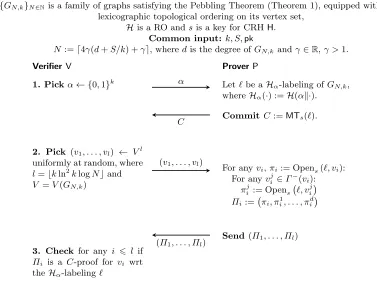
The protocolΣ4= (Gen,V,P) is described in Figure 3.1 and it is a 4-message protocol.
The protocol follows in some way Kilian’s construction of argument systems [25]. For any string α ∈ {0,1}∗, let H
α(·) be defined as H(αk·). The verifier chooses a random α and asks the prover to build a Hα-labeling of graphGN,k, whereN depends onS. The purpose ofαis to “reset” the Random Oracle. That is, any previous information aboutH is now useless with overwhelming probability. The labeling provides evidence that the prover has handled at least S memory cells. The prover then commits the labeling and sends the commitment to the verifier. At this point, the verifier asks the prover to open several random locations in the commitment and then it checks locally the integrity of the labeling. For a commitmentC
and for any node that the verifier has challenged, the prover sends what we call a C-proof for the node (defined next).
Definition 3 (C-proof ).Given a DAGG, a commitmentC, and a Random OracleH, we say that a string
π = (π0, . . . , πd) is a C-proof for a vertex v ∈ V(G) w.r.t. H if only if given ΓG−(v) = {w1, . . . , wd} the
following points hold:
1. π0 is aC-opening forv, letxbe the valueπ0 is opening to;
Generator Gentakes asinput1kand outputspk:= ({GN,k}N∈N,H, s),
where{GN,k}N∈Nis a family of graphs satisfying the Pebbling Theorem (Theorem 1), equipped with the natural
lexicographic topological ordering on its vertex set, His a RO andsis a key for CRHH.
Common input:k, S,pk
N:=d4γ(d+S/k) +γe, wheredis the degree ofGN,kandγ∈R,γ >1.
VerifierV ProverP
1. Pickα← {0,1}k α
C
Let`be aHα-labeling ofGN,k, whereHα(·) :=H(αk·).
CommitC:=MTs(`).
2. Pick (v1, . . . , vl) ← Vl uniformly at random, where l=bkln2klogNcand V =V(GN,k)
3. Check for any i 6 l if Πi is a C-proof for vi wrt theHα-labeling`
(v1, . . . , vl)
(Π1, . . . , Πl)
For anyvi,πi:= Opens(`, vi): For anyvij∈Γ−(vi):
πij:= Opens `, vji
Πi:= πi, πi1, . . . , πid
Send(Π1, . . . , Πl)
Fig. 3.1.The 4-messagePoSpaceprotocolΣ4.
3. x=H(vkx1k. . .kxd).
We omitC,G, andH, when they are clear from the context, by saying thatπis simply a proof.
In the definition of C-proof, the points 1 and 2 refer to the commitment C while point 3 ensures the integrity of the labeling. Note that the size ofπisO(kdlogN).
We remark that when TMBtakes as input a ROH, it is intended thatBhas oracle access toHand the length of the input ofB does not take into account the (exponentially long) length ofH.
Theorem 2. The protocolΣ4 in Figure 3.1 is a (one-stage)PoSpace.
Proof. We focus on theSoundness. We divide the proof in two parts. First, in the PoK Lemma, we prove that the ProtocolΣ4is a PoK for a partial labeling with “few” faults, and that the partial labeling has been computed during the round (1), i.e., after the verifierV sent the messageα and before the adversary sent the commitment messageC. Then we combine the PoK Lemma with the Labeling Lemma and the Pebbling Theorem to reach a contradiction assuming that there exists a winningpptadversary.
We stress that the knowledge extractor doesn’t need to be efficient since we do not rely on any compu-tational assumption.
Lemma 2 (PoK Lemma). Consider the protocol Σ4 = (Gen,V,P), a ppt adversary A, a ppt Turing
Machine with adviceA0, a space parameterS, and a security parameterk. Sample a random pk←Gen(1k)
and leth← A0(pk,1S). IfPrhSndA,A0
Σ4,S(k)
i
is noticeable (where the probability is taken over the randomness
of pk, h and all the randomness used during the protocol execution between A and the verifier) then, for a noticeable probability over the choice of pk, there exist a first verifier message α˜ and an adversary’s randomnessρ˜such thatA(h)calculates anHα˜-labeling`ofGN,kwithmfaults such that the following holds:
– the hint his independent of Hα˜,
– m=O lnNkand
– for any well-labeled node uin` we have( ˜αkuk`(u1)k. . .k`(ud))∈ Q,
whereQ is the set of queries toH made byAwhen fed with randomnessρ˜during round (1) of the protocol Σ4, and{u1, . . . , ud}=Γ−(u).
Proof. Consider the event
Q0:={α∈ {0,1}k | A0(pk,1S) made at least a query toHwith prefixα}.
We say that a first messageαisgood iff
Pr
hA(h),Vi(pk,1S) = 1| Vsendsαas first message
is noticeable. By Markov’s inequality, the probability that “a uniformly random first messageαis good” is noticeable. On the other hand, the probability that a uniformly random first messageαis in Q0 is bounded
bypoly(k, S)/2k. Thus, there exists ˜αthat is both good and not inQ0. Since ˜α6∈ Q0 thenh← A0(pk,1S) is independent ofHα˜. LetV =V(GN,k) be the vertex set ofGN,k and letWC(v) be the following event:
“A(h,pk,α˜) sends the commitmentC at the end of round (1) and makes the verifierV accept
when challenged with the vectorv∈Vl during round (2)”.
The eventWC(v) depends on the public keypk, A’s randomness, and the challengev ←Vl, wherel is the length of the message as defined in the protocolΣ4.
A commitment string sent by A(h,pk,α˜) to the verifierVat the end of round (1) is agood commitment
iff Pr[WC(v)] is noticeable. We have that with noticeable probabilityA(h,pk,α˜) sends a good commitment at the end of round (1).
It might be the case that A(h,pk,α˜), instead of computing the labeling through the RO queries, simply guesses the correct one. However,A’s guess is correct with probability at most 2−k. Hence, with noticeable probability during round (1):
– A(h) is not making any guesses and – A(h) sends a good commitment.
Thus, there exists a randomness ˜ρsuch thatA(h,pk,α˜) satisfies the two properties above when fed with ˜
Thus, there exists a deterministic adversary ˜A that, with noticeable probability over pk and over the challenge v, makes the verifier accept. LetC be the good commitment sent by ˜A. Now we focus on round (2). Let
E:=
u∈V | Pr
pk,v
˜
Achallenged onv∈Vl
sends a C-proof foru ∧ u∈v
< r(k)
,
wherer(k)∈poly(k).
There exists a procedure to compute the set E (recall that the extraction process doesn’t need to be efficient). Notice that by construction the nodes of V \E can be C-opened with noticeable probability, hence theyC-open to fixed labels with noticeable probability (otherwise an efficient sampling procedure can invalidate the binding property of the underlying Merkle-Tree).
For eachu∈V\E, there exists a randomnessρusuch that ˜Asends to the verifierVaC-proof foruthat
C-opens uto the most probable label. Here, it is assumed that A(h) is usingρu as source of randomness during round (2).
If we collect all those values, we obtain an Hα˜-labeling with at most|E|faults.
We now prove the second item of the lemma, i.e., the upper-bound for m = |E|. Notice that m is a random variable that depends onpk. For any ˜pklet ˜m:=m( ˜pk), the following chain of inequalities hold:
Pr
v
h
WC(v)|pk= ˜pk i
= Pr
v
h
WC(v)∧ ∀vi∈v vi6∈E| pk= ˜pk i
+
+ Pr
v
h
WC(v)∧ ∃vi∈v vi∈E |pk= ˜pk i
6Pr
v
h
∀vi ∈v vi6∈E|pk= ˜pk i
+X
u∈E Pr
v
h
WC(v)∧u∈v|pk= ˜pk i
6
1− m˜ |V|
l
+X
u∈E Pr
v
˜
Achallenged onv ∈Vl
sends a C-proof foru ∧ u∈v
pk= ˜pk
6e−|mV˜|·l+X
u∈E Pr
v
˜
Achallenged on v∈Vl
sends aC-proof foru ∧ u∈v
pk= ˜pk
Taking the expected value overpk, we obtain:
Pr
pk,v[WC(v)]6pkE
h
e−|mV|·l
i
+X
u∈E Pr
pk,v
˜
Achallenged onv∈Vl
sends a C-proof foru ∧ u∈v
<E
pk
h
e−|mV|·l
i
+|V|r(k).
There exists a constant c ∈ N such that, for k >> 1, Pr [WC(v)] > k−c. Hence, if we select r(k) = (|V|2kc)−1, we obtain that
E
pk
h
e−|mV|·l
i
> 1
2kc. Via the Paley-Zygmund inequality [32], we have:
Pr
pk
e−|mV|·l> 1
4kc
>8k12c.
Thus, with noticeable probability overpk:
m
Notice that, in the graph family {GN,k}, |V|=kNlogN. Thus, since l =kln2klogN, we achieve the required upper-bound form.
We now prove the third item of the Lemma, i.e., for any assignment ρ of the randomness of A for the round (1) such that (a) the commitment C is a good commitment and (b) Ahas not made any guess, we have that for anyu∈V \E,Qu:= ( ˜αkuk`(u1)k. . .k`(ud))∈ Q, whereQis the set of queries made byAto Huntil the end of round (1) and{u1, . . . , ud}=Γ−(u).
If that would not be the case, we can define a reduction that violate the binding property of the Merkle Tree. The probability that a uniformly random assignment of the randomness of A has the properties (a) and (b) and a uniformly random first message ofV is good and not in Q0 is noticeable. Let p(k)∈poly(k)
be a lower-bound for that probability.
By contradiction suppose there exists a u such that the query Qu 6∈ Q. By the choice of ˜α, Qu 6∈ Q0 hence it must have be made in the round (2) of the protocol.
Suppose for now that the reduction knows the values`(u1),. . . ,`(ud), then:
(a) it can choose an assignment of the randomnessρofAfor the round (1) and a first messageα∈ {0,1}k both uniformly at random. Then, it executes A(h,pk,1S, α;ρ) to obtain a commitmentC;
(b) VchallengesAin round (2) with a uniformly random vectorv ∈Vlcontainingu.Awill make the query
Qu toHand the reduction responds to it with a uniformly random string in{0,1}k;
(c) it rewindsAto the point corresponding to the end of round (1) of the protocol, then runs again point (b).
AwillC-open the nodeuin points (b) and (c) of the reduction with two different values with a probability at leastp(k)·(r(k)2−2−k).
In general the reduction doesn’t know the values`(u1), . . . , `(ud) and it can’t figure out which of the queries made by A in the round (2) of the protocol is Qu. But A is ppt so we can find a q(k) ∈ poly(k, S) that upper-bounds the number of queries made byAtoHduring round (2).
A will C-open the node u, by guessing the exact point in time Qu is queried, with two different values with a probability at leastq(k)−1·p(k)·(r(k)2−2−k). Hence, this reduction violates the binding property
of the Merkle Tree. ut
We are ready now to prove the Theorem.
By contradiction, suppose there exists an adversary A for the protocol Σ4. By applying Lemma 2, we extract with noticeable probability a partialHα˜-labeling, ensure that A(h) computed that labeling during round (1) and that the hinthis independent ofHα˜. Hence, satisfying the hypotheses of Lemma 1.
This gives us, with overwhelming probability, a pebbling sequence P of GN,k with m wildcards having pebbling space S0 = Sk +d, m = O(lnNk). In addition, the pebbling time of P is a lower bound for the execution time ofAduring round (1). To apply Theorem 1, we fixN such that
N−l>4S0+ 2m+ 1, (3)
wherel denotes the number of wildcards that are inT(GN,k).
Given c∈(0,1) and >0, we have that (2 +)m+l6cN. If we findN such that
N >4S0+cN+ 1,
(henceN >4γS0+γ, where γ= 1/(1−c)) then the inequality (3) will follow. (This is main reason why we have setN :=d4γS0+γein the ProtocolΣ4.)
By applying Theorem 1, the execution timeT ofAis such that
T>(N−l)
N−2S0−m
2S0+m+ 1
k
>c0(1 +)k, (4)
wherec0is a constant that is a lower bound forN−l. The value (1+)kderives from the fact that, eventually,
N−2S0−m>(1 +)(2S0+m+ 1).
On the Space Gap of the Protocol. The prover algorithm can be implemented basically in two ways. The most natural implementation is to first build the labeling for all the nodes in the graph and then apply the Merkle Tree, while keeping in memory the labeling which is reused during the second phase of the prover algorithm. Through this algorithm, the space gap of the prover is O(logS) while the time complexity is essentially dominated by the one labeling phase. Another way to implement the prover algorithm is by computing the labeling and the Merkle Treesimultaneously. In this way the algorithm can reuse space resulting in a strategy with space gap O(1). Note however that, in this implementation, the prover must build the labeling twice (once for the commitment and then during the challenge phase).
4
A 2-messages
PoSpace
protocol
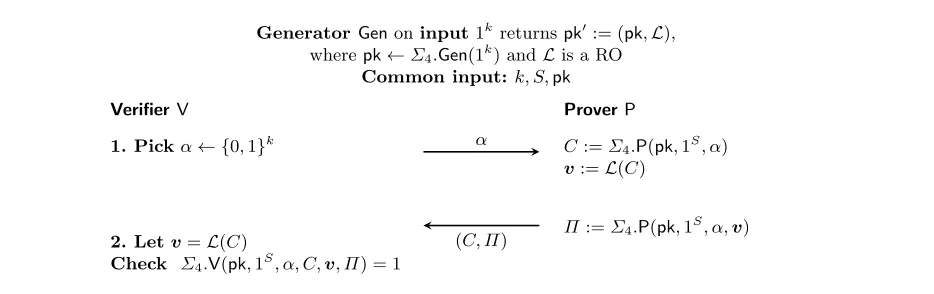
We apply the standard Fiat-Shamir paradigm to the PoSpace scheme given in Section 3.1 by using two independent Random OraclesH,L:
– H:{0,1}∗→ {0,1}k is used by the prover for the labeling of the graph;
– L:{0,1}k→Vlgiven the commitmentCas input, it yields the second verifier’s message (of the protocol
Σ4).
Let (Σ4.Gen, Σ4.P, Σ4.V) thePoSpace defined in Figure 3.1. We define in Figure 4.1 a 2-messagesPoSpace: we call Σ2 = (Gen,P,V) this protocol. Furthermore, let H0 : {0,1}∗ → {0,1}k be a RO then the function
f(x) :=Σ2.P(pk,1S,H0(x)) is a non-interactivePoSpacethat satisfies the syntactic definition of PoWs in [14].
GeneratorGenoninput1kreturnspk0
:= (pk,L), wherepk←Σ4.Gen(1k) andLis a RO
Common input:k, S,pk
VerifierV Prover P
1. Pickα← {0,1}k
2. Letv=L(C)
Check Σ4.V(pk,1S, α, C,v, Π) = 1
α
(C, Π)
C:=Σ4.P(pk,1S, α) v:=L(C)
Π :=Σ4.P(pk,1S, α,v)
Fig. 4.1.The 2-messages (one-stage)PoSpaceprotocolΣ2= (Gen,P,V).
Theorem 3. The ProtocolΣ2 in Figure 4.1 is a PoSpace.
Proof. Completeness and Succinctnessfollow from the fact that Σ4 is a PoSpace as proved in Theorem 2. To prove Soundness, we reduce an adversary Afor the schemeΣ2 to an adversaryB for the schemeΣ4 (of Figure 4.1). Suppose, by contradiction, there exists an adversary A, a hint h← A(pk0) and a valueS such that forklarge enough:
PrhSndAΣ,A0
2,S(k)
i >k−c.
(C, Π)← A(h,pk0, α;ρ), withQm=C and Σ4.V pk,1S, α, C,L(C), Π
= 1, or A(h,pk0, α;ρ) outputs the empty string. Moreover:
Pr[(C, Π)← A(h,pk0, α)∧Qm=C]>k−c·q(x)−1.
Notice that the probability above states that the outputs ofAwill be the same value asked byAtoLat the
m-th call. However, the value Qmis a random variable that may depend on all the randomness used until them-th call. We divide the randomness used byAinto two parts,ρ1 andρ2:ρ1is the randomness used by Abefore she has made them-th query to the oracleL,ρ2 is the remaining randomness.
By an averaging argument, there exists a setting of ρ1 such that the following equation holds Pr
ρ2,H,L
(C, Π) :=A(h,pk0, α;ρ1kρ2)∧Qm=C
>k−c·q(x)−1 (5) Now the valueQmis a random variable that depends only on the randomness of the challengeα, the ROs HandL, andρ1. Therefore, by repeating many times the TMA(h,pk0, α;ρ1kρ2) for a uniformly randomρ2 using the same oraclesH, L, we’ll get the same valueQmas them-th query to L. We define the pptTM with adviceB0 that on input pk and adviceρ
1, moutputs the hint ˜h:= (A0(pk,L),Q0, m, ρ1), whereQ0 is the set of RO queries made byA0 to HandL.
DefineB(˜h,pk,1S) :
– Waitfor the messageα;
– ComputeA(˜h,pk, α;ρ1) and reply to RO queries fromAviaHorLrespectively;
untilshe makes them-th RO query toL. LetQmbe such a query;
– Pausethe machineA;
– if Qm∈ Q0 abort.
– SendQmtoΣ4.V;
– Waitfor the messagevfromΣ4.V;
– chooseρ2 uniformly at random;
– ResumeAand reply to the queryQm withvand use as randomnessρ2;
– IfAoutputs the empty string,sendthe empty stringtoΣ4.V;
elselet (C, Π) be the output ofA;
– if C=Qmthen sendΠ toΣ4.V
else sendthe empty stringtoΣ4.V.
First, we show that the value Qmhas high min-entropy. Since|Q0| ∈poly(k, S), this implies thatB will abort with negligible probability.
By the equation (5), there exists an Hα-labeling`with m=O(N/lnk) faults such thatQm=MTs(`). Let R0 be the set of RO replies made by Hand L to the RO queries of A0. As αis uniformly random in {0,1}k then
e
H∞(`|R0, α)>(|V(GN,k)| −m−1)·k.
In fact only with negligible probability inkthe setQ0 contains queries toHwith prefixα. The min-entropy ofQmisω(logk) becauseMTis collision resistant. The probability that Qm is inQ0 is then negligible.
When B doesn’t abort the simulation of the protocol, Σ2 is perfect. Also notice that B needs space
S0=S+O(log(poly(k))) whereSis from the simulations ofAandO(logpoly(k)) from the auxiliary indexes. Moreover, if the event in equation (5) holds, thenBwill not send the empty string toΣ4.V. Hence, it follows that the adversaryB, with access to the hint function ˜hand using spaceS0 forklarge enough, is such that:
PrhSndBΣ,B0
4,S0(k)
i
>k−c·q(k)−1−negl(k).
5
Weak
Proof of Space
The concept of proof of space can lead to multiple interpretations. The main interpretation formalized in thePoSpacedefinition requires that the prover canhandle(i.e., read/write) space. In this section we provide a definition for a weaker alternative of PoSpacewe callweak Proof of Space (wPoSpace). This captures the property that the prover can just access space and formalizes what could effectively be achieved by properly adapting previous work on proof of storage [4, 5, 33] and on memory-bound PoW as defined in [1, 13](where the adversary model contemplates the existence of cache memory). The definition of wPoSpace is similar to the Definition of PoSpace (Definition 2) (the only change is in the Soundness part). We will provide a protocol which is awPoSpacebut not aPoSpace, hencewPoSpaceis a strictly weaker notion than PoSpace.
Definition 4 (wPoSpace). ConsiderΣ= (Gen,P,V)whereGenis a pptTM, andP,Vare interactiveppt
TMs. Let k ∈N be a security parameter and pk ←Gen(1k). Suppose that the following points hold for all
S∈N,S > k:
(Completeness) and (Succinctness) the same as in thePoSpace definition.
(weak-Soundness) For anypptadversaryA, the following event:
wSndAΣ,S(k) :=hA,Vi(pk,1S) = 1∧SpaceA(hA,Vi,pk,1S)< S,
has negligible probability (as a function of k).
Then we say thatΣ is a (one-stage) Weak Proof of Space (wPoSpace).
In the Soundness ofPoSpace, the adversary can take advantage of an unbounded space machine which is then unavailable during the protocol execution. In the Soundness ofwPoSpace, instead, this is disallowed. Notice that awPoSpace’s adversary can perform some precomputation before the execution of the protocol (i.e., before sending/receiving the first message), however, such a precomputation cannot exceed the space bound given.
Theorem 4. There exists a protocol which is awPoSpace but not aPoSpace.
Proof. We start by providing a protocol which is not a PoSpace. Consider the protocol Σ4 in Figure 3.1 where the first messageαsent byVis always the same, say 0k. We callΣ3 this modified version ofΣ4. The protocolΣ3 is not aPoSpace. For any kand S∈N, consider the hint hwhich is the H0k-labeling ofGN,k plus the complete Merkle-Tree of that labeling. We define an adversary that sends the commitmentCthat is inhand, for any verifier’s second messagev, reads the right answer fromh. That adversary needs to access
hinread-only mode, hence without using any additional working space.
The protocol Σ3 is awPoSpace. The structure of the proof is the same as the one of Theorem 2. We provide a particular case of the PoK Lemma (Lemma 2) where the hint his the empty string and ˜αis 0k. For the sake of clarity, we restate the PoK Lemma for this particular setting.
Lemma 3. Consider the protocolΣ3= (Gen,V,P), apptadversaryA, a space parameterS and a security
parameterk such thatpk←Gen(1k).
IfPrhwSndAΣ3,S(k)iis noticeable, then there exists a randomnessρ˜such thatAfed with the randomness
˜
ρ during the round (1) of the protocolΣ3 calculates an H0k-labeling ` of GN,k with m faults such that the
following holds:
– m=O lnNk
and
– for any well-labeled node uin` we have( ˜αkuk`(u1)k. . .k`(ud))∈ Q,
where Q is the set of queries toH made by Awhen fed with randomness ρ˜until the end of round (1) and
By contradiction, suppose there exists an adversary A for the protocol Σ3. By applying Lemma 3, we extract a partial H0k-labeling, ensuring thatA computed that labeling during round (1) (hence satisfying
the hypotheses of Lemma 1).
This gives us, with overwhelming probability, a pebbling sequenceP ofGN,k withmwildcards and with pebbling spaceS0= S
k +d,m=O( N
lnk). The pebbling time ofP is a lower bound for the execution time of Abefore round (2). The rest of the proof follows exactly the same structure of the proof of Theorem 2 and
it is therefore omitted. ut
Acknowledgements. We are grateful to Krzysztof Pietrzak for his insightful comments and suggestions.
References
1. Martin Abadi, Mike Burrows, Mark Manasse, and Ted Wobber. Moderately hard, memory-bound functions. ACM Trans. Internet Technol., 5(2):299–327, May 2005.
2. Mehmud Abliz and Taieb Znati. A guided tour puzzle for denial of service prevention. InACSAC, pages 279–288. IEEE Computer Society, 2009.
3. Giuseppe Ateniese, Ilario Bonacina, Antonio Faonio, and Nicola Galesi. Proofs of space: When space is of the essence. Cryptology ePrint Archive, Report 2013/805, 2013. http://eprint.iacr.org/.
4. Giuseppe Ateniese, Randal Burns, Reza Curtmola, Joseph Herring, Lea Kissner, Zachary Peterson, and Dawn Song. Provable data possession at untrusted stores. In Proceedings of the 14th ACM conference on Computer and communications security, CCS ’07, pages 598–609, New York, NY, USA, 2007. ACM.
5. Giuseppe Ateniese, Seny Kamara, and Jonathan Katz. Proofs of storage from homomorphic identification pro-tocols. InASIACRYPT, pages 319–333, 2009.
6. Adam Back. Hashcash - a denial of service counter-measure. Technical report, 2002.
7. Boaz Barak and Oded Goldreich. Universal arguments and their applications. InIEEE Conference on Compu-tational Complexity, pages 194–203. IEEE Computer Society, 2002.
8. R. B. Boppana, J. Hastad, and S. Zachos. Does co-np have short interactive proofs?Inf. Process. Lett., 25(2):127– 132, May 1987.
9. Lu´ıs Caires, Giuseppe F. Italiano, Lu´ıs Monteiro, Catuscia Palamidessi, and Moti Yung, editors. Automata, Languages and Programming, 32nd International Colloquium, ICALP 2005, Lisbon, Portugal, July 11-15, 2005, Proceedings, volume 3580 ofLecture Notes in Computer Science. Springer, 2005.
10. Ran Canetti, Ben Riva, and Guy N. Rothblum. Refereed delegation of computation. Information and Compu-tation, 226(0):16 – 36, 2013.
11. Kai-min Chung, Yael Kalai, and Salil Vadhan. Improved Delegation of Computation Using Fully Homomorphic Encryption. pages 483–501, 2010.
12. Yevgeniy Dodis, Leonid Reyzin, and Adam Smith. Fuzzy extractors: How to generate strong keys from biometrics and other noisy data. In Christian Cachin and JanL. Camenisch, editors,Advances in Cryptology - EUROCRYPT 2004, volume 3027 ofLecture Notes in Computer Science, pages 523–540. Springer Berlin Heidelberg, 2004. 13. Cynthia Dwork, Andrew Goldberg, and Moni Naor. On memory-bound functions for fighting spam.Advances in
Cryptology-Crypto 2003, 2003.
14. Cynthia Dwork and Moni Naor. Pricing via processing or combatting junk mail. Advances in Cryptology-CRYPTO’92, pages 139–147, 1993.
15. Cynthia Dwork, Moni Naor, and Hoeteck Wee. Pebbling and proofs of work. Advances in CryptologyCRYPTO 2005, pages 37–54, 2005.
16. Stefan Dziembowski, Sebastian Faust, Vladimir Kolmogorov, and Krzysztof Pietrzak. Proofs of space. Cryptology ePrint Archive, Report 2013/796, 2013. http://eprint.iacr.org/.
17. Stefan Dziembowski, Tomasz Kazana, and Daniel Wichs. Key-evolution schemes resilient to space-bounded leakage. InCRYPTO, pages 335–353, 2011.
18. Stefan Dziembowski, Tomasz Kazana, and Daniel Wichs. One-time computable self-erasing functions. In Pro-ceedings of the 8th conference on Theory of cryptography, TCC’11, pages 125–143, Berlin, Heidelberg, 2011. Springer-Verlag.
19. Stefan Dziembowski, Krzysztof Pietrzak, and Sebastian Faust. Proofs of space and a greener bitcoin. talk presented atWorkshop on Leakage, Tampering and Viruses, Warsaw 2013, 2013.
21. Oded Goldreich and Johan Hastad. On the complexity of interactive proofs with bounded communication. Information Processing Letters, 1998.
22. Shafi Goldwasser, Yael Tauman Kalai, and Guy N. Rothblum. Delegating computation: interactive proofs for muggles. InProceedings of the 40th annual ACM symposium on Theory of computing, STOC ’08, pages 113–122, New York, NY, USA, 2008. ACM.
23. Ari Juels and John G. Brainard. Client puzzles: A cryptographic countermeasure against connection depletion attacks. InNDSS. The Internet Society, 1999.
24. Nikolaos P. Karvelas and Aggelos Kiayias. Efficient proofs of secure erasure. SCN, 2014.
25. Joe Kilian. A note on efficient zero-knowledge proofs and arguments (extended abstract). InProceedings of the twenty-fourth annual ACM symposium on Theory of computing, STOC ’92, pages 723–732, New York, NY, USA, 1992. ACM.
26. Thomas Lengauer and Robert E. Tarjan. Asymptotically tight bounds on time-space trade-offs in a pebble game. Journal of the ACM (JACM), 29(4):1087–1130, 1982.
27. Silvio Micali. Computationally sound proofs. SIAM Journal on Computing, 30(4):1253–1298, 2000. 28. Satoshi Nakamoto. Bitcoin: A peer-to-peer electronic cash system. May 2009.
29. Colin Percival. Stronger key derivation via sequential memory-hard functions. presented at BSDCan ’09, 2009. 30. Daniele Perito and Gene Tsudik. Secure code update for embedded devices via proofs of secure erasure. In
ESORICS, pages 643–662, 2010.
31. Nicholas Pippenger. Superconcentrators. SIAM J. Comput., 6(2):298–304, 1977.
32. R.E.A.C.Paley and A.Zygmund. A note on analytic functions in the unit circle. page 266272, 1932.
33. Hovav Shacham and Brent Waters. Compact proofs of retrievability. InProceedings of the 14th International Conference on the Theory and Application of Cryptology and Information Security: Advances in Cryptology, ASIACRYPT ’08, pages 90–107, Berlin, Heidelberg, 2008. Springer-Verlag.
34. Adam Smith and Ye Zhang. Near-linear time, leakage-resilient key evolution schemes from expander graphs. IACR Cryptology ePrint Archive, 2013:864, 2013.
35. Martin Tompa. Time-space tradeoffs for computing functions, using connectivity properties of their circuits. In Proceedings of the tenth annual ACM symposium on Theory of computing, STOC ’78, pages 196–204, New York, NY, USA, 1978. ACM.
36. Brent Waters, Ari Juels, J. Alex Halderman, and Edward W. Felten. New client puzzle outsourcing techniques for dos resistance. InProceedings of the 11th ACM conference on Computer and communications security, CCS ’04, pages 246–256, New York, NY, USA, 2004. ACM.
A
Proof of the Pebbling Theorem (Theorem 1)
For the sake of convenience we re-write the statement of that theorem here. For the definitions of pebbling games, pebbling space and pebbling time we refer the reader to Section 2.
Pebbling Theorem (Theorem 1). There exists a family of efficiently sampleable directed acyclic graphs
{GN,k}k,N∈Nwith constant fan-ind,N input nodes,N output nodes andkNlogN nodes in total, such that:
1. Any pebbling sequence that pebbles∆ output nodes has pebbling space at mostS pebbles andmwildcards, where |∆|>4S+ 2m+ 1, and pebbling time T such that
T>|∆|
N−2S−m
2S+m+ 1 k
.
2. There exists a pebbling sequence that pebbles the graph GN,k which has pebbling space N+ 2and needs
timeO(kNlogN).
3. For any nodev∈V(GN,k), the incoming nodes ofvand the position ofvin first lexicographic topologically
order ofGN,k are computable inO(klogN).
Definition 5 (superconcentrator).We say that a directed acyclic graphG= (V, E)is anN-superconcentrator
if and only if
1. |S(G)|=|T(G)|=N,
2. for each S ⊆ S(G) and for each T ⊆ T(G) such that |S| =|T| =` there exist` vertex-disjoint paths from S toT, i.e. paths such that no vertex inV is in two of them.
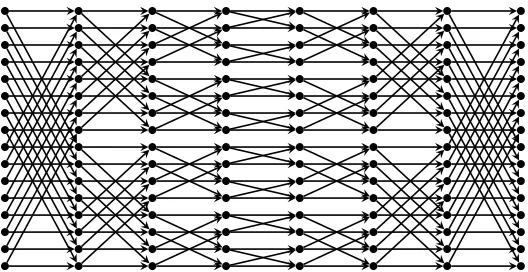
Fig. A.1.An example of 16-superconcentrator: the Butterfly Graph
Definition 6 (stack of superconcentrators).Given an N-superconcentratorGwe define the graphG×k,
the stack ofkcopies ofG, inductively as follows:G×1=GandG×k is obtained fromG×(k−1)andGby first
renaming the vertexes ofGso that they do not appear in the vertexes ofG×(k−1), obtaining a graphG0, and then by identifying T(G×(k−1))withS(G0).
Not any klayered stack of superconcentrators satisfies points 2 and 3 of the Pebbling Theorem. To obtain those properties we use the following well-known superconcentrator: theButterfly GraphBN built by putting together two FFT graphs withN inputs and outputs [35]. An example of such construction (forN= 16) is given in Figure A.1.
It is easy to see that the family of graphsGN,k:=BN×k satisfies points 2 and 3 of the Pebbling Theorem and it is ak layered stack ofN-superconcentrators. It remains to prove only point 1.
For superconcentrator graphs we can prove a tradeoff between pebbling space and pebbling time, even for pebbling games with wildcards. This result is based on a generalization of the “Basic Lower Bound Argument” (BLBA) by Tompa [35].
Lemma 4 (BLBA with wildcards).Consider anN-superconcentratorG, a setM ⊆T(G), and a pebbling
sequence P= (P0, . . . , P`)withmwildcards that pebblesM. Let Abe the set of all elements ofS(G)pebbled
and unpebbled at some point inP. If|M|>|P0|+|P`|+m+ 1 then|A|>N− |P0| − |P`| −m.
Proof. By contradiction suppose that|A|< N− |P0| − |P`| −m, this means that|Ac|>|P0|+|P`|+m+ 1 and every element inAc, by definition, is not pebbled and unpebbled. Take anyB⊆Acsuch that|B|=|M| then, asGis anN-superconcentrator, we haveπ1, . . . , π|M|vertex disjoint paths fromB toM. LetW be a
set ofmfaults forP. By construction|M|>|P0∪P`∪W|thus we have some pathπfrom some elementv ofB to some elementwofM such thatπ∩(P0∪P`∪W) =∅. By definition ofAc, and hence ofB,v is not pebbled and unpebbled andv 6∈P0∪P`∪W, thusv 6∈Pi for eachi ∈[`]. As π∩(P0∩W) =∅, we must have thatπ∩Pi=∅for eachi∈[`]. But then the vertexwis not inSi∈[`]Pi contradicting the fact thatP
Theorem 5 (Pebbling Theorem (point 1)). LetG×k be a stack of k copies of anN-superconcentrator G,∆⊆T(G×k)andP a pebbling sequence forG×k with mwildcards that pebbles ∆. LetS be the pebbling space of P and T the pebbling time ofP. If |∆|>4S+ 2m+ 1 then
T >|∆|
N−2S−m
2S+m+ 1 k
.
Proof. LetG1, . . . , Gk be thek copies of Gthat form G×k. Suppose we want to pebble a setM ⊆T(Gi) such that|M|>2S+m+ 1 and letA1, . . . , An be disjoint subsetes ofM such thatA1are the first 2S+m+ 1 elements ofM to be pebbled inP,A2are the second 2S+m+ 1 elements ofM to be pebbled inP and so on. Clearly we have that the number of these sets isn=j2S+m+1|M| k. By Lemma 4 we have that for eachAj there exists a setβ(Aj) inS(Gi), whose elements are pebbled and unpebbled, of size at least N−2S−m. Thus we have that the total number of elements inS(Gi) that have been pebbled and unpebbled is at least (N−2S−m)j2S+m+1|M| k. Notice now that eachβ(Aj)∈T(Gi−1) hence we can reapply the argument above to it provided that for each j, |β(Aj)| >N−2S−m>2S+m+ 1 (and this is implied by the fact that
N >|∆|>4S+ 2m+ 1). Thus starting fromT(Gk) = T(G×k) we can prove by induction, going back to
G1, that at least
|∆|
N−2S−m
2S+m+ 1 k
actions of pebbling and unpebbling take place onS(G1) =S(G×k). As each action is an elementary step in
the pebbling gameP we have that the result follows. ut
B
Merkle Tree
Consider the complete binary tree T over n leaves. Without loss of generality we can assume thatn is a power of 2 by using padding if necessary. Label the i-th leaf with li, then, use a collision resistant hash (CRH) function Hs : {0,1}2k → {0,1}k with random seed s to propagate the labelingl of the leaves to a labelingφalong the treeT up to the root according to the following rules:
1. φ(v) :=li ifv is thei-th leaf ofT,
2. φ(v) :=Hs(φ(v1)kφ(v2)) wherev1, v2 are the two children ofv.
Then thecommitment for a stringl is the labelφ(r) of the root of the tree: we denote it withMTs(l). The commitment is succinct in fact it has sizekwhich is independent ofn.
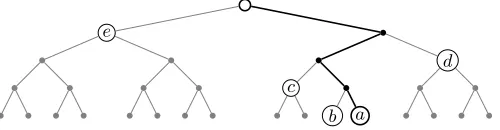
Anopening for the i-th element in the sequencel is an ordered sequence formed by elements of {0,1}k that are intended to be the label li of the i-th leaf of T together with the labelsφ(vj) for eachvj that is a sibling of vertices in the path from the root of the tree to thei-th leaf. An example of opening is shown in Figure B.1.
e
c
b a
d
Fig. B.1.An example of opening:c= (a, b, c, d, e)