A Simple and Improved Algorithm for Integer
Factorization with Implicit Hints
Koji Nuida∗† Naoto Itakura§ Kaoru Kurosawa§ ∗ National Institute of Advanced Industrial Science and Technology
(AIST), Japan ([email protected])
† Japan Science and Technology Agency (JST), PRESTO Researcher § Ibaraki University, Japan
Abstract
Given two integers N1 = p1q1 and N2 = p2q2 with α-bit primes
q1, q2, suppose that thet least significant bits ofp1 andp2 are equal. May and Ritzenhofen (PKC 2009) developed a factoring algorithm for
N1, N2whent≥2α+ 3; Kurosawa and Ueda (IWSEC 2013) improved the bound tot≥2α+ 1. In this paper, we propose a polynomial-time algorithm in a parameterκ, with an improved boundt= 2α−O(logκ); it is the first non-constant improvement of the bound. Both the con-struction and the proof of our algorithm are very simple; the worst-case complexity of our algorithm is evaluated by an easy argument, without any heuristic assumptions. We also give some computer experimental results showing the efficiency of our algorithm for concrete parameters, and discuss potential applications of our result to security evaluations of existing factoring-based primitives.
1
Introduction
For a large number of computationally secure cryptographic schemes in the literature, including the RSA cryptosystem [10], the (expected) computa-tional hardness of integer factorization is a necessary (and sometimes suf-ficient) condition for their security. Consequently, the actual hardness of integer factorization has been intensively studied so far, e.g., [4, 5, 9].
becomes efficient when a half of the most significant bits ofp are revealed. In the setting, a hint for the factorization is givenexplicitly.
On the other hand, there are also previous results where some implicit
hints are supposed. May and Ritzenhofen [7] considered the following set-ting: Given two RSA moduliN1 =p1q1 and N2 =p2q2, it is supposed that thetleast significant bits ofp1 and ofp2 are equal. Here the precise values of their t common bits are not given; i.e., the hint is only implicit. They showed that, if q1 and q2 are α-bit primes and t ≥ 2α+ 3, then N1 and
N2 can be factorized efficiently. Recently, Kurosawa and Ueda [3] gave an improved algorithm providing a better boundt≥2α+ 1; they also slightly generalized the situation in such a way that p1 ≡p2 (mod T) for some pa-rameter T > q12 +q22 (the original case corresponds to T = 2t). In this paper, we improve these results further, yielding a better bound forT.
1.1 Our Contributions
In this paper, we study the integer factorization of composite integersN1 =
p1q1 and N2 =p2q2 with implicit hintp1 ≡p2 (modT). We aim at devel-oping a polynomial-time algorithm with respect to a certain parameter κ; for example, κ can be the security parameter for some scheme, whose un-derlying assumption is the hardness of factorizing these composite integers. Then we propose an algorithm to factorize N1 or N2 with probability one in polynomial time with respect to the parameterκ under a condition1
logT = 2 logQ−O(logκ) (1)
whereQis an upper bound for q1, q2. WhenQ= 2α andT = 2t for integer parametersα and t, our condition above is equivalent to
2α−t=O(logκ) ,
significantly better than the best existing bound 2α−t ≤ −1 in [3].2 We emphasize that our result is the first result achievingnon-constant improve-ment of the bound (in fact, it is even the first to cover the situationt≤2α). The essence of our remarkable improvement from the previous results [3, 7] can be explained as follows. In the previous results, a two-dimensional latticeLassociated to the given composite integersN1, N2 is defined, and it is shown that itsshortest vector, calculated by Gaussian reduction algorithm,
1
In fact, some easy-to-satisfy conditions are also required for the sake of completeness.
2
coincides with the vector (q1, q2) of the target factors under their condition forT andQ(ortandα, whenT = 2tand Q= 2α). Now we point out that, the Gaussian reduction algorithm outputs not only the shortest vector, but also thesecond shortest vector of the lattice L. Our main idea is to utilize the second shortest vector (as well as the shortest vector) which was not previously used; this new ingredient enabled us to improve the algorithm.
Another noteworthy characteristic of our result is its simplicity; it relies solely on the basic fact that the vector⃗q= (q1, q2), which lies in the lattice
L, can be expressed by using the shortest vector⃗v and the second shortest vector⃗uof Las⃗q =a⃗v+b⃗u for some integersa, b. Our algorithm finds the correct coefficients a, b by exhaustive search; now our improved condition (1) guarantees that there are only polynomially many (with respect to κ) candidates of (a, b). Our proof is also very simple and elementary; it does not use any typical facts for lattices such as Minkowski bound and Hadamard’s inequality (which were used in the previous work [3, 7]).
We performed some computer experiments, which show that our pro-posed algorithm indeed works efficiently (e.g., the average running time on an ordinary PC was approximately 17 min. forα = 250 and t = 470). We also discuss potential applications of our proposed algorithm to some exist-ing schemes such as the Okamoto–Uchiyama cryptosystem [8] and Takagi’s variant of the RSA cryptosystem [12]; we emphasize that our algorithm does
not require the implicitly correlated factorsp1, p2 to be primes.
1.2 Related Work
As mentioned above, for the case of factorization of two integers, our result improves the previous results by May and Ritzenhofen [7] and Kurosawa and Ueda [3]. On the other hand, May and Ritzenhofen also studied factorization of three or more integers which are implicitly correlated in a similar manner. Such an extension of our result is left as a future research topic.
Sarkar and Maitra [11] extended the result of May and Ritzenhofen [7] under a heuristic assumption (see Assumption 1 of [11, page 4003]). In a recent preprint [6], Lu et al. announced that they improved the result of Sarkar and Maitra. However, their result is also based on a heuristic
assumption. In contrast, the evaluation of our algorithm in this paper needs
1.3 Organization of the Paper
In Sect. 2, we summarize basic notations and terminology, as well as some properties of Gaussian reduction algorithm for two-dimensional lattice. In Sect. 3, we clarify our problem setting, describe our proposed factorization algorithm, and then show its correctness and computational complexity. In Sect. 4, we give the results of our computer experiments to show the efficiency of our proposed algorithm. Finally, in Sect. 5, we discuss potential applications to security evaluations of some existing cryptographic schemes.
2
Preliminaries
For two-dimensional vectors ⃗v = (v1, v2), ⃗u = (u1, u2) ∈ R2, let ||⃗v|| =
√
v12+v22 and (⃗v, ⃗u) = v1u1 +v2u2 denote the Euclidean norm and the standard inner product. For a two-dimensional lattice L ⊂ Z2, let λ1 =
λ1(L) and λ2 = λ2(L) denote the successive minima of L; i.e., λi is the minimal radius of a ball containingilinearly independent vectors of L.
We recall that, in a two-dimensional lattice L, a basis (v⃗1, ⃗v2) of L sat-isfying ||v⃗1|| = λ1 and ||v⃗2|| = λ2 can be efficiently obtained by Gaussian reduction algorithm. Here we describe the algorithm:
Definition 1(Gaussian reduction algorithm). Given any basis (b⃗1, ⃗b2) of a
latticeL, Gaussian reduction algorithm performs as follows:
1. First, order the vectors b⃗1, ⃗b2 and rename those as v⃗1, ⃗v2, in such a
way that||v⃗1|| ≤ ||v⃗2||.
2. Set µ:=⌊(v⃗1, ⃗v2)/||v⃗1||2⌉, i.e., the integer closest to (v⃗1, ⃗v2)/||v⃗1||2 (if
two integers have equal smallest distance from the value, then choose the one with smaller absolute value).
3. Repeat the following, until µ becomes 0:
(a) Update v⃗2 by v⃗2 ←v⃗2−µ ⃗v1.
(b) If ||v⃗2||<||v⃗1||, then swapv⃗1 and v⃗2.
(c) Set µ:=⌊(v⃗1, ⃗v2)/||v⃗1||2⌉.
4. Output the pair (v⃗1, ⃗v2).
Proposition 1. The Gaussian reduction algorithm outputs a basis (v⃗1, ⃗v2)
of the lattice L satisfying that ||v⃗1|| = λ1 and ||v⃗2|| = λ2. Moreover, the
computational complexity of the algorithm isO(log2max{||b⃗1||,||b⃗2||}). We also use the following property of Gaussian reduction algorithm:
Lemma 1. For any input (b⃗1, ⃗b2) and the corresponding output (v⃗1, ⃗v2) of
Gaussian reduction algorithm, we have |det(b⃗1, ⃗b2)| = |det(v⃗1, ⃗v2)|, where
we write det((x1, x2),(y1, y2)) := det
(
x1 x2
y1 y2
)
=x1y2−x2y1.
Proof. The transformations for (v⃗1, ⃗v2) performed at each step of Gaussian reduction algorithm are one of the followings:
• Subtract a scalar multiple ofv⃗1fromv⃗2; it preserves the value det(v⃗1, ⃗v2).
• Swapv⃗1 and v⃗2; it changes the value det(v⃗1, ⃗v2) to −det(v⃗1, ⃗v2).
Hence, the absolute value of det(v⃗1, ⃗v2) is not changed, as desired.
3
Our Proposed Algorithm
3.1 Problem Setting
Let N1 =p1q1 and N2 = p2q2 be given composite numbers. Let T ≥ 2 be an integer parameter (for example, a power of two as in [7]) with T < N1
and T < N2. In this paper, we consider the following situation:
• We have p1≡p2 ≡p (mod T) for some unknown integerp.
• Any two ofN1,N2 and T are coprime to each other.
When T = 2t for an integer t, the first condition means that the t least significant bits ofp1 andp2are equal (the precise tbits are not known). We emphasize thatwe do NOT assume that each ofp1,p2,q1 andq2 is a prime. The second condition implies that any two of q1, q2 and T are coprime to each other, andpis coprime toT (indeed, ifpandT have a common divisor
a >1, thenp1 andp2, henceN1andN2, are multiples ofa, a contradiction).
3.2 The Algorithm
In order to describe our proposed algorithm, first we define, for given com-posite numbers N1 and N2, the following two-dimensional lattice L:
We have a basis ofLconsisting of two vectors (1, N2/N1 modT) and (0, T), whereN2/N1 modTsignifies the unique integerain [0, T−1] withN1a≡N2 (modT). It is indeed a basis ofL, sinceN1andT are coprime; if (0, x2)∈L, then we haveN1x2 ≡0 (mod T), thereforex2 must be a multiple ofT.
Then we describe our proposed algorithm to find a non-trivial factor of at least one of the given composite numbersN1 and N2:
1. Compute, by Gaussian reduction algorithm with initial basis consisting of (1, N2/N1 modT) and (0, T), a basis (⃗v= (v1, v2), ⃗u= (u1, u2)) of the latticeLabove with ||⃗v||=λ1 =λ1(L) and ||⃗u||=λ2=λ2(L).
2. Compute gcd(v1, N1), gcd(v2, N2), gcd(u1, N1) and gcd(u2, N2), and if at least one of those is different from 1, then output it and halt.
3. Ifv1u2−v2u1 <0, then replace⃗u with−⃗u.
4. ForA= 2,3, . . ., execute the following:
(a) For integersa, b̸= 0 satisfying|a|+|b|=A, execute the following: If|au1−bv1|is a non-trivial factor ofN1, then output it and halt.
3.3 Analysis of Our Algorithm
We analyze the correctness and the efficiency of our proposed algorithm. First, note that (sinceT ≥2)
||(1, N2/N1 modT)|| ≤
√
12+ (T−1)2 < T =||(0, T)|| , (2)
therefore by Proposition 1, the complexity of Step 1 of our algorithm (con-sisting of Gaussian reduction algorithm) isO(log2T). Secondly, the lattice
Lcontains the vector ⃗q:= (q1, q2); indeed, we have
N2q1−N1q2 =p2q2q1−p1q1q2 ≡pq2q1−pq1q2 = 0 (mod T) .
Now we show the following property for Step 2 of our algorithm:
Lemma 2. If our algorithm halts in Step 2, then the output of the algorithm is correctly a non-trivial factor of either N1 or N2. Moreover, if ||⃗q||< λ2,
then our algorithm always halts in Step 2.
N1 if gcd(v1, N1)= 1, and the same holds for gcd(̸ v2, N2), gcd(u1, N1) and gcd(u2, N2). This deduces the first part of the claim.
For the second part, if||⃗q||< λ2, then⃗q and⃗v are linearly dependent by the definition of λ2 = λ2(L); c⃗v = c′⃗q for some coprime integers c, c′ ̸= 0. Sinceq1 and q2 are coprime, we have|c|= 1 and⃗v=±c′⃗q. Moreover, since
||⃗q|| ≥ ||⃗v||by the choice of⃗v, we have|c′|= 1. Therefore, we have|v1|=q1 and gcd(v1, N1) =q1 ̸= 1. This completes the proof of Lemma 2.
Note that the computation of gcd in Step 2 can be done in polynomial time with respect to max{logN1,logN2}. By virtue of Lemma 2, to see the correctness of our algorithm, we may focus on the case that the algorithm does not halt at Step 2. Now we haveλ2 ≤ ||⃗q|| by Lemma 2.
Since p1 ≡p2 ≡p (modT) and⃗v, ⃗u∈L, we have
p(q2v1−q1v2)≡p(q2u1−q1u2)≡0 (modT) .
Moreover, since gcd(p, T) = 1 as mentioned in Sect. 3.1, it follows that
q2v1−q1v2 ≡q2u1−q1u2≡0 (modT) .
Hence, there are integersa0, b0∈Zsatisfying
q2v1−q1v2=a0T , q2u1−q1u2=b0T , (3)
or equivalently (
−v2 v1
−u2 u1
) ( q1 q2 ) = (
a0T
b0T
)
. (4)
We have a0 ̸= 0 by (3), since q1 is coprime to q2 and v1 (note that v1 is coprime to N1 =p1q1, since our algorithm does not halt at Step 2 by the current assumption). Similarly, we haveb0̸= 0. Now Lemma 1 implies that
det
(
−v2 v1
−u2 u1
)
= det
(
v1 v2
u1 u2
)
=±det
(
1 N2/N1 modT
0 T
)
=±T ,
while det
(
v1 v2
u1 u2
)
=v1u2−v2u1 ≥0 by virtue of Step 3 of our algorithm,
therefore we have det
(
−v2 v1
−u2 u1
)
=T. Hence the system of equations (4)
can be solved as
( q1 q2 ) = (
−v2 v1
−u2 u1
)−1(
a0T
b0T
)
= 1
T
(
u1 −v1
u2 −v2
) (
a0T
b0T
)
=
(
a0u1−b0v1
a0u2−b0v2
)
Consequently, if the pair (a, b) in Step 4a of our algorithm becomes (a0, b0), then our algorithm halts with outputq1, which is indeed a non-trivial factor of N1. This completes the proof of the property that our algorithm halts within a finite computational time and its output is always a non-trivial factor of either N1 orN2 (we note that|a0|+|b0| ≥2, sincea0, b0̸= 0).
From now, we evaluate the number of iterations in Step 4, by evaluating the sizes of a0 and b0 above. For the purpose, we introduce the following additional assumption, whereQ is an integer parameter:
• We have q1, q2 ≤Q for any givenN1, N2.
We emphasize that the parameterQis used in the analysis of the algorithm only, and is not needed by our algorithm itself. By Lemma 2, we may focus on the case λ2 ≤ ||⃗q||; otherwise, our algorithm halts at Step 2. Note that
||⃗q||=√q12+q22 ≤
√
2·Q, therefore λ2≤
√
2·Q. Now by (3), we have
|a0|=
q2v1−q1v2
T
≤ |q2v1|+|q1v2|
T ≤
Q
T(|v1|+|v2|)≤ Q T
√
2· ||⃗v||
and similarly|b0| ≤(Q/T)
√
2· ||⃗u||. Since ||⃗v|| ≤ ||⃗u||=λ2 by the choice of
⃗v and⃗u, it follows that
|a0|,|b0| ≤
Q T
√
2·λ2 ≤ 2Q2
T ,
therefore|a0|+|b0| ≤4Q2/T. Hence, the indexAin Step 4 of our algorithm does not exceed A0 := ⌊4Q2/T⌋ during the execution. Since Step 4a of our algorithm is repeated at most 4A times for each choice ofA, the total number of executions of Step 4a is at most ∑A0
A=24A = 2A0(A0 + 1)−4. Moreover, for each 1 ≤ A ≤ A0, Step 4a for each choice of (a, b) can be done in polynomial time with respect to logA0, logQand logN1 (note that
|a|,|b| ≤A0 and |v1|,|u1| ≤λ2≤
√
2·Q).
Summarizing the argument, our algorithm runs in polynomial time with respect to the maximum among log2T, logN1, logN2, log(4Q2/T), logQ and 4Q2/T. Here, the values log(4Q2/T) (≤4Q2/T) and log2T (≤logN1, sinceT < N1, N2) are redundant. Moreover, we have max{4Q2/T,logN1} ≥ logQ; indeed, if 4Q2/T <logQ, then we have 4Q2/N1 <logQ (since T <
N1),N1 >4Q2/logQ >4Q, and logN1 >logQ. Therefore, the value logQ
above is also redundant. Hence, we have the following result:
Theorem 1. In the setting of Sect. 3.1, suppose that q1, q2≤Q. Then our
proposed algorithm in Sect. 3.2 always outputs a non-trivial factor of either
N1 or N2, and its computational complexity is polynomially bounded with
By Theorem 1, if κ is another parameter (e.g., when the factorization problem we are discussing is the base of security of some cryptographic scheme, κ can be chosen as the security parameter for the scheme) and all of logN1, logN2 and Q2/T are of polynomial order with respect toκ, then our proposed algorithm runs in polynomial time with respect toκ.
For example, we consider the case that q1 and q2 areα-bit integers and the t least significant bits of p1 and p2 coincide with each other (as in the previous work [3, 7]). Then Theorem 1 implies the following result:
Theorem 2. Let κ be a parameter as mentioned above. Suppose that the bit lengths of N1 and N2 are polynomial in κ, and let Q= 2α and T = 2t.
Then our proposed algorithm runs in polynomial time with respect to κ if
t= 2α−O(logκ) .
This sufficient condition for t is significantly improved from the condi-tionst≥2α+ 3 in [7] and t≥2α+ 1 in [3]. In particular, this is the first result achieving that the difference 2α−t can be beyond of constant order.
4
Computer Experiments
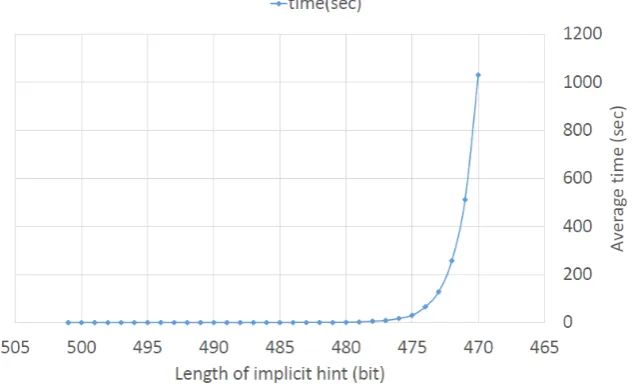
We performed a computer experiment to evaluate the running time of our proposed algorithm; see Figure 1. Here we setQ= 2α,α= 250 (i.e.,q1 and
q2are 250-bit primes),T = 2t, and the bit lengthtof implicit hints is chosen ast = 501,500, . . . ,470. The other factors p1 and p2 have 750-bit lengths. We used an ordinary machine environment, namely our algorithm is written in C++ with NTL for large-integer arithmetic, on CentOS 6.5 with 2.4GHz CPU and 32GB RAM. For eacht, we calculated the average running time of our algorithm for 100 experiments (N1 andN2 are correctly factorized at every experiment). Our experimental result shows that our algorithm can successfully factorize the integers efficiently, even for a significantly better parameter t = 470 than the best bound t ≥ 2α+ 1 = 501 in the previous results (now the average running time is approximately 1030 sec.≈17 min.). We also evaluated the sufficient number A of iterations for the main loop of our proposed algorithm by computer experiments. We used the same parameters and machine environment as above, except that the range of the bit length t of implicit hints is now t = 499,498, . . . ,475. For each
Figure 1: Running time of our proposed algorithm (here the bit lengths of
q1 andq2 areα= 250 bits,T = 2t, and the range oftis{501,500, . . . ,470})
theoretical analysis in Sect. 3.3 is ⌊4Q2/T⌋ = 2502−t; it is, for example, 227 ≈ 1.34×10⁸ for t = 475. Our experimental result suggests that this theoretical bound of A would still be far from the precise value; further analyses to improve the bound of Aare left as a future research topic.
5
Potential Applications
It is noteworthy that the implicitly correlated factors p1, p2 need not be primes in our proposed algorithm; see Sect. 3.1. This widens the potential applications of our method to security evaluations of existing schemes. In this section, we consider the cases of the Okamoto–Uchiyama cryptosystem [8] (Sect. 5.1) and Takagi’s variant of the RSA cryptosystem [12] (Sect. 5.2).
5.1 Okamoto–Uchiyama Cryptosystem
Figure 2: NumberA of iterations for the main loop (here the bit lengths of
q1 andq2 areα= 250 bits,T = 2t, and the range oftis{499,498, . . . ,475})
pi and qi in our algorithm, respectively; we emphasize again that the factor
pi in our method is not necessarily a prime.
More precisely, given two public keys n1 = p′12·q′1 and n2 =p′22·q2′ of the Okamoto–Uchiyama cryptosystem, we consider the following situation:
p′12 ≡ p′22 (modT) and q1′, q2′ ≤ Q, where T and Q are parameters. To simplify the argument, we setQ:= 2α whereαis the common bit length of
p′i and qi′. Then our proposed algorithm factorizes at least one ofn1 and n2 in polynomial time with respect to the security parameter κ, if Q2/T is of polynomial order inκ, or equivalently, if 2α−log2T =O(logκ).
From now, we discuss the frequency of the conditionp′12≡p′22 (modT) being satisfied, in the situation of the previous work [3, 7] and our situation. First, in the situation of [3, 7], T and Q should satisfy log2T ≥ 2α + 1, therefore T ≥ 2p′12 and T ≥ 2p2′2. Now the condition p′12 ≡ p′22 (modT) implies thatp′12 =p′22 as integers, i.e.,p′1 =p′2, which is a trivial case. This means that the algorithms in [3, 7] cannot be applied to the present case.
and p′1+p′2 ≡0 (mod T2) for some factorization T =T1T2 of T. Hence, to increase the possibility of the case p′12 ≡ p′22 (mod T), it would be better to use the parameterT with many possibilities of appropriate factorizations
T =T1T2. Now if T1 and T2 have an odd common divisor d >1, then 2p′1 and 2p′2, hence p′1 and p′2, are multiples of d. This is not desirable, since
p′1 and p′2 are primes. By the observation, it seems better to use a smooth and square-free T; then the number of possible factorizations T = T1T2 withcoprime factorsT1, T2 is increased. For example, we may letT be the product of all primes smaller than a certain threshold. For such parameters
T, further evaluations of how frequently given two composite numbersn1, n2 satisfy the condition above are left as a future research topic.
5.2 Takagi’s Variant of RSA
A similar argument is also applicable to Takagi’s variant of the RSA cryp-tosystem [12]. In the scheme, the public key involves a composite number of the form N = (p′)r·q′, where p′ and q′ are different large primes of the same bit length andr ≥2. We regard the integers (p′)r and q′ as pi and qi in our algorithm, respectively. Since the case r = 2 is essentially the same as the case of the Okamoto–Uchiyama cryptosystem (Sect. 5.1), here we focus on the other caser ≥3. In the case, the bit length of the factor (p′)r becomes much larger than that of the other factor q′, which would make the condition p′1r ≡ p′2r (modT) easier to satisfy under the requirement log2T = 2 log2Q−O(logκ) for our proposed algorithm. On the other hand, whenr≥3, the analysis of the conditionp′1r ≡p′2r (mod T) would be more difficult than the conditionp′12 ≡p′22 (modT) in the case of the Okamoto– Uchiyama cryptosystem. A detailed analysis of our method in relation to Takagi’s RSA is left as a future reserach topic.
Acknowledgements. The authors thank the members of Shin-Akarui-Angou-Benkyo-Kai for their precious comments on this paper, especially Goichiro Hanaoka for his suggestion about the potential applications of our result mentioned in Sect. 5.
References
[2] S. D. Galbraith, Mathematics of Public Key Cryptography, Cambridge University Press (2012)
[3] K. Kurosawa and T. Ueda, How to Factor N1 and N2 When p1 =
p2mod 2t, in: Proceedings of IWSEC 2013, LNCS 8231, 217–225 (2013)
[4] H. W. Lenstra Jr., Factoring Integers with Elliptic Curves, Ann. Math. 126, 649–673 (1987)
[5] A. K. Lenstra and H. W. Lenstra Jr., The Development of the Number Field Sieve, Springer, Heidelberg (1993)
[6] Y. Lu, L. Peng, R. Zhang and D. Lin, Towards Optimal Bounds for Implicit Factorization Problem, IACR Cryptology ePrint Archive 2014/825 (2014)
[7] A. May and M. Ritzenhofen, Implicit Factoring: On Polynomial Time Factoring Given Only an Implicit Hint, in: Proceedings of PKC 2009, LNCS 5443, 1–14 (2009)
[8] T. Okamoto and S. Uchiyama, A New Public-Key Cryptosystem as Secure as Factoring, in: Proceedings of EUROCRYPT 1998, LNCS 1403, 308–318 (1998)
[9] C. Pomerance, The Quadratic Sieve Factoring Algorithm, in: Proceed-ings of EUROCRYPT 1984, LNCS 209, 169–182 (1985)
[10] R. L. Rivest, A. Shamir and L. M. Adleman, A Method for Obtain-ing Digital Signatures and Public-Key Cryptosystems, Commun. ACM 21(2), 120–126 (1978)
[11] S. Sarkar and S. Maitra, Approximate Integer Common Divisor Prob-lem Relates to Implicit Factorization, IEEE Transactions on Informa-tion Theory 57(6), 4002–4013 (2011)