Scholarship@Western
Scholarship@Western
Electronic Thesis and Dissertation Repository
8-18-2014 12:00 AM
Learner Anxiety and Professional Practice Self-efficacy in Nursing
Learner Anxiety and Professional Practice Self-efficacy in Nursing
Education
Education
Joanna Pierazzo
The University of Western Ontario
Supervisor Dr Vicki Schwean
The University of Western Ontario Joint Supervisor Dr Pam Bishop
The University of Western Ontario
Graduate Program in Education
A thesis submitted in partial fulfillment of the requirements for the degree in Doctor of Philosophy
© Joanna Pierazzo 2014
Follow this and additional works at: https://ir.lib.uwo.ca/etd
Part of the Educational Psychology Commons, and the Nursing Commons
Recommended Citation Recommended Citation
Pierazzo, Joanna, "Learner Anxiety and Professional Practice Self-efficacy in Nursing Education" (2014). Electronic Thesis and Dissertation Repository. 2367.
https://ir.lib.uwo.ca/etd/2367
This Dissertation/Thesis is brought to you for free and open access by Scholarship@Western. It has been accepted for inclusion in Electronic Thesis and Dissertation Repository by an authorized administrator of
UNDERSTANDING LEARNER ANXIETY AND
PROFESSIONAL PRACTICE SELF-EFFICACY IN NURSING EDUCATION
By
Joanna Avolio-Pierazzo
Graduate Program in Faculty of Education
A thesis submitted in partial fulfillment of the requirements for the degree of
Doctor of Philosophy
The School of Graduate and Postdoctoral Studies The University of Western Ontario
London, Ontario, Canada
ii ABSTRACT
The purpose of this study was to examine the affective component of learner
engagement (Linnenbrink & Printrich, 2003); more specifically students’ perceptions of
learner anxiety and self-efficacy for professional practice in clinical nursing education.
This study identified the factors in clinical learning contexts that contribute to learner
anxiety, the differences among these factors in real and simulated learning contexts, and
finally, the teaching and learning strategies that minimize learner anxiety and positively
enhance self-efficacy for professional nursing practice. A convenience sample of 186
students from three university nursing programs in Ontario participated in a two-phased
mixed methods study, reflecting a response rate of 72%. In phase one, participants were
asked to respond to four self-report instruments: the State-Trait Anxiety Inventory (STAI)
(Spielberger, 1983), the Factors Contributing to Anxiety in Clinical Learning (researcher
developed), the Teaching and Learning Strategies that Enhance Professional Practice
Self-Efficacy in Clinical Learning (researcher developed) and a demographic questionnaire
requesting gender and age. In phase two, a total of 31 participants participated in one of
three focus groups.
The results of the study confirm that nursing students do experience feelings of anxiety
during clinical learning in both real and simulated contexts, although their state and trait
anxiety is similar to the average college student. The participants identified specific factors
that contribute to feelings of learner anxiety in both real and simulated learning contexts.
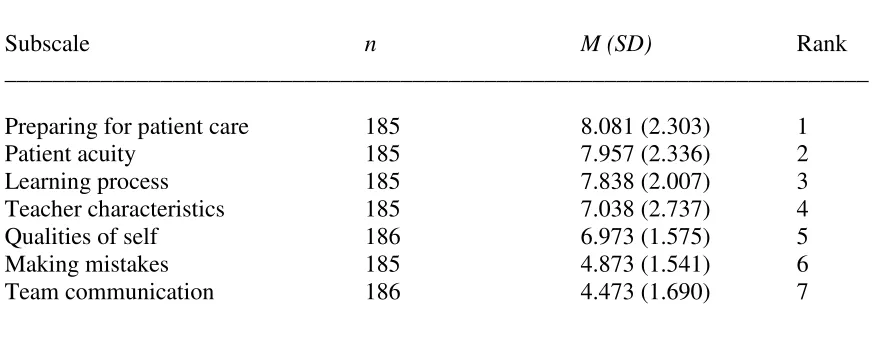
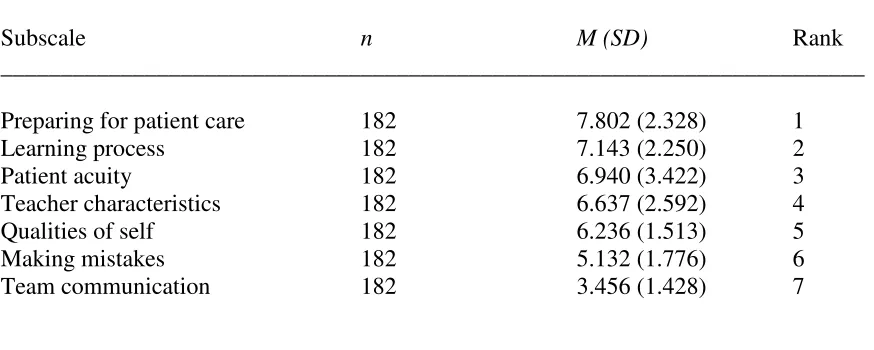
Findings reveal that in both contexts, nursing students perceive preparation for patient care
as the first subscale of factors most likely to contribute to perceptions of anxiety.
Following this, patient acuity in real contexts and learning processes in simulated contexts
iii
factors for both contexts were the same: feeling unsure about my ability; making a mistake
in patient care; and being watched by others as I provide care. Making a mistake while
caring for patients was the factor contributing most to anxiety in real clinical contexts,
whereas being watched by others contributed most to anxiety in simulated contexts.
In terms of themes describing teaching and learning strategies to enhance professional
practice self-efficacy in situations of anxiety, there were both similar and unique
differences between the two learning contexts. The teaching strategy identified by students
as contributing to their self-efficacy in both contexts was the teachers’ interaction with the
student, specifically positive encouragement, constructive feedback and challenges critical
thinking. Distinct differences in teaching strategies for both contexts were related to
specific elements of the learning process within each context. Learner strategies on the
other-hand revealed similar themes in both learning contexts, although being self-directed
and looking for new learning opportunities seemed to be more prevalent in real clinical
contexts. The findings in this study have implications for nursing educators by contributing
to a better understanding of affective learner engagement in clinical education and ensuring
safe patient care during the learning process.
Keywords: nursing education, professional practice, clinical learning, anxiety, affective
learner engagement, self-efficacy, self-efficacy for professional nursing practice, teaching
iv
ACKNOWLEDGEMENTS
It has been a wonderful journey for me. I would like to thank the following faculty
members for their patience, knowledge and skillful guidance throughout the research
process and in the preparation of this document: Dr Alan Edmunds, Dr Vicki Schwean, and
Dr Pam Bishop (Supervisors) and Dr Yolanda Babenko-Mould and Dr. Elizabeth Nowicki
(Committee members). I value the expertise you have shared with me and the quality of
my learning experience in the Faculty of Education.
A special thank you to my fellow colleagues in the PhD program and our times together,
either socially or during research meetings. We have come a long way since the first day of
this program and have been a positive support to each other along the way.
Finally, I would like to especially thank my family. You have each in your own special
way provided me the strength and perseverance that I have needed to complete this journey.
Mom and Dad, thank you for your consistent support and presence along each step of the
way. Maurice, your love and encouragement have helped me to the very end. Alyssa and
v
TABLE OF CONTENTS
Abstract ………...ii
Acknowledgements……… ………iv
Table of Contents………v
List of Tables………....viii
List of Figures………....ix
List of Appendices………..x
Chapter 1……….1
1 Introduction………..1
1.1 Background………. .2
1.2 Thesis rationale………...3
1.3 Research questions.………... .6
Chapter 2……….7
2 Literature Review………...7
2.1 Clinical learning in nursing education………..7
2.2 Learner anxiety in clinical learning………..8
2.3 Self-efficacy………...13
2.4 Self-efficacy for professional nursing practice…..……….16
2.5 Learner engagement………...20
2.6 Summary of literature…...………..25
Chapter 3………...27
3 Methodology……….27
3.1 Design………..…...27
vi
3.3 Data collection instruments………32
3.4 Data collection procedure………...37
3.5 Data analysis………...38
Chapter 4………...41
4 Results………..……….41
4.1 Research question one………...41
4.2 Research question two………48
4.3 Research question three..………55
Chapter 5………...59
5 Discussion………..59
5.1 Discussion of Research Question One………...60
5.1a Preparing for Patient Care………....62
5.1b Patient Acuity and Learning Process………65
5.1c Teacher Characteristics……….67
5.1d Qualities of Self………...70
5.1e Making Mistakes………..72
5.1f Team Communication………...74
5.2 Discussion of Research Question Two………...76
5.2a Individual Factor Differences………...77
5.2b Individual Factor Differences between Schools………..…...78
5.3 Discussion of Research Question Three………...79
5.3a Teacher Strategies Common to Both Contexts………...80
i. Positive Encouragement………...80
vii
iii. Challenge Critical Thinking……….89
5.3b Teacher Strategies in Real Contexts……….85
i. Show me First………...86
ii. Receptive to Inquiries………...87
iii. Trust in my Ability………...87
5.3c Teacher Strategies in Simulated Contexts………..………..88
i. Prompt me without Taking Over……….…….88
ii. Provide Preparatory Work………...89
iii. Ensure Safe Learning Environment………...………..90
5.3d Learner Strategies Common in Both Contexts………...91
i. Be Prepared………..91
ii. Learn from Others………...93
iii. Ask Questions>>……….94
iv. Positive Self-talk………..………...95
v. Practice in Lab……….………….…....95
5.3e Learner Strategies in Real Contexts………..…...96
i. Be Self-directed………...96
5.4 Limitations……….………..97
5.5 Implications for nurse educators………...98
5.6 Recommendations for future research………..………...99
5.7 Conclusions...………….………..100
References……….………..…102
Appendices……….………...117
viii
LIST OF TABLES
Table
1 Gender and age distribution of nursing students
2 Cronbach reliability coefficients for STAI
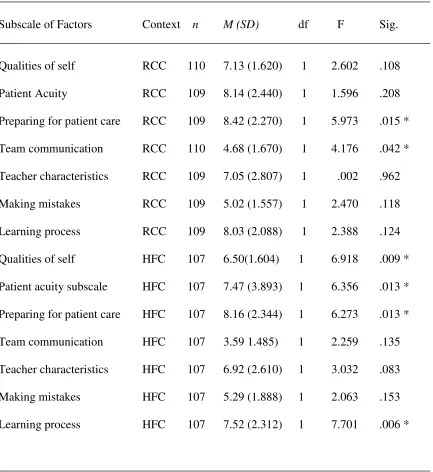
3 Subscale of factors contributing to anxiety in real clinical context
4 Subscale of factors contributing to anxiety in high fidelity clinical context
5 State anxiety scores and subscale of factors contributing to anxiety for real and high fidelity clinical context
6 Trait anxiety scores and subscale of factors contributing to anxiety for real and high fidelity clinical context
7 Paired t-tests in real and high fidelity clinical context
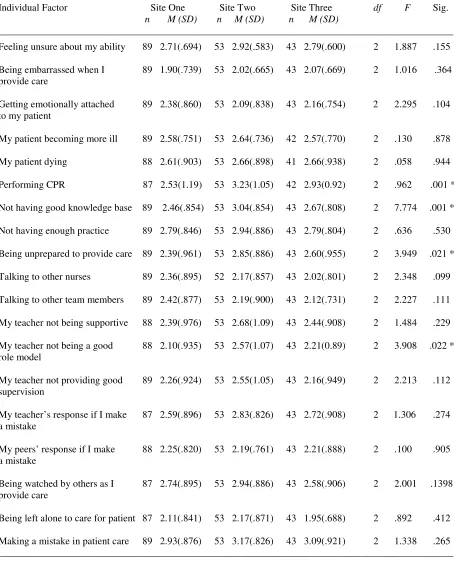
8 Individual factors contributing to anxiety in real clinical context
9 Individual factors contributing to anxiety in high fidelity context
10 Group differences in real clinical context
11 Group differences in high fidelity clinical context
12 Themes: Teacher strategies that enhance self-efficacy in real clinical context
13 Themes: Teacher strategies that enhance self-efficacy in high fidelity clinical context
14 Themes: Learner strategies that enhance self-efficacy in real clinical context
ix
LIST OF FIGURES
Figure
x
LIST OF APPENDICES
Appendix
A Study instruments
B Approval letter
CHAPTER 1
INTRODUCTION
Background
In health profession programs such as nursing, students acquire knowledge, skills and
values to manage patient care in a variety of health care contexts. During formal education
at the baccalaureate level, students integrate a theoretical foundation in nursing and science
with a professional practice exposure in a variety of healthcare settings. The balance of
both theoretical and practice components of learning varies depending on the philosophical
beliefs and values within nursing curricula at each university. Despite this variation, all
baccalaureate nursing programs in Ontario share a common goal in preparing students to
become registered nurses and complete a licensure examination at the end of their formal
education.
The professional practice component of learning, more specifically clinical nursing
education, provides an essential foundation for nursing students as they acquire knowledge
and expertise to manage clinical situations and care for patients (Benner, 1984). The term
clinical learning has been used interchangeably in the literature with professional practice
and refers to learning to enact the nursing role and to care for patients, families or other
clients in a variety of practice settings. It has been noted that learning experiences in
professional programs such as nursing, contribute to the process of knowing, acting, being
and becoming a professional (Benner, Tanner, & Chesla, 2009; Dall’Alba, 2009). For
nursing students, this process involves a variety of experiential learning encounters,
whereby students learn specific skills, competencies, and processes of professional nursing
practice. In clinical nursing education, these learning encounters occur in both real and
Real learning contexts occur when students interact and care for patients and families in
practice settings such as hospitals, clinics, and public health contexts. Simulated learning
contexts on the other hand, occur when students interact with human-like manikins,
standardized patients (individuals trained to act out patient scenarios) or other teaching and
learning tools within the laboratory or classroom setting. Today, the use of high-fidelity
clinical simulations with human-like manikins is receiving greater attention in nursing
education (Cant & Cooper, 2009). These simulated learning experiences are developed
with a high level of realism so students can actually role-play caring for an unwell patient.
In this study, real learning contexts are those occurring in settings with real patients and
families, primarily hospitals, whereas simulated learning contexts are those that involve
high fidelity clinical simulations with human-like manikins.
Thesis Rationale
A successful learning experience for nursing students may contribute to both learning
and achievement (Linnenbrink & Pintrich, 2003) in the healthcare context. As a teacher, I
recognize students’ experience significant worry with feelings of anxiety in preparation for
or during clinical learning. The literature on this topic suggests that this type of anxiety in
learning has been an ongoing concern for nursing students in real clinical settings for years
(Decarlo, Collingridge, Grant, & Ventre, 2008; Kleehammer, Hart, & Keck, 1990;
Lundberg, 2008). More recently, the same concerns have been raised in reference to
simulated learning experiences, more specifically high fidelity clinical simulations using
human-like manikins (Bremner, Aduddell, Bennett, & VanGeest, 2006; Brimble, 2008;
McCaughey & Trauynor, 2010; Shepherd, McCunnis, Brown & Hair, 2010). The evidence
alludes to the fact that students feel overwhelmed in these high fidelity learning contexts
manikin) for the first time. As students engage in clinical learning, they feel unable to
manage multiple care demands while enacting the role of the nurse (Benner, Tanner, &
Chesla, 2009). These perceptions of challenge contribute to students’ feelings of
inadequacy, anxiousness, and inability to safely care for patients (Alinier, Hunt, Gordon, &
Harwood, 2006; Leigh, 2008; Haskvitz & Koop, 2004; Heinrich, Rule, Grady & Ellis,
2002).
To facilitate safe patient care while nursing students are learning, it is important for
teachers to understand students’ experiences of anxiety in clinical learning and identify the
factors that contribute to this negative affective response. Affect is an important aspect of
students’ motivation to engage in learning. If students experience positive affective
responses to learning, they are more likely to be motivationally engaged. According to
Linnenbrink and Pintrich (2003) and Zeidner (1998), learner anxiety, general worry, or
other negative affective responses to learning seriously detract from students’ motivational
engagement. Students who are anxious may experience cognitive difficulties with recall,
memory or misinterpretation of information (Spielberger, 1970; Suliman & Halabi, 2007).
These processes are very important for nursing students’ clinical judgment and ultimately
their provision of safe patient care.
Over the last two decades, there are studies that have explored nursing students’ anxiety
in real clinical learning contexts, including the factors that may contribute to this affective
response (Carlson, Kootze & Van Rooyen, 2003; Cook, 2005; Kim, 2003; Levett-Jones,
Higgins & McMillan, 2009; Melincavage, 2011; Reid-Searl, Moxham, Walker & Happell,
2009; Zupiria et al, 2003). Unfortunately, an exploration of nursing students’ perceptions
of the factors that enhance their self-efficacy in clinical learning, including the role of the
been studies that have examined teachers’ use of empowering teaching behaviors in acute
care clinical settings and the positive impact on students’ self-efficacy for professional
practice (Babenko-Mould, 2010, 2012), although these have not addressed situations of
learner anxiety or simulated contexts . As such, the affective response in high fidelity
learning contexts with human like manikins has not been well-investigated. Considering
simulation technology has become increasingly popular as a teaching and learning strategy,
it is important to understand its impact in clinical education.
In clinical learning, nursing educators play an important role in responding to students’
affective responses such as stress and anxiety. In this teacher-learner relationship,
teachers assess and positively intervene to enhance the learning experience. If students’
affective response to learning is positive, they are more likely to be motivationally
engaged. If students’ affective response to learning is negative, they would be less
motivated to engage in the experience and their learning outcome and achievement will be
less favorable (Linnenbrink & Pintrich, 2003; Zeidner, 1998). According to several
authors (Bandura, Barbaranelli, Caprara, & Pastorelli, 1996; Meece, Wigfield & Eccles,
1990; Pintrich & DeGroot, 1990; Pintrich, Roeser & DeGroot,1994), there is a
relationship between a learners’ self-efficacy and their affective response to learning.
Students who have a high level of self-efficacy will likely experience positive emotions in
clinical learning, while those with lower levels will experience negative emotions such as
anxiety or stress (Harter, 1992). While it appears nursing students’ anxieties in clinical
learning have been a concern for many years, students’ perceptions of the teaching and
learning strategies that may positively impact students’ affective response in clinical
learning and enhance their self-efficacy for professional practice in anxiety-provoking
education consists of clinical learning, it is important to understand these relationships in
both real and high fidelity clinical contexts and identify the strategies that positively
enhance the learning experience.
Research Questions
In summary of the above rationale, the purpose of this study was to examine the
affective component of learner engagement (Linnenbrink & Printrich, 2003), specifically
students’ perceptions of learner anxiety and self-efficacy for professional practice in
clinical nursing education. More specifically, the following questions were investigated:
1) what are the current factors in real and high fidelity clinical contexts that contribute to
nursing students’ feelings of anxiety; 2) are there differences between the factors reported
to cause anxiety in high fidelity clinical contexts and those reported in real clinical contexts;
and 3) what are the teaching and learning strategies that may minimize nursing students’
feelings of anxiety in clinical learning and positively enhance their self-efficacy for
professional nursing practice. The following report will provide an overview of this study
in five chapters, including relevant implications for nurse educators and recommendations
CHAPTER 2
LITERATURE REVIEW
Clinical learning in nursing education
Similar to other professional practice programs, nursing is complex and utilizes expert
knowledge and skill in technology, science and theory coupled with the application of this
in practical clinical situations (Benner, 1984; Benner, Tanner & Chesla 2009; Gaberson &
Oermann, 2010). Nursing curricula varies depending on the curricular philosophy of the
nursing program (Iwasiw, Goldenberg & Andrusyszyn, 2009). As such, the practice of
clinical nursing education, particularly in terms of clinical exposure, teaching methodology
and progression of concepts across the four years of formal baccalaureate education will
also vary. Despite this, the clinical component of nursing education commonly involves
active learning experiences in hospital and community practice settings, caring for an
individual, a family, or a group. Nursing students are guided by clinical faculty or
instructors who support, motivate and facilitate learning about professional competencies in
nursing practice (College of Nurses, 2010; Gaberson & Oermann, 2010).
Clinical learning activities provide real-life experiences and opportunities for the
transfer of learning to common practice situations (Oerman & Gaberson, 2009). Over the
last decade, the use of simulation technology has proliferated (Jeffries, 2007) and nurse
educators are creating clinical scenarios representing situations that occur in real practice.
According to Gaba (2004), simulation is an educational technique in which elements of the
real world are appropriately integrated to achieve specific goals related to learning or
evaluation. This teaching and learning strategy may include the use of a number of
simulation typologies such as standardized patients, computer-based virtual programs,
skills, and human-like manikins (Durham & Aiden, 2008; Galloway, 2009). In the last few
years, the later technology has become increasingly popular as a strategy for enhancing
nursing students’ clinical judgment, problem-solving, team collaboration, and effective
communication skills (Bambini, Washburn & Perkins, 2009; Burns, O’Donnell, & Artman,
2010; Kardon-Edgren, Starkweather, & Ward, 2008; Kiat, Mei, Nagammal, & Jonnie,
2007; Lasater, 2007; Nehring, Lashley, & Ellis, 2001). Each simulation typology has a
specific purpose for learning in nursing education (Decker, Sportsman, Puetz, & Billings,
2008). The greater the level of fidelity, as in human-like manikins, the closer the learning
experience is representative of the real clinical environment. In this study, the focus will be
the experience of learning in real clinical settings such as the hospital, and in simulated
settings such as the clinical lab with human-like manikins.
Learner anxiety in clinical learning
Clinical learning is an important component of formal nursing education. Students
participate in clinical learning activities very early in their education. A review of the
literature in this area reveals both research evidence and anecdotal notations that identify
concerns relating to nursing students’ feelings of anxiety and stress prior to and during
placements in professional practice courses. Much of the literature describes elements of
anxiety within real practice settings, and most recently, there has been mention of student
anxiety in simulated learning contexts with human-like manikins (Bremner, Aduddell,
Bennett, & VanGeest, 2006; Lasater, 2007; McCaughey & Trauynor, 2010). When nursing
students are in their hospital placements, they engage in caring for patients with varying
levels of acuity and their attendant families. In these settings, students work with other
members of the healthcare team and provide care to address the health care needs of the
students’ responsibilities for providing care would also vary depending on prior learning
experiences and their individual learning goals.
Anxiety in the context of learning has been described as a vague, highly unpleasant
feeling of fear and apprehension (Santrock, Woloshyn, Gallagher, Di Petta, & Marini,
2010). According to Spielberger (1970), anxiety is both a psychological and physical
response to a threat to self-concept which is characterized by subjective, consciously
perceived feelings of tension. As a construct, Spielberger (1983) differentiates anxiety as
state or trait. State anxiety refers to an individual’s reaction to a situation at a given time
whereas trait anxiety refers to an individual’s inherent proneness to anxiety. As students
experience feelings of tension in a learning situation, their response to learning and their
sense of believing they can achieve particular learning goals may be impacted. In addition,
they may be more prone to cognitive deficits such as difficulty with memory, recall and
interpretation of information (Suliman & Halabi, 2007). Although feelings of anxiety may
present as a challenge to learning, according to the Yerkes-Dodson Law (Grover & Smith,
1981; Halvor Teigen, 1994; Yerkes & Dodson, 1908), not all anxiety is considered
negative. In fact, a certain amount of cognitive arousal must exist to motivate a learner to
perform. It is in those situations where learning is challenging and tasks are too difficult to
attain that learners experience greater levels of tension (Edmunds & Edmunds, 2010). In
clinical learning, nursing students encounter a variety of clinical situations, some of which
may be unpredictable and highly acute in nature. The students’ degree of state and trait
anxiety will contribute to their response to clinical learning and their ability to engage in the
caring activity.
The presence of learner anxiety in real clinical learning has been described in several
they relate to nursing students’ anxiety. In several of the studies, the practice settings for
learning are within acute care environments such as hospitals. In one study by
Chikaumaura, Iida, Ishizakj, Abi, and Kobayashi, Kataoka (2008), nursing students’ anxiety
scores were significantly increased when the students were completing their clinical
practicum. In addition, biological responses to stress were more evident, including a
decreased level of estrogen in the body during the practicum. Jimenez, Navia-Osorio, and
Diaz (2010) investigated the impact of stress on health for novice and experienced nursing
students. The outcomes described clinical stressors as more intense than any other
academic or external stressor. In studies by Sharif and Armitage (2004) and Mun (2010),
nursing students’ anxiety was found to be a predominant theme in the narratives written by
the students’ during their clinical practicum. Finally, in a study by Melo, Williams and
Rose (2010), nursing students in both problem-based and traditional lecture-based curricula
experienced anxiety in clinical learning. The anxiety scores did not differ significantly
between the two curricular approaches to teaching.
In other studies, the type of clinical supervision and clinical context also contributed to
nursing students’ perceptions of anxiety. Inadequate supervision, lack of supportive
relationships, and teacher inaccessibility were described by nursing students as
circumstances where anxiety and stress were increased in clinical learning (Carlson, Kotze,
& Van Rooyen, 2003; Cook, 2005; Levett-Jones, Lathlean, Higgins and McMillan, 2009;
Reid-Sear, Moxham, Walker, and Happell, 2009). Furthermore, the specific type of clinical
situation where student anxiety seemed to be more prevalent included mental health or
acute care situations where students felt unprepared (Happell & Hayman-White, 2009),
sexual health (Kong, Wu, & Loke, 2009), situations of patient death (Chen, Del Ben,
Morin, 2001). In these studies, real clinical learning experiences perceived as socially
uncomfortable or where nursing students felt unprepared, seemed to cause the greatest
anxiety and stress.
A small number of qualitative studies have also provided some understanding of what
may contribute to feelings of anxiety in real clinical contexts. A phenomenological study
by Melincavage (2011) revealed the following themes relating to student anxiety:
experiencing inexperience, being demeaned, being exposed, unrealistic expectations, being
abandoned, sensing difference and being uncertain about ability. Kim (2003) found the
following situations contributed to student anxiety: arriving late, being observed by
instructors, responding to initial experiences, fear of making mistakes and talking to
physicians. Finally, Zupiria et al (2003) identified the following contributors to feelings of
anxiety: lack of competence, contact with suffering patients, relationships with tutors,
classmates and workmates, uncertainty in the clinical setting, lack of control in
relationships with patients, and feeling overworked. While these studies may contribute to
a better understanding of some of the factors that cause anxiety for nursing students in real
clinical settings, there is minimal evidence identifying teaching and learning strategies to
manage these concerns and positively enhance nursing students’ affective engagement in
learning and their self-efficacy for professional practice. For this reason, these descriptions
need to be better delineated.
The affective response of anxiety in clinical nursing education has for the most been
discussed in the context of real learning experiences with patients and families. In the last
five years however, there has been an exponential increase in the use of human-like
manikins to re-create high fidelity clinical learning experiences. Although we know that
a body of literature that has raised concerns that learning in simulated settings with the use
of high fidelity manikins may also provoke feelings of anxiety (Brimble, 2008; Cato, 2013;
McCaughey & Traynor, 2010; Shepherd, McCunnis, Brown, & Hair, 2010). When nursing
students engage in high fidelity clinical simulations and care for these manikins, it has been
noted that unpleasant feelings of anxiety and stress may occur. It is suggested, there is a
strong emphasis on performing when the teacher and/or peers are assessing or observing the
interaction with the patient. The pressure to ‘perform’ contributes to students’ feeling
inadequate and unable to successfully provide patient care (Alinier, Hunt, Gordon, &
Harwood, 2006; Leigh, 2008; Haskvitz & Koop, 2004; Heinrich, Rule, Grady, & Ellis,
2002). In addition, students also feel their performance is being critiqued and compared to
other students. In fact, being observed or video recorded has been identified as contributing
to student anxiety in simulated contexts (Cordeau, 2010; Ganley &Linnard-Palmer, 2012;
Horsley, 2012). Interestingly, two studies reported videotaping was actually a positive
experience and provided the opportunity to identify areas needing further development
(Gordon & Buckly, 2009; Megel, Bailey, Schnell, Whiteaker & Vogel, 2013).
A recent study by Cato (2013) also confirmed the presence of nursing students’ anxiety
in high fidelity contexts. This study was one of the first that identified anxiety in simulated
contexts was related to the patient’s clinical situation, equipment difficulties in the
simulation room, being videotaped, and being observed by fellow peers. Cato also
identified preliminary strategies to manage this anxiety, although these were not
specifically identified by students in the context of enhancing professional practice
self-efficacy.
At present, there little substantive evidence exploring learner anxiety and student
clear whether the factors that cause anxiety in real clinical experiences are the same or
different than those that cause anxiety in simulated clinical experiences. This knowledge is
important for nursing educators when developing and teaching curricula with both real and
simulated clinical learning activities. Students need to feel comfortable and engaged in
both these contexts, particularly since the later is becoming increasing popular. If nursing
teachers understand the factors that contribute to learner anxiety in both contexts, teaching
and learning strategies may be better structured and utilized to positively enhance students’
learning experience.
Self-efficacy
Self-efficacy has been described by Bandura (1977, 1986) as an individual’s belief in
their ability to perform well on a specific task or behavior. It is a judgment of one’s
capability to carry out a course of action required to deal with a situation. Self-efficacy
affects how a person thinks, feels and acts. According to Bandura, an individual’s
perception of self-efficacy is made up of two components: efficacy expectations and
outcome expectations. An efficacy expectation is the belief that one can successfully
perform the behavior required to achieve an outcome, whereas an outcome expectation is
a person’s estimate that the behavior will lead to a specific outcome. For an individual to
successfully perform a task, both components of self-efficacy must be present.
Every individual approaches a new situation or task differently, particularly in learning
contexts. Some may display strength in their personal self-efficacy and approach specific
tasks with confidence. Others fear and avoid threatening situations they believe will be
difficult to manage. The uniqueness of each person is determined by the strength of four
sources of efficacy expectations and how the individual processes them (Bandura, 1977,
1. Mastery experiences, often called performance accomplishments in the early literature,
represent those behaviors that an individual is able to perform. Successful experiences
will raise efficacy expectations, while repeated failures will lower them. In addition, the
mastery of simple behaviors will encourage a person to proceed with more complex ones.
In nursing, students would progress their clinical learning from simple to more complex
psychomotor skills. When a student is successful with a particular skill level, they may
advance to the next skill level. For example, early in clinical learning, nursing students
learn how to safely administer medications using different routes. Students would first
begin with oral medications and then when successful, proceed to subcutaneous and
intramuscular injections and finally, intravenous administration. A student would not
progress if mastery of the previous level had not been achieved in this experience. Each
level of success encourages progression to the next level of medication administration.
2. Vicarious experiences occur by observing a credible role model perform the task or
behavior. Seeing another person succeed in a situation can create expectations in the
observer that they too will eventually succeed. This type of learning minimizes the need
for trial and error, especially in situations where the consequences are more costly or
hazardous. For nursing students, vicarious learning occurs at several points during their
baccalaureate education. For example, in the final year of nursing education, students are
assigned to one role model known as the clinical nursing preceptor. This particular role
assists students to enact all components of the nursing role and begin the transition to a
practicing nurse.
3. Verbal or social persuasion is when other credible people provide comments or
suggestions that encourage an individual to feel capable of performing a task or behavior.
self-efficacy expectations. For nursing students, an example of this may occur when one peer
provides feedback to another peer. Peer assessments are an integral component of formal
nursing education and a mandatory requirement of our regulating body, the College of
Nurses of Ontario. When a student is persuaded verbally by a peer that s/he is doing well
with a certain task, the student’s self-efficacy may be strengthened.
4. Physiological and emotional states refer to the physical cues or expressions of anxiety
that may influence an individual’s confidence in performing a task. Feelings of
nervousness and vulnerability to stress may debilitate performance and discourage further
participation in similar behaviors. Mood and affective states, particularly if they are
positive, will enhance self-efficacy. This fourth source of efficacy expectation is an
important area of investigation for this study because it is not well-understood.
According to Bandura’s (1977) theoretical principles, learner self-efficacy is formed by
the efficacy expectations described above and their outcome expectations. As a
motivational construct, self-efficacy enhances students’ behavioral, cognitive and affective
engagement in learning (Linnenbrink & Pintrich, 2003) and contributes to their overall
learning and achievement. As teachers engage with learners, it is important to understand
these relationships and the factors that positively impact students’ self-efficacy. In the
educational literature, a number of teaching and learning factors have been found to
enhance student self-efficacy: encourage students to set short-term goals and assess
progress, provide opportunities for students to evaluate learning progress, provide student
feedback and link successes to effort and ability, have students work on progress goals that
involve skill acquisition, have students self-monitor and record their progress, and finally,
link rewards to their level of performance (Schunk, 1995; Schunk & Ertmer, 2000; Schunk
The relationship between the teacher and the student in a learning encounter is
important. Thoonen et al, (2011) discuss the relationship between teacher self-efficacy and
student self-efficacy. Teachers with high self-efficacy have a more positive impact on
student learning and achievement. Santrock, Wolshyn, Gallagher, DiPetta and Marini
(2010) explore the role of the teacher in motivating young students. They provide
examples of teaching strategies that can enhance students’ self-efficacy in learning:
encourage discussion about goals with parents, role-model, provide performance contingent
rewards, teach explicit strategies for attaining goals, provide positive support and reflection,
provide appropriate mentors and models, model positive coping strategies, and let students
tell their success stories and explain how they mastered certain tasks. Although this study
explores the role of the teacher with younger students, it does highlight the relevance of the
teacher-student encounter and importance of the teacher in motivating learners and
positively enhancing their self-efficacy. In the proposed study, these same relationships
will be explored, although the learners will be nursing students in clinical learning.
Self-efficacy for Professional Nursing Practice
Professional nursing practice is a concept that receives considerable attention in the
nursing literature. Clear articulation of the behaviors and activities associated with nursing
practice is difficult to synthesize, although there have been several attempts to do this over
the years. One classic piece of literature in nursing that cannot go unmentioned in this
discussion of professional practice is the work of Patricia Benner (1984). Benner describes
the domains and competencies that characterize professional nursing practice from novice
to expert: the helping role, the teaching-coaching function, the diagnostic and monitoring
function, effective management of rapidly changing situations, administering and
health care practices, and organizational and work-role competencies. Some of these
characteristics are still very appropriate today, while others, require further refining to
capture today’s health care challenges, societal influences and growth in the nursing
profession.
Professional nursing practice is also defined by nursing regulatory bodies. The College
of Nurses of Ontario (2010) for example describes the following categories for the
professional role of the registered nurse: professional accountability, knowledge-based
practice, knowledge application, ethical practice, service to the public, and self-regulation.
Within each of these categories, a number of specific competencies are described. As nurse
educators develop curricula for baccalaureate nursing programs, these competencies are
carefully considered to ensure that the content addressed in formal education will assist
students to master the national competencies for the nursing profession. Although Ontario
has well-established competencies describing the role of the professional nurse, schools of
nursing differ in their curricular philosophies of nursing education. As such, the process for
achieving knowledge, skill and values related to professional practice will vary from one
program to the next.
Today, in nursing education, students learn about professional practice in both
theoretical and practice courses. Generally, the classroom context provides the theoretical
foundation, while the enactment of professional practice is usually completed within
clinical learning experiences. Clinical learning occurs in both real and simulated learning
environments and includes a variety of activities to practice professional nursing
competencies. In any practice settings, these competencies may include assessment,
psychomotor skill(s), interpretation of findings, collaboration with a team, and responding
judgment (Lasater, 2007; Tanner, 2006). As students engage in the learning process, they
acquire knowledge and expertise to care for individuals, families, groups, or communities.
Although professional nursing practice may consist of many skills and competencies, in this
study, I am interested in understanding the teaching and learning strategies that enhance
students’ perceptions of self-efficacy for professional nursing practice.
In reviewing the literature, there are no specific definitions or synthesized descriptions
of the construct of self-efficacy for professional nursing practice. However, several studies
were found to have examined specific elements of self-efficacy for professional practice.
Some of these elements include, student caring self-efficacy (Livsey, 2009; Madorin &
Iwasiw, 1999), student self-efficacy in providing culturally competent care (Rudnick,
2005), patient teaching efficacy (Goldenberg, Andrusyszyn, & Iwasiw, 2005),
self-efficacy for practice (Babenko Mould, 2004; Babenko-Mould, 2004, 2010, 2012; Sinclair &
Ferguson, 2009), self-efficacy for health promotion counseling (Laschinger, McWilliam, &
Weston, 1999), self-efficacy in responding to emergent clinical situations in high fidelity
simulation (Leigh, 2008), senior nursing students’ self-efficacy during preceptorship
(Goldenberg, Iwasiw, & MacMaster, 1997), and finally, self-efficacy for community-based
family nursing practice (Ford-Gilboe, Laschinger, Laforet-Fliesser, Ward-Griffin, & Foran,
1997). In the simulation literature, a number of studies have investigated nursing students’
self-efficacy and confidence in some aspect of clinical nursing practice. These studies have
shown an increase in self-efficacy in nursing students’ after participating in high-fidelity
simulation (Bantz, Dancer, Hodson-Carlton & Van Hove, 2007; Beyea, von Reyn &
Slattery, 2007; Bremner, Aduddell, Bennett, & VanGeest, 2006; Eaves & Flagg, 2001;
Lasater, 2007; Leigh, 2008; McCausland, Curran, & Cataldi, 2004; Reilly & Spratt, 2007;
Schoening, Sittner, & Todd, 2006).
Although studies have examined elements of self-efficacy for professional nursing
practice in acute care contexts and some have even attempted to understand self-efficacy as
an outcome of learning in a simulated context, we do not have one conceptual definition of
the construct. Furthermore, the concept has not been well-investigated in the context of
learner anxiety. In this study, professional practice will be described as enacting nursing
practice competencies as a student nurse. To achieve some level of understanding of these
competencies, the National Competencies for entry-level registered nurses in Ontario
(CNO, 2010) will be used as a reference point for defining professional practice. Although
baccalaureate nursing programs may differ in curricular philosophies and use of learning
activities, all programs recognize the same goal of preparing students to achieve these
national competencies. As such, self-efficacy for professional nursing practice will be
described as a belief in one’s ability to successfully enact the nursing competencies within a
student role. In this study, the researcher is interested in understanding the specific factors
that affect nursing students’ perceptions of professional practice self-efficacy.
Nursing students’ self-efficacy or belief in their ability to perform (Bandura, 1977)
activities, behaviors, and processes that are relevant to professional nursing practice will
impact how successful they care for a patient. Self-efficacy may affect how students think,
feel and act. As such, if a nursing student is self-efficacious, s/he will be more likely to
believe s/he can successfully perform the role. Nursing students learn about professional
practice in both real and simulated learning environments. These environments include a
variety of health care professionals, families, and patient situations of varying complexities.
clinical practice. If this self-assessment, as well as students’ perceived self-efficacy are
low, their affective response to learning may be negative. Low self-efficacy appears to be
associated with elements of depression, anxiety and helplessness (Bandura, 2000, 2009;
Santrock, Woloshyn, Gallagher, DiPetta, & Marini, 2010). Anxiety has been identified as
an emotional response to clinical learning in nursing education. In this study, this affective
response will be examined in greater detail, specifically identifying factors that contribute
to this response in both real and simulated learning environments. Furthermore, teaching
and leaning strategies that may minimize student anxiety and positively enhance students’
self-efficacy for professional practice will also be explored.
Learner Engagement
For almost two decades, learner engagement has been a construct of interest in
understanding student involvement in learning (Appleton, Christenson & Furlong, 2008).
The term has been widely explored in the psychology and educational psychology
literature. Unfortunately, in the nursing literature, learner engagement has not been
examined as a theoretical lens. Learner engagement has been referred to as a student’s
active involvement in a learning task or activity (Reeve, Jang, Carrell, Jeon & Barch, 2004)
or “energy in action”, a connection between an individual and an activity (Russell, Ainley
& Frydenberg, 2005). A review of the literature has revealed variation in conceptual clarity
and definitions of learner engagement. Despite the lack of consensus, one similarity is the
idea that motivational theory is foundational to understanding how this construct unfolds
and that there are factors in the learning encounter that may either engage or disengage the
learner.
To understand learner engagement as a construct in clinical nursing education,
studies in the literature. Frederick, Blumenfeld and Paris (2004) discuss learner
engagement as a metaconstruct which brings together research related to motivation,
belonging, and school climate and examining how these constructs interact with one
another. Juvonen (2006) in the Handbook of Educational Psychology (Alexander &
Winnie, 2006) discusses the importance of belonging and student connectedness within
their learning environment. As part of this, the student’s relationships with friends, family
and teachers are pivotal to creating a sense of belonging necessary for learner engagement.
Interactions with teachers, particularly if they are supportive yet academically stimulating
with high expectations and ‘deep’ learning, positively impact learner engagement (Baker,
Clark, Maier, & Viger, 2008; Bryson & Hand, 2007; Laird & Kuh, 2005; Reason,
Terenzini & Domingo, 2006). A recently published paper by Zepke and Leach (2010)
further supports this understanding. The importance of teacher and peer relationships as
predictors of student engagement and learning outcomes are described in their synthesis.
Although there are many conceptualizations of learner engagement from a descriptive
perspective, specific dimensions of learner engagement including behavioral, cognitive, and
emotional or affective engagement have been further delineated in research (Appleton,
Christenson, & Furlong, 2008; Furrer, Skinner, Marchand, & Kindermann, 2006; Harris,
2011). The behavioral dimension has been a focus of educational research, particularly in
terms of investigating factors related to both academic and behavioral engagement
(Appleton, Christenson & Furlong, 2008). Unfortunately, there has been less research on
the cognitive and affective components of learner engagement. These two aspects have
been recognized as important constructs for student success and achievement, although
more evidence is needed.
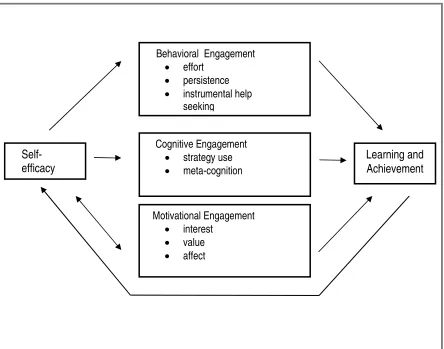
framework that not only examines specific dimensions of learner engagement, including
affect, but also proposes relationships among the constructs of student self-efficacy,
learning and achievement. The dimensions of learner engagement in this model include
behavioral, cognitive, and motivational engagement. The later includes elements of learner
interest, value and affect. Affect, specifically the emotion of learner anxiety, is the
response I was interested in exploring in this study. Figure 1 on the following page
provides a visual of the constructs of self-efficacy, learner engagement and learning
(Linnenbrink & Pintrich, 2003).
In the first dimension of engagement (behavioral), it has been demonstrated that
students who are more self-efficacious are more likely to exert effort when in difficulty or
to persist in a task knowing s/he has the requisite skills (Linnenbrink & Pintrich, 2003;
Pintrich & Schunk, 1996). Students who have weaker perceptions of self-efficacy would
more likely give up on a task even if they have the skills to do it. This can be seen in
students who know the material they are learning and have the skills to do it but lack
the confidence that they can actually use their knowledge or skills. In addition, there are
students who feel they have no control over their work performance and there is no
relationship between what they do and learning outcomes. As such, a weaker self-efficacy
would also make them less likely to seek help from others including the teacher (Ryan &
Pintrich, 1997). According to Linnenbrink and Pintrich’s framework, engaging in
Figure 1 Conceptual framework for self-efficacy, learner engagement and learning achievement (Linnenbrink & Pintrich, 2003)
The second dimension of cognitive engagement includes cognitive strategy use and
components of meta-cognitive processes. Students who are self-efficacious are more likely
to report using various cognitive strategies, including metacognitive learning strategies.
These students use deeper processing strategies such as elaboration, organization and
reflection and are more likely to plan, monitor and regulate themselves when they did their
homework. This same relational outcome was also supported in earlier studies of different
cohorts, including high school and college students (Pintrich, 1999; Wolters and Pintrich,
1998).
Self-efficacy
Behavioral Engagement • effort
• persistence • instrumental help
seeking
Cognitive Engagement • strategy use • meta-cognition
Learning and Achievement
Motivational Engagement • interest
Finally, the motivational dimension of learner engagement refers to interest, value, and
affect. Personal interest refers to the student’s intrinsic interest in the content and tasks.
Utility value refers to how useful the student believes the content or task is to them. Affect
refers to the student’s emotional experience with the learning. According to Linnenbrink
and Pintrich (2003), affect has not been examined as well as the other constructs, but it does
play an important role in how students engage in learning. They assert that positive
emotions such as pride and happiness in one’s work contribute to students’ motivational
engagement, while negative emotions such as frustration, anger, and anxiety detract from
students’ motivational engagement and negatively impact learning and achievement. In
addition, within the framework there is a reciprocal relationship between motivational
engagement (affect) and self-efficacy. In other words, a learner’s affective engagement in a
learning context will impact their overall self-efficacy.
In this theoretical framework of learner engagement (Linnenbrink & Pintrich, 2003),
initial explanations of the relationship between affective responses such as anxiety, learner
self-efficacy, and learning are delineated. Further, the model utilizes directional arrows to
display where one construct may relate to another. In addition, there is a feedback loop
from students’ learning and achievement to self-efficacy. When students successfully
engage in learning (behavioral, cognitive or motivational), they are able to successfully
learn and achieve positive outcomes. These outcomes then feed back to the learner’s
efficacy, thereby contributing positively to enhance the original state of learner
self-efficacy. At this point, it is important to note this theoretical conceptualization has evolved
as a result of research with school-age learners and has not yet been well-explored in higher
education or with adult learners. In addition, the factors that impact students’ affective
influence students’ affect and enhance their self-efficacy in situations of anxiety have not
yet been addressed.
Summary of Literature
The purpose of this study is to examine the affective component of learner engagement
in clinical learning, specifically the emotion of learner anxiety in real and simulated clinical
learning contexts. In understanding this emotional response to learning, students’
perceptions of the factors in clinical learning that contribute to this anxiety and the teaching
and learning strategies that impact this emotion and enhance students’ self-efficacy for
professional nursing practice will be explored. As described by Linnenbrink and Pintrich
(2003), anxiety is a negative emotional response to learning. More specifically, this
emotion may have a direct impact on nursing students’ clinical learning, achievement and
self-efficacy. The students’ degree of trait anxiety will influence their reaction to a learning
situation and their overall ability to be successful in the encounter. In real learning
environments, students are caring for patients and their attendant families and so it becomes
even more important that learning outcomes are successful and patient safety is maintained.
In reviewing the literature in nursing education, it is unclear what factors contribute to
nursing students’ perceptions of learner anxiety in simulated learning contexts, although in
real contexts, there has been some understanding of this. In addition, we do not know
whether there are differences in factors that contribute to anxiety in real and simulated
contexts which is important for teachers to understand while planning instruction. Since the
learning goals in each context are similarly connected to advancing clinical reasoning and
providing safe, quality patient care, there may not be distinct differences between the two.
In both contexts, students learn about all elements of patient care and are exposed to
logistical and organizational differences between the contexts, with simulated settings
relying heavily on technology and on the utilization of props to create a sense of clinical
realism. In this way, the factors that negatively impact students’ affective responses and
contribute to anxiety in simulated learning activities may be somewhat different.
Further to understanding the factors that contribute to nursing students’ anxiety, it is
also important to understand the sources that may enhance professional practice
self-efficacy in situations of anxiety. According to Bandura (1977, 1986), there are four
sources that contribute to self-efficacy. In this study, it is hypothesized that the teaching
and learning strategies identified by nursing students may be somewhat explained with the
four sources of efficacy expectations (mastery experiences; vicarious experiences; verbal or
social persuasion; physiological and emotional states). At present, there is limited
knowledge to adequately understand these relationships. If we can better understand the
interactive effects of these sources, nursing educators may be better prepared to provide
effective instruction and modify the factors that negatively impact learners’ affective
CHAPTER 3
METHODOLOGY
The purpose of this study was to examine the affective component of learner
engagement, (Linnenbrink & Pintrich, 2003) more specifically, students’ perceptions of
learner anxiety and professional practice self-efficacy in clinical nursing education. In
understanding this inquiry, students’ perceptions of the factors in clinical nursing education
that contribute to anxiety, and the teaching and learning strategies that positively enhance
professional practice self-efficacy in situations of anxiety were explored. This chapter
provides an overview of the research design, sample, data collection and data analysis
procedures.
Design
To fully examine the research questions in this study, a mixed methods design was used.
Mixed methods is a research design where there may be a mixing of philosophical
assumptions and methodological approaches within the research process (Creswell &
Piano-Clark, 2007). The literature pertaining to philosophical assumptions has been
unclear with noted debate regarding the choice of multiple or singular paradigms to guide
mixed methods research (Creswell & Piano-Clark, 2007; Mackenzie & Knipe, 2006; Smith,
2006; Sale, Lohfeld, & Brazil, 2002; Tashakkori, & Teddlie, 2003). According Hall
(2013), a researcher may adopt a single paradigm approach and integrate both quantitative
and qualitative methods. In doing so, the researcher must articulate the ontological and
epistemological beliefs guiding the inquiry.
In this study, the philosophical assumptions guiding the research inquiry is more closely
aligned to the paradigm of constructivism. Within this paradigm, the research ontology is
in the study (Creswell & Clark, 2007). The following is a summary of the philosophical
assumptions for this study: 1) the nature of reality (ontology) is not singular as in
post-positivism and there is an interest in the views of multiple participants, 2) the relationship
between the researcher and the participant (epistemology) is not distant as in
post-positivism, but one of closeness (i.e., the researcher visits the participants at their site to
interact and collect data), 3) the data collection process evolves from the participants rather
than solely deductively as in post-positivism, and 4) the participants share their own views
and feelings and from this, potential patterns and themes emerge (Creswell & Clark, 2007;
Pickard & Dixon, 2004).
The type of mixed methods design in this study was a sequential explanatory research
design (Creswell, Piano Clark, Gutmann, & Hanson, 2003; Creswell & Clark, 2007;
Tashakkori, & Teddlie, 2003). This design is characterized by the collection and analysis
of quantitative data followed by the collection and analysis of qualitative data. Typically,
in this type of design, the qualitative results assist in further explaining and interpreting the
quantitative findings. This is an important methodological consideration as one method
alone may not have appropriately addressed the research questions. Since the research
inquiry was complex, the process for data collection was completed in two phases and
included both quantitative and qualitative methods. The integration of both methodologies
facilitated a richer depth of exploration and allowed the researcher to adequately investigate
the research questions.
Briefly, in the first phase of this study, three self-report instruments were used to
determine learner anxiety: factors in clinical nursing education that contribute to learner
anxiety; differences in factors identified in real and simulated clinical contexts, and finally,
nursing practice. Each of these self-report instruments, including development will be
described in greater detail in the section noted as data collection instruments.
In the second phase of this study, three focus groups were conducted with a convenience
sample of participants who volunteered to discuss in greater depth the variables in phase
one. Focus group interviews were chosen by the researcher for a couple of reasons: to
bring together students who were genuinely interested in sharing more about their
experiences with anxiety in clinical learning, to gather a group of individuals who could
share their diverse opinions and provide explicit examples, and finally to achieve some
level of consensus with the facilitator’s guidance in order to draw conclusions about the
variables. The format of the focus groups was a combined qualitative interview approach as
described by Patton (2002), which included both an interview guide and a conversational
interview style. The interview guide provided some structure to ensure specific topics
explored in phase one were discussed in greater detail. The content of the interview guide
is addressed in greater detail in the section noted as data collection instruments. The use of
a conversational interview offered the flexibility to pursue information shared by the
participants and ask additional questions that flowed from the immediate context or phase
one data (Patton, 2002).
Sample
In this study, a convenience sample of nursing students in their final year of
baccalaureate education at an Ontario University were invited to participate. By the fourth
and final year of a baccalaureate nursing program, students would have had exposure to
both real and simulated learning activities and as such, would be better able to reflect on
their overall clinical learning experience. The students considered for recruitment were
nursing program approved by the Canadian Association of Schools of Nursing
Accreditation Program (College of Nurses of Ontario, 2011). These schools are fully
accredited for their preparation of nursing students for professional licensure in Ontario as
Registered Nurses. Of the 14 universities considered in the sampling decision, the
following inclusion criteria were applied for selection of appropriate schools of nursing:
1) students have participated in both real and simulated learning activities in each level of
their baccalaureate program in order to provide adequate exposure to assess affective
responses to learning; 2) students have had more than two simulated learning experiences
per year in order to have some sense of impact on their affective response to learning and
their self-efficacy for professional nursing practice; and finally, 3) the school of nursing has
utilized simulation-based learning for longer than one year to ensure appropriate faculty use
and delivery of this teaching methodology. An important exclusion criteria in selecting the
possible universities for recruitment included the university where the researcher was
teaching. At the time of the study, the researcher was the Simulation Faculty Lead for the
integration of high-fidelity simulation in the undergraduate nursing curriculum, and was
actively involved in teaching both theoretical and clinical courses in level four of the
baccalaureate program.
Once the inclusion and exclusion criteria were applied, the researcher rank ordered the
schools in terms of the number of hours in simulation exposure for clinical learning. From
this list, the three schools that had the greatest number of hours in simulation exposure were
asked to participate. Since no studies were found to have investigated the questions in this
study, an appropriate sample size for this study was calculated using Cohen’s (1988) effect
size convention. For an alpha significance level of 0.05 and a power level of 0.80 (Cohen,
needed to detect a significant correlation. Using a power table for the Pearson Correlation
for a one tailed t-test, a moderate effect size would be detected with a sample of 113
students.
All nursing students (n=260) in year four of the three schools of nursing were invited to
participate. Of the 260 survey packages distributed in phase one of the study, 186 were
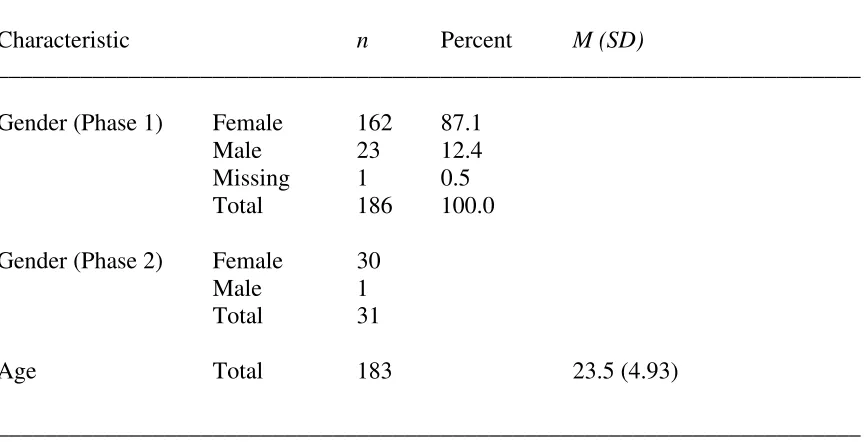
returned for a response rate of 72%. The nursing students in the study were mostly female
(87%) with a mean age of 23.5 years of age (SD=4.9). In phase two of the study, 31
students provided consent to participate in a focus group interview. All but one student was
female. The following table illustrates the distribution according to gender and age of the
nursing students.
Table 1
Gender and Age Distribution of the Nursing Students
________________________________________________________________________
Characteristic n Percent M (SD)
________________________________________________________________________
Gender (Phase 1) Female 162 87.1 Male 23 12.4 Missing 1 0.5 Total 186 100.0
Gender (Phase 2) Female 30 Male 1 Total 31
Age Total 183 23.5 (4.93)
Data Collection Instruments
In phase one of the study, nursing students were invited to complete three self-report
instruments (Appendix A) and respond to two demographic questions. The State-Trait
Anxiety Inventory (STAI) (Spielberger, 1983) was used to measure students’ levels of state
and trait anxiety. The Factors Contributing to Anxiety in Clinical Learning was
developed by the researcher to measure students’ rankings of factors contributing to
perceptions of anxiety in clinical learning. The Teaching and Learning Strategies that
Enhance Professional Practice Self-Efficacy in Clinical Learning (researcher developed),
also developed by the researcher, was used to gather qualitative comments from the nursing
students who described teaching and learning strategies that they perceived enhanced their
self-efficacy for professional practice. Finally, two demographic factors, age and gender,
were attained to provide a more detailed description of the sample group of participants.
In phase two of the study, nursing students were invited to participate in a focus group.
The consent to participate was included at the end of the third researcher-developed
instrument in phase one, Teaching and Learning Strategies that Enhance Professional
Practice Self-Efficacy in Clinical Learning (researcher developed). The focus groups at
each of the three universities were facilitated by the researcher using a researcher developed
interview guide Perceptions of Anxiety and Self-efficacy in Clinical Learning (researcher
developed).
State-Trait Anxiety Inventory
The State Trait Anxiety Inventory (STAI) (Spielberger, 1983) is a well-validated tool for
measuring state and trait anxiety and has been utilized in both research, as well as clinical
practice with patients. State anxiety has been described as a transitional response to a