MTWatch: A Tool for the Analysis of Noisy Parallel Data
Sandipan Dandapat
1, Declan Groves
21Department of Computer Science and Engineering
IIT Guwahati, Assam, India
2Centre for Next Generation Localisation, School of Computing
Dublin City University, Dublin, Ireland
[email protected], [email protected]
Abstract
State-of-the-art statistical machine translation (SMT) technique requires a good quality parallel data to build a translation model. The availability of large parallel corpora has rapidly increased over the past decade. However, often these newly developed parallel data contains contain significant noise. In this paper, we describe our approach for classifying good quality parallel sentence pairs from noisy parallel data. We use 10 different features within a Support Vector Machine (SVM)-based model for our classification task. We report a reasonably good classification accuracy and its positive effect on overall MT accuracy.
Keywords:Statistical Machine Translation, Noisy Parallel Data, Quality Estimation
1.
Introduction
The success of a state-of-the-art SMT system is highly de-pendent on the amount of suitable parallel corpora avail-able for training the engine. Large amounts of good quality parallel corpora (OPUS (Tiedemann and Nygaard., 2004), Europarl (Koehn., 2005), etc.) are available for English and other European Languages. However, the amounts of available domaspecific parallel data is still in its in-fancy for many dominant language pairs and for several domains (Axelrod et al., 2011). In addition, there exist a large number of languages which suffer from the scarcity of reasonably good amounts of parallel corpora e.g. Indic Languages, etc. (Dandapat et al., 2011) .
Due to the rapid growth of multilingual web documents, parallel corpora are more frequently created from these bilingual resources for many language pairs, particularly for those languages (and domains) that are under-resourced. However, it is difficult to ensure or measure the quality of these resources and their suitability for training MT sys-tems. They may constitute comparable, rather than truly parallel corpora, and often multilingual versions of these web-based documents have themselves been generated us-ing MT without any human post-editus-ing.
More recently, as an alternative to web-crawling, crowd sourcing has been effectively used to create parallel data (Zaidan and Callison-Burch., 2011; Post et al., 2012), especially for a particular domain within a short period of time (Lewis et al., 2011). However, crowd-based tech-niques also carry the risk of returning noisy data, due to the difficulty in controlling the crowd, in terms of produc-ing high-quality translations.
In this work, we account for the various types of noise that may be introduced to parallel corpora and report a method for automatically classifying sentence pairs into ‘good’ and ‘bad’ instances.
Very little work has been done previously on automatic quality estimation of parallel data. Huerta (2011) describes their study on different metrics for automatic quality
esti-mation and validation of manually-developed parallel cor-pora. Along with some of their features, we have used ad-ditional features in a classifier-based model for the qual-ity estimation task. Feature-based classification has been widely used for MT confidence estimation (Specia et al., 2009; He et al., 2010); our work uses a similar concept of using features for automatic classification of manually de-veloped parallel corpora.
Goutte et al. (2012) studied the effect of noisy data in MT quality. They report that performance in MT only begins to degrade when 30% noise or more is introduced. They used very large data sets which are often not available for various domains. Filtering noisy sentences is a more significant issue when we have less data at our disposal, as is the case when building domain-specific systems.
2.
Our Approach
We use an SVM-based model to classify the noisy data into two classes;goodandbad data. We trained an SVM model based on noisy parallel data using a potential fea-ture set. ConsiderDn(Dsn, Dtn)is the noisy parallel data.
(dsi, dti)is a source-target translation pair wheredsi ∈ Dns
anddti∈Dtn. We estimate the value for each of the features
for all(ds
i, dti)inDn. The feature vector corresponding to
a particular sentence pair and the associated label (goodor
bad) is used as an instance for the classification task.
2.1. Features Used
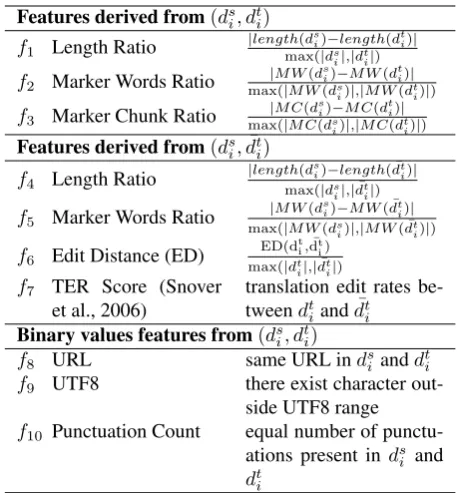
We use a total of ten different features for the classifier. The majority of the features we have used are completely language-independent. First, we derive three features ex-plicit to the source-target sentence pair(ds
i, dti)in the noisy
parallel data:
translators. While creating our noisy parallel data, we en-sure that 50% of our data consisted of good quality parallel sentence pairs. We then introduce noise to the remaining 50%. This is to ensure that both positive and negative in-stances of the parallel sentence pairs are evenly distributed so that the classifier is not biased towards one class. The three different noise types that we introduced are described below:
Random Translation (N1): This is to model the
sce-nario where a translator may insert some random text in the target language as a translation of the source sentence. This situation often occurs in crowd-based environments when untrusted users insert a random target language sen-tence copied from other sources. This situation may also occur when extracting parallel data from comparable cor-pora through web crawling. In both scenarios, the target-side sentence is a grammatically correct sentence in the target language, but is not a translation equivalent of the respective source sentence. We randomly select English source-sentences (si) from Europarl data and randomly
se-lect some target sentences (ti) from the target side of the
Europarl such thati 6= j. Note that the source side sen-tences used for one particular purpose are disjoint from all other data.
Partial Translation (N2): For generating this type of
noise, for a given parallel sentence pair (si, ti), we
ran-domly remove some words fromtito make it a noisy
trans-lation for the source sentence si. This particular noise
essentially captures ill-formed sentences of the target lan-guage which partially translate the source sentencesi. For
our noise embedding process, we randomly remove 40% of words from the originalti. Thus the length of the new noisy
target translation islen(ti)− b0.4len(ti)c.
Translation Using MT System (N3): It is often the case
that MT systems are used to produce parallel data with some post-editing effort. However, in the process of crowd-based parallel data collection, untrusted users often solely use the output of an MT system as the target translation, which can frequently produce lower quality translations. This noise is very hard to detect due to the increasing suc-cess of machine translation.3This also reflects the scenario
where increasing quantities of multilingual data published on the web is generated using raw MT. For this process, we use Microsoft’s Bing English–French MT system to pro-duce the MT output for a randomly selected si from the
source-side of English–French Europarl corpus.
4.
Experiment and Results
In our experiments we tested both the accuracy of our SVM-classifier and evaluated the performance of our MT system when trained on different data sets, as selected by the classifier, in order to measure the effect of noise on translation quality. For all of our experiments we made use of data taken from the English–French section of the Europarl corpus (Koehn., 2005).
3We consider machine translated output as bad instances of
parallel data, as we wish to focus on selecting human-quality translations for training our engines. However, MT technology often produces good quality translation for certain sentences.
4.1. Classification Accuracy
The accuracy of the classifier is defined by the ratio of the instances correctly classified against the total number of in-stances. For this approach we took two different combina-tions of the noise types in order to estimate their effect on the classification task.
• We consider all three noise types along with the good data. All noisy instances are merged into a single error class. Thus, the classification task is evaluated as a binary classifier. We shall refer to this asSVMALL.
• Furthermore, we excluded the noise generated using the MT system (N3) and only considered the
remain-ing two classes of noise (N1 andN2) along with the
good data. We shall refer to this asSVMALL−MT.
In order to train and test the classifier, we took 15k sen-tences pairs from the Europarl corpus as positive instances and randomly selected 5k sentences pairs to generate each noisy set (N1, N2andN3). These amounts ensure equal
distribution of positive (15k) and negative (15k) instances of parallel data in the experimental data set. We used a 5-fold cross validation strategy to report the classification accuracy.
4.1.1. Results
Table 2 summarises the accuracy of our classifier for
SVMALLandSVMALL−MTexperiments. We find that the overall accuracy of the classifier is 80.17% when con-sidering all types of noise. This is due to the lower accuracy in identifying the noisy classN3, as machine translated text
is difficult to distinguish from human translation. However, in the third column of the Table 2, we see that the classifier has quite a high overall accuracy (92.65%) when ignoring the MT based noiseN3. Altogether, the classifier has
rea-sonably good accuracy for bothN1andN2classes.
SVMALL SVMALL−MT
#Data Used 30k 20k
All 80.17 92.65 %
Positive 85.09 90.85 %
N1 94.08 96.26%
N2 95.04 92.64%
N3 36.62 –
Table 2: Classifier accuracies with 5-fold cross validation for different classes.
4.2. MT Quality
For these experiments we wished to measure the effect of adding different data sets (both clean and noisy) on the translation quality of our MT system.
We first built a baseline English–French MT system using OpenMaTrEx (Dandapat et al., 2010), built on 100k paral-lel English–French sentence pairs.4 We then took an addi-tional (disjoint) portion of the Europarl data, consisting of
4Note that we used only the target side of the parallel data to
120k parallel sentences. From this additional data set we randomly selected 60k sentence pairs and embedded our three different noise types, with even distribution (i.e. 20k instances for each noise class). This produced a data set consisting of 60k positive instances and 60K negative in-stances.
We then retrained the MT models by adding the following different data sets to the initial baseline training set:
• Mixed Noisy Data (MD): Both good and bad in-stances (the full 120k sentence pairs)
• Clean Data (CD):Actual positive instances from the MD data set (instances which we know are to be of good quality) (60k sentence pairs)
• Classified Data (CL): Pairs of sentences which are classified as good data according to our SVM classifier
• Size Constrained Mixed Data (MDsize):A randomly selected subset of MD consisting of the same number of sentence pairs as contained in CL
We conduct experiments using the four different data sets described above, with three different combinations of noise types (usingN1+N2+N3,N1+N2and onlyN1). We
measure the BLEU (Papineni et al., 2002) score for all our experiments to see the effect of the classified data in transla-tion performance. A completely disjoint set of 2k sentences pairs has been used to evaluate the MT system performance at each stage.
4.2.1. Results
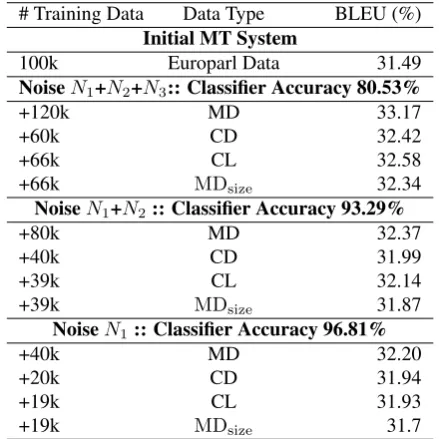
Table 3 shows the impact of the classified data on transla-tion accuracy under the different experimental setups. We can see that using the CL data set produces slight gains in translation performance, when compared to the addition of MDsize. However, making use of the entire MD data set results in higher translation quality, in terms of BLEU, compaired to all other scenarios. This is possibly attributed to the greater amount of data contained in MD which pro-vides the system with additional useful phrase pairs present in both the clean and noisy sections of the parallel corpus (similar to the observation reported in (Goutte et al., 2012)).
5.
Observations
We found that the classifier is able to achieve a high de-gree of accuracy in classifying the noise introduced to the parallel data, except for the noisy classN3. However, the
data classified by our model as good has always shown im-provement in terms of translation quality (minimum of 0.23 BLEU points), compared to the actual clean data when the amounts of additional sentences pairs remain same. This shows that it is more favourable to use the classifier for training data selection than to rely on only using those sen-tence pairs pre-classified as being clean.
The highest MT system performance is observed when the entire data set (MD) is used (we see a maximum improve-ment of 0.59 BLEU points compared to the accuracy using CL data set). However, it must be noted that making use
# Training Data Data Type BLEU (%)
Initial MT System
100k Europarl Data 31.49
NoiseN1+N2+N3:: Classifier Accuracy 80.53%
+120k MD 33.17
+60k CD 32.42
+66k CL 32.58
+66k MDsize 32.34
NoiseN1+N2:: Classifier Accuracy 93.29%
+80k MD 32.37
+40k CD 31.99
+39k CL 32.14
+39k MDsize 31.87
NoiseN1:: Classifier Accuracy 96.81%
+40k MD 32.20
+20k CD 31.94
+19k CL 31.93
+19k MDsize 31.7
Table 3: Translation accuracy after adding noisy data and classified good quality data. ‘+’ indicates the amount of data added into the initial data.
of the larger training data set results in increasing the train-ing time overhead of the system. This issue is compounded when moving towards using much larger data sets.
MT quality also depends on the amount of noise present in the data. It may be the case that for a reasonably noisy data the effect will not be significant in terms of the gains achieved in translation quality. We made use of a relatively small data set (100k sentences pairs) to build our initial sys-tem. Thus, the MT system can extract good quality phrase pairs from noisy data based on the initial distribution. The effect changes when a small amount of data is used for the initial system, which is often the case when building and collecting parallel data for a new language pair or for a nar-row domain. This is shown in Table 4. From this table we see that when equal amounts of data are used (and no MT-based noise is introduced), the addition of the CL data set has better MT performance than compared to the use of additional MD data set.
# Training Data Data Type BLEU (%)
Initial MT System
40k Europarl Data 29.86
No MT-based noise
+60k Actual Clean Data (CD) 30.35
+66k Classified as good (CL) 30.58
+66k Mixed Data (CD+N1+N2) 30.30
Table 4: Translation accuracy after adding noisy data and classified good quality data.
6.
Conclusion and Outlook
paral-lel data for MT from potentially noisy paralparal-lel data. We have shown that the classifier works with high accuracy (except for filtering out MT output) and have shown sub-sequently that using the classified data can result in gains in MT performance. For our work to date, we have made use of synthetically-generated noisy data due to the lack of availability of real noisy parallel data.
For our future work, we plan to use real noisy parallel data collected via crowd-sourcing methods to more fully un-derstand and evaluate the effect of the proposed approach. Due to the accuracy of the classifier, we believe that this method will be particularly useful for filtering out bad qual-ity crowd-sourced translations and in helping to identify and build a trusted crowd; something which is vital in using crowd-source translations in production environments.
7.
Acknowledgements
This work is supported by Science Foundation Ireland (Grants SFI11-TIDA-B2040 and 07/CE/I1142) as part of the Centre for Next Generation Localisation (www.cngl.ie) at Dublin City University.
8.
References
A. Axelrod, X. He, and J. Gao. 2011. Domain adaptation via pseudo in-domain data selection. InProceedings of the 2011 Conference on Empirical in Natural Language
Processing (EMNLP 2011), pages 355–362, Edinburgh,
Scotland.
S. Dandapat, M. Forcada, D. Groves, S. Penkale, J. Tins-ley, and A. Way. 2010. Openmatrex: A free/open-source marker-driven example-based machine translation sys-tem. InProceedings of the 7th International Conference on Natural Language Processing (IceTAL 2010), pages 121–126, Reykjav´ık, Iceland.
S. Dandapat, S. Morriessy, A. Way, and M. Forcada. 2011. Using example-based mt to support statistical mt when translating homogeneous data in resource-poor settings. InProceedings of the 15th Annual Meeting of the Euro-pean Association for Machine Translation (EAMT 2011), pages 201–208, Leuven, Belgium.
N. Gough and A. Way. 2004. Robust large-scale ebmt with marker-based segmentation. InProceedings of the 10th International Conference on Theoretical and
Method-ological Issues in Machine Translation (TMI 2004),
pages 95–104, Baltimore, MD.
C. Goutte, M. Carpuat, and G. Foster. 2012. The impact of sentence alignment errors on phrase-based machine translation performance. InProceedings of the 10th Bi-ennial Conference of the Association for Machine Trans-lation in the Americas (AMTA 2012), San Diego, CA. T. Green. 1979. Robust large-scale ebmt with
marker-based segmentation.Journal of Verbal Learning and Be-haviour, 18:481–496.
Y. He, Y. Ma, J. Roturier, A. Way, and J. van Genabith. 2010. Improving the post-editing experience using trans-lation recommendation: A user study. InProceedings of the 9th Conference of the Association for Machine Trans-lation in Americas (AMTA 2010), pages 247–256, Den-ver, CO.
J. M. Huerta. 2011. Approaches to automatic quality es-timation of manual translation in crowdsourcing parallel corpora development: A quality equivalence and cohort-consensus approach. Ibm research division, t. j. watson research center, ny.
P. Koehn. 2005. Europarl: A parallel corpus for statistical machine translation. InMT Summit X: The 10th Machine Translation Summit, pages 79–86, Phuket, Thailand. W. Lewis, R. Munro, and S. Vogel. 2011. Crisis mt:
Devel-oping a cookbook for mt in crisis situation. In Proceed-ings of the 6th Workshop on Statistical Machine Transla-tion, pages 501–511, Edinburgh, Scotland.
K. Papineni, S. Roukos, T. Ward, and W. J. Zhu. 2002. Bleu: a method for automatic evaluation of machine translation. InProceedings of the 40th Annual Meeting of the Association for Computational Linguistics (ACL 2002), pages 311–318, Philadelphia, PA.
M. Post, C. Callison-Burch, and M. Osborne. 2012. Constructing parallel corpora for six indian languages via crowdsourcing. In Proceedings of the 7th Work-shop on Statistical Machine Translation, pages 401–409, Montr´eal, Canada.
M. Snover, B. Dorr, R. Schwartz, L. Micciulla, and J. Makhoul. 2006. A study of translation edit rate with targeted human annotation. In Proceedings of the 7th Conference of the Association for Machine Translation
in Americas (AMTA 2006), pages 223–231, Cambridge,
MA.
L. Specia, M. Turqui, Z. Wang, J. Shawe-Taylor, and C. Saunders. 2009. Improving the confidence of ma-chine translation quality estimates. In Proceedings of the 12th Machine Translation Summit (MT Summit XII), pages 136–143, Ottawa, Canada.
J. Tiedemann and L. Nygaard. 2004. The opus corpus - parallel and free. In Proceedings of the 4th Interna-tional Conference on Language Resources and Evalua-tion (LREC 2004), pages 1183–1186, Lisbon, Portugal. R. Wagner and M. Fischer. 1974. The string to string
cor-rection problem. Journal of Association of Computing
Machinery (JACM), 21(1):168–173.