Exploiting Dynamic Passage Retrieval for Spoken Question Recognition and
Context Processing towards Speech-driven Information Access Dialogue
Tomoyosi Akiba
Toyohashi University of Technology 1-1 Hibarigaoka, Tenpaku-cho, Toyohashi-shi,
Aichi, 441-8580, JAPAN [email protected]
Abstract
Speech interfaces and dialogue processing abilities have promise for improving the utility of open-domain question answering (QA). We propose a novel method of resolving disambiguation problems arisen in those speech and dialogue enhanced QA tasks. The proposed method exploits passage retrieval, which is one of main components common in many QA systems. The basic idea of the method is that the similarity with some passage in the target documents can be used to select the appropriate question from the candidates. In this paper, we applied the method to solve two subtasks of QA, which are (1) N-best rescoring of LVCSR outputs, which selects a most appropriate candidate as a question sentence, in speech-driven QA (SDQA) task and (2) context processing, which compose a complete question sentence from a submitted incomplete one by using the elements appeared in the dialogue context, in information access dialogue (IAD) task. For both tasks, a dynamic passage retrieval is introduced to further improve the performance. The experimental results showed that the proposed method is quite effective in order to improve the performance of QA in both two tasks.
1. Introduction
Open-domain Question Answering (QA) was first evalu-ated extensively at TREC-8 held in 1999. From 2001, QA in Japanese have been evaluated in NTCIR Question An-swering Challenge (QAC). The goal in the QA task is to extract words or phrases as the answer to a question from an unorganized document collection, rather than the docu-ment lists obtained by traditional information retrieval (IR) systems.
Speech interfaces using large vocabulary continuous speech recognition (LVCSR) decoders have promise for improving the utility of QA systems, in which natural language ques-tions are used as inputs. We refer to the QA enhanced by the speech interface as Speech-driven Question Answering (SDQA). One of the most common problems faced with when we enhance the text-based QA system to accept spo-ken questions, arises from the recognition errors found in the transcription obtained by using LVCSR. The informa-tion loss caused by it gives a serious degradainforma-tion to the total performance of question answering. Because LVCSR de-coders can often outputs N-best list of transcriptions as the recognition candidates, this problem can be seen as resolv-ing the ambiguity caused on the speech recognition results. It can be resolved by selecting the most appropriate ques-tion from the N-best list.
On the other hand, Information Access Dialogue (IAD) task have been evaluated in the recent NTCIR QAC series. IAD task assumes the situation in which users interactively col-lect information using a QA system. The QA Systems aim-ing at the task need the abilities of context processaim-ing. In IAD task, the systems must accept a contextual question, which has reference expressions and ellipses that refer to the entities appeared in the previous questions and answers. This incomplete question has to be completed by selecting appropriate entities from the context. Therefore, this also can be seen as a problem of ambiguity resolution, and can be resolved by selecting the entities in order to compose the
most appropriate question from the history.
In this work, we propose the method of resolving those dis-ambiguation problems by exploiting passage retrieval. The basic idea of the proposed method is as follows. Suppose an input question has at least one correct answer in the tar-get document collection, there must be at least one similar passage in it. Therefore, the similarity with some passage in the target documents can be used to select the appropri-ate question from the candidappropri-ates in both SDQA and IAD task situation.
The rest of the paper is organized as follows. Section 2. describes our passage retrieval method that selects the size of the passage dynamically according to the similarity with the query. It will be applied to the two disambiguation prob-lems arisen in the QA tasks in the following two sections. Section 3. describes the N-best rescoring of candidate spo-ken questions hypothesized by a LVCSR system. Section 4. describes the context processing for the information access dialogue task. In Section 5., we will give the conclusion.
2. Dynamic Passage Retrieval
A passage, i.e. a text fragment in target documents, is used to calculate the similarity against the question. Some sys-tems use a sentence as a passage, while other syssys-tems use a paragraph. The longer the size of a passage is selected, the more candidates of the answer can be picked up. It raises the recall of the answer, while it reduces the preci-sion because the more incorrect candidates are also picked up. Developing a good passage retrieval method is one of the common research topics for question answering (Tellex et al., 2003).
We have proposed a dynamic passage retrieval method (Ak-iba et al., 2004b; Murata et al., 2005). The method selects an appropriate size of the passage on the fly by using F-measure based similarity with the question.
sentencesin the target documents.1 Here we assume that
the target documents are newspaper articles. ThoughC(s) can include any size of text fragments surroundings theo-retically, only the following sentences are considered in our implementation whether each of them should be included in the passage.
s−1: the sentence immediately befores.
s+1: the sentence immediately afters.
hA: the headline of the articleAthatsbelongs.
dA: the date string of the articleAthatsbelongs.
Therefore, we adopted the following candidate C(s) in practice.
C(s) ={{s} ∪E|E∈2{s−1s+1hAdA}}
The proposed method selects a best passageˆcfromC(s)by using following F-measure based similarityF(q, c)with a questionq,
ˆ
c= argmax
c∈C(s)
F(q, c) (1)
F(q, c) = (1 +β
2)P(q, c)R(q, c)
β2P(q, c) +R(q, c) (2)
P(q, c) = P
t∈T(q)∩T(c)idf(t)
P
t∈T(c)idf(t)
,
R(q, c) = P
t∈T(q)∩T(c)idf(t)
P
t∈T(q)idf(t)
whereT(c)is a set of terms included incandidf(t)is the inverse document frequency (IDF) of a termt.
We choseβ = 2 to emphasize the recall for the N-best rescoring of spoken questions (Section 3.) and for the ques-tion answering itself, whileβ = 1for the context process-ing (Section 4.1.).
The passage retrieval scoreSpassage(q)is defined as the max value ofF(q, c)with respect to the target document collectionD.
Spassage(q) = max
s∈Dcmax∈C(s)F(q, c) (3)
We cannot examine all of sentences in D because of the computational cost. Therefore, only the sentences included in the documents that a document retrieval engine returns by submittingqare examined to calculate the equation (3) for an approximation.
3. N-best Rescoring of Recognition
Candidates
One of the most common problems faced with when we enhance the text-based QA system to accept spoken ques-tions, arises from the uncertainty of speech recognition re-sults. The information loss caused by it gives a serious
1More specifically, the candidates should be considered with respect to an answer candidatea. However we approximateato be identical withsthat includesa.
degradation to the total performance of question answer-ing. The task specific language modeling can improve the accuracy of speech recognition and, consequently, the total performance of question answering (Akiba et al., 2004a). However, as the n-gram language model can only model the short-term constraint of word sequence, it fails to cap-ture the semantic consistency of sentence level.
Suppose an input question has at least one correct answer in the target document collection, there must be at least one similar passage in it. Thus the similarity with some passage in the target documents can be used to reduce the uncer-tainty in speech recognition process. For example, suppose two candidate sentences“What was the name of the space-craft landed safely on March in 1976?”and“What was the name of the spacecraft landed safely on Mars in 1976?”
are obtained by the speech recognition process and there found a passage “The first U.S. spacecraft to land on Mars was a spacecraft called Viking 1 which occurred on July 20, 1976.” in the target documents. Because the latter candi-date has more common words and therefore is more similar to the passage, it is more likely to be the correct question sentence.
The similarity to a passage appeared in an actual document expresses that the candidate word sequence is more or less semantically consistent as a whole. As a N-best list of can-didates obtained by an existing LVCSR decoder often in-cludes a lot of meaningless sentences in practice, the simi-larity, or thepassage retrieval scorein other words, can be used to filter out such sentences. From language modeling perspective, this process can be seen to capture the seman-tic consistency of the candidate in sentence level, which conventional n-gram language model fails to capture. In (Akiba and Abe, 2005), the passage retrieval method with fixed size passage (one sentence, three sentences, or a document) was applied for N-best rescoring. In this paper, the dynamic passage retrieval described in 2. is applied.
3.1. Combining Speech Recognition Likelihood and Passage Retrieval Score
Using the passage retrieval score solely for rescoring does not take the plausibility of the candidate itself, measured by the speech recognition process, into consideration. Sim-ply, the likelihood of speech recognitionP(qi|a), whereqi
is the i-th best recognized sentence andais the observed acoustic signal, can be used as representative of the plau-sibility. Its log likelihood logP(qi|a) ∝ logP(a|qi) +
βlogP(qi) +γ|qi|, where P(a|qi), P(qi), β, andγ are
the acoustic model, the language model, the language model weight, and the insertion penalty respectively, is also known as recognition score and is used to guide the search in the recognition process. It is automatically obtained with each recognized sentence as the result of speech recogni-tion.
The final rescoring measureSrescore is obtained by inter-polating the likelihood P(qi|a) and the passage retrieval scoreSpassage(qi),
Srescore(qi) =P(qi|a)α·Spassage(qi, sqi) (4)
3.2. Test Data
The test collection constructed in the first evaluation of Question Answering Challenge (QAC-1) (Fukumoto et al., 2003), which was carried out as a task of NTCIR Workshop 3, was used to produce the test data of spoken questions for our evaluation. The task definition of QAC-1 (subtask 12)
is as follows.
Target documents are two years of Japanese newspaper ar-ticles, from which the answers of a given question must be extracted. The answer is a noun or a noun phrase, e.g., per-son names, organization names, names of various artifacts, money, size and date. System extracts at most five answers from the documents for each question. The reciprocal num-ber of the rank is the score for the question. For example, if the second answer candidate is correct, the score is 0.5. This definition is almost equivalent to the factoid question answering in TREC, where MRR was used as an evalua-tion metric in TREC-8, 9, and 10, and the exact answer extraction is evaluated since TREC-11. The 200 questions were used for the formal evaluation, in which no answer was found for four questions in the target documents that consisted of newspaper articles in 2 years.
The 200 questions were read by four females and four males in order to produce the test speech data for our eval-uation.
An existing LVCSR system (Lee et al., 2001) was used for the purpose of transcription. The language model is con-structed from the 12 years newspaper articles and the vo-cabulary size is about 60,000 words. The resulting N-best candidatesq1q2· · ·qNare rescored bySrescore(qi)of the
equation (4), then the top ranked sentence was selected to investigate its performance by using the evaluation metric described below.
3.3. Evaluation Metrics
We used three evaluation metrics for our experiments. First of all, the word error rate (WER) of the resulting sentence was investigated in order to see how our method works as a language model for speech recognition. The average WER for all 200 questions was used as the first evaluation metric The top ranked sentenceqafter rescoring was submitted to our question answering system (Akiba et al., 2004b). The system outputs five answersa1..a5for an input questionq.
The answers are ordered by the system from 1st to 5th po-sitions according to their confidence about the correctness. Each answer is scored on the inverse number of its order, called Reciprocal Rank (RR). The score of the questionq, RR(q), is the highest score of its five answers.
rr(ai) =
1/i ifaiis a correct answer
0 otherwise (5)
RR(q) = max
ai
rr(ai) (6)
The mean RR (MRR) for all 196 questions that have at least one correct answer was used as the evaluation metric for question answering. Additionally, the rate of the questions
2Three subtasks were performed in QAC1. See (Fukumoto et al., 2003).
method WER (%) MRR %correct (%)
BASELINE 24.8 0.240 28.2
static passage 23.6 0.284 36.8
dynamic passage 23.8 0.291 38.3
ORACLE 20.3 0.279 35.0
TEXT input 0 0.516 66.5
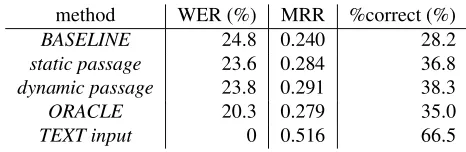
Table 1: Experimental Result of Word error rate (WER), mean reciprocal rank (MRR) and the rate of the questions correctly answered (%correct), averaged over eight speak-ers.
in 196 that the system correctly answered within five out-puts per question (% correct) was also used as the evalua-tion metric.
3.4. Results
The experimental evaluation was taken place by compar-ing the results obtained by rescorcompar-ing methods. The base-line method (referred asBASELINE) simply selects a most likely candidate (with largest likelihood score) from the re-sults of speech recognition.
The proposed methods select a candidate from 10-best list by exploiting the passage retrieval score and by rescoring them. Two passage retrieval methods are investigated. The first method selects the fixed size of passage defined in ad-vance (referred asstatic passage). The previous experiment (Akiba and Abe, 2005) revealed that the passage size of 3 sentences window was best performed among the several sizes. The similarity measure between a question and a passage used in the method isTF-IDF with pivoted doc-ument length normalization (Singhal et al., 1996). The sec-ond method selects the size of passage on the fly by using the dynamic passage retrieval described in Section 2. (re-ferred asdynamic passage). In both methods, the weight of the interpolationαin the equations (4) was estimated by using 10-fold cross validation.
As a reference, the oracle method selects the best result, which has the smallest word errors, from 10-best recogni-tion candidates (referred asORACLE).
Table 1 shows the results of WER, MRR and %correct av-eraged over the eight speakers.
As for speech recognition performance (WER), both the proposed methods (static passage and dynamic passage) improved the baseline about 4.0-4.8 % relative. We used the paired t-test for statistical testing, which investigates whether the improvements in performance is meaningful or simply due to chance. We found that the WER values forBASELINEand both the proposed methods were signif-icantly different (at the 0.005% level). This improvement might be further increased in some way, because the ideal method (ORACLE) achieved the better results (the relative improvement was about 18.1 %).
The notable results were obtained for question answering. The proposed methods showed a considerable improve-ment in the performance compared with the baseline. The paired t-test revealed that the MRR values forBASELINE
What genre does the “Harry Potter” series be-long to?
Who is the author?
Who are the main characters in that series? When was the first volume published? What title does it have?
How many volumes were published by 2001? How many languages has it been translated into? How many copies have been sold in Japan?
Figure 1: An example of the gathering type of series.
Where was Universal Studio Japan constructed? Which train station is the nearest?
Who is the actor who attended the ribbon-cutting ceremony on the opening day?
What is the movie he was featured in that was released in the New Year season of 2001? What is the movie starring Kevin Costner re-leased in the same season?
What was the subject matter of that movie? What role did Costner play in that movie?
Figure 2: An example of the browsing type of series.
4.2. Test Data
The experiment was performed by using QAC3 test collec-tion (Kato et al., 2005). The QAC3 test colleccollec-tion contains 50 series and 360 questions. The number of questions in one series ranges from 5 to 10, and the average is 7.2. The target document set, where answers are intended to be ex-tracted from a question, consists of two years of articles from two newspapers.
The test collection consists of two types of series of ques-tions: a gathering type and a browsing type. In the gather-ing type, the user has a concrete objective such as writgather-ing a report and summary on a specific topic, and asks a system a series of questions related to that topic. In the brows-ing type, the user does not have any fixed topic of interest, which therefore varies as the dialogue progresses. There-fore, the context processing for IAD task is more critical for the browsing type than for the gathering type. The test collection contains 35 series of the gathering type and 15 series of the browsing type. Figure 1 and 2 show examples of series of those two types from (Kato et al., 2005).
4.3. Experimental Results
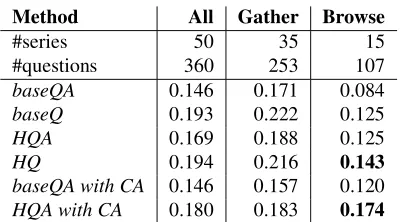
The performances of the four methods, i.e.baseQA,baseQ,
HQA, andHQ, were compared by the evaluation measure MMF1 (modified F measure averaged over the questions) (Kato et al., 2005). The results were shown in Table 2. The difference of the performance according to the types of the series was investigated. The labelAll,Gatherand Browsecorrespond to all the series, the series of the
gather-Method All Gather Browse
#series 50 35 15
#questions 360 253 107
baseQA 0.146 0.171 0.084
baseQ 0.193 0.222 0.125
HQA 0.169 0.188 0.125
HQ 0.194 0.216 0.143
baseQA with CA 0.146 0.157 0.120
HQA with CA 0.180 0.183 0.174
Table 2: QA performance differences according to the con-text processing methods (MMF1).
ing type, and the series of the browsing type, respectively. The result showed that the proposed method did not im-prove the baseline method with respect to entire test set (All): the performance of HQA was less than baseline, while the performance ofHQis almost equal tobaseline.3
However, the performances of them were quite different ac-cording to the type of series. HQoutperformedbaseline
with respect to the browsing type of series (Browse). This result indicated that the method was effective for the brows-ing type, in which the context processbrows-ing plays much more critical role than in the gathering type.
The most interesting results were those with correct an-swers (baseQA with CAandHQA with CA). With respect tobaseQA with CA, using the correct answers still did not improve the performance. This indicates that the unnec-essary terms for the question, whether or not they are cor-rect, degrades the QA performance. The result ofHQA with CAshowed almost same tendency withHQA; though it did not improve the performance in total, it did improved the performance for browsing type. Furthermore, the improve-ment for browsing type ofHQA with CAwas much greater than that ofHQ. This indicate that the proposed method se-lected the context appropriately and that giving the correct answers it further improved the performance.
4.4. Discussion
We formulated the context processing in IAD task as a problem of context selection from previous questions and answers to compose an appropriate complete question, and proposed a novel method for the problem exploiting pas-sage retrieval. The method uses only term statistics for context processing instead of conventional NLP such as anaphora resolution. Since the current implementation of the method is naive, we think some refined implementation can improve the performance further. The combination of our method and the conventional NLP method will be also hopeful.
5. Conclusion
In this paper, a novel method of resolving disambiguation problems in QA by using dynamic passage retrieval was proposed. We applied the method to two subtasks of QA;
N-best rescoring of spoken question in SDQA task and con-text processing in IAD task. In SDQA task, the experi-mental results showed that the proposed method achieved considerable improvement on both the word error rate and the QA performance. In IAD task, the experimental re-sults showed that the method improved the QA perfor-mance when it applied to the browsing type of series of questions. Because the proposed method gives a general framework for resolving disambiguation problems arisen in open-domain QA task, it will be applied to other problems than described here, including query term expansion, etc.
6. Acknowledgement
This work was partly supported by Grant-in-Aid for Scien-tific Research (KAKENHI) (C) 17500092 from Japan So-ciety for the Promotion of Science.
7. References
Tomoyosi Akiba and Hiroyuki Abe. 2005. Exploiting passage retrieval for n-best rescoring of spoken ques-tions. In Proceedings of International Conference on Speech Communication and Technology (Eurospeech), pages 65–68.
Tomoyosi Akiba, Atsushi Fujii, and Katunobu Itou. 2004a. Effects of language modeling on speech-driven question answering. InProceedings of International Conference on Spoken Language Processing, pages 1053–1056. Tomoyosi Akiba, Atsushi Fujii, and Katunobu
Itou. 2004b. Question answering using “com-mon sense” and utility maximization principle. In Proceedings of The Fourth NTCIR Workshop.
http://research.nii.go.jp/ntcir/workshop/
OnlineProceedings4/QAC/NTCIR4-QAC-AkibaT.pdf.
Jun’ichi Fukumoto, Tsuneaki Kato, and Fumito Masui. 2003. Question answering challenge (QAC-1) question answering evaluation at NTCIR workshop 3. In Pro-ceedings of The third NTCIR Workshop.
Tsuneaki Kato, Jun’ichi Fukumoto, and Fumito Masui. 2004. Question answering challenge for information access dialogue — overview of NTCIR4 QAC2 subtask 3. In Proceedings of
The Fourth NTCIR Workshop, pages 361–372.
http://research.nii.ac.jp/ntcir/workshop/
OnlineProceedings4/QAC/NTCIR4-QAC-KatoT.pdf.
Tsuneaki Kato, Jun’ichi Fukumoto, and Fumito Ma-sui. 2005. An overview of NTCIR-5 QAC3. In Proceedings of The Fifth NTCIR Workshop.
http://research.nii.ac.jp/ntcir/workshop/
OnlineProceedings5/data/QAC/NTCIR5-OV-QAC-KatoT.pdf.
Akinobu Lee, Tatsuya Kawahara, and K. Shikano. 2001. Julius — an open source real-time large vocabulary recognition engine. InProceedings of European Confer-ence on Speech Communication and Technology, pages 1691–1694, Sept.
Yuichi Murata, Tomoyosi Akiba, Atsushi Fujii, and Katunobu Itou. 2005. Question answering experiments at NTCIR-5: Qcquisition of answer evaluation patterns and context processing using passage retrieval. In Pro-ceedings of The Fifth NTCIR Workshop, pages 394–401.
http://research.nii.ac.jp/ntcir/workshop/
OnlineProceedings5/data/QAC/NTCIR5-QAC-MurataY.pdf.
Amit Singhal, Chris Buckley, and Mandar Mitra. 1996. Pivoted document length normalization. InProceedings of ACM SIGIR, pages 21–29.
Stefanie Tellex, Boris Katz, Jimmy Lin, Aaron Fernandes, and Gregory Marton. 2003. Quantitative evaluation of passage retrieval algorithms for question answering. In