Classifying Standard Linguistic Processing Functionalities based on
Fundamental Data Operation Types
Yoshihiko Hayashi and Chiharu Narawa
Graduate School of Language and Culture, Osaka University 1-8 Machikaneyama, Toyonaka, Osaka, 5600043 Japan [email protected], [email protected]
Abstract
It is often argued that a set of standard linguistic processing functionalities should be identified, with each of them given a formal specifi-cation. We would benefit from the formal specifications; for example, the semi-automated composition of a complex language processing workflow could be enabled in due time. This paper extracts a standard set of linguistic processing functionalities and tries to classify them formally. To do this, we first investigated prominent types of language Web services/linguistic processors by surveying a Web-based language service infrastructure and published NLP toolkits. We next induced a set of standard linguistic processing functionalities by carefully investigating each of the linguistic processor types. The standard linguistic processing functionalities was then characterized by the input/output data types, as well as the required data operation types, which were also derived from the investigation. As a result, we came up with an ontological depiction that classifies linguistic processors and linguistic processing functionalities with respect to the fundamental data operation types. We argue that such an ontological depiction can explicitly describe the functional aspects of a linguistic processing functionality.
Keywords: language service; language processing functionality; linguistic data type; language service ontology
1.
Introduction
It is often argued that a set of standard linguistic processing functionalities should be identified (Hayashi, 2011), with each of them given a formal specification. We would ben-efit from the formal specifications; for example, the semi-automated composition of a complex language processing workflow could be enabled in due time. Then, it is natural to ask, how can we extract a reasonable set of standard lin-guistic processing functionalities, and how can we formally specify each of them?
Because a linguistic processing functionality can be partly specified by the input/output data types, we care-fully looked at the input/output data specification of tools/libraries provided by well-known Natural Language Processing (NLP) toolkits, as well as published language Web services. However the input/output data type is not the only aspect that fully characterizes a linguistic processing functionality. Therefore we further investigated a variety of fundamental data operation types that should be required to achieve a linguistic processing functionality.
Putting these investigations together, we came up with a three-layer model that can serve as a conceptual framework for classifying a standard set of linguistic processing func-tionalities. In this paper, we provide a sketch of an ontologi-cal depiction for specifying a standard set of linguistic pro-cessing functionalities based on the three-layered model. We also try to validate primary data types in NLP, which also have been derived from the investigation, while argu-ing that our proposal may be simple yet effective toward a formal specification of the standard linguistic processing functionalities.
2.
Sources of the Investigation
To first identify a set of prominent linguistic processor types and the associated linguistic processing functionalities, we
Figure 1: Language services in the Language Grid
investigated a Web-based language service infrastructure and several NLP toolkits.
2.1. The Language Grid
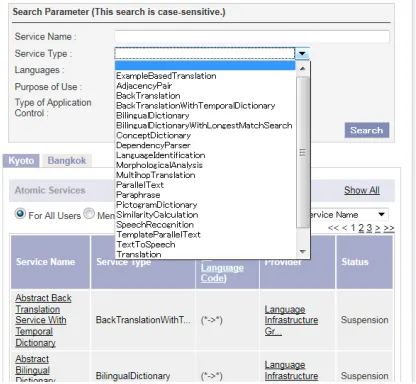
The Language Grid (Ishida, 2011)1 is a collaborative lan-guage service infrastructure on the Web. Aimed at support-ing activities of intercultural collaboration, it provides ac-cess to a range of Web-service-based language resources and linguistic processors. The Web site2gives a complete
list of language service types and actual services registered as displayed in Figure 1. As of Feb 15, 2012, 23 different service types are available.
1
http://langrid.org/
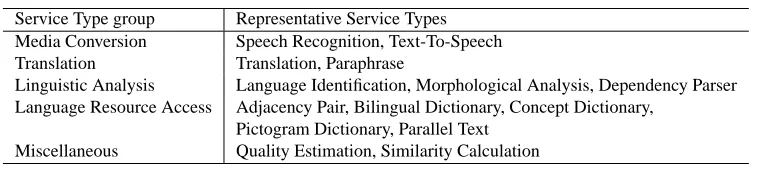
Table 1: Major Language Grid service types classified into five groups
Service Type group Representative Service Types Media Conversion Speech Recognition, Text-To-Speech Translation Translation, Paraphrase
Linguistic Analysis Language Identification, Morphological Analysis, Dependency Parser Language Resource Access Adjacency Pair, Bilingual Dictionary, Concept Dictionary,
Pictogram Dictionary, Parallel Text Miscellaneous Quality Estimation, Similarity Calculation
Table 2: Major processor types identified from the NLP toolkits
Linguistic Processor Type OpenNLP Stanford NLP FreeLing LingPipe
Language Identifier X X
Sentence Splitter X X X X
Tokenizer X X X X
POS Tagger X X X X
Lemmatizer X X
Morphological Analyzer X
Sense Tagger X X
Chunker X X
NE Classifier X X X X
Coreference Resolver X X X
Dependency Parser X X
Phrase Structure Parser X X X
Although the Web site simply provides a flat list of lan-guage service types, we have grouped the major lanlan-guage service types into five groups, as shown in Table 1, out of which Media Conversion, Translation, and Linguistic Anal-ysis are considered in the rest of this paper.
The services classified as Media Conversion perform so-called media conversion to/from text strings, and the Trans-lation services project the meaning expressed in the input text string onto the output text string, which differs from the input string with regard to language and/or style. By its purpose and nature, the Language Grid provides a variety of Translation services, which include Multi-hop Translation for cascaded translation, and Back Translation, which can be employed as a useful tool for assessing the translation qualities.
Currently, two types of Linguistic Analysis are provided in the Language Grid: Morphological Analyzer and Depen-dency Parser for Japanese. We should remark here that morpho-syntactic analysis is required to tokenize, POS-tag, and lemmatize Japanese sentences. Therefore, the to-kenization functionality, for example, is typically imple-mented by a morphological analyzer, which also performs POS tagging as well as lemmatization.
In the Web site, WSDL documents for describing these ser-vice types are publicized so that the user can invoke a spe-cific service that can achieve his/her goal by relying on the SOAP service invocation protocol. However, as frequently argued, a WSDL document cannot formally specify the meaning of the input/output data of a Web service (Fensel et al., 2011). This surely is a potential burden for (semi-)automatically composing a composite Web service.
2.2. NLP toolkits
Table 2 displays a set of linguistic processor types, each of them has been extracted by surveying the documenta-tion of the following well-known NLP toolkits: Apache OpenNLP3, Stanford Core NLP4, FreeLing5, and
Ling-Pipe6. The table thus shows which processor type is
pro-vided by each toolkit.
Note that the names of the linguistic processor types were chosen by the authors of this paper while reviewing the documentation of each toolkit, thus they may not match the original names used by the toolkits. For example, in FreeLing, ”Sentence Detection” is the name for the Sen-tence Splitter processor type in the table.
It should also be noted that, in the investigation, we partic-ularly focused on linguistic analysis functionalities, leav-ing out of the table other (somewhat application-oriented and/or ad-hoc) functionalities provided by some of the toolkits. Among the mentioned NLP toolkits, FreeLing provides a variety of processors including modules for per-forming tasks of statistical machine learning.
3.
A Linguistic Processor implements
Linguistic Processing Functionalities
By combining the results shown in the Table 1 and Table 2, we consider the following as the current set of standard linguistic processor types. Note that the set is never frozen
3
http://opennlp.apache.org
4http://nlp.stanford.edu/software/
corenlp.shtml
5
http://nlp.lsi.upc.edu/freeling/
Segmenting
bulk data (Text/Sentence) sequence data (Sentence/Word)
sequence data
Uniting mixed sequence data
Chunk
sequence data
Annotating
sequence of annotated data Annotating
bulk data annotated bulk data sequence data
Structuring Phrase Structure
Converting
bulk data (Text/Speech/Image) bulk data (Speech/Text)
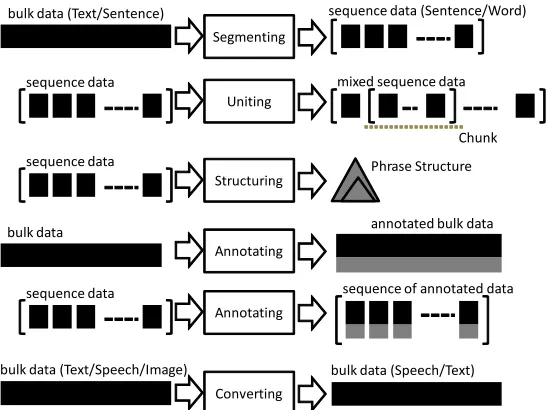
Figure 2: Fundamental data operation types
and may expand as new types are discovered.
Linguistic Processor Types::={Language Identifier, Sentence Splitter, Tokenizer, POS Tagger, Lemma-tizer, Sense Tagger, Morphological Analyzer, Chunker, NE Recognizer, Coreference Resolver, Dependency Parser, Phrase Structure Parser, Speech Recognizer, Text-To-Speech Converter, Translator, Paraphraser}
Further, we have constructed a set of linguistic processing functionalities as follows.
Linguistic Processing Functionality Types ::= {Language Identification, Sentence Splitting, Tokenization, POS Tagging, Lemmatization, Sense Tagging, Chunking, NE Classification, Coreference Resolution, Dependency Parsing, Phrase Structure Parsing, Speech Recognition Text-To-Speech Conversion, Translation, Paraphrasing}
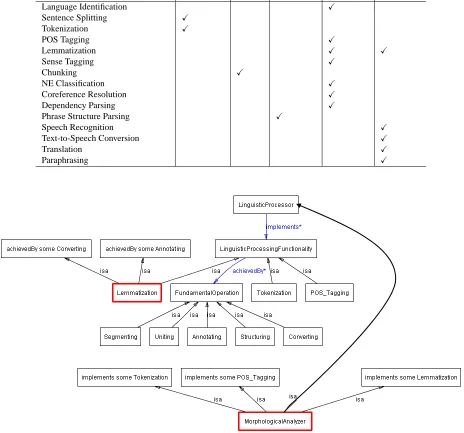
By comparing the two sets, it is easily noticed that a lin-guistic processor type, in general, implements a linlin-guistic processing functionality, whereas two of them, which are underlined in the processor type set, implement multiple functionalities, and the corresponding names do not appear in the functionality set. The relationships are as follows:
• Morphological Analyzer implements Tokenization, POS Tagging, and Lemmatization;
• NE Recognizer implements Chunking and NE Classi-fication.
4.
A Linguistic Processing Functionality is
achieved by Fundamental Data
Operations
By carefully examining the input/output data specification of the published NLP tools/libraries/services mentioned so far, we have induced a fundamental set of data operation types that can be employed for classifying standard linguis-tic processing functionalities.
Figure 2 schematizes the data operation types characterized by the input/output abstract data types. Table 3 classifies which linguistic processing functionality type is achieved by which data operation type.
Note that each linguistic processing functionality, in gen-eral, is associated with a fundamental data operation type, whereas Lemmatization involves two operation types, An-notating and Converting. That is, a lemma form is gener-ated from the word token, which would then be incorpo-rated into the annotation, probably using alemmatag. Below, we describe each of the fundamental data operation types in turn.
Segmenting: A linguistic processing functionality as-suming this operation type performs segmentation of the input bulk data into a sequence of the segmented elements. The linguistic processing functionality types achieved by this operation type are Sentence Splitting and Tokeniza-tion. The former splits a text string into a set of sentences, whereas the latter splits a sentence string into a set of word tokens. We therefore recognize Text, Sentence, and
Wordas elements of the NLP primary data types.
Uniting: In contrast to the segmenting operation, this op-eration type identifies a set of non-overlapping continuous regions from a sequence of primary data elements; these re-gions are usually referred to as chunks. We thus addChunk
as one of the NLP primary data types. Note that the result-ing output can be a mixed sequence of primary data ele-ments and sequences of primary data eleele-ments (that is, a nested sequence). The only linguistic processor functional-ity type achieved by this operation type is Chunking.
Structuring: For the moment, this operation type is per-formed solely by the Phrase Structure Parsing functional-ity, whose input is a sequence of primary data (Wordor
Chunk), and the output is aPhrase Structure, which
Table 3: Linguistic processing functionalities classified by data operation types
Linguistic Processing Functionality Segmenting Uniting Structuring Annotating Converting
Language Identification X
Sentence Splitting X
Tokenization X
POS Tagging X
Lemmatization X X
Sense Tagging X
Chunking X
NE Classification X
Coreference Resolution X
Dependency Parsing X
Phrase Structure Parsing X
Speech Recognition X
Text-to-Speech Conversion X
Translation X
Paraphrasing X
isa
Figure 3: Ontological depiction for specifying linguistic processing functionalities and the associated elements.
as a leaf node of the phrase structure tree.
Annotating: As shown in Figure 2, this operation type is embodied in two ways: (a) annotating bulk data, or (b) an-notating each element in the sequence data. A broad range of linguistic processing functionality types are classified as being achieved by this operation type. For example, Lan-guage Identification performs bulk data annotation (assigns the language name to a given text), while POS Tagging and Dependency Parsing perform sequence data annotation. We distinguishAnnotation as a special abstract data type that can modify any NLP primary data type. This category is further discussed in the next section.
Converting: In principle, this operation type achieves the generation of output bulk data from the input bulk data. An important principle of Converting is that the input and out-put data should be different in some aspect. For example,
the functionality type Text-to-Speech Conversion generates
Speech data, represented with some encoding schema,
from the input Text. A prominent linguistic processing functionality type achieved by this category is obviously Translation, which generates text in the designated target language from the input text in a specified source language, while retaining the meaning expressed in the input text.