A Secure and Robust Object-Based
Video Authentication System
Dajun He
Institute for Infocomm Research (I2R), 21 Heng Mui Keng Terrace, Singapore 119613 Email:[email protected]
Qibin Sun
Institute for Infocomm Research (I2R), 21 Heng Mui Keng Terrace, Singapore 119613 Email:[email protected]
Qi Tian
Institute for Infocomm Research (I2R), 21 Heng Mui Keng Terrace, Singapore 119613 Email:[email protected]
Received 31 March 2003; Revised 6 December 2003
An object-based video authentication system, which combines watermarking, error correction coding (ECC), and digital signature techniques, is presented for protecting the authenticity between video objects and their associated backgrounds. In this system, a set of angular radial transformation (ART) coefficients is selected as the feature to represent the video object and the background, respectively. ECC and cryptographic hashing are applied to those selected coefficients to generate the robust authentication wa-termark. This content-based, semifragile watermark is then embedded into the objects frame by frame before MPEG4 coding. In watermark embedding and extraction, groups of discrete Fourier transform (DFT) coefficients are randomly selected, and their energy relationships are employed to hide and extract the watermark. The experimental results demonstrate that our system is robust to MPEG4 compression, object segmentation errors, and some common object-based video processing such as object translation, rotation, and scaling while securely preventing malicious object modifications. The proposed solution can be further incorporated into public key infrastructure (PKI).
Keywords and phrases:watermark, authentication, error correction coding, cryptographic hashing, digital signature.
1. INTRODUCTION
Nowadays, the object-based MPEG4 standard is becoming growingly attractive to various applications in areas such as the Internet, video editing, and wireless communication be-cause of its object-based nature. For instance, in video edit-ing, it is the object of interest, not the whole video, which needs to be processed; in video transmission, if the band-width of the channel is limited, only the objects, not the background, are transmitted in real time. Generally speak-ing, object-based video processing can simplify video edit-ing, reduce bit rate in transmission, and make video search efficient. Such flexibilities, however, also pose new challenges to multimedia security (e.g., content authenticity protection) because the video object (VO) can be easily accessed, mod-ified, or even replaced by another VO in object-based video application.
Consider a video surveillance system, shown inFigure 1. The captured video is sent to processing centers or end users
Start signing
End signing
Preprocess Object
Back-ground
Object
Back-ground
Channel Synthesis Processing center/end
user
Figure1: An example of video surveillance system. Only video clips containing interesting objects will be transmitted and authenticated; and the video frames are segmented into foreground (object) and background for individual transmission. So an object-based video authen-tication system is required.
paper is to propose a secure, robust, and object-based video authentication solution.
The requirements for an object-based video authentica-tion system are different from those for a frame-based video authentication system; and these requirements are usually application dependent. As we know, it is very easy for the VO and background to be modified or even maliciously re-placed by another object by the attacker during video trans-mission or storage. Hence, for security reasons, such kinds of attacks should be alerted and detected. (We define the dis-tortions introduced by attacks asintentional distortions.) On the other hand, as shown inFigure 1, the video will usually be segmented into objects and background first, and the ob-jects and background are then compressed individually be-fore transmission; at the receiving site, the decompressed ob-jects may even be scaled, translated, or rotated to interact with the end users. For robustness reasons, such kinds of video processing should be allowed. (We define the distor-tions introduced by above-mentioned object/video process-ing as incidental distortions.) Therefore, a practical object-based video authentication system should be robust to in-cidental distortions while being sensitive to intentional dis-tortions for specific video applications.
Bartolini et al. [2] proposed a frame-based video authen-tication system for surveillance application. In their system, the camera ID, together with time and date, is used to gen-erate the watermark. This watermark is then embedded into the raw video at the camera site. The watermarked video is sent to the central unit at the sending site. The central unit monitors and analyzes the video, and generates an alarm if necessary. The alarm, is transmitted with the video sequences causing this alarm to an intervention center via various chan-nels. This watermarked video sequence can be used as a tes-timony in the court. They claimed that this system is robust to video compression with capability to detect tampering at-tack if the tampered region is not too small. However, their system is not suitable for object-based video authentication since the authentication level is at frame. Furthermore, the symmetric watermarking techniques used in this system may cause some security problems.
In an object-based video authentication system, every object in the video should be processed, signed, and au-thenticated separately. Several such algorithms have been proposed. MPEG4 Intellectual Property Rights by Adduc-ing and OrderAdduc-ing (MIRADOR) project1 was developed for
copyright protection under the MPEG4 framework by in-tegrating MPEG2 watermarking technologies into MPEG4. In this project, each object in the video is watermarked us-ing a different value (identifier) and key in order to protect the copyright of the video sequence. If the illegal user ex-ploits the object of interest in the video to create his own work, the content provider can detect such illegal usage. Piva et al. [3] also proposed a similar approach, where the raw video frame is segmented into foreground and back-ground, denoted by VO0 (video object 0) and VO1, respec-tively; each VO is embedded with a different watermark in wavelet transform domain. These two works, however, only focus on the development of object-based watermarking al-gorithm.
Some other previous works on content-based water-marking/authentication are listed as follows. Lin and Chang [4] used the relationship between the DCT coefficients at the same position in different blocks of an image as the feature to generate the watermark. This feature is robust to multi-cycle JPEG compression, but it is not robust to image scal-ing or image rotation because the relationship between the DCT coefficients cannot be kept constant when image is scaled or rotated. Dittmann et al. [5] and Queluz [6] used the edge/corner of the image as the feature to generate a dig-ital signature for authentication. Although this signature is robust to most video processing, its size is too large to cre-ate a content-based wcre-atermark; and the consistency of the edges/corners themselves under incidental distortions is also a problem.
To ensure that the authentication system is robust to in-cidental distortions, besides creating a robust content-based
Video
Figure2: Block diagram of the proposed system. The block diagram is divided into two parts by the dashed line AB: on the left side is the procedure for signing, and on the right side is the procedure for video authenticity verification.
watermark, the watermarking algorithm should be able to protect the embedded watermark from such distortions. Many works have been done at object level. Boulgouris et al. [7], Lu and Liao [8], and Lie et al. [9] chose to em-bed the watermark in the DCT domain. But these algo-rithms are not robust to segmentation error since water-marked DCT blocks on the mask boundary are very sensi-tive to mask or segmentation error. To solve this problem, Bas and Macq [10] and Piva et al. [3] chose to embed a wa-termark in the spatial domain, and wavelet domain respec-tively.
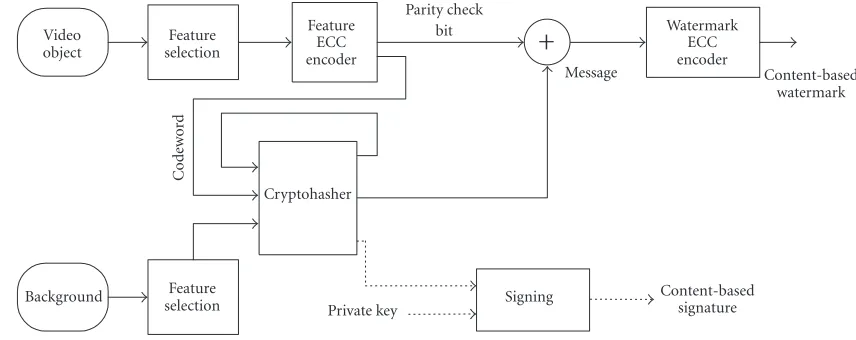
In this paper, we propose a complete object-based video authentication system to protect the authenticity of video content, as shown inFigure 2. The procedures of watermark generation and video authentication are given in Figures3 and4. The feature of the object is error correction coding (ECC) encoded first; the resultant codeword, together with the feature of the background, is then hashed (e.g., MD5 or SHA-1 [11]) to get a short content-based message so that a secure link between the object and the background is created to protect the integrity of the video. The system’s robustness to various video processing is guaranteed by ECC and wa-termarking; and the system’s security is protected by cryp-tographic hashing which is a basic algorithm used to gener-ate message authentication code (MAC [1]). We will explain these in Sections2 and3 in detail. It is worth mentioning here that this content-based message can also be signed by the system’s private key to generate a digital signature (the part marked by the dotted lines inFigure 3) and therefore it can be easily incorporated into public key infrastructure (PKI).
The proposed system is the continuation of our previous works [12,13]. The paper is organized as follows: the frame-work of the proposed system will be introduced inSection 2; the content-based watermark generation and verification are illustrated in Section 3; watermark embedding and extrac-tion algorithm will be explained in Section 4; experimen-tal results will be given inSection 5; conclusion and future works are presented inSection 6.
2. OVERVIEW OF THE PROPOSED SYSTEM
As we have described in the introduction section, the pro-posed system is designed to be robust to incidental distor-tions introduced by acceptable video processing. So we will define the acceptable video processing before briefing on the proposed system, because only after the acceptable video processing is defined, can we evaluate the robustness and se-curity of the system.
2.1. Targeted acceptable video processing
Resizing (scaling)
The resources of end users may vary significantly. For exam-ple, monitors of some devices may not be able to display the video in its original resolution. So the received video has to be scaled to meet such limitation. As a result, the designed video authentication system must be robust to resizing (scal-ing) processing. In real application such as video transcod-ing, resolution is halved when the video is converted from CIF format to QCIF format. Since the information of the ob-ject is mostly preserved when the scaling factor exceeds 1, it is easier to design a robust video authentication system under this condition compared with the case when the scaling fac-tor is less than 1. Thus, we will assume that the scaling facfac-tor is in a range from 0.5 to 1 in this system.
Rotation/translation
In video editing, the VO may be translated and/or rotated to meet end user’s specific requirement. Because the video content remains unchanged after the object is rotated and/or translated, the proposed system should be robust to object rotation in any degree and object translation in any style.
Segmentation error
Video object
Background
Feature selection
Feature ECC encoder
Feature selection
Co
de
word
Cryptohasher
Parity check bit
+
WatermarkECCencoder
Message Content-based
watermark
Content-based signature Signing
Private key
Figure3: Procedure of watermark generation. The inputs are video object and background; and the output is a content-based watermark. A secure link between the object and background is created to protect the integrity of the video. The system can be incorporated into public key infrastructure.
Background bitstream
Object bitstream
MPEG4 decoder
MPEG4 decoder
Watermark extraction
Watermark ECC decoder
Feature selection
Feature ECC decoder
Feature ECC decoder
Watermark ECC decoder
Bit-by-bit comparison Y/N PCB
Hashed digest (1)
Hashed digest (2) Feature
codeword
Crypto-hasher
Feature selection
Watermark extraction
Figure4: Procedure of video authentication. The inputs are video object and background; the output is the authenticity of video.
into a “raw video” for display and storage regardless of its authenticity at the receiving site. Only when necessary, such as the incidence of an illegal withdrawal of cash from an ATM machine, will the end users, bank in this case, check the video authenticity. So the video has to be segmented again before authentication can proceed. A segmentation er-ror between the object at the sending site and the reseg-mented object at the receiving site may exist. Therefore, the proposed system should be robust to slight segmentation er-rors.
MPEG4 coding
The VO and background are usually compressed before they are transmitted. The proposed system should, hence, be ro-bust to such kind of coding if the quality of video after com-pression is still satisfactory. In MPEG4 coding, two processes will affect the robustness of the video authentication system. One is the requantization process that is common in most coding schemes; the other is the repadding process that is unique for MPEG4 coding. In our system, we use bit rate to measure the requantization step.
Table1: Acceptable video processing and their parameters for sys-tem evaluation.
Video processing Parameters
Rotation Any degree
Translation Any direction and extent
Resizing Scaling factor: 0.5–1.0
Requantization (MPEG4 coding) Bit rate (512 Kbps) Segmentation error Edge error Repadding (MPEG4 coding) Zero padding
We summarize the typical acceptable video processing in
Table 1. The parameters for evaluating the system are also
listed here. (More details on experiments will be given in
Section 5.)
2.2. System brief description
cost. So it is reasonable that we only protect the integrity of the video clips that contain interesting objects. How to define an interesting object is application dependent and usually very difficult. Fortunately, in surveillance applica-tions, we have observed that the interesting objects, such as a person in an ATM monitoring system, are usually quite large. Thus, the size of the object is selected as a trigger to start signing and verification in the proposed system (re-fer to Figure 1). One video sequence may include many objects, and the objects themselves may overlap in some video frames. We will leave this case for future study. In this proposed system, we only focus on video sequence where every video frame contains one or more nonoverlap ob-jects.
Figure 2is the block diagram of the proposed system. It
comprises two parts: signing and verification. The procedure for signing is on the left side, and the procedure for verifica-tion is on the right side.
In the signing procedure, the input could be in either raw video format (segmentation is needed in this case) or object/background MPEG4 compliant format while the out-puts are signed MPEG4 bitstreams. Firstly, features of the object and its associated background are selected. Details of feature selection will be described later. Secondly, a content-based watermark is created content-based on the selected features, as shown inFigure 3. The selected feature of the object is ECC encoded first to ensure that the same feature can be obtained in the verification procedure in spite of the incidental dis-tortion. For the reason of system security, the ECC code-word and the feature of the background are cryptographi-cally hashed (e.g., MD5 or SHA-1) to get a content-based di-gest, which will be used to authenticate the video during ver-ification. A content-based message is created based on this digest and parity check bit (PCB) data of the codeword. In practice, another ECC scheme, such as convolutional coding [14], is employed to increase the robustness of watermark to the incidental distortions. Following the similar procedure, the watermark for the background can also be created. For simplicity, we will only focus on the object processing (ject feature selection, ob(ject watermark generation, and ob-ject watermark embedding and extraction) in this paper. The watermarks are embedded in the DFT domain of the ob-ject/background. Details will be given in Section 4. Finally, the watermarked object and background are compressed into MPEG4 bitstreams. Note that if we want to generate a dig-ital signature for the video, what we need to do is to use the system’s private key to sign on the hashed digest by the well-known digital signature scheme such as DSA or RSA [1].
To authenticate the received video, the MPEG4 bit-streams have to be decompressed to get the VO and back-ground again. (In certain applications, if the inputs are al-ready separated, object and background, this step can be skipped. If the input is a video sequence including object and background, segmentation should be employed first.) Fol-lowing the same way as signing, features of the object and background can be obtained. Note that the features are com-puted from the received object and background. Meanwhile,
watermark is extracted from the received object. Authentic-ity decision comprises two steps. In the first step, the PCB data contained in the watermark and the feature obtained from the received object are concatenated to form a feature codeword; the syndrome of the codeword is calculated to see whether it is correctable. If not, we claim that the video is unauthentic. If yes, we turn to the second step. The authen-ticity of the video is decided by bit-by-bit comparison be-tween the two hashed digests. (One is the newly generated based on hashing ECC codeword and the other is extracted from the watermark.) Even if there is only one-bit difference between them, we claim that the authenticity of the video has been broken. More detailed description will also be given in
Section 3.
From the above description, we can find that feature se-lection; watermark generation and authenticity verification; and watermark embedding and extraction are the three im-portant parts of our proposed object-based video authenti-cation system. In addition, a good segmentation tool is also very important for a successful authentication system. But it is beyond the scope of this paper.
3. WATERMARK GENERATION AND
AUTHENTICITY VERIFICATION
Before discussing the watermark generation and authenticity verification, we will discuss feature selection.
3.1. Feature selection
The feature selected to create a watermark in our proposed video authentication system should have the following three properties: robustness, discriminability/sensitivity, and short length.
Robustness
The feature should have little or even no change if the video only undergoes acceptable video processing defined in
Section 2.
Discriminability
The feature should be able to represent the specific VO. Fea-tures obtained from different objects should be different.
Short length
Because of the issue of watermark capacity, the feature size should be small.
0 10 20 30 40 ART coefficients
No
Figure5: 36 normalized ART coefficients calculated from the first frame of video Akiyo. Usually high-order coefficients have smaller magnitudes.
The definition of ART is given in equation (1).Fnmis an
ART coefficient of ordernandm;Vnm(ρ,θ) is the ART basic
function that is separable along the angular and radial di-rection; and f(ρ,θ) is a gray image in polar coordinates. In MPEG7, f(ρ,θ) represents mask function. Here, we modify this ART definition to make sure that the ART coefficients are sensitive to some intentional attacks, in which only the content of the object is modified while the shape of the ob-ject remains unchanged. This modification on ART defini-tion, however, may bring an impact: the robustness of high-order ART coefficients may be affected by the interpolation error during rotation and scaling. Later, we will see how this impact could be overcome:
Fnm=
Figure 5shows the 36 normalized ART coefficients of the
first frame of video sequence “Akiyo,” shown inFigure 6a. In MPEG7 specification, 35 ART coefficients (excluding the first coefficient) are recommended to be used, and each coeffi -cient is quantized to 4 bits/coefficient. Hence, a region-based shape descriptor is a 140-bit data. But in our video authen-tication system, 140 bits is still too long to generate a water-mark. Fortunately, from the following discussion, we will see that not all these 35 ART coefficients are necessary to be se-lected and not every coefficient is necessary to be quantized to 4 bits.
As we have mentioned above, the feature of the VO for generating a watermark should be robust and well discrim-inable. Among the ART coefficients, the low-order coeffi -cients, which are also considered as low-order moments, rep-resent the basic information of the VO while the high-order coefficients, which are also considered as high-order
mo-(a) (b)
(c) (d)
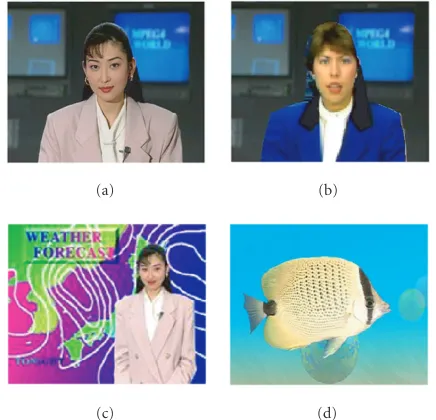
Figure6: Video sequences for feature vector evaluation. (a) Akiyo, (b) Attacked Akiyo 1, and (d) Bream are CIF videos. (c) Weather is QCIF video. The shapes of (a) and (b) are identical.
ments, represent the detailed information of the VO. So, the low-order coefficients should be part of the selected feature. The selection of high-order coefficients should consider both the robustness and the discriminability. For high discrim-inability, these coefficients, which represent the detailed in-formation, must be kept. But for robustness, these coeffi -cients, which may change due to loss of high-frequency in-formation and interpolation error when object is scaled or rotated, should be discarded. It is a trade-off. The dissimi-larity measure equation [15], which is used to measure the dissimilarity between two objects, is useful for us to choose the high-order coefficients:
Dissimilarity=
i
Md[i]−Mq[i], (3)
wheredandqrepresent different images, andMis the array of normalized magnitude of ART coefficients.
This equation clearly indicates that the coefficients with smaller magnitudes have less contribution to object recogni-tion. So, discarding these coefficients will not affect the rep-resentation of the object significantly. Since high-order co-efficients usually have smaller magnitudes, in the proposed system, we scan the 36 ART coefficients in zigzag format, and select the first 18 ART coefficients as the feature of the ob-ject. This information is known to both sending and receiv-ing sites once the decision has been made. We will explain why we select the first 18 ART coefficients as the feature of the object later in this section.
Table2: Two-bit quantization.
Level 0 1 2
Code 00 01 11
(FV) is created to represent a VO by concatenating the binary codes. The quasigray code conversion is to ensure that one-bit change of FV only represents one unit modification on the feature of video content so that the difference between two objects can be easily measured by just calculating the Ham-ming distance between their two corresponding FVs. Hence, equation (3) can be rewritten as equation (4)
Dissimilarity=FVd−FVq, (4)
wheredandqrepresent two different VO.
Now, we start to explain why the first 18 ART coefficients are selected as the feature of VO based on feature selection criteria. The empirical way to select the ART coefficients will be given first. Experimental results will then be given to prove that such a selection is correct.
The empirical way to filter the ART coefficients is as fol-lows.
(a) Scan the 36 ART coefficients in zigzag format. (b) As we have mentioned previously, low-order ART
co-efficients should be part of our selected feature. We make a reasonable assumption that the first 9 ART co-efficients are classified as low-order coefficients, and hence must be part of the selected feature. So we only consider the ART coefficients from 10 onwards. For a specifiedNi(10 ≤ Ni ≤35), the firstNi ART coeffi
-cients are used to create an FV. Then, the maximum Hamming distance between the FV extracted from the original object and the FV extracted from the object processed by all kinds of acceptable video processing is computed. If this distance is small and robust for all training video sequences,Niwill be considered as the
candidate of robustness groupGr,Gr= {Ni,. . .,Nk}.
(c) For every member in the robustness group Gr, the
Hamming distance between FVs extracted from two different VOs is calculated. If this distance is much larger than the maximum Hamming distance between the original VO and the processed VO (i.e., 3), we can say that this feature has good discriminability. All these kinds ofNiare defined as a groupGrs.
(d) The smallest number in the groupGrsis the number of
ART coefficients that should be selected.
Four video sequences are used during the above-mentioned filtering. They are CIF videos “Akiyo,” “Attacked Akiyo 1,” “Bream,” and QCIF video “Weather.” Figure 6 shows the first frame of every video sequence. Among them, the shape information of video Attacked Akiyo 1 is identical to that of the video Akiyo. We give the experimental results when the first 18 ART coefficients are selected to create an FV.
Figure 7 shows the maximum Hamming distance
be-tween the FV extracted from the original object and that
Table3: Four-bit quantization.
Level 0 1 2 3 4
Code 0000 0001 0011 0111 1111
from the object having undergone various video processing. The video processing includes scaling (scaling factor is in a range from 0.5 to 0.9), rotation (rotation degree is in a range from 10◦to 30◦) and MPEG4 compression, and “Cubic” in-terpolation technique is employed during rotation and scal-ing processscal-ing. From the results, we can find that the max-imum Hamming distance is not greater than 3. So we can claim that the selected feature is robust to object rotation, object resizing, and MPEG4 compression.Figure 8shows the difference between the mask of original object and the mask of processed object. FromFigure 8c, we can see that this dif-ference is similar to segmentation error. The maximum error on the edge is about 4 pixels. Usually the maximum pixel er-ror on the edge of segmented object is also around this num-ber. We therefore simulate the segmentation error by using the mask difference. Because the selected FV is robust to such kind of mask difference, we claim that the selected feature is robust to slight segmentation error.
Figure 9ashows the Hamming distance between the FV
extracted from Attacked Akiyo 1 and that from Akiyo. The distance between the FV extracted from Bream and that from Akiyo is given inFigure 9b. From both figures, we find that the Hamming distance exceeds 10 in most frames. This is much larger thanthe maximum Hamming distance between the originalobject and the processed object. Hence, we con-clude that the selected feature has good discriminability, be-cause we can easily deduce whether the two objects are dis-tinct objects or just modified duplicates of each other from the FVs.
Above experimental results demonstrate that the FV cre-ated from the first 18 ART coefficients can meet the robust-ness and discriminability requirements. So we will select the first 18 ART coefficients as the feature of the object in the proposed video authentication system.
3.2. Watermark generation and authenticity verification
0 50 100 150 200 250
Figure7: (a) Akiyo, (b) Attacked Akiyo 1, and (c) Weather show the maximum Hamming distance between the feature vector obtained from the original object and that from the object undergoing various video processing including rotation, resizing, and MPEG4 coding. (d) Bream (resizing only) shows the maximum Hamming distance between the original object and the scaled object. The horizontal axis represents the frame number, and the vertical axis represents the Hamming distance. From these figures, we can find that all maximum Hamming distances are not bigger than 3.
of video frames from being changed. Fourthly, the firstn-bit data of the processed result and the PCB data of the feature codeword are concatenated to create a content-based mes-sage. Finally, this message is encoded again by another ECC scheme (we define it as watermark ECC coding scheme) to generate a content-based watermark.Figure 10illustrates in-termediate results during watermark generation. It is found that the watermark is a convolutional code by encoding the content-based message.
From the procedure of watermark generation, we can find that authenticity of video is protected securely. The se-curity of the video is achieved by hashing the ECC codeword. Further processing of the hashed digests from two consecu-tive frames also improves the security of the video. In this system, only part of the hashed digest (30 bits) instead of all the 128 bits is used to create the watermark because of the limitation in watermarking capacity. Note that reducing length of hashed digest may cause some security risks; how-ever, it is still acceptable in real applications, because a strong contextual property in video content also makes attacking content difficult. Clearly, our proposed object-based solution can be easily incorporated into PKI by generating a digital signature based on the hashed digest and a selected signature scheme such as RSA or DSA [1].
The procedure for authenticating received VO is shown
inFigure 4. No original video is needed during
authentica-tion. Firstly, PCB data and the hashed digest are obtained by ECC decoding the extracted watermark. (It is the reverse process of watermark ECC coding in watermark generation.) Secondly, FV of the received object is calculated, which may be different from the FV of the original object since the re-ceived VO may have undergone various video processing; PCB data is used to correct this difference. Thirdly, a hashed digest for the received object can be calculated following similar steps in watermark generation. Finally, this hashed digest and the hashed digest obtained from the extracted watermark are compared bit by bit to decide the authentic-ity of the object: even if there is only one-bit difference, the video will be claimed as unauthentic.
We roughly explain the feature ECC coding scheme and the watermark ECC coding scheme employed in the pro-posed system. Please refer to [18] for more details on em-ploying ECC scheme.
Feature ECC coding
50 100 150 200 250 250
200 150 100 50
(a)
50 100 150 200 250 250
200 150 100 50
(b)
50 100 150 200 250 250
200 150 100 50
(c)
Figure8: Mask difference (c) between the original object: mask (a) and the processed object mask (b). This difference is similar to the segmentation error.
0 50 100 150 200 250
Frame number
H
amming
distanc
e
0 2 4 6 8 10 12 14 16 18 20
(a)
0 50 100 150 200 250
Frame number
H
amming
distanc
e
0 5 10 15 20 25
(b)
Figure9: The distance between feature vectors obtained from different video objects (a) Akiyo and Attacked Akiyo and (b) Akiyo and Bream.
is relatively small compared with the Hamming distance be-tween FVs obtained from two different VOs. So, the de-sign of feature ECC coding scheme should follow such a rule: it should be able to correct the difference between FVs obtained from the original object and that from the object that has undergone acceptable video processing; on the other hand, it should not be possible for the diff er-ence between FVs obtained from different objects to be corrected. For instance, the maximum Hamming distance is 3 in Section 3.1, so the selected feature ECC coding scheme must be able to correct 3 errors in the feature code-word.
Watermark ECC coding
Since the received VO may undergo a series of acceptable video processing, the extracted watermark is usually not identical to the embedded watermark. But in our system, we have to get the original message (i.e., the PCB data of the feature codeword and hashed digest) from the extracted wa-termark. This problem is solved by introducing the water-mark ECC coding scheme. The design of waterwater-mark ECC coding scheme should consider the error ratio between the extracted watermark and the original watermark in order to make sure that the original message can be recovered free of errors.
4. WATERMARK EMBEDDING AND EXTRACTION
To design an object-based video authentication system that is robust to various acceptable video processing, the water-marking algorithm should also be robust to these forms of video processing.
Fourier-Mellin transform is widely used in pattern recog-nition because of its invariance to image rotation, scal-ing, and translation. A watermarking algorithm based on Fourier-Mellin transform is first suggested by O’Ruanaidh and Pun [19]. Lin et al. [20] further proposed a rotation, scale, and translation resilient watermarking scheme closely related to the Fourier-Mellin transform. However, unbal-anced sampling of DFT coefficients, introduced by log-polar mapping and inverse log-mapping in Fourier-Mellin trans-form, may cause a loss of image quality. The computation ex-pense and watermark capacity of Fourier-Mellin transform-based watermarking algorithms still cannot meet the needs in designing our object-based video authentication system. This could be one of our future works.
ART coefficients calculation
Feature selection
Feature ECC coding
Hasher PCB data (1)
+
Watermark ECC coding
ART coefficients
Feature vector
Hashed digest
Hashed digest PCB data (1) 1010101100. . .111000111
Feature vector PCB data (1) Feature codeword
Crypto-hashed digest
Message
Watermark Convolutional code of message
44 bits
63 bits
30 bits 18 bits
162 bits
Figure10: Illustration of watermark generation. The main procedure is on the left side, and the intermediate results are on the right side. PCB data (1) is the PCB data of feature codeword.
4.1. Challenges and solutions for object-based watermark embedding and extraction
Repadding
In order to perform DFT on VO, the VO has to be padded to form a rectangular area (image) first since the shape of the object is usually irregular. However, this padding will affect the robustness of watermarking because the watermark in-formation will be not only in the object area but also in the padding area after watermark embedding and inverse DFT (IDFT). During MPEG4 encoding, most of this padding area will not be encoded and transmitted so that some watermark information may be lost. If the padding area is large, some watermark bits will not be correctly extracted. To solve this problem, the size of the padding area should be limited, and the relationship between two DFT coefficients instead of the individual DFT coefficient is used to embed the watermark.
Rotation
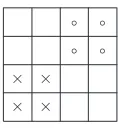
Lin et al. [20] also pointed out that the DFT of a rotated im-age is not the rotated DFT of the original imim-age due to the rectilinear tiling, as shown inFigure 11. It indicates that if the watermarked object is rotated, it has to be rotated back for watermark extraction. However, such kind of rotation will introduce interpolation error that affects robustness of wa-termarking. To overcome this problem, the relationship be-tween two groups of DFT coefficients, rather than the rela-tionship between two DFT coefficients, is used to embed the watermark, as shown inFigure 12.
Rotation also causes the synchronization problem in wa-termark embedding and extraction. We adopt the method given in [8] to solve this problem. The eigenvectors of the ob-ject are calculated first, and then the VO is adjusted to align its maximum eigenvector with the x-axis in two-dimensional space before watermark embedding and extraction. Ideally, the alignment parameters (e.g., the rotation degree) used for watermark embedding should be identical to those used for watermark extraction. In practice, this assumption is not ap-propriate. Many factors such as mask error caused by the ob-ject manipulation will interfere in getting exactly the same alignment parameters in watermark extraction. By using the relationship between two groups of DFT coefficients to em-bed the watermark, such incurred distortion will be allevi-ated.
Resizing (scaling)
In this paper, we only focus on the cases when the scaling factor is less than 1. We will also assume this scaling factor is known during watermark extraction. This assumption is reasonable since we can get the resolution information about the original object by analyzing the MPEG4 bitstream. So the object can be scaled back to its original resolution before wa-termark extraction.
50 100 150 200 250 300 300
250 200 150 100 50
(a)
50 100 150 200 250 300 300
250 200 150 100 50
(b)
Figure11: Comparison between (a) DFT of the original Akiyo image and (b) DFT of the 20◦rotated Akiyo image. The DC of the DFT is located in the center of the image. These two figures show that the DFT of a rotated image is not the rotated DFT of its original image.
◦ ◦
◦ ◦
× × × ×
Figure 12: DFT coefficients grouping for watermarking. The bottom-left corner points to the origin of DFT domain. Eight DFT coefficients in 4×4 group are classified into two subgroups.
coefficients of processed image whileFo(u,v) represents DFT
coefficients of original image.αis scaling factor whileDis half of the image resolution:
Fp(u,v)≈Fo(u,v) |u,v|< αD. (5)
Figure 13 shows this phenomenon; that only the
low-frequency and middle-low-frequency DFT coefficients have no change or little change after the object is scaled. Equation (5) also reminds us that scaling factorαshould be closely exam-ined before we select a frequency area to embed watermark. For example, if the scaling factor is 0.5, watermark should be embedded in an area where all frequencies in this area are less than half of the maximum frequency. In addition, we have to bear in mind that the modification on low-frequency coeffi -cients will significantly degrade the image quality. Consider-ing these two factors, a low-middle frequency area (texture-filled part inFigure 14a) is selected to embed watermark in our algorithm. Note that Solachidis and Pitas [21] and Barni et al. [22] also have similar considerations in their proposed algorithms. In comparison, we also show the area selected by Barni et al. [22] to embed watermark inFigure 14b. Again, the interpolation error introduced by scaling object will also affect the robustness of the watermarking algorithm. Such in-curred distortion, however, will be alleviated by using the re-lationship between two groups of DFT coefficients to embed watermark.
4.2. Watermark embedding
The embedding procedure comprises the following three steps: pre-embedding, embedding, and postembedding.
Pre-embedding
(a) Adjust the object to align its mask’s maximum eigen-vector with the x-axis in two-dimensional space. (b) Expand the object into a rectangular image whose size
is predefined. The selection of image size should con-sider the object size. Zero padding is used during ex-pansion.
(c) Compute the DFT coefficients; shift the DFT coeffi -cients in order that the DC coefficient locates in the center of DFT domain.
(d) Randomly select groups of DFT coefficients in the low-middle frequency area (shown inFigure 14a). The seed to generate the random number sequence is only known to watermark embedding site and watermark detector. Eight DFT coefficients in each 4×4 group are classified into two subgroups, defined as SG1 and SG2, respectively, as shown inFigure 12.
Embedding
(e) Compute the energies (E1,2) for SG1 and SG2:
E1,2=
SG1,SG2
F(u,v), (6)
whereF(u,v) is the DFT coefficient at frequency (u,v). (f) Calculate the adaptive threshold (TH) for each group:
TH=α∗ f M/2
β
, (7)
where f =√u2+v2stands for the frequency at point
50 100 150 200 250 300 300
250 200 150 100 50
(a)
50 100 150 200 250 300 300
250 200 150 100 50
(b)
50 100 150 200 250 300 300
250 200 150 100 50
(c)
Figure13: Comparison between (a) DFT of the original Akiyo image, (b) DFT of the scaled Akiyo image (scaling factor=0.75), and (c) DFT of the scaled Akiyo image (scaling factor=0.5). The DC of the DFT is located in the center of the image. Figures show that only the low-frequency coefficients and middle-frequency coefficients have little or no change after the image is scaled.
(a) (b)
Figure 14: Area classification in DFT domain. The texture-filled area is selected to embed the watermark: (a) selected area in our proposed algorithm and (b) selected area in Barni’s algorithm.
(g) Modify the threshold according to the following equa-tion:
MTH=
2 3TH
E1−E2>0, watermark bit=1)
orE1−E2<0, watermark bit=0),
4
3TH others.
(8)
Iteratively modifyE1andE2until equation (9) is
sat-isfied. Note thatE1andE2should be kept as positive
values during iterative calculation:
E1−E2>MTH, watermark bit=1,
E2−E1>MTH, watermark bit=0.
(9)
(h) Based on the newly modified energiesE1andE2,
ad-just the magnitude of every DFT coefficient in SG1 and SG2 while keeping their phases unchanged. The mod-ification of each DFT coefficient is with reference to its original magnitude.
(i) For every watermarked coefficient, its symmetric coef-ficient with reference to the DC component of DFT should also be modified to ensure that the water-marked video pixels have real values.
Figure15: Surveillance video Dajun.
Postembedding
(j) The watermarked image is generated using IDFT. This image is rotated back to its original orientation. (k) Finally, a watermarked VO is extracted again for
MPEG4 encoding.
4.3. Watermark extraction
Watermark extraction is the reverse procedure of watermark embedding. The received VO is scaled back to its original res-olution first. Then, similar to the embedding procedure,E1
andE2for each subgroup are calculated. Finally, the
water-mark bit is extracted based on the following criterion:
watermark bit=
1, E1−E2>0,
0, else. (10)
4.4. Evaluation of the robustness of watermarking algorithm
To evaluate the robustness of watermarking algorithm, cor-rect ratio of the extracted watermark is defined in the follow-ing equation:
correct ratio=no. of watermark bits detected correctly length of watermark .
0 50 100 150 200 250
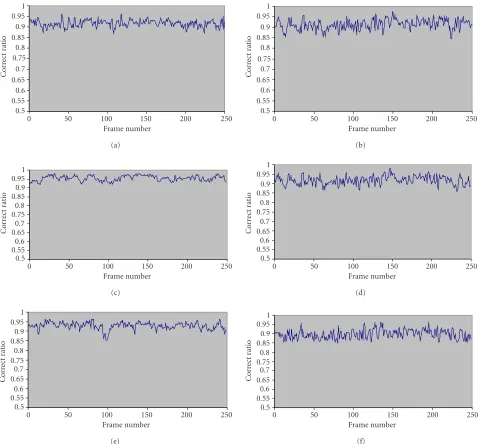
Figure16: Correct ratio of extracted watermark under various video processing. All figures show that the correct ratio is larger than 0.85. (a) Akiyo (scaling factor=0.5), (b) Bream (scaling factor=0.5), (c) Akiyo (rotation degree=30), (d) Bream (rotation degree=20), (e) Akiyo (rotation/scaling/MPEG4 coding), (f) Bream (rotation/scaling/MPEG4 coding).
The videos used for evaluation are the same as what we have used in feature selection evaluation except that the QCIF video Weather is replaced by a surveillance video called “Dajun,” shown inFigure 15. During the evaluation, a content-based 162-bit watermark is used. Some results of evaluation based on Akiyo and Bream are shown in
Figure 16. From Figure 16, we find that the correct ratio is
bigger than 0.85 if the object is rotated, scaled, or processed by a combination of rotation, scaling, and MPEG4 coding. Similar results can also be obtained from evaluation of other videos. All these results illustrate that the watermarking al-gorithm is robust enough to ensure that the original mes-sage for watermark generation can be correctly extracted if the watermark ECC coding scheme is properly designed.
5. EXPERIMENTAL RESULTS
The objective of this paper is to design an object-based video authentication system that can protect the integrity of video (object/background) while allowing various natural video processing. In our experiment, 300 frames from every video are used for evaluation. We mainly evaluate the system in fol-lowing four aspects:
(a) whether this system is robust to acceptable video pro-cessing defined inSection 2;
(b) whether this system can detect object replacement; (c) whether this system can detect background
replace-ment;
0 50 100 150 200 250 300 Frame number
PSNR
(dB)
Watermark system Watermark embedding 3.4
3.6 3.8 4.0 4.2 4.4 4.6
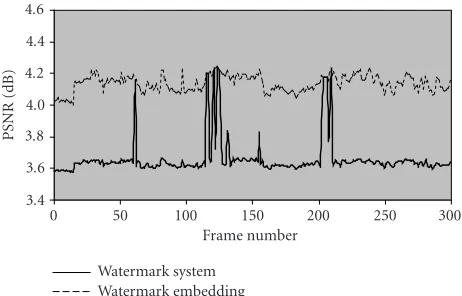
Figure17: PSNR of watermarked video Akiyo. The dashed line rep-resents the PSNR of object before and after watermarking with only watermarking distortion. The solid line represents the PSNR of wa-termarking system with not only wawa-termarking distortion but also alignment distortion and interpolation error.
We have developed this system using Visual C++ 6.0. In this system, the first 18 ART coefficients from total 36 ART coefficients in MPEG7 shape descriptor are selected as fea-ture of the object. Among these 18 coefficients, 4 coefficients are quantized into 5 levels (4 bits), and the other 14 coeffi -cients are quantized into 3 levels (2 bits). The resultant FV is a 44-bit data (4×4 + 2×14=44). We employ BCH (63,45,3) ECC coding scheme, which has 3 bits error correction capa-bility (this capacapa-bility is equal to the maximum Hamming dis-tance between the FV obtained from the original object and the FV obtained from the object undergoing various video processing), as the feature ECC coding scheme. Eighteen-bit PCB data of the feature codeword and 30-bit hashed digest are concatenated to create a 48-bit message. Convolutional coding (K =7, rate = 1/3) is used as the watermark ECC coding scheme. The start and end states are all set to 0. As a result, the watermark is a 162-bit binary data.
As we mentioned inSection 2, the size of object in video is chosen as a trigger to start signing and verification in this system. During evaluation, the system automatically starts signing or verification if ratio between object and its asso-ciated image is greater than 15% for a CIF video.
Recall that in watermark embedding procedure, we need to estimate the orientation of the object before aligning its mask’s maximum eigenvector with the x-axis in two-dimensional space. After embedding watermark, the water-marked object needs to be rotated back to its original lo-cation. So two PSNR exist to measure the system’s perfor-mance. One is the PSNR of object before and after water-marking with only waterwater-marking distortion; the other is the PSNR between the original object and the watermarked ob-ject, including watermarking distortion, alignment distor-tion as well as interpoladistor-tion error introduced by rotadistor-tion. The dashed line in Figure 17represents the former PSNR, and the solid line represents the latter PSNR. FromFigure 17, we can find that two PSNR in some frames are equal. This is
(a) (b)
Figure18: Comparison between (a) the original frame and (b) the watermarked frame (of Akiyo).
because no alignment is needed in these frames before and after watermarking since the mask’s maximum eigenvector of the object is just parallel to the x-axis. This phenomenon also means that the quality is degraded about 5 dB after the VO is rotated.
Figure 18shows the original object and the watermarked
object. The number of frames that are correctly authenti-cated is shown inTable 4. From the table, we can claim that the proposed system is robust to acceptable video process-ing. However, the results obtained from the video sequences Bream and Dajun are not as good as the results acquired from the video sequences Akiyo and Attacked Akiyo 1, especially in scaling processing. This is because of relatively small size of the object in some frames in video sequences Bream and Da-jun. To embed a 162-bit long watermark, even small object has to be expanded to a certain size using zero padding. As we have mentioned previously, this will reduce correct ratio of watermark detection. Moreover, small object will lose more information than large object when the object is scaled; this will also reduce correct ratio of watermark detection. Thus, compared with other types of video processing, watermark detection is much more sensitive to object size in scaling pro-cessing. Study of the relationship between the object size and watermarking will be our future work.
We use video Attacked Akiyo 1 to evaluate whether the system can detect object replacement. During signing, the watermark generated from video Akiyo is embedded into the object of video Attacked Akiyo 1. During verification, the sys-tem can detect that all the frames are unauthentic. So the pro-posed system can detect object replacement.
To evaluate the system’s security (i.e., to detect whether the object and background belong to the same frame or in-tegrity protection), we combined the object extracted from the embedded video Akiyo and the background taken from our laboratory to form a new video sequence called Attacked Akiyo 2, as shown inFigure 19. The verification results also show that the system performs well in protecting the integrity between the object and its associated background.
Table4: System performance when the video object undergoes various video processing (the number of video frames that are correctly authenticated for a video containing 300 frames).
Video object Resizing (scaling factor is 0.5–1.0) Rotation (0◦–30◦) MPEG4 coding Repadding
Akiyo 300 300 300 300
Bream 261 297 297 300
Dajun 274 293 300 300
Figure19: The background of the Akiyo has been replaced. This video is used to evaluate the system’s security (integrity protection). (Attacked Akiyo 2.)
in this system. As we have mentioned before, any malicious modifications, which may cause the maximum Hamming distance between the original VO and modified VO to be less than the feature ECC error-correcting capability (3 bits in our system), will be regarded as acceptable video processing. Therefore, a careful selection of feature and ECC scheme is the key work in our system.
6. CONCLUSION AND FUTURE WORKS
In this paper, we have proposed a new object-based video authentication system, where ART coefficients of the VO are used as the feature to represent the VO. A content-based wa-termark was then generated by using ECC schemes and cryp-tographic hashing to increase the robustness and security of the system. The watermark was embedded in a set of ran-domly selected DFT coefficient groups that locate in the low-middle frequency area. Experimental results further demon-strated that the proposed video authentication system is ro-bust during MPEG4 compression and normal VO processing such as scaling, rotation, as well as segmentation and mask errors. The results also showed that this system can protect the integrity of video (object and background).
In this paper, we assume that we only protect those ob-jects whose sizes are larger than a preset threshold. This as-sumption is practical in some applications such as surveil-lance. Although rigorous evaluation will involve extensive work in collecting testing videos and especially in generat-ing attacked videos, we still plan to conduct it in two ways: one is to fine-tune the parameter setting and perform the evaluation by real applications; the other is to continue the theoretic study among watermarking, ECC, and cryptogra-phy techniques to derive an adaptation framework for robust and secure content-based authentication.
Figure20: A flower is put on the embedded object. This is used to evaluate whether the system can detect object modification. (At-tacked Akiyo 3.)
REFERENCES
[1] B. Schneier, Applied Cryptography: Protocols, Algorithms, and Source Code in C, Wiley, New York, NY, USA, 2nd edition, 1996.
[2] F. Bartolini, A. Tefas, M. Barni, and I. Pitas, “Image authen-tication techniques for surveillance applications,”Proceedings of the IEEE, vol. 89, no. 10, pp. 1403–1418, 2001.
[3] A. Piva, R. Caldelli, and A. De Rosa, “A DWT-based ob-ject watermarking system for MPEG-4 video streams,” in Proc. IEEE International Conference on Image Processing (ICIP ’00), vol. 3, pp. 5–8, Vancouver, BC, Canada, September 2000.
[4] C.-Y. Lin and S.-F. Chang, “Robust image authentication method surviving JPEG lossy compression,” inStorage and Retrieval for Image and Video Databases VI, I. K. Sethi and R. C. Jain, Eds., vol. 3312 ofProc. SPIE, pp. 296–307, San Jose, Calif, USA, December 1997.
[5] J. Dittmann, A. Steinmetz, and R. Steinmetz, “Content-based digital signature for motion pictures authentication and content-fragile watermarking,” inProc. IEEE International Conference on Multimedia Computing and Systems, vol. 2, pp. 209–213, Florence, Italy, July 1999.
[6] M. P. Queluz, “Towards robust, content based techniques for image authentication,” inProc. IEEE 2nd Workshop on Mul-timedia Signal Processing, pp. 297–302, Redondo Beach, Calif, USA, December 1998.
[7] N. V. Boulgouris, F. D. Koravos, and M. G. Strintzis, “Self-synchronizing watermark detection for MPEG-4 objects,” in Proc. IEEE 8th Conference on Electronics, Circuits and Systems (ICECS ’01), vol. 3, pp. 1371–1374, Masida, Malta, September 2001.
[8] C.-S. Lu and H.-Y. M. Liao, “Video object-based watermark-ing: a rotation and flipping resilient scheme,” inProc. IEEE International Conference on Image Processing (ICIP ’01), vol. 2, pp. 483–486, Thessaloniki, Greece, October 2001.
Circuits and Systems (ISCAS ’01), vol. 2, pp. 49–52, Sydney, NSW, Australia, May 2001.
[10] P. Bas and B. Macq, “A new video-object watermarking scheme robust to object manipulation,” inProc. IEEE Inter-national Conference on Image Processing (ICIP ’01), vol. 2, pp. 526–529, Thessaloniki, Greece, October 2001.
[11] M. J. B. Robshaw, “MD2, MD4, MD5, SHA and other hash functions,” Tech. Rep. TR-101, version 4.0, RSA Laboratories, Redwood City, Calif, USA, July 1995.
[12] D. He, Q. Sun, and Q. Tian, “An object based watermarking solution for MPEG4 video authentication,” inProc. IEEE Int. Conf. Acoustics, Speech, Signal Processing (ICASSP ’03), vol. 3, pp. III-537–III-540, Hong Kong, China, April 2003.
[13] D. He, Q. Sun, and Q. Tian, “A semi-fragile object based video authentication system,” inProc. IEEE Int. Symp. Circuits and Systems (ISCAS ’03), vol. 3, pp. III-814–III-817, Bangkok, Thailand, May 2003.
[14] C. Lee,Convolutional Coding: Fundamentals and Applications, Artech House, London, UK, 1997.
[15] W.-Y. Kim and Y.-S. Kim, “A new region-based shape descrip-tor,” inISO/IEC MPEG99/M5472, Maui, Hawaii, December 1999.
[16] M. Bober, “MPEG-7 visual shape descriptors,” IEEE Trans. Circuits and Systems for Video Technology, vol. 11, no. 6, pp. 716–719, 2001.
[17] W. W. Peterson and E. J. Weldon Jr., Error-Correcting Codes, MIT Press, Cambridge, Mass, USA, 1984.
[18] Q. Sun, S.-F. Chang, K. Maeno, and M. Suto, “A new semi-fragile image authentication framework combining ECC and PKI infrastructures,” inProc. IEEE Int. Symp. Circuits and Systems (ISCAS ’02), vol. 2, pp. II-440–II-443, Phoenix-Scottsdale, Ariz, USA, May 2002.
[19] J. J. K. O’Ruanaidh and T. Pun, “Rotation, scale and transla-tion invariant spread spectrum digital image watermarking,” Signal Processing, vol. 66, no. 3, pp. 303–317, 1998.
[20] C.-Y. Lin, M. Wu, J. A. Bloom, I. J. Cox, M. L. Miller, and Y. M. Lui, “Rotation, scale, and translation resilient Public watermarking for images,”IEEE Trans. Image Processing, vol. 10, no. 5, pp. 767–782, 2001.
[21] V. Solachidis and I. Pitas, “Circularly symmetric water-mark embedding in 2-D DFT domain,” in Proc. IEEE International Conference on Acoustics, Speech, and Signal Pro-cessing (ICASSP ’99), vol. 6, pp. 3469–3472, Phoenix, Ariz, USA, March 1999.
[22] M. Barni, F. Bartolini, A. De Rosa, and A. Piva, “A new decoder for the optimum recovery of nonadditive water-marks,”IEEE Trans. Image Processing, vol. 10, no. 5, pp. 755– 766, 2001.
Dajun Hereceived the B.S. degree from Ts-inghua University, Beijing, China, in 1991 and the M.S. degree from Shanghai Jiao-tong University, Shanghai, China, in 1994, both in electrical engineering. From 1994 to 1995, he was a Lecturer in Shanghai Jiao-tong University, where he developed the HDTV simulation system for the Chinese Broadcasting Ministry. From 1996 to 2001, he was a Senior Engineer in AIWA,
Singa-pore, in charge of developing audio and visual consumer products. He joined Institute for Infocomm Research (I2R), Singapore, in 2001, as an Associate Scientist. His main research interests include image/video processing, compression, and security.
Qibin Sun received his Ph.D. degree in electrical engineering from University of Science and Technology of China, Anhui, China, in 1997. Since 1996, he has been with the Institute for Infocomm Research, Sin-gapore, where he is responsible for indus-trial as well as academic research projects in the area of face recognition, media security, and image and video analysis. He worked in Columbia University 2000–2001, as a Re-search Scientist.
Qi Tianis a Principal Scientist at the Me-dia Division, Institute for Infocomm Re-search, Singapore. His main research terests are image/video/audio analysis, in-dexing, retrieval, media content identifica-tion and security, computer vision, and pat-tern recognition. He has B.S. and M.S. de-grees from Tsinghua University, China, and a Ph.D. degree from the University of South Carolina, USA, all in electrical and