Examining the Lexical Effect on Categorical Perception of Stops
in Taiwan Southern Min
Yunglin Tai Institute of Linguistics National Chung Cheng University
Abstract
The goal of this study is to examine if there is a word superiority effect on perception of three-way contrast of stops in Taiwan Southern Min (TSM). Based on Ganong’s (1980) findings that English participants showed a significant lexical effect in phonetic perception, I hypothesize that there exists a difference in perception between real words and nonwords in TSM. The prediction is that the categorical boundary shifts as lexical status plays a role in perception of stops. Experiment 1 was conducted as a neutral set of perception of TSM bilabial stops b-p-ph. In experiment 2, cases of “nonword-word-nonword” set along the b-p-ph
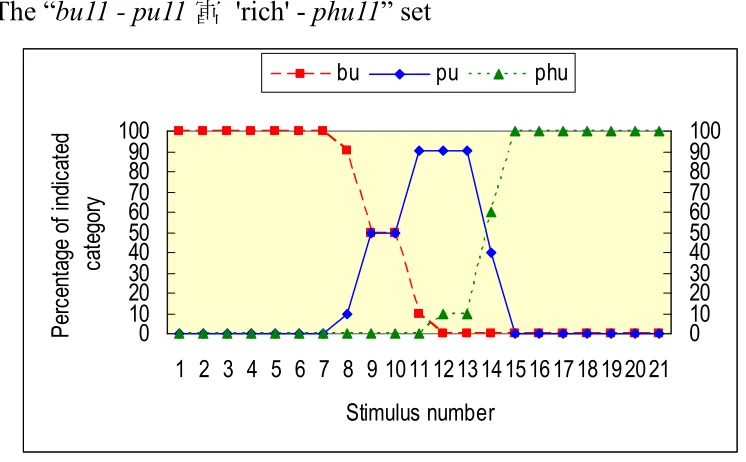
continuum were conducted. Results showed that real words corresponded to a wider range of VOT in the continuum compared to the neutral pattern. The categorical boundaries (both between /b/ and /p/ and between /p/ and /ph/) were found to shift away from the real word sides towards the nonword sides. The lexical effect may be explained by parallel processing in which a higher level of processing (lexical level) interacts with a lower level (phonemic level) in speech perception.
Keywords: perception, categorical boundary, VOT, lexical effect, processing
1. Introduction
Categorical perception, which represents that sounds within a phonemic category are perceived as indistinguishable regardless of the correct identification of each sound, supports the modular view that speech is perceptually special. In literature, consonants were found to be perceived categorically, but not gradual; that is, although listeners were able to distinguish the consonant stimuli between different phonetic categories with ease, mostly they failed to distinguish the stimuli within categories.
positive VOT value means such a lag exists (e.g. the aspirated [ph]); a VOT value of zero represents no delay in voicing; a negative VOT value refers to the phenomenon where the vocal fold vibrations begin before the articulatory release of the stop (the prevoiced [b]). As VOT varies gradually, the identification changes abruptly from one stop to another. This categorical perception drives how the modular view regards speech—as a modular system.
However, this raises an interesting question—is it modular in such a way that consonants are always perceived without the affection by other processing information? There are some parallel models proposed for linguistic processing. One of those is the Trace model of speech perception (McClelland & Elman 1986). The model assumes that different levels of processing—features, phonemes, and words—are activated simultaneously during speech perception, which contradicts with the modularity view that phonemic processing in unaffected by higher levels of processing.
Ganong (1980) investigated whether auditory word perception affected phonetic categorization. He constructed acoustic continua varying in voice onset time, each with an end being a real word and the other end a nonword (e.g., dash—tash vs. dask—task). The results showed a categorical boundary shift. Thus he argued that the lexical effect must arise at a processing stage sensitive to both lexical and auditory information.
Based on previous studies on categorical perception and Ganong’s (1980) findings on the lexical effect that English participants showed a significant lexical effect in phonetic perception, it is hypothesized that there exists a lexical effect—a difference in perception between real words and nonwords. The present study examines a language of a three-way contrast in initial stops, Taiwan Southern Min, to see if there is a word superiority effect on speech perception. The prediction is that real words will correspond to a wider range of VOT in the continuum either comparing to the neutral pattern or to the nonword situation. The logic behind it is that listeners tend to perceive an ambiguous sound as a real word rather than a nonword. If the prediction is true, it should be found that the phoneme boundaries (both between /b/ and /p/ and between /p/ and /ph/) shift away from the real word sides towards the nonword sides.
The current research questions are:
(1) Where is the categorical boundary between b and p and that between p and ph in Taiwan Southern Min (TSM)?
(2) Does lexical status (a real word or nonword) of a sound sequence affect the perception of TSM stops? If it does, how does the categorical boundary shift?
The pinyin system (including consonants, vowels and tones) adopted in this paper follows “台灣閩南語音標系統” released by Ministry of Education in 1998. Example lexemes were obtained through
臺灣閩南語辭典
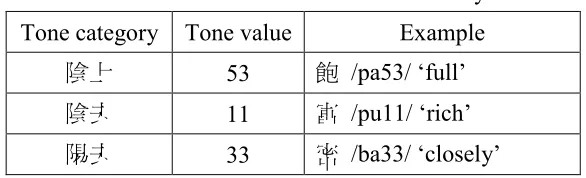
by 董 et al. (2001).Table 1. Tones used in the current study Tone category Tone value Example
陰上 53 飽 /pa53/ ‘full’ 陰去 11 富 /pu11/ ‘rich’ 陽去 33 密 /ba33/ ‘closely’
2. Experiment 1—identification of a neutral set
Experiment 1 is an identification task designed to test the categorical boundaries of bilabial stops b, p, and ph in TSM. Serving as a neutral set, stimuli were not informed to participants beforehand about their lexical or non-lexical status in TSM. Rather, they were instructed to pay attention to any change of the consonant category only.
2.1 Methods
2.1.1 Participants
Ten native speakers of TSM participated. All of them were graduate students from National Chung Cheng University, with self-reported fluency in TSM.
2.1.2 Materials
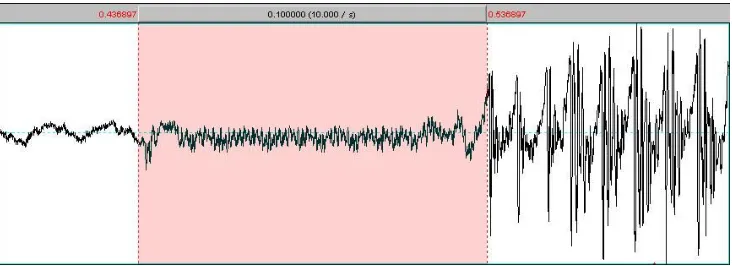
21 stimuli from the bilabial neutral continuum pair ba—pa—pha, with VOTs of -100, -90, -80, -70, -60, -50, -40, -30, -20, -10, 0, 10, 20, 30, 40, 50, 60, 70, 80, 90 and 100 msec manipulated in Praat (Boersma & Weenink 2007). Voice onset time (VOT) in msec of each syllable-initial stop was measured from the release of the stop closure to the beginning of the oscillating line which demonstrates voicing in the following vowel.
These stimuli are adjusted from a TSM male speaker’s natural speech. Among the 21 stimuli, all attributes of sounds are identical except the VOT in syllable initials.
The manipulation of prevoicing or aspiration is through deletion or addition from a range of repetitive circular noise lines. One thing to be careful is that the beginning and ending point in selection must match each other in terms of their amplitude position. Otherwise, low pitch noise or unnatural burst would be created during manipulation.
Figure 1. A Stimulus with -100ms in VOT (prevoicing)
Figure 2. A Stimulus with 0ms in VOT
Figure 3. A Stimulus with 100ms in VOT (aspiration)
2.1.3 Procedure
Stimuli were saved as a WAV file and played in a notebook computer. Participants were given a piece of paper where there are three columns (ba, pa, and pha) along the 21 stimuli. They are instructed to judge whether the CV syllable they are listening begins with b,
p or ph and then fill in the corresponding column with a check.
2.2 Results and discussion
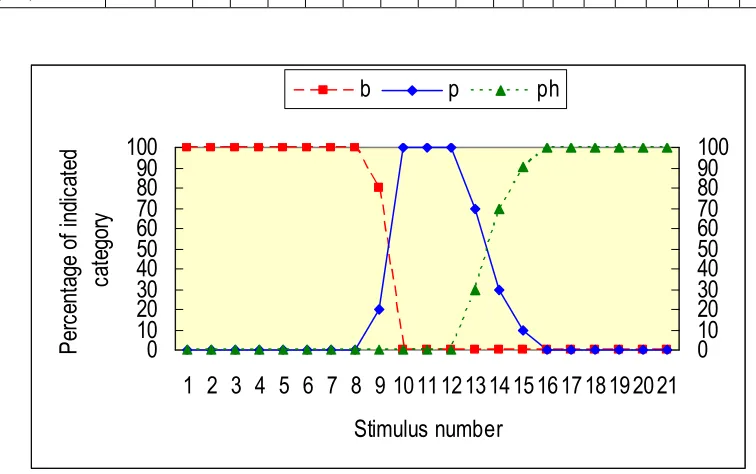
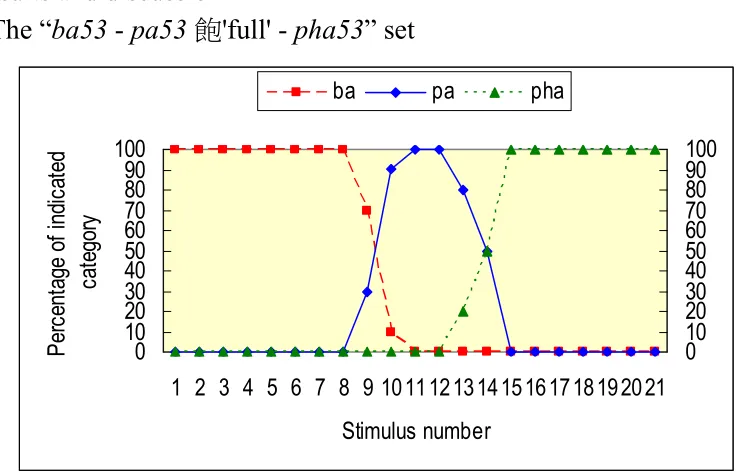
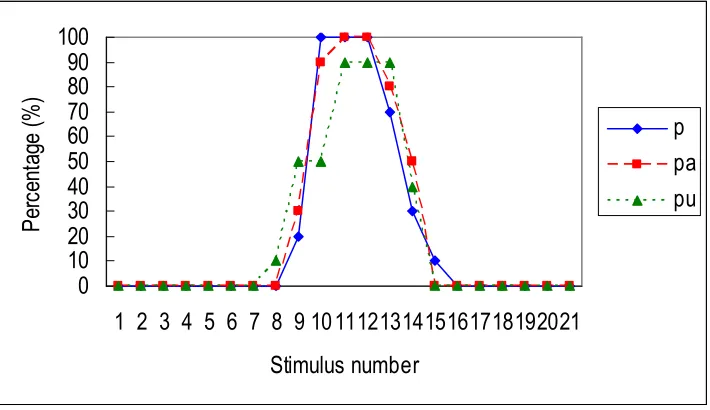
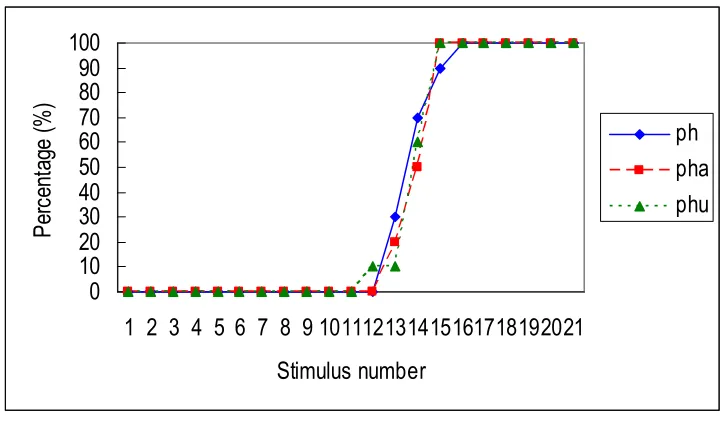
富 'rich' also corresponds to a wider range of VOT in the continuum compared to the neutral
1 2 3 4 5 6 7 8 9 1011121314 15161718192021
Stimulus number
1 2 3 4 5 6 7 8 9 10 1112131415161718192021
0
1 2 3 4 5 6 7 8 9 101112131415161718192021
may be explained by parallel processing in which a higher level of processing (lexical level) interacts with a lower level (phonemic level) in speech perception.
Other combination of lexical status (nonword-word-word and word-word-nonword) must be examined in future study to determine the lexical effect of mono-syllables in TSM. Besides, disyllabic word pairs in TSM are possible materials to examine the lexical effect in the future since disyllabic words in spoken TSM are more frequent compared to monosyllabic words.
References
[1] P. Boersma and D. Weenink, Praat: doing phonetics by computer (Version 5.0.02)
[Computer program]. Retrieved December 27, 2007, from http://www.praat.org/.
[2] B. L. Davis and P. F. MacNeilage, “The articulatory basis of babbling” in Journal of Speech and Hearing Research, Vol. 38, 1995, pp. 1199-1211.
[3] W. F. Ganong, “Phonetic categorization in auditory word perception” in Journal of Experimental Psychology: Human Perception Performance, Vol. 6, 1980, pp. 110–125. [4] J. L. McClelland and J. L. Elman, “The TRACE model of speech perception” in Cognitive Psychology, Vol.18, 1986, pp. 1-86.
[5] R. S. Newman, J. R. Sawusch, and P. A. Luce, “Lexical neighborhood effects in phonetic processing” in Journal of Experimental Psychology: Human Perception Performance , Vol. 23, 1997, pp. 873–889.
[6] 董忠司、城淑賢、張屏生,
臺灣閩南語辭典
. 五南, 2001.
1
The combination of “word-nonword-word” is not chosen because there is only one case in TSM: “bu53-pu53-phu53”.
2
Another group “bu55-pu55-phu55” is not used as materials for pu55 serves as an onomatopoeic word only.
3