Boot-strapping a WordNet using multiple existing WordNets
Francis Bond, Hitoshi Isahara, Kyoko Kanzaki, Kiyotaka Uchimoto
Language Infrastructure Group
National Institute of Information and Communications Technology (Japan) [email protected],{bond,isahara,kanzaki,uchimoto}@nict.go.jp
Abstract
In this paper we describe the construction of an illustrated Japanese Wordnet. We bootstrap the Wordnet using existing multiple existing wordnets in order to deal with the ambiguity inherent in translation. We illustrate it with pictures from the Open Clip Art Library.
1.
Introduction
It is rare for languages to have many freely available lex-ical semantic resources. In particular, few languages have as many as English. This lack of resources slows down both theoretical and applied research into language mean-ing across languages.
Consider the case for Japanese. There are at least two excellent thesauruses available: the Japanese Synonym Dictionary (Hamanishi and Ono, 1990) and Goi-Taikei, a Japanese Lexicon (Ikehara et al., 1997). Unfortunately, al-though they were both used extensively in machine transla-tion research, the published resources focus almost entirely on Japanese. Further, the thesauruses are proprietary, which makes it extremely hard to share and build on the results of research using them.
To alleviate this problem, we are investigating methods to quickly and efficiently build a Japanese version of Word-net (Fellbaum and Vossen, 2007). This wordWord-net is based on the structure of the English wordnet — Japanese near synonyms are added to the existing English synsets. For example, the English synset consisting ofseal#n#9“any of numerous marine mammals that come on shore to breed; chiefly of cold regions”1has the following Japanese words associated with it: ア ザ ラ シazarashi “seal” and 海豹 azarashi “seal”.
The WordNet project at Princeton has been a resounding success, creating a resource that is widely used in research (Fellbaum, 1998) and emulated in many languages (Vossen, 1998). In order for a lexical resource to be widely adopted it must be both accesible and usable. The Princeton Word-Net is accessible due to its being released under a non-restrictive license; and usable because it has not just pre-cise information but also reasonable coverage, especially of common words.
Because of this success, there have been many projects to build wordnets for other languages. One of the first was the EuroWordNet project, which built wordnets for several European languages (Vossen, 1998). Unfortunately, most of the wordnets are neither as accesible as the Princeton WordNet, due to more restrictive licenses, nor as usable due to more limited cover. Recently, the Global WordNet grid has tried to add even more languages, making the data as accesible as possible (Fellbaum and Vossen, 2007). There have been several initiatives to create a Japanese wordnet, but none of them have yet produced something
1All examples are from WordNet 3.0.
that is both accessible and usable. Hayashi (1999) cre-ated a translation of the entire noun part of the Princeton WordNet, including both synsets and glosses. This pro-duced a very usable resource, but it was unfortunately not at all accessible. Koide et al. (2006) looked at combin-ing EDR (EDR, 1990) with Princeton WordNet, but did not get beyond converting them both to RDF representa-tions. Kaji and Watanabe (2006) presented a method of translating synsets from English to Japanese using corpus based contexts to improve accuracy, but only tested this on a few words. More recently, Cook (2008) produced a Multi-Lingual Semantic Network by translating monose-mous parts of the Princeton WordNet into Japanese, Chi-nese and German. He also made an interface for browsing and amending the network. This data is accessible, as it is released under an open license, but loses a little on usability as most monosemous entries are for less frequent words. The amount of previous work shows the great interest and value of producing a Japanese WordNet. We therefore de-cided to construct one as follows: First, automatically trans-late the Princeton WordNet into Japanese. Second, manu-ally check the most frequent 20,000 synsets. Third, link the synsets to a corpus. Fourth, release the data under an open license. As we said earlier, this WordNet is based on the structure of the English wordnet: Japanese near synonyms are added to the existing English synsets. Adapting it more fully to Japanese is left to future research. More details of the overall project are given in Isahara et al. (2008). The obvious way to do add Japanese to the English Word-Net is by translating the entries using an English-Japanese dictionary. The problem with this is that bilingual dictionar-ies are not marked with WordNet senses, if we look up seal we get over 30 entries, including判子seal “stamp” and
海軍特殊部隊gaiguntokushubutai “Navy Seal”. We need to associate these candidates with the appropriate WordNet senses.
Our method takes advantage of the existence of wordnets in multiple languages, and uses them to sense disambiguate the translations. We were able to build it quickly and effi-ciently using the results of existing work on building word-nets and lexicons, and we intend to make it freely available so that other people can build on it.
2.
Lexical Resources
Part of Number of Synsets
Speech English French Spanish German Noun 82,115 17,826 7,902 9,951 Verb 13,767 4,919 3,775 5,166
Adjective 18,156 0 3,879 15
Adverb 3,621 0 0 0
Total 117,659 22,745 15,556 15,132
Table 1: Sizes of the Wordnets used
2.1. Wordnets
We use four wordnets, summarized in Table 1. The largest is the English Wordnet v3.0 (Fellbaum, 1998) with 117,659 entries. The EuroWordnets are considerably smaller, rang-ing from 15,132 for German up to 22,745 for French (Vossen, 1998), consisting mainly of nouns with some verbs. All of them share the same structure — a collection of synsets joined to make a semantic network.
Because Wordnet keeps growing, both in size and complex-ity synsets can split up or even potentially merge across ver-sions. The data for German was based on 1.5 and French and Spanish on 1.6. We mapped them into 3.0 using the mappings from Daude et al. (2003). When a synset mapped to more than one synset, we simply linked it to the most highly weighted one.
2.2. Lexicons
We use JMDict, the Japanese→Multilingual dictionary created by Jim Breen (Breen, 2004) for Japanese-English/French/German. We did not use its proper name dictionary, as wordnet does not have a lot of names. JMDict is widely used, and is increasing in size at the rate of almost 1,000 entries a month (Bond and Breen, 2007). To supplement this we also used the EDR Japanese-English lexicon (http://www2.nict.go. jp/r/r312/EDR/index.html) and the last down-loadable version of the Japanese-English Life Science Dic-tionary Project (v4) (http://lsd.pharm.kyoto-u. ac.jp/ja/index.html). For Japanese-Spanish, we used a small dictionary downloaded from http:// aulex.ohui.net/ (Goihata) and licensed under the GPL. The sizes of these lexicons are listed in Table 2. The lexical resources, are, as always, not evenly distributed amongst the world’s languages — Japanese-English has the most resources, followed by German, then French and then Spanish.
3.
Creating the Japanese Wordnet
The approach we are taking to build the Japanese Word-net is the standard expand approach: “translate WordNet synsets to another language and take over the structure” (Vossen, 2005). We did this both to keep a compatible structure with WordNet, and because we had access to a variety of resources to make the task easier. Our main inno-vation is that we are using WordNets in multiple languages to disambiguate the Japanese translations, thus providing more reliable estimates.
Consider the following two synsets for bat, with their trans-lation shown in Figure 1:
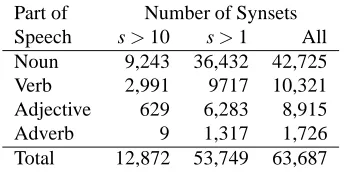
Part of Number of Synsets Speech s>10 s>1 All Noun 9,243 36,432 42,725
Verb 2,991 9717 10,321
Adjective 629 6,283 8,915
Adverb 9 1,317 1,726
Total 12,872 53,749 63,687
Table 3: Japanese Synsets by score
bat#n#1, chiropteran (nocturnal mouselike mammal with forelimbs modified to form membranous wings . . . )
bat#n#5 (a club used for hitting a ball in various games)
The Japanese-English lexicon has two translations for bat 蝙 蝠 koumori “bat (mammal)” and バ ッ ト batto “bat (club)”. However, because there is no way of distinguish-ing between them we get a mixture of the meandistinguish-ings with 蝙蝠koumori “bat#n#1” andバットbatto “bat#n#5”. chi-ropteran is not in any of the JE lexicons, andbat#n#5has no synonyms. Therefore using only the English Wordnet as source and Japanese⇔English lexicons there is no way to disambiguate them.
However, both synsets are also in the French wordnet: bat#n#1is chauve-souris andbat#n#5is batte, gour-din. These are not ambiguous in the same way: chauve-souris goes only to koumori and batte only to batto. Thus, if we can match through two languages, the mapping is much more likely to be the correct sense. The links are shown in Figure 1.
Similar approaches have been used to make new bilingual dictionaries: for example, linking Japanese-Malay through Japanese-English, English-Malay, Japanese-Chinese and Chinese-Malay (Bond et al., 2001). The difference here is that the original linking is done through the Wordnet synsets: we are effectively trying to translate a super-synset with synonyms in up to four languages (En, De, Fr, Es). The actual algorithm we used was as follows:
• For each synset in WordNet 3.0
– Find equivalents in WN-{Fr,Es,De}
– Look up translations for all equivalents {Je}, {Jf},{Js},{Jd}
– Rank Japanese equivalents
score s=|links|+10 for links in two languages
The result is a wordnet with multiple Japanese candidates for most synsets, with a confidence score s equal to the number of bilingual links plus a ten-point bonus for being linked in multiple languages.
4.
Results and Evaluation
In this section we report on how many synsets we could translate into Japanese, and with what confidence.
Part of Number of Word-Pairs
Speech ja-en ja-de ja-fr ja-es
JMDict EDR Lifsci JMDict JMDict Goihata Noun 165,984 504,450 44,567 143,753 24,348 0
Verb 22,209 184,250 4,741 26,502 7,762 133
Adjective 16,861 44,961 11,212 17,121 4,582 70
Adverb 6,180 20,125 1,266 5,915 1,478 0
Unknown 3 0 0 0 0 3,548
Total 225,803 758,568 62,210 199,260 39,447 3,751
Table 2: Size and Distribution of the various Lexicons
bat#n#1
chiropteran bat
chauve-souris Wn-Fr
Wn-En
蝙蝠
bat#n#5
バット
bat
batte gourdin
Wn-Fr Wn-Fr
J-E
J-E
J-E
J-E
J-F
J-F
Figure 1: Linking with Multiple Wordnets
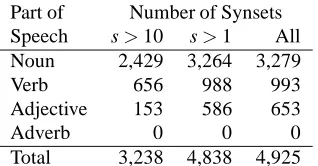
Part of Number of Synsets Speech s>10 s>1 All Noun 2,429 3,264 3,279
Verb 656 988 993
Adjective 153 586 653
Adverb 0 0 0
Total 3,238 4,838 4,925
Table 4: Base Japanese Synsets by Score (s) for the Base Synsets
synsets had at least one translation candidate confirmed in two or more languages, and 53,749 were confirmed in mul-tiple lexicons.
The results restricted to the 5,000 common base synsets which occupy central positions in the wordnet structures (Fellbaum and Vossen, 2007) are given in Table 4. In this case our cover is almost complete (4,925/5,000 = 98.5%). Most of the entries in Euro WordNet are from these base synsets, and the majority of our translations (64.6%) match in two or more languages. Our coverage is excellent for the base synsets, and good overall: larger than any of the existing non-English WordNets.
To test precision, we evaluate translation candidates by judging the suitability of all of the base synset translation candidates (this is actually part of preparing the WordNet
Appropriate Translation Candidates s>10 10>s>1 s=1 All Base 55.30% 39.64% 21.25% 26.56%
Table 5: Base Noun Candidate Precision
for release). The results are given in Table 5. Translations matching in multiple languages are markedly better than those matching in a single language (55.30% vs 21.25%), matching in multiple dictionaries in a single language is also an indicator of higher accuracy.
For both evaluation methods, translating synsets using mul-tiple languages gives higher precision and lower recall.
5.
Illustrating WordNet
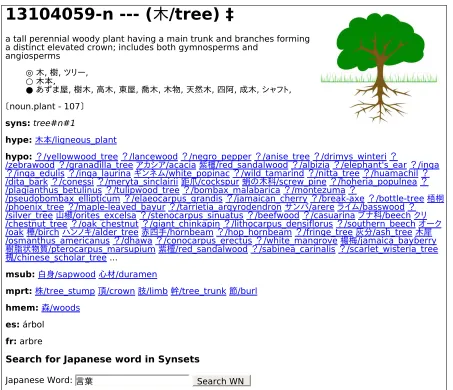
13104059-n --- (
木
/tree) ‡
a tall perennial woody plant having a main trunk and branches forming a distinct elevated crown; includes both gymnosperms and
angiosperms
◎ 木, 樹, ツリー, ○ 木本,
● あずま屋, 樹木, 高木, 東屋, 喬木, 木物, 天然木, 四阿, 成木, シャフト,
〔noun.plant - 107〕
syns: tree#n#1
hype: 木本/ligneous_plant
hypo: ?/yellowwood_tree ?/lancewood ?/negro_pepper ?/anise_tree ?/drimys_winteri ?
/zebrawood ?/granadilla_tree アカシア/acacia 紫檀/red_sandalwood ?/albizia ?/elephant's_ear ?/inga ?/inga_edulis ?/inga_laurina ギンネム/white_popinac ?/wild_tamarind ?/nitta_tree ?/huamachil ? /dita_bark ?/conessi ?/meryta_sinclairii 距爪/cockspur 蛸の木科/screw_pine ?/hoheria_populnea ? /plagianthus_betulinus ?/tulipwood_tree ?/bombax_malabarica ?/montezuma ?
/pseudobombax_ellipticum ?/elaeocarpus_grandis ?/jamaican_cherry ?/break-axe ?/bottle-tree 梧桐 /phoenix_tree ?/maple-leaved_bayur ?/tarrietia_argyrodendron サンバ/arere ライム/basswood ? /silver_tree 山椒/orites_excelsa ?/stenocarpus_sinuatus ?/beefwood ?/casuarina ブナ科/beech クリ /chestnut_tree ?/oak_chestnut ?/giant_chinkapin ?/lithocarpus_densiflorus ?/southern_beech オーク /oak 樺/birch ハンノキ/alder_tree 赤四手/hornbeam ?/hop_hornbeam ?/fringe_tree 灰分/ash_tree 木犀 /osmanthus_americanus ?/dhawa ?/conocarpus_erectus ?/white_mangrove 楊梅/jamaica_bayberry 樹脂状物質/pterocarpus_marsupium 紫檀/red_sandalwood ?/sabinea_carinalis ?/scarlet_wisteria_tree 槐/chinese_scholar_tree ...
msub: 白身/sapwood 心材/duramen
mprt: 株/tree_stump 頂/crown 肢/limb 幹/tree_trunk 節/burl
hmem: 森/woods
es: árbol
fr: arbre
Search for Japanese word in Synsets
Japanese Word: 言葉 Search WN
Figure 2: Example Entry for木/tree
the manually checked subset of WordNet sometime in June 2008. Rather than have a single maintainer and major re-leases, we hope to maintain the WordNet as a community resource, along the lines suggested by Charoenporn et al. (2008). Here a wiki-like tool is used to allow people to ex-tend and amend the WordNet, with final changes checked by moderators. In this release, we also intend to add high confidence automatic entries (unambiguous translations of monosemous words) as suggested by Cook (2008) and Charoenporn et al. (2008). This should add another 12,000 or so entries to the hand checked subset.
Currently, we have not made any new synsets for Japanese words whose meaning does not cleanly map to an English synset, although we know that these are necessary. As well as extending these synstes we will also extend the informa-tion about lexical relainforma-tions to include those not in the origi-nal Princeton WordNet, such as attribute-instance relations (Kanzaki et al., 2008) and explicit linking of orthographic variants: color/colour or蝙蝠/コウモリkoumori “bat”. In other major extensions we are hoping to do the follow-ing:
• Link the wordnet to other ontologies, such as concepts in EDR (EDR, 1990), GoiTaikei (Ikehara et al., 1997) and CoreNet (Choi and Bae, 2003).
• Sense tag a variety of corpora.
• Use the WordNet data as a module for Japanese in the METEOR Automatic Machine Translation Evaluation System (Lavie and Agarwa, 2007).
8.
Conclusions
In this paper we described the construction of the illustrated Japanese Wordnet. We bootstrapped the Wordnet using ex-isting wordnets and bilingual lexicons. We were able to produce Japanese translations for 98% of the core classes, over half of them with high confidence.
9.
References
Cecilia Ovesdotter Alm, Nicolas Loeff, and David A. Forsyth. 2006. Challenges for annotating images for sense disambiguation. In Proceedings of the Workshop on Frontiers in Linguistically Annotated Corpora 2006, pages 1–4, Sydney, Australia, July. Association for Com-putational Linguistics.
Francis Bond, Ruhaida Binti Sulong, Takefumi Yamazaki, and Kentaro Ogura. 2001. Design and construction of a machine-tractable Japanese-Malay dictionary. In MT Summit VIII, pages 53–58, Santiago de Compostela, Spain.
J. W. Breen. 2004. JMDict: a Japanese-multilingual dic-tionary. In Coling 2004 Workshop on Multilingual Lin-guistic Resources, pages 71–78, Geneva.
Thatsanee Charoenporn, Virach Sornlerlamvanich, Chumpol Mokarat, and Hitoshi Isahara. 2008. Semi-automatic compilation of Asian WordNet. In 14th Annual Meeting of the Association for Natural Lan-guage Processing, pages 1041–1044, Tokyo.
Key-Sun Choi and Hee-Sook Bae. 2003. A Korean-Japanese-Chinese aligned wordnet with shared semantic hierarchy. In Proceedings of the International Confer-ence on Natural Language Processing and Knowledge Engineering, pages 91–96.
Darren Cook. 2008. MLSN: A multi-lingual semantic net-work. In 14th Annual Meeting of the Association for Nat-ural Language Processing, pages 1136–1139, Tokyo. Jordi Daude, Lluis Padro, and German Rigau. 2003.
Val-idation and tuning of wordnet mapping techniques. In Proceedings of the International Conference on Recent Advances in Natural Language Processing (RANLP’03), Borovets, Bulgaria.
EDR. 1990. Concept dictionary. Technical report, Japan Electronic Dictionary Research Institute, Ltd, April. Christiane Fellbaum and Piek Vossen. 2007. Connecting
the universal to the specific: Towards the global grid. In First International Workshop on Intercultural Collabo-ration (IWIC-2007), pages 2–16, Kyoto.
Christine Fellbaum, editor. 1998. WordNet: An Electronic Lexical Database. MIT Press.
Masando Hamanishi and Susumu Ono, editors. 1990. Ruigo Kokugo Jiten [Japanese Synonym Dictionary]. Kadokawa Shoten, Tokyo. (in Japanese).
Yoshihiko Hayashi. 1999. Translating WordNet noun part into Japanese for cross-language natural language applications. In Technical Reports of SIG on Natu-ral Language Processing NL130-10, pages 73–80. (in Japanese).
Satoru Ikehara, Masahiro Miyazaki, Satoshi Shirai, Akio Yokoo, Hiromi Nakaiwa, Kentaro Ogura, Yoshifumi Ooyama, and Yoshihiko Hayashi. 1997. Goi-Taikei — A Japanese Lexicon. Iwanami Shoten, Tokyo. 5 vol-umes/CDROM.
Hitoshi Isahara, Francis Bond, Kiyotaka Uchimoto, Masao Utiyama, and Kyoko Kanzaki. 2008. Development of the Japanese WordNet. In Sixth international conference on Language Resources and Evaluation (LREC 2008), Marrakech. (this volume).
Hiroyuki Kaji and Mariko Watanabe. 2006. Automatic construction of Japanese WordNet. In Proceedings of the 5th International Conference on Language Resources and Evaluation (LREC 2006), Genoa, Italy, May. Kyoko Kanzaki, Francis Bond, Noriko Tomuro, and
Hi-toshi Isahara. 2008. Extraction of attribute concepts from Japanese adjectives. In Sixth international
con-ference on Language Resources and Evaluation (LREC 2008), Marrakech. (this volume).
Seiji Koide, Takeshi Morita, Takahira Yamaguchi, Hendry Muljadi, and Hideaki Takeda. 2006. OWL expressions on WordNet and EDR. In AI society Semantic Web On-tology SIG 13, SIG-SWO-A601-03. (in Japanese). Anton Lavie and Abhaya Agarwa. 2007. METEOR: An
automatic metric for MT evaluation with high levels of correlation with human judgments. In Proceedings of Workshop on Statistical Machine Translation at ACL-2007, Prague.
Jonathan Phillips. 2005. Introduction to the open clip art library. http://rejon.org/media/writings/ ocalintro/ocal_intro_phillips.html. (ac-cessed 2007-11-01).
Toshiyuki Takasaki and Yumiko Mori. 2007. Design and development of a pictogram communication system for children around the world. In First International Work-shop on Intercultural Collaboration (IWIC-2007), pages 144–157, Kyoto.
Piek Vossen, editor. 1998. Euro WordNet. Kluwer. Piek Vossen. 2005. Building wordnets.